Author Archives | Fishkeeper

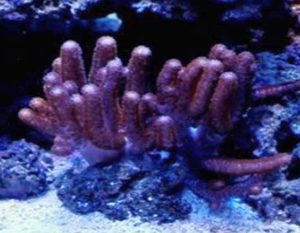
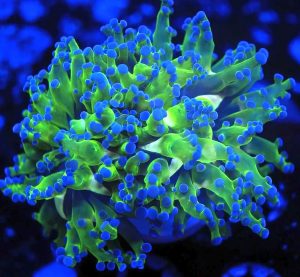
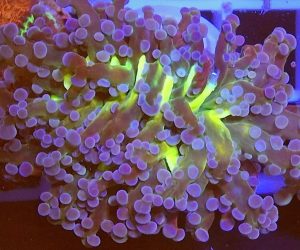
Hammer Coral (Fimbriaphyllia ancora)

Hammer Coral (Fimbriaphyllia ancora)

Hammer Coral (Fimbriaphyllia ancora)

Hammer Coral (Fimbriaphyllia ancora)

The Hammer Coral (Fimbriaphyllia ancora) formerly Euphyllia ancora or Euphyllia paraancora is known to tropical fish keeping enthusiasts as the Anchor Coral, Wall Coral, Ridge Coral, Sausage Coral, and Kidney Coral and is found throughout the Indo Pacific. Their range extends from the coast of Africa to the Western Pacific, including the waters of Indonesia, Australia, the Solomon Islands, and the Great Barrier Reef.

Hammer Coral is native to the warm waters of the Indo-Pacific region where they are common in relatively shallow coastal reefs, lagoons, and turbid waters.

Although the Hammer Coral is generally found among the protected coral reef slopes of their range in clear shallow to deeper waters with gentle to moderate currents.    They are quite adaptable and are also found in shadier spots closer to shore growing on rocks and coral rubble where water movement shields their delicate tissue from tearing.   In general, Fimbriaphyllia ancora can typically found at depths ranging anywhere from 10 to 130 feet.
Hammer Coral (Fimbriaphyllia ancora)

Hammer Coral (Fimbriaphyllia ancora)

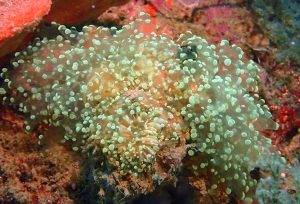
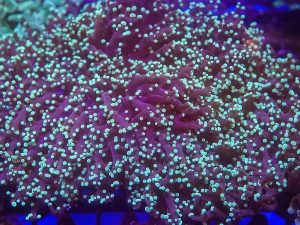
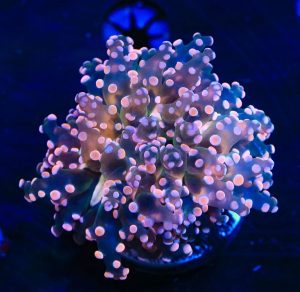
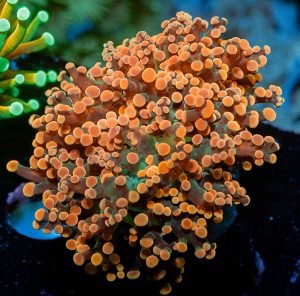
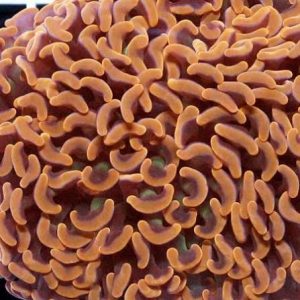
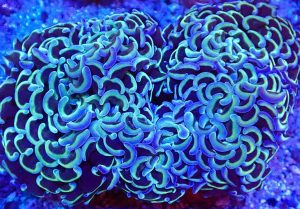
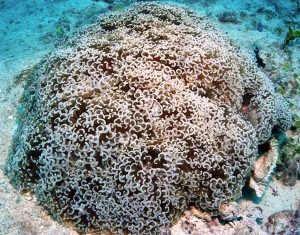
Like all species of Fimbriaphyllia, Hammer Corals form a hard, calcified skeleton that is topped with multi-tipped T shaped, flesh toned tentacles, that closely resemble an anchor or a hammer, hence their common name.
Hammer Coral (Fimbriaphyllia ancora)

Hammer Coral (Fimbriaphyllia ancora)

Hammer Corals grow in two primary skeeletal configurations:

The Branching Hammer Coral variety (Fimbriaphyllia paraancora) that grows as separate individual calcified heads that branch out like a tree. Fimbriaphyllia paraancora is generally easier to propagate (frag) and handles aquarium stress better.

The Wall Hammer Coral variety (Fimbriaphyllia ancora) that grows as a continuous, meandering wall-like skeleton with a single large, interconnected fleshy polyp.   Euphyllia remains the correct genus for Torch Corals like Euphyllia glabrescens.

The Hammer Coral has multiple recognized species and sub-clades within the genus:

Euphyllia divisa (Veron & Pichon, 1980)
Euphyllia ancora (Veron & Pichon, 1980)
Euphyllia glabrescens (Chamisso & Eysenhardt, 1821)
Euphyllia paraancora (Veron, 1990)
Euphyllia paradivisa (Veron, 1990)
Euphyllia bayeri (Hodgson & Ross, 1982)
Euphyllia cristata (Chevalier, 1971)
Hammer coral (Euphyllia ancora)
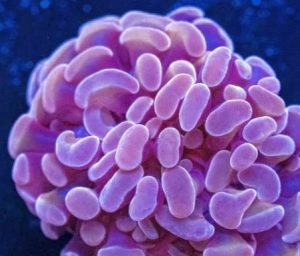
Hammer Coral (Fimbriaphyllia ancora)

Hammer Coral (Fimbriaphyllia ancora)

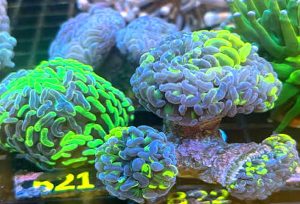
Fimbriaphyllia ancora are naturally found in shades of brown, tan, or green with green, pink or purple tips that frequently fluoresce under actinic reef lighting. Aquacultured strains are found in neon greens, deep purples, oranges, golds, pinks, and various multi colored, bi colored, or “splattered” colored patterns.
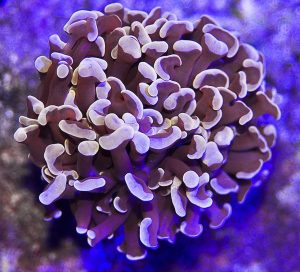
Hammer Coral (Fimbriaphyllia ancora)

Hammer Coral (Fimbriaphyllia ancora)

Their color and the intensity of their colors is entirely dependent on how much light they receive and the presence of actinic lighting. The more balanced the light, the richer the fluorescent coloration of the coral.

Like the Frogspawn Coral (Fimbriaphyllia divisa), the Hammer Coral can be housed in a small nano reef tank, however, they are best kept in larger mature reef aquariums of at least 30 gallon capacity with a live sand or fine coralline gravel substrate and plenty of live rock or other aquascape architecture for them to attach themselves to. They do well when placed in the bottom to middle of the tank with low to moderate lighting, gentle to moderate indirect water flow, and adequate space to prevent them from stinging neighboring corals.
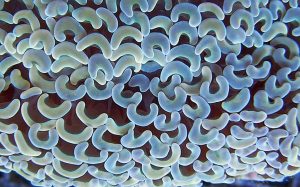
Hammer Coral (Fimbriaphyllia ancora)

Hammer Coral (Fimbriaphyllia ancora)

Fimbriaphyllia ancora is semi-aggressive towards other corals and although their normal tentacles are relatively short, they will emit long, stinging sweeper tentacles at night to ward off invasive competitors.

Albeit aggressive to outsiders like Acropora, Montipora, Chalices, Brain corals, Zoanthids and other LPS or SPS coral; Fimbriaphyllia ancora is a peaceful addition alongside other Fimbriaphyllia and certain Euphyllia sub-clades like Frogspawns, allowing hobbyists to group them together into a “Euphyllia garden.”

Compatible tankmates for Hammer Coral include Clownfish, Firefish, Cardinalfish, Gobies, Blennies, Cleaner Shrimp, and other peaceful reef-safe species.

The Hammer Coral reproduces through both sexual and asexually methods.   How they reproduce depends on whether they are the Wall or Branching variety.

In their natural environment Fimbriaphyllia ancora is historically known as a gonochoristic spawner where individual colonies produce either only eggs or only sperm during a breeding cycle.
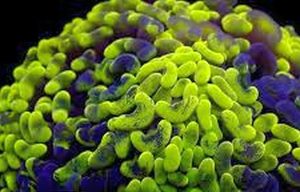
Hammer Coral (Fimbriaphyllia ancora)

Hammer Coral (Fimbriaphyllia ancora)

However, marine biologists have discovered that roughly 73% of Fimbriaphyllia ancora colonies undergo an annual sex change (sequential hermaphroditism), switching between male and female roles from one season to the next.

The lunar cycle and water temperature dictates when mass spawning occurs.   In Taiwan, it normally occurs around April or May.  Colonies synchronously release pink gamete bundles into the open water column roughly 3 to 6 nights after a full moon with fertilization taking place externally in open water. The swimming planula larvae drift with the currents before anchoring to the substrate to build a new skeleton.

Asexual reproduction also occurs with Hammer Corals, especially in a stable reef environment. A single Hammer Coral will clone itself to expand the colony through a process of budding or longitudinal fission.

In branching varieties (Fimbriaphyllia paraancora), a single head will slowly constrict and divide across its center to form two distinct new heads, expanding the skeleton upward and outward, whereas wall varieties grow continuously along a single meandering ridge.

Over time, large branching colonies can be manually fragmented (fragged) by carefully cutting the lower skeletal branches well below the living tissue line to create independent specimens.
Hammer Coral (Fimbriaphyllia ancora)

Hammer Coral (Fimbriaphyllia ancora)

In their natural environment, Hammer Corals obtain most of their nutrients from their zooxanthellae, symbiotic algae.   Although they rely mostly on photosynthesis and dissolved organics for growth, they are active micro predators that use the stinging nematocysts on their sticky, hammer shaped tentacles to paralyze and capture small prey.  The tentacles slowly retract and pull the captured food inward to the center of thepolyp head where the mouth is located.

In an aquarium environment with indirect water flow, they greatly benefit from weekly supplemental feedings of mysis shrimp, enriched brine shrimp, or specialized LPS pellet foods mixed with water that they catch with their sticky nematocysts.

The Hammer Coral, (Fimbriaphyllia ancora) is readily available in the aquarium trade to tropical fish keeping enthusiasts as wild caught and captive-bred specimens from a variety of online retailers at moderate to premium prices depending on the rarity of the color morph.

Hammer Corals (Fimbriaphyllia ancora, Euphyllia ancora) are among the most popular and vibrant Large Polyp Stony (LPS) corals in the reef hobby, famous for their anchor-shaped, hammer-tipped tentacles that add substantial movement to an aquarium.

Aquaculture of this coral has been highly successful, leading to increased availability, hardiness, and sustainability in the hobby.
Hammer Coral (Fimbriaphyllia ancora)

Hammer Coral (Fimbriaphyllia ancora)


Minimum Tank Size: 30 gallon
Tank Placement: Bottom to Middle
Water Flow: Gentle to Moderate (Indirect)
Care Level: Moderate
Aquarium Hardiness: Moderately Hardy
Temperament: Aggressive
Toxicity: Yes, strong stinging cells (Sweeper Tentacles)
Invasive: No
Water Conditions: 76 – 80°F, dKH 8 – 11°, pH 8.1–8.4, sg 1.024-1.026, Nitrate 1 – 10 ppm, Calcium 400-450 ppm
Lighting: Low to Moderate (100-150 PAR)
Feeding: mysis shrimp, brine shrimp, LPS pellets
Growth Rate: Moderate
Color Form: Green, Tan, Pink, Purple, Gold, Bi-color, etc.
Diet: Photosynthetic, Carnivore (Target Feeder)
Origin: Indo-Pacific, Australia
Family: Euphylliidae
Lifespan: Decades (Under proper care)
Aquarist Experience Level: Intermediate
Posted in Corals, Featured Articles, LPS Corals, Saltwater, Tropical Fish Keeping, Tropical Fish Species0 Comments

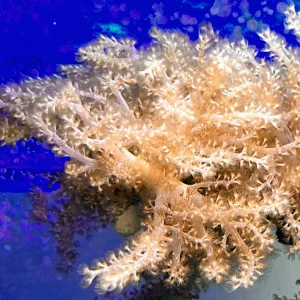
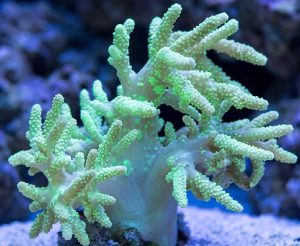
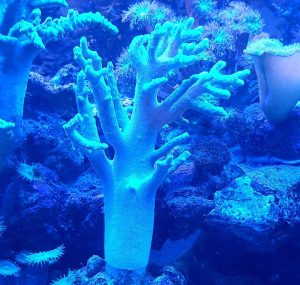
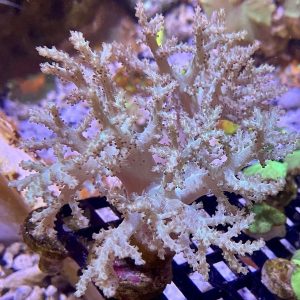
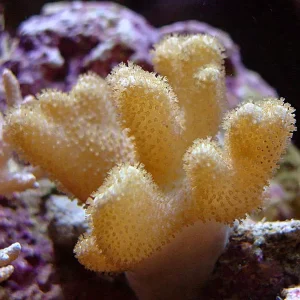
Maroon Finger Leather Coral (Sinularia sp.)

Finger Leather Coral, (Sinularia sp.)

Maroon Finger Leather Coral (Sinularia sp.)

Maroon Finger Leather Coral (Sinularia sp.)

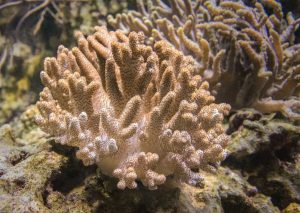
The Finger Leather Coral (Sinularia sp.) formerly classified under various historical soft coral groupings known to tropical fish keeping enthusiasts as the Flexible Leather Coral, Spaghetti Leather Coral, Digitate Leather Coral, Trough Coral and Knobby Leather Coral is found throughout the Indo Pacific with a range that extends from the coast of Africa and the Red Sea to the Western Pacific, including the waters of Indonesia, Australia, the Solomon Islands, and the Great Barrier Reef.

Finger Leather Coral is native to the warm waters of the Indo-Pacific region where they are common in relatively shallow coastal reefs, reef flats, and turbid lagoons.

Although the Finger Leather Coral is generally found among the protected coral reef slopes of their range in clear shallow to deeper waters with moderate to strong currents, they are quite adaptable and are also found in shadier spots closer to shore growing on rocks and coral rubble where water movement shields their delicate tissue from sediment buildup.  In general, Sinularia sp. can typically found at depths ranging anywhere from 5 to 90 feet.

Finger Leather Coral (Sinularia sp.)

Finger Leather Coral (Sinularia sp.)

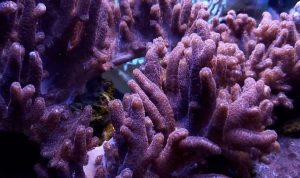
The Finger Leather Coral, like all species of Sinularia form a rubbery, sclerite-reinforced coenenchyme (tissue) topped with numerous retractable polyps that closely resemble a mass of tiny branching fingers or trees, hence their common name.

Some of the species form encrusting stalks while others form highly branched tree-like structures, with multiple recognized species and sub-clades within the genus:

Sinularia flexibilis (Quoy & Gaimard, 1833)
Sinularia brassica (May, 1898)
Sinularia asterolobata (Verseveldt, 1877)
Sinularia polydactyla (Ehrenberg, 1834)
Sinularia noto (Verseveldt, 1977)
Sinularia leptoclados (Ehrenberg, 1834)
Sinularia macropodia (Hickson & Hiles, 1900)

Finger Leather Coral (Sinularia sp.)

Finger Leather Coral (Sinularia sp.)

Finger Leather Coral (Sinularia sp.)

Finger Leather Coral (Sinularia sp.)

Sinularia are generally colored brown or tan with cream, green, or yellow tones with white or gold polyps, however, they are collected in a variety of color forms from Neon Green, Cultured Green, Deep Lime Green, Gold, Brown, Mint, etc.

Many species have a similar appearance to Mushrooms or Toadstools with a distinct stalk and capitulum.  As they grow older they develop a folded appearance.

Finger Leather Coral (Sinularia sp.)

Finger Leather Coral (Sinularia sp.)

Their color and the intensity of their colors is entirely dependent on

Finger Leather Coral (Sinularia sp.)

Finger Leather Coral (Sinularia sp.)

how much light they receive and the presence of actinic lighting. The more balanced the light, the richer the fluorescent coloration of the coral.

Because the Finger Leather Coral is highly adaptive and has the ability to thrive in stable reef environments, they are a common sight throughout their range.

Although the Finger Leather Coral can be housed in small nano reef tanks, they are best kept in larger reef tanks of at least 30 gallon capacity with a live sand or fine coralline gravel substrate and plenty of live rock or other aquascape architecture for them to attach themselves to.

The specific tank volume dictates how effectively the Finger Leather Coral’s chemical outputs are diluted.  In tanks with smaller water volumes, regular water changes are critical to prevent chemical buildup.

Finger Leather Corals do well when placed in the middle to top of the tank with moderate to high lighting, moderate to strong indirect water flow, and adequate space to prevent them from chemically stunting neighboring corals.

Finger Leather Coral (Sinularia sp.)

Finger Leather Coral (Sinularia sp.)

Sinularia sp. formerly classified broadly within Alcyoniidae is aggressive towards other corals and will emit toxic chemical compounds called terpenes into the water column to ward off invasive competitors.

To safely house this species, the aquarium’s filtration system must be configured to run high-quality activated carbon, which actively binds and neutralizes these dissolved organic compounds.

Because Sinularia periodically sheds a waxy outer skin layer to rid itself of algae, strong mechanical filtration via filter socks or fleece rollers is required to rapidly capture and export this sloughed tissue before it decays and fouls the water.

Finger Leather Coral (Sinularia sp.)

Finger Leather Coral (Sinularia sp.)

Although Finger Leather Coral is aggressive to outsiders via chemical warfare, it is a peaceful addition alongside other leather coral sub-clades like Toadstools, allowing hobbyists to group them together into a “Soft Coral garden”.

When planning your reef layout, selecting compatible companion corals is essential to avoid casualties.

Some excellent, non-reactive companion corals include other soft varieties such as Sarcophyton (Toadstool Leathers), Lobophytum (Devil’s Hand), Zoanthids, and Mushroom corals, which share similar chemical tolerances.

Conversely, delicate Large Polyp Stony (LPS) corals like Euphyllia (Frogspawn, Hammers) or Small Polyp Stony (SPS) corals like Acropora should be positioned strictly upstream of the Sinularia’s water flow to ensure its chemical plumes are swept away from their fragile tissue.

Compatible tankmates for Finger Leather Coral include Clownfish, Firefish, Cardinalfish, Gobies, Blennies, Cleaner Shrimp, and other peaceful reef-safe species.

The Finger Leather Coral reproduces asexually through a fragmentation or fission process.   In branching varieties, a single stalk will slowly constrict and pinch off at its branch to drop off as a small clone onto nearby rockwork, expanding the colony upward and outward.

Over time, large branching colonies can be manually fragmented (fragged) by carefully cutting the upper rubbery branches well below the polyp crown with a sharp scalpel to create independent specimens.

Finger Leather Coral (Sinularia sp.)

Finger Leather Coral (Sinularia sp.)

In their natural environment, Finger Leather Corals obtain most of their nutrients from their zooxanthellae, symbiotic algae.  Although they rely mostly on photosynthesis and dissolved organics for growth, they are also active absorption feeders that are able to capture and consume microscopic organic matter with their fine retractable polyps.

In an aquarium environment with indirect water flow, Finger Leather Corals benefit from weekly supplemental additions of phytoplankton, marine snow, or specialized micro-particle foods mixed with water that they catch with their tiny tentacled polyps.

The Finger Leather Coral, (Sinularia sp.) is readily available in the aquarium trade to tropical fish keeping enthusiasts as wild caught and captive-bred specimens from a variety of online retailers at budget to moderate prices depending on the size, area of collection, and intensity of the color morph.

Finger Leather Corals (Sinularia sp.) famous for their thick, finger-like stalks that mimic miniature underwater trees, are among the most popular and hardy Soft corals in the reef hobby .

Aquaculture of this species has been highly successful, leading to increased availability, hardiness, and sustainability in the hobby.

Finger Leather Coral (Sinularia sp.)

Finger Leather Coral (Sinularia sp.)


Minimum Tank Size: 30 gallon (Larger volumes provide better chemical dilution)
Tank Placement: Middle to Top
Water Flow: Moderate to Strong (Indirect)
Care Level: Easy
Aquarium Hardiness: Exceptionally Hardy
Temperament: Semi-Aggressive (Highly aggressive chemically)
Filtration Requirements: High mechanical export (socks/rollers for skin shedding) + Mandatory continuous Activated Carbon
Toxicity: Yes, heavy chemical warfare (Terpenes released into water column)
Approved Companion Corals: Toadstool Leathers, Devil’s Hand, Zoanthids, Mushrooms (Keep LPS/SPS upstream)
Invasive: No
Water Conditions: 74 – 80°F, dKH 8 – 11°, pH 8.1–8.4, sg 1.024-1.026, Nitrate 2 – 20 ppm, Calcium 380-450 ppm
Lighting: Moderate to High (150-250 PAR)
Feeding: Phytoplankton, marine snow, micro-particle food
Growth Rate: Fast
Color Form: Tan, Brown, Green, Yellow, Cream, etc.
Diet: Photosynthetic, Filter Feeder (Micro-particles)
Origin: Indo-Pacific, Red Sea, Australia
Family: Alcyoniidae
Lifespan: Decades (Under proper care)
Aquarist Experience Level: Beginner

Posted in Featured Articles, Saltwater, Soft Corals, Tropical Fish Keeping, Tropical Fish Species0 Comments

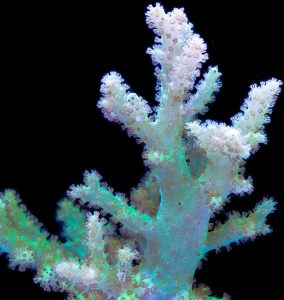
Frogspawn Coral (Fimbriaphyllia divisa, Euphyllia divisa)

Frogspawn Coral (Fimbriaphyllia divisa)

Frogspawn Corals (Fimbriaphyllia divisa, Euphyllia divisa)

Frogspawn Corals (Fimbriaphyllia divisa, Euphyllia divisa)

The Frogspawn Coral, (Fimbriaphyllia divisa) formerly Euphyllia divisa known to tropical fish keeping enthusiasts as the Zig-Zag Coral, Wall Coral, Grape Coral, Honeycomb Coral and Octopus Coral is found throughout the Indo Pacific with a range that extends from the coast of Africa to the Western Pacific, including the waters of Indonesia, Australia, the Solomon Islands, and the Great Barrier Reef.

Frogspawn Coral is native to the warm waters of the Indo-Pacific region where they are common in relatively shallow coastal reefs, lagoons, and turbid waters.

Although the Frogspawn Coral is generally found among the protected coral reef slopes of their range in clear shallow to deeper waters with gentle to moderate currents.   They are quite adaptable and are also found in shadier spots closer to shore growing on rocks and coral rubble where water movement shields their delicate tissue from tearing.   In general, Fimbriaphyllia divisa can typically found at depths ranging anywhere from 10 to 115 feet.

Frogspawn Corals (Fimbriaphyllia divisa, Euphyllia divisa)

Frogspawn Corals (Fimbriaphyllia divisa, Euphyllia divisa)

The Frogspawn Coral, like all species of Euphyllia form a hard, calcified skeleton topped with multi-tipped, flesh-toned tentacles that closely resemble a mass of frog or fish eggs, hence their common name.

Some of the species form branching structures while others form compressed wall-like structures, with multiple recognized species and sub-clades within the genus:

Euphyllia divisa (Veron & Pichon, 1980)
Euphyllia ancora (Veron & Pichon, 1980)
Euphyllia glabrescens (Chamisso & Eysenhardt, 1821)
Euphyllia paraancora (Veron, 1990)
Euphyllia paradivisa (Veron, 1990)
Euphyllia bayeri (Hodgson & Ross, 1982)
Euphyllia cristata (Chevalier, 1971)
Frogspawn coral (Euphyllia divisa)

Pink Frogspawn Corals (Fimbriaphyllia divisa, Euphyllia divisa)

Pink Frogspawn Corals (Fimbriaphyllia divisa, Euphyllia divisa)

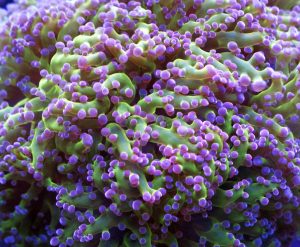
Euphyllia are generally colored brown or tan with green, pink, or purple tips, however, they are collected in a variety of color forms from Neon Green, Bicolor, Gold, Orange, Splattered, etc.

Orange Frogspawn Corals (Fimbriaphyllia divisa, Euphyllia divisa)

Orange Frogspawn Corals (Fimbriaphyllia divisa, Euphyllia divisa)

Their color and the intensity of their colors is entirely dependent on how much light they receive and the presence of actinic lighting.   The more balanced the light, the richer the fluorescent coloration of the coral.

Because the Frogspawn Coral is moderately adaptive and has the ability to thrive in stable reef environments, they are a common sight throughout their range.

Although the Frogspawn Coral can be housed in small nano reef tanks, they are best kept in larger reef tanks of at least 30 gallon capacity with a live sand or fine coralline gravel substrate and plenty of live rock or other aquascape architecture for them to attach themselves to.   They do well when placed in the bottom to middle of the tank with low to moderate lighting, gentle to moderate indirect water flow, and adequate space to prevent them from stinging neighboring corals.

Frogspawn Corals (Fimbriaphyllia divisa, Euphyllia divisa)

Frogspawn Corals (Fimbriaphyllia divisa, Euphyllia divisa)

Fimbriaphyllia divisa formerly Euphyllia divisa is aggressive towards other corals and will give off long, stinging sweeper tentacles at night to ward off invasive competitors.

Yellow Green Frogspawn Corals (Fimbriaphyllia divisa, Euphyllia divisa)

Yellow Green Frogspawn Corals (Fimbriaphyllia divisa, Euphyllia divisa)

Albeit aggressive to outsiders, it is a peaceful addition alongside other Euphyllia sub-clades like Hammers, allowing hobbyists to group them together into a “Euphyllia garden.”

Compatible tankmates for Frogspawn Coral include Clownfish, Firefish, Cardinalfish, Gobies, Blennies, Cleaner Shrimp, and other peaceful reef-safe species.

The Frogspawn Coral reproduces asexually through a process of budding or longitudinal fission. In branching varieties, a single head will slowly constrict and divide across its center to form two distinct new heads, expanding the skeleton upward and outward.

Over time, large branching colonies can be manually fragmented (fragged) by carefully cutting the lower skeletal branches well below the living tissue line to create independent specimens.

Frogspawn Corals (Fimbriaphyllia divisa, Euphyllia divisa)

Frogspawn Corals (Fimbriaphyllia divisa, Euphyllia divisa)

In their natural environment, Frogspawn Corals obtain most of their nutrients from their zooxanthellae, symbiotic algae.   Although they rely mostly on photosynthesis and dissolved organics for growth, they are also

Blue Tipped Frogspawn Corals (Fimbriaphyllia divisa, Euphyllia divisa)

Blue Tipped Frogspawn Corals (Fimbriaphyllia divisa, Euphyllia divisa)

active predators able to capture and consume larger particles with their fleshy tentacles.

In an aquarium environment with indirect water flow, they benefit from weekly supplemental feedings of mysis shrimp, brine shrimp, or specialized LPS pellet foods mixed with water that they catch with their sticky nematocysts.

The Frogspawn Coral, (Fimbriaphyllia divisa)  is readily available in the aquarium trade to tropical fish keeping enthusiasts as wild caught and captive-bred specimens from a variety of online retailers at moderate to premium prices depending on the rarity of the color morph.

Frogspawn Corals (Fimbriaphyllia divisa, Euphyllia divisa) are among the most popular and vibrant  Large Polyp Stony  (LPS) corals in the reef hobby, famous for their multi-tipped, flesh-toned tentacles that mimic frog or fish eggs.

Aquaculture of this coral has been highly successful, leading to increased availability, hardiness, and sustainability in the hobby.

Frogspawn Corals (Fimbriaphyllia divisa, Euphyllia divisa)

Frogspawn Corals (Fimbriaphyllia divisa, Euphyllia divisa)


Minimum Tank Size: 30 gallon
Tank Placement: Bottom to Middle
Water Flow: Gentle to Moderate (Indirect)
Care Level: Moderate
Aquarium Hardiness: Moderately Hardy
Temperament: Aggressive
Toxicity: Yes, strong stinging cells (Sweeper Tentacles)
Invasive: No
Water Conditions: 74 – 80°F, dKH 8 – 11°, pH 8.1–8.4, sg 1.024-1.026, Nitrate 1 – 10 ppm, Calcium 400-450 ppm
Lighting: Low to Moderate (100-150 PAR)
Feeding: mysis shrimp, brine shrimp, LPS pellets
Growth Rate: Moderate
Color Form: Green, Tan, Pink, Purple, Gold, etc.
Diet: Photosynthetic, Carnivore (Target Feeder)
Origin: Indo-Pacific, Australia
Family: Euphylliidae
Lifespan: Decades (Under proper care)
Aquarist Experience Level: Intermediate
Posted in Corals, Featured Articles, LPS Corals, Saltwater, Tropical Fish Keeping, Tropical Fish Species1 Comment

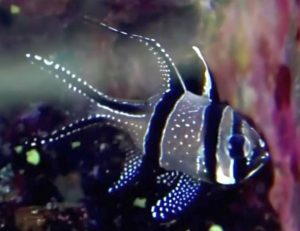
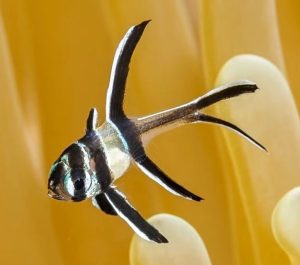
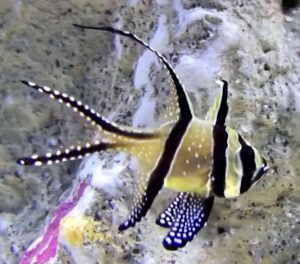
Banggai Cardinalfish (Pterapogon kauderni)

Banggai Cardinalfish (Pterapogon kauderni)

Banggai Cardinalfish (Pterapogon kauderni) School

Banggai Cardinalfish (Pterapogon kauderni) School

Banggai Cardinalfish (Pterapogon kauderni) known to tropical fish keeping enthusiasts as Banggai Cardinal, Kaudern’s Cardinalfish, Longfin Cardinalfish, or Highfin Cardinalfish are endemic to the Banggai Archipelago in Indonesia. Their entire natural habitat is concentrated around shallow coastal waters of 17 large and 10 small remote islands off the eastern coast of Central Sulawesi. A tiny isolated population resides just off the main coast of Central Sulawesi.

Non native populations of Banggai Cardinalfish in North Sulawesi (Lembeh Strait), Secret Bay in Northwest Bali, and the Ambon Bay that were introduced by trade fishers in 2000 are now established and occasionally harvested by collectors to reduce pressure on native archipelago populations.

Like the Pajama Cardinal (Sphaeramia nematoptera) and Orbiculate Cardinal (Sphaeramia orbicularis); the Banggai cardinalfish (Pterapogon kauderni) is a weak swimmer that lives a mostly sedentary lifestyle in the calm lagoons, seagrass beds, mangrove roots,and coral reef flats of their range in shallow water depths between 5 to 16 feet.

Banggai Cardinals are a peaceful species that group together for protection among branching corals, large sea anemones, and the venomous spines of Long Spined Sea Urchins (Diadema setosum).   Juveniles in particular commonly hide among the spines of long-spined sea urchins or anemone tentacles for protection.

Banggai Cardinalfish (Pterapogon kauderni)

Banggai Cardinalfish (Pterapogon kauderni)

The Banggai Cardinal has a silver body marked with bold vertical black bars and unique white spots, a tasseled first dorsal fin, elongated second dorsal and anal fins, and a deeply forked caudal fin.   Each individual fish has a distinct dot pattern used for individual identification.   Males and females are identical in size and coloration.

A single Banggai Cardinal can be housed in a mature nano reef or FOWLR tank of 20 gallon capacity with a sandy or fine coralline gravel substrate and plenty of live rock arranged into overhangs, vertical drop offs, and shaded caves for them to hide among.    For a bonded pair, a 30 gallon tank is needed and for a harem or small groups of 4 ato 6 individuals, a mature aquarium of at least 75 gallon capacity is required.

Although Banggai Cardinals are very hardy, they thrive in stable water environments with low to moderate water flow.

The Banggai Cardinal is completely reef safe and will ignore corals, decorative clams, ornamental shrimp, and crabs. They do well in reef aquariums with less intense lighting and water flow.

The Banggai Cardinal is best kept as a bonded pair or in a large school in a spacious tank if at least 75 gallon capacity with plenty of hiding spaces.   Housing groups of mature Pterapogon kauderni in a smaller tank will usually result in a dominant pair forming and systematically killing off conspecifics.

In a FOWLR aquarium they do well with Ocellaris Clownfish, Royal Gramma, Tailspot or Lawnmower Blennies, Watchman Gobies, Firefish, Dwarf Angelfish, and peaceful Wrasses. Avoid housing them with large predatory Wrasses, Dottybacks, Groupers, Lionfish, or highly aggressive damselfishes. In reef tanks, they do well with Hermit Crabs, Ckeaner Shrimp, Snails, Anemones and especially Long Spine Sea Urchins that they will school directly over.

Because Banggai Cardinalfish skip the fragile, microscopic pelagic larval stage entirely, they are among the easiest marine species to breed in a home aquarium.

They are paternal mouthbrooders where the male holds the brood until he releases fully formed, miniature versions of the parents that

Juvenile Banggai Cardinalfish (Pterapogon kauderni)

Juvenile Banggai Cardinalfish (Pterapogon kauderni)

can eat solid foods from day one.

Most tropical fish keeping enthusiasts interested in breeding Pterapogon kauderni purchase 4 to 6 juveniles and allow a pair to form as they grow into adults; usually in 4 to 6 months.

Once the pair forms, they will claim a territory in the tank and aggressively chase other fish off. Immediately remove the other fish to prevent the pair from killing them and condition the pair with Mysis shrimp, fish eggs, etc. When ready to breed, the female will initiate a flashing, vibrating like courtship “dance”.

During a flash a clutch of up to 75 eggs is fertilized and transferred into the mouth of the male where they will remain for 20 to 30 days until the eggs hatch into tiny fry and they grow eyes. During this period the male will completely stop eating to avoid swallowing his offspring.

Once the fry are released, most breeders will remove them to a 10 gallon nursery tank equipped with a sponge filter, heater, fake sea urchins or plastic plants. Feed the fry live baby brine shrimp or live copepods 3 times a day for the next 2 weeks and then transition them to finely minced frozen copepods, cyclops, and/or high protein pellets. Once they aggressively eat frozen Mysis or standard foods and reach the size of a dime, they can be moved to a larger tank.

In the wild Banggai Cardinalfish feed primarily on planktonic crustaceans like copepods, brine shrimp, Mysid shrimp larvae, isopods and amphipods. Their remaining diet includes marine worms, small mobile mollusks, tiny crabs and shrimp, small fish larvae and ectoparasites.

In an aquarium environment the majority of their diet should include live or frozen Mysis shrimp, vitamin enriched brine shrimp, cyclops, calanus, marine fish eggs, finely chopped raw shrimp, squid, or krill along with a high quality sinking marine carnivore pellet.

Because they are very slow moving feeders, target feeding with a turkey baster is highly recommend if they are housed with fast moving tankmates.

Banggai Cardinalfish (Pterapogon kauderni) are widely available to tropical fish keeping enthusiasts from a variety of online retailers, wholesalers, and local fish shops at prices that range from $30.00 to $75.00 depending on size, supplier, area of collection and if they are wild caught or captive bred. They are usually available or easily ordered upon request.

Note: Because wild collection has caused massive local population crashes (including localized extinctions on islands like Limbo Island), the Indonesian government and international bodies have tightly regulated wild exports.

Captive bred Banggai Cardinals are exceptionally hardy, disease-resistant, and readily adapt to aquarium life (accepting frozen mysis shrimp, brine shrimp, and pellets). Wild caught individuals are often stressed from transport, fragile, and more prone to disease or internal viruses.

Banggai Cardinalfish (Pterapogon kauderni)

Banggai Cardinalfish (Pterapogon kauderni)


Minimum Tank Size: Single specimen 30 gallons, 75 gallons for small schools
Aquarium Type: FOWLR or Reef
Care Level: Easy
Temperament: Peaceful
Aquarium Hardiness: Very Hardy
Water Conditions: 73-84° F, dKH 8 – 12°, pH 8.1-8.4, sg 1.020-1.025
Max size: 3.4”
Color Form: Silver, Black, White
Diet: Carnivore
Compatibility: Reef Safe
Origin: Banggai Archipelago, Indonesia
Family: Apogonidae
Lifespan: 5 years
Aquarist Experience Level: Beginner/Advanced

Posted in Cardinalfish, Featured Articles, Saltwater, Tropical Fish Keeping, Tropical Fish Species0 Comments

Orbiculate Cardinal (Sphaeramia orbicularis)

Orbiculate Cardinal (Sphaeramia orbicularis)

Orbiculate Cardinal (Sphaeramia orbicularis) School

Orbiculate Cardinal (Sphaeramia orbicularis) School

The Orbiculate Cardinal (Sphaeramia orbicularis) known to tropical fish keeping enthusiasts as the Dot Dash Cardinal, Chubby Cardinal, Polka-Dot Cardinal, and Orbicular Cardinalfish is found throughout the tropical waters of the Indo Pacific.

Their vast range extends from coastal East Africa to the Kiribati Islands off South Africa; northwards, it reaches the southern islands of Japan, particularly the Ryukyu Islands and Iriomote Island and southwards to northern Australia and New Caledonia; eastward it extends to the Oceanic Island groups as far as Kiribati, Fiji, and Micronesia (Palau, the Mariana Islands and eastern Caroline Islands); and in the central Indo-Pacific, throughout the coastal waters of Southeast Asia, Indonesia, the Philippines, and Singapore.

The Orbiculate Cardinal is normally found in small to large congregations that they form in very shallow, stagnant to slow moving brackish or coastal waters in low current areas like mangrove estuaries, brackish coastal lagoons, ports, seagrass beds, and man made structures at depths rarely exceeding 16 feet.

Sphaeramia orbicularis have adapted exceptionally well to human development and are frequently collected from the large schools they form underneath the piers, jetties, marine docks and boardwalks throughout their range.

During the daylight hours the Orbiculate Cardinal will hover completely motionless among the mangrove roots, docks, and other structure relying entirely on camouflage for protection from predators. At night they leave their structure hideaways to target tiny shrimp, crabs, and benthic organisms that arise out of the silt or muddy substrate.

The Orbiculate Cardinal (Sphaeramia orbicularis) shares the similar round profile and dark vertical waistband as the Pajama Cardinal (Sphaeramia nematoptera) but lacks the vibrant color scheme. Both are nocturnal predators and paterenal mouthbrooders.

Orbiculate Cardinal (Sphaeramia orbicularis)

Orbiculate Cardinal (Sphaeramia orbicularis)

The Orbiculate Cardinal has a dull silver, gray or olive green face and head; a dark, dark red or silver colored eye; a narrow mottled or broken thin dark black vertical mid body band with smal dark spots, reddish on the head, becoming larger black or dark gray on the posterior toward the caudal peduncle, and short translucent fins that give it a camouflaged, muted appearance.

The “Dot Dash” Cardinal found among the reefs and lagoons of East Africa has a golden to beige body color with black spots and one solid black vertical line that runs from the dorsal to the pectoral fin.

Orbiculate Cardinal (Sphaeramia orbicularis)

Orbiculate Cardinal (Sphaeramia orbicularis)

Males and females are identical in appearance and size.

The Orbiculate Cardinal is best housed in groups of 5 or more individuals in a mature FOWLR aquarium of at least 30 gallon capacity for a single specimen, or 55 gallons for a small school, with a fine sand or muddy/silt substrate that is decorated with live or fake rock arranged into large caves, overhangs, tall vertical pillars, and fake vertical mangrove roots to replicate their estuarine environment. They require good filtration, low to very gentle water flow and low, dim or shaded lighting. This species is very sensitive to ammonia and nitrite.

Although the Orbiculate Cardinal is completely reef safe and will not harm corals, clams or invertebreates; they do best in a FOWLR tank that does not require high powered reef lighting for coral growth or wavemakers.

The Orbiculate Cardinal is a peaceful community fish that should not be housed with aggressive or predatory fishes. Good tankmates include the Firefish Goby (Nemateleotris magnifica), Banggai Cardinalfish (Pterapogon kauderni), Royal Gramma (Gramma loreto), Clownfish (Amphiprion spp.), and Yellow Watchman Goby (Cryptocentrus cinctus).

If you keep a reef or FOWLR tank with a clean-up crew with very small ornamental shrimp (like tiny sexy shrimp or small anemone shrimp), they may occasionally be snapped up at night if they can fit inside the wide mouths of adult cardinalfish. Normal sized cleaner shrimp, peppermint shrimp, and snails are completely safe.

Sphaeramia orbicularis can be bred in an aquarium environment but their pelagic larvae require specialized, microscopic live foods to survive which makes them extremely challenging to raise.

In their natural habitat the breeding cycle of Orbiculate Cardinalfish is exactly the same as the Pajama Cardinal except for the choice of nesting grounds.

Although both are paternal mouthbrooders that have their breeding cycles tied to the lunar cycles. Key differences are that Orbiculate Cardinalfish spawn fortnightly, peaking shortly before a new moon and full moon. Their courtship occurs along the shallow coastlines among mangrove roots, fallen debris and pier pilings.

After fertilizatrioin, the male holds the clutch in his mouth for about 8 days until hatching and like Pajama Cardinals spit out their microscopic, free floating larvae to drift in the water column to feed on zooplankton until they are able to settle back down to the nearest mangrove root and grow into adults.

Because spawning cycles occur every 2 to 3 weeks, males spend nearly half of their adult lives in a state of starvation as they incubate eggs in their mouths. To survive and rebuild their fat reserves, they must feed aggressively and gorge themselves on high-protein prey during the short windows between brooding cycles.

In their natural habitat, Dot Dash Cardinals are nocturnal carnivores that spend their days resting motionless in tight groups and separate into hunting parties as dusk falls.

They hunt over the muddy, silty substrates, skimming the surfaces of mangrove roots, seagrass beds, and pier pilings targeting benthic invertebrates and zoobenthos that crawl along the muddy sea floor like small crabs, tiny worms, insect larvae, benthic crustaceans, small juvenile fish and insects falling from the mangroves.

In an aquarium environment they require a live or frozen high protein diet of enriched Mysis shrimp, enriched brine shrimp, chopped krill, chopped clams, and copepods, especially for juveniles.   Targeted feedings 2 to 3 times a day with a pipette or a turkey baster is recommended to give the fish time to pluck the food from the water column. They easily transition to high quality pellets and flakes.

The Orbiculate Cardinal (Sphaeramia orbicularis) is occasionally available to tropical fish keeping enthusiasts from a variety of online wholesalers, retailers and local fish shops at prices that range from $14.99 to $39.99 depending on size, area of collection and if they are wild caught or captive bred.

Orbiculate Cardinal (Sphaeramia orbicularis)

Orbiculate Cardinal (Sphaeramia orbicularis)


Minimum Tank Size: Single specimen 30 gallons, 55 gallons for small schools
Aquarium Type: FOWLR
Care Level: Easy
Temperament: Peaceful
Aquarium Hardiness: Very Hardy
Water Conditions: 73-80° F, dKH 8 – 12°, pH 8.0-8.4, sg 1.023-1.025
Max size: 3.9”
Color Form: Greenish Gray, Dull Silver, Black, Olive Brown, Pale White
Diet: Carnivore
Compatibility: Reef Safe
Origin: Indo Pacific Ocean
Family: Apogonidae
Lifespan: 5 years
Aquarist Experience Level: Beginner/Advanced

Posted in Cardinalfish, Featured Articles, Saltwater, Tropical Fish Keeping, Tropical Fish Species0 Comments

Pajama Cardinal (Sphaeramia nematoptera)

Pajama Cardinal (Sphaeramia nematoptera)

Pajama Cardinal (Sphaeramia nematoptera)

Pajama Cardinal (Sphaeramia nematoptera)

Pajama Cardinal (Sphaeramia nematoptera) known to tropical fish keeping enthusiasts as Sphaeramia nematoptera, Spotted Cardinalfish, or Red Spotted Cardinalfish is found in the western Pacific Ocean and Indo-Australian Archipelago.

Their range in the Western Pacific extends from the Ryukyu Isslands in southern Japan down to the Great Barrier Reef in Australia; in Oceana and Indo-Malayan the span eastward from Java and Indonesia all the way to Fiji; and in Micronesia they are common throught Palau, Truk, and the Caroline Islands.

The Pajama Cardinal is a peaceful, largely nocturnal species that is most commonly found in small to large schools in the shallow, sheltered coastal reefs, lagoons, and mangrove estuaries of their range at depths from 3 to 50 feet where they hover near branching Porites or Acropora corals, caves, or sea urchins during the daylight hours.

Sphaeramia nematoptera are a nocturnal benthic feeding species that shelter in the crevices of live rock, among the branches of Porites corals or between the long spines of longspine sea urchins during the day and disperse at night as solitary hunters to feed on small crustaceans like shrimp, crabs, mysids, and amphipods; zooplankton like isopods, copepods and free floating crustacean larvae; and small microscopic marine worms and tiny gastropods.   Their large, light-sensitive eyes allow them to spot tiny, translucent prey in pitch black water.

Pajama Cardinal (Sphaeramia nematoptera)

Pajama Cardinal (Sphaeramia nematoptera)

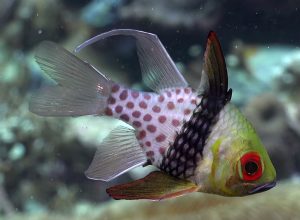
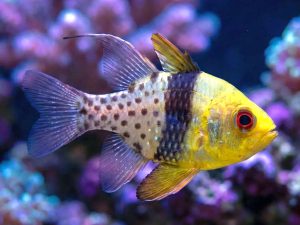
The body of the Pajama Cardinal has a greenish yellow colored front half, divided by a bold, black vertical band in the middle of their body, followed by an orange to brown spotted polka dot posterior half that is a cream to off white color. They have large, bright orange to red colored eyes and elongated forked fins.

The Pajama Cardinal is best housed in groups of 5 or more individuals in a mature FOWLR or reef aquarium of at least 55 gallon capacity with a sandy or fine coralline gravel substrate, plenty of live or dry rock arranged into deep caves, overhangs and archways, with moderate water flow, and plenty of free swimming space.

They are completely reef safe and will shelter among Porites or Acropora corals, Hammer corals, Torch corals, or plating Montipora as well as Long spined sea urchins (Diadema) that they share a symbiotic relationship with.

Pajama Cardinals are a peaceful, shy species that can be housed in a FOWLR tank with other peaceful, slow moving reef species. Suitable tank mates include; Possum Wrasse, Streaked Wrasse, Ocellaris or Percula Clownfish, Royal Gramma (Gramma loreto), Dottybacks (e.g., Orchid Dottyback), Ruby Red Dragonet, Firefish (Nemateleotris spp.), Cleaner Shrimp (Lysmata amboinensis), Blue Green Chromis, or Hawkfish (e.g., Flame Hawkfish).

Avoid Damselfish, Dottybacks, Six Line Wrasses, large Tangs, groupers, snappers, hawkfish, and Lionfish.

Pajama Cardinals are paternal mouthbrooders that have been bred in an aquarium environment however rearing the larvae remains extremely challenging.

In the wild, Pajama Cardinals form long term social pairs.   The male takes full responsibility for incubating the fertilized eggs inside his mouth until they hatch out as undeveloped, microscopic larvae.

Courtship typically takes place during the twilight hours.   Pairs separate themselves from the school and swim in tight circles, side by side, flicking or twitching their bodies until they finally align parallel to each other as they spawn.   The female releases an adhesive egg mass that contains dozens of tiny eggs that the male immediately fertilizes externally and gathers up into his mouth. Once the eggs are in his mouth he becomes passive and vulnerable.

The female then takes over to aggressively guard the brooding male from any harm.   The male churns the egg mass inside his bulbous distended mouth to oxygenate and aerate the enbryos until they hatch out in 7 to 8 days as microscopic larvae. Males frequently hold the larvae for up to 2 weeks before releasing them into the water column. After initially spawning, a pair will reliably spawn every 2 to 3 weeks.

In their natural habitat, Pajama Cardinals are nocturnal planktivores and micro-carnivores that feed on planktonic crustaceans, benthic crustaceans, invertebrate larvae and very small, newly hatched fish.

In an aquarium environment they are easily acclimated to accept a wide variety of foods like frozen Mysis shrimp, vitamin enriched brine shrimp, chopped krill, calanus, and cyclops; live blackworms, adult brine shrimp, copepods, amphipods, and once acclimated high quality marine flakes and small micro-pellets.

Pajama Cardinals are slow, deliberate swimmers with small mouths that cannot compete with aggressive tankmates for food.  They require 2 to 3 small daily feedings with one as the reef lights are cut off.

The Pajama Cardinal (Sphaeramia nematoptera) is widely available to tropical fish keeping enthusiasts from a variety of online retailers, wholesalers, and local fish shops at prices that range from $13.99 to $49.99 depending on size, area of collection and if they are wild caught or captive bred.

Pajama Cardinal (Sphaeramia nematoptera)

Pajama Cardinal (Sphaeramia nematoptera)


Minimum Tank Size: Single specimen 20 gallons, 55 gallons for small schools
Aquarium Type: FOWLR or Reef
Care Level: Easy
Temperament: Peaceful
Aquarium Hardiness: Hardy
Water Conditions: 74-80° F, dKH 8 – 12°, pH 8.0-8.4, sg 1.020-1.025
Max size: 4”
Color Form: Greenish Yellow, Black, Light Tan, Red Orange
Diet: Carnivore
Compatibility: Reef Safe
Origin: western Pacific Ocean
Family: Apogonidae
Lifespan: 5 – 8 years
Aquarist Experience Level: Beginner

Posted in Cardinalfish, Featured Articles, Saltwater, Tropical Fish Keeping, Tropical Fish Species0 Comments

Queen Triggerfish (Balistes vetula)

Queen Triggerfish (Balistes vetula)

Queen Triggerfish (Balistes vetula)

Queen Triggerfish (Balistes vetula)

The Queen Triggerfish (Balistes vetula) known to tropical fish keeping enthusiasts as Turbot, Queen Trigger, or Oldwife is found in the tropical and subtropical Atlantic Ocean. Its range extends from the western Atlantic, spanning eastern Canada down through the Gulf of Mexico, the Caribbean, and all the way to southern Brazil, as well as the eastern Atlantic from the Azores and Cape Verde down to Angola.

The Queen Triggerfish is a solitary species that is generally encountered alone or in small groups around the rocky sea floors, sandy flats, and coral reefs of their range in depths from 10 to over 100 feet, however, specimens have been collected as deep as 900 feet.

Queen Triggerfish are a relatively shy and peaceful species that become fiercely territorial and aggressive during the breeding season, when they are guarding their sandpit nests.

Queen Triggerfish (Balistes vetula)

Queen Triggerfish (Balistes vetula)

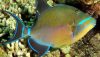
The Queen Triggerfish has a large oval shaped, laterally-compressed body with small eyes located toward the top of the head. They have a steel gray to olive green or bluish gray colored back, a yellowish orange lower head and belly, and distinct bright electric blue diagonal stripes and bands around the mouth.

Unlike some triggerfish species like the Crosshatch Triggerfish; male and female Queen Triggers share the exact same coloration and are the same size at identical ages. Both sexes can create a throbbing or grunting noise using membranes near its pectoral fins to warn off other fish.

Like most triggerfish; Queen Triggerfish have a defensive first dorsal spine that can lock upright into crevices to wedge itself safely from predators, which is unlocked by a second smaller spine.

A single juvenile Queen Triggerfish can be housed in a mature FOWLR tank of at least 200 gallon capacity with a coarse sandy coralline substrate, live rock arranged into large caves, crevices and overhangs for them to retreat and wedge themselves, and plenty of free swimming area. Because they are notorious for blowing water jets at the sandy substrate which can collapse loose rockwork, it is a good idea to secure them with epoxy.

Adult Balistes vetula require at least a 300 gallon tank to provide them with the swimming space they require.

Their messy eating habits require heavy biological filtration to maintain excellent water quality. An oversized protein skimmer, strong mechanical filter with a high water turnover rate, and a wave maker is highly recommended.

The Queen Triggerfish is NOT reef safe. They are curious and possess powerful jaws that can decimate corals, invertebrates, and clams in a reef tank. They constantly try to rearrange rockwork and will chew on exposed heater wires, filter intakes, and probe wires if they are not hidden behind the rockwork.

Although they are best housed alone, they can be housed in large community tanks with Tessalata or Green Moray Eels, large aggressive groupers, large adult angelfish like the Emperor or French Angel, and Lionfish.

Avoid housing them with any smaller or passive community fish like tangs or wrasses.

Without having a massive multi-thousand gallon tank setup, normal tropical fish keeping enthusiasts cannot breed Queen Triggerfish.

In their natural habitat, a single male Balistes vetula will establish a spawning territory that they patrol on the sandy flats roughly 33 feet in diameter.    They are demersal blockers that construct depression nests in the sandy substrate with rapid fin movements and water jets that they blow with their mouths.

Both parents guard the nest.   The female remains within a few feet of the nest and aggressively drives away any immediate intruders.   The male patrols the perimeter from larger predators, including divers, before they can get close to the female. A pair can produce anywhere from a 100,000 to over a million tiny, adhesive eggs in a single spawn that hatch into pelagic fry. The fry endure a larval duration that can last anywhere from 65 to over 100 days.

Queen Triggerfish are diurnal secondary consumers that forage during the daylight over coral reefs, sandy flats, and rocky sea floors for long spine sea urchins and other hard shelled benthic invertebrates such as crabs, shrimps, mantis shrimp, snails, chitons, clams, mussels, starfish, sea cucumbers, polychaete worms, small reef fish, and occasionally macroalgae. They use water jets from their fins to flip long spine sea urchins over to expose their vulnerable undersides before biting.

In an aquarium environment they should be fed a mixed diet of 70% hard shelled foods, 20% meaty foods, and 10% prepared foods and greens. Hard shelled foods like clams or mussels, crab legs and lobster tails, live fiddler crabs, ghost shrimp, or freshwater pest snails should be mixed with squid, octopus, Mysis, krill, silversides and large marine pellets and Nori held on a rock with a veggie clip. They should be fed this mixed diet at least 2 to 3 times a day.

The Queen Triggerfish (Balistes vetula) is commonly available to tropical fish keeping enthusiasts as wild caught specimens from a variety of online suppliers and specialty fish shops at prices that vary according to size and area of collection.

Approximate purchase sizes typically range from $149.99 for smaller individuals to over $400.00 for large adult specimens.

Queen Triggerfish (Balistes vetula)

Queen Triggerfish (Balistes vetula)


Minimum Tank Size: Juveniles 200 gallons, Adults 300+ gallons
Aquarium Type: FOWLR
Care Level: Moderate
Temperament: Aggressive
Aquarium Hardiness: Very Hardy
Water Conditions: Temp 72-82F, dKH 8 – 12°, pH 8.1-8.5, Salinity 1.022-1.026
Max size: 24″
Color Form: Steel Gray, Electric Blue, Olive Green, Yellowish Orange
Diet: Carnivore
Compatibility: Not reef safe
Origin: Atlantic Ocean
Family: Balistidae
Lifespan: Over 10-15 years
Aquarist Experience Level: Expert

Posted in Featured Articles, Saltwater, Triggerfish, Tropical Fish Keeping, Tropical Fish Species0 Comments

Longnose Batfish (Ogcocephalus corniger)

Longnose Batfish (Ogcocephalus corniger)

Longnose Batfish (Ogcocephalus corniger)

Longnose Batfish (Ogcocephalus corniger)

The Longnose Batfish (Ogcocephalus corniger) known to tropical fish keeping enthusiasts as the Walking Batfish, Red Lipped Batfish, Walking Longnose Batfish, Devil Nose Fish, Spotted Batfish or Horned Batfish is found in the warm waters of the Western Atlantic Ocean; particularly from the southeastern United States down through the Caribbean Sea and into the Gulf of America.

Longnose Batfish have been found as farn north as the coastal waters of North Carolina. They are common throughout the northern Gulf of America and across the Bahamas; and farther south through the Greater Caribbean into Central America and the coastal waters of Belize, Cozumel, Mexico down to Columbia.

Longnose Batfish are sedentary, demersal ambush predators that are usually encountered alone buried or walking along the soft, sandy, or muddy bottoms of their range where they hunt for snails, small crabs, and clams with their horn like noses.

Longnose Batfish are routinely collected by both recreational divers and scientific/commercial trawlers along the sandy flats and drop offs that immediately border coral reefs or rocky areas in the benthic neritic zone at depths from 95 to 755 feet

Longnose Batfish (Ogcocephalus corniger)

Longnose Batfish (Ogcocephalus corniger)

Unlike other marine Batfishes, the Longnose Batfish has a uniquely flat, disc shaped body when viewed from above, muscular limb like pectoral and pelvic fins, and an elongated pointed horn like snout with a small, retractable (illicium) that they use as a lure to attract smaller fish when they are buried in the sand.

The dorsal side of their body is a mottled yellowish brown, gray, or reddish brown color with hints of black, and the ventral side is usually a pale cream, light yellow, or reddish orange color.   They have a rough skin that is completely covered in small, hard, wart like tubercles.  Males and females are visually indistinguishable.

Juvenile Longnose Batfish are colored similarly to adults with mottled shades of yellow, brown, or gray that blend seamlessly with the sandy bottom. They lack the elongated horn that showcases adults.

The Longnose Batfish is an exceptionally difficult species to keep in captivity.

Juvenile Ogcocephalus corniger are best housed in a low profile mature FOWLR aquarium of at least 75 gallon capacity that is wider rather than tall with a thick, deep bed of fine, smooth aragonite sand or live sand and live rock around the perimeter and/or back walls.   They require a wave maker to provide low to moderate water flow near the bottom, and because they are messy eaters, a strong protein skimmer to provide heavy filtration. Low lighting is recommended for this species..

Adults require a larger tank of at least 150 gallon capacity with the same substrate and decor.   Tank footprint and substrate texture is far more critical than total water volume with this species.

The Longnose Batfish is NOT reef safe and should only be housed in a FOWLR setup. They are poor swimmers and tend to knock over corals and other reef structure as they “walk” along the substrate and will prey on shrimp, small crabs, and small reef fish.

Longnose Batfish are generally calm and non aggressive in a community aquarium.   In a large enough tank they coexist well with non aggressive Panther Groupers, Harlequin Tuskfish and Lionfish.   Avoid housing them with fast, aggressive species like tangs, wrasses, angelfish, triggerfish or puffers which will nip at their fins and delicate “lure”.

Longnose Batfish have not been bred in an aquarium environment.

The Longnose Batfish is a carnivorous, benthic ambush predator that feeds exclusively on small crabs, wild shrimp, mysids, amphipods, small gastropods, clams, scallops, polychaetes and other marine worms, and small fish.

Unlike deep sea anglerfish that use a glowing lure to attract prey, the Longnose Batfish uses a retractile dorsal spine called an illicium, tipped with a fleshly “esca” to attract small prey. Scientists believe that the esca secretes a chemical scent to attract crabs and snails to their mouth.

In an aquarium environment, Longnose Batfish are extremely difficult to feed.  They are slow, passive eaters that initially require live, moving prey like ghost shrimp, small glass shrimp, mysid shrimp, live earthworms or blackworms, or tiny feeder fish placed directly in front of their nose.

Once they are actively hunting live foods; target feeding them frozen enriched Mysis shrimp, chopped raw table shrimp, chopped krill, squid, and clams may be accepted over time.

The Longnose Batfish (Ogcocephalus corniger) is seldom available to tropical fish keeping enthusiasts by online wholesale, retail and specialty fish stores partly because of the specialized diving and trapping equipment needed to safely harvest them.

Due to their specialized dietary needs and low collection frequency, live availability for home aquariums is scarce and seasonal.

Many wholesalers and retail fish stores will not stock them because of the high mortality rates during transit, initial store acclimation, and difficulty in feeding.

Current Ogcocephalus corniger pricing and size ranges are:   Small (1.5″ – 2″) at $35 – $50, Medium (2″ – 4″) at $50 – $70, Large / Extra Large (4″+) at $70 or more. Availability across major online retailers is extremely scarce.

Finding one of these unique sought after fish usually requires signing up for back-in-stock email notifications or contacting specialized marine livestock dealers to place a special request.

Longnose Batfish (Ogcocephalus corniger)

Longnose Batfish (Ogcocephalus corniger)


Minimum Tank Size: 150 gallons
Care Level: Intermediate
Temperament: Peaceful
Aquarium Hardiness: Hardy
Water Conditions: 72-78° F, dKH 8 – 12°, pH 8.1-8.4, sg 1.020-1.025
Max size: 13”
Color Form: Dark Brown, Gray, Orange, Yellowish Brown
Diet: Benthic Carnivore
Compatibility: Not Reef Safe
Origin: Western Atlantic Ocean
Family: Ogcocephalidae
Lifespan: 8 – 10 years
Aquarist Experience Level: Expert

Posted in Batfish, Batfish, Featured Articles, Saltwater, Tropical Fish Keeping, Tropical Fish Species0 Comments

Katayama Anthias (Odontanthias katayamai)

Katayama Anthias (Odontanthias katayamai)

Katayama Anthias (Odontanthias katayamai)

Katayama Anthias (Odontanthias katayamai)

Katayama Anthias (Odontanthias katayamai) known to tropical fish keeping enthusiasts as the Rose Anthias or Yellow Spotted Anthias are an exceptionally rare deep water species native to the subtropical Western Pacific; specifically around southern Japan, Taiwan, and the Ryukyu Islands, with additional records extending to Guam and the Northern Mariana Islands.

Katayama Anthias are an exceptionally rare, deep-bodied reef dwelling species typically encountered hovering along the rocky drop-offs, deep ledges, and steep marine structures of their range in areas with strong currents at extreme depths ranging from 580 to nearly 1,000 feet where they forage and shelter among their complex rocky environment to evade ocean predators.

Although adult Rose Anthias are exclusively found at these extreme depths where temperatures remain cool year round, juveniles occasionally venture into sllightly shallower mesophotic zones where they are occasionally collected.

Katayama Anthias (Odontanthias katayamai)

Katayama Anthias (Odontanthias katayamai)

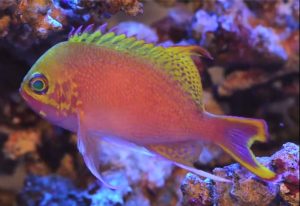
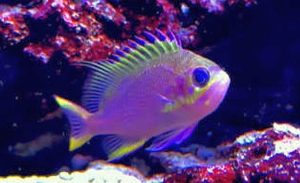
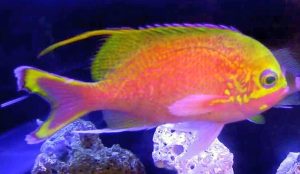
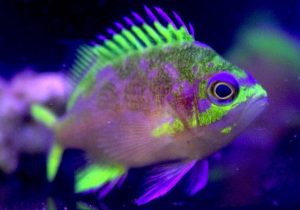
Katayama Anthias have a high, deep-bodied profile and stocky shape with striking pink, red, and yellow coloration that reveal strong fluorescence under actinic lighting.   Their bodies are covered with ornate yellow spots and magenta hues, while their dorsal, pelvic, and caudal fins are edged in vibrant shades of yellow and pink, terminating in delicate filaments.

The Katayama Anthias exhibits sexual dimorphism, with adult males being noticeably larger and displaying far more intense, vivid magenta-pink bodies overlaid with bright yellow blotches and heavily elongated filaments on the anal and caudal fins.

Females have slightly more subdued colors, maintaining a more uniform reddish-pink body with soft yellow accents

Katayama Anthias (Odontanthias katayamai)

Katayama Anthias (Odontanthias katayamai)

and shorter fin extensions.

Juvenile Katayama Anthias display a simpler pinkish-orange body with light yellow spotting limited to the face and dorsal area. Their colors intensify and their fin filaments elongate significantly as they mature into adulthood.

Odontanthias katayamai are best housed singly or in small haremic groups in a mature, well-established cool-water FOWLR or reef aquarium of at least 100 to 150 gallons capacity, with a fine sand or crushed coral substrate and plenty of live rock arranged into deep caves, overhangs, and archways for them to retreat into.

Because they originate from deep mesophotic reefs, they require dim to moderate lighting and shaded lower-light areas to escape intense reef lights.

Strong to moderate water movement provided by wavemakers is recommended to mimic the high-oxygen, current-rich environment of their natural habitat.   An aquarium chiller is essential to maintain cold water parameters, holding temperatures strictly below typical tropical reef levels.

The Katayama Anthias is completely reef safe and will not bother corals, clams, or decorative invertebrates in a reef environment.    Generally peaceful toward non-conspecifics, they can be kept singly or as a single male with a small group of females.   However, keeping multiple males in the same tank or housing small groups in undersized systems will result in severe territorial aggression.

Compatible tank mates that coexist peacefully with the Katayama Anthias include cool-water tolerant, non-aggressive species such as Plectranthias, deepwater pipefish, cool-water gobies, tilefish, and calm blennies, rather than boisterous shallow-water reef fish.

Unlike the Cherry Sakura Anthias (Sacura margaritacea)  the Katayama Anthias has recently achieved groundbreaking success in captive propagation, with captive-bred specimens raised and commercially offered by several specialist breeders.

Odontanthias katayamai are deepwater protogynous hermaphrodites that form haremic social structures in the wild, with the largest and most dominant female in a group transitioning into a male if the presiding male dies or is removed.    They are pelagic spawners that perform elaborate courtship displays near dusk, where the male flicks his fins and performs vertical dives to entice females into the water column.   During spawning, eggs and sperm are released simultaneously into the current without subsequent parental care.

Breeding in a closed system requires a mature, specialized cool-water setup of 150 gallons or larger, maintained at temperatures between 62–68°F and decorated with extensive rockwork overhangs.    Conditioning a healthy harem with 4 to 5 high-protein live and frozen feedings a day is necessary to simulate seasonal nutrient abundance and encourage regular spawning behavior.

The tiny larvae require a continuous supply of live micro-zooplankton after yolk-sac absorption.   Feeding must begin with tiny copepod nauplii such as Parvocalanus crassirostris multiple times daily to maintain a dense prey concentration. As the larvae develop over several weeks, their diet transitions to enriched rotifers (Brachionus plicatilis) and eventually to larger copepods (Tisbe or Apocyclops) and newly hatched Artemia nauplii.

Maintaining constant prey density in the larval tank is vital, as the tiny planktivorous larvae will starve if they do not float directly among dense clouds of live foods.    Tinting the larval water with live microalgae like Isochrysis galbana (“greenwater technique”) reduces stress, provides background contrast for larval hunting, and keeps the prey enriched.

In their natural habitat, Katayama Anthias feed strictly on zooplankton, copepods, and small planktonic crustaceans drifting in deep ocean currents.   In an aquarium environment, they have a high metabolism and require a varied, protein rich carnivorous diet that includes frozen PE Mysis shrimp, enriched brine shrimp, Calanus, live copepods, and high-quality marine pellets like TDO Chromos.   To replicate their natural grazing habits, frequent small feedings 3 to 5 times daily are highly recommended in lieu of  single large feedings.

An attached refugium for cultivating live copepods and amphipods is highly recommended to provide a continuous, natural supply of nutritious micro-fauna for this highly sought after species.

The Katayama Anthias (Odontanthias katayamai) is one of the absolute rarest and most coveted species in the entire marine aquarium trade.   Wild caught specimens require deep rebreather collection from extreme depths, making them exceptionally scarce and historically priced anywhere from $8,000 to over $12,000 per fish.

Outside of the Japanese market, exports are rare enough that each occurrence is treated as a notable event rather than a routine import.   The first live imported Katayama Anthias ever offered for sale domestically was in 2021 by Marine Collectors and sold at $10,000.

However, with the recent availability of captive bred juvenile specimens through elite importers and specialty retailers; tropical fish keeping enthusiasts now have a far hardier and more accessible option.    Odontanthias katayamai depending on size and availability are now typically commanding prices between $1,500 and $3,500.

Katayama Anthias (Odontanthias katayamai)

Katayama Anthias (Odontanthias katayamai)


Minimum Tank Size: 150 gallons
Aquarium Type: Cool-Water Reef or FOWLR
Care Level: Expert / Advanced
Temperament: Semi-Aggressive (toward conspecifics)
Aquarium Hardiness: Hardy when acclimated to cool parameters
Water Conditions: 62-68° F, dKH 8 to 12, pH 8.1-8.4, sg 1.023-1.025
Max size: 6.5″
Color Form: Pink, Red, Yellow, Magenta
Diet: Carnivore / Planktivore
Compatibility: Reef Safe
Origin: Southern Japan, Taiwan, Ryukyu Islands
Family: Serranidae
Lifespan: 5 – 8 years
Aquarist Experience Level: Advanced

Posted in Anthias, Featured Articles, Saltwater, Tropical Fish Keeping, Tropical Fish Species0 Comments

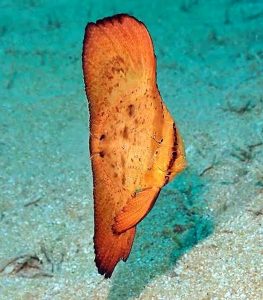
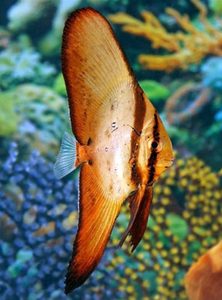
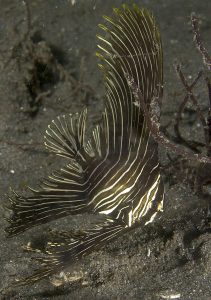
Juvenile Teira Batfish (Platax teira)

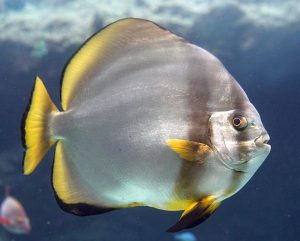
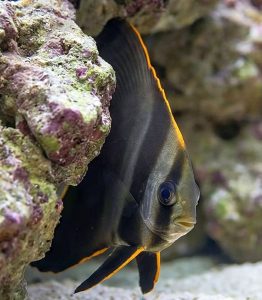
Teira Batfish (Platax teira)

Juvenile Teira Batfish (Platax teira)

Juvenile Teira Batfish (Platax teira)

Teira Batfish (Platax teira) known as the Longfin Batfish, Longfin Platax, Longfin Spadefish, or Round-faced Batfish are widely distributed throughout Indo-Pacific waters. Their range extends from the Red Sea and East Africa to Papua New Guinea, north to the Ryukyu Islands, south to Australia from the central coast of Western Australia, around the tropical north and south to the coast of New South Wales. Platax teira have also been recorded in the Bay of Islands in New Zealand.

Following the 2004 Indian Ocean earthquake and tsunami, it was reported in the Gulf of Mannar and more recently it was recorded in the Metiterranean off of Turkey and Israel.

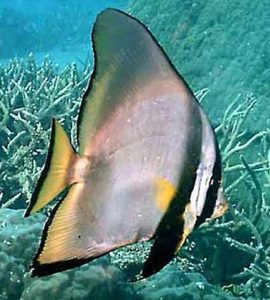
Teira Batfish are a mostly shallow water species that are found among floating seaweed, floating debris and on artificial reefs of their range at depths from 10 to 82 feet although large adults are occasionally found exploring depths down to 230 feet.

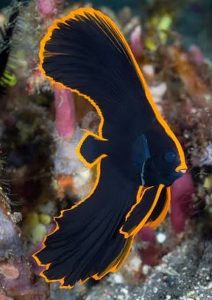
Small Juvenile Teira Batfish (Platax teira)

Small Juvenile Teira Batfish (Platax teira)

Juvenile Teira Batfish primarily inhabit shallow, highly protected environments like the estuaries, mangroves, and inner coral reefs where they are frequently found close to the surface underneath floating debris or Sargassum seaweed rafts, hiding from predators by mimicking dead leaves.

Adult Teira Batfish are naturally curious and are more commonly found in deeper

Teira Batfish (Platax teira)

Adult Teira Batfish (Platax teira)

waters where they school up on the open seaward reefs, deeper lagoons, and other deep offshore structure.   At larger sizes, adults increasingly become more pelagic and will form sizeable schools that shelter under large rafts of Sargassum that typically form following the wet season.   Divers frequently encounter them in large congregations around artificial reefs.

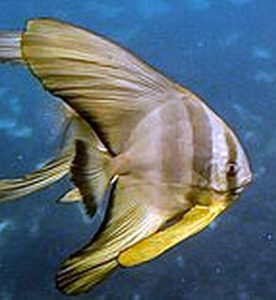
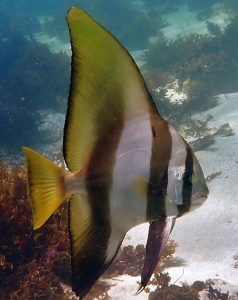
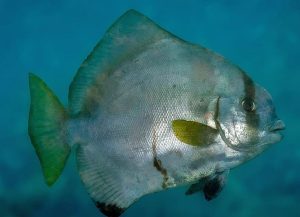
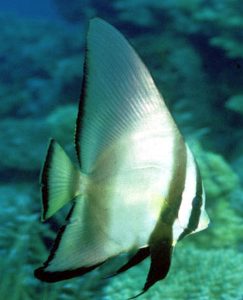
Fully adult Teira Batfish have a low hump on the nape of their body that is usually a brownish tan, gray, or silver color with a vertical blackish band through the eye and another wide black with a pale yellow or tan band through the pectoral fin. They have a dark blotch under the pectoral fin and another long, dark mark above the base of the anal fin.

As you watch adult Platax teira, they will often change color from a silvery white body with no bands, to a tannish brown with darker banding, and then fade back to silver again.

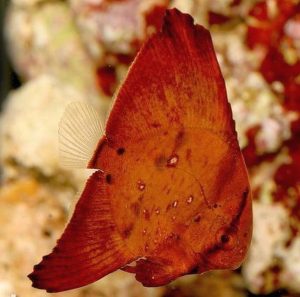
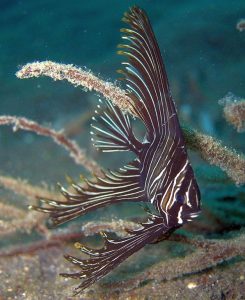
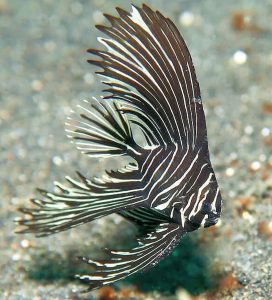
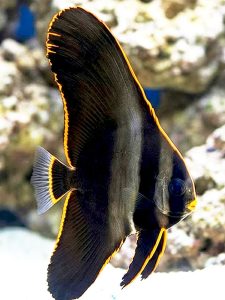
Juvenile Teira Batfish are brownish in color and look like floating leaves. Larger juveniles have highly elongated pelvic fins, front soft rays of the dorsal and anal fins that extend around the posterior at the base of the anal fin.

Small, juvenile Teira Batfish can be housed in a mature FOWLR grow out aquarium of at least 100 gallon capacity with a coralline sandy gravel substrate and a good amount of live rock arranged vertically into caves, overhangs and branches for them to hide among. They require diffused lighting, gentle low to moderate water flow, pristine water quality and stable conditions to thrive.

Within a few months juveniles transition into sub adults that require a tall, FOWLR tank of at least 250 gallon capacity with a sand or finely crushed coral substrate and plenty of free swimming space. Mature live rock should be arranged tightly along the back and perimeter of the aquarium to allow shelter zones with open water.

Adult Teira Batfish are massive omnivores that are best housed in a FOWLR aquarium of at least 450 gallons for a single fish or 800 to 1000 gallons for a pair or small school.   Tanks should be a minimum of 8 to 10 feet wide, 3 to 4 feet wide and 3 to 4 feet deep to accomidate their large size.   Landscaping with mature live rock should be kept low to the bottom and pushed tightly against the back walls.    Avoid tall pillars, high arches and sharp coral skeletons that could injure their large eyes or damage their skin and fins.

Because adult Teira Batfish generate a huge organic load, commercial grade filtration systems with a minimum water turnover rate of 10x to 15x the total tank volume per hour and a protein skimmer rated for twice the actual tank volume are necessary to keep them healthy. Bright high output open lighting is also recommended for adult Platax teira.

The Round-faced Batfish is NOT reef safe and will aggressively consume soft and stony corals, anemones, and many other types of sessile invertebrates.

Adult Teira Batfish are gentle giants and will not bully other larger fish. Some ideal tankmates include large, active, non aggressive specdies such as Mono Argentus (Monodactylus argenteus) or Silver Diamond Mullets, Vlamingi Tangs (Naso vlamingii) or Nasos, Thalassoma Wrasses or larger Coris Wrasses, Hippo Tangs or a single Harlequin Sweetlips. Avoid all small reef fish like Okinawa Chromis, small gobies, dartfish, or clownfish that will be considered as food and swallowed whole.

Like the Marble Batfish (Platax batavianus) it is impossible to breed the Teira Batfish (Platax teira) in a home aquarium. Adults are impossible to sex and because they are open-water broadcast spawners that in the wild gather in deep open areas to spawn, no home aquarium would be able to accomodate them.

In the wild, compatible pairs require massive depths and heavy, complex water currents to perform an upward spawning rush, where they release thousands of buoyant, microscopic eggs directly into the open ocean water column. The eggs drift freely as plankton in the open ocean currents until they hatch out into tiny larvae. Research into their early life stages shows that Platax teira larvae are incredibly fragile and suffer from aggressive cannibalism in the first few weeks of life. In a home aquarium, the eggs would immediately be sucked up by mechanical filters, destroyed by wavemakers, or skimmed out by protein skimmers.

In their natural habitat, Teira Batfish are opportunistic generalist omnivores that feed on what is available in their current environment. They prey on small crabs, marine worms, ghost shrimp, tiny prawns, corals, anemones, sponges and tunicates, jellyfish, vast quantities of zooplankton like copepods, crustacean larvae, and benthic marine algae and seaweeds that they scrape off rocks, ship hulls and coral heads. Teira Batfish are one of the few reef fish that regularly hunt and consume jellyfish and other gelatinous macro-plankton.

Small juvenile Teira Batfish sheltering under floating debris focus on drifting zooplankton and micro crustaceans. As they mature into sub juveniles and venture out into pelagic schools, they feed on larger invertebrates, fish chunks and jelllyfish balls.

In an aquarium environment, they should be offered a balanced diet consisting of fresh and frozen marine algae and meaty seafoods 3 to 4 times daily for juveniles and 2 to 3 times daily for adults.

Adults should be fed high quality frozen Mysis shrimp, vitamin enriched brine shrimp, chopped krill, commercial angelfish/herbifore preparations with sponge matter, fresh raw shrimp, scallops, clams, fresh white fish, large high quality Spriulina pellets, slow sinking omnivore pellets, and daily sheets of green and brown marine algae secured to the glass with a clip for continuous picking to provide crucial plant matter for their digestive tracts.

Juveniles occasionally need coaxing with targeted feedings of live ghost shrimp, blackworms, or adult mysid shrimp until acclimated.   Establish a 3 to 4 times a day feeding schedule to mimic their wild grazing behavior..

This species of Batfish can become very tame, sometimes feeding from its owner’s fingers.

Teira Batfish (Platax teira) are occasionally available to tropical fish keeping enthusiasts from specialty fish shops as well as a variety of online wholesale, retail and specialty vendors at prices that typically range between $30 and $90 for small juveniles to well over $150 for larger specimens. They are considered rare and seasonal because they are all wild caught and only available in sporadic waves.

Currently 1.5″ to 3″ Small juveniles retail from $30.00 to $55.00; Medium/Large 3″ to 5″ range from $70.00 to $115.00; Large 5″ plus command $175 to $350 or more.

Juvenile Teira Batfish (Platax teira)

Juvenile Teira Batfish (Platax teira)


Minimum Tank Size: 250-1,000+ gallons
Care Level: Moderate
Temperament: Peaceful
Aquarium Hardiness: Hardy
Water Conditions: 72-80° F, dKH 8 – 12°, pH 8.1-8.4, sg 1.020-1.025
Max size: 24″-28″
Color Form: White, Yellow, Tan, Black
Diet: Omnivore
Compatibility: Not Reef Safe
Origin: Indo Pacific
Family: Ephippidae
Lifespan: 10 – 15+ years (adults)
Aquarist Experience Level: Intermediate/Expert

Posted in Batfish, Batfish, Featured Articles, Saltwater, Tropical Fish Keeping, Tropical Fish Species0 Comments

Yellow Lined Anthias (Tosanoides flavofasciatus)

Yellow Lined Anthias (Tosanoides flavofasciatus)

Yellow Lined Anthias (Tosanoides flavofasciatus)

Yellow Lined Anthias (Tosanoides flavofasciatus)

Yellow Lined Anthias (Tosanoides flavofasciatus) known to tropical fish keeping enthusiasts as the Yellow Striped Anthias or Prismatic Anthias are found in the Western Pacific, most notably in Sagami Bay off Japan, with a second population recorded from the Tonga Ridge in Melanesia.

Yellow Lined Anthias are an uncommon deepwater reef dwelling species typically encountered in pairs or small harems along rocky drop offs, complex reef structure, and cracks, crevices, and caves of their range, at depths well below 200 feet.   They use this structure to shelter from the open ocean predators found at those depths. In cooler months, they will move up into shallower water, though still well within mesophotic depths of 110 to 160 feet, staying wherever temperatures remain cool enough for their liking.

In the wild, Yellow Striped Anthias behave much like other Tosanoides and typical anthiines, forming harems made up of a single dominant male presiding over several females, hovering above the reef to pick zooplankton from the passing current.   Like other anthiines, Tosanoides flavofasciatus are believed to be protogynous hermaphrodites.  All individuals start life as females and within a group or harem, the largest, most dominant female will transition into a male if no male is present.

Yellow Lined Anthias are strongly dichromatic and dimorphic between the sexes.  All members of the genus

Yellow Lined Anthias (Tosanoides flavofasciatus)

Yellow Lined Anthias (Tosanoides flavofasciatus)

Tosanoides have a somewhat high body profile, stocky shape, and rounded ventral fins.

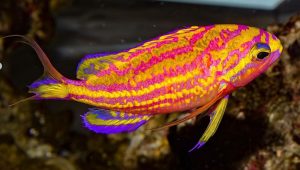
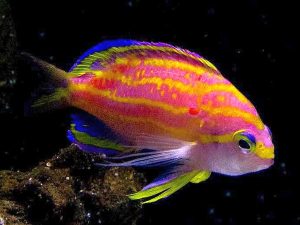
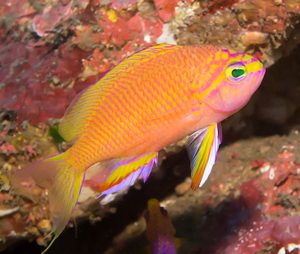
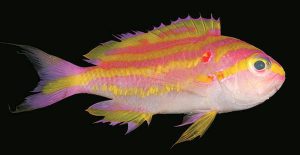
Fully colored males are decorated with alternating horizontal bands of bright yellow and deep pinkish purple that carry a metallic sheen under natural light.   The tail is asymmetrically colored, largely clear along the upper lobe with vivid pattern confined to the lower lobe, and adult males develop elongated trailing thread filaments on the anal, ventral, and caudal fins.

Females and juveniles are far plainer, with a more uniform pinkish orange

Female Yellow Lined Anthias (Tosanoides flavofasciatus)

Female Yellow Lined Anthias (Tosanoides flavofasciatus)

body, splashes of yellow and soft purple limited to the face and around the eyes, and red and yellow pelvic and anal fins outlined in purple or magenta along their leading edge. Females also lack the trailing thread filaments seen on males and stay noticeably smaller.

Tosanoides flavofasciatus are best housed in a mature, dedicated cool water reef or FOWLR aquarium of at least 75 to 100 gallons for a single fish or small haremic group, with plenty of live rock arranged into open swimming lanes as well as shaded caves, overhangs, and archways the fish can retreat into.   Because this species naturally lives well below tropical reef temperatures, it should never be housed in a standard warm reef system.

Because Yellow Lined Anthias are collected from deep, cool water, they require dim to moderate lighting instead of intense reef lighting.  Shaded retreats should always be available for them to escape high-light areas of the tank.

An aquarium chiller is essential, not optional, for this species.   Although sources differ slightly on the exact number, the ideal temperature range for Yellow Lined Anthias is anywhere from 62°F up to 72°F.  A chiller capable of holding steady in the mid to upper 60s°F is the safe target.

A wavemaker providing moderate, steady flow is also recommended to reproduce the current found in their natural deep reef environment, without turbulent, high stress areas.

Heavy filtration, aggressive protein skimming, regular water changes, and stable water chemistry are required to keep this sensitive species in good health.   Copper based medications should be avoided entirely, as deep reef anthiines are considered especially sensitive to them.

Yellow Lined Anthias are completely reef safe and will not bother corals, decorative clams or other sessile invertebrates.   They are peaceful and do best with similarly non-aggressive, cool-tolerant tankmates such as Plectranthias, deepwater pipefish, or cool-water gobies, rather than typical boisterous shallow-water reef fish. Like most anthiines, more than one male in a single system will result in aggression, and a lone male is best kept with a small group of females if a harem setup is desired.

Tosanoides flavofasciatus have not been successfully bred, raised, or commercially produced in a home aquarium to date.

Like other anthiines, they are pelagic spawners, releasing eggs and sperm into the water column during courtship, typically around sunset.   The resulting larvae are tiny, require specialized planktonic live feeds, and go through a long larval development period, all of which make captive propagation currently unviable for hobbyists.

Yellow Lined Anthias are strict planktivorous carnivores with a naturally high metabolism from feeding in open current, and they need frequent, high-nutrition meals to match it.  In the wild they feed on small drifting animals like copepods, larvae of tiny crustaceans and other similarly sized zooplankton swept along by the currents.

A varied diet of PE Mysis, enriched brine shrimp, copepods, and finely chopped seafood, alongside quality pellets such as TDO or New Life Spectrum, works well in the aquarium.   Feeding small amounts three to five times a day is preferable to one or two large feedings, and frozen and live foods should remain the staple even if the fish can occasionally be coaxed onto pellets.

Yellow Lined Anthias (Tosanoides flavofasciatus) are one of the rarest and most expensive, anthias in the entire aquarium trade, and that reputation is not hype.   Outside of Japan, there is essentially no established supply chain.   In the U.S. they are extremely rare and sporadically imported unpredictably through only a handful of specialty boutique vendors.

Because it lives at extreme depths, it can only be hand collected by specialist divers using mixed gas and closed circuit rebreathers.  This results in very few specimens brought up in a given year.

The overwhelming majority of what is collected never leaves Japan at all.   Japanese aquarists are known to purchase nearly every specimen before export is even considered, and Tosanoides flavofasciatus does show up, on and off, at a handful of elite Japanese retailers such as BlueHarbor, Vessel, and Lagoon.     Even there, it is described as inconsistent stock rather than a regular offering.    Females and juveniles surface more frequently, while large, fully colored males are considerably harder to come by.

Outside Japan, exports are rare enough that each occurrence tends to be treated as a notable event in the hobby rather than a routine restock.   The best documented U.S. case is a male brought in by the importer Marine Collectors in 2021, reported at the time as the first live specimen of this species ever offered for sale domestically, at $10,000.

The most recent specialty importer Unique Fins has listed the species with clearly tiered, published pricing by sex and grouping: a single female priced around $5,800, a single male around $13,000, and a mated trio of one male and two females around $24,000.

As of this writing, all three of those listings are marked sold out, which is itself the clearest illustration of how this species actually trades — availability comes in short, unpredictable bursts, and demand clears the stock almost immediately when it does appear.

In practical terms, Yellow Lined Anthias are not a fish you can simply shop for.  It occasionally becomes available without warning, through a very small number of specialty importers at prices that depend heavily on the individual specimen’s sex, size, coloration, and grouping.

If you are a serious tropical fish keeping enthusiast hoping to acquire a Yellow Lined Anthias, your best strategy is to build a direct relationship with a high end rare fish importer and ask to be placed on a waitlist or notification list.

Make sure a dedicated cool water system is already up, cycled, and ready well before that call ever comes.

Yellow Lined Anthias (Tosanoides flavofasciatus)

Yellow Lined Anthias (Tosanoides flavofasciatus)


Minimum Tank Size: 75-100 gallons
Aquarium Type: Deepwater Reef or FOWLR
Care Level: Expert
Temperament: Peaceful
Aquarium Hardiness: Delicate
Water Conditions: 62°F to 72°F, dKH 8 to 11, pH 8.1-8.4, sg 1.023-1.025
Max size: 3.5″ (males); 2.3″-2.4″ (females)
Color Form: Yellow, Pink, Purple, White
Diet: Carnivore (Planktivore)
Compatibility: Reef Safe; best with peaceful, cool-tolerant tankmates
Origin: Japan, Melanesia
Family: Anthiadidae
Lifespan: Not well documented; related anthiines typically live several years in captivity Aquarist Experience Level: Expert

Posted in Anthias, Featured Articles, Saltwater, Tropical Fish Keeping, Tropical Fish Species0 Comments

Orbic Batfish (Platax orbicularis)

Orbic Batfish (Platax orbicularis)

Juvenile Orbic Batfish (Platax orbicularis)

Juvenile Orbic Batfish (Platax orbicularis)

The Orbic Batfish (Platax orbicularis) known to tropical fish keeping enthusiasts as the Cooper Batfish, Circular Batfish, Orbiculate Batfish, Round Batfish, Leaf Baffish or Narrow-banded Batfish are native to the Indo-Pacific.

Orbic Batfish range in eastern Africa from South Africa, Madagascar, the Mascarenes and Seychelles, north into the Red Sea; east through the Persian Gulf and on into Micronesia as far as the Tuamotu Archipelago; north to southern Japan and south to northern Australia wgere they are found at the Ashmore Reef in the Timor Sea as well as at Christmas Island and Cocos (Keeling) Islands in the eastern Indian Ocean.

On the Australian mainland, they occur from Shark Bay in Western Australia, around the northern tropical coast and south on the east coast, almost to Sydney.

Orbicular batfish have also been recorded in the Western Atlantic off southern Florida where they were most likely introduced as deliberate releases by tropical fish keeping enthusiasts unable to house them as adults.

Orbic Batfish are usually encountered as single individuals or in small groups in the shallow, protected coastal waters and lagoons of their range, particularly around mangroves, coral reefs, and deeper areas with silt substrates at depths to 100 feet.

During the daylight hours, juvenile reddish brown Orbic Batfish shelter among the mangroves in the shallowest waters of protected lagoons amongst flotsam at depths to 16 feet, where they mimic dead mangrove leaves and Sargassum seaweed floating in the water column.

Heavy populations are generally found among the shallow mangrove roots, brackish estuaries, seagrass beds and inner sheltered lagoons grazing on microalgae and epiphytes off the seagrass blades and mangrove roots. At night they become more active and hunt small bentic invertebrates, detrital biofilms, and planktonic food particles drifting through the mangrove channels.

Adult Orbic Batfish are most commonly found in coastal lagoons, deep sandy reef channels and seaward outer reef drop offs grazing on marine algae, dense reef seaweeds, benthic invertebrates, gelatinous zooplankton and small fishes in midwater depths between 15 to over 100 feet.  Scuba divers often find them congregating at mid water depths above deep shipwrecks where they habitually follow green sea turtles to consume their feces.

Juvenile Orbic Batfish (Platax orbicularis)

Juvenile Orbic Batfish (Platax orbicularis)

Juvenile Orbiculate Batfish have a uniform reddish-brown, tan, or deep copper colored body that is often mottled with tiny black dots or faint, dark vertical bands.
They have an incredibly thin, elongated and highly symmetriccal body with massive, jagged or uneven fins that when floating sideways, mimics a dead mangrove leaf or clump of floating Sargassum seaweed.

As juveniles reach 4 – 5 inches in length, their leaf color fades into a uniform, shiny

Orbic Batfish (Platax orbicularis)

Orbic Batfish (Platax orbicularis)

silver grey color with a couple of faint, dark vertical bars that run down the face and body.   Their long crescent fins broaden, thicken, and shorten significantly giving the body a round, disk like appearance.

Juvenile Orbic Batfish grow quickly into adulthood.   A 2 inch juvenile can transition into a 10 inch sub adult in under a year.

Juvenile Orbic Batfish should be housed in a high, mature FOWLR aquarium of at least 100 gallon capacity with a coralline sandy gravel substrate and good amounts of smooth branch live rock or faux mangrove roots arranged vertically to extend to the water’s surface.   Leave the top third of the water column open so they can safely float sideways at the surface to perform their natural leaf-mimicry behavior.   They require diffused lighting, gentle very low water flow, pristine water quality and stable water parameters to thrive.

Adult Orbic Batfish require an extremely tall and wide mature FOWLR tank of at least 400 gallon capacity with a fine sand or coralline gravel substrate that is sparsely laid out with low, heavy piles of live rock.   They require strong, high volume water flow to mimic the outer reef drop offs, an unobstructed upper and middle water column for cruising, an industrial size protein skimmer to handle the bio load, and bright high output open lighting.

An 8 foot long by 3 foot wide tank is the bare minimum size for this species. Pristine water qulity and stable reef like water conditions are mandatory.

The Orbiculate Batfish is NOT reef safe and will aggressively consume soft and stony coral polyps, anemones, and smaller invertebrates like ornamental shrimp, crabs, and marine worms.

Juvenile Platax orbicularis can be housed with peaceful, passive, slow moving fish like Flametail Blennies, True Canary Blennies (Meiacanthus oualanensis), Rhino Blennies, Starry Blennies, and Banggai or Pajama Cardinal fish.   Avoid all tangs, large wrasses, dottybacks, aggressive angelfish, and hyper active damselfish.

Adulat Platax orbicularis can be housed with Naso Tang (Naso lituratus) or Sailfin Tang (Zebrasoma veliferum), Foxfaces, Rabbitfish, Harlequin Sweetlips, and large Emperor Angelfish or Blueface Angels.   Avoid all small reef fish like Okinawa Chromis, small gobies, dartfish, or clownfish that will be considered live prey and swallowed whole.

Unlike the highly territorial Pinnatus Batfish (Platax pinnatus), adult Orbicular Batfish are incredibly social and in the wild form large traveling schools.    The best tankmate for juvenile or adult Orbicular Batfish is another juvenile or adult Orbicular Batfish.

Three or more juveniles can be successfully added to a 500 – 600 gallon mega tank if you introduce them all simultaneously as juveniles.

It is impossible to breed the Orbicular Batfish in a home aquarium.   Adults are impossible to sex and because they are open-water broadcast spawners that in the wild gather in deep open areas to spawn, no home aquarium would be able to accomodate them.

In the wild, Orbic Batfish are pelagic broadcast spawners that at nightfall, typically during a full moon gather in deep open water where females release anywhere from 75,000 to 150,000 buoyant eggs into the water column to drift as plankton with the currents. The eggs hatch into microscopic 3.7 mm larvae within 24 hours, and for the next 18 days metamorphosis into tiny juveniles.

In a home aquarium, the eggs would immediately be sucked up by mechanical filters, destroyed by wavemakers, or skimmed out by protein skimmers.

In their natural habitat, Platax orbicularis are opportunistic omnivores that scrape plant matter and animal protein from their reef environments.   They generally feed on large zooplankton, jellyfish, and comb jellies drifting in the ocean; benthic invertebrates like marine worms, small crabs, shrimp, mollusks as well as marine algae and seaweeds scraped from rocky overhangs.

Juveniles exhibit a highly specialized diel feeding cycle that matches their “dead leaf” camouflage behavior. During daylight hours they scrape microalgae, algal biofilms, and tiny epibenthic organisms off floating logs, debris, and submerged roots as they mimic drifting leaves.

During the night time, they are aggressive planktivors that actively hunt free swimming zooplankton, copepods, small invertebrates and plankton moving through the water column.

Adult Orbic Batfish are heavy herbivores that consume massive amounts of dense reef seaweeds, benthic invertebrates, mollusks, gelatinous zooplankton like jellyfish, comb jellies and tunicates, small fish, and turtle feces that contains partially digested, nutrient rich plant matter.

In an aquarium environment, they should be provided with a balanced 60% meaty protein to 40% vegetable matter omnivorous diet fed in small amounts 3 times a day.

Whole or chopped frozen animal foods like Mysis shrimp, chopped raw table shrimp, diced scallops, fresh clams, minced squid, dried marine Nori, Seaweed Extreme pellets, spirulina enriched brine shrimp, and frozen commercial herbivore preparations will ensure proper nutrition and health.,

Spirulina-enriched brine shrimp, frozen herbivore paste preparations, and sheets of dried marine seaweed (Nori) secured to the glass with a clip for continuous picking will provide crucial plant matter for their digestive tracts. Juveniles often need coaxing with targeted feedings of live saltwater glass shrimp, ghost shrimp or adult mysid shrimp to spark an instant striking reflex until acclimated.

The Orbic Batfish (Platax orbicularis) is occasionally available to tropical fish keeping enthusiasts as wild caught specimens at reasonable prices from a variety of aquarium shops and online retailers, wholesalers, and transhippers however, retail availability for this species is extremely scarce.

The prices for these fish depends on their juvenile development, stage, and size. The current price of Orbic Batfish (Platax orbicularis) ranges from $39.99 to over $199.95.

Small (up to 2.5″) $54.99 – $79.99; Medium (3″ to 4″)$69.99; Large (5″ to 7″) $199.95.

Juvenile Orbic Batfish (Platax orbicularis)

Juvenile Orbic Batfish (Platax orbicularis)


Minimum Tank Size: 100-600+ gallons
Care Level: Difficult / Expert
Temperament: Peaceful
Aquarium Hardiness: Hardy
Water Conditions: 72-78° F, dKH 8 – 12°, pH 8.1-8.4, sg 1.020-1.025
Max size: 24”
Color Form: Reddish Brown, Black, Silver Gray, White
Diet: Omnivore
Compatibility: Not Reef Safe
Origin: Indo Pacific
Family: Ephippidae
Lifespan: 12 – 15+ years (adults)
Aquarist Experience Level: Expert

Posted in Batfish, Batfish, Featured Articles, Saltwater, Tropical Fish Keeping, Tropical Fish Species0 Comments

Juvenile Batfish (Platax batavianus)

Humpback Batfish (Platax batavianus)

Juvenile Batfish (Platax batavianus)

Juvenile Batfish (Platax batavianus)

Humpback Batfish (Platax batavianus) known to tropical fish keeping enthusiasts as Batavian Batfish, Marble Batfish, Zebra Batfish, Hump-headed Batfish, or Moonfish is found found throughout the Indo Pacific from the Red Sea to the Western Pacific Ocean.

The Humpback Batfish‘s range is from eastern Africa, Madagascar, Seychelles, the Maldives, Sri Lanka, Indian, the Andaman Sea, Indonesia and Australia. In the Indian Ocean their range extends in the Gulf of Thailand, Indonesia, Vietnam, Taiwan, Japan, the Phillippines, the Great Barrier Reef, New Zealand and various Pacific islands.

The Marble Batfish thrives in warm, tropical waters and are often found in the shallow reefs, lagoons, and occasionally the estuaries if their range at depths from 15 to over 135 feet.

Juvenile Batfish (Platax batavianus)Juvenile Platax batavianus typically inhabit the shallower protected depths of onshore coastal water seagrass beds; but because their long, black and white zebra like fin pattern allows them to blend in with deep water featherr stars (crinoids), they are also uniquely found in much deeper waters where crinoids abound.

Adult Humpback Batfish are solitary, but unlike like Pinnatus Batfish (Platax pinnatus) that form massive, tightschools when crossing the open ocean; they are rarely seen forming huge schools.

Platax batavianus are typically encountered patrolling deep open ocean waters in pairs or small loose groups, preferring deep continental reef shelves and areas of open sandy fields with isolated coral heads, at depths from 130 to 165 feet.

Humpback Juvenile Batfish (Platax batavianus)

Juvenile Batfish (Platax batavianus)

Juvenile Humpback Batfish have a black or deep dark brown body color covered with intricate, wavy vertical white lines and extraordinarily long craggy, wing-like or ribbon-like fins that mimics a deep water feather starfish.

As juvenile Humpback Batfish enter the sub-adult stage; the zebra like stripes on the body becomes a uniform brownish color with

Humpback Batfish (Platax batavianus)

Sub-Adult Humpback Batfish (Platax batavianus)

a distinct black bar that sweeps from the nape, down over the eye, to the chest, and a second bar that runs from the dorsal fin down to the pelvic fins. The long, lacy wing-like fins shorten significantly and become more rounded.

Juvenile Humpback Batfish should be housed in a mature FOWLR aquarium of at least 100 gallon capacity with a coralline sandy gravel substrate and large amounts of live rock arranged vertically into numerous caves, overhangs and branches for them to hide among. They require diffused lighting, gentle low to moderate water flow, pristine water quality and stable conditions.

Humpback Batfish (Platax batavianus)

Adult Humpback Batfish (Platax batavianus)

Adult Humpback Batfish require an extremely tall and wide mature FOWLR tank of at least 500 gallon capacity with a fine sand or coralline gravel substrate that is sparsely laid out with live rock. They require strong, high volume water flow and bright high output open lighting. Pristine water qulity and stable reef like water conditions are mandatory.

Because juvenile and adult batfish are high volume, messy eaters; heavy mechanical filtration, an oversize protein skimmer, and strong water turn over is needed to handle the bioload.

The Humpback Batfish is NOT reef safe and will aggressively nip at or consume soft and stony corals, anemones, and smaller invertebrates like ornamental shrimp.

Juvenile Platax batavianus can be housed with peaceful, passive, slow moving fish like Flametail Blennies, True Canary Blennies (Meiacanthus oualanensis), Rhino Blennies, Starry Blennies, and Banggai or Pajama Cardinal fish. Avoid all tangs, large wrasses, dottybacks, aggressive angelfish, and hyper active damselfish.

Adulat Platax batavianus can be housed with Naso Tang (Naso lituratus) or Sailfin Tang (Zebrasoma veliferum) tangs, Foxfaces, Rabbitfish, Harlequin Sweetlips, and large Emperor Angelfish.   Avoid all small reef fish like Okinawa Chromis, small gobies, dartfish, or clownfish that will be considered live prey and swallowed whole.

The best tankmate for juvenile or adult Humpback Batfish is another Humpback Batfish.   Add three or more juveniles to the mega tank at the same time.

It is impossible to breed the Humpback Batfish (Platax batavianus) in a home aquarium. Adults are impossible to sex and because they are open-water broadcast spawners that in the wild gather in deep open areas to spawn, no home aquarium would be able to accomodate them.

In the wild, pairs release thousands of buoyant eggs directly into the water column. The eggs drift freely in the open ocean currents as plankton until they hatch into larvae that eventually become juveniles. In a home aquarium, the eggs would immediately be sucked up by mechanical filters, destroyed by wavemakers, or skimmed out by protein skimmers.

In their natural habitat, Humpback Batfish are opportunistic omnivores that scrape plant matter and animal protein from their reef environments. They feed on large zooplankton, jellyfish, and comb jellies drifting in the ocean; benthic invertebrates like marine worms, small crabs, shrimp, mollusks as well as marine algae and seaweeds scraped from rocky overhangs.

Juveniles are “Crinoid foragers” that camouflage themselves among the feather stars and feed on small fish, worms, shrimp, and algae.

In an aquarium environment, they should be offered a balanced diet consisting of marine algae, high-quality pellet and flake foods, live or frozen foods like brine shrimp, mysis shrimp, chopped krill, diced table shrimp, and finely minced squid orclams to ensure proper nutrition and health.

Spirulina-enriched brine shrimp, frozen herbivore paste preparations, and sheets of dried marine seaweed (Nori) secured to the glass with a clip for continuous picking will provide crucial plant matter for their digestive tracts. Juveniles often need coaxing with targeted feedings of live blackworms or adult mysid shrimp until acclimated. Establish a 3 to 4 times a day feeding schedule to mimic their wild grazing behavior.

The Humpback Batfish (Platax batavianus) is occasionally available to tropical fish keeping enthusiasts by retailers under its juvenile name Zebra Batfish. They are considered rare and seasonal because they are all wild caught and only available in sporadic waves.

Currently 1.5″ to 2″ Small juveniles retail from $80.00 and $120.00; Medium/Large 3″ to 5″ plus range from $195.00 to $265.00. Captive bred Platax batavianus x Platax pinnatus go for $150.00 to $220.00 and more.

Juvenile Batfish (Platax batavianus)

Juvenile Batfish (Platax batavianus)


Minimum Tank Size: 100-600+ gallons
Care Level: Intermediate
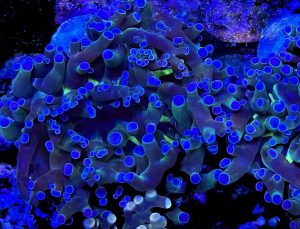
Temperament: Peaceful
Aquarium Hardiness: Hardy
Water Conditions: 72-82° F, dKH 8 – 12°, pH 8.1-8.4, sg 1.020-1.025
Max size: 26”
Color Form: Dark Brown, Black, White
Diet: Omnivore
Compatibility: Not Reef Safe
Origin: Indo Pacific/Western Pacific
Family: Ephippidae
Lifespan: 12 – 15+ years (adults)
Aquarist Experience Level: Intermediate/Expert

Posted in Batfish, Batfish, Featured Articles, Saltwater, Tropical Fish Keeping0 Comments

juvenile Pinnatus Batfish (Platax pinnatus)

Pinnatus Batfish (Platax pinnatus)

ggg

juvenile Pinnatus Batfish (Platax pinnatus)

juvenile Pinnatus Batfish (Platax pinnatus)

Pinnatus Batfish (Platax pinnatus) known to tropical fish keeping enthusiats as the Dusky Batfish, Red-faced Batfish, Pinnate Spadefish or Red-Rimmed Batfish is native to tropical waters of the Western Pacific Ocean.

The Pinnatus Batfish is abundand throughout the Indo-Malayan Archipelago, including Indonesia, the Philippines, and New Guinea. Their northern range extends to the Ryukyu Islands in Japan and spreads down to northern and eastern Australia (including the Great Barrier Reef) and as far south as New Caledonia.

Juvenile Pinnatus Batfish are a shy, relatively solitary species that are typically encountered alone or in small groups in the shallow protected mangrove forests, calm lagoons, coral reefs, and shallow shipwrecks of their range, where they hide in the shadows to avoid predators.   They prefer areas with moderate water flow around coral heads and submerged debris.

Adult Platax pinnatus are generally solitary but bolder than juveniles. They are found alone or in pairs over the steep, rocky overhangs and ledges of the outer reef slopes of their range in the deeper 50 to 100 foot depths.   They are highly territorial, loyal to a specific reef, and aggressive towards their own kind and similar looking species.

Adults frequently gather into tight, massive schools when traveling in open water over sandy substrates or migrating across the open ocean for protection.

juvenile Pinnatus Batfish (Platax pinnatus)

juvenile Pinnatus Batfish (Platax pinnatus)

Pinnatus Batfish have extremely laterally compressed, disc like bodies, with exaggerated long dorsal and anal fins that are long and flowing in the juvenile stage and gradually shorten and broaden as they age.

They have small, terminal mouths with brush-like, tricuspid teeth that are adapted for scraping algae, sponges, and small invertebrates off rocks.

Adult Pinnatus Batfish (Platax pinnatus)

Adult Pinnatus Batfish (Platax pinnatus)

Juvenile Pinnatus Batfish have a dark brown to jet black colored body outlined in vibrant neon orange to yellow.

As they grow into adulthood, their dramatic fins shorten proportionally and their colors fade into a spadefish like appearance.

Pinnatus Batfish are best housed in a mature FOWLR aquarium of at least 200 gallon capacity with a coralline gravel substrate, plenty of live rock arranged into large caves, ledges, and overhangs and a lot of free swimming space.   The Pinnatus Batfish prefers a brightly lit aquarium with high water quality and stable water parameters.

Pinnatus Batfish are NOT considered reef safe.   They will aggressively nip at or consume soft and stony corals, anemones, and smaller invertebrates like ornamental shrimp.

They are a peaceful species but because of their territorial behavior adults are best kept as a sole specimen.   They do not do well with other batfish or similar shaped species.

The more colorful juvenile Pinnatus are hyper stressed and easily intimidated.   If you put multiple juveniles together, they will often compete for the few “safe” hiding spots, leading to severe stress, eating strikes, and death.

Pinnatus Batfish are pelagic broadcasters that are practically impossible to breed in an aquarium environment. They are commercially bred in massive outdoor aquaculture environments for tropical fish keeping enthusiasts.

In their natural environment, Pinnatus Batfish are omnivorous grazers that feed on dense macroalgae like Sargassum, jellyfish, comb jellies, gelatinous zooplankton, anemones, marine worms, colonial corals, and small crustaceans.

In an aquarium environment, they must be fed small amounts of one part animal protein to two parts vegetable matter at least 3 to 4 times a day.    Juveniles will waste away if fed only once a day.

Live blackworms, live mysid shrimp, live adult brine shrimp, frozen krill, chopped squid, chopped table shrimp along with dried seaweed, spirulina enriched brine shrimp, frozen herbifore preparations, DKI pellets, and herbivore preparations should all be offered.

Wild caught juveniles frequently refuse to eat processed aquarium foods and will starve to death without actively coaxing them with live blackworms, shrimp, etc. Once they begin to eat live fare, mix in high quality frozen herbivore preparations.

Captive bred Pinnatus can be fed a varied diet that includes high-quality marine flakes, pellets, and frozen foods such as brine shrimp, mysis shrimp, and chopped seafood.

Pinnatus Batfish (Platax pinnatus) are seasonably available to tropical fish keeping enthusiasts as wild caught specimens from online wholesalers, retailers and specialty shops.   Captive bred specimens are available in waves from some commercial breeders.

Prices for 2 to 3 inch wild caught juveniles range between $73.00 to $125.00.    Captive bred juveniles retail between $200.00 and $300.00 or more.    Adults are rarely for sale but when available go for $400.00 or more.

Unlike wild-caught specimens, captive-bred Pinnatus batfish are significantly hardier, far less finicky, and are already trained to accept commercial pellet and frozen foods.

juvenile Pinnatus Batfish (Platax pinnatus)

juvenile Pinnatus Batfish (Platax pinnatus)

Adult Pinnatus Batfish (Platax pinnatus)

Adult Pinnatus Batfish (Platax pinnatus)


Minimum Tank Size: 200 – 300 gallons
Care Level: Intermediate
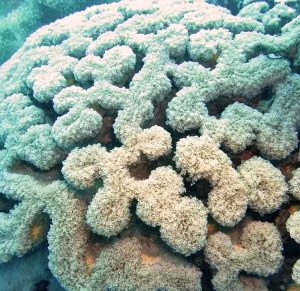
Temperament: Peaceful
Aquarium Hardiness: Hardy
Water Conditions: 72-78° F, dKH 8 – 12°, pH 8.1-8.4, sg 1.023-1.025
Max size: 16 – 18”
Color Form: Dark Brown, Black, Orange, Yellow
Diet: Omnivore
Compatibility: Not Reef Safe
Origin: Western Pacific Ocean
Family: Ephippidae
Lifespan: 8 – 10 years
Aquarist Experience Level: Intermediate/Expert

Posted in Batfish, Batfish, Featured Articles, Saltwater, Tropical Fish Keeping, Tropical Fish Species0 Comments

Rhino Blenny (Paraclinus marmoratus)

Rhino Blenny (Paraclinus marmoratus)

Rhino Blenny (Paraclinus marmoratus)

Rhino Blenny (Paraclinus marmoratus)

The Rhino Blenny (Paraclinus marmoratus) known to tropical fish keeping enthusiasts as the Marbled Blenny, Atlantic Rhino Blenny, or Rock Blenny is native to the Western Atlantic Ocean and ranges from southern Florida and the Gulf of America, down to northern South America.

The Rhino Blenny is a peaceful shallow water micro predator species that is commonly found in the lagoon reefs, shallow sea grass beds, and shallow coral reefs of their range at depths up to 20 feet, where they share a specialized relationship with Yellow Tube Sponges (Verongia fistularis) that they use to make their homes inside of.

Rhino Blenny (Paraclinus marmoratus)

Rhino Blenny (Paraclinus marmoratus)

The Rhino Blenny has a slender, heavily patterened mottled body covered with brown, tan, cream, reddish orange and white patterns that allow them to blend into their surroundings. They have a single, highly extended dorsal spine loated at the top of the head that resembles a rhinoceros horn and large, expressive eyes that move independently.

Their pectoral and pelvic fins are formed to allow them to walk and hop along the substrate. They have the ability to rapidly change their mottled color patterns to blend into a new nesting spot i.e. barnicles, sponge openings, live rocks, etc. within seconds.

The Rhino Blenny can be housed in a mature FOWLR or reef aquarium of at leat 30 gallong capacity with a live sand or coralline gravel substrate and plenty of live rock arranged into caves, crevaces, ledges and overhangs for them to forage around and pearch on.

The Rhino Blenny is considered reef safe and will not harm corals, ornamental clams, or most invertebrates, however, unlike true blennies that graze on green algae, Rhino Blennies are primarily carnivorous micro-predators.

The Rhino Blenny is peaceful toward unrelated species but highly territorial toward their own kind.

Selecting tankmates for a Rhino Blenny (Paraclinus marmoratus) comes down to avoiding fish that compete for the same rocky perches.    Suitable tankmates includes chromis, clownfish, small cardinalfish, Royal Grammas, firefish, peacefull reef wrasses, and invertebrtates like large Turbo snails, Nassarius snails, or hermit crabs.

Avoid housing them with large aggressive groupers, lionfish, or dottybacks and rock perching species like Lawnmower Blennies or aggressive bottom dwellers. Tiny crustraceans and very small decorative shrimp like the sexy shrimp will be regarded as a snack.

In the aquarium, the Rhino Blenny will quickly establish a home zone that can be centered around a preferred tube sponge, barnicle, cave or crevice. They will aggressively chase away rivals that get to close.

Keeping multiple males in a small tank usually results in fatal fights.

The Rhino Blenny has been bred in an aquarium environment however raising the larvae is extremely difficult.

In the wild, Paraclinus marmoratus breeding revolves around and within the Yellow Tube Sponge.   A dominant male will claim a sponge as his territory and when ready to spawn, performs a type of dance while flashing intense colors to lure a female into his tube or cave. Males are extremely industrious and may entertain several females into his nest over a short period. When ready to spawn, the female turns completely upside down against the tube or cave wall to deposit her eggs, while the male remains upright to fertilize them.

A single nest may have several “clutches” of eggs at different stages of development. Once the male is exhausted, he becomes highly aggressive to any females trying to enter his nest. The male fans the eggs to oxygenate them and fiercely guards them from intruders until they hatch out into tiny, transparent larvae. The microscopic larvae require live, cultured micro prey such as Parvocalanus copepod nauplii or specilized rotifers to survive.

In its natural shallow water environment, the Rhino Blenny is a carnivorous micro predator that feeds almost entirely on benthic invertebrates and micro crustaceans including isopods,mysid and caridean shrimp, amphipods and copepods, polychaetes, and gastropod larvae.

In an aquarium environment, they reauire high protein, meaty foods that quickly sink to the bottom where they feed. Live or frozen Mysis shrimp, calanus or cyclops, vitamin enriched brine shrimp, live amphipods and copepods, live blackworms, and small sinking carnivore pellets are all excellent foods. Target feed them small portions at least 1 or 2 times a day with a turkey baster or Julian’s Thing to prevent other fish in the tank from stealing their food.

The Rhino Blenny (Paraclinus marmoratus) is occasionally available to tropical fish keeping enthusiasts as wild caught specimens from specialized marine aquarium shops and online retailers. Because they are primarily hand caught in shallow Western Atlantic and Caribbean seagrass or reef beds, their retail availability and price fluctuates based on regional collection patterns.

Depending on the retailer, whether the fish has been quarantined and size: Small (1″ to 1-1/2″) Medium/Large (1-1/2″ to 3″); current prices range from $15.00 to $59.00 or more.

Rhino Blenny (Paraclinus marmoratus)

Rhino Blenny (Paraclinus marmoratus)


Minimum Tank Size: 30 gallon (90+ gallons for pairs)
Aquarium Type: FOWLR or Reef
Care Level: Moderate
Temperament: Peaceful
Aquarium Hardiness: Hardy
Water Conditions: 72-78° F, dKH 8 – 12°, pH 8.1-8.4, sg 1.020-1.025
Max size: 4.5”
Color Form: Brown, Tan, Cream, White, Reddish Orange
Diet: Carnivore
Compatibility: Reef Safe
Origin: Western Atlantic
Family: Labrisomidae
Lifespan: 4 – 6 years
Aquarist Experience Level: Beginner/Intermediate
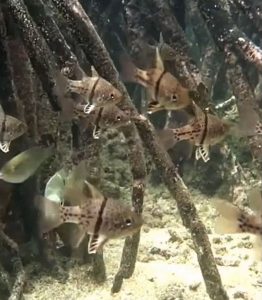
Posted in Blennies, Featured Articles, Saltwater, Tropical Fish Keeping, Tropical Fish Species0 Comments

Flametail Blenny (Enchelyurus flavipes)

Flametail Blenny (Enchelyurus flavipes)

Flametail Blenny (Enchelyurus flavipes)

Flametail Blenny (Enchelyurus flavipes)

The Flametail Blenny (Enchelyurus flavipes) known to tropical fish keeping enthusiasts as the Yellowtail Black Blenny, Orange Stripe Blenny, Orange Fin Blenny. Yellowfin Blenny, or Goldtail Combtooth Blenny is native to the Western Pacific and ranges from the South China Sea through Indonesia and the Philippines, eastward to Fiji and Papua New Guinea.

Adult Flametail Blennies are a peaceful solitary species that are normally encountered alone and in pairs in the shallow coastal reefs, clear water lagoons and rocky seaward outcrops of their range in areas rich with biofilm and microalgae growth. Flametail Blennies are often found defending their small microalgae rich territories from rivals and predators amongst the rocky patches of the reef

In between its grazing activities near the bottom of its habitat, the Flametail Blenny spends most of its time perching on rocks and darting between small worm holes or empty shells among the corals and rock crevices hiding from predators.

Flametail Blenny (Enchelyurus flavipes)

Flametail Blenny (Enchelyurus flavipes)


The Flametail Blenny has an elongated body shape with a blunt head, wide flat mouth equipped with comb like teeth for scraping algae, large expressive eyes and sublle iridescent striations across their face.

They have a jet black to deep charcoal gray body with a bight yellow to orange colored poster and yellow to orange dorsal, anal, and caudal fins. Females are oticeably plumper and fuller bodied, especially during the breeding season. During courship, males develop intensified body colors. The black body color deepens and the fiery yellow tails flash brightly.

The Yellowtail Black Blenny (Enchelyurus flavipes) is often misidentified as the Bicolor Blenny   (Ecsenius bicolor). The Yellowtail Black Blenny has a more rounded head and caudal fin compared to the more square head and angular caudal fin of the Bicolor Blenny. Also, Enchelyurus flavipes lacks the cirri found between the eyes of the Ecsenius bicolor.

The Flametail Blenny is best housed in a mature FOWLR or reef tank of at least 30 gallon capacity with an aragonite sand substrate, and plenty of mature live rock with various strains of marine algae aquascaped into small crevices, ledges, small caves, tunnels and overhangs for them to perch on and hide among. At least one wavemaker or powerhead is recommended to provide moderate water flow and a tight fitting glass or mesh tank cover is needed to prevent them from jumping from the tank.

The Flametail Blenny is reef safe with caution. They will nip at LPS corals and ornamental clam mantles when underfed or placed in small crowded systems however they are excellent at controlling nuisance algae growths on the glass and rockwork.

Enchelyurus flavipes are peaceful bottom dwellers that are compatible with virtually all community reef species. They can be territorial with other blennies, dartfish, small gobies, and species with a similar appearance, especially in smaller aquariums.

Good tankmates include the Yellow Clown Goby (Gobiodon okinawae), the Firefish Goby (Nemateleotris magnifica), the Neon Goby (Elacatinus oceanops), the Orchid Dottyback (Pseudochromis fridmani), and the Tailspot Blenny (Ecsenius stigmatura); they should not be housed with aggressive, predatory species.

Although it is best to house only one Flametail Blenny per system, multiple specimens or pairs can be kept in very large reef systems with copious amounts of live rock arranged into distinct, visually separated territories.

The Flametail Blenny has been bred in an aquarium environment. They are oviparous, demersal egg layers that attach their adhesive eggs to the substrate or inside cave roofs via a filamentous pad by the female. The male guards and tends to the eggs until they hatch into tiny planktonick larvae that drift aimlessly with the ocean currents. The tiny fry require specific strains of rotifers that are micro sized and small enough for them to eat. Rearing the tiny larvae in a home aquarium environment remains extremely challenging for most tropical fish keeping enthusiasts.

The Flametail Blenny is a diurnal omnivore that in their natural habitat graze on algal films and filamentous algae scraped off the rocks, detritus and organic debris settled in the cracks of the rocks, and micro invertebrates like copepods, tiny crustaceans, and small fish eggs.

In an mature aqurium environment with large amounts of natural algae growth, they are not finiky eaters and will accept a balanced diet rich in plant based and meaty foods. High quality spirulina pellets, algae flakes, dried seaweed and supplimental feedings of live or frozen Mysis shrimp, vitamin enriched brine shrimp and calanus are all eagerly accepted. Several mall feedings are recommended daily; at least 2 to 3.

The Flametail Blenny (Enchelyurus flavipes) is occasionally available to tropical fish keeping enthusiasts as both wild caught and sustainably captive bred specimens from specialized marine aquarium shops and online retailers.

Prices vary depending on the size, origin, and whether the specimen is aquacultured. Approximate purchase sizes generally range from Small (1″ to 1-1/2″) to Medium/Large (1-1/2″ to 3″).

Prices typically start at $29.99 to $44.99 for small specimens.

Flametail Blenny (Enchelyurus flavipes)

Flametail Blenny (Enchelyurus flavipes)


Minimum Tank Size: 30 gallon (90+ gallons for pairs)
Aquarium Type: FOWLR or Reef
Care Level: Easy
Temperament: Peaceful
Aquarium Hardiness: Hardy
Water Conditions: 74-80° F, dKH 8 – 12°, pH 8.1-8.4, sg 1.020-1.025
Max size: 3”
Color Form: Jet Black, Charcoal, Fiery Yellow, Orange
Diet: Herbivore/Omnivore
Compatibility: Reef Safe
Origin: South China Sea
Family: Blenniidae
Lifespan: 3 – 5 years
Aquarist Experience Level: Beginner/Intermediate
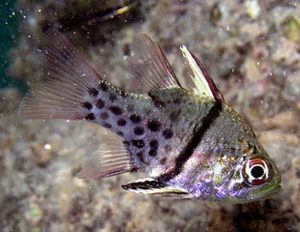
Posted in Blennies, Featured Articles, Saltwater, Tropical Fish Keeping, Tropical Fish Species0 Comments

Canary Blenny (Meiacanthus oualanensis)

Canary Blenny (Meiacanthus oualanensis)

Canary Blenny (Meiacanthus oualanensis)

Canary Blenny (Meiacanthus oualanensis)

The Canary Blenny (Meiacanthus oualanensis) known to tropical fish keeping enthusiasts as the Oualan Forktail Blenny or Canary Fang Blenny is native to the coral reefs of the Indo-Pacific and is found along the islands of Fiji, Tahiti, and the Great Barrier Reef.

Adult Canary Blennies are a solitary species that are normally encountered in pairs or alone in the shallow, protected, clear water lagoons and seaward reefs of their range, hovering a few feet above the rockwork and coral heads in the water column at depths ranging from 3 to over 50 feet, where they feed on zooplankton and tiny benthic invertebrates.

Juvenile Canary Blennies are usually found in shallower waters where they gather together in small groups.

The Canary Blenny is a fang blenny that like other members of the Meiacanthus genus possess two venomous canine like teeth in the lower jaw that they use primarily for defense.   Non venomous Plagiotremus flavus and juvenile Scolopsis bilineatus have learned to mimic the venomous Canary Blenny to protect themselves from predators.

canary blenny (meiacanthus oualanensis)

canary blenny (meiacanthus oualanensis)

The Canary Blenny has an elongated, bright banana yellow colored body with subtle greenish yellow hue along the dorsal that is tapered to the rear. They have large, prominent eyes without eye bars, a subterminal mouth with two large grooved teeth hidden in the lower jaw with venom glands that they use for defense. Adults develop a lunate or lyretail with long trailing filaments.
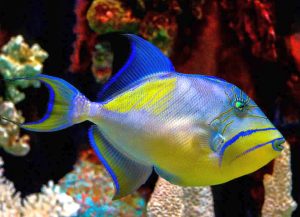
The Canary Blenny is reef safe and can be housed in a mature FOWLR or reef aquarium of at least 30 gallon capacity with a live sand or coralline gravel substrate, copious amounts of well established live rock arranged into caves, crevices, ledges and outcrops for them to hide and graze among for small crustaceans, and plenty of free swimming space. A tight fitting lid is necessary for this species as they are expert jumpers.

The Canary Blenny should be kept as mated pairs or alone unless the tank is very large. They can become territorial towards conspecifics but cohabit well with the majority of peaceful reef dwelling species. They should not be housed with larger carnivorous species that could eat them. Suitable tankmates include clownfish, cardinalfish, Dartfish, peaceful wrasses, and bottom dwelling gobies like the Watchman.

The Canary Blenny will not eat coral polyps, decorative clams, or soft corals. They constantly search the water column and rockwork for tiny hidden pests in the tank.

The Oualan Forktail Blenny has been bred in an aquarium environment as well as by commercial aquacultural facilities for the aquarium trade. They are highly successful demersal spawners.

In their natural habitat, male Meiacanthus oualanensis stake out a crevice in the coral reef, an empty shell, or an empty worm borehole where they perform a lunging type of dance to entice a passing female. A willing female will lay a clutch of tiny, adhesive eggs onto the inner wals of the cavity where the male fertilizes them. A single female will deposit 100 to 300 oval shaped, reddish brown eggs about 1.2 mm in dia. The male will fan and guard the eggs until they hatch out into tiny planktonic larvae that float in the open water until they mature into minature gobies.

In an aquarium, capped PVC pipes replace caves or coral niches. The deposited eggs hatch during the evening in around 10 to 12 days. The tiny larvae must be moved to a rearing tank and initially fed S-type rotifers, followed by baby brine shrimp. The tiny silver colored larvae turn yellow around day 35 and become juvenile Canary Blennies.

In the wild, the Canary Blenny constantly feeds on zooplankton, small copepods, amphipods, crustaceans larvae and micro inverrtebrates.

In an aquarium environment provide the Canary Blenny with a mature tank that contains an abundance of live rock.

They prefer floating or slowly sinking foods like frozen mysis shrimp, vitamin enriched brine shrimp, calanus, and finely chopped krill or seafoods. High quality marine flakes and small pellets are also acceped, especially by commercially bred individuals. Because of their high metabolism rate, several small feedings are recommended daily; at least 2 to 3.

The Canary Blenny (Meiacanthus oualanensis) is commonly available to tropical fish keeping enthusiasts as wild caught or commercially bred specimens at reasonable prices from a variety of aquarium shops and online retailers, wholesalers, and transhippers. Prices vary on size and area of collection. Captive bred juvenile specimens 1.25″ to 2″ in length are priced at around $35.00. Wild caught Fiji specimens 1.5″ to 3″ are currently priced from $39.99 to over $41.99.

Canary Blenny (Meiacanthus oualanensis)

Canary Blenny (Meiacanthus oualanensis)


Minimum Tank Size: 30 gallon (90+ gallons for pairs)
Aquarium Type: FOWLR or Reef
Care Level: Moderate
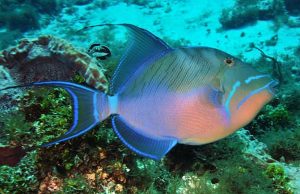
Temperament: Semi Aggressive
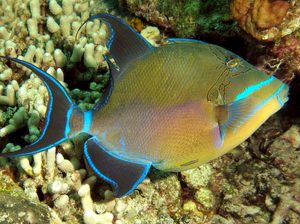
Aquarium Hardiness: Hardy
Water Conditions: 72-78° F, dKH 8 – 12°, pH 8.1-8.4, sg 1.020-1.025
Max size: 5”
Color Form: Yellow, Green
Diet: Omnivore
Compatibility: Reef Safe
Origin: Indo Pacific
Family: Blenniidae
Lifespan: 4 – 6 years
Aquarist Experience Level: Beginner

Posted in Blennies, Featured Articles, Saltwater, Tropical Fish Keeping, Tropical Fish Species0 Comments

Starry Blenny (Salarias ramosus)

Starry Blenny (Salarias ramosus)

Starry Blenny (Salarias ramosus)

Starry Blenny (Salarias ramosus)

The Starry Blenny (Salarias ramosus) known to tropical fish keeping enthusiasts as the Snowflake Blenny, Stellate Blenny, Rock Blenny, Coral Blenny, Reef Blenny or Starry Lawnmower Blenny is native to Western Central Pacific reefs and ranges from the Philippines southward to northwestern Australia.
The Starry Blenny is found in the shallow protected inshore reefs, estuaries, and brackish water environments of their range among corals, rocky outcrops, reef rubble margins, and weedy mixed sandy bottoms around areas of heavy filamentous algae growth at depths from 3 to over 50 feet.

Salarias ramosus are a peaceful bottom dwelling species that spend most of their time grazing on algae and perching on live rock and coralsl In their natural environment around the margins of coral reefs, they are often seen forming small groups usually around reef rubble. Solitary Starry Blennies are also found on rock or coral outcrops.

Starry Blenny (Salarias ramosus)

Starry Blenny (Salarias ramosus)

The Starry Lawnmower Blenny has a dark brown elongated body covered with numerous small light blue to white colored dots and a few white blotches over the back . They have a blunt head, a wide flat mouth with combed teeth for grazing algae, bushy whisker like appendages protruding from between their expressive eyes, and yellow pectoral and caudal fins.
Males have more elongated streamers and larger, bushier cirri above the eyes. Females tend to be plumper with fuller bodies and have more compact cirri.

During the breeding season, male Starry Blennies will intensify their body colors to attract a mate. The color patterns become darker and more intense.

The Starry Blenny can be housed in a mature FOWLR or reef aquarium of at least 30 gallon capacity containing various strains of marine algae, with an aragonite sand mixed with reef rubble substrate, and plenty of live rock arranged into tight crevices, tunnels, ledges, and caves for them to hide among.

At least one powerhead is needed to maintain a high water flow and keep oxygen levels elevated and a tight fittting mesh or glass lid is recommended to prevent them from jumping from the tank, especially when first introduced into a system.

The Starry Blenny is generally considered reef safe however in small systems or when underfed, they will occasionally nip at LPS corals and ornamental clam mantles. They make a great addition to peaceful FOWLR and reef tanks and are excellent at controlling nuisance algae growth in the system.

The Starry Blenny is a peaceful bottom dweller that is compatible with virtually all community reef fish but they have been known to be territorial with other Blennies, small Gobies, Dartfish and species that have a similar appearance. Compatible with clownfish, tangs, wrasses, and other mid-water swimmers, they should not be housed with aggressive species.

It is best to house only one specimen in a small system. Multiple males and mated pairs can be housed in very large reef systems with copious amounts of live rock arranged into specific territories.

The Starry Blenny can spawn in an aquarium environment but rearing the tiny larvae is extremely challenging.

Like the Lawnmower Blenny (Salarias fasciatus), Salarias ramosus are egg layers that produce small adhesive eggs and plaegic larvae.

Males guard and tend to the demersal eggs that are deposited in small crevices and attached to the substrate via a filamentous, adhesive pad or pedestal. The tiny larvae are planktonic and are often found in shallow, coastal waters.

In their natural habitat, the Starry Blenny is a dedicated herbivore and detritivore. They spend nearly all of their daylight hours scraping surfaces with their specialized, comb-like teeth feeding on filamentous algae, diatoms, microalgae, detritus, cyanobacteria and biofilm.

In an aquarium environment, they do best in well established systems with large amounts of natural algae to feed on. Their diet should be supplemented with fresh or frozen herbifore preparations, marine algae sheets, spirulina flakes, algae wafers, dried nori, and blanched vegetables. Some individuals may accept frozen mysis shrimp as a supplement. Feed algae based foods two to three times daily.

A steady diet of microalgae and macroalgae is essential for the health and well being of this species.

The Starry Blenny (Salarias ramosus) is commonly available to tropical fish keeping enthusiasts as wild caught specimens at reasonable prices from a variety of aquarium shops and online retailers, wholesalers, and transhippers. Prices vary on size and area of collection.

Approximate purchase sizes; Small: 1″ to 2″; Medium: 2″ to 3-1/4″ Large: 3-1/4″ to 4-1/2″

Prices start at $39.99 for small specimens from the Philippines.

Starry Blenny (Salarias ramosus)

Starry Blenny (Salarias ramosus)


Minimum Tank Size: 30 gallon (90+ gallons for pairs)
Aquarium Type: FOWLR or Reef
Care Level: Easy
Temperament: Semi Aggressive
Aquarium Hardiness: Hardy
Water Conditions: 72-78° F, dKH 8 – 12°, pH 8.1-8.4, sg 1.020-1.025
Max size: 5½”
Color Form: White, Yellow
Diet: Herbivore
Compatibility: Reef Safe
Origin: Western Pacific, Indonesia
Family: Blenniidae
Lifespan: 4 – 6 years
Aquarist Experience Level: Beginner

Posted in Blennies, Featured Articles, Saltwater, Tropical Fish Keeping, Tropical Fish Species0 Comments

Lined Blenny (Ecsenius lineatus)

Lined Blenny (Ecsenius lineatus)

Lined Blenny (Ecsenius lineatus)

Lined Blenny (Ecsenius lineatus)

Lined Blenny (Ecsenius lineatus) known to tropical fish keeping enthusiasts as Linear Blenny, Dot-Dash Blenny, Lined Combtooth Blenny, Lined Coiral Blenny, and Blennie Bigoula is widespread throughout the tropical waters of the Indo-West Pacific.

It is found from the eastern coast of Africa to the Philippines with a range that extends from Yemen to northwest Australia, the Philippines, and Ogasawara Island in Japan.

Although Ecsenius lineatus and Meiacanthus grammistes are both sold as Lined Blennies, they are entirely different in anatomy, behavior, and biology. The primary difference is that Meiacanthus grammistes is a venomous midwater swimmer; while Ecsenius lineatus is a non-venomous, rock-dwelling bottom-dweller

In the northernmost parts of their range, adult Linear Blennies are found in clear shallow lagoons and the coastal to outer reef crests in areas with rich coral growth at depths from 3 to about 50 feet.   They spend the majority  of their days perched on coral heads, rubble, and rocky outcrops.

Like all Ecsenius blennies, Linear Blennies are dedicated herbivores equipped with specialized comb like teeth that they use for scraping microalgae and diatom films from hard surfaces.

Ecsenius lineatus are rarely observed at dephs less than 15 feet, however, further south of their range, collectors encounter them on the bottom of their environment among the crevices and rocks as deep as 92 feet.

Lined Blenny (Ecsenius lineatus)

Lined Blenny (Ecsenius lineatus)

The Lined Blenny (Ecsenius lineatus) has a round, elongated body with a small

Lined Blenny (Ecsenius lineatus)

Lined Blenny (Ecsenius lineatus)

mouth, very large eyes, and a dark brown to black longitudinal stripe on its white body that is often interrupted in larger specimens.

In some populations, the black lateral stripe is sometimes present as a series of black blotches. Sexual dimorphism is subtle, with males sometimes slightly larger than females.

The Linear Blenny can be housed in a FOWLR or mature reef aquarium of at least 30 gallon capacity with a coraline gravel substrate and plenty of algae covered live rock arranged into caves, crevices, ledges and overhangs for them to graze, perch on and hide.

The Lined Blenny is generally considered reef safe however they will occasionally nip at the polyps or bases of Acropora sp., Montipora sp. and other SPS corals. They make a great addition to peaceful FOWLR and reef tanks that are heavily stocked with mature colonies of Acropora sp.

Ecsenius lineatus is peaceful and compatible with virtually all community reef fish including clownfish, gobies, cardinalfish, firefish, wrasses, and tangs. They can become mildly territorial toward other combtooth blennies, particularly other Ecsenius species. They should not be housed with aggressive species.

The Linear Blenny has not been successfully bred in an aquarium environment.   Their breeding behavior is similar to other Ecsenius species like the Midas Blenny.

Lined Blennies are egg layers that deposit small adhesive eggs in small crevices or empty shells. The male guards the nest until hatching. The larvae are tiny and pelagic, requiring rotifers and phytoplankton as first foods.

In their natural habitat Lined Blennies are primarily herbivorous, grazing on diatoms, film algae, cyanobacteria, and occasionally small invertebrates like mysis or brine shrimp.

In an aquarium environment, they require a varied algae based diet of frozen or dried foods like spirulina pellets, algae wafers, dried nori sheets, and occasional offerings of live or frozen mysis and brine shrimp.   It is important to provide sufficient live rock and algae covered surfaces in the tank to encourage their natural grazing behavior. Multiple small feedings at least 2 to 3 times a day are recommended.

The Lined Blenny (Ecsenius lineatus) is relatively available to tropical fish keeping enthusiasts as wild caught specimens from a variety of local aquarium shops and online retailers, wholesalers, and transhippers at prices that vary on size and area of collection.

Approximate purchase sizes:  Small: 1-1/4″ to 1-1/2″; Medium/Large: 1-1/2″ to 2-1/2″

Prices start at $30.99 for small Indian Ocean specimens, to over $60.00 for small aquarium ready specimens from South Asia.

Lined Blenny (Ecsenius lineatus)

Lined Blenny (Ecsenius lineatus)


Minimum Tank Size: 30 gallon
Aquarium Type: FOWLR or Reef
Care Level: Easy
Temperament: Peaceful
Aquarium Hardiness: Hardy
Water Conditions: 72-78° F, dKH 8 – 12°, pH 8.1-8.4, sg 1.020-1.025
Max size: 3½””
Color Form: Black, Tan and White
Diet: Herbivore
Compatibility: Reef Safe
Origin: Indo-West Pacific
Family: Blenniidae
Lifespan: 3 – 5 years
Aquarist Experience Level: Beginner

Posted in Blennies, Featured Articles, Saltwater, Tropical Fish Keeping, Tropical Fish Species0 Comments

Redlip Blenny (Ophioblennius atlanticus)

Redlip Blenny (Ophioblennius atlanticus)

Redlip Blenny (Ophioblennius atlanticus)

Redlip Blenny (Ophioblennius atlanticus)

The Redlip Blenny (Ophioblennius atlanticus) known to tropical fish keeping enthusiasts as the Horse Face Blenny, Horesface Blenny, Atlantic Redlip Blenny, or Red-lipped Blenny is native to the tropical waters of the central Atlantic Ocean and Caribbean.

Its range extends to the eastern Atlantic from Senegal to Angola, and the offshore islands. In the northeastern Atlantic Ophioblennius atlanticus is confined to the Macaronesian archipelagos of the Canary Islands, Madeira, and the Azores. And in the western Atlantic, it is found off Bermuda, the coast of North Carolina and south through the West Indies to Brazil. A couple of sightings have also been documented in the central Mediterranean Sea.

Adult Redlip Blennies are a solitary species that can be found alone, in pairs, and in North Carolina waters, in small aggregations occupying shallow reefs, particularly coral crests and fringing reefs, and rocky substrates of their range, grazing on algae at depths between 30 to over 65 feet .

Juveniles and spawning pairs are most often found in the much shallower tide pools and reef flats in depths ranging from 1 to 27 feet.

The Redlip Blenny is highly territorial, especially towards conspecifics. They effectively farm their own food source by cultivating and harvesting gardens of filamentous algae in their claimed territories and will aggressively drive off any other herbivorous species that try to graze there.  Ophioblennius atlanticus have two sharp canine teeth that they use to confront intruders.  In the wild, territorial disputes are frequent.

Redlip Blenny (Ophioblennius atlanticus)

Redlip Blenny (Ophioblennius atlanticus)

The Redlip Blenny has a large head with four small branching horns, prominent expressive eyes, a blunt nose, distinctive bright red orange lips, and an elongated eel like body with long ventral fins that they use to perch on the substrate.    Their body is a dark chocolate brown to blended black and red color, with yellow markings camouflaging the body and fins.

A paler variant occurs that has a shell-white body and a reddish brown head with a yellow dorsal fin, reddish tinged lateral fins, and a

Redlip Blenny (Ophioblennius atlanticus)

Redlip Blenny (Ophioblennius atlanticus)

black or bicolored tail.  Males are typically larger with more vividly red colored lips than females.

The Redlip Blenny is best housed in a mature FOWLR or reef aquarium of at least 30 gallon capacity with a fine coralline gravel substrate and plenty of aged live rock arranged into caves, crevices, layered ledges and overhangs for it to perch on and hide among.

They are jumpers and require a tight fitting lid on their tank.

The Redlip Blenny is considered reef safe as long as it is adequately fed. They ignore invertebrates , most corals and clams but have been observed picking on soft coral polyps.

In community aquariums, Redlip Blennies may become aggressive toward other blennies or gobies that infringe on their territory.   They do well with other non-similar shaped species.

Unless they are kept in a large aquarium with copious amounts of live rock, it’s safer to keep only one individual or mated pair in a community tank.

Redlip Blennies are egg-layers that deposit their spawn in crevices within the male’s territory.   They have been bred in an aquarium environment however the larvae are difficult to rear.

In their natural environment, Ophioblennius atlanticus are polygynous.     Females consistently mate with multiple males.  When a pair is ready to spawn, usually in the ten days prior to and four days after the full moon, the male clears algae, rocks, and debris from a crevice or cavity to create a small, box like nest to attract a female. A single male will maintain several nests, usually around five of differing sizes.   The male hovers near the nest with dorsal and anal fins spread to entice a female. When a female selects a nest, adhesive eggs are laid in a single layer along the walls or ceilings of the nest crevice. Multiple females often lay their eggs in the same nest.  After fertilizing the eggs, the male cares for the eggs by fanning, removing any fungus infected eggs, and protecting them from predators.

The demersal eggs hatch into planktonic larvae after about five days, usually at night.   The buoyant larvae float along as plankton and initially feed on rotifers and later on larger foods until they mature into adults.

In their natural habitat, the Redlip Blenny is a territorial herbivore that farms and grazes on filamentous algae.

In addition to grazing on the natural growth of algae in a well established aquarium, they should be provided Spirulina based flake or pellet foods, marine algae sheets (nori), and commercially frozen preparations with high vegetable content.   Occasional offerings of frozen mysis shrimp may also be accepted.   Two to three feedings per day are recommended.

The Redlip Blenny (Ophioblennius atlanticus) is only occasionally available to tropical fish keeping enthusiasts as wild caught specimens from a variety of local aquarium shops and online retailers, wholesalers, and transhippers at prices that vary on size and area of collection.  Despite their abundance in the wild, Caribbean and Florida collectors prioritize higher priced species and seldom collect them.

Approximate purchase sizes:  1 1/2″ to 3″   When available, prices range from $29.49 to $49.99

Redlip Blenny (Ophioblennius atlanticus)

Redlip Blenny (Ophioblennius atlanticus)


Minimum Tank Size: 30 gallon (55+ gallons for pairs)
Aquarium Type: Reef or FOWLR
Care Level: Moderate
Temperament: Semi-Aggressive
Aquarium Hardiness: Hardy
Water Conditions: 72-78° F, dKH 8 – 12°, pH 8.1–8.4, sg 1.020-1.025
Max size: 5″
Color Form: Black, Red, Yellow
Diet: Herbivore
Compatibility: Reef Safe
Origin: Indo Pacific
Family: Blenniidae
Lifespan: 4 – 6 years
Aquarist Experience Level: Beginner

Posted in Blennies, Featured Articles, Saltwater, Tropical Fish Keeping, Tropical Fish Species0 Comments

Saltwater Fish

Featuring Clownfish

Aquarium Supplies

On-Sale Aquarium Supplies!

Saltwater Specials

Categories