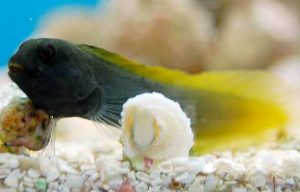
Flametail Blenny (Enchelyurus flavipes)
The Flametail Blenny (Enchelyurus flavipes) known to tropical fish keeping enthusiasts as the Yellowtail Black Blenny, Orange Stripe Blenny, Orange Fin Blenny. Yellowfin Blenny, or Goldtail Combtooth Blenny is native to the Western Pacific and ranges from the South China Sea through Indonesia and the Philippines, eastward to Fiji and Papua New Guinea.
Adult Flametail Blennies are a peaceful solitary species that are normally encountered alone and in pairs in the shallow coastal reefs, clear water lagoons and rocky seaward outcrops of their range in areas rich with biofilm and microalgae growth. Flametail Blennies are often found defending their small microalgae rich territories from rivals and predators amongst the rocky patches of the reef
In between its grazing activities near the bottom of its habitat, the Flametail Blenny spends most of its time perching on rocks and darting between small worm holes or empty shells among the corals and rock crevices hiding from predators.
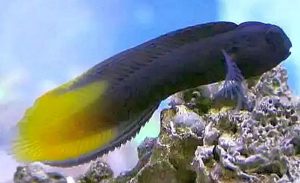
Flametail Blenny (Enchelyurus flavipes)
The Flametail Blenny has an elongated body shape with a blunt head, wide flat mouth equipped with comb like teeth for scraping algae, large expressive eyes and sublle iridescent striations across their face.
They have a jet black to deep charcoal gray body with a bight yellow to orange colored poster and yellow to orange dorsal, anal, and caudal fins. Females are oticeably plumper and fuller bodied, especially during the breeding season. During courship, males develop intensified body colors. The black body color deepens and the fiery yellow tails flash brightly.
The Yellowtail Black Blenny (Enchelyurus flavipes) is often misidentified as the Bicolor Blenny (Ecsenius bicolor). The Yellowtail Black Blenny has a more rounded head and caudal fin compared to the more square head and angular caudal fin of the Bicolor Blenny. Also, Enchelyurus flavipes lacks the cirri found between the eyes of the Ecsenius bicolor.
The Flametail Blenny is best housed in a mature FOWLR or reef tank of at least 30 gallon capacity with an aragonite sand substrate, and plenty of mature live rock with various strains of marine algae aquascaped into small crevices, ledges, small caves, tunnels and overhangs for them to perch on and hide among. At least one wavemaker or powerhead is recommended to provide moderate water flow and a tight fitting glass or mesh tank cover is needed to prevent them from jumping from the tank.
The Flametail Blenny is reef safe with caution. They will nip at LPS corals and ornamental clam mantles when underfed or placed in small crowded systems however they are excellent at controlling nuisance algae growths on the glass and rockwork.
Enchelyurus flavipes are peaceful bottom dwellers that are compatible with virtually all community reef species. They can be territorial with other blennies, dartfish, small gobies, and species with a similar appearance, especially in smaller aquariums.
Good tankmates include the Yellow Clown Goby (Gobiodon okinawae), the Firefish Goby (Nemateleotris magnifica), the Neon Goby (Elacatinus oceanops), the Orchid Dottyback (Pseudochromis fridmani), and the Tailspot Blenny (Ecsenius stigmatura); they should not be housed with aggressive, predatory species.
Although it is best to house only one Flametail Blenny per system, multiple specimens or pairs can be kept in very large reef systems with copious amounts of live rock arranged into distinct, visually separated territories.
The Flametail Blenny has been bred in an aquarium environment. They are oviparous, demersal egg layers that attach their adhesive eggs to the substrate or inside cave roofs via a filamentous pad by the female. The male guards and tends to the eggs until they hatch into tiny planktonick larvae that drift aimlessly with the ocean currents. The tiny fry require specific strains of rotifers that are micro sized and small enough for them to eat. Rearing the tiny larvae in a home aquarium environment remains extremely challenging for most tropical fish keeping enthusiasts.
The Flametail Blenny is a diurnal omnivore that in their natural habitat graze on algal films and filamentous algae scraped off the rocks, detritus and organic debris settled in the cracks of the rocks, and micro invertebrates like copepods, tiny crustaceans, and small fish eggs.
In an mature aqurium environment with large amounts of natural algae growth, they are not finiky eaters and will accept a balanced diet rich in plant based and meaty foods. High quality spirulina pellets, algae flakes, dried seaweed and supplimental feedings of live or frozen Mysis shrimp, vitamin enriched brine shrimp and calanus are all eagerly accepted. Several mall feedings are recommended daily; at least 2 to 3.
The Flametail Blenny (Enchelyurus flavipes) is occasionally available to tropical fish keeping enthusiasts as both wild caught and sustainably captive bred specimens from specialized marine aquarium shops and online retailers.
Prices vary depending on the size, origin, and whether the specimen is aquacultured. Approximate purchase sizes generally range from Small (1″ to 1-1/2″) to Medium/Large (1-1/2″ to 3″).
Prices typically start at $29.99 to $44.99 for small specimens.
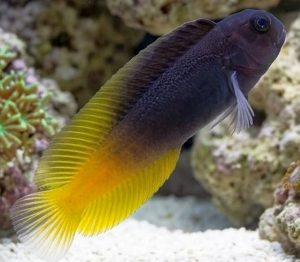
Flametail Blenny (Enchelyurus flavipes)
Minimum Tank Size: 30 gallon (90+ gallons for pairs)
Aquarium Type: FOWLR or Reef
Care Level: Easy
Temperament: Peaceful
Aquarium Hardiness: Hardy
Water Conditions: 74-80° F, dKH 8 – 12°, pH 8.1-8.4, sg 1.020-1.025
Max size: 3”
Color Form: Jet Black, Charcoal, Fiery Yellow, Orange
Diet: Herbivore/Omnivore
Compatibility: Reef Safe
Origin: South China Sea
Family: Blenniidae
Lifespan: 3 – 5 years
Aquarist Experience Level: Beginner/Intermediate