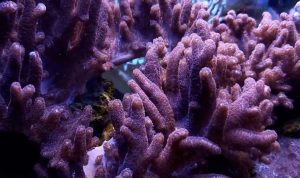
Maroon Finger Leather Coral (Sinularia sp.)
The Finger Leather Coral (Sinularia sp.) formerly classified under various historical soft coral groupings known to tropical fish keeping enthusiasts as the Flexible Leather Coral, Spaghetti Leather Coral, Digitate Leather Coral, Trough Coral and Knobby Leather Coral is found throughout the Indo Pacific with a range that extends from the coast of Africa and the Red Sea to the Western Pacific, including the waters of Indonesia, Australia, the Solomon Islands, and the Great Barrier Reef.
Finger Leather Coral is native to the warm waters of the Indo-Pacific region where they are common in relatively shallow coastal reefs, reef flats, and turbid lagoons.
Although the Finger Leather Coral is generally found among the protected coral reef slopes of their range in clear shallow to deeper waters with moderate to strong currents, they are quite adaptable and are also found in shadier spots closer to shore growing on rocks and coral rubble where water movement shields their delicate tissue from sediment buildup. In general, Sinularia sp. can typically found at depths ranging anywhere from 5 to 90 feet.
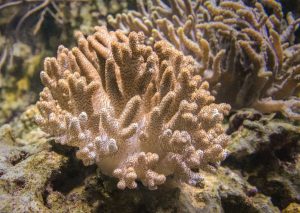
Finger Leather Coral (Sinularia sp.)
The Finger Leather Coral, like all species of Sinularia form a rubbery, sclerite-reinforced coenenchyme (tissue) topped with numerous retractable polyps that closely resemble a mass of tiny branching fingers or trees, hence their common name.
Some of the species form encrusting stalks while others form highly branched tree-like structures, with multiple recognized species and sub-clades within the genus:
Sinularia flexibilis (Quoy & Gaimard, 1833)
Sinularia brassica (May, 1898)
Sinularia asterolobata (Verseveldt, 1877)
Sinularia polydactyla (Ehrenberg, 1834)
Sinularia noto (Verseveldt, 1977)
Sinularia leptoclados (Ehrenberg, 1834)
Sinularia macropodia (Hickson & Hiles, 1900)
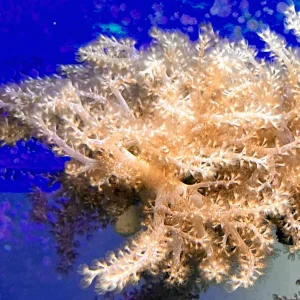
Finger Leather Coral (Sinularia sp.)
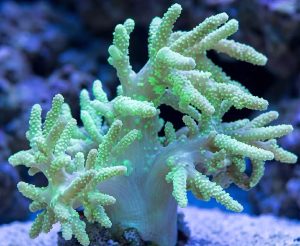
Finger Leather Coral (Sinularia sp.)
Sinularia are generally colored brown or tan with cream, green, or yellow tones with white or gold polyps, however, they are collected in a variety of color forms from Neon Green, Cultured Green, Deep Lime Green, Gold, Brown, Mint, etc.
Many species have a similar appearance to Mushrooms or Toadstools with a distinct stalk and capitulum. As they grow older they develop a folded appearance.
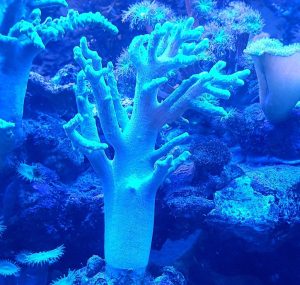
Finger Leather Coral (Sinularia sp.)
Their color and the intensity of their colors is entirely dependent on
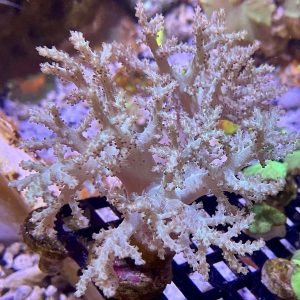
Finger Leather Coral (Sinularia sp.)
how much light they receive and the presence of actinic lighting. The more balanced the light, the richer the fluorescent coloration of the coral.
Because the Finger Leather Coral is highly adaptive and has the ability to thrive in stable reef environments, they are a common sight throughout their range.
Although the Finger Leather Coral can be housed in small nano reef tanks, they are best kept in larger reef tanks of at least 30 gallon capacity with a live sand or fine coralline gravel substrate and plenty of live rock or other aquascape architecture for them to attach themselves to.
The specific tank volume dictates how effectively the Finger Leather Coral’s chemical outputs are diluted. In tanks with smaller water volumes, regular water changes are critical to prevent chemical buildup.
Finger Leather Corals do well when placed in the middle to top of the tank with moderate to high lighting, moderate to strong indirect water flow, and adequate space to prevent them from chemically stunting neighboring corals.
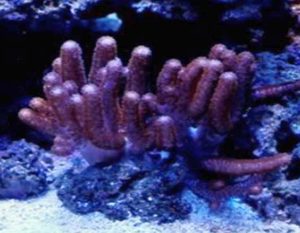
Finger Leather Coral (Sinularia sp.)
Sinularia sp. formerly classified broadly within Alcyoniidae is aggressive towards other corals and will emit toxic chemical compounds called terpenes into the water column to ward off invasive competitors.
To safely house this species, the aquarium’s filtration system must be configured to run high-quality activated carbon, which actively binds and neutralizes these dissolved organic compounds.
Because Sinularia periodically sheds a waxy outer skin layer to rid itself of algae, strong mechanical filtration via filter socks or fleece rollers is required to rapidly capture and export this sloughed tissue before it decays and fouls the water.

Finger Leather Coral (Sinularia sp.)
Although Finger Leather Coral is aggressive to outsiders via chemical warfare, it is a peaceful addition alongside other leather coral sub-clades like Toadstools, allowing hobbyists to group them together into a “Soft Coral garden”.
When planning your reef layout, selecting compatible companion corals is essential to avoid casualties.
Some excellent, non-reactive companion corals include other soft varieties such as Sarcophyton (Toadstool Leathers), Lobophytum (Devil’s Hand), Zoanthids, and Mushroom corals, which share similar chemical tolerances.
Conversely, delicate Large Polyp Stony (LPS) corals like Euphyllia (Frogspawn, Hammers) or Small Polyp Stony (SPS) corals like Acropora should be positioned strictly upstream of the Sinularia’s water flow to ensure its chemical plumes are swept away from their fragile tissue.
Compatible tankmates for Finger Leather Coral include Clownfish, Firefish, Cardinalfish, Gobies, Blennies, Cleaner Shrimp, and other peaceful reef-safe species.
The Finger Leather Coral reproduces asexually through a fragmentation or fission process. In branching varieties, a single stalk will slowly constrict and pinch off at its branch to drop off as a small clone onto nearby rockwork, expanding the colony upward and outward.
Over time, large branching colonies can be manually fragmented (fragged) by carefully cutting the upper rubbery branches well below the polyp crown with a sharp scalpel to create independent specimens.
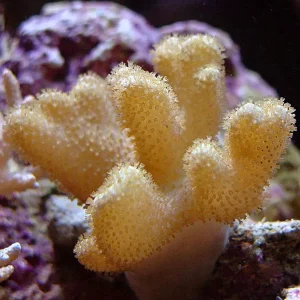
Finger Leather Coral (Sinularia sp.)
In their natural environment, Finger Leather Corals obtain most of their nutrients from their zooxanthellae, symbiotic algae. Although they rely mostly on photosynthesis and dissolved organics for growth, they are also active absorption feeders that are able to capture and consume microscopic organic matter with their fine retractable polyps.
In an aquarium environment with indirect water flow, Finger Leather Corals benefit from weekly supplemental additions of phytoplankton, marine snow, or specialized micro-particle foods mixed with water that they catch with their tiny tentacled polyps.
The Finger Leather Coral, (Sinularia sp.) is readily available in the aquarium trade to tropical fish keeping enthusiasts as wild caught and captive-bred specimens from a variety of online retailers at budget to moderate prices depending on the size, area of collection, and intensity of the color morph.
Finger Leather Corals (Sinularia sp.) famous for their thick, finger-like stalks that mimic miniature underwater trees, are among the most popular and hardy Soft corals in the reef hobby .
Aquaculture of this species has been highly successful, leading to increased availability, hardiness, and sustainability in the hobby.
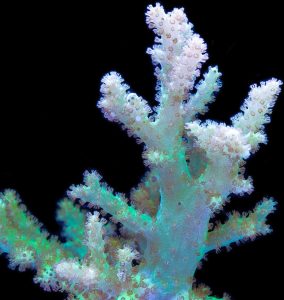
Finger Leather Coral (Sinularia sp.)
Minimum Tank Size: 30 gallon (Larger volumes provide better chemical dilution)
Tank Placement: Middle to Top
Water Flow: Moderate to Strong (Indirect)
Care Level: Easy
Aquarium Hardiness: Exceptionally Hardy
Temperament: Semi-Aggressive (Highly aggressive chemically)
Filtration Requirements: High mechanical export (socks/rollers for skin shedding) + Mandatory continuous Activated Carbon
Toxicity: Yes, heavy chemical warfare (Terpenes released into water column)
Approved Companion Corals: Toadstool Leathers, Devil’s Hand, Zoanthids, Mushrooms (Keep LPS/SPS upstream)
Invasive: No
Water Conditions: 74 – 80°F, dKH 8 – 11°, pH 8.1–8.4, sg 1.024-1.026, Nitrate 2 – 20 ppm, Calcium 380-450 ppm
Lighting: Moderate to High (150-250 PAR)
Feeding: Phytoplankton, marine snow, micro-particle food
Growth Rate: Fast
Color Form: Tan, Brown, Green, Yellow, Cream, etc.
Diet: Photosynthetic, Filter Feeder (Micro-particles)
Origin: Indo-Pacific, Red Sea, Australia
Family: Alcyoniidae
Lifespan: Decades (Under proper care)
Aquarist Experience Level: Beginner