
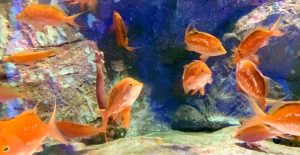
Cherry Sakura Anthias (Sacura margaritacea) School
The Cherry Sakura Anthias (Sacura margaritacea) known to tropical fish keeping enthusiasts as the Cherry Anthias, Sakura Anthias or in Japan; Sakuradai, is a rare deep-water species of marine anthias native to the Northwest Pacific Ocean, the coastal waters of Japan and a unique population farther south.
Cherry Sakura Anthias range extends across Eastern Asia and includes Japan, the Ogasawara (Bonin) Islands, South Korea, coastal China, Taiwan and much farther south to New Caledonia.
Cherry Anthias frequently congregate in large schools above rocky environments and among deep water gorgonians and soft corals that rely on strong, rapid ocean currents to sweep massive clouds of zooplankkton and tiny invertebrates for them to extract from the water column. Unlike other anthias species, Sacura margaritacea are found in very numerous schools with hundreds of individuals and harems with several males.
Sakura Anthias are often found in large numbers of “super schools” hovering over deep rocky reefs, steep slopes, and rocky outcrops of their range at depths from 50 to almost 400 feet, where plenty of crevices, caves, and ledges occur for them to retreat to and escape from predators.
Sacura margaritacea practice a phenomenon known as tropical submergence.
In their northern range around Sagami Bay in Japan, Cherry Sakura Anthias are occasionally found in just 30 to 50 feet of water during the winter months.
In their southern range toward Okinawa and the Ogasawara Islands where surface water temperatures are much warmer, they are almost always found at depths between 130 to 150 feet or more.
Like other anthias species, Cherry Anthias are protogynous hermaphrodites where all individuals start life as females. They display clear sexual dimorphism.
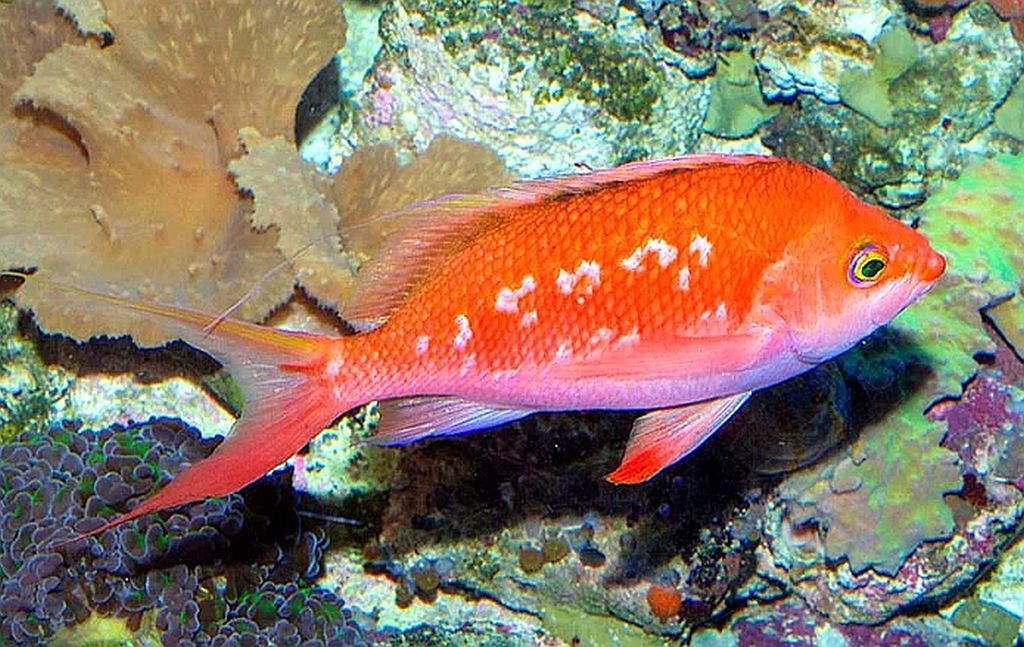
Male Cherry Sakura Anthias (Sacura margaritacea)
Males are exceptionally vibrant and have a rich, intense red orange to scarlet pink or cherry red body color with prominent, irregularly shaped, pearly white to platinum silver spots arranged in horizontal rows along the flanks.
The fiery reddish pink colored fins are tipped with blue or turquoise and iridescent highlights along the margins, ending in elegant, elongated filaments as they mature into adults.
Females are a bright yellow orange to solid orange body color and lack the pearlescent white spots found on the
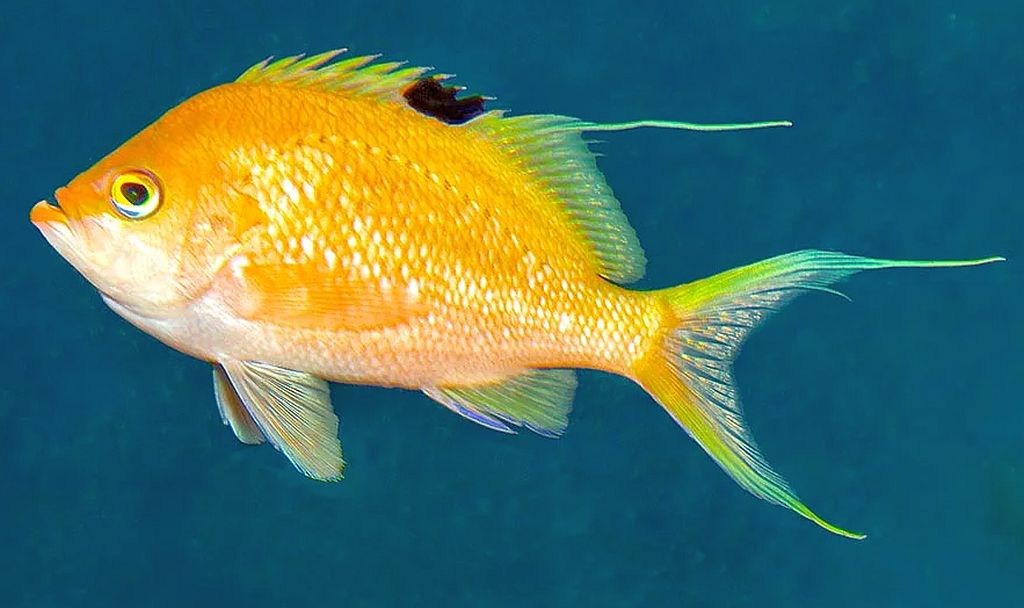
Female Male Cherry Sakura Anthias (Sacura margaritacea)
flanks of males. They have a black blotch located on the last four spiny rays of the dorsal fin that reliably distinguishes them from males.
Transitioning fish will have a body color that shifts from bright yellow orange to a deep cherry red. The defining black spot on the dorsal will fade and regress, and the pearlescent white pattern will begin to develop along the sides of the body.
Because Cherry Anthias are a subtropical, deep water species, they cannot be kept the exact same way as other anthias species.
A single individual is best housed in a mature reef or FOWLR tank of at least 75 gallon capacity with a coralline gravel or sandy substrate, plenty of live rock arranged into large crevices, deep caves, and dark overhangs for the to hide among and plenty of open swimming area in the upper water column.
A small harem of one male and 3 or more females or a group of all juvenile/female individuals are best kept in at least a 150 gallon tank with the same décor. Over time the most dominant female will transition into a bright cherry red male. Avoid housing multiple mature males together unless you have an exceptionally massive system.
Cherry Sakura Anthias are completely reef safe and will generally ignore corals and invertebrates.
They require lower light levels, which is why plenty of shaded areas in the tank are needed. A lighting system that provides a gradual dawn to dusk lighting cycle will greatly benefit this species if your reef system is brightly lit for corals. When first introduced, keep the lights dim or run a heavily blue-skewed spectrum. They look their absolute best under deep blue or actinic lighting Over time, this species will adjust to brighter lights if they have plenty of shady rocky areas to retreat to.
To replicate their natural deep water reef slope environment, multiple wavemakers are needed to provide strong, continuous water movement and proper oxygenation necessary for them to thrive.
Because they require multiple small feedings; heavy filtration, aggressive protein skimming, regular water changes, and media reactors are required to keep nitrates and phosphates at zero.
An aquarium chiller is mandatory to maintain water temperatures at their recommended range, and because they are excellent jumpers; a tight fitting mesh lid or glass cover is recommended to keep them in the tank.
Cherry Sakura Anthias are peaceful toward other non-anthias species but can be territorial against rivals. They do best with other cool water or deep water reef fish like wrasses, assessors, or basslets.
Sacura margaritacea have not been successfully bred in an aquarium environment.
Like all anthias, Cherry Anthias are broadcast pelagic spawners. When a harem is ready to spawn the dominant male will initiate a dramatic courtship dance by flaring his fins, flashing his pearlescent white spots, and darting rapidly around the females. Once a female accepts his advances, the pair will engage in a darting dash toward the surface where they simultaneously release their eggs and sperm into the water column before immediately diving back down to the rockwork. The fertilized eggs are buoyant, transparent, and typically under 1mm in diameter.
In the wild, the eggs drift out into the open ocean currents as plankton. In an aquarium environment, they are usually swept into the filtration system or consumed by other tankmates.
Tropical fish keeping enthusiasts who manage to collect the eggs before they are destroyed must be able to feed the microscopic larvae. Hatched out larvae survive on their yolk sacs for a few days but then need specific strains of pelagic copepod nauplii like Parvocalanus crassirostris to continue their existence. Deep water anthias have a long larval stage that can last anywhere from 30 to 90 days before metamorphosis into recognizable post larval juveniles. Without specialized equipment, keeping water quality pristine in a specialized larval rearing tank for that long is impossible.
Cherry Sakura Anthias are strict, opportunistic zooplanktivores that continuously feed almost entirely on floating fish eggs, primitive tunicate larvae, crab and invertebrate larvae, mysid shrimp, tiny amphipods, and pelagic copepods and their larvae.
In an aquarium environment they need a varied diet rich in carotenoids and marine proteins. Frozen high quality Mysis shrimp, Calanus, chopped krill, fortified brine shrimp, cyclops, and over time high quality protein rich pellets and flake foods rich in astaxanthin will be eagerly accepted. Small targeted feedings 2 to 3 times a day broadcast directly into the water flow will trigger their natural hunting instinct.
The Cherry Sakura Anthias (Sacura margaritacea) is a rare, highly coveted “holy grail” species that is very limited and seasonal in the United States. Because they are a deep-water species collected from specific subtropical areas around Japan, they demand a high price. This species is almost exclusively supplied by high end online livestock divers and specialized boutique importers.
Major online wholesale and retail outlets, specialty trans shippers, and vendors who list them as unavailable require tropical fish keeping enthusiasts to be on a waiting list for purchase when available.
When available in the United States, prices vary according to size, sex, and area of collection.
Individual female and juvenile Cherry Sakura Anthias typically retail between $599.00 and $600.00 each.
Individual fully transitioned supermales with cherry red colors and long fin filaments sell for $750.00 to $875.00.
Specialty vendors occasionally offer conditioned pairs of one male and one female at around $950.00; and a small harem can easily cost thousands of dollars.
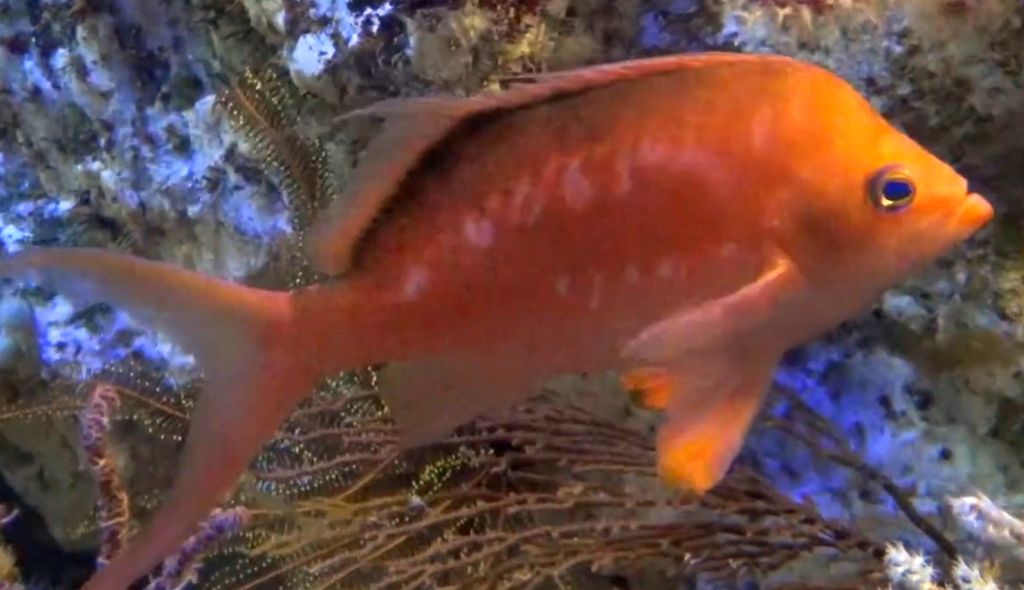
Male Cherry Sakura Anthias (Sacura margaritacea)
Minimum Tank Size: 75 gallons; 150 gallons for groups
Aquarium Type: Reef or FOLR
Care Level: Moderate
Temperament: Semi Aggressive
Aquarium Hardiness: Hardy
Water Conditions: 65°F to 72°F, dKH 8 to 11, pH 8.1-8.4, sg 1.024-1.026
Max size: 5″
Color Form: Orange, Red, Yellow
Diet: Carnivore (zooplanktivores)
Compatibility: Reef
Origin: Izu Peninsula & Sagami Bay and Ogasawara Islands
Family: Serranidae
Lifespan: 4-6 years
Aquarist Experience Level: Expert/Advanced
One Response to “Cherry Sakura Anthias (Sacura margaritacea)”
Trackbacks/Pingbacks
[…] species that is reef safe and can be housed with sponges, corals, and species of the genera Sacura, Pseudanthias, Tosanoides and Pseudolabrus. Like many deep water species, they are more […]