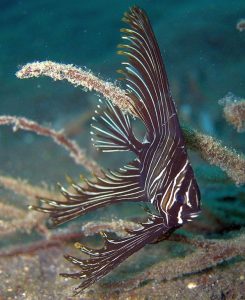
Juvenile Batfish (Platax batavianus)
Humpback Batfish (Platax batavianus) known to tropical fish keeping enthusiasts as Batavian Batfish, Marble Batfish, Zebra Batfish, Hump-headed Batfish, or Moonfish is found found throughout the Indo Pacific from the Red Sea to the Western Pacific Ocean.
The Humpback Batfish‘s range is from eastern Africa, Madagascar, Seychelles, the Maldives, Sri Lanka, Indian, the Andaman Sea, Indonesia and Australia. In the Indian Ocean their range extends in the Gulf of Thailand, Indonesia, Vietnam, Taiwan, Japan, the Phillippines, the Great Barrier Reef, New Zealand and various Pacific islands.
The Marble Batfish thrives in warm, tropical waters and are often found in the shallow reefs, lagoons, and occasionally the estuaries if their range at depths from 15 to over 135 feet.
Juvenile Batfish (Platax batavianus)Juvenile Platax batavianus typically inhabit the shallower protected depths of onshore coastal water seagrass beds; but because their long, black and white zebra like fin pattern allows them to blend in with deep water featherr stars (crinoids), they are also uniquely found in much deeper waters where crinoids abound.
Adult Humpback Batfish are solitary, but unlike like Pinnatus Batfish (Platax pinnatus) that form massive, tightschools when crossing the open ocean; they are rarely seen forming huge schools.
Platax batavianus are typically encountered patrolling deep open ocean waters in pairs or small loose groups, preferring deep continental reef shelves and areas of open sandy fields with isolated coral heads, at depths from 130 to 165 feet.
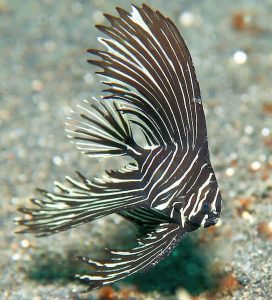
Juvenile Batfish (Platax batavianus)
Juvenile Humpback Batfish have a black or deep dark brown body color covered with intricate, wavy vertical white lines and extraordinarily long craggy, wing-like or ribbon-like fins that mimics a deep water feather starfish.
As juvenile Humpback Batfish enter the sub-adult stage; the zebra like stripes on the body becomes a uniform brownish color with
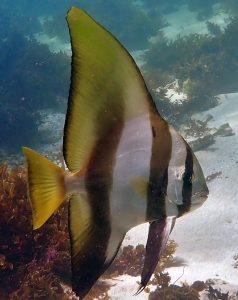
Sub-Adult Humpback Batfish (Platax batavianus)
a distinct black bar that sweeps from the nape, down over the eye, to the chest, and a second bar that runs from the dorsal fin down to the pelvic fins. The long, lacy wing-like fins shorten significantly and become more rounded.
Juvenile Humpback Batfish should be housed in a mature FOWLR aquarium of at least 100 gallon capacity with a coralline sandy gravel substrate and large amounts of live rock arranged vertically into numerous caves, overhangs and branches for them to hide among. They require diffused lighting, gentle low to moderate water flow, pristine water quality and stable conditions.
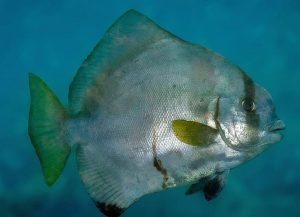
Adult Humpback Batfish (Platax batavianus)
Adult Humpback Batfish require an extremely tall and wide mature FOWLR tank of at least 500 gallon capacity with a fine sand or coralline gravel substrate that is sparsely laid out with live rock. They require strong, high volume water flow and bright high output open lighting. Pristine water qulity and stable reef like water conditions are mandatory.
Because juvenile and adult batfish are high volume, messy eaters; heavy mechanical filtration, an oversize protein skimmer, and strong water turn over is needed to handle the bioload.
The Humpback Batfish is NOT reef safe and will aggressively nip at or consume soft and stony corals, anemones, and smaller invertebrates like ornamental shrimp.
Juvenile Platax batavianus can be housed with peaceful, passive, slow moving fish like Flametail Blennies, True Canary Blennies (Meiacanthus oualanensis), Rhino Blennies, Starry Blennies, and Banggai or Pajama Cardinal fish. Avoid all tangs, large wrasses, dottybacks, aggressive angelfish, and hyper active damselfish.
Adulat Platax batavianus can be housed with Naso Tang (Naso lituratus) or Sailfin Tang (Zebrasoma veliferum) tangs, Foxfaces, Rabbitfish, Harlequin Sweetlips, and large Emperor Angelfish. Avoid all small reef fish like Okinawa Chromis, small gobies, dartfish, or clownfish that will be considered live prey and swallowed whole.
The best tankmate for juvenile or adult Humpback Batfish is another Humpback Batfish. Add three or more juveniles to the mega tank at the same time.
It is impossible to breed the Humpback Batfish (Platax batavianus) in a home aquarium. Adults are impossible to sex and because they are open-water broadcast spawners that in the wild gather in deep open areas to spawn, no home aquarium would be able to accomodate them.
In the wild, pairs release thousands of buoyant eggs directly into the water column. The eggs drift freely in the open ocean currents as plankton until they hatch into larvae that eventually become juveniles. In a home aquarium, the eggs would immediately be sucked up by mechanical filters, destroyed by wavemakers, or skimmed out by protein skimmers.
In their natural habitat, Humpback Batfish are opportunistic omnivores that scrape plant matter and animal protein from their reef environments. They feed on large zooplankton, jellyfish, and comb jellies drifting in the ocean; benthic invertebrates like marine worms, small crabs, shrimp, mollusks as well as marine algae and seaweeds scraped from rocky overhangs.
Juveniles are “Crinoid foragers” that camouflage themselves among the feather stars and feed on small fish, worms, shrimp, and algae.
In an aquarium environment, they should be offered a balanced diet consisting of marine algae, high-quality pellet and flake foods, live or frozen foods like brine shrimp, mysis shrimp, chopped krill, diced table shrimp, and finely minced squid orclams to ensure proper nutrition and health.
Spirulina-enriched brine shrimp, frozen herbivore paste preparations, and sheets of dried marine seaweed (Nori) secured to the glass with a clip for continuous picking will provide crucial plant matter for their digestive tracts. Juveniles often need coaxing with targeted feedings of live blackworms or adult mysid shrimp until acclimated. Establish a 3 to 4 times a day feeding schedule to mimic their wild grazing behavior.
The Humpback Batfish (Platax batavianus) is occasionally available to tropical fish keeping enthusiasts by retailers under its juvenile name Zebra Batfish. They are considered rare and seasonal because they are all wild caught and only available in sporadic waves.
Currently 1.5″ to 2″ Small juveniles retail from $80.00 and $120.00; Medium/Large 3″ to 5″ plus range from $195.00 to $265.00. Captive bred Platax batavianus x Platax pinnatus go for $150.00 to $220.00 and more.
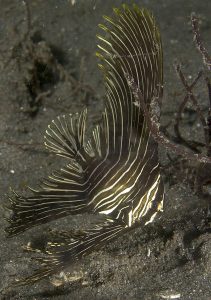
Juvenile Batfish (Platax batavianus)
Minimum Tank Size: 100-600+ gallons
Care Level: Intermediate
Temperament: Peaceful
Aquarium Hardiness: Hardy
Water Conditions: 72-82° F, dKH 8 – 12°, pH 8.1-8.4, sg 1.020-1.025
Max size: 26”
Color Form: Dark Brown, Black, White
Diet: Omnivore
Compatibility: Not Reef Safe
Origin: Indo Pacific/Western Pacific
Family: Ephippidae
Lifespan: 12 – 15+ years (adults)
Aquarist Experience Level: Intermediate/Expert