ggg
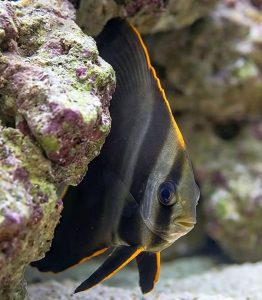
juvenile Pinnatus Batfish (Platax pinnatus)
Pinnatus Batfish (Platax pinnatus) known to tropical fish keeping enthusiats as the Dusky Batfish, Red-faced Batfish, Pinnate Spadefish or Red-Rimmed Batfish is native to tropical waters of the Western Pacific Ocean.
The Pinnatus Batfish is abundand throughout the Indo-Malayan Archipelago, including Indonesia, the Philippines, and New Guinea. Their northern range extends to the Ryukyu Islands in Japan and spreads down to northern and eastern Australia (including the Great Barrier Reef) and as far south as New Caledonia.
Juvenile Pinnatus Batfish are a shy, relatively solitary species that are typically encountered alone or in small groups in the shallow protected mangrove forests, calm lagoons, coral reefs, and shallow shipwrecks of their range, where they hide in the shadows to avoid predators. They prefer areas with moderate water flow around coral heads and submerged debris.
Adult Platax pinnatus are generally solitary but bolder than juveniles. They are found alone or in pairs over the steep, rocky overhangs and ledges of the outer reef slopes of their range in the deeper 50 to 100 foot depths. They are highly territorial, loyal to a specific reef, and aggressive towards their own kind and similar looking species.
Adults frequently gather into tight, massive schools when traveling in open water over sandy substrates or migrating across the open ocean for protection.
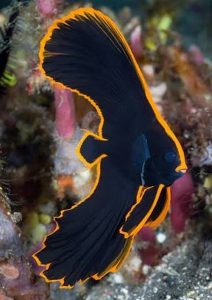
juvenile Pinnatus Batfish (Platax pinnatus)
Pinnatus Batfish have extremely laterally compressed, disc like bodies, with exaggerated long dorsal and anal fins that are long and flowing in the juvenile stage and gradually shorten and broaden as they age.
They have small, terminal mouths with brush-like, tricuspid teeth that are adapted for scraping algae, sponges, and small invertebrates off rocks.
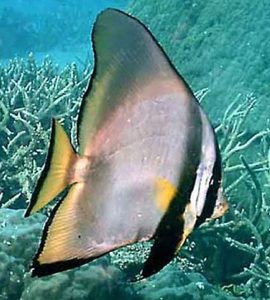
Adult Pinnatus Batfish (Platax pinnatus)
Juvenile Pinnatus Batfish have a dark brown to jet black colored body outlined in vibrant neon orange to yellow.
As they grow into adulthood, their dramatic fins shorten proportionally and their colors fade into a spadefish like appearance.
Pinnatus Batfish are best housed in a mature FOWLR aquarium of at least 200 gallon capacity with a coralline gravel substrate, plenty of live rock arranged into large caves, ledges, and overhangs and a lot of free swimming space. The Pinnatus Batfish prefers a brightly lit aquarium with high water quality and stable water parameters.
Pinnatus Batfish are NOT considered reef safe. They will aggressively nip at or consume soft and stony corals, anemones, and smaller invertebrates like ornamental shrimp.
They are a peaceful species but because of their territorial behavior adults are best kept as a sole specimen. They do not do well with other batfish or similar shaped species.
The more colorful juvenile Pinnatus are hyper stressed and easily intimidated. If you put multiple juveniles together, they will often compete for the few “safe” hiding spots, leading to severe stress, eating strikes, and death.
Pinnatus Batfish are pelagic broadcasters that are practically impossible to breed in an aquarium environment. They are commercially bred in massive outdoor aquaculture environments for tropical fish keeping enthusiasts.
In their natural environment, Pinnatus Batfish are omnivorous grazers that feed on dense macroalgae like Sargassum, jellyfish, comb jellies, gelatinous zooplankton, anemones, marine worms, colonial corals, and small crustaceans.
In an aquarium environment, they must be fed small amounts of one part animal protein to two parts vegetable matter at least 3 to 4 times a day. Juveniles will waste away if fed only once a day.
Live blackworms, live mysid shrimp, live adult brine shrimp, frozen krill, chopped squid, chopped table shrimp along with dried seaweed, spirulina enriched brine shrimp, frozen herbifore preparations, DKI pellets, and herbivore preparations should all be offered.
Wild caught juveniles frequently refuse to eat processed aquarium foods and will starve to death without actively coaxing them with live blackworms, shrimp, etc. Once they begin to eat live fare, mix in high quality frozen herbivore preparations.
Captive bred Pinnatus can be fed a varied diet that includes high-quality marine flakes, pellets, and frozen foods such as brine shrimp, mysis shrimp, and chopped seafood.
Pinnatus Batfish (Platax pinnatus) are seasonably available to tropical fish keeping enthusiasts as wild caught specimens from online wholesalers, retailers and specialty shops. Captive bred specimens are available in waves from some commercial breeders.
Prices for 2 to 3 inch wild caught juveniles range between $73.00 to $125.00. Captive bred juveniles retail between $200.00 and $300.00 or more. Adults are rarely for sale but when available go for $400.00 or more.
Unlike wild-caught specimens, captive-bred Pinnatus batfish are significantly hardier, far less finicky, and are already trained to accept commercial pellet and frozen foods.
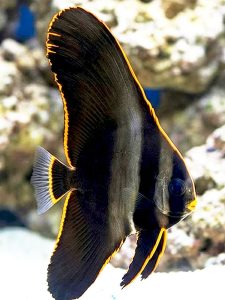
juvenile Pinnatus Batfish (Platax pinnatus)
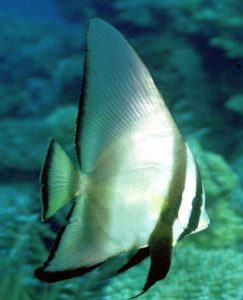
Adult Pinnatus Batfish (Platax pinnatus)
Minimum Tank Size: 200 – 300 gallons
Care Level: Intermediate
Temperament: Peaceful
Aquarium Hardiness: Hardy
Water Conditions: 72-78° F, dKH 8 – 12°, pH 8.1-8.4, sg 1.023-1.025
Max size: 16 – 18”
Color Form: Dark Brown, Black, Orange, Yellow
Diet: Omnivore
Compatibility: Not Reef Safe
Origin: Western Pacific Ocean
Family: Ephippidae
Lifespan: 8 – 10 years
Aquarist Experience Level: Intermediate/Expert