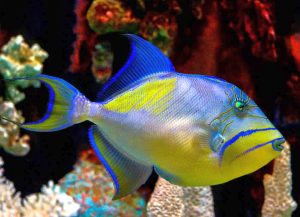
Queen Triggerfish (Balistes vetula)
The Queen Triggerfish (Balistes vetula) known to tropical fish keeping enthusiasts as Turbot, Queen Trigger, or Oldwife is found in the tropical and subtropical Atlantic Ocean. Its range extends from the western Atlantic, spanning eastern Canada down through the Gulf of Mexico, the Caribbean, and all the way to southern Brazil, as well as the eastern Atlantic from the Azores and Cape Verde down to Angola.
The Queen Triggerfish is a solitary species that is generally encountered alone or in small groups around the rocky sea floors, sandy flats, and coral reefs of their range in depths from 10 to over 100 feet, however, specimens have been collected as deep as 900 feet.
Queen Triggerfish are a relatively shy and peaceful species that become fiercely territorial and aggressive during the breeding season, when they are guarding their sandpit nests.
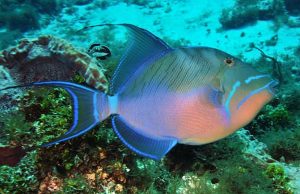
Queen Triggerfish (Balistes vetula)
The Queen Triggerfish has a large oval shaped, laterally-compressed body with small eyes located toward the top of the head. They have a steel gray to olive green or bluish gray colored back, a yellowish orange lower head and belly, and distinct bright electric blue diagonal stripes and bands around the mouth.
Unlike some triggerfish species like the Crosshatch Triggerfish; male and female Queen Triggers share the exact same coloration and are the same size at identical ages. Both sexes can create a throbbing or grunting noise using membranes near its pectoral fins to warn off other fish.
Like most triggerfish; Queen Triggerfish have a defensive first dorsal spine that can lock upright into crevices to wedge itself safely from predators, which is unlocked by a second smaller spine.
A single juvenile Queen Triggerfish can be housed in a mature FOWLR tank of at least 200 gallon capacity with a coarse sandy coralline substrate, live rock arranged into large caves, crevices and overhangs for them to retreat and wedge themselves, and plenty of free swimming area. Because they are notorious for blowing water jets at the sandy substrate which can collapse loose rockwork, it is a good idea to secure them with epoxy.
Adult Balistes vetula require at least a 300 gallon tank to provide them with the swimming space they require.
Their messy eating habits require heavy biological filtration to maintain excellent water quality. An oversized protein skimmer, strong mechanical filter with a high water turnover rate, and a wave maker is highly recommended.
The Queen Triggerfish is NOT reef safe. They are curious and possess powerful jaws that can decimate corals, invertebrates, and clams in a reef tank. They constantly try to rearrange rockwork and will chew on exposed heater wires, filter intakes, and probe wires if they are not hidden behind the rockwork.
Although they are best housed alone, they can be housed in large community tanks with Tessalata or Green Moray Eels, large aggressive groupers, large adult angelfish like the Emperor or French Angel, and Lionfish.
Avoid housing them with any smaller or passive community fish like tangs or wrasses.
Without having a massive multi-thousand gallon tank setup, normal tropical fish keeping enthusiasts cannot breed Queen Triggerfish.
In their natural habitat, a single male Balistes vetula will establish a spawning territory that they patrol on the sandy flats roughly 33 feet in diameter. They are demersal blockers that construct depression nests in the sandy substrate with rapid fin movements and water jets that they blow with their mouths.
Both parents guard the nest. The female remains within a few feet of the nest and aggressively drives away any immediate intruders. The male patrols the perimeter from larger predators, including divers, before they can get close to the female. A pair can produce anywhere from a 100,000 to over a million tiny, adhesive eggs in a single spawn that hatch into pelagic fry. The fry endure a larval duration that can last anywhere from 65 to over 100 days.
Queen Triggerfish are diurnal secondary consumers that forage during the daylight over coral reefs, sandy flats, and rocky sea floors for long spine sea urchins and other hard shelled benthic invertebrates such as crabs, shrimps, mantis shrimp, snails, chitons, clams, mussels, starfish, sea cucumbers, polychaete worms, small reef fish, and occasionally macroalgae. They use water jets from their fins to flip long spine sea urchins over to expose their vulnerable undersides before biting.
In an aquarium environment they should be fed a mixed diet of 70% hard shelled foods, 20% meaty foods, and 10% prepared foods and greens. Hard shelled foods like clams or mussels, crab legs and lobster tails, live fiddler crabs, ghost shrimp, or freshwater pest snails should be mixed with squid, octopus, Mysis, krill, silversides and large marine pellets and Nori held on a rock with a veggie clip. They should be fed this mixed diet at least 2 to 3 times a day.
The Queen Triggerfish (Balistes vetula) is commonly available to tropical fish keeping enthusiasts as wild caught specimens from a variety of online suppliers and specialty fish shops at prices that vary according to size and area of collection.
Approximate purchase sizes typically range from $149.99 for smaller individuals to over $400.00 for large adult specimens.
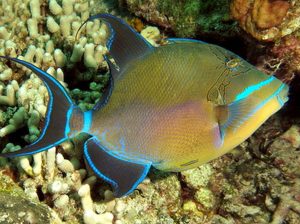
Queen Triggerfish (Balistes vetula)
Minimum Tank Size: Juveniles 200 gallons, Adults 300+ gallons
Aquarium Type: FOWLR
Care Level: Moderate
Temperament: Aggressive
Aquarium Hardiness: Very Hardy
Water Conditions: Temp 72-82F, dKH 8 – 12°, pH 8.1-8.5, Salinity 1.022-1.026
Max size: 24″
Color Form: Steel Gray, Electric Blue, Olive Green, Yellowish Orange
Diet: Carnivore
Compatibility: Not reef safe
Origin: Atlantic Ocean
Family: Balistidae
Lifespan: Over 10-15 years
Aquarist Experience Level: Expert