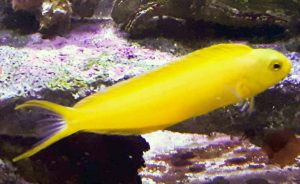
Canary Blenny (Meiacanthus oualanensis)
The Canary Blenny (Meiacanthus oualanensis) known to tropical fish keeping enthusiasts as the Oualan Forktail Blenny or Canary Fang Blenny is native to the coral reefs of the Indo-Pacific and is found along the islands of Fiji, Tahiti, and the Great Barrier Reef.
Adult Canary Blennies are a solitary species that are normally encountered in pairs or alone in the shallow, protected, clear water lagoons and seaward reefs of their range, hovering a few feet above the rockwork and coral heads in the water column at depths ranging from 3 to over 50 feet, where they feed on zooplankton and tiny benthic invertebrates.
Juvenile Canary Blennies are usually found in shallower waters where they gather together in small groups.
The Canary Blenny is a fang blenny that like other members of the Meiacanthus genus possess two venomous canine like teeth in the lower jaw that they use primarily for defense. Non venomous Plagiotremus flavus and juvenile Scolopsis bilineatus have learned to mimic the venomous Canary Blenny to protect themselves from predators.
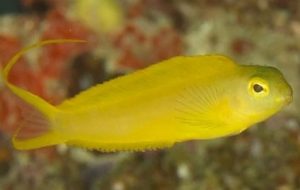
canary blenny (meiacanthus oualanensis)
The Canary Blenny has an elongated, bright banana yellow colored body with subtle greenish yellow hue along the dorsal that is tapered to the rear. They have large, prominent eyes without eye bars, a subterminal mouth with two large grooved teeth hidden in the lower jaw with venom glands that they use for defense. Adults develop a lunate or lyretail with long trailing filaments.
The Canary Blenny is reef safe and can be housed in a mature FOWLR or reef aquarium of at least 30 gallon capacity with a live sand or coralline gravel substrate, copious amounts of well established live rock arranged into caves, crevices, ledges and outcrops for them to hide and graze among for small crustaceans, and plenty of free swimming space. A tight fitting lid is necessary for this species as they are expert jumpers.
The Canary Blenny should be kept as mated pairs or alone unless the tank is very large. They can become territorial towards conspecifics but cohabit well with the majority of peaceful reef dwelling species. They should not be housed with larger carnivorous species that could eat them. Suitable tankmates include clownfish, cardinalfish, Dartfish, peaceful wrasses, and bottom dwelling gobies like the Watchman.
The Canary Blenny will not eat coral polyps, decorative clams, or soft corals. They constantly search the water column and rockwork for tiny hidden pests in the tank.
The Oualan Forktail Blenny has been bred in an aquarium environment as well as by commercial aquacultural facilities for the aquarium trade. They are highly successful demersal spawners.
In their natural habitat, male Meiacanthus oualanensis stake out a crevice in the coral reef, an empty shell, or an empty worm borehole where they perform a lunging type of dance to entice a passing female. A willing female will lay a clutch of tiny, adhesive eggs onto the inner wals of the cavity where the male fertilizes them. A single female will deposit 100 to 300 oval shaped, reddish brown eggs about 1.2 mm in dia. The male will fan and guard the eggs until they hatch out into tiny planktonic larvae that float in the open water until they mature into minature gobies.
In an aquarium, capped PVC pipes replace caves or coral niches. The deposited eggs hatch during the evening in around 10 to 12 days. The tiny larvae must be moved to a rearing tank and initially fed S-type rotifers, followed by baby brine shrimp. The tiny silver colored larvae turn yellow around day 35 and become juvenile Canary Blennies.
In the wild, the Canary Blenny constantly feeds on zooplankton, small copepods, amphipods, crustaceans larvae and micro inverrtebrates.
In an aquarium environment provide the Canary Blenny with a mature tank that contains an abundance of live rock.
They prefer floating or slowly sinking foods like frozen mysis shrimp, vitamin enriched brine shrimp, calanus, and finely chopped krill or seafoods. High quality marine flakes and small pellets are also acceped, especially by commercially bred individuals. Because of their high metabolism rate, several small feedings are recommended daily; at least 2 to 3.
The Canary Blenny (Meiacanthus oualanensis) is commonly available to tropical fish keeping enthusiasts as wild caught or commercially bred specimens at reasonable prices from a variety of aquarium shops and online retailers, wholesalers, and transhippers. Prices vary on size and area of collection. Captive bred juvenile specimens 1.25″ to 2″ in length are priced at around $35.00. Wild caught Fiji specimens 1.5″ to 3″ are currently priced from $39.99 to over $41.99.
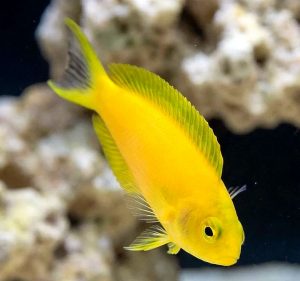
Canary Blenny (Meiacanthus oualanensis)
Minimum Tank Size: 30 gallon (90+ gallons for pairs)
Aquarium Type: FOWLR or Reef
Care Level: Moderate
Temperament: Semi Aggressive
Aquarium Hardiness: Hardy
Water Conditions: 72-78° F, dKH 8 – 12°, pH 8.1-8.4, sg 1.020-1.025
Max size: 5”
Color Form: Yellow, Green
Diet: Omnivore
Compatibility: Reef Safe
Origin: Indo Pacific
Family: Blenniidae
Lifespan: 4 – 6 years
Aquarist Experience Level: Beginner