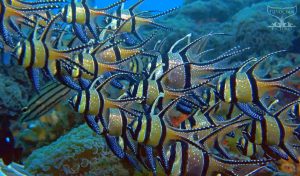
Banggai Cardinalfish (Pterapogon kauderni) School
Banggai Cardinalfish (Pterapogon kauderni) known to tropical fish keeping enthusiasts as Banggai Cardinal, Kaudern’s Cardinalfish, Longfin Cardinalfish, or Highfin Cardinalfish are endemic to the Banggai Archipelago in Indonesia. Their entire natural habitat is concentrated around shallow coastal waters of 17 large and 10 small remote islands off the eastern coast of Central Sulawesi. A tiny isolated population resides just off the main coast of Central Sulawesi.
Non native populations of Banggai Cardinalfish in North Sulawesi (Lembeh Strait), Secret Bay in Northwest Bali, and the Ambon Bay that were introduced by trade fishers in 2000 are now established and occasionally harvested by collectors to reduce pressure on native archipelago populations.
Like the Pajama Cardinal (Sphaeramia nematoptera) and Orbiculate Cardinal (Sphaeramia orbicularis); the Banggai cardinalfish (Pterapogon kauderni) is a weak swimmer that lives a mostly sedentary lifestyle in the calm lagoons, seagrass beds, mangrove roots,and coral reef flats of their range in shallow water depths between 5 to 16 feet.
Banggai Cardinals are a peaceful species that group together for protection among branching corals, large sea anemones, and the venomous spines of Long Spined Sea Urchins (Diadema setosum). Juveniles in particular commonly hide among the spines of long-spined sea urchins or anemone tentacles for protection.
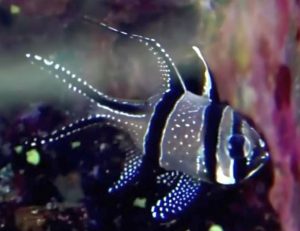
Banggai Cardinalfish (Pterapogon kauderni)
The Banggai Cardinal has a silver body marked with bold vertical black bars and unique white spots, a tasseled first dorsal fin, elongated second dorsal and anal fins, and a deeply forked caudal fin. Each individual fish has a distinct dot pattern used for individual identification. Males and females are identical in size and coloration.
A single Banggai Cardinal can be housed in a mature nano reef or FOWLR tank of 20 gallon capacity with a sandy or fine coralline gravel substrate and plenty of live rock arranged into overhangs, vertical drop offs, and shaded caves for them to hide among. For a bonded pair, a 30 gallon tank is needed and for a harem or small groups of 4 ato 6 individuals, a mature aquarium of at least 75 gallon capacity is required.
Although Banggai Cardinals are very hardy, they thrive in stable water environments with low to moderate water flow.
The Banggai Cardinal is completely reef safe and will ignore corals, decorative clams, ornamental shrimp, and crabs. They do well in reef aquariums with less intense lighting and water flow.
The Banggai Cardinal is best kept as a bonded pair or in a large school in a spacious tank if at least 75 gallon capacity with plenty of hiding spaces. Housing groups of mature Pterapogon kauderni in a smaller tank will usually result in a dominant pair forming and systematically killing off conspecifics.
In a FOWLR aquarium they do well with Ocellaris Clownfish, Royal Gramma, Tailspot or Lawnmower Blennies, Watchman Gobies, Firefish, Dwarf Angelfish, and peaceful Wrasses. Avoid housing them with large predatory Wrasses, Dottybacks, Groupers, Lionfish, or highly aggressive damselfishes. In reef tanks, they do well with Hermit Crabs, Ckeaner Shrimp, Snails, Anemones and especially Long Spine Sea Urchins that they will school directly over.
Because Banggai Cardinalfish skip the fragile, microscopic pelagic larval stage entirely, they are among the easiest marine species to breed in a home aquarium.
They are paternal mouthbrooders where the male holds the brood until he releases fully formed, miniature versions of the parents that
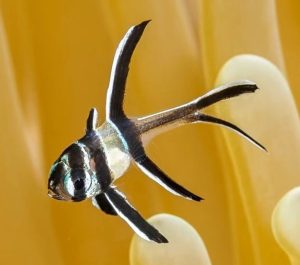
Juvenile Banggai Cardinalfish (Pterapogon kauderni)
can eat solid foods from day one.
Most tropical fish keeping enthusiasts interested in breeding Pterapogon kauderni purchase 4 to 6 juveniles and allow a pair to form as they grow into adults; usually in 4 to 6 months.
Once the pair forms, they will claim a territory in the tank and aggressively chase other fish off. Immediately remove the other fish to prevent the pair from killing them and condition the pair with Mysis shrimp, fish eggs, etc. When ready to breed, the female will initiate a flashing, vibrating like courtship “dance”.
During a flash a clutch of up to 75 eggs is fertilized and transferred into the mouth of the male where they will remain for 20 to 30 days until the eggs hatch into tiny fry and they grow eyes. During this period the male will completely stop eating to avoid swallowing his offspring.
Once the fry are released, most breeders will remove them to a 10 gallon nursery tank equipped with a sponge filter, heater, fake sea urchins or plastic plants. Feed the fry live baby brine shrimp or live copepods 3 times a day for the next 2 weeks and then transition them to finely minced frozen copepods, cyclops, and/or high protein pellets. Once they aggressively eat frozen Mysis or standard foods and reach the size of a dime, they can be moved to a larger tank.
In the wild Banggai Cardinalfish feed primarily on planktonic crustaceans like copepods, brine shrimp, Mysid shrimp larvae, isopods and amphipods. Their remaining diet includes marine worms, small mobile mollusks, tiny crabs and shrimp, small fish larvae and ectoparasites.
In an aquarium environment the majority of their diet should include live or frozen Mysis shrimp, vitamin enriched brine shrimp, cyclops, calanus, marine fish eggs, finely chopped raw shrimp, squid, or krill along with a high quality sinking marine carnivore pellet.
Because they are very slow moving feeders, target feeding with a turkey baster is highly recommend if they are housed with fast moving tankmates.
Banggai Cardinalfish (Pterapogon kauderni) are widely available to tropical fish keeping enthusiasts from a variety of online retailers, wholesalers, and local fish shops at prices that range from $30.00 to $75.00 depending on size, supplier, area of collection and if they are wild caught or captive bred. They are usually available or easily ordered upon request.
Note: Because wild collection has caused massive local population crashes (including localized extinctions on islands like Limbo Island), the Indonesian government and international bodies have tightly regulated wild exports.
Captive bred Banggai Cardinals are exceptionally hardy, disease-resistant, and readily adapt to aquarium life (accepting frozen mysis shrimp, brine shrimp, and pellets). Wild caught individuals are often stressed from transport, fragile, and more prone to disease or internal viruses.
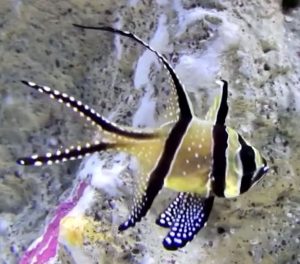
Banggai Cardinalfish (Pterapogon kauderni)
Minimum Tank Size: Single specimen 30 gallons, 75 gallons for small schools
Aquarium Type: FOWLR or Reef
Care Level: Easy
Temperament: Peaceful
Aquarium Hardiness: Very Hardy
Water Conditions: 73-84° F, dKH 8 – 12°, pH 8.1-8.4, sg 1.020-1.025
Max size: 3.4”
Color Form: Silver, Black, White
Diet: Carnivore
Compatibility: Reef Safe
Origin: Banggai Archipelago, Indonesia
Family: Apogonidae
Lifespan: 5 years
Aquarist Experience Level: Beginner/Advanced