Katayama Anthias (Odontanthias katayamai)
Katayama Anthias (Odontanthias katayamai) known to tropical fish keeping enthusiasts as the Rose Anthias or Yellow Spotted Anthias are an exceptionally rare deep water species native to the subtropical Western Pacific; specifically around southern Japan, Taiwan, and the Ryukyu Islands, with additional records extending to Guam and the Northern Mariana Islands.
Katayama Anthias are an exceptionally rare, deep-bodied reef dwelling species typically encountered hovering along the rocky drop-offs, deep ledges, and steep marine structures of their range in areas with strong currents at extreme depths ranging from 580 to nearly 1,000 feet where they forage and shelter among their complex rocky environment to evade ocean predators.
Although adult Rose Anthias are exclusively found at these extreme depths where temperatures remain cool year round, juveniles occasionally venture into sllightly shallower mesophotic zones where they are occasionally collected.
Katayama Anthias (Odontanthias katayamai)
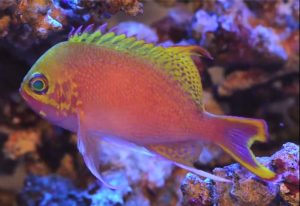
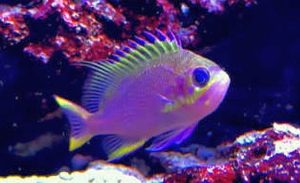
Katayama Anthias have a high, deep-bodied profile and stocky shape with striking pink, red, and yellow coloration that reveal strong fluorescence under actinic lighting. Their bodies are covered with ornate yellow spots and magenta hues, while their dorsal, pelvic, and caudal fins are edged in vibrant shades of yellow and pink, terminating in delicate filaments.
The Katayama Anthias exhibits sexual dimorphism, with adult males being noticeably larger and displaying far more intense, vivid magenta-pink bodies overlaid with bright yellow blotches and heavily elongated filaments on the anal and caudal fins.
Females have slightly more subdued colors, maintaining a more uniform reddish-pink body with soft yellow accents
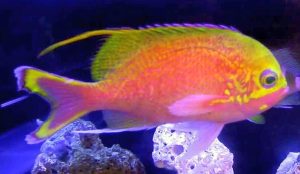
Katayama Anthias (Odontanthias katayamai)
and shorter fin extensions.
Juvenile Katayama Anthias display a simpler pinkish-orange body with light yellow spotting limited to the face and dorsal area. Their colors intensify and their fin filaments elongate significantly as they mature into adulthood.
Odontanthias katayamai are best housed singly or in small haremic groups in a mature, well-established cool-water FOWLR or reef aquarium of at least 100 to 150 gallons capacity, with a fine sand or crushed coral substrate and plenty of live rock arranged into deep caves, overhangs, and archways for them to retreat into.
Because they originate from deep mesophotic reefs, they require dim to moderate lighting and shaded lower-light areas to escape intense reef lights.
Strong to moderate water movement provided by wavemakers is recommended to mimic the high-oxygen, current-rich environment of their natural habitat. An aquarium chiller is essential to maintain cold water parameters, holding temperatures strictly below typical tropical reef levels.
The Katayama Anthias is completely reef safe and will not bother corals, clams, or decorative invertebrates in a reef environment. Generally peaceful toward non-conspecifics, they can be kept singly or as a single male with a small group of females. However, keeping multiple males in the same tank or housing small groups in undersized systems will result in severe territorial aggression.
Compatible tank mates that coexist peacefully with the Katayama Anthias include cool-water tolerant, non-aggressive species such as Plectranthias, deepwater pipefish, cool-water gobies, tilefish, and calm blennies, rather than boisterous shallow-water reef fish.
Unlike the Cherry Sakura Anthias (Sacura margaritacea) the Katayama Anthias has recently achieved groundbreaking success in captive propagation, with captive-bred specimens raised and commercially offered by several specialist breeders.
Odontanthias katayamai are deepwater protogynous hermaphrodites that form haremic social structures in the wild, with the largest and most dominant female in a group transitioning into a male if the presiding male dies or is removed. They are pelagic spawners that perform elaborate courtship displays near dusk, where the male flicks his fins and performs vertical dives to entice females into the water column. During spawning, eggs and sperm are released simultaneously into the current without subsequent parental care.
Breeding in a closed system requires a mature, specialized cool-water setup of 150 gallons or larger, maintained at temperatures between 62–68°F and decorated with extensive rockwork overhangs. Conditioning a healthy harem with 4 to 5 high-protein live and frozen feedings a day is necessary to simulate seasonal nutrient abundance and encourage regular spawning behavior.
The tiny larvae require a continuous supply of live micro-zooplankton after yolk-sac absorption. Feeding must begin with tiny copepod nauplii such as Parvocalanus crassirostris multiple times daily to maintain a dense prey concentration. As the larvae develop over several weeks, their diet transitions to enriched rotifers (Brachionus plicatilis) and eventually to larger copepods (Tisbe or Apocyclops) and newly hatched Artemia nauplii.
Maintaining constant prey density in the larval tank is vital, as the tiny planktivorous larvae will starve if they do not float directly among dense clouds of live foods. Tinting the larval water with live microalgae like Isochrysis galbana (“greenwater technique”) reduces stress, provides background contrast for larval hunting, and keeps the prey enriched.
In their natural habitat, Katayama Anthias feed strictly on zooplankton, copepods, and small planktonic crustaceans drifting in deep ocean currents. In an aquarium environment, they have a high metabolism and require a varied, protein rich carnivorous diet that includes frozen PE Mysis shrimp, enriched brine shrimp, Calanus, live copepods, and high-quality marine pellets like TDO Chromos. To replicate their natural grazing habits, frequent small feedings 3 to 5 times daily are highly recommended in lieu of single large feedings.
An attached refugium for cultivating live copepods and amphipods is highly recommended to provide a continuous, natural supply of nutritious micro-fauna for this highly sought after species.
The Katayama Anthias (Odontanthias katayamai) is one of the absolute rarest and most coveted species in the entire marine aquarium trade. Wild caught specimens require deep rebreather collection from extreme depths, making them exceptionally scarce and historically priced anywhere from $8,000 to over $12,000 per fish.
Outside of the Japanese market, exports are rare enough that each occurrence is treated as a notable event rather than a routine import. The first live imported Katayama Anthias ever offered for sale domestically was in 2021 by Marine Collectors and sold at $10,000.
However, with the recent availability of captive bred juvenile specimens through elite importers and specialty retailers; tropical fish keeping enthusiasts now have a far hardier and more accessible option. Odontanthias katayamai depending on size and availability are now typically commanding prices between $1,500 and $3,500.
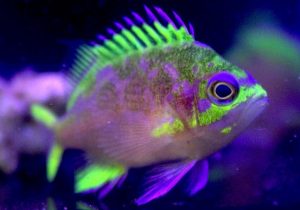
Katayama Anthias (Odontanthias katayamai)
Minimum Tank Size: 150 gallons
Aquarium Type: Cool-Water Reef or FOWLR
Care Level: Expert / Advanced
Temperament: Semi-Aggressive (toward conspecifics)
Aquarium Hardiness: Hardy when acclimated to cool parameters
Water Conditions: 62-68° F, dKH 8 to 12, pH 8.1-8.4, sg 1.023-1.025
Max size: 6.5″
Color Form: Pink, Red, Yellow, Magenta
Diet: Carnivore / Planktivore
Compatibility: Reef Safe
Origin: Southern Japan, Taiwan, Ryukyu Islands
Family: Serranidae
Lifespan: 5 – 8 years
Aquarist Experience Level: Advanced