Author Archives | Fishkeeper

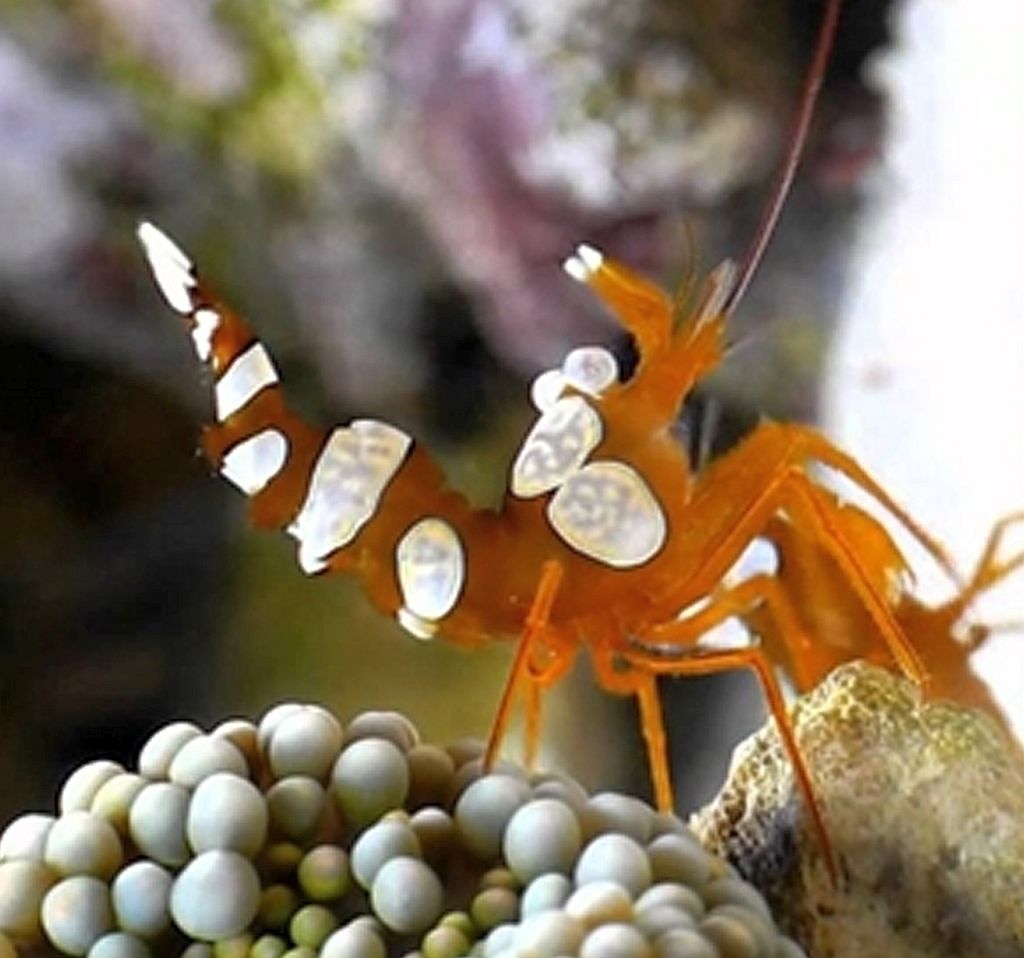
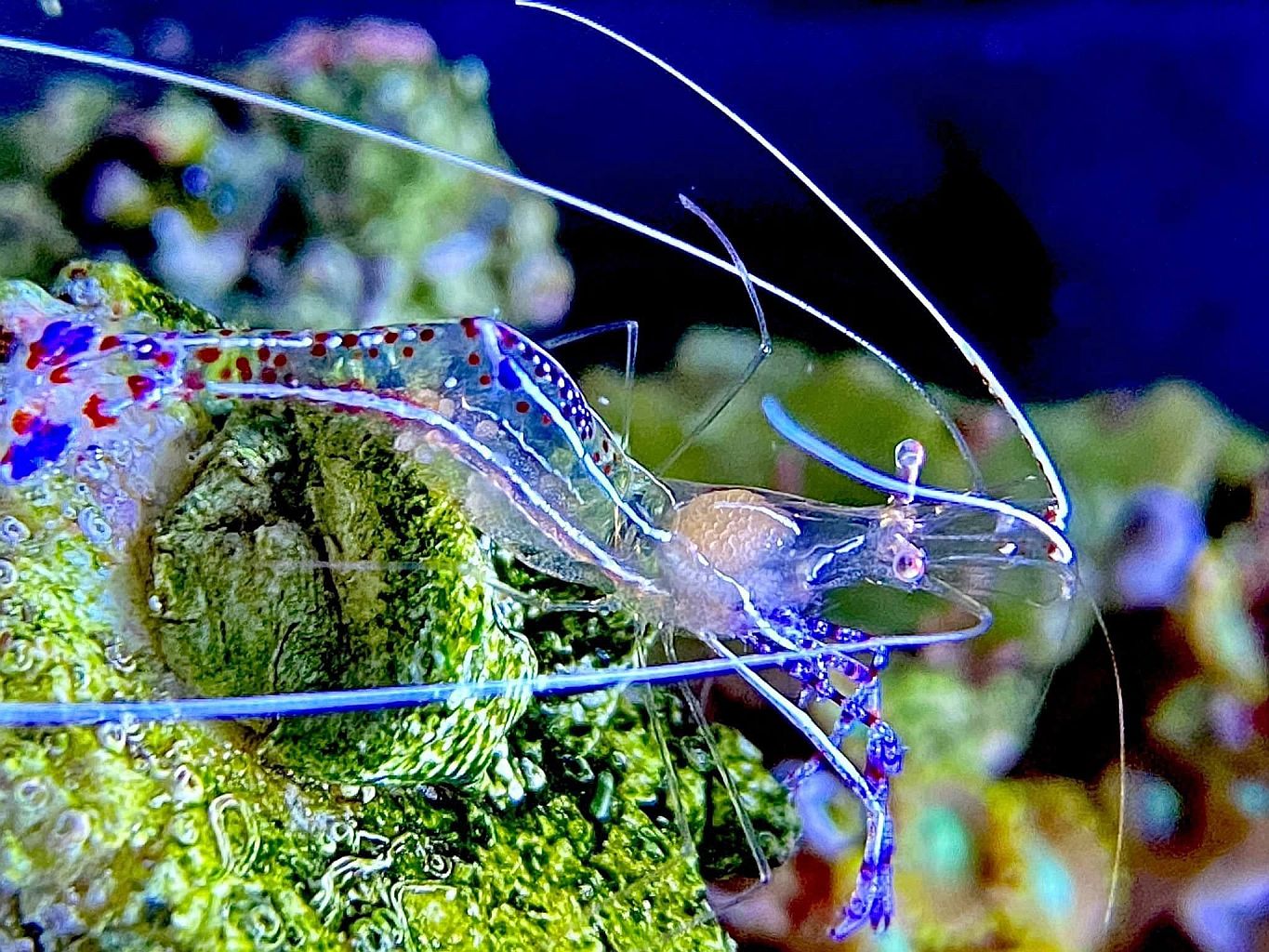
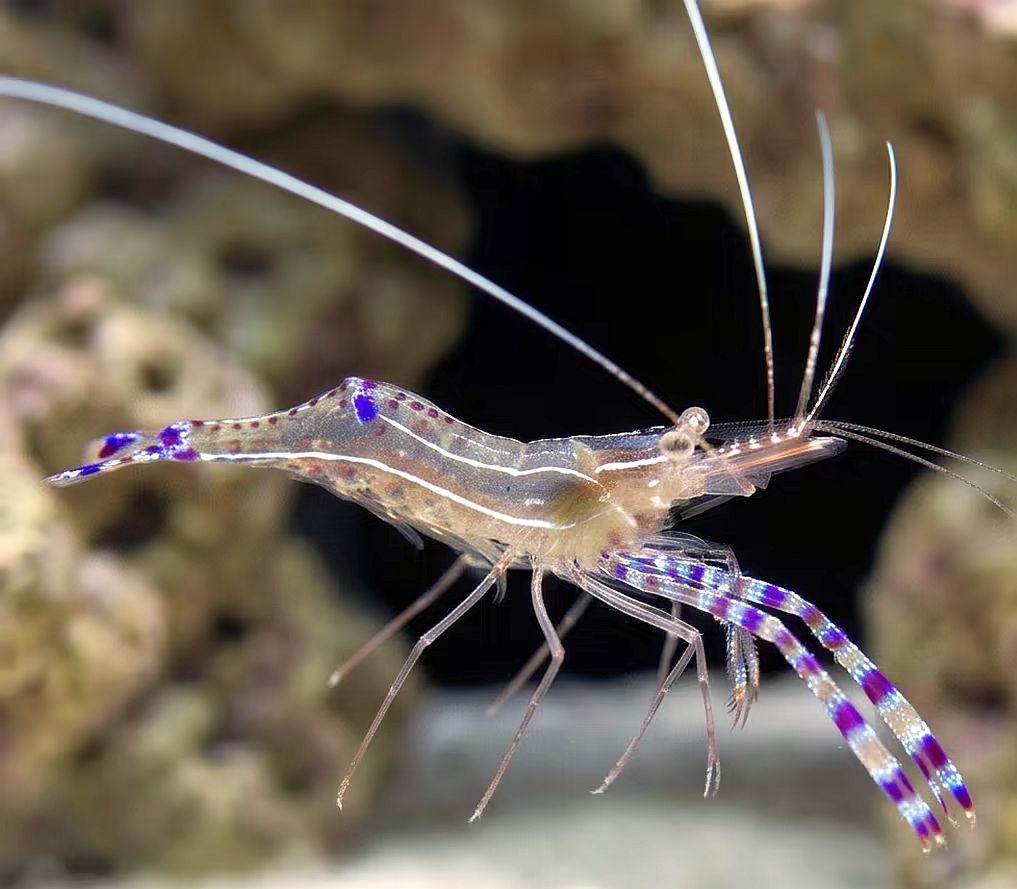
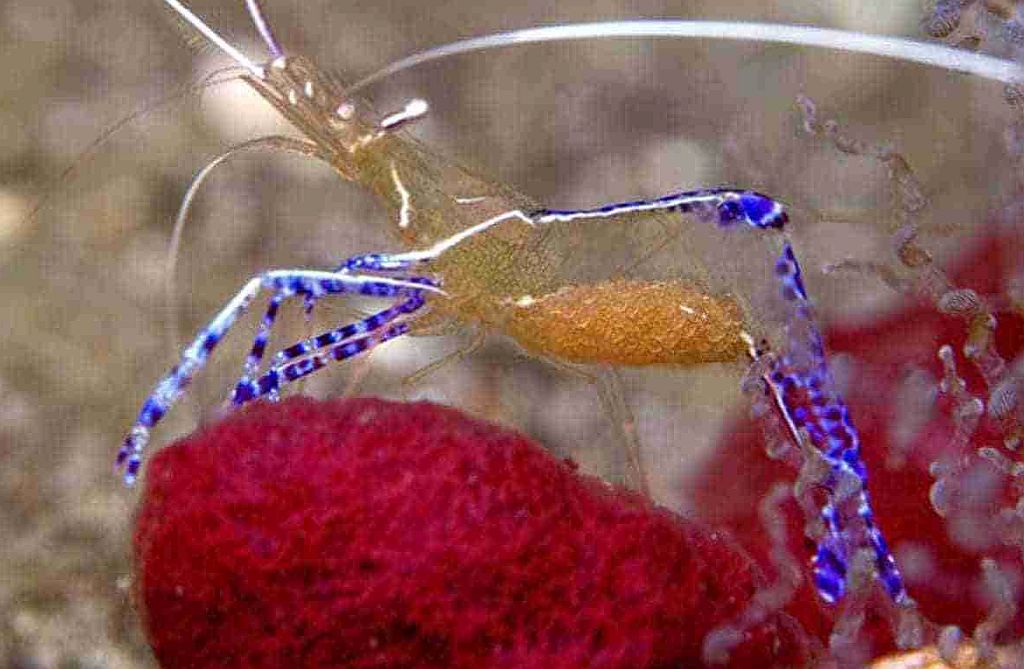
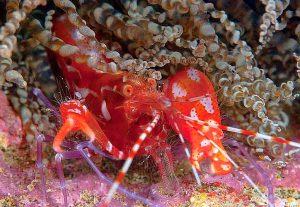
White-Patched Anemone Shrimp (Periclimenes brevicarpalis- Ancylomenes brevicarpalis)

White-Patched Anemone Shrimp (Periclimenes brevicarpalis / Ancylomenes brevicarpalis)

White-Patched Anemone Shrimp (Periclimenes brevicarpalis- Ancylomenes brevicarpalis)

White-Patched Anemone Shrimp (Periclimenes brevicarpalis- Ancylomenes brevicarpalis)

The White-Patched Anemone Shrimp (Periclimenes brevicarpalis / Ancylomenes brevicarpalis), known to tropical fish keeping enthusiasts as the Peacock Anemone Shrimp, Glass Anemone Shrimp, or Clown Anemone Shrimp, is a marine decapod crustacean species that is found throughout the tropical waters of the Indo-West Pacific, from the Red Sea and East Africa to Australia, the Philippines, and southern Japan.

White-Patched Anemone Shrimp are normally found among the shallow coral reefs, sandy slopes, and clear coastal bays of their range at depths from 3 feet to over 100 feet where they live in a strict, obligate commensal relationship with large sea anemones and some large polyp stony (LPS) corals.

Periclimenes brevicarpalis are not natural diggers. They are constantly on the move and are active during both the day and night, spending their entire lives directly nestled within or walking along the perimeter of their host invertebrate.

Substantial numbers of White-Patched Anemone Shrimp can typically be found clustered closely together on the stinging tentacles or oral discs of Carpet Anemones (Stichodactyla species), Bubble Tip Anemones (Entacmaea quadricolor), or Long Tentacle Anemones (Macrodactyla doreensis).  Apparently, the toxic, stinging cells of these host animals provide the White-Patched Anemone Shrimp a safe haven from benthic and pelagic predators that actively hunt the open reef faces.

Although White-Patched Anemone Shrimp are frequently found together in small groups sharing the exact same host anemone, they are not necessarily social animals in a complex schooling hierarchy.   They are a docile, non-aggressive species that readily tolerate conspecifics, forming small family pairs or groups of 2 to 5 individuals that safely share the host’s protection without experiencing territorial infighting.

Periclimenes brevicarpalis are very small marine crustaceans.   Adult males only grow up to 1 inch, while females grow up to 1.5 inches in body length.
White-Patched Anemone Shrimp (Periclimenes brevicarpalis- Ancylomenes brevicarpalis)

White-Patched Anemone Shrimp (Periclimenes brevicarpalis- Ancylomenes brevicarpalis)

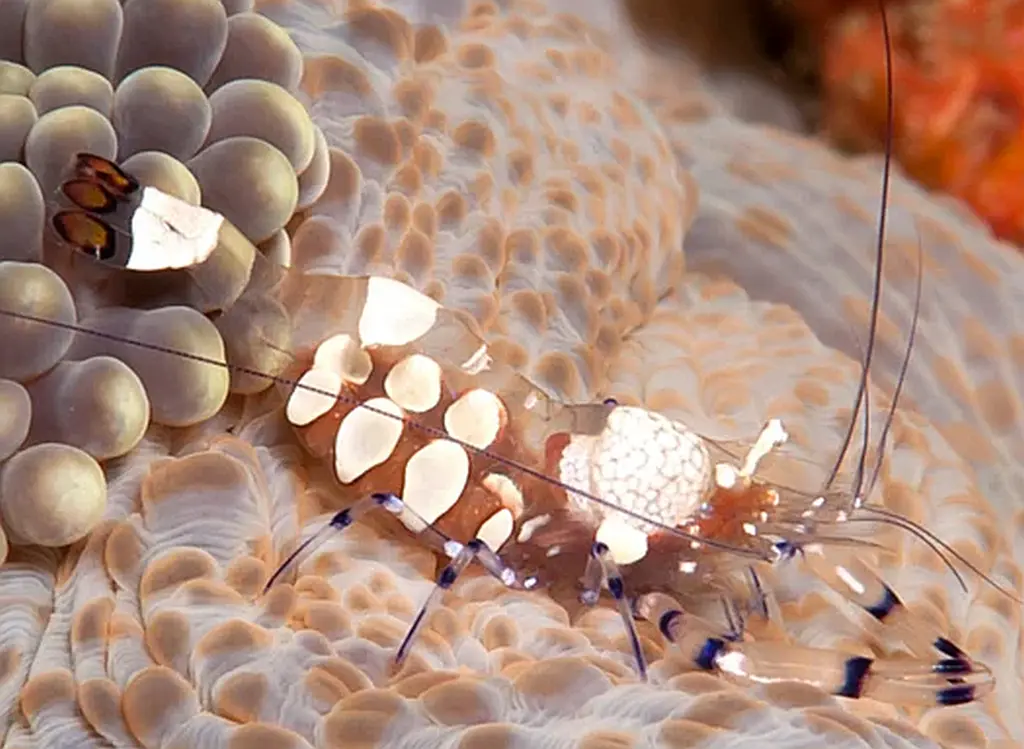
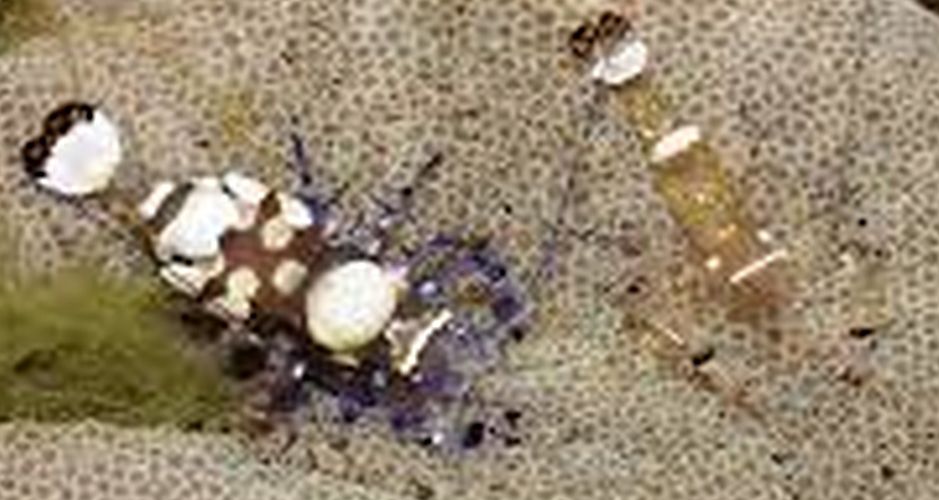
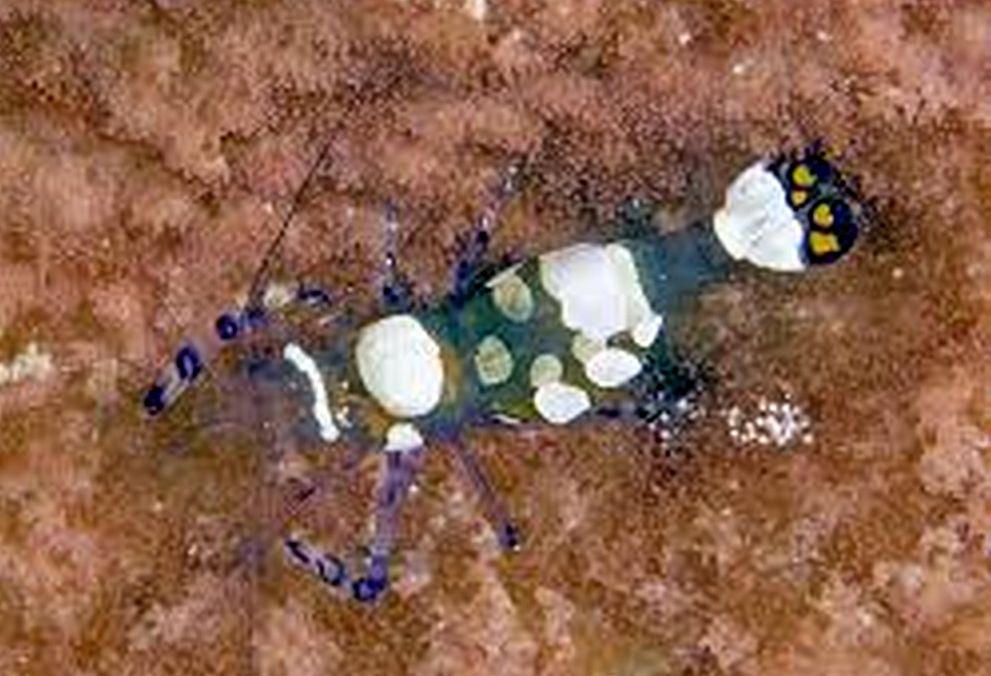
True White-Patched Anemone Shrimp have a highly transparent, glass-like see-through body adorned with a spectacular pattern of large, opaque white patches on the carapace, legs, and tail fan, alongside a distinctive iridescent purple or blue ring on the tail resembling a peacock’s feather.   They have relatively short, transparent antennae and a stockier, plumper body profile compared to their elongated Caribbean cousins.

White-patched Anemone Shrimp are gonochoric (separate male and female individuals), displaying clear external sexual dimorphism.

Mature female Periclimenes brevicarpalis grow significantly larger, stockier, and wider-bodied than males, and have significantly more white patches on their carapace to help mask and support the large egg clutches carried beneath their abdomens.
White-Patched Anemone Shrimp (Periclimenes brevicarpalis- Ancylomenes brevicarpalis)

White-Patched Anemone Shrimp (Periclimenes brevicarpalis- Ancylomenes brevicarpalis)

Unlike many marine creatures that can retreat into a heavy shell, the White-Patched Anemone Shrimp does not have a proper individual defensive shell mechanism.   Instead, they rely almost entirely on their near-total body transparency and the chemical shield of their host anemone.   When a predatory fish approaches with bad intentions, the shrimp uses its pleopods (swimmerets) to rapidly flick backward or sidestep directly between the protective, stinging folds of the host’s tentacles, completely out of harm’s way.

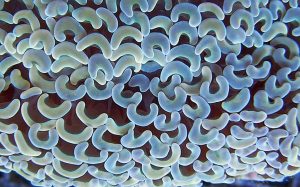
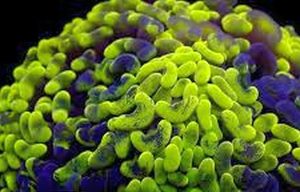
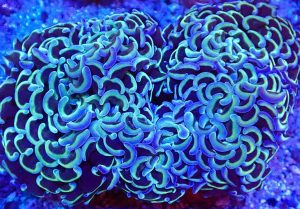
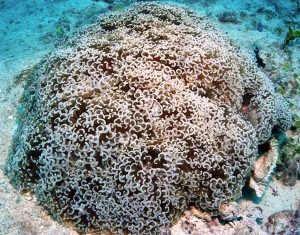
The White-Patched Anemone Shrimp is completely reef safe and is best housed in a well-established reef or nano aquarium of at least 5 gallon capacity with a smooth coralline sand substrate, plenty of live rock arranged into caves, crevices, and overhangs, and a mandatory host anemone or large polyp stony coral (like a Heliofungia or Elegance Coral) for them to inhabit.

The shrimp are far too small to cause any physical damage to any decor in a reef tank and will not bother corals, though they will continuously pace along the lips and tentacles of their chosen host.

White-Patched Anemone Shrimp are non-aggressive, exceptionally docile by nature, and are best housed in a small, dedicated nano tank with peaceful, tiny tank mates like Neon Gobies, Clown Gobies, Sexy Shrimp, and peaceful snails.

Avoid keeping them with large and/or aggressive fish, Coral Banded Shrimp, Hawkfish, Dottybacks, large predatory crabs, and all species of predatory wrasses or carnivorous fish, as their small size makes them an instant, easy snack if they wander even a few inches away from the protection of their host anemone.

Like other nano cleanup crew members, the White-Patched Anemone Shrimp (Periclimenes brevicarpalis) has an opportunistic appetite for debris, which makes them excellent candidates for a nano clean-up crew.    In the aquarium, they are great miniature scavengers that thrive on microscopic detritus, debris, sloughed tissue, organic film, and the excess mucus shed by their host anemones or corals.

The White-Patched Anemone Shrimp is relatively easy to keep, provided they are given a suitable host invertebrate and are kept away from predatory tank mates.   They are very sensitive to sudden changes in water values, especially rapid drops in salinity and pH, and copper-based medications are completely lethal to them.   In addition to stable water quality, they require a constant food source, a stable tropical water temperature between 72–78°F, and adequate iodine levels to support their frequent molting process.   An excellent filtration system, protein skimmer, and regular partial water changes are highly recommended to keep this tiny species healthy.

Though mature pairs frequently mate and produce eggs in the home aquarium, White-patched anemone shrimp do not generally reproduce successfully in a standard community environment due to their complex planktonic larval stages.   Mating takes place immediately following a female’s molt, and the female carries a small cluster of translucent, fertilized eggs under her abdomen attached to her pleopods for roughly 10 to 14 days.

The larvae hatch and are released into the water column after dark.   In a standard reef aquarium, the clouded water may briefly trigger a minor feeding response from corals and other filter feeders, as the microscopic free-swimming larvae are treated as immediate planktonic food and are quickly eaten by fish long before they can metamorphose into crawling juveniles.

In their natural environment, the White-Patched Anemone Shrimp feeds on microscopic detrital elements, organic film, mucus from their host anemones, and tiny pieces of food captured by the host’s tentacles.   Their primary wild food consists of grazing the surfaces of their host invertebrates without causing them any harm.

In an established reef aquarium environment, they feed on the natural biofilm in the tank along with any leftover shrimp or fish foods, such as crushed flakes, small pellets, powdered coral foods, mysis shrimp, and frozen brine shrimp.   They are opportunistic and will easily adapt to standard aquarium feeding, often waiting for food to float near their chosen host or boldly grabbing drifting particles directly out of the water column.

The White-Patched Anemone Shrimp (Periclimenes brevicarpalis) is a very popular saltwater species that can be purchased from online retailers, specialized local fish stores, and wholesalers at very reasonable prices.  Depending on size, area of collection, quantity, and vendor, current prices range from $22.00 to $52.00 per individual.

Although aquacultured specimens are increasingly becoming available due to their popularity in the micro-reef hobby, the majority of Periclimenes brevicarpalis sold to nano reef enthusiasts are wild caught.
White-Patched Anemone Shrimp (Periclimenes brevicarpalis- Ancylomenes brevicarpalis)

White-Patched Anemone Shrimp (Periclimenes brevicarpalis- Ancylomenes brevicarpalis)


Minimum Tank Size: 5 gallons
Aquarium Type: Nano Reef or Dedicated Invertebrate Tank
Care Level: Easy to Moderate
Temperament: Peaceful
Aquarium Hardiness: Semi-Hardy
Water Conditions: 72–78°F, dKH 8 to 12, pH 8.1-8.4, sg 1.023-1.025
Max. Size: 1.5″
Color Form: Transparent with Large White Patches and Purple/Blue Tail Spots
Diet: Omnivore/scavenger
Compatibility: Reef Compatible
Origin: Indo-West Pacific (Red Sea to Australia)
Family: Palaemonidae
Lifespan: 1 – 2 years
Aquarist Experience Level: Beginner to Intermediate

Posted in Tropical Fish Keeping, Featured Articles, Invertebrates, Saltwater, Shrimp, Tropical Fish Species0 Comments

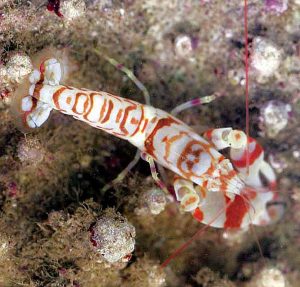
Harlequin Shrimp (Hymenocera picta)

Harlequin Shrimp (Hymenocera picta)

Harlequin Shrimp (Hymenocera picta)

Harlequin Shrimp (Hymenocera picta)

The Harlequin Shrimp (Hymenocera picta), known to tropical fish keeping enthusiasts as the Painted Shrimp or Clown Shrimp, is found throughout the tropical waters of the Indo-West Pacific and the Eastern Pacific Ocean.

The Harlequin Shrimp is a small marine decapod crustacean that is normally found among the shallow coral reefs, rocky crevices, and rubble fields of their range at depths from the low intertidal zone to around 65 feet where they spend their lives hunting their exclusive prey, the sea starfish.

Hymenocera picta are not natural diggers. They are a highly deliberate, constantly moving, mostly nocturnal species, with the peak of their hunting activity begfinning at dusk.

Substantial numbers of Harlequin Shrimp can often be found tucked away inside small caves or beneath low rocky ledges during the day. The dense rockwork apparently provides Harlequin Shrimp a safe haven from benthic and pelagic predators that hunt them from the open reef, especially large wrasses and moray eels.

Although Harlequin Shrimp are frequently found sharing the same reef system, they are not necessarily social animals in a large colony. They are a docile, non-aggressive species toward fish, but they are highly territorial toward other members of their own sex.

Except for the strict, lifelong monogamous pairs they form to hunt much larger starfish like Acanthaster planci (Crown-of-Thorns) or Linckia laevigata, Harlequin Shrimp do not seem to associate much with conspecifics.

Because the majority of starfish they hunt are often much larger than the shrimp themselves, Harlequin Shrimp

Harlequin Shrimp (Hymenocera picta)

Harlequin Shrimp (Hymenocera picta)

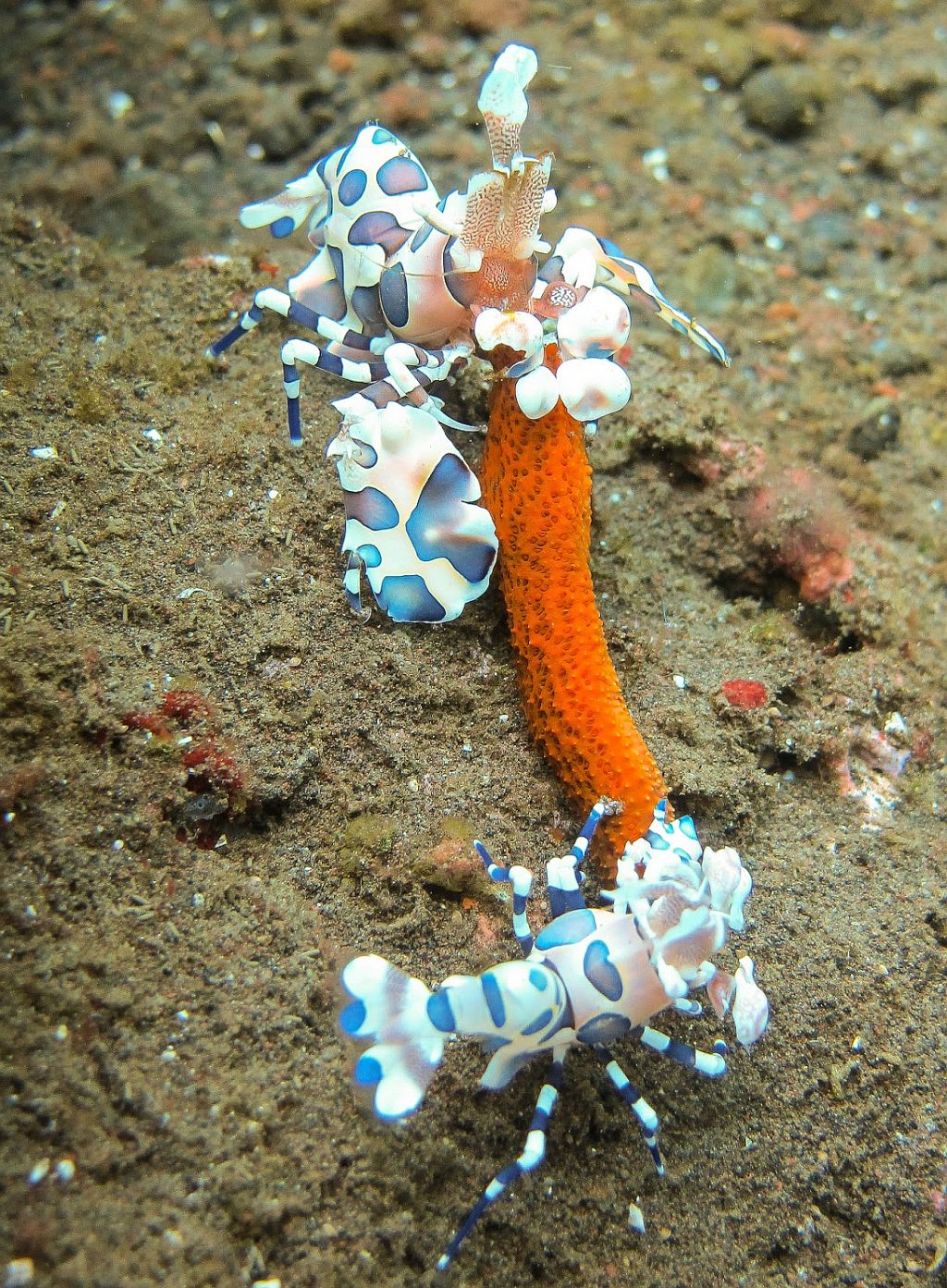
pairs use their petal-like sensory antennules to track down a target. They work together to flip the starfish onto its back to immobilize it, and then methodically eat it alive over the course of days or several weeks, focusing on the tube feet and soft tissues first to keep the prey alive for as long as possible.

Hymenocera picta seldom exceed 1.5 to 2 inches in body length.

Harlequin Shrimp (Hymenocera picta)

Harlequin Shrimp (Hymenocera picta)

True Harlequin Shrimp feature an extraordinary, highly distinct look with a translucent, cream-white to yellowish body adorned with large, ornate spots. These vibrant pink, purple, or blue markings are frequently outlined by a dark ring, creating a striking contrast. Their physical structure is highly modified into a leaf-like shape, complete with flattened, petal-shaped antennae. They also possess massively expanded, shield-like pincers, which they wave rhythmically to navigate their surroundings and deter rivals.

Harlequin shrimp are gonochoric, displaying clear external sexual dimorphism. Mature females are noticeably larger and heavier-bodied than males and possess colored abdominal plates (pleopods) on the underside of their body. Males lack the distinct color patterns on their abdominal plates.

Unlike many marine creatures that can retreat into a heavy shell for protection, the Harlequin Shrimp does not have a heavy defensive armor shell. Instead, they rely on their cryptic, disruptive coloration to blend into toxic sea anemones or corals, and use their intimidating leaf-like claws to ward off threats.

While generally slow and methodical, Harlequin Shrimp can escape danger in an instant. When threatened, they use their pleopods to execute a sudden, backward tail-flick, launching themselves deep into the safety of the rockwork.

The Harlequin Shrimp is completely reef safe with caution and is best housed in a well-established reef aquarium of at least 10 gallons in capacity. The ideal setup includes a fine coralline sand substrate, plenty of live rock arranged into small caves, crevices, overhangs, and stable hiding places, leaving sufficient room for a mated pair to roam.

Although Harlequin Shrimp are too small to cause any damage in a reef tank and will completely ignore all corals and true anemones, they will aggressively hunt down and consume any ornamental starfish in the aquarium.

Harlequin Shrimp are quite docile and non-aggressive. They do exceptionally well in a mature FOWLR or nano reef tank with peaceful tank mates like small, non-carnivorous fish.

Good tankmates include: Firefish, Gobies, Blennies, Cardinalfish, and peaceful snails like Cerith or Trochus snails.

Tankmates to avoid: Larger and more aggressive fish, Hawkfish, Dottybacks, Coral Banded Shrimp, large predatory crabs, and all species of starfish-eating or predatory wrasses that will view these slow-moving ornamental shrimp as an easy meal.

Unlike almost all other cleanup crew members, Harlequin Shrimp (Hymenocera picta) have an incredibly strict, specialized diet and lack the ravenous appetite for algae or fish waste that other shrimp species posses.

In the aquarium, Clown Shrimp are obligate carnivores that thrive exclusively on the tube feet and tissue of live echinoderms, specifically starfish like the Chocolate Chip Starfish or the nuisance micro Asterina starfish, making them legendary biological weapons for clearing out Asterina starfish plagues in reef systems.

Because of its highly specific diet, the Harlequin Shrimp is not especially easy to keep long-term. They are extremely sensitive to sudden changes in water parameters, particularly sudden drops in salinity. Furthermore, copper-based medications are completely lethal to them.

In addition to pristine water quality, they require stable tropical water temperatures between 72–78°F, adequate iodine levels to support their regular molting process, and a constant, steady supply of live starfish to survive. An excellent reef filtration system and oversize protein skimmer are highly recommended to handle the organic waste generated by decaying starfish pieces.

Though there have been sporadic reports of successfully raising Hymenocera picta in specialized aquaculture facilities, Harlequin shrimp do not generally reproduce successfully in a standard home aquarium environment due to their highly delicate planktonic larval stages.

Mated pairs stay closely bonded and spawning occurs right after the female molts. The female carries a large cluster of thousands of bright, fertilized eggs under her abdomen attached to her pleopods for roughly 12 to 18 days. The tiny larvae hatch and are released into the water column after dark.

In a standard reef or FOWLR aquarium, this release will usually cloud up the waterr to trigger a minor feeding response from corals. The microscopic free-swimming larvae are treated as immediate planktonic food and are quickly consumed by fish long before they can complete their numerous larval molting phases.

In their natural environment, the Harlequin Shrimp feeds exclusively on the vascular tube feet and soft tissues of live starfish, including large species like the Crown-of-Thorns starfish (Acanthaster planci), Linckia, and Fromia species. They hunt their prey as a pair working together to flip a starfish onto its back, rendering it helpless while they slowly consume it alive over several days.

In an established aquarium environment, Harlequin Shrimp will only feed on live starfish like the inexpensive Chocolate Chip Starfish (Protoreaster nodosus) or wild-caught Asterina starfish. They will completely ignore flakes, pellets, algae wafers, frozen mysis, brine shrimp, or any other prepared seafoods and will starve to death if a continuous supply of live starfish is not provided.

Experienced tropical fish keeping enthusiasts will often keep 2 or 3 live Chocolate Chip Starfish in the sump or refugium and humanely slice off a single leg every week to drop into the main tank. The live leg will stay fresh while the shrimp eats it, and the donor starfish will slowly regenerate its limb while recovering in the sump.

The Harlequin Shrimp (Hymenocera picta) is a highly sought-after, premium saltwater species that can be purchased from online retailers, specialized local fish stores, and wholesalers.

They are frequently sold online to tropical nano-reef keeping enthusiasts as specialized biological solutions for Asterina starfish infestations or exotic additions to miniature nano reef aquariums. Current retail prices typically range from $40.00 to over $90.00 per individual, depending on the size, sex, and whether they are purchased as a certified mated pair.

Although aquacultured specimens are occasionally available from specialized breeders; the majority of Harlequin Shrimp are wild caught.

Harlequin Shrimp (Hymenocera picta)

Harlequin Shrimp (Hymenocera picta)


Minimum Tank Size: 10 gallons
Aquarium Type: Established Reef or FOWLR
Care Level: Difficult (Due to strict diet)
Temperament: Peaceful
Aquarium Hardiness: Semi-Hardy
Water Conditions: 72–78°F, dKH 8 to 12, pH 8.1–8.4, sg 1.023–1.025
Max. Size: 2″
Color Form: Cream-White with Pink, Purple, or Blue Spots
Diet: Strict Obligate Carnivore (Starfish only)
Compatibility: Reef Compatible (Will eat ornamental Starfish)
Origin: Indo-West Pacific, Eastern Pacific
Family: Palaemonidae
Lifespan: 2 – 5 years
Aquarist Experience Level: Intermediate to Expert

Posted in Featured Articles, Invertebrates, Saltwater, Shrimp, Tropical Fish Keeping, Tropical Fish Species0 Comments

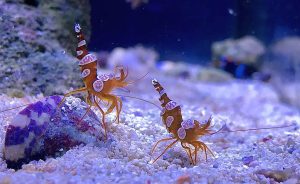
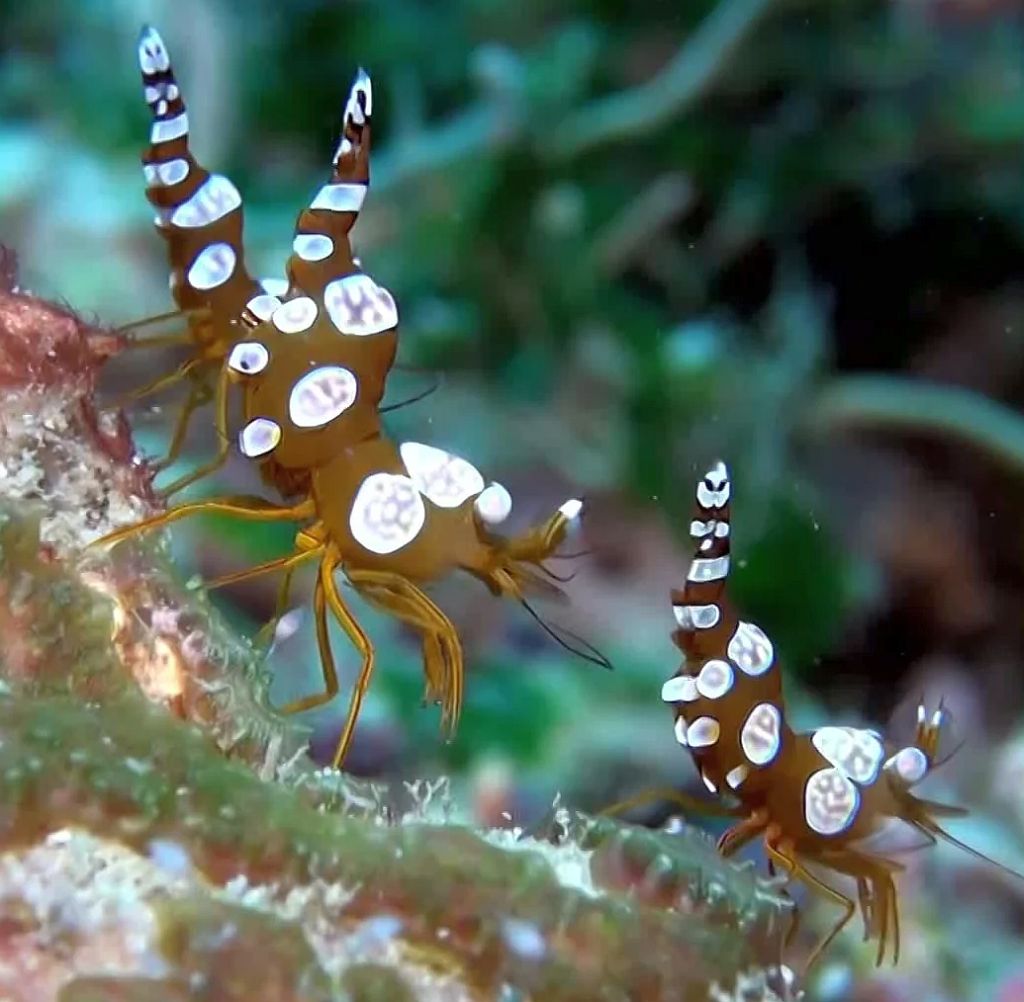
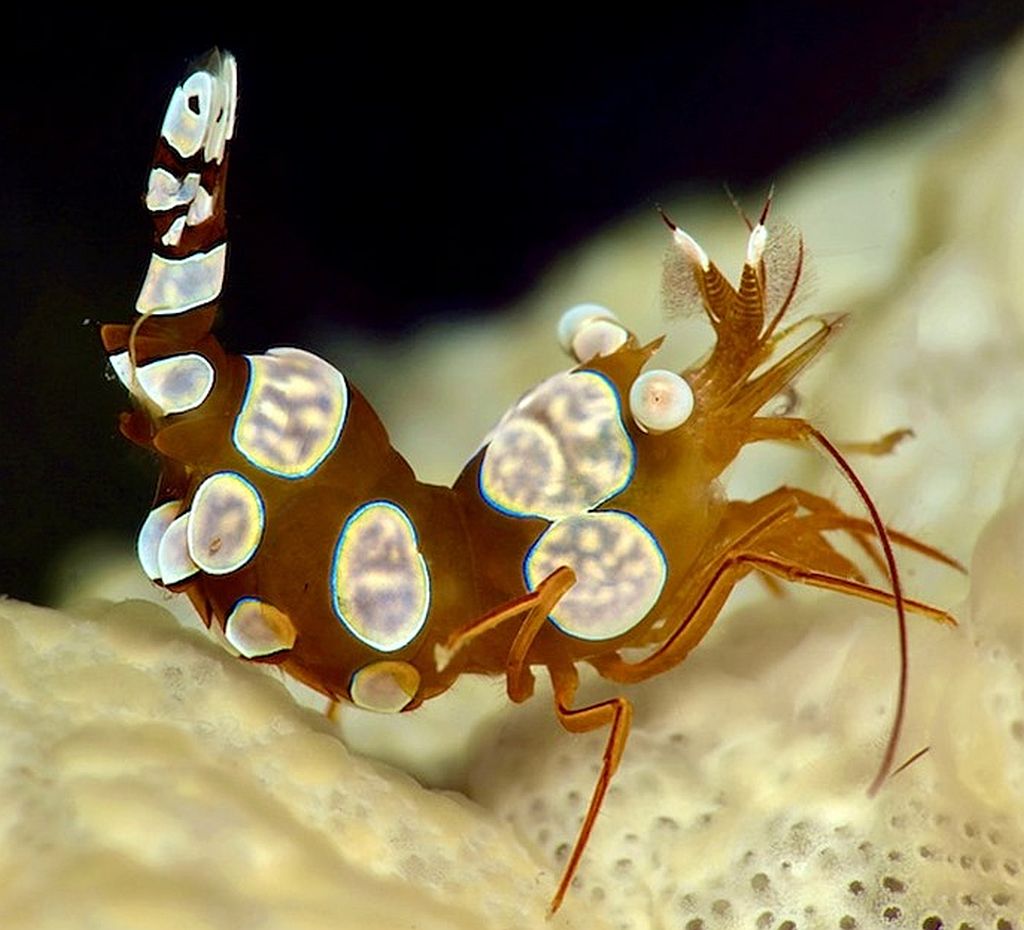
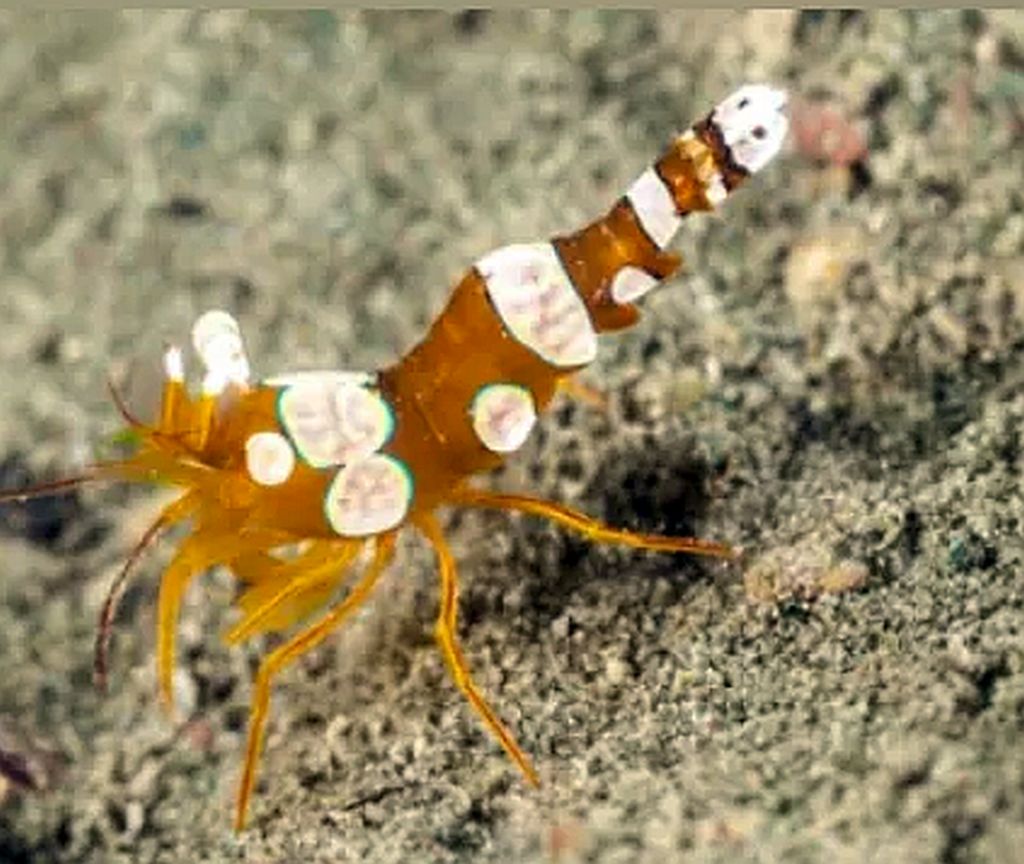
Sexy Shrimp (Thor amboinensis)

Sexy Shrimp (Thor amboinensis)

Sexy Shrimp (Thor amboinensis)

Sexy Shrimp (Thor amboinensis)

The Sexy Shrimp (Thor amboinensis), known to tropical fish keeping enthusiasts as the High-backed Shrimp, Squat Shrimp, or Dancing Shrimp, is a marine decapod crustacean species that is found globally throughout the tropical waters of the Indo-West Pacific and the western Atlantic Ocean.

Sexy Shrimp are normally found among the coral reefs and shallow lagoons of their range at depths from the low intertidal zone to around 60 feet, where they often set up a commensal relationship with various species of large sea anemones and corals.

Thor amboinensis are not natural diggers.   They are very active and constantly on the move throughou the day and night, and  are most frequently seen actively displaying on or near their host invertebrates.

Substantial numbers of Sexy Shrimp can typically be found clustered closely together around the base or the

Sexy Shrimp (Thor amboinensis)

Sexy Shrimp (Thor amboinensis)

tentacles of host anemones, carpet anemones, or large polyp stony (LPS) corals.    Apparently, the stinging tentacles of these hosts provide the tiny Sexy Shrimp a safe haven from benthic and pelagic predators that would otherwise easily snap them up from below or above.

Although Sexy Shrimp are frequently found together in large numbers around a single host, they are not necessarily social animals in a complex structural school.   They are a docile, completely non-aggressive species that readily associate with conspecifics, forming peaceful colonies that safely share the exact same host territory without any infighting.

Thor amboinensis are exceptionally tiny marine crustaceans that seldom exceed 0.5 to 0.75 inches in body length.

Sexy Shrimp (Thor amboinensis)

Sexy Shrimp (Thor amboinensis)

True Sexy Shrimp have a striking, highly distinct coloration featuring a bright orange-brown to olive body adorned with large, iridescent white or silver spots outlined in fine blue rings. They possess a characteristic behavior where they continuously arch their abdomens upward over their heads and wag their tails back and forth in a distinct “dancing” motion, which gives them their unique common name.

Sexy shrimp are protandric hermaphrodites, meaning they function initially as males and later transition into larger females as they mature. Unlike many smaller shrimp species, they do display mild external sexual dimorphism; mature females are significantly larger than males and possess slightly different abdominal plating to support egg carrying.

Unlike larger marine organisms that can rely on size or a heavy shell, the Sexy Shrimp does not have a proper individual defensive mechanism.   Instead, they rely almost entirely on their tiny size, transparent camouflage elements, and the chemical protection of their stinging host anemone.   Their top speed is quite quick when they utilize a rapid backward tail-flick to jump through the water column directly into the protective folds of their host when threatened.

The Sexy Shrimp is completely reef safe with caution and is best housed in a well-established 5 or 10 gallon nano or pico reef aquarium with a fine coralline gravel or sandy substrate, plenty of live rock arranged into mini hiding places, and a suitable host coral or anemone for them to inhabit.   Although a large colony of Sexy Shrimp may occasionally nip slightly at the mucus layer of a host coral if alternative food sources are scarce, they are far too small to cause any serious damage to any decor in a reef aquarium.

Sexy Shrimp are non-aggressive and exceptionally docile by nature. They are at their best in a small, dedicated nano tank with peaceful, tiny tank mates like Neon Gobies, Clown Gobies, or small, non-carnivorous fish.

Good tankmates include Bumble Bee Snails, Cerith Snails, Trochus Snails, and other miniature ornamental shrimp like Pederson Cleaner Shrimps.

Because their minuscule size makes them an instant snack for almost any predatory tank mate, avoid housing them with Coral Banded Shrimp, Hawkfish, Dottybacks, most species of crab, any large or aggressive fish, and all carnivorous species.

Like other nano cleanup crew members, the Sexy Shrimp (Thor amboinensis) has an opportunistic appetite for debris, which makes them great candidates for a micro tank clean-up crew. In the aquarium, they are excellent miniature scavengers that thrive on organic debris, sloughed tissue, microscopic detritus, and mucus shed by their host anemones or corals.

Provided they are housed in small aquariums without predatory fish, Sexy Shrimp are relatively easy to keep. They

Sexy Shrimp (Thor amboinensis)

Sexy Shrimp (Thor amboinensis)

are very sensitive to sudden changes in water values, especially parameters like salinity, pH, and water temperature. In addition to stable water quality, they require a constant food source, a stable tropical water temperature between 72–78°F, and adequate iodine levels to support their frequent molting process.

An excellent filtration system and regular partial water changes are highly recommended to keep this tiny species healthy.

Despite a handful of reports of successful captive breeding; Sexy Shrimp do not generally yield surviving offspring in a standard community aquarium environment.

Breeding pairs form naturally within a colony, and mating occurs right after the female molts. The female carries a small cluster of bright fertilized eggs under her abdomen for roughly 2 to 3 weeks. The tiny larvae are released into the water column after dark. In a standard nano or small reef aquarium, the release may briefly trigger a feeding response from corals. The microscopic free-swimming larvae are usually regarded as planktonic food and are quickly consumed before they can ever complete their complex larval molting stages.

In their natural environment, the Sexy Shrimp feeds on microscopic detrital elements, organic film, mucus from their host coelenterates, and tiny pieces of captured food. Their primary wild food consists of grazing the surfaces of their host invertebrates without causing them harm.

In an established aquarium environment, they feed on the natural biofilm in the tank along with any leftover shrimp or fish foods, such as crushed flakes, small pellets, powdered coral foods, mysis shrimp, and frozen brine shrimp. They are surprisingly bold feeders for their size and will happily leave their host for brief moments during feeding times to grab drifting food particles.

The Sexy Shrimp (Thor amboinensis) is a very popular saltwater species that can be purchased from online retailers, local fish stores, and specialized transhippers at very reasonable, inexpensive prices.

They are frequently sold online to tropical nano-reef keeping enthusiasts as specialized additions to miniature aquariums. Current retail prices typically range from $19.99 to over $29.99 per individual.

Because these social invertebrates do best when kept in groups, many online vendors offer discounted bundle packs or bulk pricing tiers.

Although aquacultured specimens are becoming more available due to their popularity in the micro-reef hobby, the majority of Sexy Shrimp sold to tropical fish keeping enthusiasts are wild caught.

Sexy Shrimp (Thor amboinensis)

Sexy Shrimp (Thor amboinensis)


Minimum Tank Size: 5 gallons
Aquarium Type: Nano Reef or Dedicated Invertebrate Tank
Care Level: Easy to Moderate
Temperament: Peaceful
Aquarium Hardiness: Semi-Hardy (Vulnerable to sudden water shifts)
Water Conditions: 72–78°F, dKH 8 to 12, pH 8.1-8.4, sg 1.023-1.025
Max. Size: 0.75″
Color Form: Orange-Brown, White/Silver Spots, Blue Outlines
Diet: Omnivore/scavenger
Compatibility: Reef Compatible (With Caution)
Origin: Indo-Pacific, Caribbean, Western Atlantic
Family: Thoridae
Lifespan: 1 – 3 years
Aquarist Experience Level: Beginner to Intermediate
Posted in Featured Articles, Invertebrates, Saltwater, Shrimp, Tropical Fish Keeping, Tropical Fish Species0 Comments

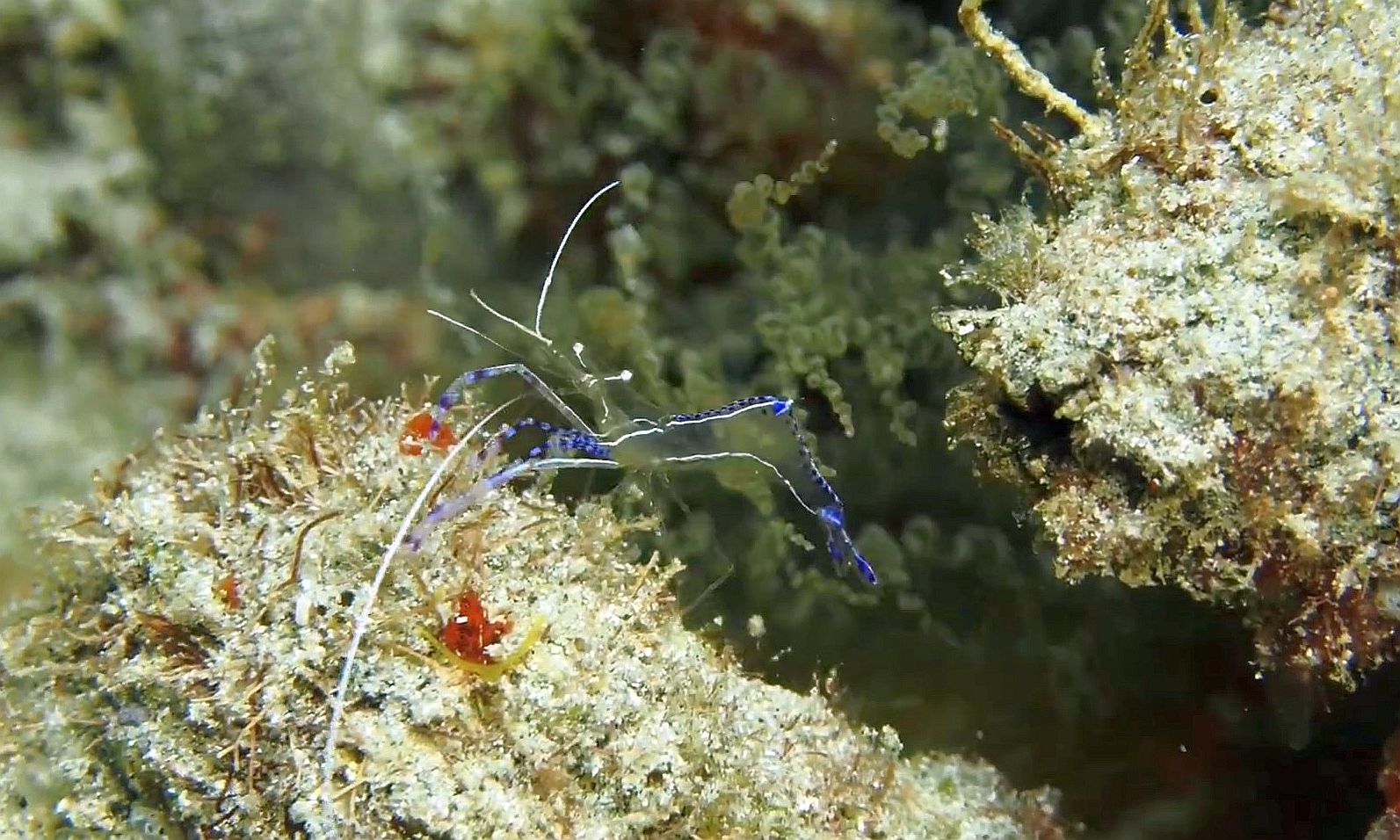
Pederson Cleaner Shrimp (Periclimenes pedersoni)

Pederson Cleaner Shrimp (Anemonefera pedersoni / Periclimenes pedersoni)

Pederson Cleaner Shrimp (Periclimenes pedersoni)

Pederson Cleaner Shrimp (Periclimenes pedersoni)

The Pederson Cleaner Shrimp (Anemonefera pedersoni / Periclimenes pedersoni), known to tropical fish keeping enthusiasts as the Pederson Anemone Shrimp or Caribbean Cleaner Shrimp, is a marine decapod crustacean species that is found throughout the western Atlantic Ocean, from the waters of North Carolina and Bermuda, through the Caribbean Sea and Gulf of Mexico, down to northern South America.

Pederson Cleaner Shrimp are normally found among shallow coral reefs and clear lagoons of their range at depths from 3 feet to over 100 feet where they live in strict, obligate commensal relationships with large sea anemones.

Periclimenes pedersoni are not natural diggers.   They are an active species that seem to be constantly on the

Pederson Cleaner Shrimp (Periclimenes pedersoni)

Pederson Cleaner Shrimp (Periclimenes pedersoni)

move throughout the day and night, spending their entire lives directly on or within the immediate perimeter of their host anemone.

Substantial numbers of Pederson Cleaner Shrimp can typically be found clustered around the column or clinging directly to the stinging tentacles of the Corkscrew Anemone (Bartholomea annulata) or the Giant Caribbean Anemone (Condylactis gigantea).   Apparently, the potent venom of these host tentacles provides the tiny Pederson Cleaner Shrimp a safe haven from benthic predators that hunt them from the reef, especially small crabs.

Although Pederson Cleaner Shrimp are frequently found together in large numbers sharing the exact same host anemone, they are not necessarily social animals in a coordinated school.   They are a docile, completely non-aggressive species that readily associate with conspecifics, forming small cleaning stations of 1 to 5 individuals that safely share the host’s protection without any territorial infighting.

Periclimenes pedersoni are exceptionally miniature marine crustaceans that seldom exceed 1 inch in body length.

Pederson Cleaner Shrimp (Periclimenes pedersoni)

Pederson Cleaner Shrimp (Periclimenes pedersoni)

True Pederson Cleaner Shrimp have a highly transparent, see-through body adorned with a striking pattern of brilliant purple and white spots, lines, and chevrons on the abdomen and tail fan.   They possess two pairs of long, fine, completely white antennae that they wave vigorously back and forth while performing a rocking, sway-dance body movement to signal passing reef fish that their specialized cleaning station is open for business.

Pederson Cleaner Shrimp are gonochoric (separate male and female individuals), displaying moderate external sexual dimorphism.   Mature females grow noticeably larger and develop a much broader, deeper abdominal cavity than males to comfortably hold and protect their developing egg clutches.

Unlike many marine creatures that can retreat into a heavy shell, the Pederson Cleaner Shrimp does not have a specialized defensive mechanism.   Instead, they rely almost entirely on their near-total glass transparency and the chemical shield of their host anemone for protection.   When a bad intentioned predatory fish approaches, the shrimp uses its pleopods (swimmerets) to rapidly flick backward into the protective, stinging folds of the host’s tentacles, out of harm’s way.

The Pederson Cleaner Shrimp is completely reef safe and is best housed in a well-established nano or pico reef

Pederson Cleaner Shrimp (Periclimenes pedersoni)

Pederson Cleaner Shrimp (Periclimenes pedersoni)

aquarium with plenty of live rock arranged into stable structures, a smooth sandy substrate, and a mandatory host anemone (such as a Bartholomea or Condylactis species) to inhabit.   The Pederson Cleaner Shrimp is far too small to cause any physical damage to decor in a reef tank and will not bother corals, though they will occasionally walk over adjacent polyps to greet client fish.

Pederson Cleaner Shrimp are non-aggressive, exceptionally docile by nature, and do best in a dedicated small aquarium with peaceful, tiny tank mates like Neon Gobies, Clown Gobies, Sexy Shrimp, and peaceful snails.  Avoid keeping them with large or aggressive fish, Coral Banded Shrimp, Hawkfish, Dottybacks, most crab species, and all species of predatory wrasses or carnivorous fish.  Their minuscule size makes them an instant, easy snack if they wander even a few inches away from their host anemone.

Like their larger relatives the Skunk Cleaner Shrimp (Lysmata amboinensis), the Pederson Cleaner Shrimp (Periclimenes pedersoni) has a ravenous appetite for parasites and dead tissue, which makes them excellent candidates for a nano tank, health clean-up crew.   In the aquarium, they are great scavengers and dedicated cleaners that thrive on fish parasites, microscopic debris, mucus, and dead skin scraped from cooperating fish clients that actively visit their anemone cleaning station.

The Pederson Cleaner Shrimp is relatively easy to keep, provided they are given a host anemone and are kept away from predatory tank mates.   They are very sensitive to sudden changes in water values, especially rapid drops in salinity and pH, and copper medications are lethal to them.   In addition to pristine water quality, they require a constant food source, a stable tropical water temperature between 72–78°F, and adequate iodine levels to support their frequent molting process.   An excellent filtration system and regular partial water changes are recommended to maintain this tiny species.

Though mature pairs frequently mate and produce eggs in an aquarium environment, Pederson Cleaner Shrimp do not generally reproduce successfully, mainly due to their complex planktonic larval stages.

Mating takes place immediately following a female’s molt, and the female carries a small cluster of translucent, fertilized eggs under her abdomen attached to her pleopods for roughly 10 to 14 days.

The tiny larvae hatch and are released into the water column after dark.  In a standard reef aquarium, the water may briefly trigger a minor feeding response from corals and other filter feeders, as the microscopic free-swimming larvae are treated as immediate planktonic food and are quickly eaten by fish long before they can metamorphose into crawling juveniles.

In their natural environment, the Pederson Cleaner Shrimp feeds on tissue parasites, mucus, and dead skin scraped from client reef fish like tangs, parrotfish, and damselfish.   Their primary wild food consists of these parasitic organisms, supplemented by small organic detrital elements caught on the mucus of their host anemone.

In an established aquarium environment, they feed on the parasites of their small tank mates along with any leftover shrimp or fish foods, such as crushed flakes, small pellets, powdered coral foods, mysis shrimp, and frozen brine shrimp.  Pederson Cleaner Shrimp are bold cleaners and will frequently walk right out onto the lips of visiting fish to pick at food, or swim to the surface to take micro-pellets directly from the aquarist’s hand.

The Pederson Cleaner Shrimp (Periclimenes pedersoni) is a popular and relatively common saltwater species that can be purchased from online retailers, local fish stores, and wholesalers at reasonable prices.     They are frequently sold online to tropical fish keeping enthusiasts as specialized biological parasite controllers and fascinating symbiotic additions for nano reef aquariums.

The current prices for a Pederson cleaner shrimp (commonly misspelled as Peterson) generally ranges from  $22.95 to over $52.99 heavily depending on the shrimp’s size, origin, and whether the vendor provides quarantined livestock.

Because captive breeding is not yet widely viable, all Pederson Cleaner Shrimp are wild caught.

Pederson Cleaner Shrimp (Periclimenes pedersoni)

Pederson Cleaner Shrimp (Periclimenes pedersoni)


Minimum Tank Size: 5 gallons
Aquarium Type: Nano Reef or Dedicated Invertebrate Tank
Care Level: Easy to Moderate
Temperament: Peaceful
Aquarium Hardiness: Semi-Hardy
Water Conditions: 72–78°F, dKH 8 to 12, pH 8.1–8.4, sg 1.023–1.025
Max. Size: 1″
Color Form: Transparent with Purple and White Spots
Diet: Omnivore/cleaner
Compatibility: Reef Compatible
Origin: Western Atlantic (North Carolina to Caribbean)
Family: Palaemonidae
Lifespan: 1 – 2 years
Aquarist Experience Level: Beginner to Intermediate
Posted in Featured Articles, Invertebrates, Saltwater, Shrimp, Tropical Fish Keeping, Tropical Fish Species0 Comments

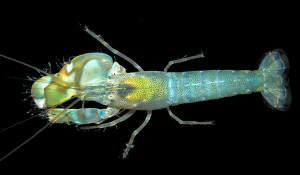
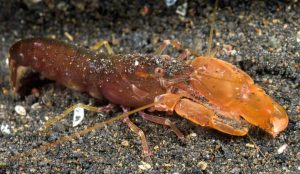
Pistol Shrimp (Alpheus heterochaelis)

Pistol Shrimp (Alpheus heterochaelis)

Pistol Shrimp (Alpheus heterochaelis)

Pistol Shrimp (Alpheus heterochaelis)

The Pistol Shrimp (Alpheus heterochaelis), known to tropical fish keeping enthusiasts as the Bigclaw Snapping Shrimp, Green Pistol Shrimp, or Snapping Shrimp, is a marine decapod crustacean species that is found throughout the western Atlantic Ocean, from North Carolina down through the Gulf of Mexico and the Caribbean to Brazil.

Pistol Shrimp are normally found among shallow estuaries, the salt marshes, and oyster reefs of their range at depths from the low intertidal zone to around 30 feet where they often inhabit muddy or sandy seafloors with plenty of scattered rubble.

Alpheus heterochaelis are consummate natural diggers.   They seem to be constantly on the move and are mostly nocturnal animals, with the peak of their activity beginning at dusk, though they will continuously excavate their tunnels throughout the day.

Large numbers of Pistol Shrimp are often found completely hidden underground in complex, multi-chambered burrows that they excavate beneath flat stones or live rock, rather than in the open.

The extensive tunnel network provides Pistol Shrimp with protection from benthic predators that hunt them from the water column above, particularly croakers and aggressive crabs.

Although Pistol Shrimp are frequently found inhabiting the same large rubble fields, this does not necessarily mean they are social animals.   They are generally non-aggressive toward peaceful fish but can be highly territorial toward other members of their own species, except when they form a compatible male-female pair and share a common burrow.

However, Pistol Shrimp are well known for forming close, mutually beneficial symbiotic relationships with various species of watchman gobies.   The goby acts as the shrimp’s “eyes,” keeping watch for potential predators, while the shrimp serves as the “bulldozer,” excavating and maintaining their shared burrow.

Pistol Shrimp (Alpheus heterochaelis)

Pistol Shrimp (Alpheus heterochaelis)

Alpheus heterochaelis are small marine crustaceans that seldom exceed 1.5 to 2 inches in body length. True Pistol Shrimp have a slightly translucent, dull greenish-brown to greyish-blue colored body that provides excellent camouflage against muddy substrates. They possess a highly modified, massively oversized snapper claw that can be up to half the size of their entire body.   This specialized claw features a plunger-like mechanism that, when snapped shut under extreme muscular tension, shoots out a high-velocity cavitation bubble capable of producing a loud “sonic pop” that stuns small prey and deters intruders.

Pistol Shrimp are gonochoric, meaning individuals are either male or female. They exhibit mild external sexual dimorphism, with mature males typically having a slightly larger snapping claw relative to their body size than females.

Unlike many marine animals that rely on thick protective shells or venomous stingers as their primary defensive mechanism, the Pistol Shrimp uses its powerful snapping claw to generate acoustic cavitation bubbles to ward off curious predators and to stun their prey.   The shrimp also uses its specialized appendages to clear shifting sand and debris from their tunnel entrances.   Their reaction time is lightning fast, allowing them to retreat backward into the safety of their burrows in an instant.

The Pistol Shrimp is completely reef safe and is best housed in a well-established FOWLR or reef aquarium of at least 20 gallon capacity, with a thick argonite sand and mixed rubble substrate, plenty of flat live rock arranged safely on the bottom glass to prevent collapsing tunnels, and sufficient room for them to burrow and build their complexes.

Pistol Shrimp are too small to damage any corals, but they will constantly rearrange loose gravel and small pieces of rubble to reinforce their burrow entrances, which can occasionally bury low-lying frags that are not securely attached.

Many species of Pistol Shrimp in the family Alpheidae form mutualistic partnerships with watchman gobies and make fascinating additions to both reef and FOWLR aquariums.

For a successful partnership, choose compatible species, preferably an established pair, and provide a suitable burrowing environment.   A deep sand bed approximately 3 to 4 inches deep, mixed with coarser coral rubble and small shell fragments, provides the shrimp with the materials they need to construct stable tunnels.   Because the shrimp’s digging can undermine the rockwork, all live rock should be situated directly on the bottom of the tank before adding the substrate.

Pistol Shrimp are secretive by nature and non-aggressive.   Choose peaceful, non-aggressive tankmates that will not harass the goby or prey on the shrimp.

Pistol Shrimp get along exceptionally well in a FOWLR tank with small, non-carnivorous fish like Yellow Watchman Gobies, Hi Fin Red Banded Gobies, Randall’s Pistol Gobies, Peppermint Shrimp, and peaceful snails like Cerith or Nassarius snails.

Although the Pistol Shrimp is relatively easy to keep and very hardy once acclimated; they are sensitive to sudden changes in water values, rapid fluctuations in salinity and pH, and copper-based medications that are lethal to them. In addition to stable water quality, they require a constant food source, a stable tropical water temperature between 72–78°F, and adequate iodine levels to support their regular molting process.

An efficient filtration system and protein skimmer is highly recommended to maintain the pristine water quality and stable water conditions they require, and because gobies are notorious jumpers, a tight fitting tank lid is essential.

Pistol Shrimp (Alpheus heterochaelis)

Pistol Shrimp (Alpheus heterochaelis)

Never house Pistol Shrimp with large and/or aggressive carnivorous fish like Hawkfish, Dottybacks, all species of large predatory wrasses, most predatory crab species, or mantis shrimp that will aggressively hunt them down inside their burrows.

Although there are a few reports of successfully hatching them in captivity, Alpheus heterochaelis do not generally reproduce successfully in a home aquarium environment due to their complex larval stages.

Males and females form tight bonds when kept as a pair, and mating occurs immediately following a female’s molt. The female carries a cluster of bright fertilized eggs (berries) under her abdomen attached to her pleopods for approximately 3 to 4 weeks.    Once the tiny, dark “eyeballs” are clearly visible in the eggs, hatching will generally occur within 24 to 48 hours; almost always at night.

In the wild, the tiny, transparent larvae spend the next 3 to 5 days drifting as zoplankton with the ocean currents, molting through their three larval stages, and dropping to the sea floor as tiny juveniles.

In a typical reef tank, the majority of larvae do not survive the first night. They are quickly drawn into the filtration system, captured by protein skimmers, or eaten by corals and fish. Few if any free swimming larvae escape from being quickly consumed by tankmates before they can metamorphose into crawling juveniles.

In their natural environment, the Pistol Shrimp is an opportunistic omnivore and ambush predator that feeds on a diverse diet of small fish, crabs, worms, amphipods, mollusks, smaller shrimp, and scavaged organic detritus, decaying animal carcasses, and macro algae that accumulate or pass by their burrow entrances.

In addition to scavenging organic materials from the mud, they use their massive claw to generate a localized acoustic shockwave to instantly stun or kill small fish or invertebrates passing their burrow entrance. The shockwave briefly emits temperatures matching the surface of the sun and reaches pressure levels louder than a gunshot.

In an aquarium environment, Alpheus heterochaelis are great scavengers that thrive on shifting the sand for detritus, debris, and any leftover shrimp or fish foods, such as sinking pellets, flakes, mysis shrimp, brine shrimp, and frozen meaty foods that drift near their burrow opening.   They will rarely venture far from their tunnel during daylight hours, preferring to wait for food to land right at their doorstep.

The Pistol Shrimp (Alpheus heterochaelis) is a very common saltwater species that can be purchased from online retailers, local fish stores, and wholesalers at reasonable prices. They are frequently sold online to tropical fish keeping enthusiasts as half of a “symbiotic pair” alongside watchman gobies for reef tanks.

Prices for individual pistol shrimp typically range from $15 to $40, while pre-bonded goby and shrimp pairs run anywhere from $60 to over $200.

Prices depend heavily on the specific species involved, whether the animals are sold individually or pre-bonded, and whether they have been fully quarantined by the retailer.

The most popular and active bulldozer, Tiger Pistol Shrimp (Alpheus bellulus) pair seamlessly with Watchman gobies and sell from $18 – $25.

The smaller bright red and white striped Randall’s / Candy Cane Pistol (Alpheus randalli) sell from $15 – $32.

The colorful but solitary Bullseye Pistol Shrimp (Alpheus soror) sell from $35 – $40.

Pistol Shrimp (Alpheus heterochaelis)

Pistol Shrimp (Alpheus heterochaelis)


Minimum Tank Size: 20 gallons
Aquarium Type: Established Reef or FOWLR
Care Level: Easy
Temperament: Peaceful (Territorial with other Pistol Shrimp)
Aquarium Hardiness: Hardy
Water Conditions: 72–78°F, dKH 8 to 12, pH 8.1-8.4, sg 1.023-1.025
Max. Size: 2″
Color Form: Green, Brown, Grey-Blue
Diet: Omnivore/scavenger
Compatibility: Reef Compatible
Origin: Western Atlantic (North Carolina to Brazil)
Family: Alpheidae
Lifespan: 1 – 3 years
Aquarist Experience Level: Beginner

Posted in Featured Articles, Invertebrates, Saltwater, Shrimp, Tropical Fish Keeping, Tropical Fish Species0 Comments

Coral Banded Shrimp (Stenopus hispidus)

Coral Banded Shrimp (Stenopus hispidus)

Coral Banded Shrimp (Stenopus hispidus)

Coral Banded Shrimp (Stenopus hispidus)

The Coral Banded Shrimp (Stenopus hispidus), known to tropical fish keeping enthusiasts as the Banded Boxer Shrimp, Banded Cleaner Shrimp, or Barber-Pole Shrimp, is a marine decapod crustacean species that is found globally throughout circumtropical marine reef habitats across both the Indo-Pacific and the western Atlantic Ocean.

Coral Banded Shrimp are normally found among shallow to deep coral reefs, ledges, and rocky crevices of their range at depths from 6 feet to over 680 feet where they often establish stable home territories.

Unlike Pistol Shrimp, Stenopus hispidus are not natural diggers. They are constantly on the move and though they remain visible during the day, they are largely nocturnal, with their peak foraging activity beginning at dusk.

Substantial numbers of Coral Banded Shrimp can typically be found hanging upside down on the roofs of caves or deep inside dark rocky crevices. The protected overhangs provide the Coral Banded Shrimp with a safe haven from groupers and other large pelagic predators that actively hunt them from the open water column.

Although Coral Banded Shrimp are frequently found in close proximity to one another on the reef; they are not necessarily social animals.

Coral Banded Shrimp are a highly territorial, semi-aggressive species that can be fiercely intolerant of conspecifics.   They do not usually associate with members of their own kind unless they form a lifelong, monogamous mated pair, occupying a strict territory that can span 3 to 10 feet in diameter.

Coral Banded Shrimp are medium sized marine crustaceans that can grow up to 2 to 3 inches in body length, excluding their exceptionally long appendages.

Coral Banded Shrimp (Stenopus hispidus)

Coral Banded Shrimp (Stenopus hispidus)

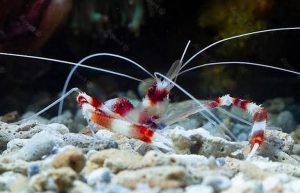
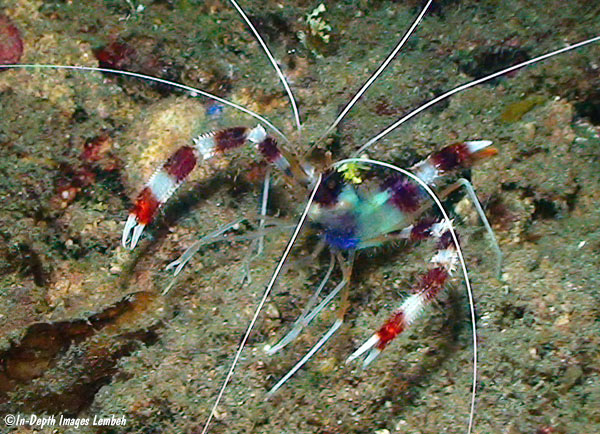
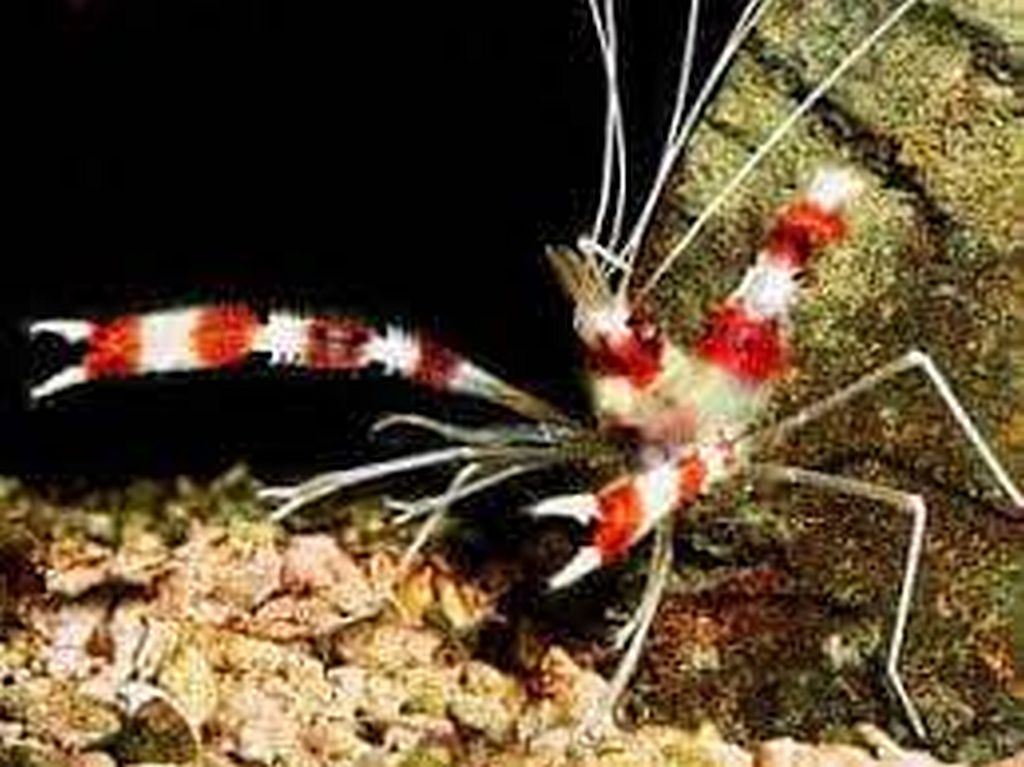
True Coral Banded Shrimp have vibrantly colored alternating bands of bright red and snow white across their carapace, abdomen, and large third pair of legs.   They have a spiny, prickly textured body and two pairs of long, hair like white antennae that they wave continuously to signal passing fish.   Their third pair of walking legs supports a massive, muscular set of pincers that gives them their distinct “boxer” like appearance.

Coral banded shrimp are gonochoric (separate male and female individuals), that display mild external sexual dimorphism.   Mature females are typically larger than males, and frequently have a blue-green coloration on their underbelly due to their developing ovaries.

Unlike many marine invertebrates that can retreat fully into a thick, heavy shell for protection; the Coral Banded Shrimp relies on its imposing claws and chemical signals for it’s primary defense.    When a predator approaches, they will aggressively raise their large pincers to ward off the threat.   In the event that fails, they utilize an autotomizing mechanism to break off a claw to escape, which will safely regenerate during subsequent molts.   When outmatched, their swift reaction time allows them to rapidly flick backward into the safety of their crevice or cave structures.

Coral Banded Shrimp are best housed in a well established FOWLR or reef aquarium of at least 30 gallon capacity with a fine argonite sand substrate, plenty of live rock arranged into large caves, dark overhangs, and deep hiding places, and sufficient room for them to claim a territory.

The Coral Banded Shrimp is completely reef safe with caution.   They are too small to cause any real structural damage to the decor in the tank, but they need to be monitored around delicate polyped corals that they may occasionally pick at or steal food from.   Large Stenopus hispidus should not be housed with small, delicate shrimp species like the Peppermint Shrimp (Lysmata wurdemanni) or Sexy Shrimp (Thor amboinensis) as they will aggresively hunt them down and consume them.

Coral Banded Shrimp are naturally semi-aggressive toward other crustaceans and are best housed individually or as a strict, verified mated pair, especially in a smaller tank.

They do exceptionally well in a large FOWLR tank with peaceful to semi-aggressive tank mates like Tangs, Clownfish, Angelfish, and robust snails.

Avoid keeping them with large, aggressive predatory fish like Lionfish, Groupers, or large Triggers that will view them as food.

Like other large cleaner species, the Coral Banded Shrimp (Stenopus hispidus) has a ravenous appetite for organic material

Coral Banded Shrimp (Stenopus hispidus)

Coral Banded Shrimp (Stenopus hispidus)

and fish pests, which makes them excellent candidates for a utility cleanup crew.    In a FOWLR or reef aquarium, they are great scavengers and discretionary cleaners that thrive on fish parasites, dead tissue, unwanted bristleworms, detritus, and leftover fish waste.

Although the Coral Banded Shrimp is relatively easy to keep and very hardy once acclimated; they are extremely sensitive to sudden changes in water values, rapid fluctuations in salinity and pH, and copper-based medications that are lethal to them.

An efficient, high quality filtration system and protein skimmer is highly recommended to maintain the pristine water quality and stable water conditions they require.   Adequate concentrations of calcium, magnesium, and iodine are also essential to properly support their 3 to 8 week molting and skeletal regeneration cycle.

Though Coral Banded Shrimp pairs often produce eggs and spawn in captivity, they do not generally yield surviving offspring in a home aquarium environment.

Coral Banded Shrimp are dedicated oviparous breeders.   The male courts the female sequentially after she molts.   The female carries the fertilized, color-shifting eggs directly under her abdomen, attached to her swimming legs for roughly 16 days until the microscopic larvae hatch out.

The microscopic free swimming larvae normally undergo a long 210 day pelagic stage when released into the water column as dark plankton, however, in a standard reef aquarium the release will usually trigger a feeding frenzy from corals and fish.   Few if any free swimming larvae escape from being quickly consumed by tankmates before they can metamorphose into crawling juveniles.

In their natural environment, the Coral Banded Shrimp feeds on tissue parasites, fungi, and damaged skin cells picked from cooperative reef fish; along with small arthropods and benthic detrital elements. Their primary wild food consists of scavenging organic matter and operating cleaning stations for large reef species like moray eels and tangs.

In an established reef aquarium environment, Coral Banded Shrimp will aggressively feed on bristleworms and natural tank detritus along with any leftover shrimp or fish foods, such as meaty sinking pellets, flakes, mysis shrimp, brine shrimp, and chopped frozen seafood.

The Coral Banded Shrimp (Stenopus hispidus) is a very common saltwater species that that is available to tropical fish keeping enthusiasts from a variety of online retailers, local fish shops, and wholesalers at very reasonable prices that range from $14.00 to $64.99  per individual; depending size, quantity, variety, area of collection and vendor.

Because these shrimp are highly aggressive toward their own kind and must be housed singly or as a true male-female pair a certified mated pair generally costs around $39.69.

The multi month larval stage makes commercial captive breeding exceptionally challenging which is why the majority of specimens are wild caught. Captive bred specimens are more costly but are said to be less likely to nip at corals or soft polyps in a reef tank.

Coral Banded Shrimp (Stenopus hispidus)

Coral Banded Shrimp (Stenopus hispidus)


Minimum Tank Size: 30 gallons
Aquarium Type: Established Reef or FOWLR
Care Level: Easy
Temperament: Semi-aggressive (Territorial with other shrimp)
Aquarium Hardiness: Hardy
Water Conditions: 72–78°F, dKH 8 to 12, pH 8.1–8.4, sg 1.023–1.025
Max. Size: 3″
Color Form: Red and White Banded
Diet: Carnivore/scavenger
Compatibility: Reef Compatible With Caution
Origin: Indo-Pacific, Caribbean
Family: Stenopodidae
Lifespan: 3 – 5 years
Aquarist Experience Level: Beginner

Posted in Featured Articles, Invertebrates, Saltwater, Shrimp, Tropical Fish Keeping, Tropical Fish Species0 Comments

Peppermint Shrimp (Lysmata wurdemanni)

Peppermint Shrimp (Lysmata wurdemanni)

Peppermint Shrimp (Lysmata wurdemanni)

Peppermint Shrimp (Lysmata wurdemanni)

The Peppermint Shrimp (Lysmata wurdemanni), known to tropical fish keeping enthusiasts as the Veined Shrimp or Caribbean Cleaner Shrimp, is a marine decapod crustacean species that is found throughout the western Atlantic Ocean. Its range extends from the coast of New England down through the Gulf of Mexico and the Caribbean, to Brazil.

Peppermint Shrimp are normally found in areas with heavy structural cover among the shallow reefs, rock jetties, and dock pilings of their range at depths from the low intertidal zone to around 100 feet.

Unlike Pistol Shrimp, Lysmata wurdemanni are not natural diggers.   They are constantly on the move and are strictly considered nocturnal animals, with the peak of their activity beginning at dusk.

During the day, substantial numbers of Peppermint Shrimp are often found by divers huddled deep inside of dark caves, under rocky ledges, or wedged between tight crevices, apparently seeking refuge from benthic and pelagic predators like groupers and wrasses that actively hunt them from open water..

Although Peppermint Shrimp are frequently found gathered together in large numbers sharing the same reef structures, they are not necessarily social animals.   Lysmata wurdemanni are a docile, non-aggressive species that do not seem to associate closely with conspecifics unless they decide to mate or aggregate loosely for daytime safety.

Unlike some territorial shrimp, they are highly tolerant of their own kind and can be kept in large groups without conflict.

Peppermint Shrimp (Lysmata wurdemanni)

Peppermint Shrimp (Lysmata wurdemanni)

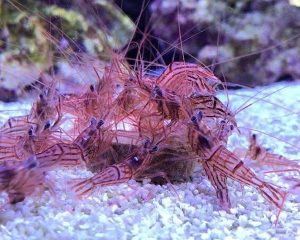
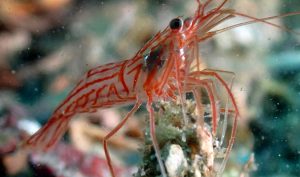
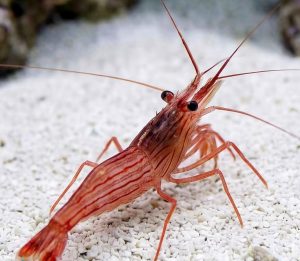
The Peppermint Shrimp is a small marine crustacean that seldom exceeds 1.5 to 2 inches in body length.   They have a translucent, creamy-white to pinkish body that is covered in a complex network of longitudinal and transverse bright red or bright pink stripes that is remeniscent to a classic peppermint candy, hence their common name.   Lysmata wurdemanni lack the intense, solid pigmentation seen in their scarlet cousins the Fire Shrimp (Lysmata debelius) and have shorter, translucent antennae compared to other cleaner shrimp species

Peppermint shrimp are protandric simultaneous hermaphrodites.   They begin their mature lifecycle as functional males, but as they grow, they develop functioning female reproductive organs while still retaining their male reproductive organs.   There is no external sexual dimorphism, making it impossible to visually separate individuals by visual appearance.

The Peppermint Shrimp does not have any heavy defensive shell mechanism for protection from predators; instead, they rely heavily on their transparent camouflage and agility to survive.    When a predator approaches, they rapidly flick their tails to propel themselves backward into the deepest recesses of the rockwork.    Their response time is incredibly rapid, which makes them very difficult to catch in a mature reef system.

The Peppermint Shrimp is best housed in a well established FOWRL or reef aquarium of at least 10 to 20 gallon capacity with a fine sand or coralline gravel substrate, plenty of live rock arranged into dark caves, overhangs, and deep hiding places, and enough room for them to roam and scavange under low light conditions.

The Peppermint Shrimp is completely reef safe with caution.   Although they are too small do any damage to decorations in a reef tank, they will nip on soft corals, polyps, and decorative clam mantles if their primary food source is not available.

Peppermint Shrimp do well in a FOWLR tank with small, peaceful, non-carnivorous reef fish.   Suitable tankmates include Firefish, Gobies, Blennies, Clownfish, and peaceful snails like Cerith or Nassarius snails.

They should never be housed with large and/or aggressive species like Hawkfish, Dottybacks, Longnose Hawkfish, large predatory Wrasses, and most predatory crab species that will quickly hunt them down and consume them.

The Peppermint Shrimp (Lysmata wurdemanni) has a ravenous appetite for nuisance pests and organic waste, which makes them excellent candidates for a tank clean-up crew.

In an aquarium environment, they are legendary scavengers that thrive on detritus, debris, leftover fish foods, and most notably, nuisance Aiptasia (glass anemones). They are a primary biological control method for reef keepers struggling to rid their tanks from pest anemones.

Although the Peppermint Shrimp is relatively easy to keep, they are very sensitive to sudden changes in water values, rapid fluctuations in salinity and pH, and copper-based medications that are lethal to them.

An efficient, high quality filtration system and protein skimmer is highly recommended to maintain the clean water quality and stable water conditions they require.   A constant food source and adequate iodine levels to aid with their frequent molting schedule is also needed to keep them healthy.

There have been numerous reports of tropical fish keeping enthusiasts successfully breeding Lysmata wurdemanni in an aquarium environment, but even on a commercial scale, Peppermint Shrimp do not generally produce surviving offspring without dedicated rearing tank setups.

Since they are simultaneous hermaphrodites, any two mature Peppermint Shrimp can act as a pair.   Spawning occurs shortly after a molt when the female-phase exoskeleton is soft and the eggs are fertilized externally before being attached to the pleopods.

The “female” shrimp carries the fertilized eggs under its abdomen for approximately 10 to 14 days, during which the egg mass changes color from a bright green, to a translucent gold, before hatching.

The microscopic free swimming larvae are released into the water column after dark as plankton, which in a standard reef aquarium will often trigger a feeding frenzy from corals and fish.   Few if any of the free swimming larvae ever reach settlement before becoming planktonic food.

In their natural environment, Peppermint Shrimp feed on dead organic tissue, detritus, small pest cnidarians, and other microscopic organisms. Their primary wild diet consists of scavenging organic waste from the sea floor and picking at small sedentary invertebrates.

In an established aquarium environment, they are opportunistic scavengers that will feed on the nuisance Aiptasia anemones with gusto, along with any leftover shrimp or fish food flakes, pellets, algae wafers, frozen mysis, or brine shrimp.

Peppermint Shrimp are opportunistic feeders that will quickly venture out into the open water column as soon as the main aquarium lights go out and food is introduced.

The Peppermint Shrimp (Lysmata wurdemanni) is one of the most common and inexpensive saltwater species that can be purchased from online retailers and local fish stores at prices that range from $10.00 to $18.00 per individual; depending on size, variant, area of collection, quantity, and vendor.

They are frequently sold to tropical fish keeping enthusiasts as essential members of “cleanup crews” for Aiptasia anemone removal in reef tanks. Purchasing a 3-pack or larger quantity not only drops the individual price below $10, but when introduced in small groups is much more efficient at clearing target pests.

Unlike many other ornamental shrimp, a lot of online retailers now offer captive bred Peppermint Shrimp alongside wild-caught individuals.   Captive bred specimens are slightly more costly but are less likely to nip at corals or soft polyps in a reef tank.

Peppermint Shrimp (Lysmata wurdemanni)

Peppermint Shrimp (Lysmata wurdemanni)


Minimum Tank Size: 10 gallons
Aquarium Type: Established Reef or FOWLR
Care Level: Easy
Temperament: Peaceful
Aquarium Hardiness: Semi-Hardy
Water Conditions: 72–78°F, dKH 8 to 12, pH 8.1–8.4, sg 1.023–1.025
Max. Size: 1.5″ – 2″
Color Form: Translucent Pink, Red Stripes
Diet: Omnivore/scavenger
Compatibility: Reef Compatible (With Caution)
Origin: Western Atlantic (Caribbean, Gulf of Mexico)
Family: Lysmatidae
Lifespan: 1 – 2 years
Aquarist Experience Level: Beginner

Posted in Featured Articles, Invertebrates, Saltwater, Shrimp, Tropical Fish Keeping, Tropical Fish Species0 Comments

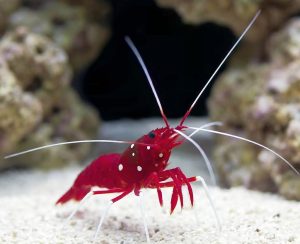
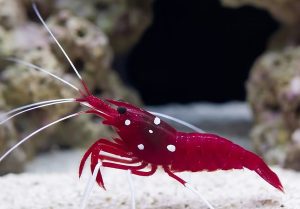
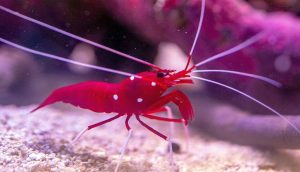
Fire Shrimp (Lysmata debelius)

Fire Shrimp (Lysmata debelius)

Fire Shrimp (Lysmata debelius)

Fire Shrimp (Lysmata debelius)

The Fire Shrimp (Lysmata debelius), known to tropical fish keeping enthusiasts as the Blood Shrimp, Blood Red Fire Shrimp, Scarlet Cleaner Shrimp, or Cardinal Shrimp, is a marine decapod crustacean species that is found throughout the Indo-West Pacific, from the Red Sea and East Africa to the Tuamotu Archipelago.

Fire Shrimp are normally found among the deep coral reef slopes and rocky crevices of their range at depths from 30 to over 100 feet where they prefer deeper, darker areas than other cleaner species.

Lysmata debelius are not natural diggers.   They are a notably crybtic species that are constantly on the move and considered nocturnal animals, with the peak of their activity beginning at dusk.

During the day, substantial numbers of Fire Shrimp can normally be found hidden deep inside caves, under dark rocky overhangs, or tucked away in reef crevices that provide a safe haven from large benthic and pelagic predators that actively hunt them on the open reef faces.

Although Fire Shrimp are frequently found together in the wild sharing the same large cave system, they are not necessarily social animals.   In smaller confines, they can be highly territorial toward conspecifics.

Fire Shrimp are a usually docile and non-aggressive toward fish.    They do not seem to associate closely with other members of their own species unless they are a mated pair or housed in a massive aquarium with plenty of live rock to stake out a territory.

Lysmata debelius are small marine crustaceans that seldom exceed 2 inches in body length (excluding their antennae).

Fire Shrimp (Lysmata debelius)

Fire Shrimp (Lysmata debelius)

True Fire Shrimp have an intensely vibrant, striking coloration featuring a deep blood-red or scarlet body, contrasted by brilliant white spots on the carapace and white stockings on their legs.    They possess long, stark white antennae that they wave carefully to signal passing fish, though they are generally more reclusive than their cousins, the Skunk Cleaner Shrimp.

Fire Shrimp are protandric simultaneous hermaphrodites.    They begin their mature life as males, but as they grow, they develop functioning female reproductive organs while still retaining their male reproductive organs.    There is no external sexual dimorphism to visually distinguish between individuals.

Unlike many marine organisms that can retreat into a heavy, protective shell; the Fire Shrimp does not have a heavy defensive shell mechanism.    Instead, they rely on their extreme reclusiveness, speed, and the safety of dark caves for defense.   Like lobsters when startled, they use their pleopods (swimmerets) to rapidly flick backward into the deepest recesses of the rockwork or cave to escape.

The Fire Shrimp is completely reef safe and is best housed in a well-established FOWLR or reef aquarium with a fine coralline gravel or sand substrate, plenty of live rock arranged into deep caves, dark overhangs, and hiding places, and sufficient room for them to roam and graze under low-light conditions.

Fire Shrimp are too small to damage any decor in a reef tank and will not bother corals, decorative clams, or invertebrates, making them an excellent aesthetic addition to a reef layout.

Fire Shrimp are docile by nature, non-aggressive, and do well in a FOWLR tank with peaceful tank mates like small, non-carnivorous reef fish.    Some good tankmates include Firefish, Neon Gobies, Fairy Wrasses, Cardinalfish, Clownfish, and peaceful invertebrates like Tuxedo Urchins or Cerith snails.

Avoid keeping them with large and/or aggressive carnivorous fish like Lionfish, Hawkfish, Dottybacks, Groupers, and large Triggers, as well as aggressive predatory crabs and large hermit crabs that may attempt to trap them in their caves.

Like other cleanup crew members, the Fire Shrimp (Lysmata debelius) has a great appetite for organic debris and opportunistic parasites, which makes them excellent candidates for a tank clean-up crew.    In the aquarium, they are excellent scavengers that thrive on tissue parasites, dead skin, detritus, and leftover fish waste that often settles into the hard-to-reach crevices of the live rock.

Provided they are acclimated slowly, the Fire Shrimp is not particularly difficult to keep.    Like many species of marine shrimp, they are very sensitive to sudden changes in water values, especially salinity, and copper based medications that are lethal to them.

In addition to stable water quality, Lysmata debelius require a constant food source, a stable tropical water temperature between 72–78°F, and proper iodine levels to ensure successful molting.   An excellent filtration system and protein skimmer are recommended to keep this species healthy.

Although Scarlet Cleaner Shrimp will frequently mate and carry their eggs in an aquarium environment, they generally will not reproduce successfully, mainly due  to their incredibly complex, multi-stage larval development.    Because Lysmata debelius are simultaneous hermaphrodites, any two mature individuals can successfully mate with each other.   After one shrimp molts, the other will fertilize the eggs which are then carried under its abdomen attached to its pleopods.

The fertilized eggs are carried for approximately 10 to 14 days until they hatch and the tiny larvae are released as plankton into the water column, usually after dark.     In a reef aquarium, the water may briefly cloud up with the microscopic larvae and trigger a feeding frenzy among the corals and other filter feeders in the tank.  The microscopic larvae are a prized food source and are usually quickly consumed before they can ever metamorphose into crawling shrimp.

In their natural environment, the Fire Shrimp feeds on organic detrital elements, tissue parasites, and mucus scraped from cooperating client fish that visit their caves.   Their primary food consists of small parasites and organic debris found within the reef cracks.

In an established aquarium environment, they feed on the algae biofilm and detritus in the tank along with any leftover shrimp or fish foods.  They will readily consume marine flakes, pellets, algae or spirulina wafers, mysis shrimp, brine shrimp, and high-quality frozen preparations.   Initially shy, they quickly become bold enough to emerge from their caves at feeding time to snatch food from the water column.

The Fire Shrimp (Lysmata debelius) is a highly sought after species that is occasionally available to tropical fish keeping enthusiasts from a variety of online retailers, premium transhippers, and local fish stores at prices that range between $48.00 to $98.00 per individual; depending on size, area of collection, and vendor.

Because of their spectacular scarlet and blood red coloration, they normally command higher prices than the common Skunk Cleaner Shrimp (Lysmata amboinensis).

Fire Shrimp (Lysmata debelius)

Fire Shrimp (Lysmata debelius)


Minimum Tank Size: 10 gallons
Aquarium Type: Established Reef or FOWLR
Care Level: Easy to Moderate
Temperament: Peaceful (Territorial with conspecifics)
Aquarium Hardiness: Semi-Hardy
Water Conditions: 72–78°F, dKH 8 to 12, pH 8.1–8.4, sg 1.023–1.025
Max. Size: 2″
Color Form: Deep Scarlet Red, White Spots, White Legs
Diet: Omnivore/scavenger
Compatibility: Reef Compatible
Origin: Indo-West Pacific (Red Sea to Tuamotu)
Family: Lysmatidae
Lifespan: 2 – 5 years
Aquarist Experience Level: Beginner to Intermediate
Posted in Featured Articles, Invertebrates, Saltwater, Shrimp, Tropical Fish Keeping, Tropical Fish Species0 Comments

Camelback Shrimp (Rhynchocinetas durbanensis)

Camelback Shrimp (Rhynchocinetas durbanensis)

Camelback Shrimp (Rhynchocinetas durbanensis)

Camelback Shrimp (Rhynchocinetas durbanensis)

The Camelback Shrimp (Rhynchocinetas durbanensis), known to tropical fish keeping enthusiasts as the Hinge-beak Shrimp, Dancing Shrimp, or Durban Hinge-beak Shrimp, is a marine decapod crustacean species that is found throughout the Indo-West Pacific, from South Africa and the Red Sea to Indonesia, the Philippines, and southern Japan.

Camelback Shrimp are normally found among shallow coral reefs, rocky overhangs, and seawalls of their range at depths from 10 to over 110 feet where they aggregate in large, dramatic numbers.

Rhynchocinetas durbanensis are not natural diggers.   They are constantly on the move and are primarily considered nocturnal animals, with the peak of their activity beginning at dusk, though they will readily venture out during the day if kept in a shadowed environment.

Substantial numbers of Camelback Shrimp can typically be found crowded together on the roofs of caves, beneath large table corals, or wedged deeply into rocky fissures.    Apparently, these dark structures provide the Camelback Shrimp a safe haven from pelagic predators that hunt them from the open water, especially large wrasses and groupers.

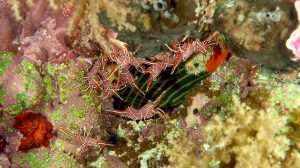
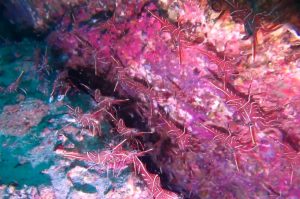
Although Camelback Shrimp are frequently found together in large numbers sharing the exact same cave system, they are highly social animals that thrive in large colonies like the one below.

Camelback Shrimp (Rhynchocinetas durbanensis)

Camelback Shrimp (Rhynchocinetas durbanensis)

They are a docile, non-aggressive species that actively seek out the company of conspecifics, forming massive aggregates that safely move and “dance” together without exhibiting the territorial aggression commonlseen in other ornamental shrimp species.

Rhynchocinetas durbanensis are small marine crustaceans that seldom exceed 1.5 to 2 inches in body length.

Camelback Shrimp (Rhynchocinetas durbanensis)

Camelback Shrimp (Rhynchocinetas durbanensis)

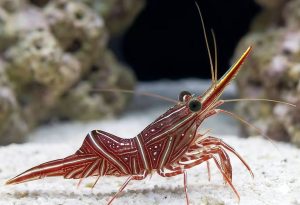
True Camelback Shrimp have a striking, highly intricatly colored semi-translucent body that is covered in a network of brilliant red lines and brilliant white stripes, interspersed with small white spots.   They possess a characteristic humped back (carapace) and a unique, highly specialized upward-curving rostrum (beak) that is hinged, allowing the shrimp to swing its beak up and down in a mechanical nodding fashion.

Camelback Shrimp are gonochoric (separate male and female individuals), displaying pronounced external sexual dimorphism. Dominant mature males are easily distinguished from females by their massively enlarged, elongated third pair of maxillipeds (pincers), which they use to establish dominance within the colony hierarchies and display during courtship.

Unlike true cleaner shrimp that rely on symbiotic immunity for defense, the Camelback Shrimp does not have a proper individual defensive mechanism against predators.   Instead, they rely strictly on safety in numbers, cryptic coloration, and agility.

When threatened, the entire colony will utilize a rapid backward tail-flick to simultaneously scatter into the deepest, darkest cracks of the live rock.

The Camelback Shrimp is reef safe with caution and is best housed in a well-established FOWLR or reef aquarium of at least 10 gallon capacity with a fine coralline gravel or live sand substrate decorated with plenty of live rock arranged into large caves, dark overhangs, and hiding places, and sufficient room for a small group to colonize.   The shrimp are too small to cause structural damage to tank decor, but they must be monitored closely around corals.

Unlike true Skunk Cleaner Shrimp (Lysmata amboinensis), Camelback Shrimp are notorious for nipping at colonial zoanthids, soft leather corals, disc anemones, and the delicate polyps of large polyp stony (LPS) corals, especially if they are underfed.

Camelback Shrimp are non-aggressive, docile by nature, and do exceptionally well in a FOWLR tank with peaceful tank mates like small, non-carnivorous reef fish.   Good tankmates include Firefish, Gobies, Blennies, Cardinalfish, and peaceful snails like Trochus or Cerith snails.

Avoid keeping them with large and/or aggressive fish, Hawkfish, Dottybacks, Coral Banded Shrimp, and all species of large predatory wrasses or triggers that will quickly view these small colonial shrimp as a primary food source.

Unlike other cleanup crew members, the Camelback Shrimp (Rhynchocinetas durbanensis) has a ravenous appetite for micro-fauna and organic debris rather than fish parasites, which makes them excellent candidates for a general tank cleanup crew.   In the aquarium, they are great scavengers that thrive on detritus, debris, uneaten fish food, and organic waste that settles into the shadows of the aquarium rockwork.

The Camelback Shrimp is relatively easy to keep and quite hardy compared to other delicate cleaner species.   They are very sensitive to sudden changes in water values, especially rapid drops in salinity, and copper medications that are completely lethal to them.

In addition to clean water quality, they require a constant food source to keep them from picking at corals, a stable tropical water temperature between 72–78°F, and adequate iodine levels to support their frequent molting process.   An excellent filtration system and a protein skimmer are recommended to maintain this species.

Though Camelback Shrimp frequently form pairs and produce eggs within a colony, they do not generally reproduce successfully in a standard home aquarium environment due to their complex planktonic larval stages.

Mating occurs right after a female molts, and the female carries a cluster of bright fertilized eggs under her abdomen attached to her pleopods for roughly 10 to 14 days.   The microscopic larvae hatch and are released into the water column after dark.   In a standard aquarium, the water may briefly trigger a feeding frenzy among corals and other filter feeders, as the microscopic free-swimming larvae are treated as immediate planktonic food and are quickly eaten by fish before they can ever complete their development.

In their natural environment, the Camelback Shrimp feeds on detrital elements, micro-invertebrates, algae biofilm, and organic debris found within reef crevices.   Their primary wild food consists of scavenging organic waste from the seafloor and opportunistically picking at sedentary colonial invertebrates.

In an established aquarium environment, Camelback Shrimp feed on the natural detritus in the tank along with any leftover shrimp or fish foods, such as flakes, pellets, algae wafers, frozen mysis, and brine shrimp.   They are highly enthusiastic feeders that will quickly swarm any food that lands near their chosen cave or overhang during feeding time.

The Camelback Shrimp (Rhynchocinetas durbanensis) is a very common saltwater species that can be purchased from online retailers, local fish stores, and wholesalers at very reasonable, inexpensive prices.   They are frequently sold online to tropical fish keeping enthusiasts in small groups as active, colorful utility additions to community tanks.

Because commercial captive breeding is not yet widely established, the majority of Camelback Shrimp sold are wild caught.

Current retail prices for the Camelback Shrimp generally range between $12.48 to over $29.99, depending on the sizing, variant, area of collection, and vendor.   This makes them significantly more budget-friendly than standard Skunk Cleaner or Fire Shrimp species.

Camelback Shrimp (Rhynchocinetas durbanensis)

Camelback Shrimp (Rhynchocinetas durbanensis)


Minimum Tank Size: 10 gallons
Aquarium Type: FOWLR or Reef with Caution
Care Level: Easy
Temperament: Peaceful
Aquarium Hardiness: Hardy
Water Conditions: 72–78°F, dKH 8 to 12, pH 8.1-8.4, sg 1.023-1.025
Max. Size: 2″
Color Form: Red and White Patterned
Diet: Omnivore/scavenger
Compatibility: Reef Compatible (With Caution)
Origin: Indo-West Pacific
Family: Rhynchocinetidae
Lifespan: 1 – 3 years
Aquarist Experience Level: Beginner

Posted in Featured Articles, Invertebrates, Saltwater, Shrimp, Tropical Fish Keeping, Tropical Fish Species0 Comments

Skunk Cleaner Shrimp (Lysmata amboinensis)

Skunk Cleaner Shrimp (Lysmata amboinensis)

Skunk Cleaner Shrimp (Lysmata amboinensis)

Skunk Cleaner Shrimp (Lysmata amboinensis)

The Skunk Cleaner Shrimp (Lysmata amboinensis), known to tropical fish keeping enthusiasts as the Scarlet Cleaner Shrimp, Pacific Cleaner Shrimp or Cleaner Shrimp,  is a marine decapod crustacean species that is found throughout the Indo-West Pacific and parts of the tropical Atlantic Ocean.

Skunk Cleaner Shrimp are normally found among the coral reefs and rocky crevices of their range at depths from the low intertidal zone to over 130 feet where they often set up distinct “cleaning stations.”

Lysmata amboinensis are not natural diggers.   They are constantly on the move and are active during both the day and night, though they tend to retreat into darker crevices if bright lights are suddenly turned on.   Substantial numbers of Skunk Cleaner Shrimp can typically be found on the undersides of coral ledges or deep inside caves that provide the Cleaner Shrimp a safe refuge from pelagic predators that might snap them up in open water.

Although Skunk Cleaner Shrimp are frequently found grouped together in large numbers, they do not form coordinated, tightly-knit schools.   Instead, they are a docile, non-aggressive species that is highly tolerant of conspecifics, allowing them to live peacefully side-by-side in pairs or small groups.

Lysmata amboinensis are small marine crustaceans that seldom exceed 2 inches in body length (excluding their long antennae).

Skunk Cleaner Shrimp (Lysmata amboinensis)

Skunk Cleaner Shrimp (Lysmata amboinensis)

True Skunk Cleaner Shrimp have a vibrantly colored bright amber or yellow body with a distinct, bold red stripe down the back, split down the center by a stark white line—hence the name “Skunk Cleaner.”    They possess three pairs of long, bright white antennae that they wave continuously to signal fish that their cleaning services are open for business.

Skunk Cleaner shrimp are protandric simultaneous hermaphrodites.   They all start life as males, but as they grow, they develop functioning female reproductive organs while still retaining their male reproductive organs.   There is no external sexual dimorphism to distinguish individuals.

Unlike many marine creatures that can retreat into a heavy shell, the Skunk Cleaner Shrimp relies on its speed, agility, and unique symbiotic relationship with predators for defense.    Instead of being eaten, they rely on their reputation as a doctor of the reef.   Their top speed is quite fast when they use their pleopods (swimmerets) to flick backward into a cave when threatened.

The Skunk Cleaner Shrimp is completely reef safe and is best housed in a well-established reef aquarium of at least 10 gallon capacity with plenty of mature live rock arranged into caves, overhangs, and hiding places, and sufficient room for them to roam and look for clients.   The shrimp are too small to damage any decor in a reef tank and will not bother decorative clams or corals, though they may occasionally step on them to steal a piece of food.

Cleaner Shrimp are non-aggressive, docile by nature, and do well in a FOWLR tank with peaceful tank mates like small, non-carnivorous fish.    Good tankmates include Firefish, Gobies, Blennies, Clownfish, Cardinalfish, and peaceful snails like Cerith or Trochus snails.   Avoid keeping them with large and/or aggressive carnivorous fish like Lionfish, Groupers, Hawkfish, and large Triggers, and aggressive predatory crabs that will view the shrimp as a meal.

Like other cleanup crew members, the Skunk Cleaner Shrimp (Lysmata amboinensis) has a ravenous appetite for parasites and dead tissue, which makes them excellent candidates for a tank health crew.

In the aquarium environment, they are superb scavengers that thrive on fish parasites (like marine ich), dead skin, debris, and other fish waste.

The Cleaner Shrimp is relatively easy to keep compared to other cold-water species, provided acclimation is done carefully.  Lysmata amboinensis are extremely sensitive to changes in water values, especially sudden shifts in salinity and copper medications (which are lethal to them).   In addition to stable water quality, they require a constant food source, a stable tropical water temperature between 72–78°F, and adequate iodine levels to support their regular molting process.   An excellent filtration system and protein skimmer are recommended to keep this species thriving.

Although Skunk Cleaner Shrimp frequently produce eggs in the home aquarium, they do not generally yield surviving offspring, mainly due to their long, complex, larval stages.   Because they are simultaneous hermaphrodites, any two mature individuals can mate.  One shrimp will molt, and the other will fertilize its eggs shortly after.

The shrimp carries the fertilized eggs under its abdomen (attached to the pleopods) for roughly 10 to 14 days until they turn a greenish hue and hatch.  The tiny larvae are released into the water column after dark.

In an aquarium, the release of these microscopic larvae triggers a temporary feeding response from both fish and filter-feeding corals, which treat the free-swimming plankton as a nutritious meal long before they can metamorphose into crawling juveniles.

In their natural environment, the Skunk Cleaner Shrimp feeds on tissue parasites, mucus, and dead skin scraped from “client” fish, alongside general detrital elements.    Their primary food is parasites like ciliates, but they also eat organic debris on the reef.

In an established aquarium environment, they feed on the parasites of their tankmates along with any leftover shrimp or fish foods, such as flakes, pellets, algae wafers, mysis shrimp, brine shrimp, and chopped frozen foods.   They are notoriously bold feeders and will happily swim to the surface to take food right out of the aquarist’s hand.

The Skunk Cleaner Shrimp (Lysmata amboinensis) is a very common saltwater species that can be purchased from online retailers, local fish stores, and wholesalers at reasonable prices.    They are often sold online to tropical fish keeping enthusiasts as foundational members of “cleanup crews” and biological parasite control for established reef tanks.

Although captive-bred individuals are occasionally available, most specimens sold are wild caught.  Current retail prices for the Skunk Cleaner Shrimp generally range between $35.99 to over $75.99, depending on the sizing, variant, area of collection, and vendor.

Skunk Cleaner Shrimp (Lysmata amboinensis)

Skunk Cleaner Shrimp (Lysmata amboinensis)


Minimum Tank Size: 10 gallons
Aquarium Type: Established Reef or FOWLR
Care Level: Easy to Moderate
Temperament: Peaceful
Aquarium Hardiness: Semi-Hardy (Sensitive to acclimation and copper)
Water Conditions: 72–78°F, dKH 8 to 12, pH 8.1–8.4, sg 1.023–1.025
Max. Size: 2″ (body length)
Color Form: Amber, Red, White
Diet: Omnivore/scavenger
Compatibility: Reef Compatible
Origin: Indo-West Pacific, Tropical Atlantic
Family: Lysmatidae
Lifespan: 2 – 5 years
Aquarist Experience Level: Beginner to Intermediate
Posted in Featured Articles, Invertebrates, Saltwater, Shrimp, Tropical Fish Keeping, Tropical Fish Species0 Comments

Tailspot Cardinal (Apogon dovii)

Tailspot Cardinal (Apogon dovii)

Tailspot Cardinal (Apogon dovii)

Tailspot Cardinal (Apogon dovii)

The Tailspot Cardinal (Apogon dovii), known to tropical fish keeping enthusiasts as the Tailspot Cardinalfish, Onespot Cardinalfish, Tailspot Flame Cardinalfish, Tail-striped Cardinalfish, Dottyback Cardinal, and Cardenal Colimanchada, is native to the Tropical Eastern Pacific Ocean.

Their range extends from Mazatlán, Mexico, southward along the coast of Central America including El Salvador, Guatemala, Honduras, Nicaragua, and Costa Rica, down to Ecuador and northern Peru.  It is also frequently documented around offshore oceanic islands such as the Cocos Islands and the Galápagos Islands.

The Tailspot Cardinal is a cryptic reef-dwelling species that during daylight hours are found alone, in pairs, or in small social groups hovering motionless in the deep rock pockets, rocky crevices, and coral recesses of their range along steep vertical drops and sheltered marine structures at depths from 10 to over 150 feet

Tailspot Cardinals are nocturnal planktivorous predators that remain close to protective structure by day and merge into loose aggregations to forage in the open water column on zooplankton, pelagic fish larvae, pelagic fish eggs, mysid shrimp, and small crustaceans at night.

During the day in the shallower inshore environments where they are most commonly encountered in depths from 10 to 45 feet, Tailspot Cardinals are often found nestling between protective reef caves, rocky overhangs, and shaded ledges.

Although Tailspot Cardinals will occasionally hover near bottom structures, they will rarely venture out over open sand or mud flats devoid of overhead cover.

Tailspot Cardinal (Apogon dovii)

Tailspot Cardinal (Apogon dovii)

The Tailspot Cardinal has a solid pink to translucent red or vibrant deep red colored body with a large, distinct, round black spot on the caudal peduncle just at the base of the tail fin; a large mouth, and oversize eyes with a dark pupil and a broad dusky stripe bordered by white lines extending from the snout through and behind the eye to the edge of the gill cover.    They possess two separate, symmetrical dorsal fins, and a moderately concave tail fin.

Juvenile Tailspot Cardinals have a striking yellow body color with a distinctive black spot near the tail base.   As they mature, their colors intensify, and additional markings become more pronounced, creating a visually stunning display of reds, yellows, and blacks.

Minimal sexual dimorphism does exist with Apogon dovii.   Breeding males can temporarily lose the bold black spot on their caudal

Tailspot Cardinal (Apogon dovii)

Tailspot Cardinal (Apogon dovii)

peduncle to become plain red with dark markings on their unpaired fins.    Females have a noticeably plumper body profile, especially during spawning periods.

The Tailspot Cardinal (Apogon dovii) is often confused with the Mediterranean Cardinalfish (Apogon imberbis), which is a closely related but distinctly different Eastern Atlantic and Mediterranean species that looks exceptionally similar, to the extent that Albert Günther originally suggested considering them the same species without regard to their entirely separate geographic ranges.

The Tailspot Cardinal can be housed in a mature FOWLR or reef aquarium of at least 30 to 40 gallon capacity with an aragonite sand substrate, and plenty of live rock stacked into dark shaded caverns, ledges, and overhangs for them to shelter among.   Because they startle easily, a tight-fitting mesh or glass lid is mandatory, and low-light or programmable LED settings are recommended to provide subdued lighting and keep them from staying hidden. A reliable filtration system and low to moderate water movement are recommended to maintain pristine water quality.

The Tailspot Cardinal is reef safe and makes an excellent choice for a well established coral reef aquarium.    They will not bother corals or ornamental clams, but they naturally consume tiny invertebrates; which means that small prized ornamental shrimp and tiny worms may be opportunistically eaten.

Tailspot Cardinals have a peaceful demeanor and are slow swimming, making them excellent candidates for a community tank where they can be kept singly or in small social groups of three or more individuals when provided with sufficient space.

In larger aquariums, Tailspot Cardinals can be housed with peaceful, non-aggressive species like Banggai Cardinalfish, Firefish Gobies, Royal Grammas, Coral Beauties, Six-Line Wrasses, or Tailspot Blennies. Aggressive predators like Groupers, Lionfish, Eels, and hyperactive or overly territorial fish should obviously be avoided.

The Tailspot Cardinal is a paternal mouthbrooder where the male carries out oral brooding of the fertilized eggs. Like other related species in the family Apogonidae, they produce a cohesive egg mass consisting of several hundred demersal, relatively large eggs that the male catches and aerates inside his mouth, fasting during the entire 3 to 7 day brooding period. The male releases the tiny 2 mm to 4 mm pelagic larvae into ocean currents to feed on microscopic plankton for several weeks before they settle downward onto the reef and transforming into recognizable juveniles.

Successfully raising the tiny larvae to adulthood in a home aquarium environment is exceptionally difficult and requires dedicated rearing tanks and constant access to specialized live microscopic copepod cultures.

In the wild, Tailspot Cardinals are nocturnal carnivores that feed primarily on zooplankton, tiny crustaceans, and suspended marine organisms. In an aquarium environment, they should be fed a varied carnivorous diet including live or frozen mysis shrimp, enriched brine shrimp, flake foods, pellets, and finely chopped seafoods. Adults should be fed 1 or 2 times a day, ideally at dusk or dawn, to replicate their natural nocturnal foraging schedule and maintain their health.

The Tailspot Cardinal (Apogon dovii) is occasionally available to tropical fish keeping enthusiasts from specialized online retailers, wholesalers, and local fish shops at prices that vary according to size, vendor, and area of collection. Current online pricing ranges for Small (under 2 inches): ~$45.00 to $49.00, Medium (2 to 3 inches): ~$52.00 to $67.00, Large (3 to 4 inches): ~$74.00 to over $93.00.

Because they are rarely captive-bred on a commercial scale, the marine aquarium trade relies on wild-caught imports from the tropical Eastern Pacific, particularly regions like Costa Rica and Nicaragua.

Tailspot Cardinal (Apogon dovii)

Tailspot Cardinal (Apogon dovii)


Minimum Tank Size: Single specimen 30-40 gallons
Aquarium Type: FOWLR or Reef
Care Level: Easy
Temperament: Peaceful, Non-aggressive
Aquarium Hardiness: Very Hardy
Water Conditions: 72-80° F, dKH 8–12°, pH 8.1-8.4, sg 1.023-1.025
Max size: 3.9”
Color Form: Red, Pink, Shimmering Silver, Black
Diet: Carnivore
Compatibility: Reef Safe with Caution
Origin: Eastern Pacific Ocean, Mexico to Peru, Galápagos
Family: Apogonidae
Lifespan: 5+ years
Aquarist Experience Level: Beginner / Advanced

Posted in Cardinalfish, Featured Articles, Saltwater, Tropical Fish Keeping, Tropical Fish Species0 Comments

Yellowstriped Cardinalfish (Ostorhinchus cyanosoma)

Yellowstriped Cardinalfish (Ostorhinchus cyanosoma)

Yellowstriped Cardinalfish (Ostorhinchus cyanosoma)

Yellowstriped Cardinalfish (Ostorhinchus cyanosoma)

The Yellowstriped Cardinalfish (Ostorhinchus cyanosoma), known to tropical fish keeping enthusiasts as the Yellow-striped Cardinalfish, Orange-lined Cardinalfish, Goldenstriped Cardinalfish, and Gold-line Cardinalfish, is native to the tropical Indo-West Pacific Ocean.

Its vast range extends from the Red Sea and the Persian Gulf southward to Mozambique, stretching across the Indian Ocean east to Fiji, north to the Ryukyu and Bonin Islands of Japan, and south to Fiji, New Caledonia, and Tonga.

Yellowstriped Cardinalfish are a peaceful, slow moving species that typically inhabit the sheltered, clear-water lagoons and seaward coral reefs of their range at depths ranging from 3 to over 165 feet where they gather in small to large aggregations inside caves, under ledges, or safely tucked among the long spines of Diadema sea urchins.

Yellowstriped Cardinalfish are carnivorous nocturnal planktivores that during the day gather into tight, highly organized schools or small aggregations. They spend the day hovering completely motionless deep inside dark caves, rock crevices, or under shaded reef ledges. They often use the sharp spines of Diadema sea urchins or branching corals to shield themselves from predators.

At night the schools leave their daytime shelters and break apart into individuals or loose pairs to scour the reef flats and sandy microhabitats for zooplankton, benthic copepods, tiny shrimp and micro crustaceans.

Yellowstriped Cardinalfish (Ostorhinchus cyanosoma)

Yellowstriped Cardinalfish (Ostorhinchus cyanosoma)

The Yellowstriped Cardinalfish has a sleek, elongated semi translucent silver body color with striking, neon bluish iridescent undertones, decorated with six vibrant horizontal stripes that can be golden yellow to deep orange. The stripes run from the snout across the large, dark, golden ringed eyes, all the way back to the base of the caudal fin. Their mostly transparent fins have a faint yellow to orange tint, and they have two separate dorsal fins.

Yellowstriped Cardinalfish (Ostorhinchus cyanosoma) are frequently confused with the Southern Orange-lined Cardinalfish (Ostorhinchus properuptus) which share a nearly identical long, slender body shape. The main differences between the two are the number of horizontal stripes, how the lowermost stripe travels along the body, and their geographic range.

Yellowstriped Cardinalfish (Ostorhinchus cyanosoma)

Yellowstriped Cardinalfish (Ostorhinchus cyanosoma)

Interestingly, their physical appearance subtly shifts at night under the cover of darkness; the distinctive midlateral orange spot near the base of the tail turns a vivid, deep red.

The Yellowstriped Cardinalfish can be housed in a mature FOWLR or reef aquarium of at least 20 gallon capacity for a single specimen or pair, with a coralline sand or gravel substrate and plenty of mature live rock arranged into deep caves, dark overhangs, and wide crevices for them to shelter in during the day.

In a reef tank, adding a Diadema sea urchin will replicate their natural habitat.

Because they startle easily, a tight fitting mesh or glass lid is mandatory, and a programmable LED with Moonlight setting is recommended to provide subdued lighting and keep them from staying hidden. An oversized protein skimmer, strong filtration system and a small power head is recommended to maintain water quality and provide low to moderate movement.

The Yellowstriped Cardinalfish is best housed in small schools of 5 to 7 invididuals in a larger 30 to 55 gallon aquarium.

Because they are so peaceful and slow moving, they can be safely housed with other small, passive, docile species.   Ideal tankmates include related species like Banggai (Pterapogon kauderni) and Pajama Cardinalfish (Sphaeramia nematoptera); small bottom dwellers like Neon Gobies, Clown Gobies, Firefish, Tailspot Blennies, and Midas Blennies; and passive open water swimmers like Royal Grammas, Orchid Dottybacks (if added last), and small, peaceful wrasses like the Possum Wrasse or Flasher Wrasses.

The Yellowstriped Cardinalfish is completely reef safe.   They will not bother corals or ornamental clams but large specimens in theory will eat tiny, newly hatched ornamental shrimp and small worms in the system. They are absolutely safe with larger ornamental Cleaner Shrimp, Fire Shrimp, crabs, snails, and all types of soft or stony corals.

Breeding Ostorhinchus cyanosoma in a home aquarium environment is entirely possible, but it presents a much higher difficulty level than breeding the popular Banggai Cardinalfish.    Although they readily spawn in captivity, rearing their tiny, pelagic larvae make them a true challenge for advanced aquarists.

Like other members of the Apogonidae family, Yellowstriped Cardinalfish are paternal mouthbrooders. They form distinct pairs and after a brief courtship and spawing, the female produces a sticky cluster of approximately 150 to 300 demersal, adhesive, 0.3 to 0.7 mm eggs that the male incubates in his mouth for approximately 7 – 10 days until the larvae are ready to be released, during which time the male does not feed.   The tiny fry are normally releaed at night into the water column with no further parental care.

Rearing the microscopic larvae requires a dedicated separate tank with gentle flow and live micro-copepod cultures.

In their natural environment, Yellowstriped Cardinalfish feed almost entirely on meat based micro-organisms like reef shrimp, amphipods, sergestid crustaceans, floating zooplankton, copepods, fish larvae, small worms, microscopic snails, and organic scraps that drift past the reef.

In an aquarium environment, they should be fed enriched brine shrimp, Mysis shrimp, Calanus, Cyclops, finely chopped fresh shrimp, scallops, clams, and protein rich micro pellets or crushed omnivore flakes.

Feed them once at dawn as the tank lights turn on and at dusk right after the LEDs turn off and the blue moonlight is on. Feeding gut loaded brine shrimp or live copepods at night will immediately trigger their natural hunting instincts.

The Yellowstriped Cardinalfish (Ostorhinchus cyanosoma) is widely available to tropical fish keeping enthusiasts from a variety of local fish shops and online retailers at prices ranging from $16 to $35 or more depending on size, area of collection, and if they are captive bred specimens.

Yellowstriped Cardinalfish (Ostorhinchus cyanosoma)

Yellowstriped Cardinalfish (Ostorhinchus cyanosoma)


Minimum Tank Size: 20-30 gallons
Aquarium Type: FOWLR or Reef
Temperament: Highly Peaceful
Aquarium Hardiness: Very Hardy
Water Conditions: 72-78° F, dKH 8–12°, pH 8.1-8.4, sg 1.020-1.025
Max size: 2.5″
Color Form: Silver, Neon Blue, Orange, Yellow
Compatibility: Reef Safe
Origin: Indo-West Pacific Ocean, Red Sea, Fiji, Tonga
Family: Apogonidae
Lifespan: 5-7 years
Aquarist Experience Level: Beginner

Posted in Cardinalfish, Featured Articles, Saltwater, Tropical Fish Keeping, Tropical Fish Species0 Comments

Gold Ring Danio (danio tinwini)

Gold Ring Danio (danio tinwini)

Gold Ring Danio (danio tinwini) Shoal

Gold Ring Danio (danio tinwini) Shoal

The Gold Ring Danio (danio tinwini) known to tropical fish keeping enthusiasts as the Tinwini Danio, TW02 Danio, Fire Ring Danio, and Spotted Danio is a dwarf freshwater cyprinid that is native to the pristine, slow moving river basins and heavily vegetated streams of northern Myanmar.

Originally introduced to the hobby in 2003 and officially described in 2009, this true nano cyprinid is celebrated for its highly energetic nature and intricate patterning.

The Gold Ring Danio is found only in the Mogaung Chaung (Mogaung stream), an Irrawaddy tributary in the Myitkyina District of the Kachin State in northern Myanmar

The Mogaung Chaung is a tributary of the Irrawaddy/Ayeyarwady River, and although the species is probably endemic only to this region, the possibility that it’s been collected from other localities for the aquarium trade cannot be discounted.

The exact locality where they are found is the ‘Stream from Shatrazyut (Sha Da Zup) village, on road from Mogaung to Tanai, 25°54’54″N, 96°39’48″E, Ayeyarwaddy River drainage, Kachin State, Myanmar’.

Although no exact details are available about the Gold Ring Danio’s habitat, it is presumed to be similar to that of other small members of the genus which is the slower moving, often marginal sections of well-oxygenated, highly vegetated streams, canals, and minor rivers.

Myanmar (Burma) in the western portion of mainland Southeast Asia is considered to be a center of diversity for this genus which has over ten species, most of which are endemic to the area and of importance to tropical fish keeping enthusiasts.

Gold Ring Danio (danio tinwini)

Gold Ring Danio (danio tinwini)

The Gold Ring Danio has an almost translucent, shimmering gold to silver iridescent body color with an emerald to subtle salmon sheen, that is decorated with dark, leopard like blue or black spots that extend from the gills to the tail. They have unpaired fins that are uniquely spotted and ringed which leads to their common name.

Male danio tinwini are more streamlined and brightly colored than females which are larger bellied, rounder, and feature a fatter silver colored belly.

The Gold Ring Danio is smaller than the similar D. kyathit and D. nigrofasciatus and have spotted unpaired fins and much shorter barbels that distinguish them apart.

Gold Ring Danios are a peaceful, active shoaling species that must be kept in groups of at least 8 to 10 or more individuals in an aquarium to bring out ther vibrant colors.

Despite their small size, the Gold Ring Danio should be housed in a tank of at least 10 to 15 gallons with a dark sand or fine gravel substrate with variably sized rocks, that is well decorated with live plants like Java Moss, Anubias, or Cryptocorynes, some driftwood, and a few floating plants to mimic the shaded flowing river or streams they are found in.

Low lighting and a tight fitting lid is absolutely necessary because of their jumping notoriety.

Additional powerheads or filter outlets can be used to provide a heavy flow, but torrent-like conditions should be avoided.

Gold Ring Danios make an interesting display with other species from the Kachin area like Danio choprae, Danio kyathit, Pethia erythromycter, P. didi, Acanthocobitis zonalternans, Lepidocephalichthys guntea, Badis corycaeus and Dario hysginon.

Gold Ring Danios are continuous, non-parental egg-scatterers.   Like other Zebra Danios, they will spawn readily if they are well fed, but they will ruthlessly eat their own eggs and fry if given the chance.

To successfully raise a healthy batch of fry, you need to protect the eggs using either a heavily planted community tank or a dedicated breeding setup.

Gold Ring Danios are micro predatory omnivores that in the wild hunt for microscopic insects, tiny invertebrates, crustacean larvae, and zooplankton.

In an aquarium environment, they can be fed slow sinking micro pellets, Bug Bites, and crushed flakes with occasional offerings of newly hatched brine shrimp, daphnia, Moina, micro worms, Cyclops and rotifers. Because of their incredibly active lifestile, they should be fed small portions to 3 times a day.

Avoid over sizing and over feeding to mitigate ammonia spikes.

Gold Ring Danio (danio tinwini)

Gold Ring Danio (danio tinwini)


Minimum Tank Size: 10 gallons
Care Level: Easy
Temperament: Peaceful
Aquarium Hardiness: Hardy
Water Conditions: 64-79° F, 1–5 dGH, pH 6.5-7.5
Max. Size: 3″
Color Form: Blue, Black, Gold, Silver
Diet: Omnivore
Compatibility: Suitable for peaceful community tanks
Origin: Mogaung Chaung, northern Myanmar
Family: Cyprinidae
Lifespan: up to 5 years
Aquarist Experience Level: Beginner

Posted in Danios and Minnows, Featured Articles, Tropical Fish Keeping, Tropical Fish Species0 Comments

Ornate Blenny (Ecsenius ornatissimus)

The Ornate Blenny (Ecsenius ornatissimus) known to tropical fish keeping enthusiasts as the Ornate Combtooth Blenny, Ornate Coral Blenny, Hawaii Blenny, Red-Stripe Blenny, Yaeyama Blenny,  White-spotted Blenny and Hawaiian Ornate Blenny is native to the Indo-Pacific Ocean.  Its highly localized range extends from the Hawaiian Islands and Johnston Atoll, Okinawa, to the Great Barrier Reef in Australia.

The Ornate Blenny is a diurnal, shallow-water dwelling species that during daylight hours are found alone or in pairs perched alertly upon live stony corals in the clear water lagoons, rich coastal reef flats, and the upper surge zones of the seaward reef slopes of their range.   To satisfy their intense grazing requirements, Ornate Blennies prefer the sunlit upper reef crests, where sunlight promotes heavy microalgae growth .  

Ecsenius ornatissimus is highly dependent on live stony coral heads (particularly Porites and Acropora formations) that grow in the lagoons and shallow reef flats at depths from 3 to over 50 feet, though they have been recorded as deep as 100 feet. 

During the day in the shallower inshore environments where they are most commonly encountered in depths to 30 feet, Ornate Blennies can often be found nestling within the dense coral branches of Porites or Pocillopora or sheltering inside empty worm tubes, such as abandoned vermetid snail or polychaete bores.

Lacking a swim bladder, the Ornate Blenny rarely swims in open water.   Instead, they use their flexible pelvic fins to “hop” along and perch directly on top of live coral heads.   They spend the majority of their day propped up on their fins, constantly scanning their surroundings with their large, independently moving eyes.

Although Ornate Blennies will occasionally dart over encrusted rock or rubble bottoms near the base of a reef structure, they rarely venture out over any open sand flats devoid of solid vertical cover or protective benthic structures.

Ornate Blennies are strictly diurnal herbivores that are ferociously territorial of their individual perches by night and merge into loose, temporary foraging routines on the open reef to scrape at microscopic microalgae, filamentous turf algae, and organic detritus by day.

When an Ornate Blenny grazes in the daylight, it utilizes its specialized comb-like teeth to rasp microscopic layers of food.  Unlike some related species that interact with large macroalgae sheets, it relies entirely on its exceptional jaw anatomy to scoop tiny diatoms and film moving through the coral canopy.

The Ornate Blenny has a cream, pale yellow, or greenish colored body with horizontal red lines, dark vertical bars, and a fine peppering of white spots; a small, inferior, comb-toothed mouth, and large independently moving eyes with dark pupils, a bright reflective orange-red iris, and thin colored lines radiating outward from the center.

They have a single continuous dorsal fin that features a heavily reddish front tip on the spinous portion, small clear or dark yellow pelvic fins, and a rear edge on the soft dorsal, anal, and tail fins that remains distinctly clear or translucent.

Male Ornate Blennies have a larger, broader squared-off head profile to accommodate territorial combat, and a leaner, more elongated body profile than females, which are noticeably plumper.

The Ornate Blenny (Ecsenius ornatissimus) is often confused with the Bicolor Blenny (Ecsenius bicolor), which is a closely related but distinctly different Indo-Pacific species that features a two-tone dark purple front and bright orange rear body, whereas the Ornate Blenny will only exhibit continuous complex red-and-green patterning.

The Ornate Blenny can be housed in a mature FOWLR or reef aquarium of at least 30 gallon capacity with an aragonite sand substrate, plenty of live rock stacked into high sunlit perches and empty barnacle or large worm shells scattered along the rockwork for them to shelter among.

Because they jump easily, a tight fitting mesh or glass lid is mandatory, and a programmable LED with Sunrise setting is recommended to provide bright lighting and encourage natural algae growth.    An oversized protein skimmer, strong filtration system and a small power head is recommended to maintain water quality and provide low to moderate movement.

The Ornate Blenny is reef safe with caution.   They will not touch ornamental shrimp or small worms but large specimens will opportunistically nip at fleshy coral polyps and clam mantles.

Unless you are buying a guaranteed, pre-bonded mated pair, only house one Ornate Blenny per tank.   Putting two random Ornate Blennies in a 30 gallon tank will result in severe territorial fighting over preferred perching rocks.

In larger FOWLR or reef tanks Ornate Blennies can be housed with peaceful, non aggressive species that occupy different levels in the tank such as Firefish Gobies, Pajama Cardinalfish, Clownfish or Chalk Basslets.    Avoid aggressive predators like Groupers, Lionfish, Eels, Frogfish, large Hawkfish and Wrasses.   Hyperactive species like Maroon Clownfish, Dottybacks, large aggressive Tangs, Damselfish and large aggressive Angelfish should also be avoided.

Breeding the Ornate Blenny is exceptionally rare in an aquarium environment and successfully raising the fry to adulthood is extremely difficult.

Unlike fish species that release fully formed, large miniature juveniles that can immediately eat baby brine shrimp, Ornate Blennies release tiny, microscopic pelagic larvae that require a dedicated, separate rearing tank equipped only with a very gentle air stone and constant access to specialized, live microscopic rotifer cultures.

Ornate Blennies are paternal egg guarders that after a brief courtship carry out spawning.   A pair will produce an adhesive clutch of 150 to 200 demersal, extremely small 0.75 mm x 0.5 mm eggs, that the female attaches to a hidden hard substrate like the inside of a small rock cave, crevice, or shell using a small, filamentous adhesive pad or pedestal.

The male guards the fertilized eggs in his cave where he aerates them by fanning them and rolling his body around.  After guarding the egg clutch during the incubation period of 6 to 10 days, the tiny 3.5 mm fry are released at night into the plankton rich ocean currents to feed on microscopic rotifer nauplii until they become juveniles and eventually adults.

Because male Ornate Blennies actively defend a single permanent nesting site, they will continuously court and accept eggs from multiple different females over the breeding season.   Because of this “promiscuous” nesting structure, a single male’s cave or crevice can contain a massive, continuous cluster of up to several thousand eggs at entirely different stages of development

A mature, well nourished female Ornate Blenny (Ecsenius ornatissimus) will typically produce a clutch of several hundred eggs every 8 to 10 days throughout the year.

In the wild, Ornate Blennies are diurnal reef grazers that feed on unicellular algae, turf algae, diatoms, organic detritus, and small coral mucus.   In a mature aquarium environment they will feed on the diatoms, film algae, and unicellular green algae on the live rock and the back or side walls of the tank.

They should also be fed live or frozen spirulina brine shrimp, Mysis shrimp, cyclops, enriched micro-pellets, nori sheets, and finely chopped herbivore flakes.  Small amounts fed 2 to 3 times daily is recommended for tanks with minimal algae growth.  In tanks with heavy algae growth, once a day supplemental feeding is all that is needed.

The Ornate Blenny (Ecsenius ornatissimus) is rarely available to tropical fish keeping enthusiasts and is seldom seen at online retailers, wholesalers, or local fish shops.  When available, prices generally range from $45.00 to $85.00 or more depending on size, supplier, and area of collection.

Because they are not captive bred on a commercial scale and lead a highly localized lifestyle, the marine aquarium trade relies entirely on accidental or rare wild-caught imports from  Hawaii and mixed Indo-Pacific blenny shipments.   They are usually only available by special order request or online stock alerts from boutique marine retailers.

Minimum Tank Size: Single specimen 30 gallons
Aquarium Type: FOWLR or Reef
Care Level: Moderate (due to feeding and grazing requirements)
Temperament: Semi-Aggressive (towards other blennies)
Aquarium Hardiness: Hardy
Water Conditions: 74-80° F, dKH 8 – 12°, pH 8.1-8.4, sg 1.020-1.025
Max size: 3.5”
Color Form: Cream, Yellow, Green, Red, White
Diet: Herbivore
Compatibility: Reef Safe with Caution
Origin: Hawaiian Islands, Johnston Atoll
Family: Blenniidae
Lifespan: 2-5 years
Aquarist Experience Level: Intermediate/Advanced

Posted in Blennies, Featured Articles, Saltwater, Tropical Fish Keeping, Tropical Fish Species0 Comments

Belted Cardinalfish (Apogon townsendi)

Belted Cardinalfish (Apogon townsendi)

Belted Cardinalfish (Apogon townsendi)

Belted Cardinalfish (Apogon townsendi)

The Belted Cardinalfish (Apogon townsendi), known to tropical fish keeping enthusiasts as the Townsend’s Cardinalfish or Red Belted Cardinalfish, is native to the Western Atlantic Ocean.

The range of the Belted Cardinalfish extends from Bermuda and Southern Florida, across the Bahamas, to the Gulf of Mexico and the entire Caribbean Sea (including the Antilles) southward to northern South America.

The Belted Cardinalfish is a colorful, reef-associated species that during daylight hours is found alone or in small groups hovering inside deep rocky crevices, coral reef holes and underwater caves at depths from 10 to over 180 feet.

During the day in thelir shallower reef environments, in depths from 15 to 45 feet where they are most commonly encountered, Belted Cardinalfish can frequently be seen hovering between the protective, venomous spines of the long-spined sea urchin (Diadema antillarum) or sheltering deep underneath ledges and grottoes.

Although Belted Cardinalfish are occasionally seen hovering over hard rocky or rubble substrates along the base of a reef slope, they rarely venture out over open sand flats devoid of overhead coral structure or the cover of sea urchins.

Belted Cardinalfish are strictly nocturnal predators that during daylight hours are very territorial of their chosen cave or sea urchin territory.  As night falls, they merge into loose, temporary aggregations to forage in the water column on benthic and pelagic crustaceans, zooplankton, and small larvae.

When Belted Cardinalfish hunt in the darkness, they utilize their large eyes to pick out drifting zooplankton and microscopic micro-crustaceans passing by the reefs edge.   To avoid larger nocturnal predators like eels and groupers, their brilliant red colors wash out slightly at night into a cryptic pattern.

Belted Cardinalfish (Apogon townsendi)

Belted Cardinalfish (Apogon townsendi)

The Belted Cardinalfish has a bright pinkish-red to translucent red-orange body color on its upper flank, transitioning to a yellowish-red hue on its belly; a large, oblique mouth with bands of tiny, simple teeth lining its jaws, and oversize eyes with a dark pupil.

They have two separate dorsal fins, with a long black bar or “belt” wrapped vertically under the end of the second dorsal fin, and a broad, dark vertical bar defined by black edges wrapped entirely over the caudal peduncle at the base of the tail.

Male Belted Cardinalfish have larger, more pronounced dorsal fins, a broader squared-off jawline that facilitates oral incubation, and retain a leaner body profile than females which become noticeably plumper when gravid.

The Belted Cardinalfish (Apogon townsendi) is often confused with the Barred Cardinalfish (Apogon binotatus), which is a

Belted Cardinalfish (Apogon townsendi)

Barred Cardinalfish (Apogon binotatus)

closely related Western Atlantic species that shares a similar reddish tone but has two thin, complete dark bands wrapped entirely around the body rather than the unique trailing “belt” and broad peduncle bar configuration of Apogon townsendi.

The Belted Cardinalfish can be housed in a mature FOWLR or reef aquarium of at least 30 gallon capacity with an aragonite sand substrate, plenty of live rock stacked into dark shaded caverns, overhangs and crevices for them to shelter among during the day.  In a reef tank, adding a long-spined sea urchin will replicate their natural habitat.

Because they startle easily, a tight fitting mesh or glass lid is mandatory, and a programmable LED with Moonlight setting is recommended to provide subdued lighting and keep them from staying hidden.   An oversized protein skimmer, strong filtration system and a small power head is recommended to maintain water quality and provide low to moderate movement.

The Belted Cardinalfish is reef safe with caution. They will not bother corals or ornamental clams but large specimens will eat tiny ornamental shrimp and small worms in the system.

Unless you are buying a guaranteed, pre-bonded mated pair or a small group into a aquarium, only purchase a single Belted Cardinalfish per tank.  Putting two random Belted Cardinals in a 30 gallon tank will result in severe territorial fighting over cave or sea urchin occupancy.

In larger FOWLR or reef tanks Belted Cardinals can be housed with peaceful, non aggressive species that occupy different levels in the tank such as Royal Grammas, Firefish Gobies, Clownfish or Tailspot Blennies.

Avoid aggressive predators like Groupers, Lionfish, Eels, Frogfish, large Hawkfish and Wrasses and hyperactive fish like Maroon Clownfish, Dottybacks, large Tangs, Damselfish and large aggressive Angelfish.

The Belted Cardinalfish is rarely bred successfully on a commercial scale in an aquarium environment and raising the fry to adulthood is exceptionally difficult.

Unlike Banggai Cardinalfish which release fully formed, large miniature juveniles that can immediately eat baby brine shrimp, Belted Cardinalfish release tiny, microscopic pelagic larvae that require a dedicated, separate rearing tank equipped only with a very gentle air stone and constant availability to specialized, live microscopic copepod cultures.

Belted Cardinalfish are paternal mouthbrooders that after a distinct courtship carry out spawning.   A pair will produce a sticky, cohesive, ball like mass, that consists of thousands of incredibly tiny 0.5 to 0.6 mm eggs.   The male catches the fertilized egg mass in his mouth where he aerates them by churning them and rolling them around.   After fasting for 7 to 14 days during incubation, the tiny fry are released at night into the plankton rich ocean currents to feed on microscopic copepod nauplii until they become juveniles and eventually adults.

A mature female Belted Cardinalfish (Apogon townsendi) typically produces a clutch of several hundred to over a thousand eggs per spawning cycle.

In the wild, Belted Cardinalfish are nocturnal ambush predators that feed on zooplankton, copepods, amphipods, and small crustacean larvae.   In an aquarium environment they should be initially fed live or frozen mysis shrimp, enriched brine shrimp, calanus, and finely chopped seafoods at dusk and dawn.    Feed adults 1 or 2 times a day, juveniles 2 to 3 times a day, and post brooding males at least 2 to 3 times a day.    Feeding them once in the morning and once in the evening replicates their nocturnal schedule.

The Belted Cardinalfish (Apogon townsendi) is occasionally available to tropical fish keeping enthusiasts from specialty online retailers, wholesalers, and local fish shops at prices that range from $19.00 to $45.00 depending on size and area of collection.

Because they are rarely captive bred on a commercial scale, the marine aquarium trade relies almost entirely on wild caught imports from the Caribbean and the Western Atlantic.    They are usually available in stock or are easily ordered upon request.

Belted Cardinalfish (Apogon townsendi)

Belted Cardinalfish (Apogon townsendi)


Minimum Tank Size: 30 gallons
Aquarium Type: FOWLR or Reef
Care Level: Easy
Temperament: Highly Peaceful
Aquarium Hardiness: Very Hardy
Water Conditions: 72-78° F, dKH 8 – 12°, pH 8.1-8.4, sg 1.020-1.025
Max size: 2.6” to 3″
Color Form: Pink, Red, Orange, Black
Diet: Carnivore
Compatibility: Reef Safe with Caution
Origin: Western Atlantic, Caribbean Sea, Bermuda, Southern Florida down to South America
Family: Apogonidae
Lifespan: 5-7 years
Aquarist Experience Level: Beginner/Advanced

Posted in Cardinalfish, Featured Articles, Saltwater, Tropical Fish Keeping, Tropical Fish Species0 Comments

Blackfin Cardinalfish (Astrapogon puncticulatus)

Blackfin Cardinalfish (Astrapogon puncticulatus)

Blackfin Cardinalfish (Astrapogon puncticulatus)

Blackfin Cardinalfish (Astrapogon puncticulatus)

The Blackfin Cardinalfish (Astrapogon puncticulatus) known to tropical fish keeping enthusiasts as the Narrowlined Cardinalfish and Punctate Cardinalfish is native to the Western Atlantic Ocean.

Its range extends from Bermuda and Southeast Florida, the Bahamas, and across the Caribbean Sea and Gulf of Mexico; and southward along the coast of South America to Brazil.

The Blackfin Cardinalfish is a cryptic, shallow-water dwelling species that during daylight hours are found alone or in pairs hovering motionless within dark shelters, shallow reef flats, lagoons, and tidepools at depths from 0 to over 25 feet, though they have been recorded as deep as 187 feet.

During the day in the shallower inshore environments where they are most commonly encountered in depths from 2 to 15 feet, Blackfin Cardinalfish are often found nestling within dense, clear seagrass beds (Thalassia testudinum) or sheltering inside empty gastropod shells, such as discarded snail or conch shells.

Although Blackfin Cardinalfish will occasionally hover over soft sandy or muddy bottoms near the base of a reef structure, they will rarely venture out over open sand flats devoid of overhead cover or protective benthic debris.

Blackfin Cardinalfish are strictly nocturnal predators that are fiercely territorial of their individual shelters by day and merge into loose, temporary aggregations to forage in the open water on small benthic and pelagic crustaceans, zooplankton, and tiny fishes at night.

When a Blackfin Cardinalfish hunts in the dark, it utilizes its large eyes to detect microscopic movements of prey. Unlike some related species that interact with bioluminescent ostracods, it relies entirely on its exceptional night vision to ambush tiny copepods and shrimp moving through the seagrass canopy.

Blackfin Cardinalfish (Astrapogon puncticulatus)

Blackfin Cardinalfish (Astrapogon puncticulatus)

The Blackfin Cardinalfish has a bronze, pale brown, or tan colored body with mottled lines, dark blotches, and a fine peppering of black dots; a large, oblique, extendable mouth, and oversize eyes with a dark pupil, a bright reflective bronze-yellow iris, and four dark bars radiating outward from the center.

They have two separate dorsal fins that feature a heavily blackish front tip on the first dorsal fin, large jet-black or dark grey pelvic fins, and a rear edge on the second dorsal, anal, and tail fins that remains distinctly clear or translucent.

Males have a larger, broader squared-off jawline to accommodate brooding, and retain a leaner, more compressed body profile than females which are noticeingly plumper.

The Blackfin Cardinalfish (Astrapogon puncticulatus) is often confused with the Conchfish (Astrapogon stellatus), which is a closely related but distinctly different Western Atlantic species that lives inside the mantle cavity of living queen conchs, whereas the Blackfin Cardinalfish will only inhabit empty shells.

The Blackfin Cardinalfish can be housed in a mature FOWLR or reef aquarium of at least 30 gallon capacity with an aragonite sand or bare bottom substrate, plenty of live rock stacked into dark shaded caverns, and empty conch or large snail shells scattered along the floor for them to shelter among. Because they startle easily, a tight fitting mesh or glass lid is mandatory, and a programmable LED with Moonlight setting is recommended to provide subdued lighting and keep them from staying hidden. An oversized protein skimmer, strong filtration system and a small power head is recommended to maintain water quality and provide low to moderate movement.

The Blackfin Cardinalfish are reef safe with caution. They will not touch corals or ornamental clams but large specimens will
opportunistically eat tiny ornamental shrimp and small worms.

Unless you are buiying a guaranteed, pre-bonded mated pair, only place one Blackfin Cardinalfish per tank. Putting two random Blackfin Cardinals in a 30 gallon tank will result in severe territorial fighting over preferred hiding shells.

In larger FOWLR or reef tanks Blackfin Cardinals can be housed with peaceful, non aggressive species that occupy different levels in the tank such as Royal Grammas, Firefish Gobies, Clownfish or Tailspot Blennies.

Avoid aggressive predators like Groupers, Lionfish, Eels, Frogfish, large Hawkfish and Wrasses and hyperactive fish like Maroon Clownfish, Dottybacks, large Tangs, Damselfish and large aggressive Angelfish.

The Blackfin Cardinalfish is exceptionally rare in the aquarium environment and successfully raising the fry to adulthood is difficult.

Unlike Banggai Cardinalfish which release fully formed, large miniature juveniles that can immediately eat baby brine shrimp, Blackfin Cardinals release tiny, microscopic pelagic larvae that require a dedicated, separate rearing tank equipped only with a very gentle air stone and constant access to specialized, live microscopic copepod cultures.

Blackfin Cardinalfish are paternal mouthbrooders that after a brief courtship carry out spawning. A pair will produce a sticky, cohesive, ball-like mass consisting of thousands of extremely small eggs. The male catches the fertilized egg mass in his mouth where he aerates them by churning them and rolling them around. After fasting during the incubation period, the tiny fry are released at night into the plankton rich ocean currents to feed on microscopic copepod nauplii until they become juveniles and eventually adults.

A mature female Blackfin Cardinalfish (Astrapogon puncticulatus) typically produces a clutch of several hundred to over a thousand eggs per spawning cycle.

In the wild, Blackfin Cardinalfish are nocturnal ambush predators that feed on zooplankton, mysid shrimp, copepods, amphipods, and small fish fry.   In an aquarium environment they should be initially fed live or frozen mysis shrimp, enriched brine shrimp, calanus, and finely chopped seafoods at dusk or dawn. Feed adults 1 or 2 times a day, juveniles 2 to 3 times a day, and post brooding males at least 2 to 3 times a day. Feeding once in the morning and once in the evening replicates their nocturnal schedule.

The Blackfin Cardinalfish (Astrapogon puncticulatus) is rarely available to tropical fish keeping enthusiasts and is seldom seen at online retailers, wholesalers, or local fish shops, but when available, prices generally range from $20.00 to $55.00 depending on size, supplier, and area of collection.

Because they are not captive bred on a commercial scale and lead a highly secretive lifestyle, the marine aquarium trade relies entirely on accidental or rare wild-caught imports from the Caribbean. They are usually only available by special request.

Blackfin Cardinalfish (Astrapogon puncticulatus)

Blackfin Cardinalfish (Astrapogon puncticulatus)


Minimum Tank Size: Single specimen 30 gallons
Aquarium Type: FOWLR or Reef
Care Level: Moderate (due to shyness and feeding requirements)
Temperament: Semi-Aggressive
Aquarium Hardiness: Hardy
Water Conditions: 72-78° F, dKH 8 – 12°, pH 8.1-8.4, sg 1.020-1.025
Max size: 2.0”
Color Form: Bronze, Brown, Tan, Black [0]
Diet: Carnivore [0]
Compatibility: Reef Safe with Caution
Origin: South Florida, Bahamas, Caribbean, Bermuda, Brazil
Family: Apogonidae
Lifespan: 3-5 years
Aquarist Experience Level: Intermediate/Advanced

Posted in Cardinalfish, Featured Articles, Saltwater, Tropical Fish Keeping, Tropical Fish Species0 Comments

Conchfish (Astrapogon stellatus)

Conchfish (Astrapogon stellatus)

Conchfish (Astrapogon stellatus) in Conch

Conchfish (Astrapogon stellatus) in Conch

The Conchfish (Astrapogon stellatus), known to tropical fish keeping enthusiasts as the Conch Fish, Conch Cardinalfish or Conch Cardinal, is native to the Western Atlantic Ocean. 

Its range extends from Bermuda, southern Florida, and the Bahamas, throughout the Greater and Lesser Antilles, and southward along the coast of South America to Rio de Janeiro, Brazil.

The Conchfish is a cryptic, reef-associated species that during daylight hours are found alone or in pairs hovering motionless within highly specialized, protective marine shelters at depths from 3 to over 130 feet.

During the day in the shallower inshore environments where they are most commonly encountered in depths from 3 to 45 feet, Conchfish are famously found nestling inside the mantle cavities of living Queen Conchs (Aliger gigas), or alternatively sheltering inside large pen shells (Atrina rigida, Pinna carnea) and deep tube sponges.

Although Conchfish will occasionally hover over soft sandy or muddy bottoms near the base of a seagrass bed or reef structure, they will rarely venture out over open sand flats devoid of their preferred living host invertebrates.

Conchfish are strictly nocturnal predators that are fiercely protective of their individual living shelters by day and emerge at night to forage in the open water on small benthic and pelagic shrimp, crabs, copepods, and minor zooplankton.

When a Conchfish hunts in the dark, it relies on its acute sensory system and oversized eyes to target small crustaceans navigating the sand beds. It slips completely out of its host conch at dusk and returns safely inside the living shell before the break of dawn.

Conchfish (Astrapogon stellatus)

Conchfish (Astrapogon stellatus)

The Conchfish has a dark brown to solid black colored body that, along with the head and median fins, is heavily peppered with minute dark spots; a large, oblique, extendable mouth, and oversize eyes with a dark pupil and distinct dark bars that radiate outward across its snout and head.

They have two separate dorsal fins, a smooth preopercle (gill cover margin) and large, expansive pelvic fins that reach back to the rear third of the anal fin base.

Males have a larger, broader squared-off jawline to facilitate the physical space required for mouthbrooding, and retain a leaner, more compressed body profile than females which are noticeably plumper.

The Conchfish (Astrapogon stellatus) is often confused with the Blackfin Cardinalfish (Astrapogon puncticulatus), which is a closely related Western Atlantic species that lacks the strict symbiotic relationship with living conchs, opting instead to hide exclusively within empty discarded shells or human litter.

The Conchfish can be housed in a mature FOWLR or reef aquarium of at least 30 gallon capacity with an aragonite sand or bare bottom substrate, plenty of live rock stacked into dark shaded caverns, and deep tube sponges or large, protective shell configurations for alternative shelter. Because they startle easily, a tight fitting mesh or glass lid is mandatory, and a programmable LED with Moonlight setting is recommended to provide subdued lighting and keep them from staying hidden. An oversized protein skimmer, strong filtration system and a small power head is recommended to maintain water quality and provide low to moderate movement.

The Conchfish are reef safe with caution.   They will not touch corals or ornamental clams but large specimens will opportunistically eat tiny ornamental shrimp and small worms.

Only purchase a single Conchfish per tank unless you are buying a guaranteed, pre-bonded mated pair. Putting two random Conchfish in a 30 gallon tank will result in severe territorial fighting over preferred hiding spots.

In larger FOWLR or reef tanks Conchfish can be housed with peaceful, non aggressive species that occupy different levels in the tank such as Royal Grammas, Firefish Gobies, Clownfish or Tailspot Blennies.   Avoid aggressive predators like Groupers, Lionfish, Eels, Frogfish, large Hawkfish and Wrasses and hyperactive fish like Maroon Clownfish, Dottybacks, large Tangs, Damselfish and large aggressive Angelfish.

The Conchfish is exceptionally rare in the hobby due to its reclusive nature and successfully raising the fry to adulthood is exceptionally difficult.

Unlike Banggai Cardinalfish which release fully formed, large miniature juveniles that can immediately eat baby brine shrimp, Conchfish release tiny, microscopic pelagic larvae that require a dedicated, separate rearing tank equipped only with a very gentle air stone and constant access to specialized, live microscopic copepod cultures.

Conchfish are paternal mouthbrooders that after a brief courtship carry out spawning. A pair will produce a sticky, cohesive, ball-like mass consisting of thousands of extremely small eggs. The male catches the fertilized egg mass in his mouth where he aerates them by churning them and rolling them around. After fasting during the duration of the hatch, the tiny fry are released at night into the plankton rich ocean currents to feed on microscopic copepod nauplii until they become juveniles and eventually adults.

A mature female Conchfish (Astrapogon stellatus) typically produces a clutch of several hundred to over a thousand eggs per spawning cycle.

In the wild, Conchfish are nocturnal ambush predators that feed on zooplankton, mysid shrimp, copepods, amphipods, and small fish fry. In an aquarium environment they should be initially fed live or frozen mysis shrimp, enriched brine shrimp, calanus, and finely chopped seafoods at dusk or dawn. Feed adults 1 or 2 times a day, juveniles 2 to 3 times a day, and post brooding males at least 2 to 3 times a day. Feeding once in the morning and once in the evening replicates their nocturnal schedule.

The Conchfish (Astrapogon stellatus) is rarely available to tropical fish keeping enthusiasts and is seldom seen at online retailers or local fish shops due to the over-harvesting and strict environmental protection of its wild host, the queen conch.     When available, usually only by special request, prices generally range from $25.00 to $65.00 depending on size and importer supply.

Because they are not captive bred on a commercial scale, the marine aquarium trade relies entirely on accidental or rare wild-caught imports from the Caribbean.

Conchfish (Astrapogon stellatus)

Conchfish (Astrapogon stellatus)


Minimum Tank Size: Single specimen 30 gallons
Aquarium Type: FOWLR or Reef
Care Level: Moderate (due to extreme shyness and specialized sheltering needs)
Temperament: Semi-Aggressive
Aquarium Hardiness: Hardy
Water Conditions: 72-78° F, dKH 8 – 12°, pH 8.1-8.4, sg 1.020-1.025
Max size: 3.0”
Color Form: Brown, Dark Brown, Black
Diet: Carnivore
Compatibility: Reef Safe with Caution
Origin: Western Atlantic, Caribbean Sea, Bahamas, southern Florida down to Brazil
Family: Apogonidae
Lifespan: 3-5 years
Aquarist Experience Level: Intermediate/Advanced

Posted in Cardinalfish, Featured Articles, Saltwater, Tropical Fish Keeping, Tropical Fish Species0 Comments

Flame Cardinalfish (Apogon maculatus)

Flame Cardinalfish (Apogon maculatus)

Flame Cardinalfish (Apogon maculatus)

Flame Cardinalfish (Apogon maculatus)

The Flame Cardinalfish (Apogon maculatus) known to tropical fish keeping enthusiasts as the Flamefish, Spotted Cardinalfish, Ruby Cardinalfish, and Two Spot Cardinalfish is native to the Western Atlantic Ocean.

Its range extends from as far north as New England, to Bermuda and Southeast Florida, the entire Gulf of America, the Bahamas and across the Caribbean Sea; and southward along the coast of South America to Rio de Janeiro, Brazil.

The Flame Cardinalfish is a cryptic reef dwelling species that during daylight hours are found alone or in pairs hovering motionless in the deep rock pockets and coral recesses of their range along steep vertical drops, hard rocky ledges, and undersides of large coral outcroppings at depths from 3 to over 420 feet.,

During the day in the shallower inshore environments where they are most commonly encountered in depths from 2 to 45 feet, Flame Cardinalfish are often found nestling between dense, branching hard corals and large barrel sponges, or sheltering under spaces in sea walls, around pilings, and under docks.

Although Flame Cardinalfish will occasionally hover over soft sandy or muddy bottoms near the base of a reef structure, they will rarely venture out over open sand flats devoid of overhead cover.

Flame Cardinalfish are strictly nocturnal predators that are fiercely territorial of their individual caves by day and merge into loose, temporaty aggregations to forage in the open water on benthic and pelagic shrimp, crabs, mysids, zooplankton, planktonic larvae, smaller fish and ostracods at night.

When a Flame Cardinalfish eats an ostracod in the dark, the tiny crustacean releases a chemical cocktail that ignites a chemical explosion of bright blue bioluminescent light inside the fish’s semi-translucent mouth that alerts other predatory species of its location. Usually they will immediately spit out the ostracod which creates an illusion of the fish spitting fire.

Flame Cardinalfish (Apogon maculatus)

Flame Cardinalfish (Apogon maculatus)

The Flame Cardinalfish has a bright red, crimson or vibrant orange colored body with a round black spot on the upper flank just beneath the base of the second dorsal fin; a large, oblique, extendable mouth, and oversize eyes with a dark pupil a bright, reflective iris and two horizontil iridescent white, blue, or green white lines across the center.

They have two separate dorsal fins that are generally transparent or reddish in color, and a black saddle like bar wrapped over the caudal peduncle.

Males have larger, more pronounced dorsal fins with darker outlines, a larger, broader squared off jawline, and retain a leaner, more compressed pody profile than females which are noticeably plumper.

The Flamefish (Apogon maculatus) is often confused with the Flame Cardinal or Red Cardinal (Apogon binotatus), which is a closely related but distinctly different Western Atlantic species that lacks the single bold body spot and instead has two dark bands wrapped completely around its body.

The Flame Cardinalfish can be housed in a mature FOWLR or reef aquarium of at least 30 gallon capacity with an aragonite sand or bare bottom substrate, and plenty of live rock stacked into dark shaded caverns and overhangs for them to shelter among. Because they startle easily, a tight fitting mesh or glass lid is mandatory, and a programmable LED with Moonlight setting is recommended to provide subdued lighting and keep them from staying hidden. An oversized protein skimmer, strong filtration system and a small power head is recommended to maintain water quality and provide low to moderate movement.

The Flame Cardinalfish are reef safe with caution. They will not touch corals or ornamental clams but large specimens will

Flame Cardinalfish (Apogon maculatus)

Flame Cardinalfish (Apogon maculatus)

opportunistically eat tiny ornamental shrimp and small worms.

Only purchase a single Flame Cardinalfish per tank unless you are buying a guaranteed, pre-bonded mated pair. Putting two random Flame Cardinals in a 30 gallon tank will result in severe territorial fighting.

In larger FOWLR or reef tanks Flame Cardinals can be housed with peaceful, non aggressive species that occupy different levels in the tank such as Royal Grammas, Firefish Gobies, Clownfish or Tailspot Blennies. Avoid aggressive predators like Groupers, Lionfish, Eels, Frogfish, large Hawkfish and Wrasses and hyperactive fish like Maroon Clownfish, Dottybacks, large Tangs, Damselfish and large aggressive Angelfish.

The Flame Cardinalfish is commonly bred in an aquarium environment however successfully raising the fry to adulthood is exceptionally difficult.

Unlike Banggai Cardinalfish which release fully formed, large miniature juveniles that can immediately eat baby brine shrimp, Flame Cardinals release tiny, microscopic pelagic larvae that require a dedicated, separate rearing tank equipped only with a very gentle air stone and constant access to specialized, live microscopic copepod cultures.

Flame Cardinalfish are paternal mouthbrooders that after a brief courtship where the pair swims in quick zigzag patterns and fan their fins near the substrate carry out spawning. A pair will produce a sticky, cohesive, ball like mass consisting of thousands of extremely small, less than 1 mm eggs. The male catches the fertilized egg mass in his mouth where he aerates them by churning them and rolling them around. After fasting for 5 to 8 days, the tiny fry are released at night into the plankton rich ocean currents to feed on microscopic copepod nauplii until they become juveniles and eventually adults.
A mature female Flame Cardinalfish (Apogon maculatus) typically produces a clutch of 1,000 to over 3,000 eggs per spawning cycle.

In the wild, Flame Cardinalfish are nocturnal ambush predators that feed on zooplankton, mysid shrimp, copepods, amphipods, and small fish fry. In an aquarium environment they should be initially fed live or frozen mysis shrimp, enriched brine shrimp, calanus, and finely chopped seafoods at dusk or dawn. Feed adults 1 or 2 times a day, juveniles 2 to 3 times a day, and post brooding males at least 2 to 3 times a day. Feeding once in the morning and once in the evening replicates their nocturnal schedule.

The Flame Cardinalfish (Apogon maculatus) is widely available to tropical fish keeping enthusiasts from a variety of online retailers, wholesalers, and local fish shops at prices that range from $15.00 to $69.00 depending on size, supplier, and area of collection.

Because they are rarely captive bred on a commercial scale, the marine aquarium trade relies almost entirely on wild-caught imports from the Caribbean and the Western Atlantic. They are usually available or easily ordered upon request.

Flame Cardinalfish (Apogon maculatus)

Flame Cardinalfish (Apogon maculatus)


Minimum Tank Size: Single specimen 30 gallons
Aquarium Type: FOWLR or Reef
Care Level: Easy
Temperament: Semi Aggressive
Aquarium Hardiness: Very Hardy
Water Conditions: 72-78° F, dKH 8 – 12°, pH 8.1-8.4, sg 1.020-1.025
Max size: 4.3”
Color Form: Red, Crimson, Orange, Black
Diet: Carnivore
Compatibility: Reef Safe with Caution
Origin: Western Atlantic, Caribbean Sea, Gulf of Mexico, Southeast Florida, down to Brazil
Family: Apogonidae
Lifespan: 5 years
Aquarist Experience Level: Beginner/Advanced

Posted in Cardinalfish, Featured Articles, Saltwater, Tropical Fish Keeping, Tropical Fish Species0 Comments

Torch Coral (Euphyllia glabrescens)

Torch Coral (Euphyllia glabrescens)

Torch Coral (Euphyllia glabrescens) Mixed frags

Torch Coral (Euphyllia glabrescens) Mixed frags

The Torch Coral (Euphyllia glabrescens) known to tropical fish keeping enthusiasts as the Pom-Pom Coral, Trumpet Coral, and Long-Tentacle Euphyllia is found throughout the Indo Pacific with a range that extends from the coast of East Africa to the Western Pacific; including the waters of Indonesia, the Philippines, Fiji, Solomon Islands and Tonga, the Red Sea and Gulf of Aden, and in northern Australia, the Great Barrier Reef.

The Torch Coral is rare to the Red Sea and the Gulf of Aden, and considered relatively uncommon through the northern Indian Ocean, the Persian Gulf, the central Indo-Pacific, Australia, Southeast Asia, southern Japan and the East China Sea, Micronesia, and American Samoa.    Most specimens collected for marine reef keeping enthusiasts are from Fiji and Indonesia.

Torch Coral (Euphyllia glabrescens)

Torch Coral (Euphyllia glabrescens)

The Torch Coral can be found in the shallow, sheltered, intertidal zones all the way down to 330 feet.    They are most common in clear, high flowing water areas with strong tidal currents with abundant filtered sunlight at mid depths between 50 to 75 feet.

The constantly shifting currents in the mid depths act as a buffer from intense, skin bleaching UV rays yet provide enough light for the symbiotic zooxanthellae algae that they host for photosynthesis.

Torch Corals can be found scattrered throughout the reef in conspicuous but isolated colonies attached to hard substrates, especially on the outer reef slopes that are directly exposed to the strong fluctuating tidal currents.

Although the majority of Torch Corals are found in environments with stable tropical temperatures, some rare and sought after color

Torch Coral (Euphyllia glabrescens)

Torch Coral (Euphyllia glabrescens)

morphs like the Gold Torch occur in cooler, more nutrient rich water zones.

Like all species of Euphyllia, Torch Corals form a hard, calcified skeleton topped with multi-tipped, flesh-toned tentacles that closely resemble a burning torch flame or a pom-pom waving in the current; hence their common name.

Holy Grail Torch Coral (Euphyllia glabrescens)

Holy
Grail Torch Coral (Euphyllia glabrescens)

Euphyllia glabrescens is a colonial LPS coral with a phaceloid formation of corallites.   Their thin walled sharp edged phaceloid skeleton grows upward with long branching tublar stalks.   At the tip of each notably smooth branch is a circular corallite that is 0.79–1.18 inches in diameter and spaced approximately 0.59–1.18 inches apart.

Each individual branch has one soft bodied polyp head with a single, visible mouth that is used to ingest food particles and expel waste. Extending from each head are large, elongated tubular tentacles that are capped with distinct, bulbous, knob-like tips that contain their highly concentrated cnidocytes (stinging cells) called “sweeper tentacles”.

At night the coral deploys these tentacles to fend off competing corals.

Torch Coral (Euphyllia glabrescens)

Torch Coral (Euphyllia glabrescens)

Indonesian Torch Corals typically have thinner, longer and more fluid tentacles compared to Australian variations that generally have shorter, thicker, and more cylindrical tentacles.

Torch Corals grow in a variety of colors and are often bicolored with contrasting tentacles and polyp tips.   In their natural habitat, colors range from gray blue, olive drab, dark purple, to deep brown with green, pink, or purple tips.

Torch Coral (Euphyllia glabrescens)

Torch Coral (Euphyllia glabrescens)

Morphs that high end tropical fish keeping enthusiasts cherish include intensely fluorescent neon green, gold, bicolor, and blazing orange tentacles capped with white, pink, or light blue tips; such as the Hellfire and 24K varieties.

Their color and the intensity of their colors is entirely dependent on how much light they receive and the presence of actinic lighting. The more balanced the light, the richer the fluorescent coloration of the coral.

Some Euphyllia species form branching structures while others form compressed wall-like structures, with multiple recognized species and sub-clades within the genus:

Euphyllia divisa (Veron & Pichon, 1980)
Euphyllia ancora (Veron & Pichon, 1980)
Euphyllia glabrescens (Chamisso & Eysenhardt, 1821)
Euphyllia paraancora (Veron, 1990)
Euphyllia paradivisa (Veron, 1990)
Euphyllia bayeri (Hodgson & Ross, 1982)
Euphyllia cristata (Chevalier, 1971)
Torch coral (Euphyllia glabrescens)
Green Torch Corals (Euphyllia glabrescens)

Although the Torch Coral can be housed in fully mature small nano reef tanks, they are best kept in larger reef tanks of at least 30 gallon capacity or better yet 55 gallons with a medium grade (1.0 to 2.0 mm) Aragonite Sand substrate and plenty of heavy, porous, locking live rock or locking reef rocks arranged into flat shelves and deep secure crevices.

Torch Corals do best when placed in the lower to middle third of the aquarium with moderate blue-dominant LED spectrum lighting, indirect water flow, and adequate space to prevent them from stinging neighboring corals.

Indo-Pacific Torch Corals (Green, Purple, or Brown) thrive in moderate light around 100 to 150 PAR.

Torch Coral (Euphyllia glabrescens)

Torch Coral (Euphyllia glabrescens)

High end Australian and designer morphs (Gold, Dragon Soul, or Holy Grail) do best in the upper limit of moderate to high lighting and prefer 200 to 250 PAR.

A blue-dominant LED spectrum (actinics, deep blues, and violets) maximizes the neon fluorescence of the tips of Euphyllia glabrescens.

Torch Corals are top heavy and must always be glued to solid rockwork, never place them directly on top of a sand bed or a crushed coral substrate.

Glue or epoxy the coral’s phaceloid base firmly to an isolated rock mound set apart from the main reef structure so their fully extended sweeper tentacles cannot reach other corals and sessile invertebrates at night.

Whenever you introduce a new Torch Coral to your tank, always start it at the bottom of the rockwork.

Torch Coral (Euphyllia glabrescens)

Torch Coral (Euphyllia glabrescens)

Even if its final destination is a moderate-light shelf higher up, give it 2 to 3 weeks to acclimate to your specific light fixtures before physically gluing it into its permanent, moderate-light home

They prefer a slightly elevated nutrient load rather than an ultra-clean, stripped water column.

The Torch Coral is a potent stinger that is aggressive to outsiders and can sometimes harm other Euphyllia sub-clades like Hammers or Frogspawns, meaning hobbyists must monitor them closely if grouped together into a “Euphyllia garden.”

They have some of the most potent stinging cells in the LPS world but can be housed with most Euphyllia glabrescens morphs like Holy Grails, Dragon Souls, and standard green corals.   They will sting and kill Hammer Corals (Fimbriaphyllia ancora) and Frogspawn corals (Fimbriaphyllia paradivisa) and are totally incompatible with Acropora, Montipora, Leather Corals, Zoanthids and Mushrooms.

Compatible tankmates for Torch Coral include Clownfish, Firefish, Cardinalfish, Gobies, Blennies, Cleaner Shrimp, and other peaceful reef-safe species. Avoid most butterflyfish, large and dwarf angelfish, large filefish like the Aptasia eating Bristletail Filefish and large, destructive invertebrates like Green Brittle Starfish and aggressive crabs.

Although the Torch Coral can reproduce asexually by fragmentation as well as sexual brooding; asexual reproduction is the only

Torch Coral (Euphyllia glabrescens)

Torch Coral (Euphyllia glabrescens)

viable way to propagate them in an aquarium environment.

With stable water parameters and spot feeding, healthy Torch Corals will reproduce on their own by intratentacular budding or splitting.   Over several weeks, a single circular mouth will slowly elongate and split into two distinct mouths within the same polyp. The tissue eventually pinches inward in the middle and the underlying phaceloid skeleton secretes a new vertical divider that within 12 to 18 months can grow into a large, multi headed colony.

Because of their tall, branching phaceloid skeleton, torches are one of the most straightforward Large Polyp Stony (LPS) corals to manually propagate or frag.   Each polyp grows on an isolated, trunk-like calcium carbonate tube, which can be manually divided into a multi-headed colony without cutting into living coral tissue.

First look for the dry, non living white skeleton below the flesh band on the coral.  Use a diamond blade coral saw or bone cutter to cleanly slice through the bare skeleton at least 1 or 2 inches below the flesh band. Dip the cut frag into an iodine based reef disinfectant, pat the bottom dry, secure it to a ceramic frag plug with a drop of supergel and place it back into a moderately flowing area of the tank to recover.

Torch Coral (Euphyllia glabrescens)

Torch Coral (Euphyllia glabrescens)

Unlike Hammer and Frogspawn corals which are broadcast spawners that simultaneously eject eggs and sperm into open water, Torch Corals are brooders. Male Torch Coral colonies release sperm into the water column and surrounding female polyps take the sperm in to fertilize their internal eggs. The female broods the embryos inside her body until they become free swimming planktonic planula larvae that already contain zooxanthellae algae. The drifting larvae eventually settle onto a hard surface where they begin to secrete their calcium carbonate base and grow to adulthood.

In their natural environment, Torch Corals are opportunistic suspension feeders that rely heavily on the natural rythms of the ocean water column. They obtain 80–90% of their nutrients from their zooxanthellae, symbiotic algae that absorb sunlight and convert it to sugars that are fed directly to the coral polyp. At night they expand their tentacles to capture copepods,amphipods, fish larvae, invertebrate eggs and microscopic zooplankton. They also passively absorb dissolved amino acids, fish waste and organic compounds sloughed off by other reef organisms directly through their cell walls.

In a reef aquarium environment, Torch Corals reqire targeted supplemental feedings of Mysis shrimp, fortified brine shrimp, finely chopped krill, powdered coral foods, soft high quality LPS pellets, and liquid amino acid supplements or live phytoplankton directly into the water column. Target feed them no more than 1 or 2 times a week.

The Torch Coral, (Euphyllia glabrescens) is readily available in the aquarium trade to tropical fish keeping enthusiasts as wild caught and captive-bred specimens from a variety of online retailers and local tropical fish stores at moderate to extreme premium prices depending on size and the rarity of the color morph. Current market prices range from $45 to over $350 per single head (polyp).

Aquaculture of this coral has been highly successful, leading to increased availability, hardiness, and sustainability in the hobby. Intense, uniform fluorescent hues like the “24K Gold”, “Holy Grail“, or “Hellfire” torches sell for premium rates; such as the 24K Gold Torch for $249.99 per polyp or master-grade Indo Gold heads for $349.99

Torch Coral (Euphyllia glabrescens)

Torch Coral (Euphyllia glabrescens)


Minimum Tank Size: 30 gallon
Tank Placement: Middle to Top
Water Flow: Moderate (Indirect)
Care Level: Moderate to Experienced
Aquarium Hardiness: Moderately Hardy
Temperament: Very Aggressive
Toxicity: Yes, strong stinging cells (Long Sweeper Tentacles)
Invasive: No
Water Conditions: 76 – 80°F, dKH 8 – 9°, pH 8.1–8.4, sg 1.024-1.026, Nitrate 5 – 15 ppm, Phosphate 0.03-0.10 ppm, Calcium 420-450 ppm, Magnesium 1300-1400 ppm,
Lighting: Moderate (100-250 PAR)
Feeding: mysis shrimp, brine shrimp, LPS pellets
Growth Rate: Moderate
Color Form: Green, Gold, Purple, Black, Bicolor, Tiger, etc.
Diet: Photosynthetic, Carnivore (Target Feeder)
Origin: Indo-Pacific, Australia
Family: Euphylliidae
Lifespan: Decades (Under proper care)
Aquarist Experience Level: Intermediate
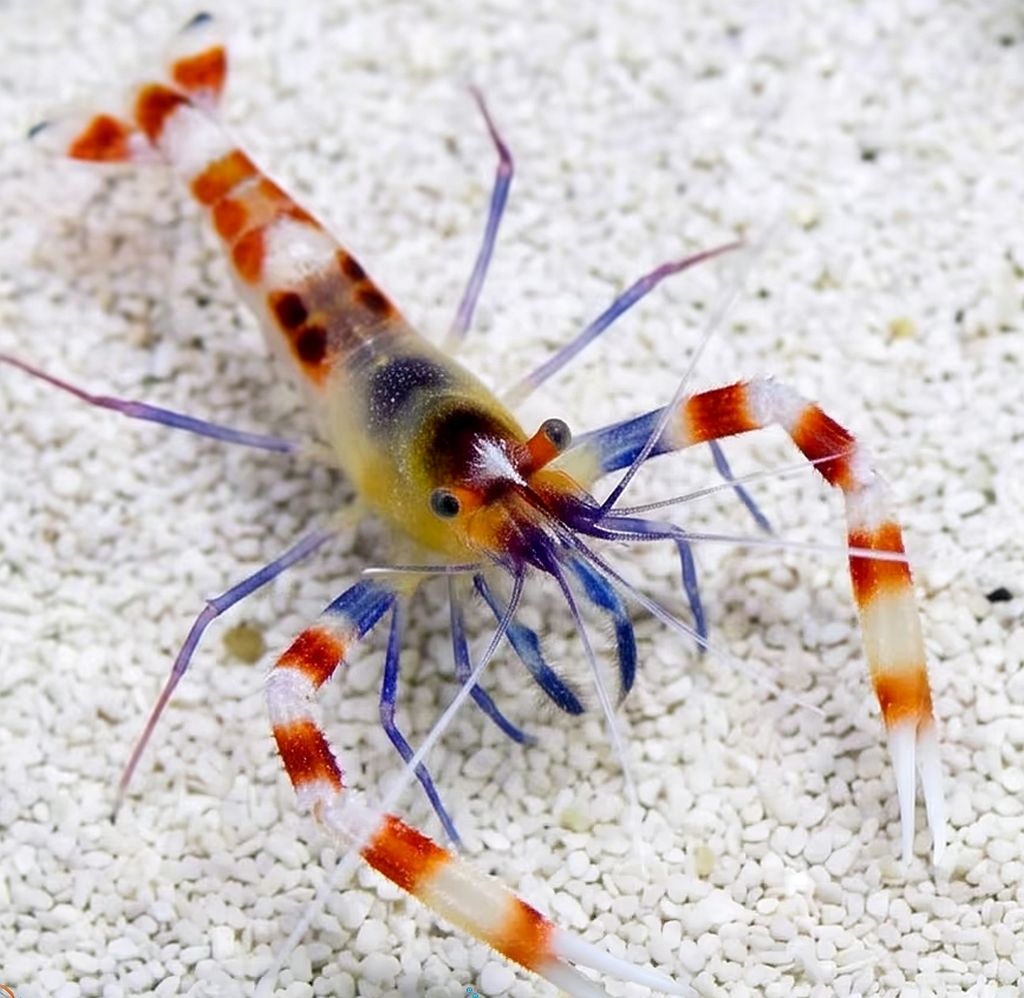
Posted in Corals, Featured Articles, LPS Corals, Saltwater, Tropical Fish Keeping, Tropical Fish Species0 Comments

Hammer Coral (Fimbriaphyllia ancora)

Hammer Coral (Fimbriaphyllia ancora)

Hammer Coral (Fimbriaphyllia ancora)

Hammer Coral (Fimbriaphyllia ancora)

The Hammer Coral (Fimbriaphyllia ancora) formerly Euphyllia ancora or Euphyllia paraancora is known to tropical fish keeping enthusiasts as the Anchor Coral, Wall Coral, Ridge Coral, Sausage Coral, and Kidney Coral and is found throughout the Indo Pacific. Their range extends from the coast of Africa to the Western Pacific, including the waters of Indonesia, Australia, the Solomon Islands, and the Great Barrier Reef.

Hammer Coral is native to the warm waters of the Indo-Pacific region where they are common in relatively shallow coastal reefs, lagoons, and turbid waters.

Although the Hammer Coral is generally found among the protected coral reef slopes of their range in clear shallow to deeper waters with gentle to moderate currents.    They are quite adaptable and are also found in shadier spots closer to shore growing on rocks and coral rubble where water movement shields their delicate tissue from tearing.   In general, Fimbriaphyllia ancora can typically found at depths ranging anywhere from 10 to 130 feet.

Hammer Coral (Fimbriaphyllia ancora)

Hammer Coral (Fimbriaphyllia ancora)

Like all species of Fimbriaphyllia, Hammer Corals form a hard, calcified skeleton that is topped with multi-tipped T shaped, flesh toned tentacles, that closely resemble an anchor or a hammer, hence their common name.

Hammer Coral (Fimbriaphyllia ancora)

Hammer Coral (Fimbriaphyllia ancora)

Hammer Corals grow in two primary skeeletal configurations:

The Branching Hammer Coral variety (Fimbriaphyllia paraancora) that grows as separate individual calcified heads that branch out like a tree. Fimbriaphyllia paraancora is generally easier to propagate (frag) and handles aquarium stress better.

The Wall Hammer Coral variety (Fimbriaphyllia ancora) that grows as a continuous, meandering wall-like skeleton with a single large, interconnected fleshy polyp.   Euphyllia remains the correct genus for Torch Corals like Euphyllia glabrescens.

The Hammer Coral has multiple recognized species and sub-clades within the genus:

Euphyllia divisa (Veron & Pichon, 1980)
Euphyllia ancora (Veron & Pichon, 1980)
Euphyllia glabrescens (Chamisso & Eysenhardt, 1821)
Euphyllia paraancora (Veron, 1990)
Euphyllia paradivisa (Veron, 1990)
Euphyllia bayeri (Hodgson & Ross, 1982)
Euphyllia cristata (Chevalier, 1971)
Hammer coral (Euphyllia ancora)

Hammer Coral (Fimbriaphyllia ancora)

Hammer Coral (Fimbriaphyllia ancora)

Fimbriaphyllia ancora are naturally found in shades of brown, tan, or green with green, pink or purple tips that frequently fluoresce under actinic reef lighting. Aquacultured strains are found in neon greens, deep purples, oranges, golds, pinks, and various multi colored, bi colored, or “splattered” colored patterns.

Hammer Coral (Fimbriaphyllia ancora)

Hammer Coral (Fimbriaphyllia ancora)

Their color and the intensity of their colors is entirely dependent on how much light they receive and the presence of actinic lighting. The more balanced the light, the richer the fluorescent coloration of the coral.

Like the Frogspawn Coral (Fimbriaphyllia divisa), the Hammer Coral can be housed in a small nano reef tank, however, they are best kept in larger mature reef aquariums of at least 30 gallon capacity with a live sand or fine coralline gravel substrate and plenty of live rock or other aquascape architecture for them to attach themselves to. They do well when placed in the bottom to middle of the tank with low to moderate lighting, gentle to moderate indirect water flow, and adequate space to prevent them from stinging neighboring corals.

Hammer Coral (Fimbriaphyllia ancora)

Hammer Coral (Fimbriaphyllia ancora)

Fimbriaphyllia ancora is semi-aggressive towards other corals and although their normal tentacles are relatively short, they will emit long, stinging sweeper tentacles at night to ward off invasive competitors.

Albeit aggressive to outsiders like Acropora, Montipora, Chalices, Brain corals, Zoanthids and other LPS or SPS coral; Fimbriaphyllia ancora is a peaceful addition alongside other Fimbriaphyllia and certain Euphyllia sub-clades like Frogspawns, allowing hobbyists to group them together into a “Euphyllia garden.”

Compatible tankmates for Hammer Coral include Clownfish, Firefish, Cardinalfish, Gobies, Blennies, Cleaner Shrimp, and other peaceful reef-safe species.

The Hammer Coral reproduces through both sexual and asexually methods.   How they reproduce depends on whether they are the Wall or Branching variety.

In their natural environment Fimbriaphyllia ancora is historically known as a gonochoristic spawner where individual colonies produce either only eggs or only sperm during a breeding cycle.

Hammer Coral (Fimbriaphyllia ancora)

Hammer Coral (Fimbriaphyllia ancora)

However, marine biologists have discovered that roughly 73% of Fimbriaphyllia ancora colonies undergo an annual sex change (sequential hermaphroditism), switching between male and female roles from one season to the next.

The lunar cycle and water temperature dictates when mass spawning occurs.   In Taiwan, it normally occurs around April or May.  Colonies synchronously release pink gamete bundles into the open water column roughly 3 to 6 nights after a full moon with fertilization taking place externally in open water. The swimming planula larvae drift with the currents before anchoring to the substrate to build a new skeleton.

Asexual reproduction also occurs with Hammer Corals, especially in a stable reef environment. A single Hammer Coral will clone itself to expand the colony through a process of budding or longitudinal fission.

In branching varieties (Fimbriaphyllia paraancora), a single head will slowly constrict and divide across its center to form two distinct new heads, expanding the skeleton upward and outward, whereas wall varieties grow continuously along a single meandering ridge.

Over time, large branching colonies can be manually fragmented (fragged) by carefully cutting the lower skeletal branches well below the living tissue line to create independent specimens.

Hammer Coral (Fimbriaphyllia ancora)

Hammer Coral (Fimbriaphyllia ancora)

In their natural environment, Hammer Corals obtain most of their nutrients from their zooxanthellae, symbiotic algae.   Although they rely mostly on photosynthesis and dissolved organics for growth, they are active micro predators that use the stinging nematocysts on their sticky, hammer shaped tentacles to paralyze and capture small prey.  The tentacles slowly retract and pull the captured food inward to the center of thepolyp head where the mouth is located.

In an aquarium environment with indirect water flow, they greatly benefit from weekly supplemental feedings of mysis shrimp, enriched brine shrimp, or specialized LPS pellet foods mixed with water that they catch with their sticky nematocysts.

The Hammer Coral, (Fimbriaphyllia ancora) is readily available in the aquarium trade to tropical fish keeping enthusiasts as wild caught and captive-bred specimens from a variety of online retailers at moderate to premium prices depending on the rarity of the color morph.

Hammer Corals (Fimbriaphyllia ancora, Euphyllia ancora) are among the most popular and vibrant Large Polyp Stony (LPS) corals in the reef hobby, famous for their anchor-shaped, hammer-tipped tentacles that add substantial movement to an aquarium.

Aquaculture of this coral has been highly successful, leading to increased availability, hardiness, and sustainability in the hobby.

Hammer Coral (Fimbriaphyllia ancora)

Hammer Coral (Fimbriaphyllia ancora)


Minimum Tank Size: 30 gallon
Tank Placement: Bottom to Middle
Water Flow: Gentle to Moderate (Indirect)
Care Level: Moderate
Aquarium Hardiness: Moderately Hardy
Temperament: Aggressive
Toxicity: Yes, strong stinging cells (Sweeper Tentacles)
Invasive: No
Water Conditions: 76 – 80°F, dKH 8 – 11°, pH 8.1–8.4, sg 1.024-1.026, Nitrate 1 – 10 ppm, Calcium 400-450 ppm
Lighting: Low to Moderate (100-150 PAR)
Feeding: mysis shrimp, brine shrimp, LPS pellets
Growth Rate: Moderate
Color Form: Green, Tan, Pink, Purple, Gold, Bi-color, etc.
Diet: Photosynthetic, Carnivore (Target Feeder)
Origin: Indo-Pacific, Australia
Family: Euphylliidae
Lifespan: Decades (Under proper care)
Aquarist Experience Level: Intermediate
Posted in Corals, Featured Articles, LPS Corals, Saltwater, Tropical Fish Keeping, Tropical Fish Species0 Comments

Saltwater Fish

Featuring Clownfish

Aquarium Supplies

On-Sale Aquarium Supplies!
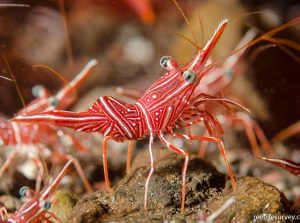
Saltwater Specials

Categories