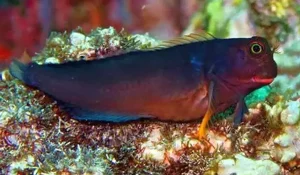
Redlip Blenny (Ophioblennius atlanticus)
The Redlip Blenny (Ophioblennius atlanticus) known to tropical fish keeping enthusiasts as the Horse Face Blenny, Horesface Blenny, Atlantic Redlip Blenny, or Red-lipped Blenny is native to the tropical waters of the central Atlantic Ocean and Caribbean.
Its range extends to the eastern Atlantic from Senegal to Angola, and the offshore islands. In the northeastern Atlantic Ophioblennius atlanticus is confined to the Macaronesian archipelagos of the Canary Islands, Madeira, and the Azores. And in the western Atlantic, it is found off Bermuda, the coast of North Carolina and south through the West Indies to Brazil. A couple of sightings have also been documented in the central Mediterranean Sea.
Adult Redlip Blennies are a solitary species that can be found alone, in pairs, and in North Carolina waters, in small aggregations occupying shallow reefs, particularly coral crests and fringing reefs, and rocky substrates of their range, grazing on algae at depths between 30 to over 65 feet .
Juveniles and spawning pairs are most often found in the much shallower tide pools and reef flats in depths ranging from 1 to 27 feet.
The Redlip Blenny is highly territorial, especially towards conspecifics. They effectively farm their own food source by cultivating and harvesting gardens of filamentous algae in their claimed territories and will aggressively drive off any other herbivorous species that try to graze there. Ophioblennius atlanticus have two sharp canine teeth that they use to confront intruders. In the wild, territorial disputes are frequent.
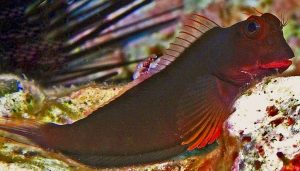
Redlip Blenny (Ophioblennius atlanticus)
The Redlip Blenny has a large head with four small branching horns, prominent expressive eyes, a blunt nose, distinctive bright red orange lips, and an elongated eel like body with long ventral fins that they use to perch on the substrate. Their body is a dark chocolate brown to blended black and red color, with yellow markings camouflaging the body and fins.
A paler variant occurs that has a shell-white body and a reddish brown head with a yellow dorsal fin, reddish tinged lateral fins, and a
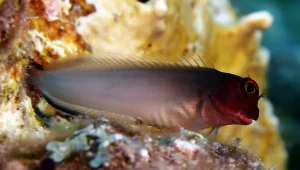
Redlip Blenny (Ophioblennius atlanticus)
black or bicolored tail. Males are typically larger with more vividly red colored lips than females.
The Redlip Blenny is best housed in a mature FOWLR or reef aquarium of at least 30 gallon capacity with a fine coralline gravel substrate and plenty of aged live rock arranged into caves, crevices, layered ledges and overhangs for it to perch on and hide among.
They are jumpers and require a tight fitting lid on their tank.
The Redlip Blenny is considered reef safe as long as it is adequately fed. They ignore invertebrates , most corals and clams but have been observed picking on soft coral polyps.
In community aquariums, Redlip Blennies may become aggressive toward other blennies or gobies that infringe on their territory. They do well with other non-similar shaped species.
Unless they are kept in a large aquarium with copious amounts of live rock, it’s safer to keep only one individual or mated pair in a community tank.
Redlip Blennies are egg-layers that deposit their spawn in crevices within the male’s territory. They have been bred in an aquarium environment however the larvae are difficult to rear.
In their natural environment, Ophioblennius atlanticus are polygynous. Females consistently mate with multiple males. When a pair is ready to spawn, usually in the ten days prior to and four days after the full moon, the male clears algae, rocks, and debris from a crevice or cavity to create a small, box like nest to attract a female. A single male will maintain several nests, usually around five of differing sizes. The male hovers near the nest with dorsal and anal fins spread to entice a female. When a female selects a nest, adhesive eggs are laid in a single layer along the walls or ceilings of the nest crevice. Multiple females often lay their eggs in the same nest. After fertilizing the eggs, the male cares for the eggs by fanning, removing any fungus infected eggs, and protecting them from predators.
The demersal eggs hatch into planktonic larvae after about five days, usually at night. The buoyant larvae float along as plankton and initially feed on rotifers and later on larger foods until they mature into adults.
In their natural habitat, the Redlip Blenny is a territorial herbivore that farms and grazes on filamentous algae.
In addition to grazing on the natural growth of algae in a well established aquarium, they should be provided Spirulina based flake or pellet foods, marine algae sheets (nori), and commercially frozen preparations with high vegetable content. Occasional offerings of frozen mysis shrimp may also be accepted. Two to three feedings per day are recommended.
The Redlip Blenny (Ophioblennius atlanticus) is only occasionally available to tropical fish keeping enthusiasts as wild caught specimens from a variety of local aquarium shops and online retailers, wholesalers, and transhippers at prices that vary on size and area of collection. Despite their abundance in the wild, Caribbean and Florida collectors prioritize higher priced species and seldom collect them.
Approximate purchase sizes: 1 1/2″ to 3″ When available, prices range from $29.49 to $49.99

Redlip Blenny (Ophioblennius atlanticus)
Minimum Tank Size: 30 gallon (55+ gallons for pairs)
Aquarium Type: Reef or FOWLR
Care Level: Moderate
Temperament: Semi-Aggressive
Aquarium Hardiness: Hardy
Water Conditions: 72-78° F, dKH 8 – 12°, pH 8.1–8.4, sg 1.020-1.025
Max size: 5″
Color Form: Black, Red, Yellow
Diet: Herbivore
Compatibility: Reef Safe
Origin: Indo Pacific
Family: Blenniidae
Lifespan: 4 – 6 years
Aquarist Experience Level: Beginner