Orbiculate Cardinal (Sphaeramia orbicularis)
The Orbiculate Cardinal (Sphaeramia orbicularis) known to tropical fish keeping enthusiasts as the Dot Dash Cardinal, Chubby Cardinal, Polka-Dot Cardinal, and Orbicular Cardinalfish is found throughout the tropical waters of the Indo Pacific.
Their vast range extends from coastal East Africa to the Kiribati Islands off South Africa; northwards, it reaches the southern islands of Japan, particularly the Ryukyu Islands and Iriomote Island and southwards to northern Australia and New Caledonia; eastward it extends to the Oceanic Island groups as far as Kiribati, Fiji, and Micronesia (Palau, the Mariana Islands and eastern Caroline Islands); and in the central Indo-Pacific, throughout the coastal waters of Southeast Asia, Indonesia, the Philippines, and Singapore.
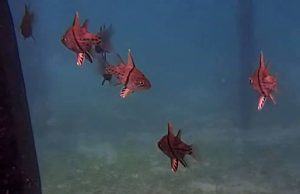
The Orbiculate Cardinal is normally found in small to large congregations that they form in very shallow, stagnant to slow moving brackish or coastal waters in low current areas like mangrove estuaries, brackish coastal lagoons, ports, seagrass beds, and man made structures at depths rarely exceeding 16 feet.
Sphaeramia orbicularis have adapted exceptionally well to human development and are frequently collected from the large schools they form underneath the piers, jetties, marine docks and boardwalks throughout their range.
During the daylight hours the Orbiculate Cardinal will hover completely motionless among the mangrove roots, docks, and other structure relying entirely on camouflage for protection from predators. At night they leave their structure hideaways to target tiny shrimp, crabs, and benthic organisms that arise out of the silt or muddy substrate.
The Orbiculate Cardinal (Sphaeramia orbicularis) shares the similar round profile and dark vertical waistband as the Pajama Cardinal (Sphaeramia nematoptera) but lacks the vibrant color scheme. Both are nocturnal predators and paterenal mouthbrooders.
Orbiculate Cardinal (Sphaeramia orbicularis)
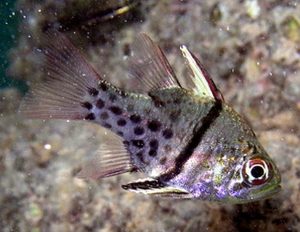
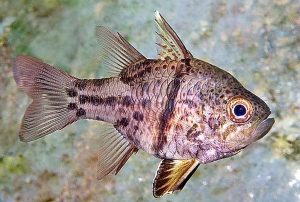
The Orbiculate Cardinal has a dull silver, gray or olive green face and head; a dark, dark red or silver colored eye; a narrow mottled or broken thin dark black vertical mid body band with smal dark spots, reddish on the head, becoming larger black or dark gray on the posterior toward the caudal peduncle, and short translucent fins that give it a camouflaged, muted appearance.
The “Dot Dash” Cardinal found among the reefs and lagoons of East Africa has a golden to beige body color with black spots and one solid black vertical line that runs from the dorsal to the pectoral fin.
Orbiculate Cardinal (Sphaeramia orbicularis)
Males and females are identical in appearance and size.
The Orbiculate Cardinal is best housed in groups of 5 or more individuals in a mature FOWLR aquarium of at least 30 gallon capacity for a single specimen, or 55 gallons for a small school, with a fine sand or muddy/silt substrate that is decorated with live or fake rock arranged into large caves, overhangs, tall vertical pillars, and fake vertical mangrove roots to replicate their estuarine environment. They require good filtration, low to very gentle water flow and low, dim or shaded lighting. This species is very sensitive to ammonia and nitrite.
Although the Orbiculate Cardinal is completely reef safe and will not harm corals, clams or invertebreates; they do best in a FOWLR tank that does not require high powered reef lighting for coral growth or wavemakers.
The Orbiculate Cardinal is a peaceful community fish that should not be housed with aggressive or predatory fishes. Good tankmates include the Firefish Goby (Nemateleotris magnifica), Banggai Cardinalfish (Pterapogon kauderni), Royal Gramma (Gramma loreto), Clownfish (Amphiprion spp.), and Yellow Watchman Goby (Cryptocentrus cinctus).
If you keep a reef or FOWLR tank with a clean-up crew with very small ornamental shrimp (like tiny sexy shrimp or small anemone shrimp), they may occasionally be snapped up at night if they can fit inside the wide mouths of adult cardinalfish. Normal sized cleaner shrimp, peppermint shrimp, and snails are completely safe.
Sphaeramia orbicularis can be bred in an aquarium environment but their pelagic larvae require specialized, microscopic live foods to survive which makes them extremely challenging to raise.
In their natural habitat the breeding cycle of Orbiculate Cardinalfish is exactly the same as the Pajama Cardinal except for the choice of nesting grounds.
Although both are paternal mouthbrooders that have their breeding cycles tied to the lunar cycles. Key differences are that Orbiculate Cardinalfish spawn fortnightly, peaking shortly before a new moon and full moon. Their courtship occurs along the shallow coastlines among mangrove roots, fallen debris and pier pilings.
After fertilizatrioin, the male holds the clutch in his mouth for about 8 days until hatching and like Pajama Cardinals spit out their microscopic, free floating larvae to drift in the water column to feed on zooplankton until they are able to settle back down to the nearest mangrove root and grow into adults.
Because spawning cycles occur every 2 to 3 weeks, males spend nearly half of their adult lives in a state of starvation as they incubate eggs in their mouths. To survive and rebuild their fat reserves, they must feed aggressively and gorge themselves on high-protein prey during the short windows between brooding cycles.
In their natural habitat, Dot Dash Cardinals are nocturnal carnivores that spend their days resting motionless in tight groups and separate into hunting parties as dusk falls.
They hunt over the muddy, silty substrates, skimming the surfaces of mangrove roots, seagrass beds, and pier pilings targeting benthic invertebrates and zoobenthos that crawl along the muddy sea floor like small crabs, tiny worms, insect larvae, benthic crustaceans, small juvenile fish and insects falling from the mangroves.
In an aquarium environment they require a live or frozen high protein diet of enriched Mysis shrimp, enriched brine shrimp, chopped krill, chopped clams, and copepods, especially for juveniles. Targeted feedings 2 to 3 times a day with a pipette or a turkey baster is recommended to give the fish time to pluck the food from the water column. They easily transition to high quality pellets and flakes.
The Orbiculate Cardinal (Sphaeramia orbicularis) is occasionally available to tropical fish keeping enthusiasts from a variety of online wholesalers, retailers and local fish shops at prices that range from $14.99 to $39.99 depending on size, area of collection and if they are wild caught or captive bred.
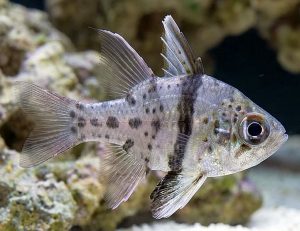
Orbiculate Cardinal (Sphaeramia orbicularis)
Minimum Tank Size: Single specimen 30 gallons, 55 gallons for small schools
Aquarium Type: FOWLR
Care Level: Easy
Temperament: Peaceful
Aquarium Hardiness: Very Hardy
Water Conditions: 73-80° F, dKH 8 – 12°, pH 8.0-8.4, sg 1.023-1.025
Max size: 3.9”
Color Form: Greenish Gray, Dull Silver, Black, Olive Brown, Pale White
Diet: Carnivore
Compatibility: Reef Safe
Origin: Indo Pacific Ocean
Family: Apogonidae
Lifespan: 5 years
Aquarist Experience Level: Beginner/Advanced