Yellow Lined Anthias (Tosanoides flavofasciatus)
Yellow Lined Anthias (Tosanoides flavofasciatus) known to tropical fish keeping enthusiasts as the Yellow Striped Anthias or Prismatic Anthias are found in the Western Pacific, most notably in Sagami Bay off Japan, with a second population recorded from the Tonga Ridge in Melanesia.
Yellow Lined Anthias are an uncommon deepwater reef dwelling species typically encountered in pairs or small harems along rocky drop offs, complex reef structure, and cracks, crevices, and caves of their range, at depths well below 200 feet. They use this structure to shelter from the open ocean predators found at those depths. In cooler months, they will move up into shallower water, though still well within mesophotic depths of 110 to 160 feet, staying wherever temperatures remain cool enough for their liking.
In the wild, Yellow Striped Anthias behave much like other Tosanoides and typical anthiines, forming harems made up of a single dominant male presiding over several females, hovering above the reef to pick zooplankton from the passing current. Like other anthiines, Tosanoides flavofasciatus are believed to be protogynous hermaphrodites. All individuals start life as females and within a group or harem, the largest, most dominant female will transition into a male if no male is present.
Yellow Lined Anthias are strongly dichromatic and dimorphic between the sexes. All members of the genus
Yellow Lined Anthias (Tosanoides flavofasciatus)
Tosanoides have a somewhat high body profile, stocky shape, and rounded ventral fins.
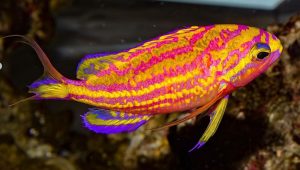
Fully colored males are decorated with alternating horizontal bands of bright yellow and deep pinkish purple that carry a metallic sheen under natural light. The tail is asymmetrically colored, largely clear along the upper lobe with vivid pattern confined to the lower lobe, and adult males develop elongated trailing thread filaments on the anal, ventral, and caudal fins.
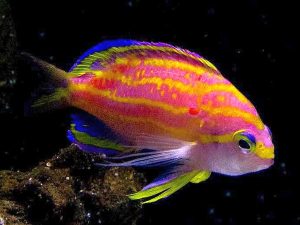
Females and juveniles are far plainer, with a more uniform pinkish orange
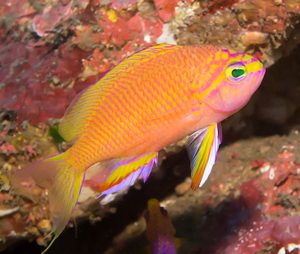
Female Yellow Lined Anthias (Tosanoides flavofasciatus)
body, splashes of yellow and soft purple limited to the face and around the eyes, and red and yellow pelvic and anal fins outlined in purple or magenta along their leading edge. Females also lack the trailing thread filaments seen on males and stay noticeably smaller.
Tosanoides flavofasciatus are best housed in a mature, dedicated cool water reef or FOWLR aquarium of at least 75 to 100 gallons for a single fish or small haremic group, with plenty of live rock arranged into open swimming lanes as well as shaded caves, overhangs, and archways the fish can retreat into. Because this species naturally lives well below tropical reef temperatures, it should never be housed in a standard warm reef system.
Because Yellow Lined Anthias are collected from deep, cool water, they require dim to moderate lighting instead of intense reef lighting. Shaded retreats should always be available for them to escape high-light areas of the tank.
An aquarium chiller is essential, not optional, for this species. Although sources differ slightly on the exact number, the ideal temperature range for Yellow Lined Anthias is anywhere from 62°F up to 72°F. A chiller capable of holding steady in the mid to upper 60s°F is the safe target.
A wavemaker providing moderate, steady flow is also recommended to reproduce the current found in their natural deep reef environment, without turbulent, high stress areas.
Heavy filtration, aggressive protein skimming, regular water changes, and stable water chemistry are required to keep this sensitive species in good health. Copper based medications should be avoided entirely, as deep reef anthiines are considered especially sensitive to them.
Yellow Lined Anthias are completely reef safe and will not bother corals, decorative clams or other sessile invertebrates. They are peaceful and do best with similarly non-aggressive, cool-tolerant tankmates such as Plectranthias, deepwater pipefish, or cool-water gobies, rather than typical boisterous shallow-water reef fish. Like most anthiines, more than one male in a single system will result in aggression, and a lone male is best kept with a small group of females if a harem setup is desired.
Tosanoides flavofasciatus have not been successfully bred, raised, or commercially produced in a home aquarium to date.
Like other anthiines, they are pelagic spawners, releasing eggs and sperm into the water column during courtship, typically around sunset. The resulting larvae are tiny, require specialized planktonic live feeds, and go through a long larval development period, all of which make captive propagation currently unviable for hobbyists.
Yellow Lined Anthias are strict planktivorous carnivores with a naturally high metabolism from feeding in open current, and they need frequent, high-nutrition meals to match it. In the wild they feed on small drifting animals like copepods, larvae of tiny crustaceans and other similarly sized zooplankton swept along by the currents.
A varied diet of PE Mysis, enriched brine shrimp, copepods, and finely chopped seafood, alongside quality pellets such as TDO or New Life Spectrum, works well in the aquarium. Feeding small amounts three to five times a day is preferable to one or two large feedings, and frozen and live foods should remain the staple even if the fish can occasionally be coaxed onto pellets.
Yellow Lined Anthias (Tosanoides flavofasciatus) are one of the rarest and most expensive, anthias in the entire aquarium trade, and that reputation is not hype. Outside of Japan, there is essentially no established supply chain. In the U.S. they are extremely rare and sporadically imported unpredictably through only a handful of specialty boutique vendors.
Because it lives at extreme depths, it can only be hand collected by specialist divers using mixed gas and closed circuit rebreathers. This results in very few specimens brought up in a given year.
The overwhelming majority of what is collected never leaves Japan at all. Japanese aquarists are known to purchase nearly every specimen before export is even considered, and Tosanoides flavofasciatus does show up, on and off, at a handful of elite Japanese retailers such as BlueHarbor, Vessel, and Lagoon. Even there, it is described as inconsistent stock rather than a regular offering. Females and juveniles surface more frequently, while large, fully colored males are considerably harder to come by.
Outside Japan, exports are rare enough that each occurrence tends to be treated as a notable event in the hobby rather than a routine restock. The best documented U.S. case is a male brought in by the importer Marine Collectors in 2021, reported at the time as the first live specimen of this species ever offered for sale domestically, at $10,000.
The most recent specialty importer Unique Fins has listed the species with clearly tiered, published pricing by sex and grouping: a single female priced around $5,800, a single male around $13,000, and a mated trio of one male and two females around $24,000.
As of this writing, all three of those listings are marked sold out, which is itself the clearest illustration of how this species actually trades — availability comes in short, unpredictable bursts, and demand clears the stock almost immediately when it does appear.
In practical terms, Yellow Lined Anthias are not a fish you can simply shop for. It occasionally becomes available without warning, through a very small number of specialty importers at prices that depend heavily on the individual specimen’s sex, size, coloration, and grouping.
If you are a serious tropical fish keeping enthusiast hoping to acquire a Yellow Lined Anthias, your best strategy is to build a direct relationship with a high end rare fish importer and ask to be placed on a waitlist or notification list.
Make sure a dedicated cool water system is already up, cycled, and ready well before that call ever comes.
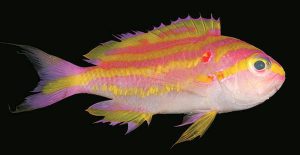
Yellow Lined Anthias (Tosanoides flavofasciatus)
Minimum Tank Size: 75-100 gallons
Aquarium Type: Deepwater Reef or FOWLR
Care Level: Expert
Temperament: Peaceful
Aquarium Hardiness: Delicate
Water Conditions: 62°F to 72°F, dKH 8 to 11, pH 8.1-8.4, sg 1.023-1.025
Max size: 3.5″ (males); 2.3″-2.4″ (females)
Color Form: Yellow, Pink, Purple, White
Diet: Carnivore (Planktivore)
Compatibility: Reef Safe; best with peaceful, cool-tolerant tankmates
Origin: Japan, Melanesia
Family: Anthiadidae
Lifespan: Not well documented; related anthiines typically live several years in captivity Aquarist Experience Level: Expert