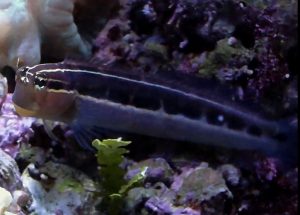
Lined Blenny (Ecsenius lineatus)
Lined Blenny (Ecsenius lineatus) known to tropical fish keeping enthusiasts as Linear Blenny, Dot-Dash Blenny, Lined Combtooth Blenny, Lined Coiral Blenny, and Blennie Bigoula is widespread throughout the tropical waters of the Indo-West Pacific.
It is found from the eastern coast of Africa to the Philippines with a range that extends from Yemen to northwest Australia, the Philippines, and Ogasawara Island in Japan.
Although Ecsenius lineatus and Meiacanthus grammistes are both sold as Lined Blennies, they are entirely different in anatomy, behavior, and biology. The primary difference is that Meiacanthus grammistes is a venomous midwater swimmer; while Ecsenius lineatus is a non-venomous, rock-dwelling bottom-dweller
In the northernmost parts of their range, adult Linear Blennies are found in clear shallow lagoons and the coastal to outer reef crests in areas with rich coral growth at depths from 3 to about 50 feet. They spend the majority of their days perched on coral heads, rubble, and rocky outcrops.
Like all Ecsenius blennies, Linear Blennies are dedicated herbivores equipped with specialized comb like teeth that they use for scraping microalgae and diatom films from hard surfaces.
Ecsenius lineatus are rarely observed at dephs less than 15 feet, however, further south of their range, collectors encounter them on the bottom of their environment among the crevices and rocks as deep as 92 feet.
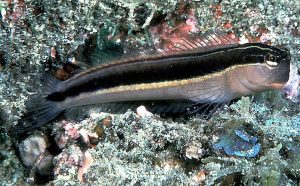
Lined Blenny (Ecsenius lineatus)
The Lined Blenny (Ecsenius lineatus) has a round, elongated body with a small
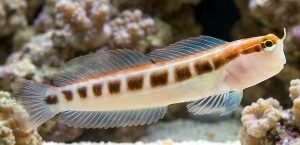
Lined Blenny (Ecsenius lineatus)
mouth, very large eyes, and a dark brown to black longitudinal stripe on its white body that is often interrupted in larger specimens.
In some populations, the black lateral stripe is sometimes present as a series of black blotches. Sexual dimorphism is subtle, with males sometimes slightly larger than females.
The Linear Blenny can be housed in a FOWLR or mature reef aquarium of at least 30 gallon capacity with a coraline gravel substrate and plenty of algae covered live rock arranged into caves, crevices, ledges and overhangs for them to graze, perch on and hide.
The Lined Blenny is generally considered reef safe however they will occasionally nip at the polyps or bases of Acropora sp., Montipora sp. and other SPS corals. They make a great addition to peaceful FOWLR and reef tanks that are heavily stocked with mature colonies of Acropora sp.
Ecsenius lineatus is peaceful and compatible with virtually all community reef fish including clownfish, gobies, cardinalfish, firefish, wrasses, and tangs. They can become mildly territorial toward other combtooth blennies, particularly other Ecsenius species. They should not be housed with aggressive species.
The Linear Blenny has not been successfully bred in an aquarium environment. Their breeding behavior is similar to other Ecsenius species like the Midas Blenny.
Lined Blennies are egg layers that deposit small adhesive eggs in small crevices or empty shells. The male guards the nest until hatching. The larvae are tiny and pelagic, requiring rotifers and phytoplankton as first foods.
In their natural habitat Lined Blennies are primarily herbivorous, grazing on diatoms, film algae, cyanobacteria, and occasionally small invertebrates like mysis or brine shrimp.
In an aquarium environment, they require a varied algae based diet of frozen or dried foods like spirulina pellets, algae wafers, dried nori sheets, and occasional offerings of live or frozen mysis and brine shrimp. It is important to provide sufficient live rock and algae covered surfaces in the tank to encourage their natural grazing behavior. Multiple small feedings at least 2 to 3 times a day are recommended.
The Lined Blenny (Ecsenius lineatus) is relatively available to tropical fish keeping enthusiasts as wild caught specimens from a variety of local aquarium shops and online retailers, wholesalers, and transhippers at prices that vary on size and area of collection.
Approximate purchase sizes: Small: 1-1/4″ to 1-1/2″; Medium/Large: 1-1/2″ to 2-1/2″
Prices start at $30.99 for small Indian Ocean specimens, to over $60.00 for small aquarium ready specimens from South Asia.
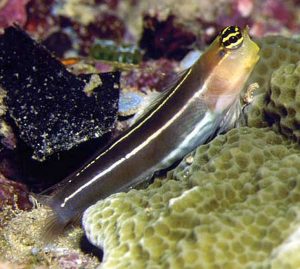
Lined Blenny (Ecsenius lineatus)
Minimum Tank Size: 30 gallon
Aquarium Type: FOWLR or Reef
Care Level: Easy
Temperament: Peaceful
Aquarium Hardiness: Hardy
Water Conditions: 72-78° F, dKH 8 – 12°, pH 8.1-8.4, sg 1.020-1.025
Max size: 3½””
Color Form: Black, Tan and White
Diet: Herbivore
Compatibility: Reef Safe
Origin: Indo-West Pacific
Family: Blenniidae
Lifespan: 3 – 5 years
Aquarist Experience Level: Beginner