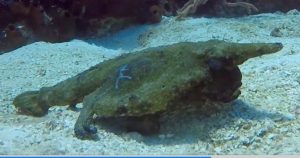
Longnose Batfish (Ogcocephalus corniger)
The Longnose Batfish (Ogcocephalus corniger) known to tropical fish keeping enthusiasts as the Walking Batfish, Red Lipped Batfish, Walking Longnose Batfish, Devil Nose Fish, Spotted Batfish or Horned Batfish is found in the warm waters of the Western Atlantic Ocean; particularly from the southeastern United States down through the Caribbean Sea and into the Gulf of America.
Longnose Batfish have been found as farn north as the coastal waters of North Carolina. They are common throughout the northern Gulf of America and across the Bahamas; and farther south through the Greater Caribbean into Central America and the coastal waters of Belize, Cozumel, Mexico down to Columbia.
Longnose Batfish are sedentary, demersal ambush predators that are usually encountered alone buried or walking along the soft, sandy, or muddy bottoms of their range where they hunt for snails, small crabs, and clams with their horn like noses.
Longnose Batfish are routinely collected by both recreational divers and scientific/commercial trawlers along the sandy flats and drop offs that immediately border coral reefs or rocky areas in the benthic neritic zone at depths from 95 to 755 feet
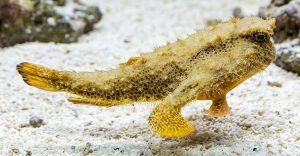
Longnose Batfish (Ogcocephalus corniger)
Unlike other marine Batfishes, the Longnose Batfish has a uniquely flat, disc shaped body when viewed from above, muscular limb like pectoral and pelvic fins, and an elongated pointed horn like snout with a small, retractable (illicium) that they use as a lure to attract smaller fish when they are buried in the sand.
The dorsal side of their body is a mottled yellowish brown, gray, or reddish brown color with hints of black, and the ventral side is usually a pale cream, light yellow, or reddish orange color. They have a rough skin that is completely covered in small, hard, wart like tubercles. Males and females are visually indistinguishable.
Juvenile Longnose Batfish are colored similarly to adults with mottled shades of yellow, brown, or gray that blend seamlessly with the sandy bottom. They lack the elongated horn that showcases adults.
The Longnose Batfish is an exceptionally difficult species to keep in captivity.
Juvenile Ogcocephalus corniger are best housed in a low profile mature FOWLR aquarium of at least 75 gallon capacity that is wider rather than tall with a thick, deep bed of fine, smooth aragonite sand or live sand and live rock around the perimeter and/or back walls. They require a wave maker to provide low to moderate water flow near the bottom, and because they are messy eaters, a strong protein skimmer to provide heavy filtration. Low lighting is recommended for this species..
Adults require a larger tank of at least 150 gallon capacity with the same substrate and decor. Tank footprint and substrate texture is far more critical than total water volume with this species.
The Longnose Batfish is NOT reef safe and should only be housed in a FOWLR setup. They are poor swimmers and tend to knock over corals and other reef structure as they “walk” along the substrate and will prey on shrimp, small crabs, and small reef fish.
Longnose Batfish are generally calm and non aggressive in a community aquarium. In a large enough tank they coexist well with non aggressive Panther Groupers, Harlequin Tuskfish and Lionfish. Avoid housing them with fast, aggressive species like tangs, wrasses, angelfish, triggerfish or puffers which will nip at their fins and delicate “lure”.
Longnose Batfish have not been bred in an aquarium environment.
The Longnose Batfish is a carnivorous, benthic ambush predator that feeds exclusively on small crabs, wild shrimp, mysids, amphipods, small gastropods, clams, scallops, polychaetes and other marine worms, and small fish.
Unlike deep sea anglerfish that use a glowing lure to attract prey, the Longnose Batfish uses a retractile dorsal spine called an illicium, tipped with a fleshly “esca” to attract small prey. Scientists believe that the esca secretes a chemical scent to attract crabs and snails to their mouth.
In an aquarium environment, Longnose Batfish are extremely difficult to feed. They are slow, passive eaters that initially require live, moving prey like ghost shrimp, small glass shrimp, mysid shrimp, live earthworms or blackworms, or tiny feeder fish placed directly in front of their nose.
Once they are actively hunting live foods; target feeding them frozen enriched Mysis shrimp, chopped raw table shrimp, chopped krill, squid, and clams may be accepted over time.
The Longnose Batfish (Ogcocephalus corniger) is seldom available to tropical fish keeping enthusiasts by online wholesale, retail and specialty fish stores partly because of the specialized diving and trapping equipment needed to safely harvest them.
Due to their specialized dietary needs and low collection frequency, live availability for home aquariums is scarce and seasonal.
Many wholesalers and retail fish stores will not stock them because of the high mortality rates during transit, initial store acclimation, and difficulty in feeding.
Current Ogcocephalus corniger pricing and size ranges are: Small (1.5″ – 2″) at $35 – $50, Medium (2″ – 4″) at $50 – $70, Large / Extra Large (4″+) at $70 or more. Availability across major online retailers is extremely scarce.
Finding one of these unique sought after fish usually requires signing up for back-in-stock email notifications or contacting specialized marine livestock dealers to place a special request.
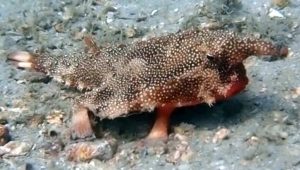
Longnose Batfish (Ogcocephalus corniger)
Minimum Tank Size: 150 gallons
Care Level: Intermediate
Temperament: Peaceful
Aquarium Hardiness: Hardy
Water Conditions: 72-78° F, dKH 8 – 12°, pH 8.1-8.4, sg 1.020-1.025
Max size: 13”
Color Form: Dark Brown, Gray, Orange, Yellowish Brown
Diet: Benthic Carnivore
Compatibility: Not Reef Safe
Origin: Western Atlantic Ocean
Family: Ogcocephalidae
Lifespan: 8 – 10 years
Aquarist Experience Level: Expert