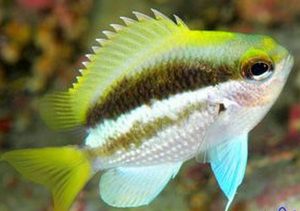
Okinawa Chromis (Chromis okamurai)
The Okinawa Chromis (Chromis okamurai) is one of the rarest Chromis species known to high end tropical fish keeping enthusiasts and the aquarium trade.
The Okinawa Chromis is only found in the Northwest Pacific Ocean where it is rarely collected from the Okinawa Trough in the East China Sea which sits directly behind Japan’s Ryukyu island chain. Until recently, only a single known specimen was dredged up in 1979.
Because the Okinawa Chromis (Chromis okamurai) lives in extreme deep-water habitats, specific scientific observations of its social behavior in the wild are very limited. However, based on general genus traits and data from the few specimens kept in aquariums, we can outline its primary social dynamics.
Chromis okamurai are a peaceful, deepwater, non migratory, reef associated species that are found at depths from 330 to over 570 feet where they hover over rocky and coral slopes in loose aggregations feeding on zooplankton.
When threatened by predators, the entire school acts in unison, diving together into the safety of rock crevices or deep coral structures for protection.
Most damselfish are extremely territorial and aggressive however, Chromis okamurai is exceptionally peaceful, even when compared to more common Chromis species.
Observations made by high end Japanese collectors note that Okinawa Chromis show no aggression toward other fish species and tend to completely ignore other tankmates.
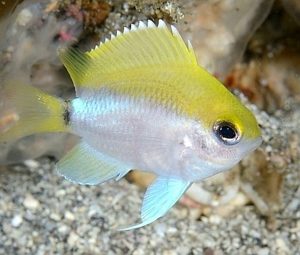
Okinawa Chromis (Chromis okamurai)
The Okinawa Chromis has an oval, compact, laterally compressed body with a deeply forked caudal fin, and a beautiful, iridescent silver pink to lavender purple body color with subtle yellow to gold shading along the dorsal ridge and the upper margins of the fins.
They have extremely smooth, fine ctenoid scales that give the fish a shimmering appearance; large, highly reflective dark eyes, and a distinct small dark blotch at the base of the pectoral fins.
Okinawa Chromis must be housed in a mature FOWLR or deep water azooxanthellate (non-photosynthetic) coral reef aquarium of at least 55 gallon capacity with a live sand or coralline gravel substrate, live rock arranged into caves, ledges, cervices and overhangs for them to hide among and plenty of lateral free swimming space to mimic their reef slope habitat.
Because they require colder water temperatures, lower lighting and moderate water movement; an aquarium chiller, wave makers, and a reef filtration system
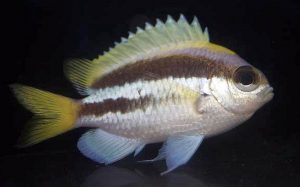
Okinawa Chromis (Chromis okamurai)
with excellent protein skimming is needed to maintain the pristine, stable water quality essential to their well being.
Because intense reef LEDs will stress Okinawa Chromis, use dimmable fixtures with a heavy blue spectrum to simulate their depth range.
Chromis okamurai are completely reef safe and will not bother corals, clams, or ornamental invertebrates. They can be housed with peaceful, deep water community fish like Anthias, Assessors, candy basslets, or deep water gobies.
Avoid aggressive tankmates like larger damselfish, dottybacks, or triggers.
Although it is unlikely for tropical fish keeping enthusiasts in this country to acquire even a single specimen, a 75 to 100 gallon aquarium would be needed to house 6 or more individuals.
Breeding the Okinawa Chromis in a home aquarium is exceptionally difficult and has not yet been achieved. Because they are an extremely rare, expensive deepwater species and all specimens in the trade are wild caught by divers using specialized technical rebreathers, obtaining a pair is highly unlikely.
The life history characteristics for the family specify that this group is oviparous, with distinct pairing during breeding. The eggs are demersal and adhere to the substrate where the males guard and aerate the eggs. In a chilled deep water setup (around 70°F), the demersal eggs typically take 4 to 5 days to mature and hatch. Hatching almost always occurs in total darkness.
The 2 mm long larvae lack functional eyes, a mouth and a digestive gut. During the first 48 hours they drift in the water column as plankton as they absorb their yolk sacs. Any surviving larvae require micro foods like Oithona colcarva or Parvocalanus crassirostris.
In their natural deep water environment, Okinawa Chromis are pelagic planktivores that constantly feed on drifting copepods, shrimp larvae, Mysids and Amphipods, invertebrate spawning, and floating fish eggs.
They have high metabolisms that in an aquarium environment require constant, small feedings of frozen or live Calanus, copepods, Mysis shrimp, enriched brine shrimp, reef plankton blends, tiny krill, Masstick, Cyclops and rotifers for juveniles. Because they are continuous grazers in the wild, at least 3 to 4 small portions should be fed daily.
This Okinawa Chromis is one of the rarest Chromis species in the aquarium trade and is incredibly difficult to obtain. Hand collected by technical rebreather divers at depths below 330 ft. only a single retailer so far has been able to bring this species into the United States aquarium trade alive.
Because it is seldom even seen at mesophotic depths in the Okinawa Trough, and Japan rarely exports deepwater species; the Okinawa Chromis (Chromis okamurai) is not currently available to either tropical fish keeping enthusiasts or high end collectors.
Unique Fins was the first retailer to bring this species into the United States aquarium trade, and this specimen is likely the first or one of the first ever collected alive. Their asking price for the hand collected 2″ juvenile specimen was $5,499.99 USD.
If or when another rarely collected individual at some point becomes available for sale; you can expect prices to be in that range per individual.
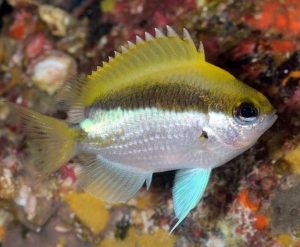
Okinawa Chromis (Chromis okamurai)
Minimum Tank Size: 55 gallons
Aquarium Type: Reef or FOLR
Care Level: Moderate
Temperament: Peaceful
Aquarium Hardiness: Hardy when acclimated
Water Conditions: 68-74° F, dKH 8 to 12, pH 8.1-8.4, sg 1.024-1.026, Nitrate< 10 ppm
Max size: 3.5″
Color Form:
Diet: Carnivore
Compatibility: Reef
Origin: Japan; possibly China
Family: Pomacentridae
Lifespan: 5 – 7 years
Aquarist Experience Level: Advanced/Expert