Starry Blenny (Salarias ramosus)
The Starry Blenny (Salarias ramosus) known to tropical fish keeping enthusiasts as the Snowflake Blenny, Stellate Blenny, Rock Blenny, Coral Blenny, Reef Blenny or Starry Lawnmower Blenny is native to Western Central Pacific reefs and ranges from the Philippines southward to northwestern Australia.
The Starry Blenny is found in the shallow protected inshore reefs, estuaries, and brackish water environments of their range among corals, rocky outcrops, reef rubble margins, and weedy mixed sandy bottoms around areas of heavy filamentous algae growth at depths from 3 to over 50 feet.
Salarias ramosus are a peaceful bottom dwelling species that spend most of their time grazing on algae and perching on live rock and coralsl In their natural environment around the margins of coral reefs, they are often seen forming small groups usually around reef rubble. Solitary Starry Blennies are also found on rock or coral outcrops.
Starry Blenny (Salarias ramosus)
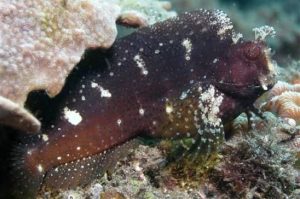
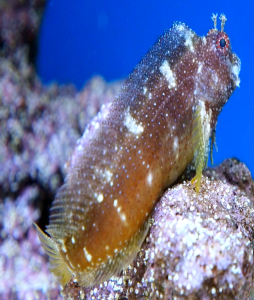
The Starry Lawnmower Blenny has a dark brown elongated body covered with numerous small light blue to white colored dots and a few white blotches over the back . They have a blunt head, a wide flat mouth with combed teeth for grazing algae, bushy whisker like appendages protruding from between their expressive eyes, and yellow pectoral and caudal fins.
Males have more elongated streamers and larger, bushier cirri above the eyes. Females tend to be plumper with fuller bodies and have more compact cirri.
During the breeding season, male Starry Blennies will intensify their body colors to attract a mate. The color patterns become darker and more intense.
The Starry Blenny can be housed in a mature FOWLR or reef aquarium of at least 30 gallon capacity containing various strains of marine algae, with an aragonite sand mixed with reef rubble substrate, and plenty of live rock arranged into tight crevices, tunnels, ledges, and caves for them to hide among.
At least one powerhead is needed to maintain a high water flow and keep oxygen levels elevated and a tight fittting mesh or glass lid is recommended to prevent them from jumping from the tank, especially when first introduced into a system.
The Starry Blenny is generally considered reef safe however in small systems or when underfed, they will occasionally nip at LPS corals and ornamental clam mantles. They make a great addition to peaceful FOWLR and reef tanks and are excellent at controlling nuisance algae growth in the system.
The Starry Blenny is a peaceful bottom dweller that is compatible with virtually all community reef fish but they have been known to be territorial with other Blennies, small Gobies, Dartfish and species that have a similar appearance. Compatible with clownfish, tangs, wrasses, and other mid-water swimmers, they should not be housed with aggressive species.
It is best to house only one specimen in a small system. Multiple males and mated pairs can be housed in very large reef systems with copious amounts of live rock arranged into specific territories.
The Starry Blenny can spawn in an aquarium environment but rearing the tiny larvae is extremely challenging.
Like the Lawnmower Blenny (Salarias fasciatus), Salarias ramosus are egg layers that produce small adhesive eggs and plaegic larvae.
Males guard and tend to the demersal eggs that are deposited in small crevices and attached to the substrate via a filamentous, adhesive pad or pedestal. The tiny larvae are planktonic and are often found in shallow, coastal waters.
In their natural habitat, the Starry Blenny is a dedicated herbivore and detritivore. They spend nearly all of their daylight hours scraping surfaces with their specialized, comb-like teeth feeding on filamentous algae, diatoms, microalgae, detritus, cyanobacteria and biofilm.
In an aquarium environment, they do best in well established systems with large amounts of natural algae to feed on. Their diet should be supplemented with fresh or frozen herbifore preparations, marine algae sheets, spirulina flakes, algae wafers, dried nori, and blanched vegetables. Some individuals may accept frozen mysis shrimp as a supplement. Feed algae based foods two to three times daily.
A steady diet of microalgae and macroalgae is essential for the health and well being of this species.
The Starry Blenny (Salarias ramosus) is commonly available to tropical fish keeping enthusiasts as wild caught specimens at reasonable prices from a variety of aquarium shops and online retailers, wholesalers, and transhippers. Prices vary on size and area of collection.
Approximate purchase sizes; Small: 1″ to 2″; Medium: 2″ to 3-1/4″ Large: 3-1/4″ to 4-1/2″
Prices start at $39.99 for small specimens from the Philippines.
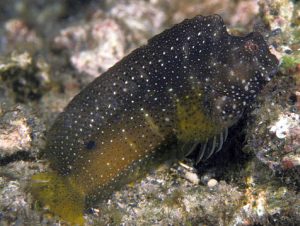
Starry Blenny (Salarias ramosus)
Minimum Tank Size: 30 gallon (90+ gallons for pairs)
Aquarium Type: FOWLR or Reef
Care Level: Easy
Temperament: Semi Aggressive
Aquarium Hardiness: Hardy
Water Conditions: 72-78° F, dKH 8 – 12°, pH 8.1-8.4, sg 1.020-1.025
Max size: 5½”
Color Form: White, Yellow
Diet: Herbivore
Compatibility: Reef Safe
Origin: Western Pacific, Indonesia
Family: Blenniidae
Lifespan: 4 – 6 years
Aquarist Experience Level: Beginner