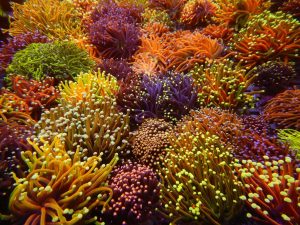
Torch Coral (Euphyllia glabrescens) Mixed frags
The Torch Coral (Euphyllia glabrescens) known to tropical fish keeping enthusiasts as the Pom-Pom Coral, Trumpet Coral, and Long-Tentacle Euphyllia is found throughout the Indo Pacific with a range that extends from the coast of East Africa to the Western Pacific; including the waters of Indonesia, the Philippines, Fiji, Solomon Islands and Tonga, the Red Sea and Gulf of Aden, and in northern Australia, the Great Barrier Reef.
The Torch Coral is rare to the Red Sea and the Gulf of Aden, and considered relatively uncommon through the northern Indian Ocean, the Persian Gulf, the central Indo-Pacific, Australia, Southeast Asia, southern Japan and the East China Sea, Micronesia, and American Samoa. Most specimens collected for marine reef keeping enthusiasts are from Fiji and Indonesia.
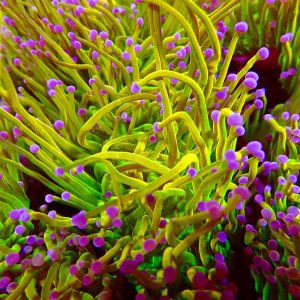
Torch Coral (Euphyllia glabrescens)
The Torch Coral can be found in the shallow, sheltered, intertidal zones all the way down to 330 feet. They are most common in clear, high flowing water areas with strong tidal currents with abundant filtered sunlight at mid depths between 50 to 75 feet.
The constantly shifting currents in the mid depths act as a buffer from intense, skin bleaching UV rays yet provide enough light for the symbiotic zooxanthellae algae that they host for photosynthesis.
Torch Corals can be found scattrered throughout the reef in conspicuous but isolated colonies attached to hard substrates, especially on the outer reef slopes that are directly exposed to the strong fluctuating tidal currents.
Although the majority of Torch Corals are found in environments with stable tropical temperatures, some rare and sought after color
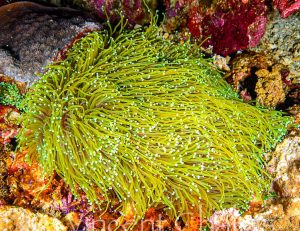
Torch Coral (Euphyllia glabrescens)
morphs like the Gold Torch occur in cooler, more nutrient rich water zones.
Like all species of Euphyllia, Torch Corals form a hard, calcified skeleton topped with multi-tipped, flesh-toned tentacles that closely resemble a burning torch flame or a pom-pom waving in the current; hence their common name.
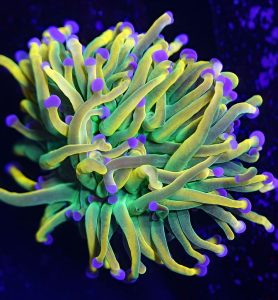
Holy
Grail Torch Coral (Euphyllia glabrescens)
Euphyllia glabrescens is a colonial LPS coral with a phaceloid formation of corallites. Their thin walled sharp edged phaceloid skeleton grows upward with long branching tublar stalks. At the tip of each notably smooth branch is a circular corallite that is 0.79–1.18 inches in diameter and spaced approximately 0.59–1.18 inches apart.
Each individual branch has one soft bodied polyp head with a single, visible mouth that is used to ingest food particles and expel waste. Extending from each head are large, elongated tubular tentacles that are capped with distinct, bulbous, knob-like tips that contain their highly concentrated cnidocytes (stinging cells) called “sweeper tentacles”.
At night the coral deploys these tentacles to fend off competing corals.
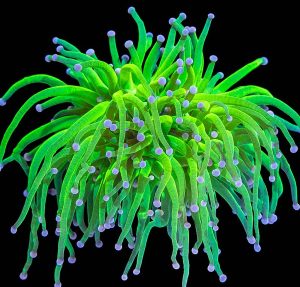
Torch Coral (Euphyllia glabrescens)
Indonesian Torch Corals typically have thinner, longer and more fluid tentacles compared to Australian variations that generally have shorter, thicker, and more cylindrical tentacles.
Torch Corals grow in a variety of colors and are often bicolored with contrasting tentacles and polyp tips. In their natural habitat, colors range from gray blue, olive drab, dark purple, to deep brown with green, pink, or purple tips.
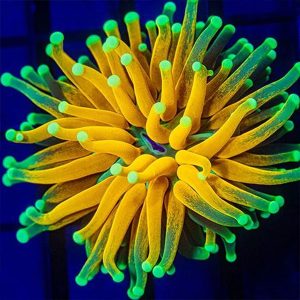
Torch Coral (Euphyllia glabrescens)
Morphs that high end tropical fish keeping enthusiasts cherish include intensely fluorescent neon green, gold, bicolor, and blazing orange tentacles capped with white, pink, or light blue tips; such as the Hellfire and 24K varieties.
Their color and the intensity of their colors is entirely dependent on how much light they receive and the presence of actinic lighting. The more balanced the light, the richer the fluorescent coloration of the coral.
Some Euphyllia species form branching structures while others form compressed wall-like structures, with multiple recognized species and sub-clades within the genus:
Euphyllia divisa (Veron & Pichon, 1980)
Euphyllia ancora (Veron & Pichon, 1980)
Euphyllia glabrescens (Chamisso & Eysenhardt, 1821)
Euphyllia paraancora (Veron, 1990)
Euphyllia paradivisa (Veron, 1990)
Euphyllia bayeri (Hodgson & Ross, 1982)
Euphyllia cristata (Chevalier, 1971)
Torch coral (Euphyllia glabrescens)
Torch coral (Euphyllia glabrescens)
Green Torch Corals (Euphyllia glabrescens)
Green Torch Corals (Euphyllia glabrescens)
Although the Torch Coral can be housed in fully mature small nano reef tanks, they are best kept in larger reef tanks of at least 30 gallon capacity or better yet 55 gallons with a medium grade (1.0 to 2.0 mm) Aragonite Sand substrate and plenty of heavy, porous, locking live rock or locking reef rocks arranged into flat shelves and deep secure crevices.
Torch Corals do best when placed in the lower to middle third of the aquarium with moderate blue-dominant LED spectrum lighting, indirect water flow, and adequate space to prevent them from stinging neighboring corals.
Indo-Pacific Torch Corals (Green, Purple, or Brown) thrive in moderate light around 100 to 150 PAR.
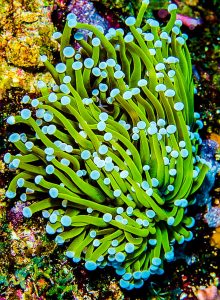
Torch Coral (Euphyllia glabrescens)
High end Australian and designer morphs (Gold, Dragon Soul, or Holy Grail) do best in the upper limit of moderate to high lighting and prefer 200 to 250 PAR.
A blue-dominant LED spectrum (actinics, deep blues, and violets) maximizes the neon fluorescence of the tips of Euphyllia glabrescens.
Torch Corals are top heavy and must always be glued to solid rockwork, never place them directly on top of a sand bed or a crushed coral substrate.
Glue or epoxy the coral’s phaceloid base firmly to an isolated rock mound set apart from the main reef structure so their fully extended sweeper tentacles cannot reach other corals and sessile invertebrates at night.
Whenever you introduce a new Torch Coral to your tank, always start it at the bottom of the rockwork.
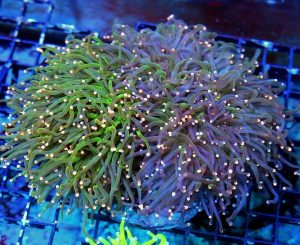
Torch Coral (Euphyllia glabrescens)
Even if its final destination is a moderate-light shelf higher up, give it 2 to 3 weeks to acclimate to your specific light fixtures before physically gluing it into its permanent, moderate-light home
They prefer a slightly elevated nutrient load rather than an ultra-clean, stripped water column.
The Torch Coral is a potent stinger that is aggressive to outsiders and can sometimes harm other Euphyllia sub-clades like Hammers or Frogspawns, meaning hobbyists must monitor them closely if grouped together into a “Euphyllia garden.”
They have some of the most potent stinging cells in the LPS world but can be housed with most Euphyllia glabrescens morphs like Holy Grails, Dragon Souls, and standard green corals. They will sting and kill Hammer Corals (Fimbriaphyllia ancora) and Frogspawn corals (Fimbriaphyllia paradivisa) and are totally incompatible with Acropora, Montipora, Leather Corals, Zoanthids and Mushrooms.
Compatible tankmates for Torch Coral include Clownfish, Firefish, Cardinalfish, Gobies, Blennies, Cleaner Shrimp, and other peaceful reef-safe species. Avoid most butterflyfish, large and dwarf angelfish, large filefish like the Aptasia eating Bristletail Filefish and large, destructive invertebrates like Green Brittle Starfish and aggressive crabs.
Although the Torch Coral can reproduce asexually by fragmentation as well as sexual brooding; asexual reproduction is the only
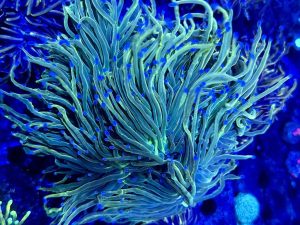
Torch Coral (Euphyllia glabrescens)
viable way to propagate them in an aquarium environment.
With stable water parameters and spot feeding, healthy Torch Corals will reproduce on their own by intratentacular budding or splitting. Over several weeks, a single circular mouth will slowly elongate and split into two distinct mouths within the same polyp. The tissue eventually pinches inward in the middle and the underlying phaceloid skeleton secretes a new vertical divider that within 12 to 18 months can grow into a large, multi headed colony.
Because of their tall, branching phaceloid skeleton, torches are one of the most straightforward Large Polyp Stony (LPS) corals to manually propagate or frag. Each polyp grows on an isolated, trunk-like calcium carbonate tube, which can be manually divided into a multi-headed colony without cutting into living coral tissue.
First look for the dry, non living white skeleton below the flesh band on the coral. Use a diamond blade coral saw or bone cutter to cleanly slice through the bare skeleton at least 1 or 2 inches below the flesh band. Dip the cut frag into an iodine based reef disinfectant, pat the bottom dry, secure it to a ceramic frag plug with a drop of supergel and place it back into a moderately flowing area of the tank to recover.
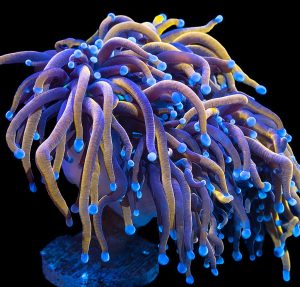
Torch Coral (Euphyllia glabrescens)
Unlike Hammer and Frogspawn corals which are broadcast spawners that simultaneously eject eggs and sperm into open water, Torch Corals are brooders. Male Torch Coral colonies release sperm into the water column and surrounding female polyps take the sperm in to fertilize their internal eggs. The female broods the embryos inside her body until they become free swimming planktonic planula larvae that already contain zooxanthellae algae. The drifting larvae eventually settle onto a hard surface where they begin to secrete their calcium carbonate base and grow to adulthood.
In their natural environment, Torch Corals are opportunistic suspension feeders that rely heavily on the natural rythms of the ocean water column. They obtain 80–90% of their nutrients from their zooxanthellae, symbiotic algae that absorb sunlight and convert it to sugars that are fed directly to the coral polyp. At night they expand their tentacles to capture copepods,amphipods, fish larvae, invertebrate eggs and microscopic zooplankton. They also passively absorb dissolved amino acids, fish waste and organic compounds sloughed off by other reef organisms directly through their cell walls.
In a reef aquarium environment, Torch Corals reqire targeted supplemental feedings of Mysis shrimp, fortified brine shrimp, finely chopped krill, powdered coral foods, soft high quality LPS pellets, and liquid amino acid supplements or live phytoplankton directly into the water column. Target feed them no more than 1 or 2 times a week.
The Torch Coral, (Euphyllia glabrescens) is readily available in the aquarium trade to tropical fish keeping enthusiasts as wild caught and captive-bred specimens from a variety of online retailers and local tropical fish stores at moderate to extreme premium prices depending on size and the rarity of the color morph. Current market prices range from $45 to over $350 per single head (polyp).
Aquaculture of this coral has been highly successful, leading to increased availability, hardiness, and sustainability in the hobby. Intense, uniform fluorescent hues like the “24K Gold”, “Holy Grail“, or “Hellfire” torches sell for premium rates; such as the 24K Gold Torch for $249.99 per polyp or master-grade Indo Gold heads for $349.99
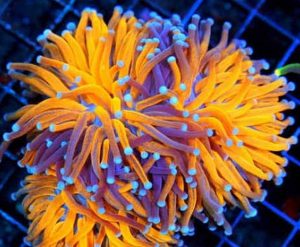
Torch Coral (Euphyllia glabrescens)
Minimum Tank Size: 30 gallon
Tank Placement: Middle to Top
Water Flow: Moderate (Indirect)
Care Level: Moderate to Experienced
Aquarium Hardiness: Moderately Hardy
Temperament: Very Aggressive
Toxicity: Yes, strong stinging cells (Long Sweeper Tentacles)
Invasive: No
Water Conditions: 76 – 80°F, dKH 8 – 9°, pH 8.1–8.4, sg 1.024-1.026, Nitrate 5 – 15 ppm, Phosphate 0.03-0.10 ppm, Calcium 420-450 ppm, Magnesium 1300-1400 ppm,
Lighting: Moderate (100-250 PAR)
Feeding: mysis shrimp, brine shrimp, LPS pellets
Growth Rate: Moderate
Color Form: Green, Gold, Purple, Black, Bicolor, Tiger, etc.
Diet: Photosynthetic, Carnivore (Target Feeder)
Origin: Indo-Pacific, Australia
Family: Euphylliidae
Lifespan: Decades (Under proper care)
Aquarist Experience Level: Intermediate