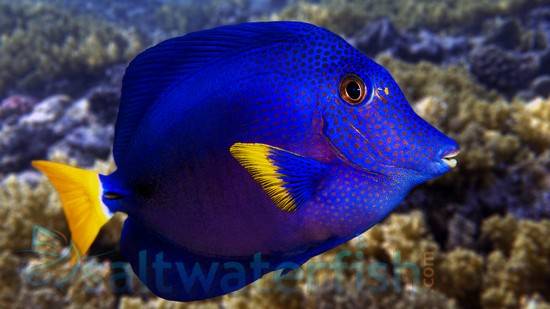
The Ornate Blenny (Ecsenius ornatissimus) known to tropical fish keeping enthusiasts as the Ornate Combtooth Blenny, Ornate Coral Blenny, Hawaii Blenny, Red-Stripe Blenny, Yaeyama Blenny, White-spotted Blenny and Hawaiian Ornate Blenny is native to the Indo-Pacific Ocean. Its highly localized range extends from the Hawaiian Islands and Johnston Atoll, Okinawa, to the Great Barrier Reef in Australia.
The Ornate Blenny is a diurnal, shallow-water dwelling species that during daylight hours are found alone or in pairs perched alertly upon live stony corals in the clear water lagoons, rich coastal reef flats, and the upper surge zones of the seaward reef slopes of their range. To satisfy their intense grazing requirements, Ornate Blennies prefer the sunlit upper reef crests, where sunlight promotes heavy microalgae growth .
Ecsenius ornatissimus is highly dependent on live stony coral heads (particularly Porites and Acropora formations) that grow in the lagoons and shallow reef flats at depths from 3 to over 50 feet, though they have been recorded as deep as 100 feet.
During the day in the shallower inshore environments where they are most commonly encountered in depths to 30 feet, Ornate Blennies can often be found nestling within the dense coral branches of Porites or Pocillopora or sheltering inside empty worm tubes, such as abandoned vermetid snail or polychaete bores.
Lacking a swim bladder, the Ornate Blenny rarely swims in open water. Instead, they use their flexible pelvic fins to “hop” along and perch directly on top of live coral heads. They spend the majority of their day propped up on their fins, constantly scanning their surroundings with their large, independently moving eyes.
Although Ornate Blennies will occasionally dart over encrusted rock or rubble bottoms near the base of a reef structure, they rarely venture out over any open sand flats devoid of solid vertical cover or protective benthic structures.
Ornate Blennies are strictly diurnal herbivores that are ferociously territorial of their individual perches by night and merge into loose, temporary foraging routines on the open reef to scrape at microscopic microalgae, filamentous turf algae, and organic detritus by day.
When an Ornate Blenny grazes in the daylight, it utilizes its specialized comb-like teeth to rasp microscopic layers of food. Unlike some related species that interact with large macroalgae sheets, it relies entirely on its exceptional jaw anatomy to scoop tiny diatoms and film moving through the coral canopy.
The Ornate Blenny has a cream, pale yellow, or greenish colored body with horizontal red lines, dark vertical bars, and a fine peppering of white spots; a small, inferior, comb-toothed mouth, and large independently moving eyes with dark pupils, a bright reflective orange-red iris, and thin colored lines radiating outward from the center.
They have a single continuous dorsal fin that features a heavily reddish front tip on the spinous portion, small clear or dark yellow pelvic fins, and a rear edge on the soft dorsal, anal, and tail fins that remains distinctly clear or translucent.
Male Ornate Blennies have a larger, broader squared-off head profile to accommodate territorial combat, and a leaner, more elongated body profile than females, which are noticeably plumper.
The Ornate Blenny (Ecsenius ornatissimus) is often confused with the Bicolor Blenny (Ecsenius bicolor), which is a closely related but distinctly different Indo-Pacific species that features a two-tone dark purple front and bright orange rear body, whereas the Ornate Blenny will only exhibit continuous complex red-and-green patterning.
The Ornate Blenny can be housed in a mature FOWLR or reef aquarium of at least 30 gallon capacity with an aragonite sand substrate, plenty of live rock stacked into high sunlit perches and empty barnacle or large worm shells scattered along the rockwork for them to shelter among.
Because they jump easily, a tight fitting mesh or glass lid is mandatory, and a programmable LED with Sunrise setting is recommended to provide bright lighting and encourage natural algae growth. An oversized protein skimmer, strong filtration system and a small power head is recommended to maintain water quality and provide low to moderate movement.
The Ornate Blenny is reef safe with caution. They will not touch ornamental shrimp or small worms but large specimens will opportunistically nip at fleshy coral polyps and clam mantles.
Unless you are buying a guaranteed, pre-bonded mated pair, only house one Ornate Blenny per tank. Putting two random Ornate Blennies in a 30 gallon tank will result in severe territorial fighting over preferred perching rocks.
In larger FOWLR or reef tanks Ornate Blennies can be housed with peaceful, non aggressive species that occupy different levels in the tank such as Firefish Gobies, Pajama Cardinalfish, Clownfish or Chalk Basslets. Avoid aggressive predators like Groupers, Lionfish, Eels, Frogfish, large Hawkfish and Wrasses. Hyperactive species like Maroon Clownfish, Dottybacks, large aggressive Tangs, Damselfish and large aggressive Angelfish should also be avoided.
Breeding the Ornate Blenny is exceptionally rare in an aquarium environment and successfully raising the fry to adulthood is extremely difficult.
Unlike fish species that release fully formed, large miniature juveniles that can immediately eat baby brine shrimp, Ornate Blennies release tiny, microscopic pelagic larvae that require a dedicated, separate rearing tank equipped only with a very gentle air stone and constant access to specialized, live microscopic rotifer cultures.
Ornate Blennies are paternal egg guarders that after a brief courtship carry out spawning. A pair will produce an adhesive clutch of 150 to 200 demersal, extremely small 0.75 mm x 0.5 mm eggs, that the female attaches to a hidden hard substrate like the inside of a small rock cave, crevice, or shell using a small, filamentous adhesive pad or pedestal.
The male guards the fertilized eggs in his cave where he aerates them by fanning them and rolling his body around. After guarding the egg clutch during the incubation period of 6 to 10 days, the tiny 3.5 mm fry are released at night into the plankton rich ocean currents to feed on microscopic rotifer nauplii until they become juveniles and eventually adults.
Because male Ornate Blennies actively defend a single permanent nesting site, they will continuously court and accept eggs from multiple different females over the breeding season. Because of this “promiscuous” nesting structure, a single male’s cave or crevice can contain a massive, continuous cluster of up to several thousand eggs at entirely different stages of development
A mature, well nourished female Ornate Blenny (Ecsenius ornatissimus) will typically produce a clutch of several hundred eggs every 8 to 10 days throughout the year.
In the wild, Ornate Blennies are diurnal reef grazers that feed on unicellular algae, turf algae, diatoms, organic detritus, and small coral mucus. In a mature aquarium environment they will feed on the diatoms, film algae, and unicellular green algae on the live rock and the back or side walls of the tank.
They should also be fed live or frozen spirulina brine shrimp, Mysis shrimp, cyclops, enriched micro-pellets, nori sheets, and finely chopped herbivore flakes. Small amounts fed 2 to 3 times daily is recommended for tanks with minimal algae growth. In tanks with heavy algae growth, once a day supplemental feeding is all that is needed.
The Ornate Blenny (Ecsenius ornatissimus) is rarely available to tropical fish keeping enthusiasts and is seldom seen at online retailers, wholesalers, or local fish shops. When available, prices generally range from $45.00 to $85.00 or more depending on size, supplier, and area of collection.
Because they are not captive bred on a commercial scale and lead a highly localized lifestyle, the marine aquarium trade relies entirely on accidental or rare wild-caught imports from Hawaii and mixed Indo-Pacific blenny shipments. They are usually only available by special order request or online stock alerts from boutique marine retailers.
Minimum Tank Size: Single specimen 30 gallons
Aquarium Type: FOWLR or Reef
Care Level: Moderate (due to feeding and grazing requirements)
Temperament: Semi-Aggressive (towards other blennies)
Aquarium Hardiness: Hardy
Water Conditions: 74-80° F, dKH 8 – 12°, pH 8.1-8.4, sg 1.020-1.025
Max size: 3.5”
Color Form: Cream, Yellow, Green, Red, White
Diet: Herbivore
Compatibility: Reef Safe with Caution
Origin: Hawaiian Islands, Johnston Atoll
Family: Blenniidae
Lifespan: 2-5 years
Aquarist Experience Level: Intermediate/Advanced