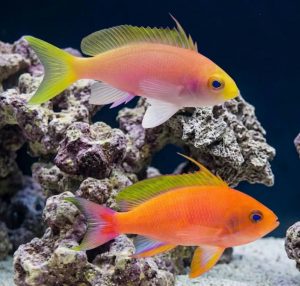
Resplendent Anthias (Pseudanthias pulcherrimus) pair
Resplendent Anthias (Pseudanthias pulcherrimus) known to tropical fish keeping enthusiasts as the Tierra Anthias, Elegant Anthias or Resplendent Goldie is native to the western Indian Ocean and have been documented in the Maldivian archipelagos, Chagos Archipelago, the Seychelles and the coastal reefs bordering the Andaman Sea.
Resplendent Anthias are typically found in close knit social groups or harems hovering above caves and steep overhangs on the deeper outer reef slopes of their range at depths from 30 to well over 230 feet.
Dense concentrations of Resplendent Anthias are most often encountered feeding on plankton along the deep channels, steep outer drop offs, and current swept edges of the seaward reefs found on the deeper reef slopes; below 100 feet.
Resplendent Anthias are protogynous hermaphrodites that thrive in groups (harems) consisting of one dominant male with multiple females. If the dominant male dies, the largest, most aggressive female will undergo a biological change and turn into a male.
Pseudanthias pulcherrimus exhibit sexual dimorphism. Females have a mainly orange colored body with a pinkish-purple hue, and a bright yellow face, nose, dorsal and caudal fin.
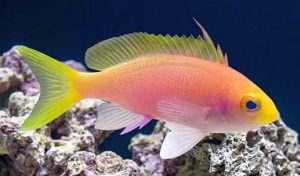
Resplendent Anthias (Pseudanthias pulcherrimus) female
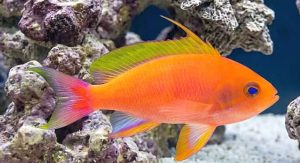
Resplendent Anthias (Pseudanthias pulcherrimus) male
Males are more intensely colored with the same orange colored body with a pinkish-purple hue, a deep yellow orange face, nearly transparent caudal fins, deep pink edges on their pectoral and anal fins, and iridescent blue pelvic fins that are edged in red.
Resplendent Anthias can be housed as single specimens, in small groups of females, or ideally in small harems in a mature FOWLR or well established reef aquarium of at least 80 gallon capacity with a coralline gravel substrate and copious amounts of live rock arranged into crevices, caves, ledges and overhangs for shade, and plenty of midwater free swimming space.
Resplendent Anthias prefer lower light levels, which is why plenty of shaded areas in the tank are needed. A lighting system with a dawn to dusk cycle will greatly benefit this species if your reef system is brightly lit for corals.
To replicate their natural deep water reef slope environment, multiple powerheads or a wavemaker is needed to provide strong, continuous water movement and proper oxygenation necessary for them to thrive.
Because they require multiple small feedings daily; heavy filtration, aggressive protein skimming, regular water changes, and media reactors are recommended to keep nitrates and phosphates at zero.
Although an aquarium chiller is not mandatory to maintain water temperatures at their recommended range, a tight fitting mesh lid or glass cover is highly recommended to keep Pseudanthias pulcherrimus in their tank.
Resplendent Anthias are peaceful, reef safe and fully compatible with all types of corals and invertebrates.
Although they can become aggressive towards conspecifics when kept in groups in smaller aquariums; housing them in larger groups or as a single male with several females is strongly recommended to mitigate aggression.
Resplendent Anthias really thrive in large harems (preferrably one male and up to ten females) in a 150 gallon or larger tank. Avoid housing them with aggressive or overly large species that may intimidate or outcompete them for food.
Compatible tank mates in a FOWLR setting include cardinalfish, gobies, several species of blennies, clownfish, and wrasses.
Resplendent Anthias (Pseudanthias pulcherrimus) have not been bred in an aquarium environment.
Like the Sacura margaritacea (Cherry Sakura Anthias) all wild-caught specimens available to tropical fish keeping enthusiasts are collected from their natural deep-water environments in the Indian Ocean.
Pseudanthias pulcherrimus are pelagic spawners that broadcast microscopic, buoyant eggs. Hatched larvae require microscopic strains of copepod nauplii and have an exceptionally long pelagic larval period that lasts up to 90 days. Rearing the larvae even in specialized, high oxygen, pristine larval rearing tanks is extremely challenging which is why rearing them is elusive.
In their natural habitat, Resplendent Anthias feed on drifting oceanic plankton specifically pelagic copepods, invertebrate larvae, floating fish eggs, tunicate larvae, tiny amphipods and Mysid shrimp.
In an aquarium environment, they can be fed frozen Calanus and Cyclops, enriched or vitamin fortified frozen Mysis and brine shrimp, finely chopped prawn and krill, and over time high protein pellets and flakes. Small amounts should be fed 2 to 4 times a day. Their natural hunting instinct can be triggered by putting the food into the flow of your wavemakers.
An attached refugium that cultivates live copepods and amphipods is highly beneficial to all anthias species.
Resplendent Anthias (Pseudanthias pulcherrimus) are available to tropical fish keeping enthusiasts from a number of online wholesalers, trans shippers, and marine retailers as wild caught individuals at prices that vary by size and area of collection. They typically retail between $50 to $115 per individual. Maldives specimens range from $56.99 for small individuals up to $73.99 for larger specimens.
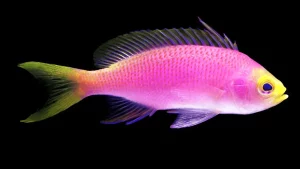
Resplendent Anthias (Pseudanthias pulcherrimus) female
Minimum Tank Size: 70 gallons; 125 gallons for small groups
Aquarium Type: Reef or FOLR
Care Level: Moderate
Temperament: Peaceful
Aquarium Hardiness: Hardy after acclimated
Water Conditions: 72-78° F, dKH 8 to 12, pH 8.1-8.4, sg 1.020-1.025
Max size: 2.5″ to 3 ”
Color Form: Orange, Purple, Pink, Yellow
Diet: Carnivore/Planktivore
Compatibility: Reef
Origin: Western Indian Ocean
Family: Serranidae
Lifespan: 5 years
Aquarist Experience Level: Intermediate/Advanced