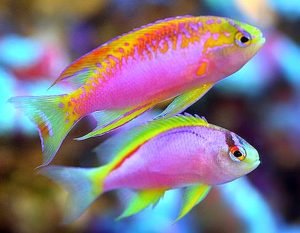
Ventralis Anthias (Pseudanthias ventralis) Pair
Ventralis Anthias (Pseudanthias ventralis) known to tropical fish keeping enthusiasts as Longfin Anthias, Longfin Basslet, Hawaiian Ventralis, Hawaiian Longfin Anthias, and Marshall Islands Ventralis are found in the Western and Southern Pacific Oceans.
Their range extends from Southern Japan and the Mariana Islands in the northwestern Pacific, to the Marshall Islands and Micronesia in the Central Pacific, to the Great Barrier Reef, the Coral Sea, Vanuatu, and New Caledonia in the southwestern edge of their range; and the Cook Islands and French Polynesia, all the way east to the remote Pitcairn Islands in the southeast.
Ventralis Anthias are a cryptic, deepwater species that are usually encountered alone, in pairs, and in tight clusters inside the caves of coral rubble, deep channel walls, and steep outer reef drop offs of their range in the ocean’s twilight zone depths exclusively from 180 to over 400 feet. They seldom venture into the open water column except to feed on passing zooplankton outside their cave entrances.
The Ventralis Anthias is a sexually dimorphic species. Males and females display entirely different, yet equally vibrant, color patterns that vary slightly depending on the area of collection.
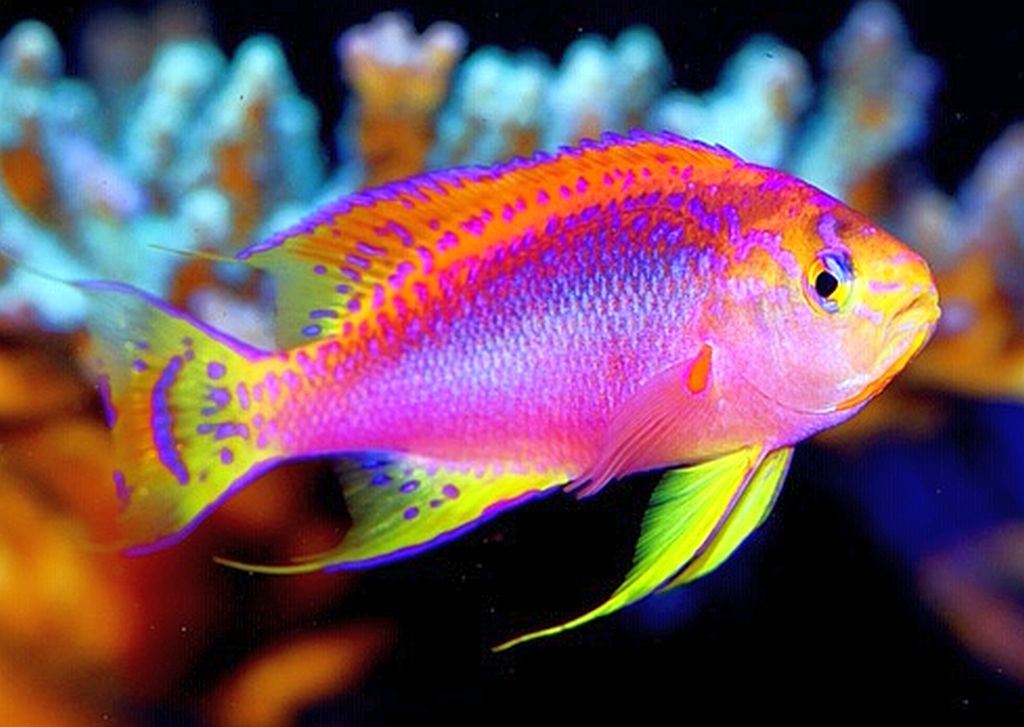
Ventralis Anthias (Pseudanthias ventralis)
Adult males have a brilliant magenta, fuchsia, or deep violet pink body color with a distinct, bright yellow stripe or mask that runs from the snout, through the eye, and down toward the pectoral fins. The back and upper portion are covered with irregular, electric yellow patches and metallic blue or lavender spots that form a mosaic like pattern. Both dorsal and pelvic fins are highly elongated. The bright yellow dorsal fin has an electric blue or translucent lavender margin, the caudal fin is clear or lightly trimmed in neon blue.
Females have a solid radiant yellow or soft golden orange upper body that fades into a
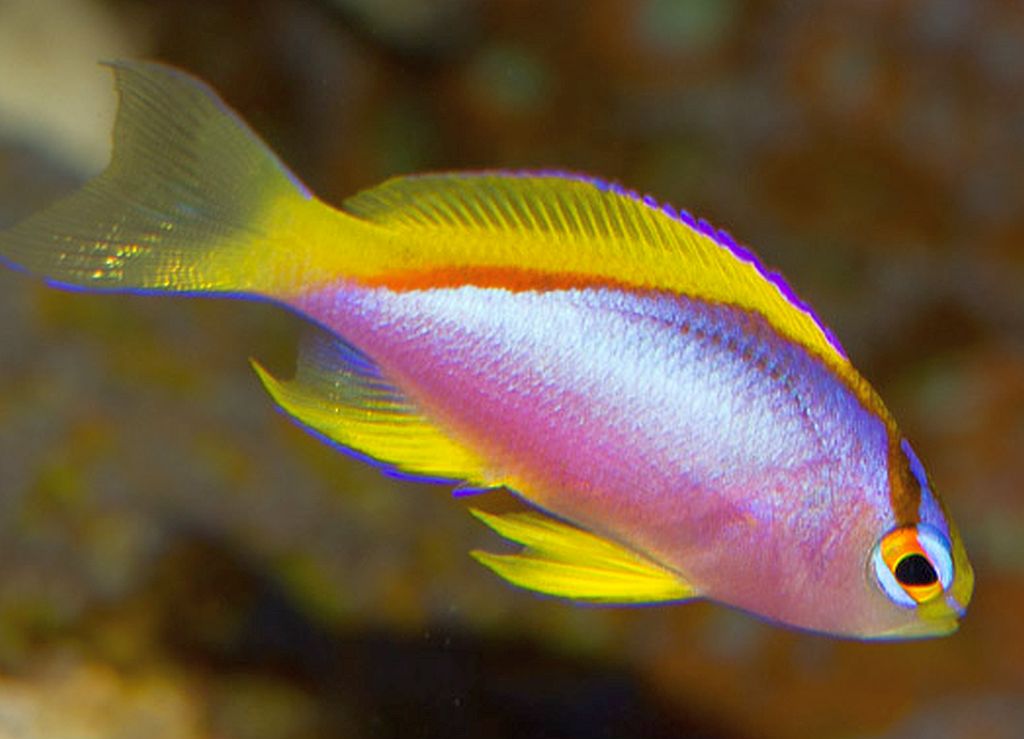
Female Ventralis Anthias (Pseudanthias ventralis)
soft lavender , pearlescent pink or white along the lower body and belly. Their fins are shorter and more rounded than the males and they have large dark eyes that are often ringed with a thin, bright violet or blue circle.
Ventralis Anthias are protogynous hermaphrodites (all are born female, and the dominant female transitions into a male), you will occasionally see a transitional specimen. During this phase, the fish will temporarily look like a blend of both—developing the elongated fins and starting to sprout the intense magenta patches and blue spots over its yellow female base color.
Ventralis Anthias can be housed either singly, or in small groups in a mature, well established, deep water FOWLR or reef aquarium of at least 100 gallon capacity with a crushed coralline substrate, copious amounts of live rock arranged into crevices, caves, and overhangs for them to hide among and plenty of free swimming space.
To mimic their natural deep water environment, Ventralis Anthias require plenty of dark or low light areas with multiple interconnected caves, overhangs, and large micro caverns for them to retreat to. They are extremely light sensitive and are easily intimidated by the intense lighting configurations used in shallow-water SPS reef tanks.
An aquarium chiller is essential to keep water temperatures in their targeted range of 68°F to 74°F. In the wild, these fish live far below the warm surface waters of the reef. Shallow water reef tank temperatures will cause them severe metabolic stress and drastically shorten their lifespan.
Finally, to replicate the deep water currents they are found in, at least one wavemaker should be added to the system.
Ventralis Anthias are completely reef safe and will not disturb corals or invertebrates. Generally peaceful, they can be kept alone, in mated pairs, or in small groups of females. They can become aggressive towards conspecifics when housed in small groups in smaller tanks.
Clownfish, blennies, dottybacks, tangs, and gobies all make suitable tankmates for Pseudanthias ventralis.
The Ventralis Anthias has not yet been successfully bred in an aquarium environment.
While other exotic deepwater anthias like the Blotched Anthias (Odontanthias borbonius) and Marcia’s Anthias (Pseudanthias marciae) have seen breakthroughs in captive breeding; all Ventralis Anthias found in the aquarium trade are wild caught specimens.
In their deep water environment, Ventralis Anthias are zooplanktivores that feed almost entirely on microscopic organisms drifting in the deep ocean currents. Tiny pelagic and benthic copepods and amphipods, invertebrate larvae, small fish eggs, and Mysid shrimp that school in the crevices of the reef make up their primary diet.
In an aquarium environment, their incredibly high metabolism requires almost continuous feeding. Small quantities of nutrient dense foods like Calanus (high protein, red copepods), cyclops or Cyclop-eeze, finely chopped Mysis shrimp, enriched live brine shrimp, live copepods, and high quality marine pellets should be fed 5 to 8 times a day. An attached refugium seeded with live copepods will help provide a constant supply of food.
The Ventralis Anthias (Pseudanthias ventralis) is an uncommon anthias in the aquarium trade that is occasionally available to tropical fish keeping enthusiasts from high end marine wholesalers, trans shippers and specialty retailers from the Philippines, New Caledonia, and rarely Japan. They are rare, seasonal, and expensive.
Waiting lists for unquarantined individuals price them from $350 to over $600 depending on size, sex, and area of collection.
Because they suffer from extremely high mortality rates during shipping and decompression, specialized vendors who fully condition and prophylactically quarantine them for several weeks list them for $1,200 to over $1,500 per individual. Currently $1,200.00 for 1″ to 2″ female Coral Sea specimens and $449.00 for female Marshall Island specimens.
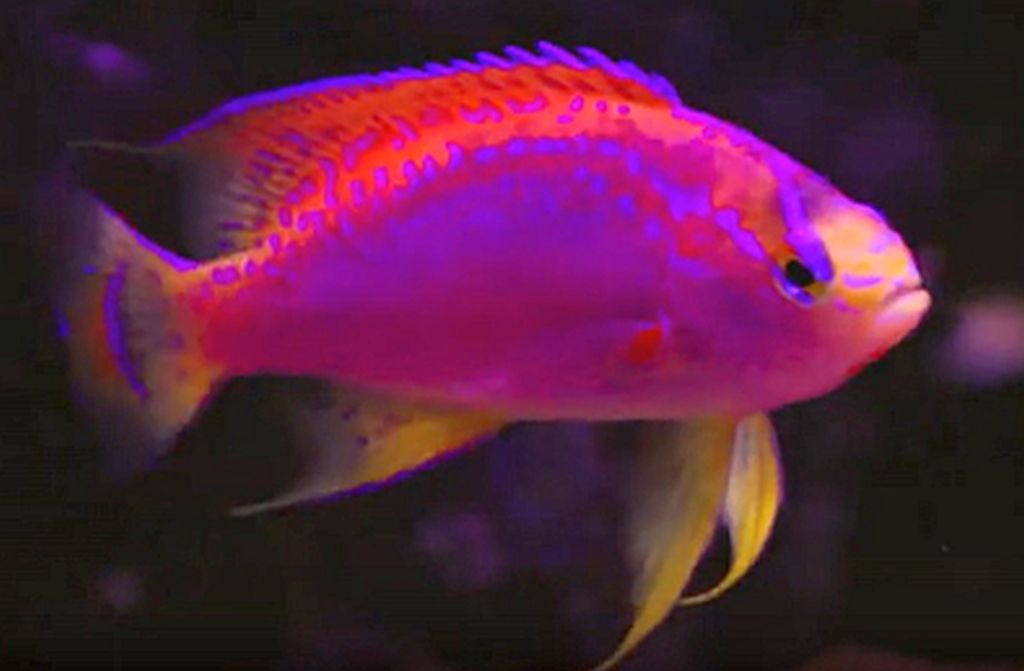
Ventralis Anthias (Pseudanthias ventralis)
Minimum Tank Size: 100 gallons
Aquarium Type: Reef or FOLR
Care Level: High
Temperament: Semi Aggressive
Aquarium Hardiness: Delicate
Water Conditions: 68-74° F, dKH 8 to 12, pH 8.1-8.4, sg 1.023-1.025
Max size: 3.5″
Color Form: Pink, Orange, Purple, Yellow
Diet: Carnivore
Compatibility: Reef
Origin: Coral Sea, South Pacific, French Polynesia, Japan
Family: Serranidae
Lifespan: 5 years
Aquarist Experience Level: Expert Only