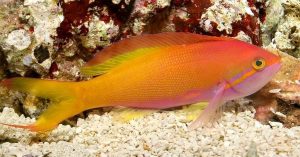
Carberryi Anthias (Nemanthias carberryi)
Carberryi Anthias (Nemanthias carberryi) known to tropical fish keeping enthusiasts as the Threadfin Anthias are native to the western Indian Ocean and range from the Maldives to Malindi, Kenya along the coast of East Africa.
Carberryi Anthias are usually encountered hovering just off the outer coral reef slopes of their range in the strong nutrient rich waters feeding on zooplankton at depths from 12 to over 100 feet.
During daylight hours, they form huge, hovering aggregations swimming into the current above branching corals with their bodies acting like a net to pluck out planktonic organisms. At dusk the entire school retreats into the safety of reef crevices and branching corals to hide from predators.
Carberryi Anthias are haremic, protogynous hermaphrodites where all individuals are born female. The largest and most dominant female in a group or given territory will gradually transition into a male. The male’s role in a “harem” is to defend it from rival males and lead the shoal in open water feeding.
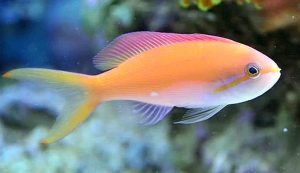
Carberryi Anthias (Nemanthias carberryi)
Carberryi Anthias are sexually dimorphic. Females have a bright orange to pinkish body color with a bright yellow dorsal ridge that extends into the caudal fin.
Males are more dramatically colored with the head, throat, and lower abdomen a
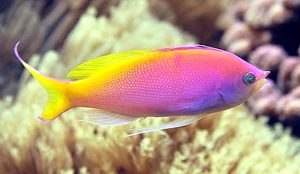
Carberryi Anthias (Nemanthias carberryi)
deep purplish magenta, and the rear half of the body a bright canary yellow. The long, streaming filaments of their iridescent dorsal and caudal fins are often edged in red, violet or electric blue along the margins; particularly during mating displays.
Nemanthias carberryi are best housed in a mature reef or FOWLR aquarium of at least 70 gallon capacity with a coralline sand substrate, tons of live rock aquascaped into overhangs, caves, and tight crevices fort them to hide among, and plenty of midwater free swimming space.
Because of their heavy feeding regimen, they require robust mechanical and biological filtration, heavy protein skimming and regular water changes to prevent phosphate and nitrate spikes. Carberry Anthias love strong currents, so at least one wavemaker or programmable powerhead is needed to replicate the brisk currents encountered on the outer reef slopes.
Because all anthias are notorious jumpers, a tight-fitting mesh or glass lid is mandatory.
Carberryi Anthias thrive when kept in groups or shoals of one male with four to six or more females or juveniles in at a 70 gallon or larger tank. They are completely reef safe and will not harm corals, decorative clams, or invertebrates in the system.
Carberryi Anthias are generally peaceful and are easily bullied by aggressive fish like large dottybacks, territorial wrasses, and aggressive damsels. They do well with peaceful reef species like wrasses, gobies, cardinalfish, and peaceful surgeonfish.
Although many tropical fish keeping enthusiasts with large systems have witnessed spawning behavior in their tanks, Carberryi Anthias have not been successfully bred in an aqurium environment for a variety of reasons.
Nemanthias carberryi are pelagic spawners that require massive, vertical tanks to support the spawning of a full harem.
Aquaculture specialists have commercialized other anthias species like Borbonius Anthias, but the rearing of Nemanthias carberryi larvae has been elusive without an existing basline.
Harvesting viable eggs is difficult. The mouths of newly hatched larvae are microscopic and require feedings of ultra tiny strains of first stage copepod nauplii which are extremely difficult to keep alive. For these reasons, all Carberri Anthias available in the aquarium trade are wild caught.
Carberryi Anthias are mid water planktivores that continuously feed on microscopic organic matter drifting in the outer reef slope currents. Their primary food is zooplankton that consists of tiny benthic pelagic larvae, rotifers, copepods, fish eggs, and tiny crustaceans.
In an aquarium environment they require a nutrient dense diet that remains suspended in the water column. Live and frozen Calanus, Cyclops, Mysis shrimp, vitamin enriched brine shrimp, finely chopped seafoods and occasional offerings of small, slow sinking micro pellets should be fed 3 to 5 or more times a day.
A refugium stocked with macroalgae like Chaetomorpha is highly recommended when keeping Nemanthias carberryi. As the copepods and amphipods multiply, the water flow from the refugium washes them into the tank to provide a nutritional 24/7 food source to the fish.
Carberryi Anthias (Nemanthias carberryi) are available to tropical fish keeping enthusiasts from a number of online wholesalers, trans shippers, and marine retailers as wild caught specimens at prices that vary by size and area of collection. They typically retail between $40 to $90 or more per individual at approximate purchase sizes: Small: 1″ to 1-3/4″ Medium: 1-3/4″ to 2-1/2″ Large: 2-1/2″ to 3-1/4″.
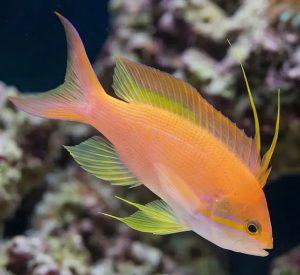
Carberryi Anthias (Nemanthias carberryi)
Minimum Tank Size: 70 gallons; 125 gallons for small groups
Aquarium Type: Reef or FOLR
Care Level: Moderate
Temperament: Semi aggressive
Aquarium Hardiness: Hardy after acclimated
Water Conditions: 72-78° F, dKH 8 to 12, pH 8.1-8.4, sg 1.020-1.025
Max size: 4″
Color Form: Orange, Purple, Yellow, Black
Diet: Carnivore/Planktivore
Compatibility: Reef
Origin: Western Indian Ocean
Family: Serranidae
Lifespan: 5 years
Aquarist Experience Level: Intermediate/Advanced