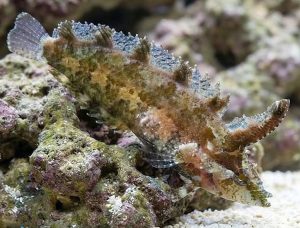
Rhino Blenny (Paraclinus marmoratus)
The Rhino Blenny (Paraclinus marmoratus) known to tropical fish keeping enthusiasts as the Marbled Blenny, Atlantic Rhino Blenny, or Rock Blenny is native to the Western Atlantic Ocean and ranges from southern Florida and the Gulf of America, down to northern South America.
The Rhino Blenny is a peaceful shallow water micro predator species that is commonly found in the lagoon reefs, shallow sea grass beds, and shallow coral reefs of their range at depths up to 20 feet, where they share a specialized relationship with Yellow Tube Sponges (Verongia fistularis) that they use to make their homes inside of.
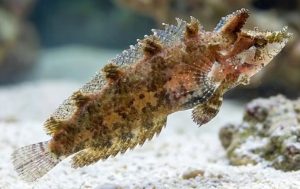
Rhino Blenny (Paraclinus marmoratus)
The Rhino Blenny has a slender, heavily patterened mottled body covered with brown, tan, cream, reddish orange and white patterns that allow them to blend into their surroundings. They have a single, highly extended dorsal spine loated at the top of the head that resembles a rhinoceros horn and large, expressive eyes that move independently.
Their pectoral and pelvic fins are formed to allow them to walk and hop along the substrate. They have the ability to rapidly change their mottled color patterns to blend into a new nesting spot i.e. barnicles, sponge openings, live rocks, etc. within seconds.
The Rhino Blenny can be housed in a mature FOWLR or reef aquarium of at leat 30 gallong capacity with a live sand or coralline gravel substrate and plenty of live rock arranged into caves, crevaces, ledges and overhangs for them to forage around and pearch on.
The Rhino Blenny is considered reef safe and will not harm corals, ornamental clams, or most invertebrates, however, unlike true blennies that graze on green algae, Rhino Blennies are primarily carnivorous micro-predators.
The Rhino Blenny is peaceful toward unrelated species but highly territorial toward their own kind.
Selecting tankmates for a Rhino Blenny (Paraclinus marmoratus) comes down to avoiding fish that compete for the same rocky perches. Suitable tankmates includes chromis, clownfish, small cardinalfish, Royal Grammas, firefish, peacefull reef wrasses, and invertebrtates like large Turbo snails, Nassarius snails, or hermit crabs.
Avoid housing them with large aggressive groupers, lionfish, or dottybacks and rock perching species like Lawnmower Blennies or aggressive bottom dwellers. Tiny crustraceans and very small decorative shrimp like the sexy shrimp will be regarded as a snack.
In the aquarium, the Rhino Blenny will quickly establish a home zone that can be centered around a preferred tube sponge, barnicle, cave or crevice. They will aggressively chase away rivals that get to close.
Keeping multiple males in a small tank usually results in fatal fights.
The Rhino Blenny has been bred in an aquarium environment however raising the larvae is extremely difficult.
In the wild, Paraclinus marmoratus breeding revolves around and within the Yellow Tube Sponge. A dominant male will claim a sponge as his territory and when ready to spawn, performs a type of dance while flashing intense colors to lure a female into his tube or cave. Males are extremely industrious and may entertain several females into his nest over a short period. When ready to spawn, the female turns completely upside down against the tube or cave wall to deposit her eggs, while the male remains upright to fertilize them.
A single nest may have several “clutches” of eggs at different stages of development. Once the male is exhausted, he becomes highly aggressive to any females trying to enter his nest. The male fans the eggs to oxygenate them and fiercely guards them from intruders until they hatch out into tiny, transparent larvae. The microscopic larvae require live, cultured micro prey such as Parvocalanus copepod nauplii or specilized rotifers to survive.
In its natural shallow water environment, the Rhino Blenny is a carnivorous micro predator that feeds almost entirely on benthic invertebrates and micro crustaceans including isopods,mysid and caridean shrimp, amphipods and copepods, polychaetes, and gastropod larvae.
In an aquarium environment, they reauire high protein, meaty foods that quickly sink to the bottom where they feed. Live or frozen Mysis shrimp, calanus or cyclops, vitamin enriched brine shrimp, live amphipods and copepods, live blackworms, and small sinking carnivore pellets are all excellent foods. Target feed them small portions at least 1 or 2 times a day with a turkey baster or Julian’s Thing to prevent other fish in the tank from stealing their food.
The Rhino Blenny (Paraclinus marmoratus) is occasionally available to tropical fish keeping enthusiasts as wild caught specimens from specialized marine aquarium shops and online retailers. Because they are primarily hand caught in shallow Western Atlantic and Caribbean seagrass or reef beds, their retail availability and price fluctuates based on regional collection patterns.
Depending on the retailer, whether the fish has been quarantined and size: Small (1″ to 1-1/2″) Medium/Large (1-1/2″ to 3″); current prices range from $15.00 to $59.00 or more.
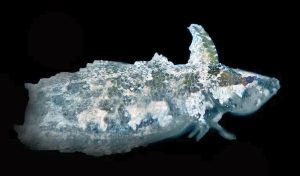
Rhino Blenny (Paraclinus marmoratus)
Minimum Tank Size: 30 gallon (90+ gallons for pairs)
Aquarium Type: FOWLR or Reef
Care Level: Moderate
Temperament: Peaceful
Aquarium Hardiness: Hardy
Water Conditions: 72-78° F, dKH 8 – 12°, pH 8.1-8.4, sg 1.020-1.025
Max size: 4.5”
Color Form: Brown, Tan, Cream, White, Reddish Orange
Diet: Carnivore
Compatibility: Reef Safe
Origin: Western Atlantic
Family: Labrisomidae
Lifespan: 4 – 6 years
Aquarist Experience Level: Beginner/Intermediate