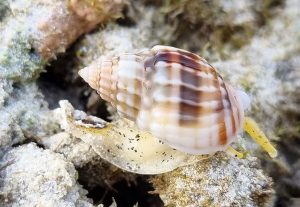
Super Nassarius Snail (Nassarius distortus)
The Super Nassarius Snail (Nassarius distortus) know to tropical fish keeping enthusiasts as the Super Tongan Nassarius is widely distributed throughout the Indo-West Pacific. It’s range extends in the Western and Central Pacific from Eastern Asia down through the tropical islands of the South Pacific including Fiji and Tonga; hence their common name.
In Australia they are found in the tropical waters of Queensland off the coast of northern and eastern Australia’ and in the Indian Ocean their range extends westward into the Indian Ocean including populations along the coasts of East Africa, Mozambique, and Madagascar.
Nassarius distortus are are carnivorous, opportunistic nocturnal scavengers that can be found in the warm, shallow tropical waters of their range at depths from the intertidal zone, down to 40 or 50 feet, where they bury themselves within the substrate during daylight hours.
Super Tongan Nassarius are unparalled scavengers that typically emerge at dusk or when they detect the scent of food in the water column. In an aquarium environment, they are ideal detritus eaters that help maintain adequate oxygen levels in the substrate as they sift and burrow through the sand bed.
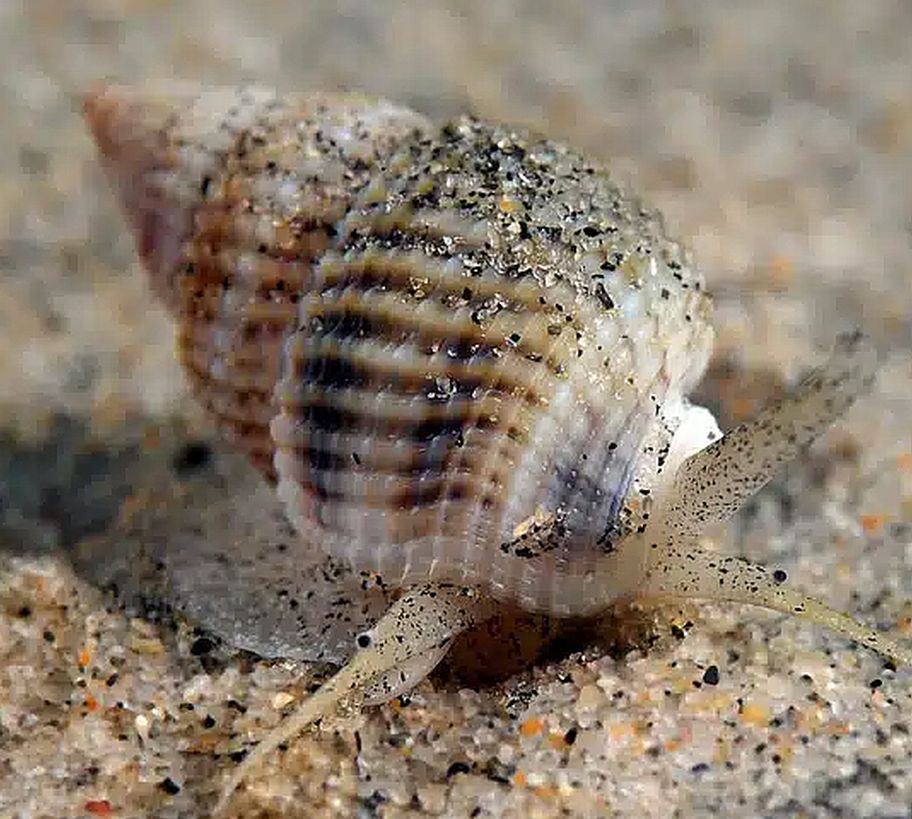
Super Nassarius Snail (Nassarius distortus)
The Super Nassarius Snail has a heavy, ornate, oval shaped, spiral shell that resembles an olive pit. the heavily sculpted surface of their shell has a lattice like pattern that is formed by the sharp axial ribs crisscrossing with fine spiral grooves. This gives the shell a distinct beaded or rough ridged texture. The wide, oval shaped shell opening is protected by a thick, flared outer lip which has a glossy enameled columellar callus that the snail presses against the sandy substrate.
The body of Super Nassarius Snail is typically a mottled cream, soft ivory white, or pale gray color sprinkled with tiny dark freckle like specks that can be tan, a soft brown, or olive-gray colored. The elephant trunk like siphon is long and extremely flexible. When buried in the sand, the snail uses it like a snorkel to “taste” and sniff out food items.
Super Nassarius Snails have a small, thin, fingernail like operculum attached to the back of their foot that they use to completely seal themselves inside their shell when threatened. There are no visible differences between sexes.
The Super Nassarius Snail is occasionally misidentified as the Tiger Nassarius or Babylon Snail which have bold, leopard like spots or deep orange/brown checkerboard squares on a completely smooth, heavy shell. Nassarius distortus have more subtle mottled markings and a much more distinctly ridged shell.
The Super Nassarius Snail is completely reef safe and can be housed in a well established FOWLR or reef aquarium of at least 20 gallon capacity with live rock and a fine to medium grained sand substrate that is at least 2 to 3 inches deep for them to completely submerge their shells. Do NOT keep them in bare bottom tanks or aquariums with rough substrates of coarsely crushed coral or gravel.
Nassarius distortus are hardy scavengers that make an excellent cleanup crew for detritus, decaying organics, fish waste and leftover meaty foods. They are strictly carnivorous scavengers and will not clean algae off your glass or rocks. They make ideal residents for larger reef systems.
The Super Nassarius Snail is a gonochoric species; with distinct individual sexes. They are extremely difficult to breed in an aquarium environment. Short of observing a female actively depositing egg capsules onto the aquarium glass or rockwork, it is virtually impossible for tropical fish keeping enthusiasts to sex them visually.
A mature male and female in a well fed tank will eventually mate. The breeding pair will lock together and remain entirely immobile on the substrate for 2 to 3 hours.
The female will deposit 35 to 40 small, transparent, jelly like egg capsules onto a hard surface, typically in neat rows or grids on the aquarium glass, powerhead, or rockwork. Each capsule contains 350 to 800 individual eggs and hardens when in contact with saltwater to protect the developing embryos.
In a week to ten days the eggs hatch into microscopic, free swimming larvae called veligers that in the wild float away as part of the plankton chain. The veligers feed on microscopic phytoplankton for several weeks before dropping out of the water column and settling onto the substrate as tiny juvenile snails.
During the entire multi day spawning period, the female will completely stop eating.
The Super Nassarius Snail is a benthic scavenging carnivore that in their natural habitat feeds on dead fish, crabs, shrimp, and other invertebrates, clams and other bivalves. When large meals are not available, they consume organic detritus which includes fish waste and organic materials that settle into the substrate.
In an aquarium environment, they will normally feed on leftover fish flakes or pellets, pieces of frozen mysis or brine shrimp, dying organic tissue and basically anything that your fish don’t consume. They have an incredibly powerful sense of smell and will burst out of the sand bed as soon as food hits the water column. As a general rule, 1 snail is recommended for 2 or 3 gallons of tank water.
Because they are super efficient scavengers; a clean, lightly stocked tank with an aggressive filtration system can lead to starvation. If this occurs, target feed your snails high quality carnivore pellets, chunks of chopped clam, scallops, or mysis shrimp 2 or 3 times a week after the aquarium lights are turned off.
If you notice the Super Nassarius Snails in your tank scaled up on the glass during daylight hours or completely buried when you feed your fish; it may be an indication that there is not enough food in the sand for them to eat and they are starving.
The Super Nassarius Snail (Nassarius distortus) is readily available to tropical fish keeping enthusiasts from a variety of online retailers at approximate purchase sizes of 1/4″ to 3/4″ at prices that vary from $3.99 for individuals to $11.99 for a 5 pack. Larger quantity “clean up crews” are normally less expensive per individual.
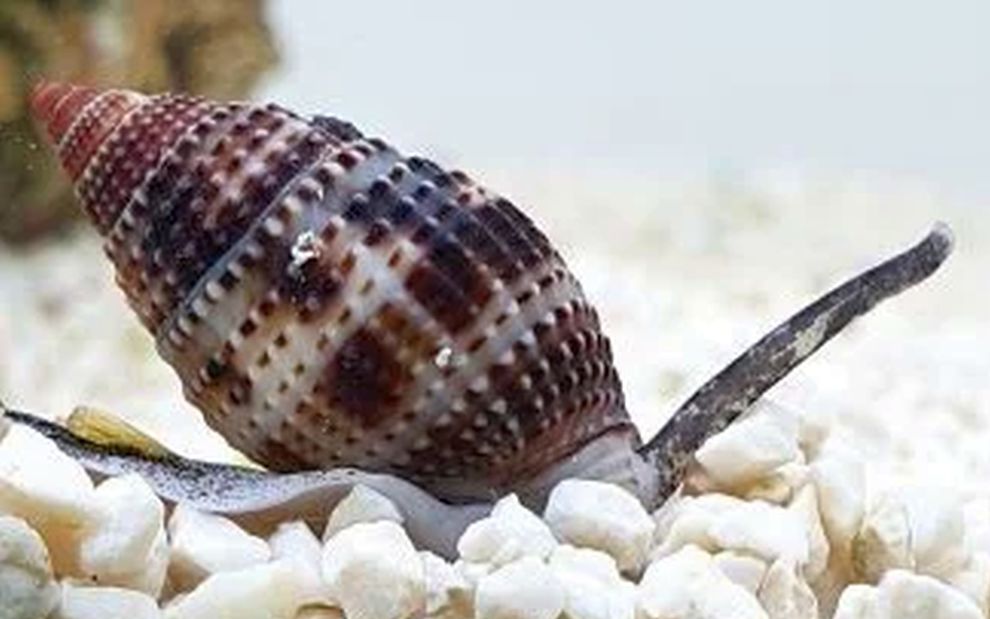
Super Nassarius Snail (Nassarius distortus)
Minimum Tank Size: 20 gallons
Aquarium Type: Established Reef or FOWLR
Care Level: Easy
Temperament: Peaceful
Aquarium Hardiness: Hardy
Water Conditions: 72°F – 78°F, dKH 8-12, pH 8.1-8.4, sg 1.023-1.025
Max. Size: 1″
Color Form: White, Tan, Brown,
Diet: Carnivore
Compatibility: Reef Compatible
Origin: Indo-West Pacific
Family: Nassariidae
Lifespan: 4 – 5 years
Aquarist Experience Level: Beginner