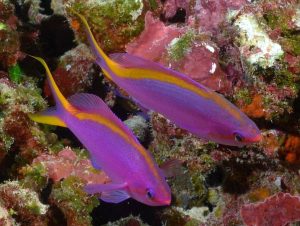
Purple-Queen-Anthias-Pseudanthias-tuka-pair
Purple Queen Anthias (Pseudanthias tuka) known to tropical fish keeping enthusiasts as Queen Purple Anthias, Amethyst Anthias, or Sailfin Anthias are Native to the Indian and Western Pacific Oceans.
Its range extends from Mauritius, Maldives in the Indian Ocean; to the Philippines, Indonesia, Palau, Solomon Islands, Fiji, and Society Islands in the Western and Central Pacific; south to the Great Barrier Reef in Australia.
First discovered in 1927 off the coast of New Caledonia, Purple Queen Anthias are normally encountered in large shoals or harems of one male to several females along the steep coral rich reef slopes and drop-offs of their range, typically at shallower depths of 50 to 100 feet where they feed on nutrient rich plankton.
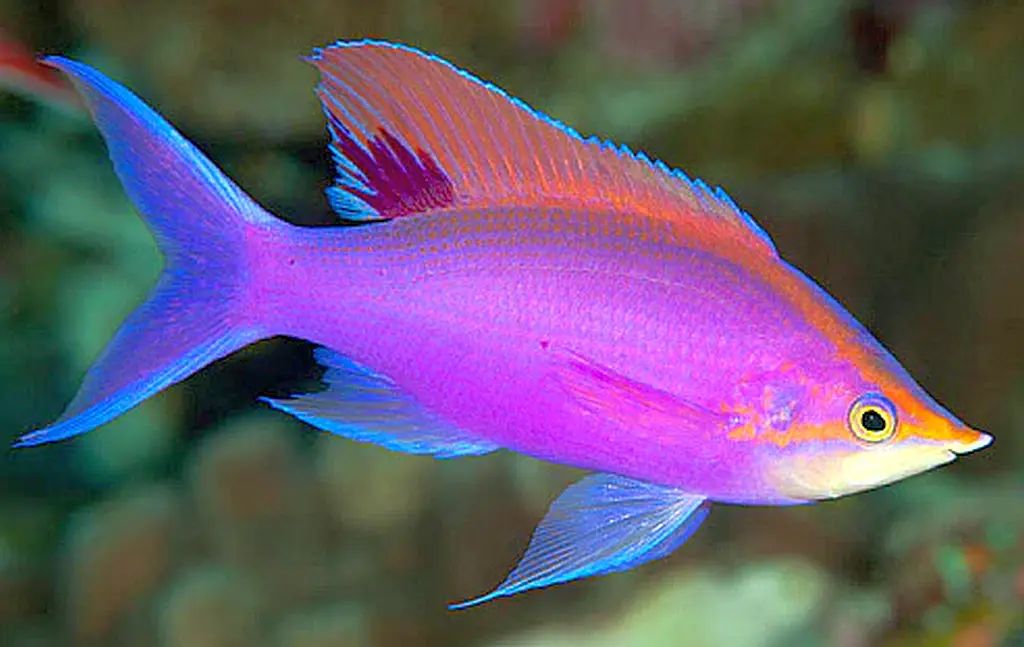
Male Purple Queen Anthias (Pseudanthias tuka)
Purple Queen Anthias have slender, moderately compressed streamlined bodies with pointed snouts, slightly protruding lower jaws, and deeply forked lyretail shaped caudal fins that in adult males end in long filaments. .
Females have a vivid, solid violet to purple body color with a bright yellow stripe running along the back
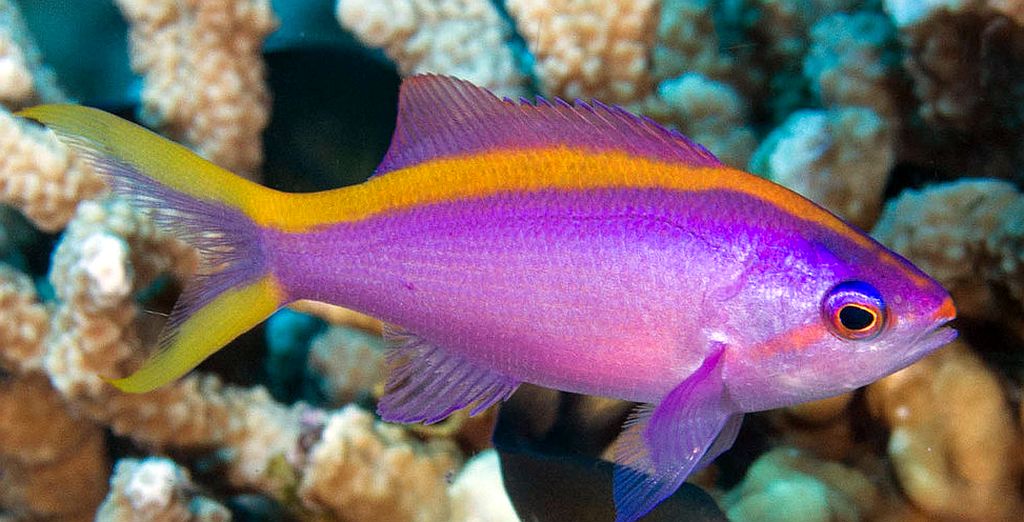
Female Purple Queen Anthias (Pseudanthias tuka)
onto the upper lobe of the caudal fin. Females are less colorful, often appearing in shades of orange or pink.
Transitioned males have a deep purple to magenta colored body without the yellow stripe. Adults develop a dark red, burgundy or purplish colored spot on the base of the pectoral fins and a yellowish orange patch on the throat.
There is a known geographical variation of Pseudanthias tuka found in the Rowley Shoals off northwestern Australia where males develop a thin yellow stripe along the very top edge of their dorsal fin, however, this is a regional trait.
Purple Queen Anthias are a relatively small species. Adult males reach a maximum size of 4.7 inches while females only grow to 3 or 3.5 inches in length.
The Purple Queen Anthias (Pseudanthias tuka) is often confused with the Evans’ Anthias (Pseudanthias evansi) which also have bold purple bodies, however, both males and females have bright yellow colored dorsal and caudal fins.
A small group or harem of Purple Queen Anthias are best housed in a mature reef or FOWLR aquiarium of at least 130 gallon capacity with a fine coralline gravel substrate, copious amounts of live rock arranged into caves, overhangs, and crevices for them to hide among and plenty of free swimming space.
To replicate their natural reef slope environment, multiple wavemakers are needed to provide the heavy water flow and proper oxygenation necessary. Because they require constant small feedings; heavy filtration, aggressive protein skimming, regular water changes, and media reactors are needed to keep nitrates and phosphates at zero.
An aquarium chiller should be considered to maintain water temperatures at their recommended range, and because they are excellent jumpers; a tight fitting mesh lid or glass cover is recommended to prevent them from jumping out of the tank.
Sailfin Anthias are completely reef safe and compatible with corals and invertebrates. They prefer lower light levels and should be provided with plenty of shaded areas. If your reef tank is brightly lit for corals. a lighting system that provides a gradual dawn to dusk lighting cycle can be of great benefit fo this species.
Purple Queen Anthias are reef safe and fully compatible with corals and invertebrates. Although they can be kept singly, as a mated pair, or in small groups of females; they are best kept in a harem of one male with 4 to 6 females. Never introduce multiple males into the same tank, as they will fight to the death.
Because Pseudanthias tuka are timid, easily stressed, and slow to feed; they must be housed with peaceful, slow-moving, non-aggressive tank mates that will not intimidate them or outcompete them for food
Compatible tank mates in a FOWLR setting include cardinalfish, Midas Blennies, Watchman Gobies, Fairy Wrasses, Firefish and Dartfish, Mandarinfish, and peaceful Chromis like Chromis viridis.
Avoid large wrasses, aggressive tangs, surgeonfish, dottybacks, damsels, and predatory Groupers, Lionfish or Hawkfish.
The Purple Queen Anthias has not been successfully bred in an aquarium environment. Like all anthias, Purple Queen Anthias are protogynous hermaphrodites that form harems of a dominant male and a small pod of females.
With several females in an aquarium, the largest most dominant female will transform into a male. In optimal, stress free aquarium environments, a harem may perform coujrtship and spawning rituals similar to those in the wild.
Around dusk or under dim lighting, the male will flash his colors, dart around and make U swimming petterns to attract a willing female to spawn. A pair will dash to the top of the tank and simultaneously release their tiny, spherical, floating eggs and sperm into the water column before diving back to the bottom into the rocks.
The tiny pelagic eggs are usually either sucked into the tank’s filtration system, destroyed by protein skimmers, or eaten by other tankmates before any hatch out. Anthias larvae are microscopic and require specilized, ultra small copepods in a continuous current to survive. Facilities like the Biota Group that have succefully bred other anthias species still have not been able to breed this species.
Purple Queen Anthias are strict planktivores that in their natural environment feed continuously on zooplankton like fish eggs,invertebrate larvae, pelagic tunicates, and microscopic copepods. They generally ignore non living organic debris.
In an aquarium environment, they must initially be fed live rotifers, copepods and newly hatched brine shrimp 4 to 5 times a day. After they are eating live foods, finely chopped frozen copepods (Cyclops), fish roe, calanus, and vitamin enriched myhsis shrimp can gradually be mixed in.
In a home tank, they generally do not recognize flakes, pellets, or dead food, and will quickly starve to death if not properly trained.
An established, oversized refugium connected to your main tank is strongly recommended to provide a continuous, natural supply of live copepods into the water column between regular feedings.
The Purple Queen Anthias (Pseudanthias tuka) is moderately available to tropical fish keeping enthusiasts from a number of online wholesalers, trans shippers, and retailers, as wild caught individuals from Cebu, Indonesia, and the Great Barrier Reef usually by special order at approximate purchase sizes: 1″ to 3.5″.
Prices vary by size, area of collection, and gender but retail around $49.99 to $99.99 or more.
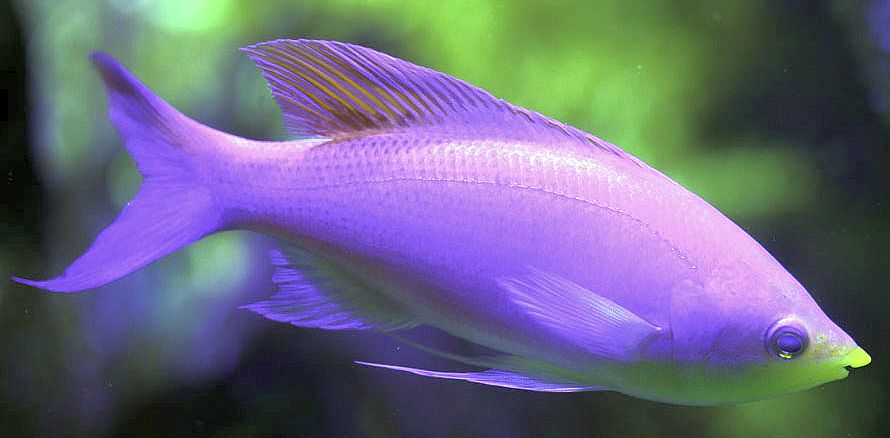
Purple Queen Anthias (Pseudanthias tuka)
Minimum Tank Size: 130 gallons
Aquarium Type: Reef or FOLR
Care Level: Extensive
Temperament: Peaceful
Aquarium Hardiness: Delicate
Water Conditions: 72-78° F, dKH 8 to 12, pH 8.1-8.4, sg 1.020-1.025
Max size: 4.7″
Color Form: Purple, Red, Yellow
Diet: Plankitivore
Compatibility: Reef
Origin: Indian and Western Pacific Oceans
Family: Serranidae
Lifespan: 5 – 7 years
Aquarist Experience Level: Expert Only