Sunburst-Anthias-Serranocirrhitus-latus
The Sunburst Anthias (Serranocirrhitus latus) known to tropical fish keeping enthusiasts as the Fathead Sunburst Anthias and Square Block Anthias are native to the Western Pacific Ocean. Its range is quite broad, stretching from the islands of southern Japan down to the northern coast of Australia
It extends as far north as Taiwan and the Ryukyu and Izu Islands of Japan; south to the Great Barrier Reef in Australia and New Caledonia; and from the Moluccas (Indonesia) in the west to Fiji, Palau, and Tonga in the east.
Sunburst Anthias are a secretive species that are typically found along the steep slopes, drop offs and overhangs of their range on the inshore coral reefs in depths from 50 to over 230 feet. Unlike most anthias that swim in large schools in open water, the Sunburst Anthias prefers hanging around caves and overhangs in the deeper waters of the outer reef slopes.
Divers frequently find them swimming upside down close to the ceilings of caves or under ledges where they wait for drifting zooplankton in areas with moderate to strong currents.
Sunburst Anthias are one of the few Anthias species that do not display sexual dimorphism.
Sunburst-Anthias-Serranocirrhitus-latus
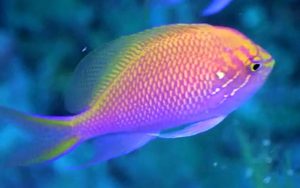
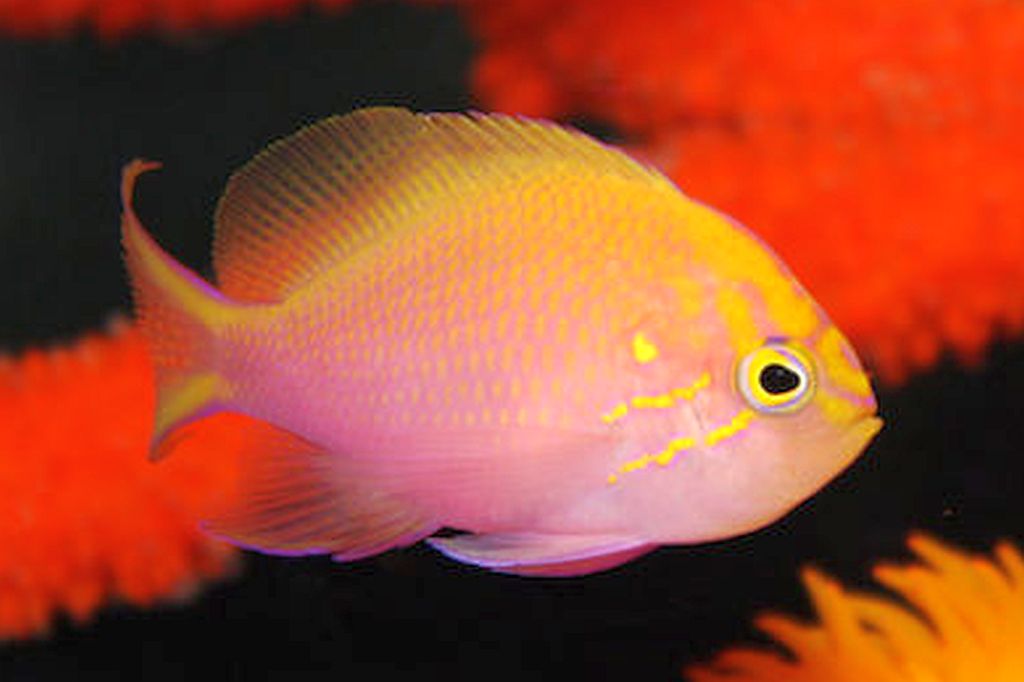
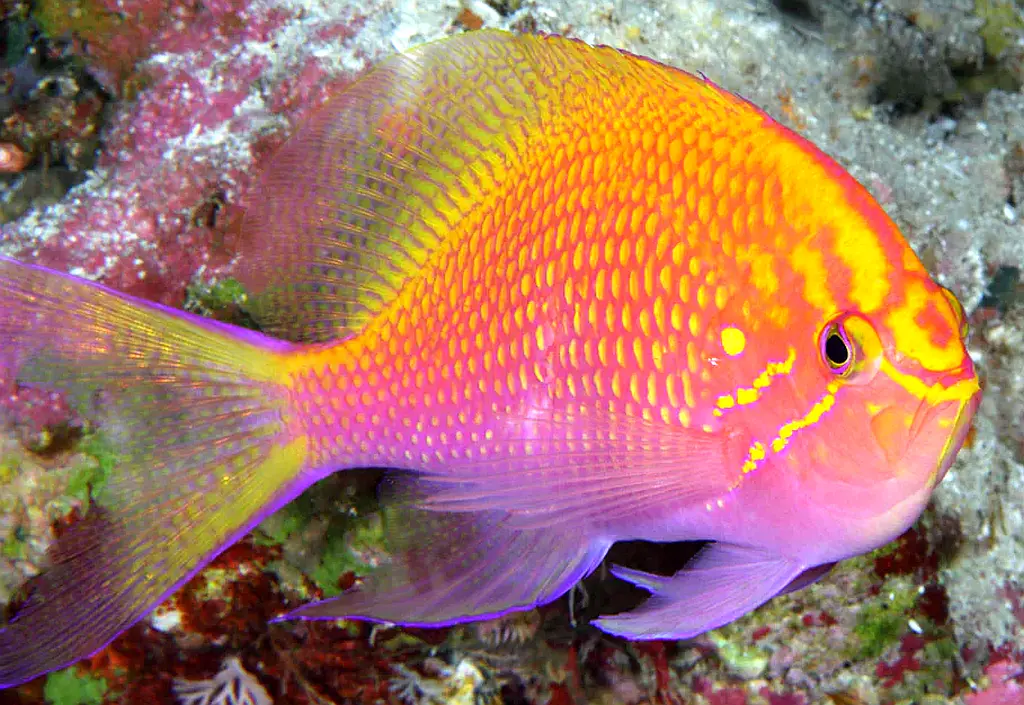
The Sunburst Anthias has a predominantly pink body color with bright yellow to orange scale margins and facial markings. Their translucent pectoral, anal, and caudal fins are tinged in light to purplish blue.
Adult males are more vibrantly colored than females and frequently display vivid yellow or orange hues with contrasting purple and pink accents. Females have a more subdued appearance.
Juvenile Serranocirrhitus latus have less pronounced colors. As they mature, their colors become more pronounced and vivid, especially in males.
Sunburst Anthias can be housed in a mature FOWLR or reef tank of at least 70 gallon capacity with a sand or coralline gravel substrate and copious amounts of live rock arranged into caves, overhangs, ledges, and crevaces for them to hide among.
A powerhead or wavemaker is needed to provide the heavy water flow and proper oxygenation necessary to mimic their natural reef environment. An aquarium chiller should also be considered to maintain water temperatures at their recommended range, and because they are excellent jumpers; a tight fitting mesh lid or glass cover is essential to prevent them from jumping out of the tank.
Sunburst Anthias are completely reef safe and compatible with corals and invertebrates. Because they inhabit deeper waters, they prefer lower light levels and should be provided with plenty of shaded areas. Deep rocky caves, wide overhangs and ledges will suffice if your reef tank is brightly lit for corals.
Sunburst Anthias are often quite territorial toward their own kind. Unless you are keeping them in a very large sytstem of 150 gallons or more where they can defend distinct territories, it is best to keep only one per tank.
Serranocirrhitus latus are generally peaceful and pretty shy. They are easily intimidated by aggressive tankmates like large Tangs, Angels or Dottybacks.
Compatible tank mates include Clownfish (Amphiprion species), Firefish Gobies (Nemateleotris species), Royal Gramma (Gramma loreto), Banggai Cardinalfish (Pterapogon kauderni) and Fairy Wrasses (Cirrhilabrus species).
Sunburst Anthias can be kept as a mated pair, in a small group of females, or as one male with several females. Never keep two males in the same tank, as it can lead to extreme aggression.
Breeding Sunburst Anthias is extremely difficult in a home aquarium environment and although commercial breeding has been achieved, it is not commonplace.
Like other members of the Serranidae family, Sunburst Anthias are protogynous hermaphrodites. They are all born female, and the most dominant, largest individual in a group will eventually transition into a male.
Fathead Anthias, have a unique spawning ritual in the wild that differs slightly from other more social, schooling anthias species. Most anthias species form huge schools when spawning. Sunburst Anthias are more reclusive and typically live alone or in very small harems of one dominant male and a few females. Males are very territorial and perform interisting acrobatic displays to court females and defend their territory.
They are pelagic spawners that release their eggs and sperm into the water column. During the spawning ritual, a pair will leave the safety of the reef and dart upwards toward the surface. At the top of this ascent, they simultaneously release gametes before quickly darting back down to the cover of their rocky cave. Once fertilized, the tiny spherical eggs (roughly 0.65–0.80 mm) drift with the ocean currents as planbkton until they hatch out into tiny larvae. The tiny larvae have voracious appetites and fend for themselves until they attain adulthood.
In an aquarium environment, the floating eggs are usually sucked into the filtration system or eaten by other fish in the tank before they can be collected. The microscopic newly hatched larvae are nearly impossible to raise and require copepod nauplii that are challenging to culture.
In their natural habitat, Serranocirrhitus latus constantly feed on zooplankton, fish eggs, small invertebrates, and crustaceans. In an aquarium environment with plenty of live rock, they should be fed a variety of meaty foods like finely chopped seafood, vitamin enriched frozen mysis shrimp, brine shrimp, and a steady supply of copepods and amphipods 3 to 5 times a day.
Over time they will accept high quality flake foods or pellets but to keep them thriving, a refugium is recommended for cultivating a continuous food supply of nutritious live copepods and amphipods.
Sunburst Anthias (Serranocirrhitus latus) are available to tropical fish keeping enthusiasts from a number of online wholesalers, trans shippers, and retailers, as wild caught individuals usually by special order at approximate purchase sizes: Small: 1″ to 2″; Medium: 2″ to 3″; Large: 3″ to 4″.
Prices vary by size and area of collection but start around $139.99 for small .75-1.25″ Western Pacific specimens to $219.99 for the same size South Pacific individual. Large specimens start at $256.99 from Western Pacific waters.
Sunburst-Anthias-Serranocirrhitus-latus
Minimum Tank Size: 70 gallons
Aquarium Type: Reef or FOLR
Care Level: Moderate
Temperament: Peaceful
Aquarium Hardiness: Hardy
Water Conditions: 72-78° F, dKH 8 to 12, pH 8.1-8.4, sg 1.020-1.025
Max size: 5″
Color Form: Blue, Orange, Red, Yellow
Diet: Carnivore
Compatibility: Reef
Origin: Western Pacific, Fiji, Tonga
Family: Serranidae
Lifespan: 3 – 5 years
Aquarist Experience Level: Intermediate