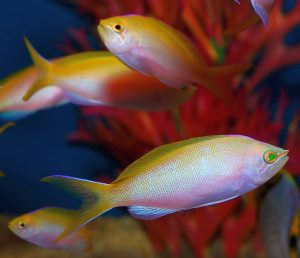
Bartlett’s Anthias School (Pseudanthias bartlettorum)
The Bartlett’s Anthias (Pseudanthias bartlettorum) known to tropical fish keeping enthusiasts as the Bartlett’s Fairy Bass is found in the western Pacific Ocean and ranges from Palau, Kosrae in the Caroline Islands, Kwajalein in the Marshall Islands, Nauru and Tabuaeran in Kiribati and Tonga.
The Bartlett’s Anthias is normally encountered in areas with strong currents along the reef slopes, faces, and channel drop offs of their range at depths to 100 feet or more where they are normally encountered in large schools of a few males with several dozen females and juvenile stragglers.
Like most Anthias species, Bartlett’s Anthias are protogynous hermaphrodites that change sex from female to male. I n the wild when a male in a harem dies, the largest and most dominant female will morph into a male to take his place.
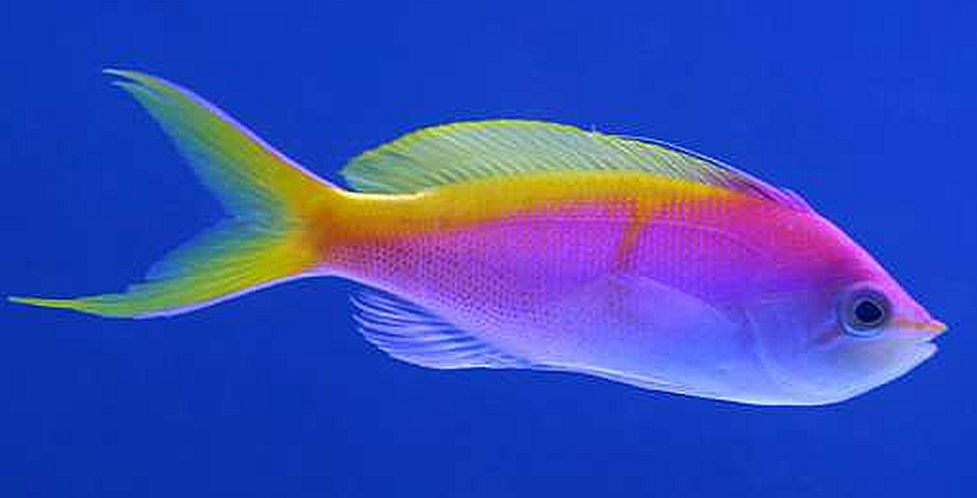
Bartlett’s Anthias (Pseudanthias bartlettorum)
The Bartlett’s Anthias has a moderately compressed two toned body with a thick, pointed upper lip. The upper portion of the head and body are a bright yellow color with the lower portion of the body typically a magenta or purple to lavender color that fades on the bellly. The iris is dark orange in color, and a dark orange band on the head runs from the snout to the lower part of the eye. The dorsal fin is yellow tinged with lavender, the anal fin is pale lavender with a redish margin on the caudal penducal and the caudal fin is yellow with violet outer margins. The pelvic fins are a pale lavender color and the pectoral fins are transluscent.
Male Pseudanthias bartlettorum have more intensely colored violet bodies with brighter yellow along the back and upper caudal lobe. Females tend to be more lavender in color with a yellow back and caudal fin.
Bartlett’s Anthias are best housed singly or in small harems of one male with 2 to 5 females in a mature well established FOWLR or reef aquarium of at least 80 gallon capacity, with a sandy or finely crushed coral substrate with plenty of live rock arranged into crevices, caves, and overhangs for them to hide among and plenty of free swimming space.
A powerhead or wavemaker will ensure the moderate water flow and proper oxygenation to mimic their natural deep water environment. An aquarium chiller is suggested to maintain water temperatures in their recommended range and because they are excellent jumpers; a tight fitting lid or glass cover is essential to prevent them from leaping out of the tank.
Pseudanthias bartlettorum are reef safe and totally compatible with corals and invertebrates. They can be kept singly, as a mated pair, or in small groups of females. Although they can become aggressive towards conspecifics when kept in small groups in smaller aquariums; housing them in larger groups or as a single male with several females is recommended to mitigate aggression. For a larger school of five or more individuals, a 150 gallon tank is recommended.
Compatible tank mates include clownfish, blennies, dottybacks, tangs, wrasses, cardinals, and gobies.
Widespread captive rearing of Bartlett’s Anthias is limited but they have been bred by tropical fish keeping enthusiasts in large established 100 gallon plus systems decorated with copious amounts off mature live rock with heavy water flow.
They are protogynous hermaphrodites that spawn in harems where one male dominates several females, making them somewhat suitable for captive breeding. Pseudanthias bartlettorum are pelagic spawners that often spawn daily when conditioned with multiple feedings. Males perform courtship displays that start above the reef with some fin flicking and dive towards the bottom as they display their ventral fins. The eggs are released by the females into the water column and fertilized by the males usually during a daily feeding frenzy, close to dusk.
For the average hobbyist, raising the fry is nearly impossible. In the wild, they spawn in large groups where the eggs are swept away by strong currents. In an aquarium environment, the floating eggs are usually sucked into the filtration system or eaten by other fish in the tank before they can be collected. The microscopic newly hatched larvae are difficult to raise and require copepod nauplii that are hard to culture. For this reason the majority of specimens sold to tropical fish keeping enthusiats are wild caught.
In their natural habitat, Pseudanthias bartlettorum are constanyt plankton grazers. In an aquarium environment the biggest challenge to feeding them is their high metabolism.
Bartlett’s Anthias should be fed a variety of meaty foods like finely chopped seafood, vitamin enriched frozen mysis shrimp, brine shrimp, copepods, and amphipods 3 to 4 times a day. Over time they may accept high quality flake foods but to keep them thriving, a refugium is highly recommended for cultivating a continuous food supply of nutritious live copepods and amphipods.
The Bartlett’s Anthias (Pseudanthias bartlettorum) is sporadically available to tropical fish keeping enthusiasts from a number of online wholesalers, trans shippers, and retailers, usually by special order at prices around $ $73.99 to $87.49 for Medium 1 1/2″ to 2 1/4″ Marshall Island specimens.
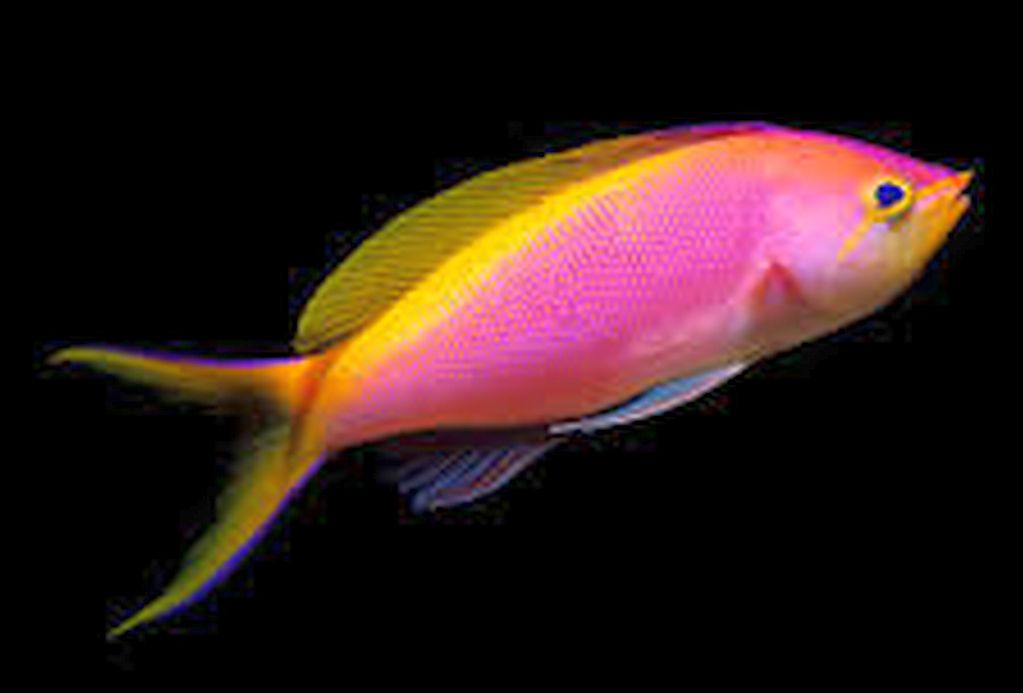
Bartlett’s Anthias (Pseudanthias bartlettorum)
Minimum Tank Size: 80 gallons
Aquarium Type: Reef or FOLR
Care Level: Moderate
Temperament: Semi Aggressive
Aquarium Hardiness: Hardy once acclimated
Water Conditions: 72-78° F, dKH 8 to 12, pH 8.1-8.4, sg 1.020-1.025
Max size: 3.5″”
Color Form: Orange, Purple, Red. Yellow
Diet: Carnivore
Compatibility: Reef
Origin: western Pacific Ocean
Family: Serranidae
Lifespan: 5 – 7 years
Aquarist Experience Level: Intermediate/Advanced