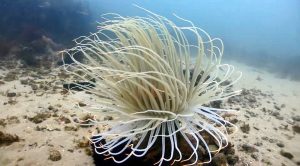
Colored Tube Anemone (Cerianthus membranaceus)
The Colored Tube Anemone (Cerianthus membranaceus) known to tropical fish keeping enthusiasts as the Fluorescent Tube Anemone, Burrowing Tube Anemone, or Ornate Tube Anemone, is an exotic, non-photosynthetic anthozoan species that is found across tropical and subtropical marine environments throughout the Indo-Pacific and Atlantic oceans.
The Colored Tube Anemone (Cerianthus sp.) is also classified within the subclass Ceriantharia and commonly sold in the aquarium hobby as the Tube-Dwelling Anemone, Cylinder Anemone, or Cerianthid Anemone.
Their range extends from the Red Sea and East Africa to Indonesia, the Philippines, Japan, northern Australia, and select tropical coastal waters of the western Atlantic.
Colored Tube Anemones are most commonly found among soft, muddy seabeds, sandy lagoon floors, silty seagrass beds, and deep reef rubble slopes of their range in coastal waters, from just below the low-tide line down to depths of 130 feet or more where they live permanently buried inside self-constructed parchment-like tubes.
Burrowing Tube Anemones have been recorded from shallow sheltered bays down to roughly 150 feet among fine sand, silt, and mud substrates where deep, undisturbed sediments allow them to construct long vertical burrows that can extend over a foot beneath the seafloor.
Cerianthus species are true tube-building, sand-burrowing organisms. Unlike true sea anemones (order Actiniaria) that use a sticky pedal disc to grip rockwork or walk across aquarium glass, Colored Tube Anemones lack a pedal disc entirely and instead secrete a tough, fibrous, mucus-and-nematocyst-woven tube buried deep in the sand bed.
Throughout the day and night, rather than hosting clownfish, Colored Tube Anemones remain permanently housed
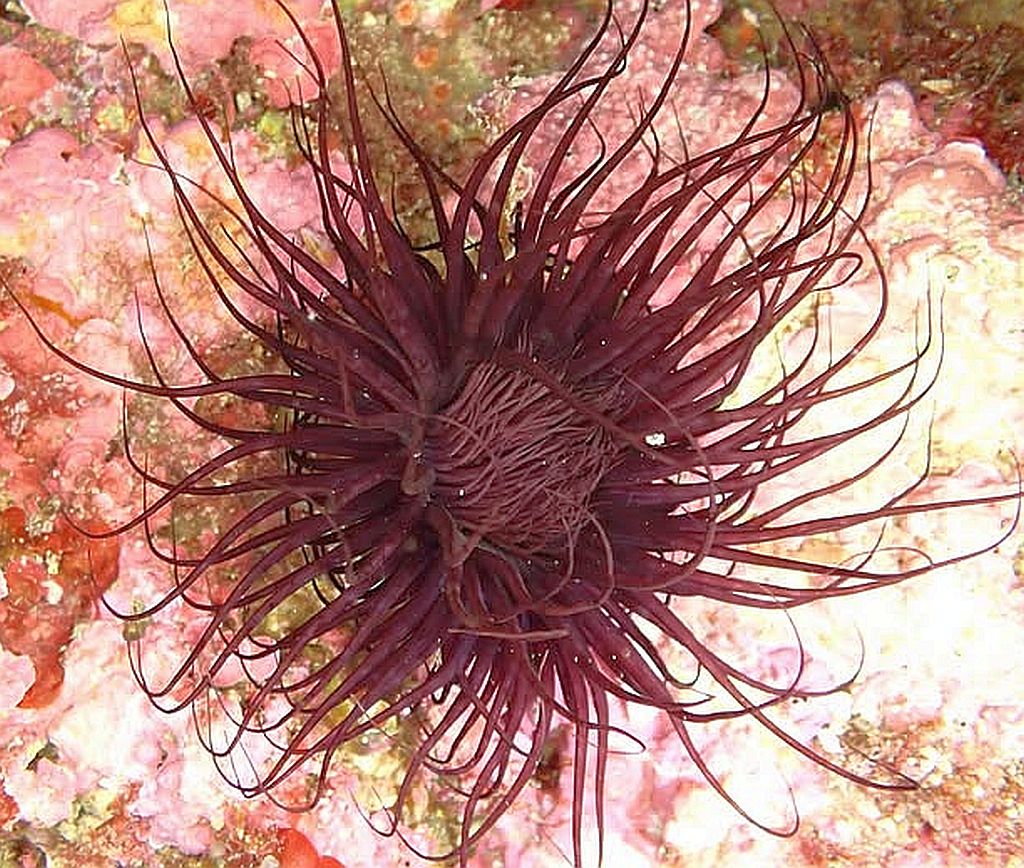
Rust Colored Tube Anemone (Cerianthus membranaceus)
inside their subterranean parchment tube, extending their graceful double crown of flowing tentacles out into the water column to filter passing currents. Living inside a deep, buried tube provides complete physical security, allowing the animal to vanish instantaneously down into the sand bed in a fraction of a second when startled or threatened by predators.
Although Colored Tube Anemones are stationary once settled into a deep sand bed and never wander onto upper rockwork, they are aggressively predatory and territorial toward nearby sessile corals and small, slow-moving fish.
Colored Tube Anemones are typically found spaced apart across open sandy bottoms rather than in tight clusters. Because their long outer tentacles can stretch 6 to 10 inches into the current and pack a potent sting, they will severely injure neighboring corals and ensnare unwary bottom-dwelling fish or shrimp that drift within reach.
Cerianthus species are medium to large marine invertebrates whose tentacle crowns commonly expand to 6 to 12 inches in diameter in home aquariums, with their buried parchment tubes reaching 10 to 18 inches in length.
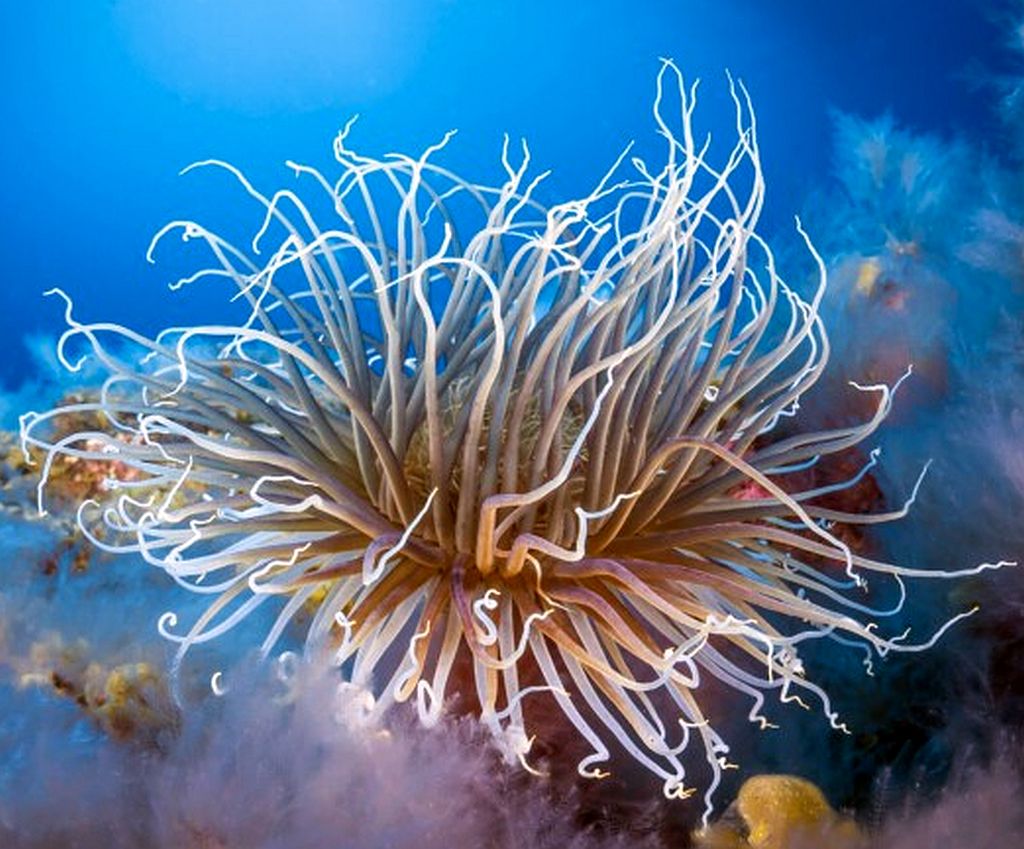
Colored Tube Anemone (Cerianthus membranaceus)
True Colored Tube Anemones display an otherworldly, fireworks-like silhouette that features a soft, cylindrical, footless body encased inside a leathery grey-brown mucus tube, topped by two distinct concentric whorls of long, slender tentacles.
They have a characteristically graceful double crown consisting of an outer ring of long, sweeping feeding tentacles and a shorter, tightly clustered inner ring of labial tentacles surrounding the central mouth that actively manipulate captured prey.
Colored Tube Anemones are strictly non-photosynthetic (azooxanthellate) anthozoans that lack symbiotic zooxanthellae, deriving their breathtaking colors entirely from natural fluorescent tissue pigments that glow brilliantly under blue actinic reef lighting. Popular hobby color varieties include neon orange, fiery red, electric green, deep violet, hot pink, pure white, and striking bi-color morphs featuring contrasting purple or green centers with orange or pink outer tentacles.
Colored Tube Anemones are hermaphroditic anthozoans that lack external sexual dimorphism. It is impossible to visually distinguish individuals by sex in a home aquarium.
Unlike stony corals that secrete a rigid calcium carbonate skeleton, the Colored Tube Anemone lacks any hard
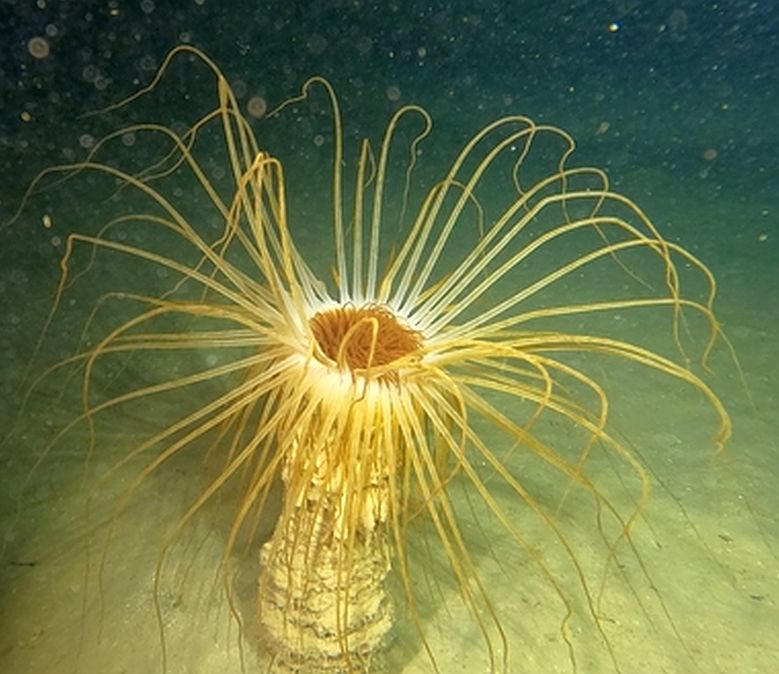
Yellow Colored Tube Anemone (Cerianthus membranaceus)
protective armor. Instead, they rely on their tough, flexible parchment tube built from specialized stinging threads (ptychocysts) and lightning-fast withdrawal reflex for survival. When startled by a shadow, water disturbance, or predator, they instantly contract their longitudinal muscles and shoot straight down into their buried tube until danger passes.
The Colored Tube Anemone is semi-reef safe with caution and is best housed in a well-established reef or species-specific lagoon aquarium of at least 30 to 50 gallon capacity with a deep 4 to 6 inch fine sand bed (or a dedicated PVC pipe planter filled with sand), a mature biological filter, low to moderate lighting, gentle to moderate laminar water flow, and ample open clearance away from neighboring corals.
Colored Tube Anemones are peaceful toward agile, mid-water swimming reef fish and add dramatic movement and glowing fluorescence to shaded sand zones where most photosynthetic corals cannot thrive. Because they are strictly non-photosynthetic, they do not require expensive high-PAR reef lighting—and because they cannot climb glass or rockwork once established in deep sand, they pose virtually zero risk of getting sucked into high-mounted wavemakers.
Clownfish do not naturally host in Tube Anemones, and introducing clownfish to one often results in the clownfish being stung or eaten rather than hosted.
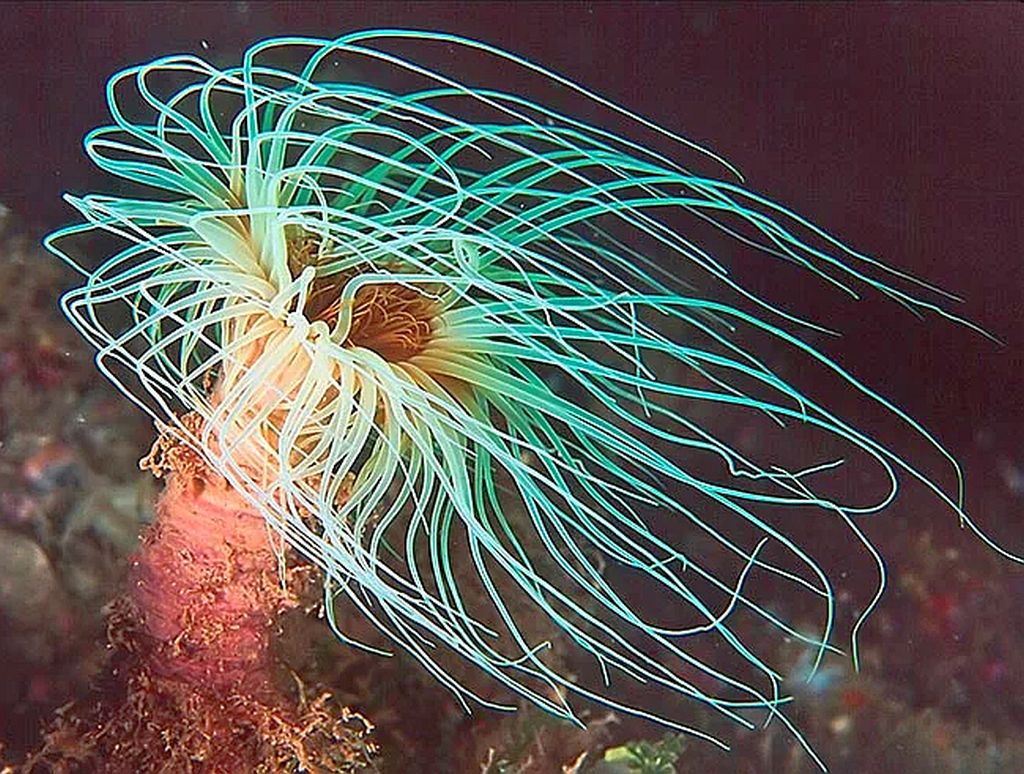
Colored Tube Anemone (Cerianthus membranaceus)
Colored Tube Anemones are opportunistic predators toward tiny, slow-moving tank mates and do best in a calm, mature reef or low-light lagoon system with alert, mid-water swimming fish.
Good tank mates include Ocellaris and Percula Clownfish (provided they do not attempt to host), Cardinalfish, Chromis, Dartfish, Anthias, Tangs, and peaceful reef-safe Wrasses.
Avoid keeping them with slow-moving bottom dwellers, Mandarin Dragonets, Seahorses, Pipefish, small Gobies, Sexy Anemone Shrimp, or large Angelfish and Butterflyfish, as small bottom-perching fish and shrimp can be captured and eaten while angelfish and butterflyfish may nip at their extended tentacles.
Provided its unique substrate and feeding requirements are met in a mature reef system that has been running for at least 4 to 6 months, the Colored Tube Anemone is moderately hardy and surprisingly adaptable compared to giant photosynthetic host anemones.
Like all marine invertebrates, Cerianthus species are sensitive to sudden salinity swings, elevated nitrates, and copper-based medications, which are immediately fatal to them. To thrive, they require stable tropical temperatures between 74–80°F, a specific gravity of 1.024–1.026, a pH of 8.1–8.4, low to moderate lighting (50–150 PAR), and gentle, unidirectional currents that carry suspended food into their sweeping tentacles without whipping them violently.
If you provide them with a deep sand bed or bury them inside a wide, sand-filled PVC pipe hidden behind rockwork, and target feed them on a regular basis, Colored Tube Anemones can be kept alive for many years.
Colored Tube Anemones do not reproduce sexually or divide asexually in standard home aquariums.
In their natural coastal habitats, Colored Tube Anemones reproduce via seasonal broadcast spawning. They

Colored Tube Anemone (Cerianthus membranaceus)
release eggs and sperm (gametes) into the water column that develop into prolonged, planktonic larval stages (known as cerinula larvae) before settling into soft sediment. The free-swimming planktonic larvae drift with ocean currents for weeks before settling onto soft, muddy seafloors.
In a reef, FOWLR, or species specific tank, aquarists should plan around maintaining a single specimen with generous clearance for its sweeping tentacle crown.
Unlike photosynthetic host anemones that derive most of their energy from sunlight, the Colored Tube Anemone (Cerianthus sp.) is an obligate, non-photosynthetic carnivore that relies 100% on captured food for survival.
In their natural environment, they extend their long outer tentacles into gentle currents to snare passing zooplankton, copepods, brine shrimp, mysids, and tiny larval fish, using their short inner tentacles to pass prey directly into the central mouth.
In an established aquarium environment, Colored Tube Anemones will slowly starve and shrink away if left unfed. Reef lighting provides them with zero nutritional energy.
To keep them healthy, experienced tropical fish keeping enthusiasts must target-feed Cerianthus membranaceus two to three times per week using small portions of mysis shrimp, enriched brine shrimp, finely minced krill, clam, squid, or meaty reef-frenzy blends delivered gently into their outer tentacles with a turkey baster or feeding pipette.
The Colored Tube Anemone (Cerianthus membranaceus) is a moderately common, eye-appealing specialty invertebrate that can be purchased from online marine retailers and local fish shops at low to moderate prices depending on size, area of collection, and color intensity.
Cerianthus membranaceus are highly sought after by reef and deep-water biotope enthusiasts for their glowing neon fluorescence under blue LEDs, flowing double tentacle crown, and ability to thrive in shaded sand zones without intense lighting.
Current retail prices for the Colored Tube Anemone range from $39.99 to $69.99 or more for classic white, tan, or single-tone green and purple specimens. Vibrant neon orange, hot pink, and contrasting bi-color showpiece individuals typically cost between $79.99 and $129.99 or more depending on size and vendor.
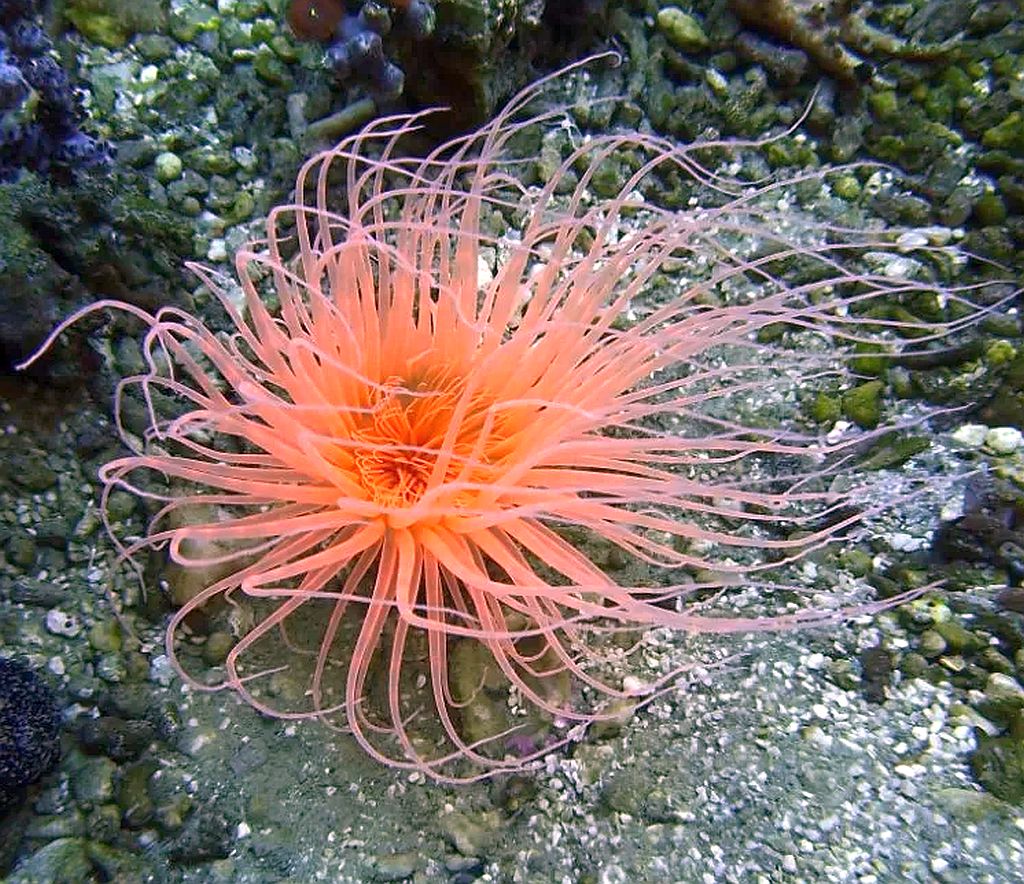
Colored Tube Anemone (Cerianthus membranaceus)
Minimum Tank Size: 30 – 50 gallons (mature tank running 4–6+ months with 4–6″ deep sand bed)
Aquarium Type: Mature Reef, Lagoon, or Low-Light Biotope System
Tank Care Level: Moderate
Temperament: Semi-Aggressive (Stings neighboring corals and eats tiny slow fish/shrimp)
Aquarium Hardiness: Moderately Hardy (Requires regular target feeding)
Water Conditions: 74–80° F, dKH 8 to 12, pH 8.1 – 8.4, sg 1.024 – 1.026
Max Size: 8″ – 12″ (Tentacle crown spread)
Color Form: Neon Orange, Pink, Electric Green, Violet, White, or Bi-Color Morphs
Diet: Carnivore / Planktivore (Strictly Non-Photosynthetic — Must Be Fed)
Compatibility: Semi-Reef Safe With Caution (Not a Clownfish Host)
Origin: Indo-Pacific (Indonesia, Philippines, Red Sea, and Australia)
Family: Cerianthidae
Lifespan: 10 – 30+ years
Aquarist Experience Level: Intermediate