Author Archives | Fishkeeper

Palespotted Cory Cat (Corydoras gossei)

Palespotted Cory Cat (Corydoras gossei)

Palespotted Cory Cat (Corydoras gossei)

Palespotted Cory Cat (Corydoras gossei)

Palespotted Cory Cats (Corydoras gossei) are a peaceful Brazilian species of catfish found in smaller river tributaries of the Rio Mamore watershed and the Rio Rondonia.

The Palespotted Cory is sometimes called the Smokey Cory by tropical fish keeping enthusiasts which probably comes from the greyish color that the species posses on the upper half of their bodies.  The lower half of their bodies are white to yellow, and their front fins are often yellow in color.  The rest of the Palespotted Cory’s fins are clear.

Palespotted Corys are an active social species that do best in a peaceful community tank with at least 6 or 7 of their own kind or with other smaller non aggressive fish that do not consider them dinner.

These Corys are great housekeepers and do an excellent job of keeping the aquarium free of excess food and decaying plant matter.

An ideal aquarium setup for the Palespotted Cory is a tank that closely resembles their natural habitat.  This is a typical densely planted Amazon setup with a sandy or extremely fine gravel substrate, lots of driftwood or tree roots, some smooth rocks and some low light ground cover like Java Fern.  The addition of dried leaves will mimic their natural water conditions and stain the water to their liking.

Although they are not nocturnal and are active during daylight hours, Palespotted Corys prefer a dimly lit tank with areas of filtered lighting that mimic the look of a dense jungle tree canopy.  They are very sensitive to poor water conditions and high nitrates and require good filtration to keep them healthy. They are highly intolerant of salt, chemicals, and medications.  Do not use an undergravel filter with these fish or any of the Cory species.

The Palespotted Cory Cat can be bred by keeping a number of fish together and allowing them to pair off.  After the pair spawns, they should be separated from their eggs, or the eggs should be transferred to another system for incubation. In about five days the fry become waterborne and can be fed baby brine shrimp and crushed flake food.

The Palespotted Cory Cat is an omnivorous and needs a mixture of vegetable matter and meaty foods in their diet to give them the vitamins and minerals necessary to keep them healthy and in breeding condition.  They feed on worms, crustaceans and insect larva in their natural habitat, but will eagerly accept commercial flake foods, as well as algae and decaying plant matter.   Freeze dried bloodworms, tubifex, shrimp pellets, live and frozen brine shrimp, and live tropical fish foods should all be on the menu for these Corys.

Palespotted Cory Cat (Corydoras gossei)

Palespotted Cory Cat (Corydoras gossei)


Minimum Tank Size: 30 Gallons
Care Level: Easy
Temperament: Peaceful
Aquarium Hardiness: Hardy
Water Conditions: 72-79° F, KH 1-12, pH 6.0-7.0
Maximum Size: 2″
Color Form: Brown, Orange
Diet:   Omnivore
Compatibility:  Great in community tanks
Origin:   Brazil
Family:   Callichthyidae
Lifespan:  3 – 5  Years or more
Aquarist Experience Lever: Intermediate

Posted in Catfish, Corydoras, Featured Articles, Freshwater Fish2 Comments

Ornate Bichir (Polypterus ornatipinnis)

Ornate Bichir (Polypterus ornatipinnis)

Ornate Bichir (Polypterus ornatipinnis)

Ornate Bichir (Polypterus ornatipinnis)

The Ornate Bichir (Polypterus ornatipinnis) is found in the Africa’s Congo River, Lake Tanganyika, and Lake Rukwa and is considered by most tropical fish keeping enthusiasts to be the most attractive of the Bichirs.

The Ornate Bichir has a protruding upper jaw and is the largest of the Polypterus species, reaching two feet in length.
It has a striking black and yellow pattern on its body, head, and fins, and 9 to 11 dorsal spines. The eyes are on the sides of its head and above its two pectoral fins.  This Bichir can range in color from dark brown to a brownish grey, and is very common species in the aquarium trade.

The Ornate Bichirs distinct color pattern tends to fade and blend into the base color as they grow and since they maintain their color patterns longer; juvenile specimens that have sharp, distinct, color patterns are in great demand.   Males have a large pocket like anal fin which is thicker than the females.

As juveniles, Ornate Bichirs can be housed in a tank as small as 20 gallons, however as adults that grow over 2 feet in length, they require a tank with a lot of bottom space of least 250 gallons.

Like other members of the Polypteridae family, Ornate Bichirs have a lung like swim bladder and gills that allow them to survive out of water for brief periods of time by breathing atmospheric air.  Although they are bottom dwellers, they are also “escape artists” and jumpers and should have a tight well sealed lid on their aquarium that provides them with enough air space to gulp air when needed.

Ornate Bichirs are semi aggressive but will swallow any fish they they can fit into their rather large mouths.  Choose larger, passive tank mates for these fish and fish of at least the same size when housing two or more of the same species. Ornate Bichirs are aggressive towards their own kind.

The Ornate Bichir does best in a large densely planted aquarium with a sandy or fine gravel bottom and numerous hiding places.  They benefit from lots of caves, roots and driftwood in the tank.  Being messy eaters, they need good filtration and regular partial water changes to keep them healthy.

Ornate Bichirs are carnivorous and will eat almost any kind of meaty food.  They will thrive when fed good quality carnivore pellets, carnivore sticks, chunks of frozen brine shrimp, mysis shrimp, or beef heart; chopped market shrimp, pieces of raw fish, bloodworms, black worms, and earthworms.  In short anything live and meaty will be readily accepted.

Although breeding the Ornate Bichir is not a common occurrence in an aquarium, it has been accomplished.  Females are said to deposit eggs on clumps of vegetation.

Ornate Bichir (Polypterus ornatipinnis)

Ornate Bichir (Polypterus ornatipinnis)When available for purchase it is best to buy small specimens in the 2″ to 4″ range.


Minimum Tank Size: 55 gallons
Care Level: Difficult
Temperament: Semi-aggressive
Aquarium Hardiness: Hardy
Water Conditions: 77-83° F, KH 1-12, pH 6.5-7.5
Max. Size: 2′ 1″
Color Form: Tan
Diet: Carnivore
Compatibility: Keep with others of same species
Origin: Central Africa
Family: Polypteridae
Lifespan: 24 Years
Aquarist Experience Lever: Intermediate

Posted in Bichir & Ropefish, Featured Articles, Freshwater Fish0 Comments

Guinean Bichir (Polypterus ansorgii)

Guinean Bichir (Polypterus ansorgii)

Guinean Bichir (Polypterus ansorgii)

Guinean Bichir (Polypterus ansorgii)

The Guinean bichir (Polypterus ansorgii)is native to West Africa (Guinea). It is believed to be found from the Ogun River in Nigeria to the Corbal River in Guinea Bissau, in Lake Kainji and in the Niger river basin near Kouroussa in Guinea however, its wider distribution is unconfirmed.

The Guinean Bichir is considered rare by tropical fish keeping enthusiasts because it is not generally exported for the aquarium trade.  It is easily confused with other species which could explain the wide deviation of their reported maximum size.

The Guinean Bichir was originally believed to attain a maximum length of 11″ however it is now believed that wild specimens may grow to 36″ in length.

Guinean Bichirs are greenish black in color with large dark blotches on their flanks. The jaws are about the same length, but the lower jaw protrudes slightly more on mature specimens.  They have 12 to 15 dorsal “finlets” that extend toward the rear of their pectoral fin.  In male Bichirs, the anal fin is larger and thicker than the females

All Bichirs are relatively peaceful with fish that are too large for them to consume, but given the chance, they will eat smaller fish and even others of their own kind.  Bichir tank mates should be close to the same size when housing more than one fish in a tank.

The Guinean Bichir needs a substrate of sand or fine gravel in an aquarium densely planted with potted or well rooted and overhanging plants, Java Fern, and Java Moss to give them respite from bright lights.  Being nocturnal, they need places to hide and do well in aquariums with lots of rockwork and plenty of bogwood and driftwood.

Guinean Bichirs love meaty live foods such as blood worms, black worms, small crustaceans, and earthworms.  They will also eat a variety of frozen foods such as brine shrimp, mysis shrimp and beef heart.  Although dried foods are usually rejected, they will gradually accept a quality carnivore pellet, stick, or tablet.

Guinean Bichirs are sloppy eaters.  They need good filtration and frequent partial water changes to maintain water quality and keep them healthy.

Although they are bottom dwellers, they still need to surface periodically to breathe air.  Make sure their tank is tightly covered and that there is sufficient space for them to gulp air when needed.

To date there are no confirmed breeding s of Guinean Bichirs.

Guinean Bichir (Polypterus ansorgii)

Guinean Bichir (Polypterus ansorgii)


Minimum Tank Size: 55 gallons
Care Level: Moderately Difficult
Temperament: Semi-aggressive
Aquarium Hardiness: Hardy
Water Conditions: 74-83° F, KH 1-12, pH 6.2-8.0
Max. Size: 11″
Color Form: Tan
Diet: Carnivore
Compatibility: Keep with others of same size
Origin: West Africa, Guinea
Family: Polypteridae
Lifespan: 10 Years
Aquarist Experience Level: Intermediate

Posted in Bichir & Ropefish, Featured Articles, Freshwater Fish1 Comment

Rope Fish (Erpetoichthys calabaricus)

Ropefish (Erpetoichthys calabaricus) a.k.a. Reedfish

Rope Fish (Erpetoichthys calabaricus)

Rope Fish (Erpetoichthys calabaricus)

Ropefish (Erpetoichthys calabaricus) also called the Reedfish or Snakefish, is a primitive member of the Bichir family that is native to West and Middle Africa. Its natural habitat stretches from the Ogun River in Nigeria to the Chiloango River in the Republic of the Congo.

The Ropefish lives in warm, slow moving or standing, brackish or fresh water and can breathe atmospheric air when necessary to survive low dissolved oxygen water conditions. They have a pair of “lungs” which allows them to live quite some time out of water.

Ropefish have several unusual features that include an elongated eel like body, a flattened head, thick bony scales that create a reticulated pattern, and a modified swim bladder that acts as a pair of lungs.

The Ropefish grows to 15 inches in length, has poor eyesight, and is a nocturnal predator. In its natural habitat, it feeds on worms, crustaceans and insects.

These fascinating fish are have an inquisitive personality and are favorites of many tropical fish keeping enthusiasts. Despite their large size, they are quite peaceful by nature and are usually the target of “bullying” in an aquarium. They are quite social and enjoy the company of other Ropefish, especially when in an aquarium environment.

Ropefish will occasionally jump out of the aquarium when bullied by other fish, so a tight cover is recommended when keeping this species. They are notorious “escape artists” and can “jump” quite a distance.

They need a large densely planted, sand or fine gravel tank, with plenty of roots and driftwood for them to hide in.  They are benefited by the addition of a small amount of salt to their tank.

Although Ropefish are nocturnal, they can be encouraged to come out during the day by feeding them bloodworms, redworms, or nightcrawlers. When placed in with more aggressive fish, they have a tendency to stay close to the surface of the tank where they feel safer. These fish frequently leave the water when they feel threatened or when water quality mandates them to do so.

The Rope Fish is a carnivore and requires live food in its diet.  earthworms, bloodworms, tubifex, insect larvae , and chopped meat or beef heart will all be readily accepted.

No breeding of Ropefish has ever been documented in an aquarium setting.

When available for purchase, Ropefish are usually less than 10″ in length.

Rope Fish (Erpetoichthys calabaricus)

Rope Fish (Erpetoichthys calabaricus)


Minimum Tank Size: 55 gallons
Care Level: Easy
Temperament: Peaceful
Aquarium Hardiness: Hardy
Water Conditions: 72-82° F, KH 8-22, pH 6.0-7.5
Max. Size: 2′ 11″
Color Form: Yellow
Diet: Carnivore
Compatibility: Keep with others of same species
Origin: Africa
Family: Polypteridae
Lifespan: 20 Years
Aquarist Experience Lever: Intermediate

Posted in Bichir & Ropefish, Featured Articles, Freshwater Fish0 Comments

Saddled Bichir

Bichir – The Dinosaur or Dragon Fish

Bichir (polypterus-endlicheri)

Bichir (polypterus-endlicheri)

Bichirs (Polypteridae) are sometimes referred to by tropical fish keeping enthusiasts as the Dragon Bichir, Dragon Fin, Dinosaur Fish, or Dragon Fish.  The name has probably derived from their “dragon like” appearance.

Bichirs are a primitive ray-finned fish that are found in the swampy, shallow floodplains and estuaries of the Nile River system in tropical Africa and are in the same family (Polypteridae) as reedfish and ropefish.

Bichirs are elongated, eel like fish that have from 7 to 18 small dorsal “finlets” in lieu of the single dorsal fin that most ray-finned fish posses.  Each of the small finlets have double edged tips and are the only ones with actual spines.

Except for their pectoral fins, which are fleshy and similar to the lobe-finned fishes, the Bichir is covered with thick trapezoidal scales.

The jaw structure of the Bichir is similar to that of a frogs, and they have a pair of slit like openings called spiracles that they use to breath air through a pair of lungs that are connected to their esophagus by a glottis.    They posses both a modified paired swim bladder that has the function of “lungs”, as well as gills to breathe.    The right side of their swim bladder is larger than the left and is used for breathing atmospheric air.

In poorly oxygenated water, Bichirs will often travel on land for short periods using their muscular pelvic fins but because their bodies must remain moist, they cannot stay out of water for extended periods.    These fish can actually drown if denied access to atmospheric oxygen.

All Bichirs are nocturnal opportunistic feeders that have poor eyesight and an excellent sense of smell.   In their natural habitat they come out from their hiding places at night to feed on small fish, invertebrates, crustaceans, worms, and insects.   In an aquarium environment they should only be housed with larger peaceful fish that they cannot get into their mouths.   These fish will eat anything up to their own size.

Depending on the species, Bichirs can grow quite large and frequently outgrow their surroundings.   Because of their size, they should be housed in as large a tank as possible for their maximum size.  The chart below describes the species and subspecies of Polypterus along with their maximum known size.

Scientific name Common name(s) Size Origin
Polypterus ansorgii Guinean bichir 11″ (28cm) West Africa (Guinea)
Polypterus (bichir) bichir Nile bichir 27″ (68cm) Nile, Cameroon, Ethiopia, Ghana
Polypterus (bichir) katangae 18″ (45cm) Central Africa (Katanga region)
Polypterus (bichir) lapradei 24″ (60cm) or more Most of West Africa
Polypterus delhezi Armoured / Banded bichir 14″ (35cm) Central Africa: Congo river, Upper and middle Congo
Polypterus endlicheri congicus Congo bichir 39″ (97cm) Congo, Lake Tanganyika
Polypterus endlicheri endlicheri Red / Saddled bichir 24″ (60cm) or more Nigeria, Lake Chad, White Nile
Polypterus ornatipinnis Ornate bichir 24″ (60cm) Central and East Africa: Congo river basin, Lake
Tanganyika
Polypterus palmas buettikoferi 14″ (35cm) West Africa
Polypterus palmas palmas Marbled bichir 12″ (30cm) Congo, Liberia, Sierra Leone, Guinea
Polypterus palmas polli Poll’s bichir 12″ (30cm) W. & Central Africa, Congo River
Polypterus retropinnis West African / Speckled bichir 13″ (33cm) West and Central Africa
Polypterus senegalus meridionalis 28″ (70cm) Central Africa
Polypterus senegalus senegalus Senegal bichir 16″ (40cm) Africa: East, West and central
Polypterus teugelsi 16″ (40cm) Cameroon
Polypterus weeksii Mottled / Week’s / Fat-Headed bichir 16-24″ (40-60cm) Congo


In the aquarium hobby, many tropical fish keeping enthusiasts find the Bichir to be an extremely popular fish.

Despite the fact that they are predators and  spend a great deal of time lying on the bottom of the tank, it is understandable why so many enthusiasts keep them.  They are relatively easy to maintain and can tolerate a wide variety of water conditions, and are extremely long lived.

They do make good tank mates with many of the larger species that they are unable to eat, and although they are unpredictable with smaller fish, they are usually passive towards their larger tank mates.

In an aquarium environment that is properly maintained, they can easily live well over 10 years.

Feeding Bichirs is usually not a challenge.  Being carnivores they prefer a varied diet of live foods such as small worms, ghost shrimp, tubifex, chopped beef heart, mussels, and insects.    However, they will also eat prepared dry foods like Krill or shrimp pellets, as well as most other freeze dried and frozen meaty foods.

Posted in Bichir & Ropefish, Featured Articles, Freshwater Fish, Tropical Fish Keeping0 Comments

Odessa Barb

Odessa Barb (Puntius padamya)

Odessa Barb (Puntius padamya)

Odessa Barb (Puntius padamya)

The Odessa Barb (Pethia padamya) is also known by tropical fish keeping enthusiasts as the Scarlet Barb or Ticto Barb.

At one time the Odessa Barb (Pethia padamya)  was believed to be one of the Puntius ticto color variations, however, it’s  natural coloring lacks the wide red stripe along its body, peculiar for this species and in 2008, Pethia padamya was re-described as a separate species.

Native to South East Asia, the Odessa Barb‘s native region includes Bangladesh, Bhutan, China, India, Laos, Myanmar (Burma), Nepal, Pakistan, Sri Lanka and Thailand.

Puntius ticto live in the upper Mekong, Meklong, Irrawaddy, Salween and upper portions of the Chao Phraya basin.

Odessa Barb (Pethia padamya)

Odessa Barb (Pethia padamya)

Male Odessa Barbs are black to silver in color with a beautiful bright red stripe that runs horizontally from the head to the caudal fin. Females are silver and pink with a black spot above the pectoral fin.

Odessa Barbs are active schooling fish that prefer a densely planted tank of at least 30 gallon capacity with soft, mildly acidic water. Their aquarium should be aquascaped with rocks and driftwood, but leave plenty of space for the fish to swim. Because they are a schooling fish, they should be kept in groups of at least 6 specimens.

Odessa Barbs are constantly in motion and should not be housed with slower moving fish. They may nip the fins of larger slower moving species.

Breeding Odessa Barbs is a matter of placing a number of specimens in a tank until they begin to pair off.   When a pair develops, the female will start laying eggs while the male follows behind her fertilizing them.  Some Java Fern should be placed in the tank to provide the fry with hiding places when they hatch out.

Once hatched the fry will be free swimming in 5 to 6 days, at which time they should be fed newly hatched brine shrimp until they are large enough to be fed a quality crushed flake food.

Mature Odessa Barbs should be fed a quality flake food with frequent supplements of live, frozen, or freeze dried bloodworms, brine shrimp, daphnia, tubifex, mosquito larvae and vegetable matter.

Odessa Barbs are usually 1″ to 1-1/2″ when available for purchase in tropical fish shops.

Odessa Barb (Puntius padamya)

Odessa Barb (Puntius padamya)

Minimum Tank Size: 30 gallons
Care Level: Easy
Temperament: Semi-aggressive
Aquarium Hardiness: Hardy in groups
Water Conditions: 74-79° F, KH 4-10, pH 6.5-7.5
Max. Size: 3″
Color Form: Red, White
Diet: Omnivore
Compatibility: Suitable for community tanks
Origin: Borneo, Indonesia, Sumatra
Family: Cyprinidae
Lifespan: up to 5 – 7 years
Aquarist Experience Level: Beginner

Posted in Barbs, Featured Articles, Freshwater Fish, Tropical Fish Keeping2 Comments

Synodontis Angelicus Catfish (Synodontis angelicus)

Synodontis Angelicus Catfish (Synodontis angelicus)

Synodontis Angelicus Catfish (Synodontis angelicus)

Synodontis Angelicus Catfish (Synodontis angelicus)

The Synodontis Angelicus Catfish (Synodontis angelicus) is a species of upside-down catfish that tropical fish keeping enthusiasts also refer to as the Angel Catfish, Angelicus Cat, Black Clown Catfish, Polka-dot African catfish or Angel Squeaker.  It is in the “naked catfish” group and may also be known as S. robianus, S. tholloni, S. werneri, and S. angelicus zonatus

This river dwelling species is native to the Congo River Basin of Cameroon, the Democratic Republic of the Congo and the Republic of the Congo. It is a peaceful species that grows to a length of almost 10″ in an aquarium environment, and up to 22″ in their natural habitat.

The Synodontis Angelicus Catfish has a chocolate brown, jet black, dark gray or deep purplish colored body that is boldly sprinkled with a variable pattern of creamy white spots of the about the same size.  As the fish matures, these spots become less pronounced and become more gray.  Stress, illness, sex and age also factor in as to why they radically change their background colors.

The Synodontis Angelicus Catfish is primarily nocturnal and loves to excavate and burrow around in the substrate.  They may nibble on live plants and they appreciate a fine sandy bottom in their tank with lots of rock, driftwood, roots, and caves to hide in and among.  This is one species that will not thrive if left in an open environment; they must have multiple places for them to hide.

Since they grow to almost 10″ in length, they should be housed in an aquarium of at least 55 gallon capacity with a power head to provide them with a moderate current that they prefer in their natural habitat.

These fish are social and can be kept in small groups as schooling fish with other species of Synodontis or kept with most African Cichlids of approximately the same size.  They aggressively guard their caves from other Synodontis species but they do well in a community tank with Congo Tetras and other larger African Tetras.

To date there have been no successful aquarium breeding of the Synodontis Angelicus Catfish.  They are egg scatterers, but none have hatched.

Synodontis Catfish are omnivores and will readily accept freeze dried bloodworms, freeze dried tubifex, sinking catfish pellets, shrimp pellets, insect larvae, small shrimp, and high quality flake foods.

Wild collected specimens are usually available for sale when they are 4″ to 6″ in length.

Synodontis Angelicus Catfish (Synodontis angelicus)

Synodontis Angelicus Catfish (Synodontis angelicus)


Minimum Tank Size: 55 gallons
Care Level: Easy
Temperament: Semi-aggressive
Aquarium Hardiness: Hardy
Water Conditions: 75-82° F, KH 4-15, pH 6.5-7.8
Max. Size: 8″
Color Form: Tan
Diet: Insectivore, Algae
Compatibility: Keep with larger fish
Origin: Africa – Zaire, Cameroons
Family: Mochokidae
Lifespan: 16 – 17 years
Aquarist Experience Lever: Intermediate

Posted in Catfish, Featured Articles, Freshwater Fish2 Comments

Tiger Shovelnose Catfish (Pseudoplatystoma fasciatum)

Tiger Shovelnose Catfish (Pseudoplatystoma fasciatum)

Tiger Shovelnose Catfish (Pseudoplatystoma fasciatum)

Tiger Shovelnose Catfish (Pseudoplatystoma fasciatum)

The Tiger Shovelnose Catfish (Pseudoplatystoma fasciatum) also known by tropical fish keeping enthusiasts as the Tiger Catfish, is found in various rivers and tributaries in South America.  It prefers deeper waters in the main river channels but can be found in lakes, flooded forests, and other freshwater areas.

The Tiger Shovelnose Catfish is long and slender with a beautiful silver coloration over it’s entire body.   Its body is covered with black stripes and spots which give the fish a tiger like appearance, hence its name.

The Tiger Shovelnose Catfish has a long flat shaped mouth that is adorned with very long whiskers.

These catfish grow quite large in captivity (over 3 feet) and require at least a 180 gallon aquarium to keep them happy and healthy. They are active and should have a tight fitting tank cover to prevent them from jumping out of their tank.

Tiger Shovelnose Catfish (Pseudoplatystoma fasciatum)

Tiger Shovelnose Catfish (Pseudoplatystoma fasciatum)

Because of its impressive size, the Tiger Shovelnose Catfish should only be housed with larger fish.

Their tank should be densely planted with rocks and driftwood to simulate their natural environment.

Not much is known about the breeding habits of the Tiger Shovelnose Catfish, but the females have fuller stomachs and a wider overall shape.

The Tiger Shovelnose Catfish is not a picky eater. In their natural habitat they are voracious feeders and prey on fish and crustaceans.    In an aquarium environment, feed them different types of worms, small fish, sinking catfish pellets, and frozen foods.

When available for purchase they are usually only 4″ to 6″ long but they grow quickly. For this reason they should be kept in a single species tank or with other much larger fish.

Tiger Shovelnose Catfish (Pseudoplatystoma fasciatum)

Tiger Shovelnose Catfish (Pseudoplatystoma fasciatum)


Minimum Tank Size: 180 gallons
Care Level: Moderate
Temperament: Aggressive
Aquarium Hardiness: Hardy
Water Conditions: 75-82° F, KH 6-20, pH 6.3-8.0
Max. Size: 3′ 3″
Color Form: Black, White
Diet: Omnivore
Compatability: Keep with larger fish
Origin: South America
Family: Pimelodidae
Lifespan: 20+ years
Aquarist Experience Lever: Intermediate

Posted in Catfish, Featured Articles, Freshwater Fish0 Comments

Synodontis Ocellifer Catfish (Synodontis ocellifer)

Synodontis Ocellifer Catfish (Synodontis ocellifer)

Synodontis Ocellifer Catfish (Synodontis ocellifer)

Synodontis Ocellifer Catfish (Synodontis ocellifer)

The Synodontis Ocellifer Catfish (Synodontis ocellifer) hails from the Gambia River and various other river systems of Northern and Western Africa. They inhabit river basins from Senegal to Chad; more specifically the Senegal, Gambia, Volta, Chad, and Niger basins.

The Synodontis Ocellifer is a handsome peaceful catfish that has a pale yellowish brown body with black spots. Some specimens have a lighter background coloration or minimal spotting, but the adipose fin is the main characteristic to look at when making comparisons to other spotted catfish species. The Synodontis Ocellifer catfish has an extremely long adipose fin that runs from the caudal fin to almost the dorsal fin.

All species of Synodontis catfish have a hardened head cap with an attached humeral process that is directly behind the gill opening and points towards the rear. Both the dorsal and pectoral fins have a hardened, serrated first ray and the caudal fin of this species is always forked.

Synodontis Ocellifer catfish have one pair of maxillary barbels, sometimes with membranes and occasionally branched. The two pairs of mandibular barbels have nodes attached and are often branched. They have short cone shaped teeth in their upper jaw, and movable “S”shaped teeth in their lower jaw.

Synodontis Ocellifer Catfish can rub the base of their pectoral spine against the pectoral girdle to make an audible “squeaking” sound when disturbed or in distress.

Tropical fish keeping enthusiasts value the Synodontis Ocellifer Catfish as a peaceful bottom scavenger that gets along well with other fish in community aquariums.

They need a densely planted 55 gallon aquarium or larger with plenty of rocks, driftwood, and a stable temperature to keep them healthy and happy.  The Synodontis Ocellifer is a very peaceful species that appreciates having several places for them to hide in their tank.

To date there have been no reports of the Synodontis Ocellifer Catfish being successfully bred in an aquarium setting.

Synodontis Catfish are omnivores and will readily accept a good quality flake food, sinking catfish pellets, tubifex and freeze dried bloodworms.

Wild caught fish are usually available for purchase when they are 3″ to 4″ in length.

Synodontis Ocellifer Catfish (Synodontis ocellifer)

Synodontis Ocellifer Catfish (Synodontis ocellifer)


Minimum Tank Size: 55 gallons
Care Level: Easy
Temperament: Peaceful
Aquarium Hardiness: Hardy
Water Conditions: 75-82° F, KH 4-15, pH 6.5-7.8
Max Size: 6″ – 8″
Color Form: Black, Tan, Yellow
Diet: Omnivore
Compatability: Excellent community tank fish
Origin: West Africa
Family: Mochokidae
Lifespan: Up to 20 years
Aquarist Experience Level: Beginner

Posted in Catfish, Featured Articles, Freshwater Fish0 Comments

Columbian Shark (Arius jordani)

Columbian Shark (Arius jordani)

Columbian Sharks (Arius jordani)

Columbian Sharks (Arius jordani)

The Columbian Shark (Arius jordani) is also known by tropical fish keeping enthusiasts as the Black Fin Shark, Jordan’s Catfish, and the West American Cat Shark.

The Columbian Shark is found in fresh and brackish waters from Mexico to Peru.  They inhabit tidal lagoons and estuaries throughout their range and can withstand a full marine environment.

The Columbian Shark has a high dorsal fin and long whiskers.  The body of the Colombian Shark Catfish is elongated and silver in color with a white belly. The fins are black, tipped with white.  The Columbian Shark has a broad head with relatively large eyes and mouth. They have three pairs of barbels; two on the lower chin area and one pair on the upper jaw. Juveniles are quite attractive and are constantly moving around the tank but as the mature they slow down and their colors begin to fade.

Arius jordani has a venom producing gland at the base of their dorsal spines which can cause careless handlers a great deal of pain. Extreme caution should be exercised when handling these fish.

Columbian Sharks are paternal mouthbrooders. The fish spawn in the sea and the very few eggs that are produced are incubated by the males in their mouth. Like Salmon, the males swim into the coastal rivers to deposit the fry in fresh water where they remain during the early stages of their life cycle. As they grow, they slowly migrate back to the coastal areas where they eventually complete their life cycle in the ocean.

In an aquarium environment, they require good filtration, an adequate current, plenty of rocks, caves (for hiding), a dark substrate and subdued lighting. Because they grow quite large they need at least a 75 gallon tank to keep them happy.

Since the Columbian Shark does best with some aquarium salt added to their tank, aquatic plants should not be included in their aquascape. A 2% salt solution (7.0548 oz of salt to 26 gallons) is recommended for keeping juvenile Columbian Sharks and as they mature, they can be slowly acclimated to a total marine environment.

Feeding the Columbian Shark is easy. They eat sinking catfish pellets, algae wafers or pellets, bloodworms and other smaller fish that they can fit into their mouths. Although they are peaceful scavengers, they should not be placed in a community aquarium with smaller fish.

Juveniles are offered for sale when they reach 2″ to 4″ in length.

Columbian Shark (Arius jordani).

Columbian Shark (Arius jordani).


Minimum Tank Size: 70 gallons
Care Level: Easy
Temperament: Peaceful
Aquarium Hardiness: Hardy
Water Conditions: 74-79° F, KH 10-12, pH 7.0-7.5
Max. Size: 10″
Color Form: White, Yellow
Diet: Omnivore
Compatability: Best housed in brackish aquariums with larger fish
Origin: Central America, North America, South America
Family: Ariidae
Lifespan: 10-15 years
Aquarist Experience Level: Beginner

Posted in Catfish, Featured Articles, Freshwater Fish, Sharks0 Comments

Striped Raphael Catfish (Platydoras armatulus)

Striped Raphael Catfish (Platydoras armatulus)


Striped Raphael Catfish (Platydoras armatulus)

Striped Raphael Catfish (Platydoras armatulus)

The Striped Raphael Catfish (Platydoras armatulus) is popular with tropical fish keeping enthusiasts and is commonly kept in community aquariums.

The Striped Raphael Catfish is also known as the talking catfish, chocolate doradid, thorny catfish, chocolate catfish and Southern Striped Raphael catfish. It has a wide range and is commonly found in the Amazon, Parnaiba, Tocantins, Orinoco, Essequibo Rivers in French Guiana and the Suriname of South America.

The Striped Raphael Catfish is a burrowing fish that in its natural habitat feeds on crustaceans, mollusks, and organic debris. They like sandy bottoms and have been identified as a “cleaner” for several types of piscivorous fish.

It has a curious tadpole like body shape with bold black and white stripes running from front to back that give the Raphael Cat its striking appearance. It sports an impressive set of spines that run along its lateral line and has pronounced, dagger like pectoral and dorsal fins that can inflict pain if mishandled.

Fortunately the Striped Raphael Catfish is peaceful, curious, inquisitive and full of personality when active, but it is a nocturnal catfish that prefers hiding during daylight hours.

Striped Raphael Cats are hardy and very easy to care for. Like other members of the Doradid family of armored catfish, they are “talkers” and produce a guttural type of croak or a series of squeaks when threatened or when they want to intimidate other fish.

The Striped Raphael Catfish is mild mannered and does well in peaceful community aquariums of at least a 30 gallon capacity that is well planted and aquascaped with rock overhangs, caves, and driftwood. Since they are a burrowing species, they should be provided a sand or fine gravel substrate to keep them happy.

These fish will get along well with both peaceful fish and larger more aggressive species in a well aquascaped tank.

Feed Striped Raphael Catfish sinking pellets, live brine shrimp, small freeze dried and frozen foods like bloodworms or brine shrimp.

When available for purchase they are anywhere from 2″ to 2-1/2″ in length.

Striped Raphael Catfish (Platydoras armatulus)

Striped Raphael Catfish (Platydoras armatulus)


Minimum Tank Size: 30 gallons
Care Level: Easy
Temperament: Peaceful
Aquarium Hardiness: Hardy
Water Conditions: KH 4-20, pH 6.0-7.5
Max. Size: 7″
Color Form: Brown, Tan
Diet: Omnivore
Compatibility: Good community tank fish
Origin: Colombia, French Guiana
Family: Doradidae
Live Span: 5 to 30 years
Aquarist Experience Level: Beginner

Posted in Catfish, Featured Articles, Freshwater Fish0 Comments

Hammers Cobalt Blue Lobster

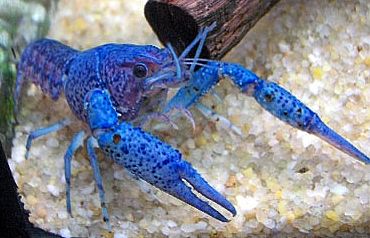
Hammers Cobalt Blue Lobster (Procambarus clarkii)

Hammers Cobalt Blue Lobster (Procambarus clarkii)

Hammers Cobalt Blue Lobster (Procambarus clarkii)

The Hammers Cobalt Blue Lobster (Procambarus clarkii) is one of the more dazzling ornamental crayfish that tropical fish
keeping enthusiasts often keep in their aquariums.

Selective breeding gives this Procambarus Clarkii its brilliant blue color which does not fade (except when stressed) as the “lobster” grows.   In fact, as the Cobalt Blue Lobster grows larger, its light blue color in younger specimens changes to a magnificent brilliant blue color which intensifies as it matures.

Although wild specimens can reach appreciably larger sizes; the selective breeding that produces the brilliant blue coloration also limits the adult size of the specimen.   Hammers Cobalt Blue Lobsters typically reach only about 5 inches in an aquarium environment.

The Hammers Cobalt Blue Lobster is often brown or a light drab blue color if it has been shipped.   This is due to stress incurred during shipping however, in a few days the bright blue color returns as the crustacean regains its composure and takes up residence in the tank.

Since it only attains a length of about 5 inches when fully grown, the Hammers Cobalt Blue Lobster can be housed in an aquarium of at least 20 gallons.  They need a medium to fine sand or gravel substrate for burrowing, and should have plenty of river rock, plants, and driftwood in their tank for cover.

Hammers Cobalt Blue Lobsters are territorial towards their own kind and need plenty of room if more than one is kept in the same tank. A good rule of thumb is to provide each “lobster” with at least 20 gallons of tank space.

These lobsters are omnivorous scavengers and will usually not bother fish unless they are ailing, slow or very small.  Occasionally they will pick on Plecos but for the most part they are fine in a peaceful community tank with mid level swimming fish.

The Hammers Cobalt Blue Lobster is easy to feed. As a scavenger it will eat almost anything that settles on the bottom of the tank. Supplement their diet with a quality sinking pellet, flake food, chopped worms, or algae wafers.

The Hammers Cobalt Blue Lobster can be pricey and is usually available for sale when they reach 2″ to 3″ in length.

Hammers Cobalt Blue Lobster (Procambarus clarkii)

Hammers Cobalt Blue Lobster (Procambarus clarkii)


Minimum Tank Size: 20 gallons
Care Level: Easy
Temperament: Semi-aggressive
Aquarium Hardiness: Hardy
Water Conditions: 68-85° F, KH 3-10, pH 6.5-8.0
Max. Size: 5″
Color Form: Cobalt Blue
Diet: Omnivore
Origin: Farm Raised in the USA
Family: Cambaridae
Livespan: 5 – 6 years
Aquarist Experience Level: Beginner

Posted in Featured Articles, Freshwater Fish, Oddball Fish1 Comment

Pictus Catfish (Pimelodus pictus)

Pictus Catfish (Pimelodus pictus)

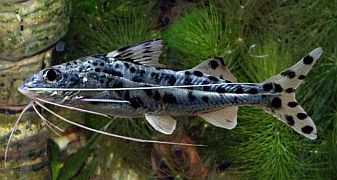
The Pictus Catfish (Pimelodus pictus) is a peaceful South American species that is native to the Amazon and Orinoco river basins. It has a pale to silvery gray body with a black spotted pattern throughout and extremely long barbels.

Pictus Catfish have sharp serrated venomous spines on their dorsal and pectoral fins that always seem to get caught in nets when transferring fish from tank to tank.

Pictus Catfish are nocturnal bottom scavengers and active swimmers. There are two forms known to tropical fish keeping enthusiasts.  The large spotted form, and a small spotted form. The large spotted form does not grow as large as the small spotted form and is the form commonly seen in the aquarium trade.

The Pictus Catfish can be housed with almost any larger soft water species and is one of the more peaceful fish that adds beauty to a community tank.

It should be noted that Pictus Catfish consider small Neon or Cardinal tetras fair game if they can fit them into their mouths.  Care should be always be taken when adding smaller fish into the aquarium.

Pictus Catfish prefer a dimly lit, heavily planted tank with plenty of rocks, caves and driftwood for them to hide in and around.  They need at least a 70 gallon tank to freely swim around in and keep them happy.

Pimelodus Pictus are egg layers but they are extremely difficult to breed in and aquarium environment.

Feeding Pictus Catfish is not difficult.  They eat left over foods that accumulate on the bottom of the tank and will eat a variety of frozen or freeze dried foods.  Sinking catfish pellets, shrimp pellets, small live foods, tubifex, vegetables and chopped hearts are all eagerly accepted.

Although Pictus Catfish grow to 5″ in length, they are usually available for sale when they are 2″ to 3″ long.

Pictus Catfish (Pimelodus pictus)

Pictus Catfish (Pimelodus pictus)


Minimum Tank Size: 70 gallons
Care Level: Easy
Temperament: Peaceful
Aquarium Hardiness: Hardy
Water Conditions: 75-81° F, pH 7.0-7.5
Max. Size: 5″- 8″
Color Form: Black, White
Diet: Omnivore
Origin: South America
Family: Pimelodidae
Live Span: 6 – 8 years
Aquarist Experience Level: Begin

Posted in Catfish, Featured Articles, Freshwater Fish0 Comments

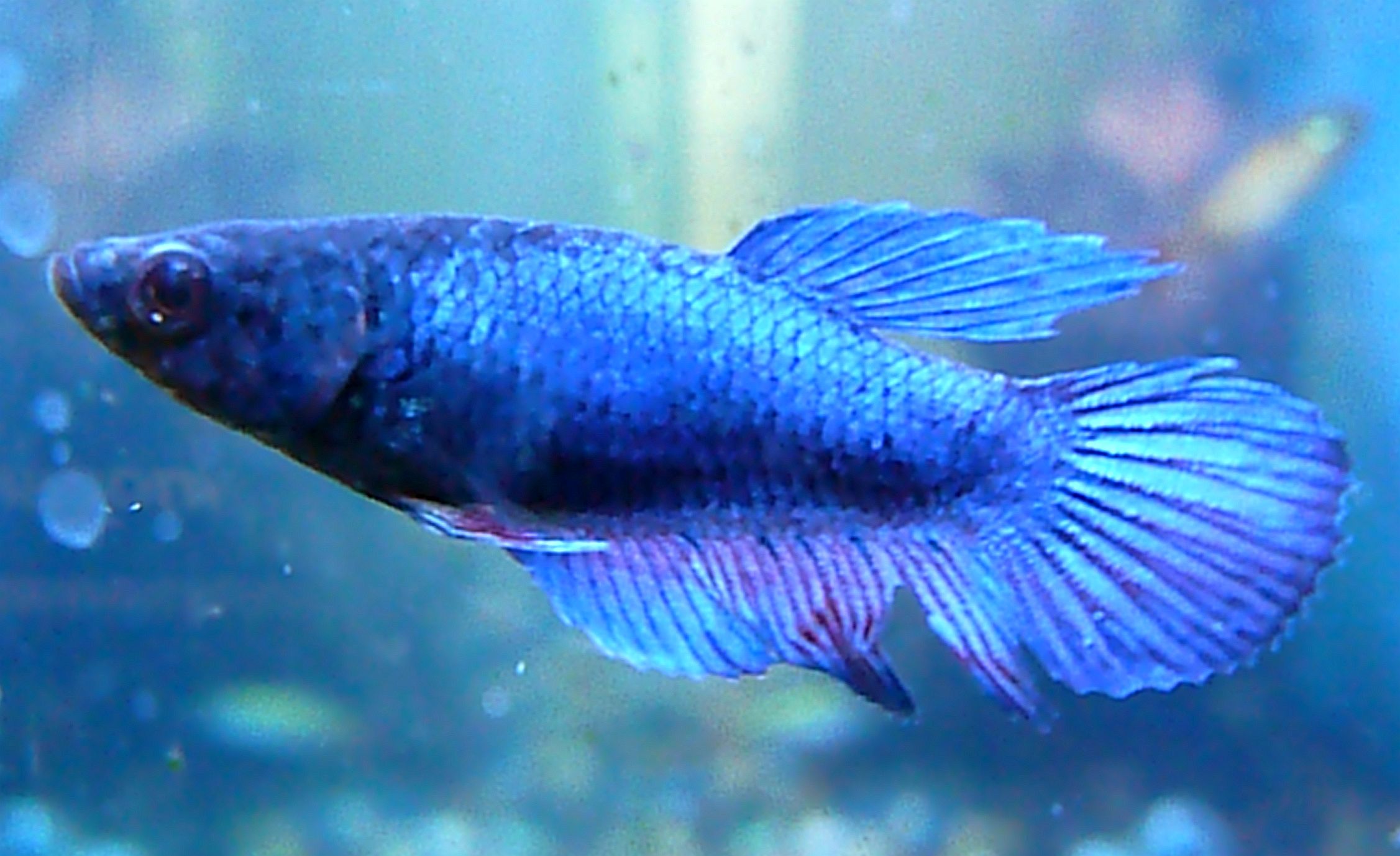
Female Betta (Betta splendens)

Female Betta (Betta splendens)

Crowntail Betta Pair

Crowntail Betta Pair

The Female Betta (Betta splendens) like their male counterpart, is undoubtedly one of our most popular freshwater tropical fish species. Because Betta splendens are easy to care for, they are a favorite of both beginning and advanced tropical fish keeping enthusiasts.

Although Female Bettas are less brightly colored in the various shades and vibrant hues that adorn the males, they resemble the wild Short Fin variety. 

Like the males, female Bettas are hardy little fish and despite their frail looking delicate beauty can live many years when kept in ideal water conditions.

The Betta splendens is often referred to as the “Siamese Fighting Fish” because of the males combative personality towards other males however, the smaller, shorter finned females of the species can usually be housed together with other female Bettas without any serious disputes.

Although Bettas are often sold in small bowls or plastic containers, the ideal environment for keeping them healthy is a well filtered aquarium of at least one gallon that holds a steady temperature of between 75° and 86°F.   Since they prefer to have  a variety of hiding places in their tank, it should be aquascaped with freshwater plants and driftwood, rocks, etc.

Female Bettas are easily bred in the home aquarium. Place the male and female together in a small tank until breeding commences.  The male “blows” a bubble nest on the surface under a floating leaf or plant.  When eggs are laid by the female they are placed inside the bubble nest by the male until they hatch out (usually in 24 hours).  The fry should be fed infusoria until they are able to eat powdered flakes or newly hatched brine shrimp.

Bettas require a carnivore diet of quality flake food, baby brine shrimp, frozen or freeze dried bloodworms, tubifex or mosquito larvae.

Female Bettas are considered ready for sale when they are 1″ or 2″ in length.

Female Betta Splendens

Female Betta Splendens


Minimum Tank Size: 1 gallon
Care Level: Easy
Temperament: Peaceful
Water Conditions: 75-86° F, KH 0-25, pH 6.0-8.0
Max. Size: 3″
Color Form: Assorted, Blue, Red
Diet: Carnivore
Compatibility: Excellent in peaceful community tanks
Origin: Farm Raised – Thailand
Family: Belontiidae
Life Span: 8 Years
Aquarist Experience Level: Beginner

Posted in Bettas, Featured Articles, Freshwater Fish0 Comments

Doubletail Betta

Tropical Fish Keeping Of Bettas (Siamese Fighting Fish)

The tropical fish keeping of Siamese Fighting Fish (Betta splendens) is by far one of the most wide spread activities that newcomers to the fish keeping hobby enjoy.

Beyond Words Bettas

Beyond Words Bettas

The Betta (Betta splendens) is one of the most popular and well known freshwater tropical fish species in the world.  Well over 100 years ago, tropical fish keeping enthusiasts in Thailand and Cambodia began breeding Bettas to emphasize their colors and to enhance other qualities, like their long delicate fins.  Over the years  Bettas have been transformed by breeders from a rather drab fish to their current status as one of the most beautiful fish in the aquarium hobby.

In the wild, Bettas are found in the slow moving rivers, ponds, rice paddies, puddles, and drainage ditches throughout Southeast Asia.   All species of Betta are small fish but they vary considerably in size from under 1 in (total length) in B. chanoides to 5 inches for the Akar betta (B. akarensis).

Because they are all anabantoids, Bettas are capable of living in low oxygen water conditions that would kill most other species of tropical fish.  Bettas have a unique organ called the labyrinth which allows them to breathe atmospheric air and to survive in severe conditions.    It also aids in their breeding activities.

Of the over 73 recognized species of Bettas known throughout the world, many Betta species are common (B. splendens) in the aquarium trade, however, other Bettas such as B. persephone have been listed as “Critically Endangered”.  Several other species are  listed as endangered or threatened, primarily due to the reduction of their natural habitat.

Beginning tropical fish keeping enthusiasts usually find Bettas sold in small bowls or plastic containers in pet shops, department stores, etc.   This is by no means the best way to keep Bettas in an aquarium environment.   They need at least a 1 gallon tank that is well filtered and can be kept at a steady water temperature of between 75° and 86°F.

They do best in a shady well planted tank with plenty of surface cover and a variety of hiding places.  Tropical lilies, tall stem plants, floating plants like Riccia spp., Salvinia and Cryptocoryne spp. are excellent choices for subdued lighting conditions.

Other plants like Microsorum or Taxiphyllum spp. can be attached to driftwood and rocks, caves,  pieces of clay flower pots, etc. should be placed in the tank to provide additional shelter for the fish.

For breeding tanks, many tropical fish keeping enthusiasts add some beech, oak, almond, or other type of dried leaf litter to the tank.  As the leaf litter decomposes, tannins are released and beneficial microbe colonies and microorganisms form to provide a  food source for the fry.

Because Betta Splendens inhabit slow moving waters in their natural habitat, filtration should not be too strong.  An air powered sponge filter is all that is needed.  Bettas are excellent jumpers so you do need to cover their tank.  Leave an air gap for them to occasionally gulp air.

Male Siamese Fighting Fish are highly territorial and aggressive towards males of their own kind as well as other brightly colored tropical s that could be mistaken by them as their own species.  For this reason they are best housed alone or in a large community aquarium of selected species.

Based on their breeding activities,  Bettas are usually divided into two groups; bubble nest builders (like Betta Splendens) and mouth brooders (like Betta Picta).  The mouth brooders are generally found in fast moving stream environments are are believed to have evolved from bubble nest builders that are found in rice paddies and stagnant water.

Wild Bettas are hardy, opportunistic feeders and will eat almost anything in their environment.  This includes mosquito larvae, worms, tubifex, daphnia, small insects, and even small fish.

Although Bettas are NOT recommended for the standard community tank set-up for reasons already touched upon,  they are often successfully kept with tank mates that they cannot intimidate.  Avoid keeping them with fish that have similar shaped or long trailing fins that males can identify as rivals and then only keep one male per tank.  Many aquarists keep a male with several females in a single species tank with great success.

Breeding Betta Splendens

The Betta Splendens is a bubble nesting species and is relatively easy to breed.

Breeding Bettas

Breeding Bettas

Set up a tank with a tight fitting cover and NO GAPS.  The fry will need access to warm humid air in order for their labyrinth organ to develop.

Place the pair in a planted tank with some fine leaved surface vegetation or a broad leafed plant.  The male will construct a bubble nest on the surface, under a leaf or among the surface vegetation.  During nest building, the male will not tolerate the female in its vicinity until it’s completion.

Prior to spawning the body color of the female will pale and bars will appear on her flank.

The male will wrap himself around the female usually directly under the bubble nest and at the point of climax, milt and a few eggs are released.  The female catches the eggs between her pelvic fins and her body.   The male then transfers the eggs to the bubble nest while the female recovers.  The process is repeated until the female no longer expels any eggs which could take quite some time.

The male guards the nest until the eggs hatch, usually in 24 to 48 hours.   The fry remain in the bubble nest until their egg sacs are fully absorbed, usually in 3 to 4 days.  All during this time the male will catch and return any eggs that fall from the nest and if disturbed, the male may move the nest to another location.

When the fry become free swimming, the male will lose interest but unlike other tropical fish, the adults will not usually eat their young.

Feed the fry infusoria for the first few days until they are large enough to accept  micro worms and brine shrimp.  For optimal growth, offer the fry small feedings of different foods 2 -3 times per day.

Betta Splendens have been hybridized and selectively line-bred for the aquarium trade, leading to the development of several color forms that do not occur naturally.

The following lists some of the different tail types and color variations:

Tail Types:

Color Patterns & Variations:

  • Butterfly
  • Marble
  • Koi
  • Grizzle
  • Metallic
  • Copper
  • Dragon
  • Full Mask
  • Melano Black
  • Black Lace
  • Super Black
  • Cambodian
  • Bi Color
  • Red
  • Extended Red
  • Red Loss
  • White
  • Multi
  • Thai Flag
  • Yellow
  • Orange
  • Gold
  • Steel
  • Turquoise
  • Royal Blue
  • Black Orchid
  • Beyond Words
  • Dalmation


Posted in Bettas, Featured Articles, Freshwater Fish, Tropical Fish Keeping1 Comment

Emperor Tetra (Nematobrycon palmeri)

Emperor Tetra (Nematobrycon palmeri)

Emperor Tetra (Nematobrycon palmeri)

Emperor Tetra (Nematobrycon palmeri)

The Emperor Tetra (Nematobrycon palmeri) is a peaceful fish that is native to the Atrato and San Juan river basins in western Colombia.

Most tropical fish keeping enthusiasts find the Emperor Tetra to be a perfect candidate for the community aquarium.

The Emperor Tetra has a long, slim flattened body with sickle shaped dorsal, pectoral, and anal fins. The fish has a silvery body with a black line placed within a purplish blue stripe that runs the entire length of its body. Its fins are translucent yellow.

Males can easily be distinguished from females by their eyes, fins, and black stripe. The males have metallic blue eyes while the female’s eyes are metallic green. The male has a pronounced three pronged tail, with the medial black stripe extending beyond the rest of the tail. In females, the black stripe only reaches the clear part of the tail. Males are usually larger than females and their anal fins are longer. The caudal fin the the male is also more pointed than in females.

Emperor tetras prefer soft water, a pH of 6.5, and a temperature range between 73° and 80° F.  They do not school like Neon and Cardinal tetras, but when in large groups when cool water temperatures are encountered, they will briefly come together in large shoals.  Emperor Tetras are one species that appears to be content when paired together.

In an aquarium, they can be housed with other peaceful soft water to brackish water fish.  They do better with subdued lighting and should have their tanks densely planted in river sand and aquascaped with plenty of rocks and driftwood for them to hide in. Floating water plants will help mimic their natural habitat, provide additional cover and bring out the purple hues of these beautiful fish.

Emperor Tetras will occasionally breed in an aquarium environment. They need a large well planted tank with slightly acidic water and preferably, no other fish. Usually no extra stimulation is needed and a majority of fry will survive in the tank if the parents are well fed, without the necessity of transferring the fry to a breeding tank.

In a densely planted established aquarium the fry will have algae, protozoa, etc. to eat and as they grow, you can provide them with daphnia and crushed dry flake food.

Emperor Tetras are omnivores and will eat brine shrimp, daphnia, freeze dried bloodworms, tubifex, micro pellets and high quality flake foods.

When available for purchase, these intriguing tetras are usually 3/4″ to 1-1/4″ in size.

Emperor Tetra (Nematobrycon palmeri)

Emperor Tetra (Nematobrycon palmeri)


Minimum Tank Size: 10 gallons
Care Level: Moderate
Temperament: Peaceful
Water Conditions: 72-77° F, KH 4-8, pH 6.0-8.0
Max. Size: 1½”
Color Form: Black, Purple, Silver
Diet: Omnivore
Compatibility: Excellent in peaceful community tanks
Origin: Colombia, South America
Family: Characidae
Lifespan: 6 years
Aquarist Experience Level: Experienced

Posted in Featured Articles, Freshwater Fish, Tetras, Tropical Fish Keeping2 Comments

Tropical Fish Keeping – Learn How To Keep A Fish Tank Clean

Learning how to keep a fish tank clean is not difficult, but you need to do it on a regular basis in order to stop algae and other contaminants from building up in your aquarium and to keep your fish healthy and happy.

This article explains what tropical fish keeping enthusiasts need to do to keep a glass freshwater community aquarium clean.

The first thing you will need is a calendar to mark off which day of the month you plan on cleaning your tank, or tanks.  A 30 day cycle is sufficient for most tropical fish but some delicate, hard to keep species require more attention. Set up a “doable” schedule and stick to it.

On the day selected, get your “cleaning supplies” ready. I use this term lightly because there are very few supplies needed. Below is a short list of suggested items:

  • Clean 5 gallon plastic bucket
  • Siphon type gravel cleaner|
  • Magnetic aquarium glass cleaner
  • Replacement mechanical and chemical filter media (for outside filter).
  • Vinegar based glass cleaning solution or Aquarium-safe glass cleaner for the outside glass.
  • Amquel, Nova Aqua, or some other dechlorinator, denitrator, etc.

Clean the front and sides of the aquarium with the Magnetic aquarium glass cleaner.

Run it along the bottom of the glass barely into the substrate, scrubbing as necessary to remove unwanted algae that is clinging to the aquarium. Run the magnet from the outside of the tank from the bottom to the very top in long sweeps. Use the same technique on the sides of the tank. Most tropical fish keeping enthusiasts leave algae on the back of the tank for Plecostomus, Loaches, etc. to graze on.

Use a partially dull razor blade to remove difficult patches of residue from the glass. Some fish keepers use rubber gloves when cleaning the inside of the tank but it is not necessary. Just be sure that no detergents or chemicals get into the tank.

Next, decide how much water you are going to change out from your aquarium.

This depends on what type fish you are keeping and what schedule you are trying to maintain. Some Plecostomus species and Loaches need a weekly 10 to 30% water change to keep them healthy in a specialty tank, and other more hardy species only require a 25% to 50% water change each month.

If your fish are ill and receiving medication, more frequent water changes will obviously be needed.

When removing water from the aquarium you can clean the gravel or sand substrate at the same time.

Start the siphon into a clean 5 gallon plastic bucket and push the gravel vacuum into the gravel, perpendicular to the bottom. Excess food, fish waste, and other nasty debris will be sucked into the vacuum and out to the pickup bucket. When the water in the tube looks clear, lift and move it to the next spot until the entire bottom is cleaned.

Pinch the small plastic tube and lift the wide end from the tank to stop the siphon when your bucket gets almost full.  Re-start the siphon by placing the gravel cleaner into the gravel and sucking on the small tube until the water starts coming over the rim of the tank.

Be careful not to suck up any slow moving or burrowing fish like loaches, eels, etc.

If you have sand substrate, remove the wide end and use the hose part of the siphon to remove debris from the top of the sand. After starting the siphon, hold the tube about an inch from the surface of the sand so as not to disturb the sand. When the surface looks clean, run your fingers or a wide plastic hair comb through the sand to bring up any buried debris that could be trapped under shifting sand. The nasty stuff should float up above the sand where it can easily be siphoned off.

Clean off surface debris and excess algae that builds up on rocks, driftwood, decorations, etc. and make that part of your water change program.

Excess algae is normally caused by too much light and too many nutrients in the water. Routine water changes, a timer on your lighting and algae eating fish will keep everything in balance however, when necessary you can remove excess algae with an algae pad or fresh tooth brush washed with hot water.

Decorations that have too great a buildup of algae can be removed and soaked in a 10% bleach solution for 10 to 15 minutes max. Remove them from the solution, pour scalding water over them and allow them to thoroughly air dry before putting them back into the tank. DO NOT use this procedure on bogwood or driftwood.

Refill your tank to the correct level.

When you have removed the correct amount of water from the tank, replace it with fresh, treated water at the same temperature of the aquarium that it was taken from. Use a good thermometer to keep it as close as possible to the tank’s temperature, avoid the “stick on” type thermometers.

Since most people are probably using tap water to make water changes; take a water sample to your local aquarium shop and have it tested for chlorine, chloramine, heavy metals, nitrates, nitrites, and other toxins that could “do in” your fish. Testing will give you a good idea of how pure the water is coming out of your tap and what you need to do to condition it for your aquarium.

Products like Amquel and NovaAqua will generally do a good job on most trace pollutants.

Some tropical fish keeping enthusiasts use bottled spring water, reverse osmosis units or a bank of chemical filters to further purify tap water before using it in their aquariums.  Test each brand of bottled spring water before using it.  They are not all equal!

Next, clean the exterior of the aquarium.

Wipe down the outside of the tank, the glass top, hood, lights, and outside of the filters with water taken from the tank or if needed, a mile solution of white vinegar and tank water.

Lastly, change out the filter cartridge about once a month.

The carbon inside the filter cartridge insert loses efficiency and can become detrimental to fish.

If you have an under gravel filter in your aquarium, changing both filter cartridges at the same time is not a problem; however, if you are using sand as a substrate, change out only one filter cartridge during each water change and rotate them.

If your tank has been kept clean and is “in balance” the filter cartridges can be rinsed off weekly using tank water and replaced when they become excessively dirty. Using tank water preserves the beneficial bacteria growing on the filter cartridges.

Learning how to keep a fish tank clean is easy, uncomplicated, and becomes easier still when done on a regular schedule.

Posted in Featured Articles, Setting Up Your First Aquarium, Tropical Fish Keeping0 Comments

Tiger Botia Loach - Syncrossus hymenophysa (ex Botia hymenophysa)

Tiger Botia Loach – Syncrossus hymenophysa (ex Botia hymenophysa)

Tiger Botia Loach - Syncrossus hymenophysa (ex Botia hymenophysa)

Tiger Botia Loach – Syncrossus hymenophysa (ex Botia hymenophysa)

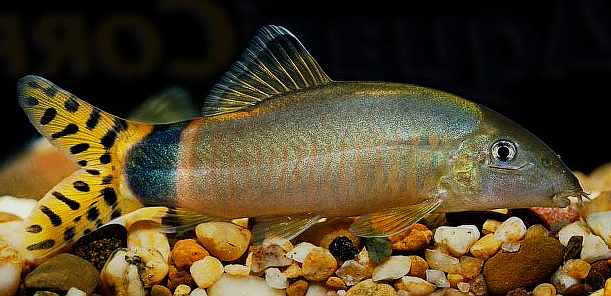
The Tiger Botia Loach (Syncrossus hymenophysa) is also commonly called the Green Tiger Loach, Banded Loach, Green Tiger Botia, Tiger Botia or Zebra Loach and is highly prized by tropical fish keeping enthusiasts for their beauty, rarity, and scavenging ability.

The Tiger Botia Loach is found in the Musi River basin, South Sumatra province, Sumatra, Indonesia, the Malaysian state of Sarawak, and the Indonesian province West Kalimantan, on Borneo. It has also been reported in the Pahang and Perak river system in Malaysia and in Java.

It has an elongated body with a conical pointed head.  Its mouth faces downward and like other Botias has three pairs of barbels protruding from its mouth area.  It has a forked erectile spine below its eye that is about as long as the diameter of the eye. The upper part of its body is brownish or yellowish brown, and the underparts are pale yellow. Its grayish yellow or gray-green flank is marked with 11 or more dark brown to black transverse bars (stripes), which are positioned slightly obliquely and give the fish its “Tiger” appearance. The bars are separated by narrow pale areas that do not reach the belly. Its fins are yellowish or greenish, and there are thin dark bands on its dorsal and caudal fins.

The Tiger Botia Loach grows quite large (10″ in length), is semi aggressive, but enjoys the company of others of its own size, age, and species.  It is a shoaling fish that should be kept in groups of 5 or more in a tank of at least 55 gallon capacity.

Tiger Botia Loaches are active carnivorous scavengers but they are shy and need caves, holes, bogwood roots and other places to hide, especially when sleeping.  They are active burrowers and need a sand or very fine gravel substrate in their aquarium which should be densely planted (with potted plants) and heavily aquascaped with smooth river rock and driftwood.

In their natural habitat, Tiger Loaches are found in small, upland, headwater streams to main river channels and lakes.  They are tolerant of water parameters but require soft clean water with a moderate current.  A 25-30% monthly water change should be considered routine maintenance for this species.

In addition to being natural predators of snails, Tiger Botia Loaches will voraciously eat insect larvae, small or chopped worms, frozen or freeze dried bloodworms, tubifex, brine shrimp, ghost shrimp and flake or carnivore pellets.  They are grazers and should be fed small portions several times a day.

The breeding habits of this species is still not known, and successful captive breeding have not been recorded.

Tiger Botias are usually  1-3/4″ to 2-1/2″ long when offered for sale.
Tiger Botia Loach - Syncrossus hymenophysa (ex Botia hymenophysa)

Tiger Botia Loach – Syncrossus hymenophysa (ex Botia hymenophysa)


Minimum Tank Size: 55 gallons
Care Level: Moderate
Temperament: Semi-aggressive
Aquarium Hardiness: Hardy
Water Conditions: 72-86° F, KH 8-12, pH 6.0-7.0, dH: <12 degrees.
Max Size: 10″
Color Form: Black, Green, Tan, White
Diet: Omnivore
Compatibility: Not suitable for peaceful community tanks
Origin: Asia
Family: Cobitidae
Life Span: 7 Years
Aquarist Experience Level: Intermediate

Posted in Featured Articles, Freshwater Fish, Loaches, Tropical Fish Keeping1 Comment

Jaguar loach (Yasuhikotakia splendida)

Jaguar Loach (Yasuhikotakia splendida)

Jaguar loach (Yasuhikotakia splendida)

Jaguar loach (Yasuhikotakia splendida)

The Jaguar Loach (Yasuhikotakia splendida) comes from a handful of localities in the Xe Pian river, a tributary system of the Xe Khong ,which itself drains into the Mekong river main channel, in the Champasak and Attapeu provinces of southern Laos.

The Jaguar Loach (Yasuhikotakia splendida) is more commonly referred to as the Yellow Tail Polka Dot Loach.

It has a large dark band that goes completely around its caudal peduncle that is outlined anteriorly and posteriorly by complete narrower pale rings.  Its dorsal, anal and caudal fins are pale to bright yellow with distinctive round, oval or oblong dark spots on the caudal fin.  It has a submarginal dark stripe on its dorsal and anal fins.  The dorsal fin of the Jaguar Loach has eight branched rays and there are 14-19 narrow irregular bars on its  side.
The Jaguar Loach is a shoaling species that does best in groups of at least 6 or more fish.  They are an inquisitive, semi aggressive species that does best with their own kind and are probably not the best choice for a community tank.
Jaguar Loaches need at least a 55 gallon densely planted tank, aquascaped with a sand or fine gravel substrate, lots of smooth water worn rounded rocks, caves, and enough bogwood roots and branches to create several hiding places for the fish.

Like many other loaches they need highly filtered, well oxygenated water with a moderate current in the tank to mimic their natural environment.  A power head or two with a venturi will handle this requirement.  They are extremely intolerant to accumulations of organic waste and require spotless water conditions in order to thrive in an aquarium environment.  Weekly 30-50% tank volume water changes should be considered routine maintenance.

Lighting for Jaguar Loaches should be relatively subdued, and plants like Microsorum, Taxiphyllum or Anubias spp. that can be can be attached to pieces of driftwood or other décor in the tank to provide shade are good choices.

Since Jaguar Loaches are also avid diggers, they should be provided with a deep enough substrate to facilitate their activities.

The Jaguar Loach will eat sinking pellets, granules or wafers, live or frozen foods such as mosquito larvae, brine shrimp, Mysis shrimp and chopped prawns.

There have been no confirmed reports of Jaguar Loaches being been bred in captivity.

Jaguar loach (Yasuhikotakia splendida)

Jaguar loach (Yasuhikotakia splendida)


Minimum Tank Size: 55 gallon
Care Level: Moderate
Temperament: Semi aggressive
Aquarium Hardiness: Hardy
Water Conditions: 79-84°F, KH 8-18, pH 6.8-7.2
Max Size: 4″
Color Form: Tan, Yellow
Diet: Omnivore
Compatibility: Keep with other of same species
Origin: Southern Laos
Family: Cobitidae
Life Span:  8 – 15 years
Aquarist Experience Level: Intermediate

Posted in Featured Articles, Freshwater Fish, Loaches, Tropical Fish Keeping1 Comment

Zebra Botia Loach (Botia striata) a.k.a. Candystripe Loach

Zebra Botia Loach (Botia striata) a.k.a. Candystripe Loach

Zebra Botia Loach (Botia striata) a.k.a. Candystripe Loach

Zebra Botia Loach (Botia striata) a.k.a. Candystripe Loach

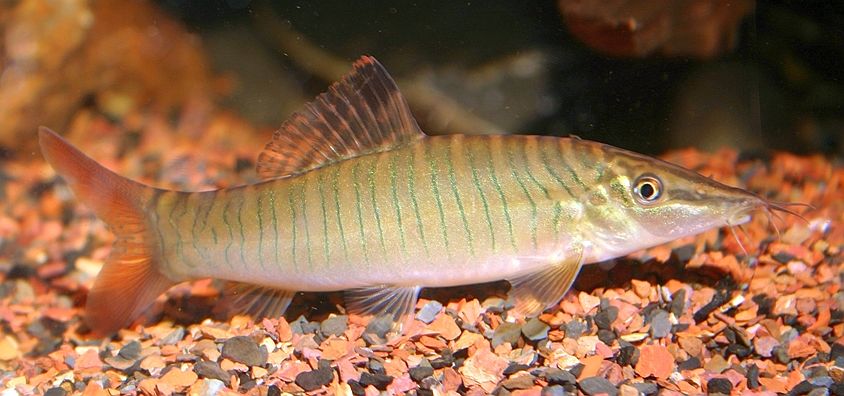
The Zebra Botia Loach (Botia striata) is also called the Zebra Loach, Tiger Loach, Lined Loach, or Candystripe Loach. It is a peaceful shoaling species that is found in the clear mountain streams of Maharashtra and Western Ghats, India. The Zebra Botia Loach is similar to Botia rostrata, the “Seargent Major Loach” in appearance.

The Zebra Loach has its entire body and fins barred with alternating tan and dark brown, to near black stripes. This gives the fish a unique appearance which is prized by tropical fish keeping enthusiasts. Like other loaches it has four pairs of barbels protruding from its mouth. Females can be distinguished by their rounder abdomens.

Botia Rostrata "Seargent Major Loach"

Botia Rostrata “Seargent Major Loach”

Although the Zebra Botia Loach is sometimes thought to be a scaleless fish, they do posess very small scales.

Zebra Loaches are active, peaceful, semi aggressive shoaling scavengers that enjoy the company of their own species. Like other loaches that originate from tropical streams, they like to school with others of their own age, size and species. They should be kept in small shoals of 6 or more fish a community aquarium.

Zebra Loaches need a fine sandy substrate in their tank which should be densely planted and aquascaped with plenty of smooth rock caves, holes, bogwood (or driftwood) and other hiding places.

Their aquarium should be provided with soft, well filtered, slightly acidic, highly oxygenated water, and a moderate current to mimic their natural environment.

Zebra Botia Loaches should be fed small portions of food several times during the day. They will accept most brands of sinking catfish pellets and flake foods but they should also be given a variety of frozen and freeze dried foods to supplement their diets.

Brine shrimp, daphnia, mosquito larvae, bloodworms and some fresh vegetable matter like a slice of cucumber will keep them healthy and active. Zebra Loaches will quickly rid your aquarium of unwanted snails that creep into your tank.

The breeding habits of this species are not known and although there have been several accounts of females becoming gravid in home aquaria, no proven accounts of spawning have been documented and successful captive breeding has yet to be recorded.

Because of their small size, unique markings and peaceful disposition; Zebra Botia Loaches or Candystripe Loaches make a perfect choice for most community tank settings.

When available for purchase, Zebra Loaches are usually 1-3/4″ to 2-1/2″ in length.

Zebra Botia Loach (Botia striata) a.k.a. Candystripe Loach

Zebra Botia Loach (Botia striata) a.k.a. Candystripe Loach


Minimum Tank Size: 30 gallons
Care Level: Moderate
Temperament: Peaceful, Semi aggressive
Aquarium Hardiness: Hardy
Water Conditions: 72-86° F, KH 8-12, pH 6.0-7.0
Maximum size: 4 inches
Color Form: Tan
Diet: Omnivore
Compatibility: Excellent community tank fish
Origin: India, Indonesia
Family: Cobitidae
Life span: 8 – 15 years
Aquarist Experience Level: Intermediate

Posted in Featured Articles, Freshwater Fish, Loaches, Tropical Fish Keeping, Tropical Fish Species1 Comment

Saltwater Fish

Featuring Clownfish

Aquarium Supplies

On-Sale Aquarium Supplies!

Saltwater Specials

Categories