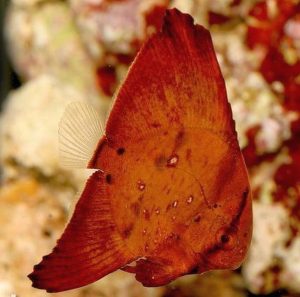
Juvenile Orbic Batfish (Platax orbicularis)
The Orbic Batfish (Platax orbicularis) known to tropical fish keeping enthusiasts as the Cooper Batfish, Circular Batfish, Orbiculate Batfish, Round Batfish, Leaf Baffish or Narrow-banded Batfish are native to the Indo-Pacific.
Orbic Batfish range in eastern Africa from South Africa, Madagascar, the Mascarenes and Seychelles, north into the Red Sea; east through the Persian Gulf and on into Micronesia as far as the Tuamotu Archipelago; north to southern Japan and south to northern Australia wgere they are found at the Ashmore Reef in the Timor Sea as well as at Christmas Island and Cocos (Keeling) Islands in the eastern Indian Ocean.
On the Australian mainland, they occur from Shark Bay in Western Australia, around the northern tropical coast and south on the east coast, almost to Sydney.
Orbicular batfish have also been recorded in the Western Atlantic off southern Florida where they were most likely introduced as deliberate releases by tropical fish keeping enthusiasts unable to house them as adults.
Orbic Batfish are usually encountered as single individuals or in small groups in the shallow, protected coastal waters and lagoons of their range, particularly around mangroves, coral reefs, and deeper areas with silt substrates at depths to 100 feet.
During the daylight hours, juvenile reddish brown Orbic Batfish shelter among the mangroves in the shallowest waters of protected lagoons amongst flotsam at depths to 16 feet, where they mimic dead mangrove leaves and Sargassum seaweed floating in the water column.
Heavy populations are generally found among the shallow mangrove roots, brackish estuaries, seagrass beds and inner sheltered lagoons grazing on microalgae and epiphytes off the seagrass blades and mangrove roots. At night they become more active and hunt small bentic invertebrates, detrital biofilms, and planktonic food particles drifting through the mangrove channels.
Adult Orbic Batfish are most commonly found in coastal lagoons, deep sandy reef channels and seaward outer reef drop offs grazing on marine algae, dense reef seaweeds, benthic invertebrates, gelatinous zooplankton and small fishes in midwater depths between 15 to over 100 feet. Scuba divers often find them congregating at mid water depths above deep shipwrecks where they habitually follow green sea turtles to consume their feces.
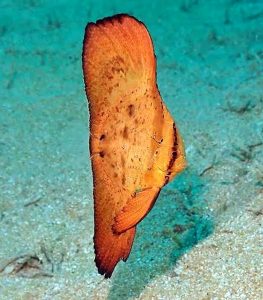
Juvenile Orbic Batfish (Platax orbicularis)
Juvenile Orbiculate Batfish have a uniform reddish-brown, tan, or deep copper colored body that is often mottled with tiny black dots or faint, dark vertical bands.
They have an incredibly thin, elongated and highly symmetriccal body with massive, jagged or uneven fins that when floating sideways, mimics a dead mangrove leaf or clump of floating Sargassum seaweed.
As juveniles reach 4 – 5 inches in length, their leaf color fades into a uniform, shiny
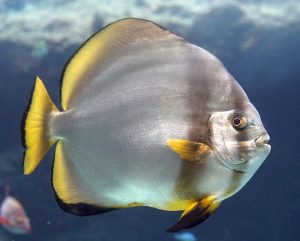
Orbic Batfish (Platax orbicularis)
silver grey color with a couple of faint, dark vertical bars that run down the face and body. Their long crescent fins broaden, thicken, and shorten significantly giving the body a round, disk like appearance.
Juvenile Orbic Batfish grow quickly into adulthood. A 2 inch juvenile can transition into a 10 inch sub adult in under a year.
Juvenile Orbic Batfish should be housed in a high, mature FOWLR aquarium of at least 100 gallon capacity with a coralline sandy gravel substrate and good amounts of smooth branch live rock or faux mangrove roots arranged vertically to extend to the water’s surface. Leave the top third of the water column open so they can safely float sideways at the surface to perform their natural leaf-mimicry behavior. They require diffused lighting, gentle very low water flow, pristine water quality and stable water parameters to thrive.
Adult Orbic Batfish require an extremely tall and wide mature FOWLR tank of at least 400 gallon capacity with a fine sand or coralline gravel substrate that is sparsely laid out with low, heavy piles of live rock. They require strong, high volume water flow to mimic the outer reef drop offs, an unobstructed upper and middle water column for cruising, an industrial size protein skimmer to handle the bio load, and bright high output open lighting.
An 8 foot long by 3 foot wide tank is the bare minimum size for this species. Pristine water qulity and stable reef like water conditions are mandatory.
The Orbiculate Batfish is NOT reef safe and will aggressively consume soft and stony coral polyps, anemones, and smaller invertebrates like ornamental shrimp, crabs, and marine worms.
Juvenile Platax orbicularis can be housed with peaceful, passive, slow moving fish like Flametail Blennies, True Canary Blennies (Meiacanthus oualanensis), Rhino Blennies, Starry Blennies, and Banggai or Pajama Cardinal fish. Avoid all tangs, large wrasses, dottybacks, aggressive angelfish, and hyper active damselfish.
Adulat Platax orbicularis can be housed with Naso Tang (Naso lituratus) or Sailfin Tang (Zebrasoma veliferum), Foxfaces, Rabbitfish, Harlequin Sweetlips, and large Emperor Angelfish or Blueface Angels. Avoid all small reef fish like Okinawa Chromis, small gobies, dartfish, or clownfish that will be considered live prey and swallowed whole.
Unlike the highly territorial Pinnatus Batfish (Platax pinnatus), adult Orbicular Batfish are incredibly social and in the wild form large traveling schools. The best tankmate for juvenile or adult Orbicular Batfish is another juvenile or adult Orbicular Batfish.
Three or more juveniles can be successfully added to a 500 – 600 gallon mega tank if you introduce them all simultaneously as juveniles.
It is impossible to breed the Orbicular Batfish in a home aquarium. Adults are impossible to sex and because they are open-water broadcast spawners that in the wild gather in deep open areas to spawn, no home aquarium would be able to accomodate them.
In the wild, Orbic Batfish are pelagic broadcast spawners that at nightfall, typically during a full moon gather in deep open water where females release anywhere from 75,000 to 150,000 buoyant eggs into the water column to drift as plankton with the currents. The eggs hatch into microscopic 3.7 mm larvae within 24 hours, and for the next 18 days metamorphosis into tiny juveniles.
In a home aquarium, the eggs would immediately be sucked up by mechanical filters, destroyed by wavemakers, or skimmed out by protein skimmers.
In their natural habitat, Platax orbicularis are opportunistic omnivores that scrape plant matter and animal protein from their reef environments. They generally feed on large zooplankton, jellyfish, and comb jellies drifting in the ocean; benthic invertebrates like marine worms, small crabs, shrimp, mollusks as well as marine algae and seaweeds scraped from rocky overhangs.
Juveniles exhibit a highly specialized diel feeding cycle that matches their “dead leaf” camouflage behavior. During daylight hours they scrape microalgae, algal biofilms, and tiny epibenthic organisms off floating logs, debris, and submerged roots as they mimic drifting leaves.
During the night time, they are aggressive planktivors that actively hunt free swimming zooplankton, copepods, small invertebrates and plankton moving through the water column.
Adult Orbic Batfish are heavy herbivores that consume massive amounts of dense reef seaweeds, benthic invertebrates, mollusks, gelatinous zooplankton like jellyfish, comb jellies and tunicates, small fish, and turtle feces that contains partially digested, nutrient rich plant matter.
In an aquarium environment, they should be provided with a balanced 60% meaty protein to 40% vegetable matter omnivorous diet fed in small amounts 3 times a day.
Whole or chopped frozen animal foods like Mysis shrimp, chopped raw table shrimp, diced scallops, fresh clams, minced squid, dried marine Nori, Seaweed Extreme pellets, spirulina enriched brine shrimp, and frozen commercial herbivore preparations will ensure proper nutrition and health.,
Spirulina-enriched brine shrimp, frozen herbivore paste preparations, and sheets of dried marine seaweed (Nori) secured to the glass with a clip for continuous picking will provide crucial plant matter for their digestive tracts. Juveniles often need coaxing with targeted feedings of live saltwater glass shrimp, ghost shrimp or adult mysid shrimp to spark an instant striking reflex until acclimated.
The Orbic Batfish (Platax orbicularis) is occasionally available to tropical fish keeping enthusiasts as wild caught specimens at reasonable prices from a variety of aquarium shops and online retailers, wholesalers, and transhippers however, retail availability for this species is extremely scarce.
The prices for these fish depends on their juvenile development, stage, and size. The current price of Orbic Batfish (Platax orbicularis) ranges from $39.99 to over $199.95.
Small (up to 2.5″) $54.99 – $79.99; Medium (3″ to 4″)$69.99; Large (5″ to 7″) $199.95.
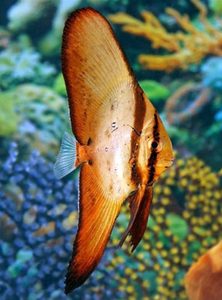
Juvenile Orbic Batfish (Platax orbicularis)
Minimum Tank Size: 100-600+ gallons
Care Level: Difficult / Expert
Temperament: Peaceful
Aquarium Hardiness: Hardy
Water Conditions: 72-78° F, dKH 8 – 12°, pH 8.1-8.4, sg 1.020-1.025
Max size: 24”
Color Form: Reddish Brown, Black, Silver Gray, White
Diet: Omnivore
Compatibility: Not Reef Safe
Origin: Indo Pacific
Family: Ephippidae
Lifespan: 12 – 15+ years (adults)
Aquarist Experience Level: Expert