Author Archives | Fishkeeper

Clown Knifefish (C. ornata)

Clown Knifefish (C. ornata)

Clown Knifefish (C. ornata)

Clown Knifefish (C. ornata)

The Clown Knifefish (C. ornata) is a South East Asian species that is also referred to as the Clown Featherback, Spotted Knifefish, and Spotted Featherback by tropical fish keeping enthusiasts.   Its close Indian relative the Chitala chitala is also called the Clown Knifefish, Royal Clown Knifefish, Royal Spotted Knifefish, or Spotted Featherback, and is less common than C. ornata.

Clown Knifefish are found in swamps, lakes, and the moving backwaters of medium to large rivers in Thailand, Laos, Cambodia, and Vietnam.

They live close to shore and are commonly found around overhanging vegetation and docks. Juvenile fish often school among the submerged roots and aquatic plants of their range while the adults, like those of many species, are normally loaners.

Like the lybrinth fishes, the Clown Knifefish can survive in the warm stagnant waters of their range by breathing oxygen. They are a shy, highly predatorial, nocturnal species that is highly aggressive toward other fish especially as they mature.

The coloring and behavior of C. ornata and C. chitala are identical, but the Indian species grows a bit larger and reaches a length of 4 feet.

Both species have an elongated body shape with an arched back, a small dorsal fin, and a continuous single fin, that is formed by the joining of the caudal and anal fins, that runs along the underside of the body.  The continuous fin allows the fish to move forward or backward with ease.

Their overall body coloring is silvery gray with variable patterns of large spots above the base of the anal fin.  No two patterns are the same.  Some fish have a double row of smaller spots and others may have no spots at all.  Albinos forms of both species are rare but known.

Even in a home aquarium, the Clown Knifefish will grow to a length of over 3 feet. Although they spend most of their lives in the middle or bottom of the water column, they will occasionally swim to the surface to take a gulp of air or to feed.

They can be housed a 55 gallon tank until they reach around 10″ in size, but if you plan on keeping them for the long term, you need a tank of at least 200 gallons or more.   A high quality filter and a couple of power heads are also needed to provide some current and a UV sterilizer should be included in the system to kill bacteria and keep down disease.   Because these fish are scaleless and very sensitive to water condition changes, a high quality filter is a must, as are weekly water changes of 30 – 50%.

Clown Knifefish are nocturnal and are easily stressed.  You can minimize problems with these fish by setting up a tank that mimics the slow moving lakes and rivers that they live in in the wild. Clown Knifefish appreciate a densely planted tank that has a sandy or fine gravel substrate, driftwood roots and rocks in the form of caves for them to hide in during the day, and plenty of swimming space with a few floating plants in the tank.  In short, if you provide them with well filtered water, a dimly lit tank and plenty of hiding places, you should have a happy Clown Knife.

Unfortunately, many tropical fish keeping enthusiasts purchase juvenile Clown Knifefish when they are offered for sale at only 3″ to 6″ in length. At this stage they are delicate, suseptable to stress and disease, and wind up being housed in unsuitable conditions. Most will die, but those that survive are usually hardy and long lived (up to 15 years).

Remember that the cute little 3 inch fish you bought can grow to over 3 feet long, however in an aquarium 10″ to 20″ inches is usually the maximum size.  If you plan on keeping one until “death do you part”; be prepared to setup a 200 gallon tank.

Clown Knifefish are highly predatory piscivores and in the wild they mostly eat fish. In an aquarium they prefer eating fresh small fish, ghost shrimp or worms, but they can be conditioned to start eating sinking carnivore pellets or some other prepared food. Do not plan on keeping them in a community tank unless the tank mates are much larger. These fish will eat anything they can get into their wide mouths.
When shopping for a Clown Knife, avoid fish that are under 3 inches long or over 6 inches.   The small ones are relatively delicate and the larger ones can be harder to get feeding.

Breeding Clown Knifefish is possible but probably won’t happen unless you have the pair in a 500 gallon or larger tank.  The pair will usually lay their eggs on floating plants where the male will guard them for 6 or 7 days until they hatch out. Fry should be removed from the tank and fed baby brine shrimp until they become large enough to eat other foods.

Clown Knifefish are common and offered for sale in tropical fish shops at a size of 3″ to 6″ in length.

Clown Knifefish (C. ornata)

Clown Knifefish (C. ornata)


Minimum Tank Size: 75 – 200 gallons
Care Level: Moderate
Temperament: Semi Aggressive
Aquarium Hardiness: Hardy as adults
Water Conditions: 75 – 82° F, 2 – 10 dGH, pH 5.5-7.0
Max. Size: 3′ 6″
Color: Silver, Bronze
Tank Compatability: Mid level swimmer, aggressive to smaller fish
Diet: Carnivore
Origin: Southeast Asia
Family: Apteronotidae
Lifespan: Up to 15 years
Aquarist Experience Level: Advanced

Posted in Featured Articles, Freshwater Fish, Knife Fish, Oddball Fish, Tropical Fish Species2 Comments

Loricaria Catfish (Loricaria sp.) .

Loricaria Catfish (Loricaria sp.)

Loricaria Catfish (Loricaria sp.)

Loricaria Catfish (Loricaria sp.)

Loricaria Catfish (Loricaria sp.) are a South American Whiptail catfish that is found in the upper Rio Negro and from the lower rio Branco downstream to the mouth of the rio Negro, including the lower rio Jauaperi in Brazil.

The Loricaria Cat has a slender body with a camouflage color pattern that covers the entire fish. It is a small species that has unique patterns of abdominal plate development and conspicuous crests on the dorsal surfaces of the head.

Loricaria Catfish (Loricaria sp.)

Loricaria Catfish (Loricaria sp.)

Loricaria spinulifera is a relatively new species that inhabits the deep river channels of South American rivers and is often misidentified as Loricaria pumila, or Loricaria lundbergi.   Loricaria pumila is the smallest known Loricaria that reaches sexual maturity at 3 1/4″ but all three species display a reduction in eye size and pigmentation.

Loricaria Catfish should be housed in a densely planted 30 gallon or larger tank, with a sand or extremely fine gravel substrate, that is highly aerated and heavily filtered. Some smooth river rock and pieces of driftwood, or bogwood roots can be used to aquascape the tank and give them plenty of hiding places.

Loricaria spinulifera breed by laying their eggs on rocks or plants on the bottom.  Although breeding in the aquarium has been accomplished, it is not a common occurrence.

A densely planted tank with good amounts of algae will sustain the Loricaria however, if no algae are is present, supplement their diet with a quality vegetable based flake food and algae wafers. In nature these fish also eat insect larvae, so an occasional offering of bloodworms or tubifex can be made.

Many Loricaria species are sold by tropical fish shops under the generic name Whiptail Cats when they are approximately 4″ to 6″ in size however, there are currently 17 recognized species in this genus that are listed below.

Loricaria apeltogaster Boulenger, 1895
Loricaria birindellii M. R. Thomas & Sabaj Pérez, 2010
Loricaria cataphracta Linnaeus, 1758
Loricaria clavipinna Fowler, 1940
Loricaria coximensis M. S. Rodriguez, Cavallaro & M. R. Thomas, 2012
Loricaria holmbergi M. S. Rodriguez & Miquelarena, 2005
Loricaria lata C. H. Eigenmann & R. S. Eigenmann, 1889
Loricaria lentiginosa Isbrücker, 1979
Loricaria luciae M. R. Thomas, M. S. Rodriguez, Cavallaro, Froehlich & R. M. C. Castro, 2013
Loricaria lundbergi M. R. Thomas & Rapp Py-Daniel, 2008
Loricaria nickeriensis Isbrücker, 1979
Loricaria parnahybae Steindachner, 1907
Loricaria piracicabae R. Ihering (pt), 1907
Loricaria pumila M. R. Thomas & Rapp Py-Daniel, 2008
Loricaria simillima Regan, 1904
Loricaria spinulifera M. R. Thomas & Rapp Py-Daniel, 2008
Loricaria tucumanensis Isbrücker, 1979

Loricaria Catfish (Loricaria sp.)

Loricaria Catfish (Loricaria sp.)


Minimum Tank Size: 30 gallons
Care Level: Easy
Temperament: Peaceful
Water Conditions: 70-75° F, KH 8-10, pH 6.8-7.4
Color Form: Green, Tan, Yellow
Diet: Omnivore
Origin: South America
Family: Loricariidae

Posted in Featured Articles, Freshwater Fish, Tropical Fish Keeping, Whiptail Catfish0 Comments

Loricaria Catfish (Loricaria sp.) Rio Atabapo

Crying Whiptail (Loricaria sp. `RIO ATABAPO`)

Male Loricaria Catfish (Loricaria sp.) Rio Atabapo

Male Loricaria Catfish (Loricaria sp.) Rio Atabapo

The Crying Whiptail (Loricaria sp. `RIO ATABAPO`) is also known by tropical fish keeping enthusiasts as Loricaria Columbia or Colombian Loricaria (Loricaria sp. `Colombia`).

The “Crying Whiptail” name is derived from the two black stripes that run on top of the head and through the eye of the fish that resemble large tears.

Crying Whiptails are similar to Rineloricaria spp. but but are differentiated by their more feathered sucker mouths.  This is more evident in adult specimens.   The sucker lips of the male Crying Whiptail is always larger than those of the females.

The species is easily identified by the two distinctive parallel black lines that start at the snout and end just before the dorsal fin. They have a black blotch on the dorsal fin that sometimes takes up the entire dorsal fin and runs down into the body.   Two additional broad black lines are noted on the caudal penduncle with a single broad line in the middle of their caudal fin.   Well conditioned adult fish usually display a filament on top of their their caudal fin.

The Crying Whiptail was initially discovered in an unnamed river north of the town of Villavicencio, southeast of Bogota, Colombia however;  the species has since earned its nickname (Loricaria sp. `RIO ATABAPO`) which suggests that it was found further east in the Rio Atabapo, Venezuela.   This particular species is collected in a river that is only 5m to 30m wide, with rocks and a few sandy zones.

Crying Whiptails are peaceful bottom dwellers that in their natural habitat, dig themselves into the sandy substrate of the river bottom.  They are very peaceful fish, easy to keep, and should not be housed with any aggressive species that could outcompete them for food.

In an aquarium environment, they require a long (4′ or wider) sparsely planted tank, with plenty of open fine sandy areas on the bottom for them to bury themselves.   The tank should be aquascaped with a few river rocks and a piece of bogwood or two to mimic the river conditions they are found in.

Crying Whiptails are mouth brooders which is why the lips of the males are larger than the females.   The males care for their eggs by keeping them underneath their head, torso, and in their mouths.  Females will usually deposit 60 – 100 eggs per spawning and the male will hold the entire clutch of eggs in their mouths at one time.

The young will hatch out after 16 days.   Raising the fry is not a problem with this species.   They will eat tablets and brine shrimp as soon as their yolk sacs are absorbed.

Crying Whiptails are easy to feed and will eagerly accept commercially prepared tablets, bloodworms, brine shrimp or other meaty frozen foods.   Vegetables and algae are not on their diet.

When available for sale, Crying Whiptails are usually 3″ to 4″ in size.

Loricaria Catfish (Loricaria sp.) Rio Atabapo

Loricaria Catfish (Loricaria sp.) Rio Atabapo


Minimum Tank Size: 30 gallons
Care Level: Easy
Temperament: Peaceful
Aquarium Hardiness: Hardy
Water Conditions: 74-83° F, 6° KH, pH 6.4 – 7.6
Max. Size: 7 – 8″
Color Form: Brown, Black
Diet: Carnivore
Compatibility: Excellent in peaceful community tanks
Origin: Orinoco River, Atabapo Colombia
Family: Loricariidae ycipitidae
Life Span 8-12 years
Aquarist Experience Level: Beginner

Posted in Featured Articles, Freshwater Fish, Whiptail Catfish0 Comments

Green Spotted Puffer (Tetraodon nigroviridis)

Green Spotted Puffer (Tetraodon nigroviridis)

Green Spotted Puffer (Tetraodon nigroviridis)

Green Spotted Puffer (Tetraodon nigroviridis)

The Green Spotted Puffer (Tetraodon nigroviridis) is also known as the Spotted Green Puffer or Leopard Puffer by tropical fish keeping enthusiasts.

It is found in the freshwater rivers, lakes, streams and flooded areas of India, Sri Lanka, Myanmar, Thailand, Cambodia, Vietnam, Malaysia, Indonesia and the Philippines as well as the brackish waters of these coastal areas.

The Green Spotted Puffer has a beautiful rich green coloration on top with dark spots and a whitish belly.   It has cute a pug like face with slightly bulging eyes and a small mouth that gives it a curious expression.   Although they are curious, playful, extremely active and when housed alone will come to recognize its owner, they are territorial and aggressive toward their tank mates.

Green Spotted Puffers (Tetraodon nigroviridis) are often confused with its close relatives the Green Puffer or Ceylon Puffer (Tetraodon fluviatilis), and the Freshwater Spotted Puffer (Tetraodon schoutedeni).

All three are spotted with very similar coloration, but the Green Spotted Puffer is more rounded and ball shaped, while the Green Puffer (T. fluviatilis) is more elongated.   These two puffers are relatively common in tropical fish keeping however, the Freshwater Spotted Puffer (T. schoutedeni) is rare and has not been available for years.

The Green Spotted Puffer is often sold as a beginners fish and is frequently housed in community tanks with disastrous results. Like all puffer fish, the Green Spotted Puffer is aggressive and at a minimum, a fin nipper.   They can be housed in a community tank with other active species such as Arius catfish, Scats, Monos, mollies or archerfish, but placing them with slow moving or long finned species is a recipe for trouble.

Green Spotted Puffers can successfully be kept in groups of 4 to 5 fish in larger aquariums if there are plenty of hiding places provided.  Keeping them in large groups dissipates the amount aggression that is displayed between individual fish.

Green Spotteed Puffers should be kept in a densely planted aquarium of at least 20 gallons, with a sandy substrate and plenty of rocks, driftwood, twisted roots, and branches for cover and plenty of swimming area.   If you want to keep more than one fish or some other species with them, a well planted 55 or 60 gallon aquarium is a better choice.   Plant the aquarium with hard leaved plants.  Soft leaved plants will become part of their varied diet.

These little puffers are amazing jumpers and require a totally enclosed lid.   During the rainy season, Juvenile puffers will jump from puddle to puddle searching for food and then return to their pond or river.   The addition of floating plants into the tank is recommended to diffuse light and minimize their jumping.

Because these puffers are so sensitive to deteriorating water conditions, they require heavy filtration and regular partial water changes.

Although Green Spotted Puffers are considered a true freshwater species, this is true only as juveniles.   As the mature, they will require a more brackish water or marine environment.   Marine salt will increase their longevity in freshwater.

In their natural habitat, Green Spotted Puffers are constant hunters and feed on mollusks, invertebrates, crustaceans, plant matter and fish scales.   In an aquarium environment, they do well with on live or frozen bloodworms, ghost shrimp, shelled crab legs and shrimp, clams, brine shrimp and a continuous diet of snails to keep their teeth ground down.   They require several feedings of small amounts per day; no more than they can quickly consume.   These puffer fish are constant grazers and if allowed, will literally eat themselves to death.

Spawning in an aquarium environment has been accomplished with these puffer fish but only in brackish water.   They should be provided some slate or smooth flat rocks on the bottom of the tank where the female will lay approximately 500 eggs.  The male will guard the eggs until they hatch out in about 7 days.

Prior to hatching, the male excavates a pit in the sandy substrate and moves the fry to this area where he continues to guard them.   The fry have an exceptionally high mortality rate and are reportedly difficult to raise, but can be fed baby brine shrimp,, and Cyclops nauplii until they are able to eat small snails.

Green Spotted Puffers are commonly available as juveniles for purchase when they are approximately 1″ to 1 1/2″ in size.

Green Spotted Puffer (Tetraodon nigroviridis)

Green Spotted Puffer (Tetraodon nigroviridis)


Minimum Tank Size: 20 gallons
Care Level: Moderate
Temperament: Aggressive
Aquarium Hardiness: Moderately Hardy
Water Conditions: 74-82° F, 9 – 19 dGH, pH 7.5-8.5
Max. Size: 6.7″
Color Form: Green, Black, Yellow
Diet: Carnivore
Origin: Africa to Asia
Family: Tetraodontidae
Lifespan: Up to 15 years in brackish water
Aquarist Experience Level: Advanced

Posted in Featured Articles, Freshwater Fish, Oddball Fish, Puffer Fish0 Comments

Figure Eight Puffer (Tetraodon biocellatus)

Figure Eight Puffer (Tetraodon biocellatus)

Figure Eight Puffer (Tetraodon biocellatus)

Figure Eight Puffer (Tetraodon biocellatus)

The Figure Eight Puffer (Tetraodon biocellatus) is also known as the Eye Spot Puffer and is found in the rivers and coastal waters of Cambodia, Malaysia, Borneo, and Indonesia.

The Figure Eight Puffer is a colorful little fish that is dark brown to green on the back with a white belly.  It has greenish yellow patterns and spots on their backside that vary from specimen to specimen.   A few black spots are outlined in yellow on the tail, body and nose, and the marking on either side of their caudal fins resemble the number 8, or an “eye spot”, which probably contributes to their name. It is virtually impossible to sex Figure Eight Puffers, but females are thought to grow larger than the males.

Although the Figure Eight Puffer is most often found in freshwater, they also frequent brackish waters in coastal areas.

Most Figure Eight Puffers are relatively peaceful compared to other puffer fish. In freshwater, they can be kept with fast moving species like characins, rasboras, mollies and barbs. They will nip the fins of slow moving fish.

In a brackish water environment, they do well with barbs, bumblebee gobies, Monos, mollies, salt tolerant Chanda species, etc.

Figure Eight Puffers should be housed in a heavily filtered 15 to 20 gallon aquarium. Like all puffer fish they are sensitive to nitrates, nitrites and ammonia and because they are such sloppy eaters, heavy filtration and frequent water changes are mandatory.

Figure Eight Puffers are a long lived, active species that need plenty of room for swimming when they are not hiding. These puffers are best kept in a densely planted tank with lots of twisted driftwood roots for cover, and a sandy substrate. A few floating plants should also be included to diffuse light in their tank.

Figure Eight Puffers are classed as molluscivores. They will readily feed on mussels, oysters, cockles, krill, shrimp, earthworms and snails.  Some puffers can be trained to take other foods, such as flake food or pellets, but it should not be their primary diet. Live snails are recommended to keep their fused teeth from becoming overgrown.

Although the Figure Eight Puffer is considered a true freshwater species, it tends to live longer with the addition of marine salt to their aquariums.

Spawning occurs in brackish water where the eggs are laid on the bottom substrate or on flat rocks. After the eggs are fertilized, the male will guard them for approximately a week until the fry become free swimming.

Although not as common as its counterpart Tetraodon ocellatus, when available for purchase they are generally about 3/4″ to 1 1/2″ in size.

Figure Eight Puffer (Tetraodon biocellatus)

Figure Eight Puffer (Tetraodon biocellatus)


Minimum Tank Size: 20 gallons
Care Level: Moderate
Temperament: Aggressive
Aquarium Hardiness: Moderately Hardy
Water Conditions: 72-82° F, kH 8-15, pH 6.5-7.5
Max. Size: 3.5″
Color Form: Green, Tan, White, Yellow
Diet: Molluscivore
Origin: Southeast Asia, Borneo
Family: Tetraodontidae
Lifespan: Up to 15 years
Aquarist Experience Level: Intermediate

Posted in Freshwater Fish, Oddball Fish, Puffer Fish, Puffer Fish0 Comments

Slender Rasbora (Rasbora daniconius)

Slender Rasbora (Rasbora daniconius)

Slender Rasbora (Rasbora daniconius)

Slender Rasbora (Rasbora daniconius)

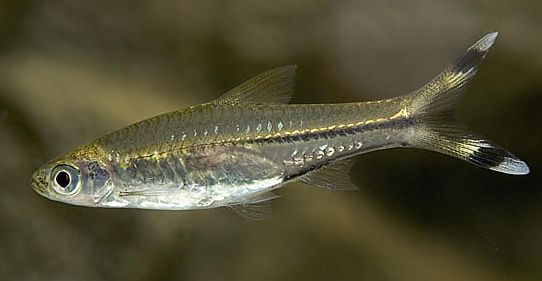
The Slender Rasbora (Rasbora daniconius) is also called the Black Line Rasbora, Striped Rasbora, Gold Line Rasbora, Common Rasbora, Golden Striped Rasbora, Slender Barb, and Striped Barb by tropical fish keeping enthusiasts and is found in the river systems of South and Southeast Asia from Sri Lanka, the Indus basin, the Mekong River and the northern Malay Peninsula. It has also been collected in Borneo and Sumatra.

As the name implies, the Slender Rasbora is a slim fish with a compressed, oblong body that in the wild reaches a length of over 6 inches. In an aquarium environment it will reach a length of about 3 1/2 inches.

The Slender Rasbora is silver in color with olive colored undertones. The belly of the males is predominately white whereas females are more yellow to reddish colored. A striking blue black colored line outlined with gold runs the length of the body right through the tail of the fish. Their rather large scales are highly reflective and their yellow fins are small.

Slender Rasboras are primarily found in slow moving, muddy, sandy streams and rivers but they frequent all sorts of waterways from medium to large rivers, ponds, ditches, canals, brooks, streams, flooded fields to even brackish waters. They will occasionally form large schools to feed on small aquatic insects and detritus.

Slender Rasboras are active, schooling fish that spend their time in the mid water column. In an aquarium they should be kept in schools of at least 8 to 10 fish in a long densely planted aquarium of at least 20 gallons capacity, with a sandy or fine gravel substrate, some “river rocks” and plenty of room for them to swim.

To replicate their natural environment, they should be provided with strong direct lighting and slightly acidic, medium hard water conditions. Because Slender Rasboras are jumpers and easily excitable, their aquarium should be planted with a variety of aquatic plants and have some bogwood or driftwood roots placed in it to make them feel safe and bring out their color. A tightly fitting cover is needed for these fish.

Slender Rasboras are peaceful and can be mixed with other active fish of similar temperament. Some good tankmate selections include Good tankmates include other Cyprinids, larger characins,live bearers, peaceful bottom dwelling catfish and loaches and some of the dwarf cichlds.

In the wild Slender Rasboras feed on small aquatic insects and detritus. In the aquarium, they can be fed a quality flake food or pellets augmented with some lettuce or other vegetable matter and live, frozen or freeze dried daphnia, brine shrimp, bloodworms or tubifex. These fish do best when fed two or three times a day. Offer them only what they can consume in three to four minutes.

Slender Rasboras lay their eggs among the leaves of plants and are relatively easy to breed. They do not care for their eggs or fry

First, condition a pair or a school by feeding them live foods several times a day for a month. Well fed females will begin filling out with eggs and an intense chasing courtship will begin. Increase the water temperature in the spawning tank slightly and drop the pH to about 7.0. When ready, a spawning pair will begin depositing their eggs on fine leaved plants like Hornwort, Cabomba, Milfoil, Java Moss, Crystalwort or a spawning mop. A pair will assume a side by side position and the male will try to wrap himself around the female until eggs are laid. The ritual continues until the female finds another hiding place and the spawning process repeats itself.

Remove the parents as soon as the spawning is completed or they will devour the eggs. Fry will hatch in 3 to 4 days and be free swimming in about 3 more days. Feed the fry infusoria for the first few days until they are large enough to eat baby brine shrimp.

Slender Rasboras are not common but specialized fish stores occasionally carry them. When they are available for purchase, they are relatively expensive and 1″ to 1 1/2″ in size.

Slender Rasbora (Rasbora daniconius)

Slender Rasbora (Rasbora daniconius)


Minimum Tank Size: 20 gal
Carel Level: Easy
Temperament: Peaceful
Aquarium Hardiness: Moderately hardy
Water Conditions: 71.0 to 80.0° F, 8 – 17 dGH, pH 6.0-7.5
Max Size: 6″
Color Form: Silver
Diet: Omnivore
Compatability: Good community tank fish
Origin: South, Southeast Asia
Family: Cyprinidae
Lifespan: 5 – 8 years
Aquarist Experience Level: Beginner
(native species include Lagenandra ovata and Blyxa auberti) for cover.

Posted in Featured Articles, Freshwater Fish, Rasboras0 Comments

Panda Barb (Puntius fasciatus) School

Panda Barb (Puntius fasciatus)

Panda Barb (Puntius fasciatus)..

Panda Barb (Puntius fasciatus)..

The Panda Barb (Puntius fasciatus) is also known by tropical fish keeping enthusiasts as the Striped Barb, Ember Barb, Banded Barb and Black Spot Barb.

The Panda Barb is native to the Western Ghats mountains in the south Indian states of Goa, Karnataka, Kerala and Tamil Nadu. Its range is from the Kanyakumari district at the southern tip of the country, to almost as far as the Maharashtra state to the north.
Although it is more common the the western slopes of its range at sea level and in the foothills; it has also been found throughout many river drainage systems.

Panda Barbs are found in a variety of environments that include major rivers, hill streams, irrigation canals, ponds, lakes and even ditches.  They prefer quiet, shallow areas with lots of submerged vegetation or leaf litter, but they are also found in the fast moving foothill streams.

The Panda Barb is a shoaling fish and is usually found in large schools with their own kind and other small cyprinids like the Ticto (Pethia ticto) Barb, Maharaja Barb (Puntius sahyadriensis), Narayan Barb (Puntius setnai), Blackspot Barb (Dawkinsia filamentosua), Mascara Barb (Puntius assimilis), Striped Rasbora (Rasbora daniconius), etc.

Panda Barb (Puntius fasciatus).

Panda Barb (Puntius fasciatus)

The Panda Barb is silver with four black stripes running vertically up its body however, a number of geographically isolated varieties differ in color and body patterns.

Panda Barbs collected from the headwaters and from mountain streams of highland environments have olive-green, orangy to crimson bodies, instead of silver.   Specimens collected from lower altitudes are normally purple or reddish.

The number and positioning of the dark body bars is also variable, and dependent on geographical area.  Specimens collected from Goa have five bars on their body.  Specimens from Karnataka in northern Kerala have four bars, and those from central and southern Kerala, three.  Some Panda Barbs collected from southern Kerala only have two barbs on their body and the unique, much desired Panda Barb from Kanyakumari has no bars at all.

The Panda Barb is one of the more under appreciated cyprinids.  They are hardy, relatively peaceful, colorful, interesting in their behavior and make a welcome addition to any larger community aquarium.

Panda Barbs do best in groups of 8 to 10 or more specimens, and under subdued lighting with a dark substrate to bring out their colors, provide a beautiful aquarium display.   They need a large densely planted aquarium with some smooth river rock, pieces of driftwood, twisted bogwood roots, some floating plants and some leaf litter to mimic a gently flowing stream.  They require enough filtration to provide some gently water movement in the tank.

Panda Barbs are omnivorous and require a variety of foods. In the wild they forage on diatoms, algae, organic detritus, small insects, worms, crustaceans, and other Zooplankton.  In an aquarium environment they should be fed a quality flake food augmented with regular offerings of small live, freeze dried, and frozen foods such as bloodworms, daphnia, brine shrimp, small insects, worms, and an occasional algae wafer to enhance their colors and keep them in top condition.

The Panda Barb is an egg scatterer that when properly conditioned, will spawn in a mature, dimly lit aquarium, with fine leaved plants like Taxiphyllum spp. or a spawning mop. The water should be neutral to slightly acidic, and the temperature raised into the high 70s. Place a half dozen of each sex in the spawning tank and remove them as soon as the eggs are scattered. Eggs will hatch in 24 to 48 hours and the fry will be free swimming 24 hours later at which time they should be fed infusoria or an infusoria grade food for the next week. As they grow larger, offer them , Daphnia or baby brine shrimp.

Most tropical fish shops will occasionally stock juvenile Panda Barbs. When available, they are usually sold when they are 1-1/2″ to 2″ in size.

Panda Barb (Puntius fasciatus)

Panda Barb (Puntius fasciatus)


Minimum Tank Size: 30 gallons
Care Level: Easy
Temperament: Peaceful
Aquarium Hardiness: Hardy
Water Conditions: 60-77° F, KH 4-10, pH 6.0-7.5
Max. Size: 5″
Color Form: Black, White
Diet: Omnivore
Compatibility: Great community tank fish
Origin: Southern India
Family: Cyprinidae
Lifespan: 4-6 years
Aquarist Experience Level: Beginner

Posted in Barbs, Featured Articles, Freshwater Fish0 Comments

Fahaka Puffer (Tetraodon lineatus).

Fahaka Puffer (Tetraodon lineatus)

Fahaka Puffer (Tetraodon lineatus).

Fahaka Puffer (Tetraodon lineatus).

The Fahaka Puffer (Tetraodon lineatus) is also known to tropical fish keeping enthusiasts as the Nile Puffer, Striped Puffer, Band Puffer, Lineatus puffer, and Globe Fish.   They inhabit large rivers, open waters that are weedy and densely vegetated, and are found in the Nile, Niger, Volta, Gambia, Geba, Chad basin, and Senegal Rivers in Africa.

The Fahaka Puffer is a very large fish that grows to 18 inches or more in length, however a sub-species called Tetraodon fahaka rudolfianus only grows to about 3 inches in length, making it a more suitable species for tropical fish keeping enthusiasts.

The Fahaka Puffer is a solitary, stocky, elongated fish that is covered with short prickles.  The back of its body is colored a brownish gray that gradually gets lighter until it ends into the whitish belly.  The Fahaka Puffer has bright orange to red eyes and a series of light, almost golden colored, horizontal stripes that run from the pectoral fins back across the tail; hence the a.k.a.s “Striped Puffer” and “Band Puffer“.

Juvenile Fahaka Puffers are more mottled in appearance and as they get older, their colors become more vivid.  Like the Bornean Red-Eye Puffer (Carinotetraodon borneensis), these puffer fish change color depending on their mood, age and environment.

All puffer fish have the ability to puff themselves up with air or water when threatened and Fahaka Puffers are no exception. In addition to this defense mechanism, toxic substances in their flesh make them poisonous when eaten.

In the wild Fahaka Puffers feed on oysters, mussels, cockles, krill and other mollusks.  In an aquarium environment they should be offered a variety of human quality hard shelled foods to keep their teeth worn down.  This includes snails, shellfish, crustaceans, lobster, crab legs, and clams.   Avoid giving them “feeder” fish which may pass on diseases.

If their teeth grow too long, they need to be clipped with cuticle cutters on a regular basis.

Fahaka Puffers are a solitary and extremely aggressive species that cannot be kept with other species.  When confined with others of their own kind, a battle will immediately ensue unless they are housed in an extremely large tank.

Despite their aggressiveness with other fish, Fahaka Puffers make excellent aquarium “pets”. They are one species that actually bond with their owners and make friendly, entertaining, expressive, almost human like pets.

Puffers do not have gill covers or scales and are more susceptible to diseases, nitrite, nitrate, and ammonia levels. They are also messy eaters, often leaving uneaten food on the bottom of their tank.

This makes a 125 gallon or larger aquarium with highly filtered water a must for Fahaka Puffers.  Large, powerful, canister filters that can turn the tank water over 6 to 10 times an hour are a must for these fish, as are weekly water changes of 30% – 50%.

Their accommodations should also include moderate to normal lighting, some smooth rocks, driftwood, and a sandy or extremely fine gravel substrate.   Although in the wild they are found around densely vegetated weedy areas, live plants will for the most part be destroyed during feeding and should probably be avoided in an aquarium environment.

Although it has been accomplished, breeding the Fahaka Puffer in an aquarium is extremely difficult if not impossible.  They will normally kill each other on sight and in their natural habitat when they do breed, it is normally at a depth of 50 feet or more.

When the female Fahaka Puffer produces an ovipositor organ, they will mate with any willing male.  The male puffer swims upside down under the female and grips the female so that both sexual organs connect.  Eggs and sperm are released several times to fertilize thousands of eggs during a spawning.   The fertilized eggs should be removed to a separate brood tank once they sink to the bottom of the breeding tank, where they will hatch in 3 to 4 days.

After hatching, the water level should be lowered to give the fry easier access to the surface.  After a week the fry will be free swimming and should constantly be fed infusoria to prevent starvation.   As the fry grow into their second week, they can be introduced to baby brine shrimp.

As they grow, the fry will become more and more aggressive, so its a good idea to “cull” out the larger, more aggressive fish to separate tanks.

Fahaka Puffers are not common in the aquarium hobby and when available are usually adults or juveniles of  1″- 2″ in length.


Fahaka Puffer (Tetraodon lineatus).

Fahaka Puffer (Tetraodon lineatus).


Minimum Tank Size: 125 gal
Care Level: Difficult
Temperament: Aggressive and Predatory
Aquarium Hardiness: Moderately hardy
Water Conditions: 75.0 to 82.0°F, pH 7.0, dH 10 -12 (Never put this puffer in soft water)
Maximum size: 18+ inches
Color Form: Brown
Diet: Carnivore
Origin: Africa
Family: Tetraodotidae
Lifespan: 10 years or more
Aquarist Experience Level: Experienced

Posted in Featured Articles, Freshwater Fish, Oddball Fish, Puffer Fish0 Comments

Indian Dwarf Puffer (Tetraodon travancoricus).

Indian Dwarf Puffer (Tetraodon travancoricus)

Indian Dwarf Puffer (Tetraodon travancoricus).

Indian Dwarf Puffer (Tetraodon travancoricus).

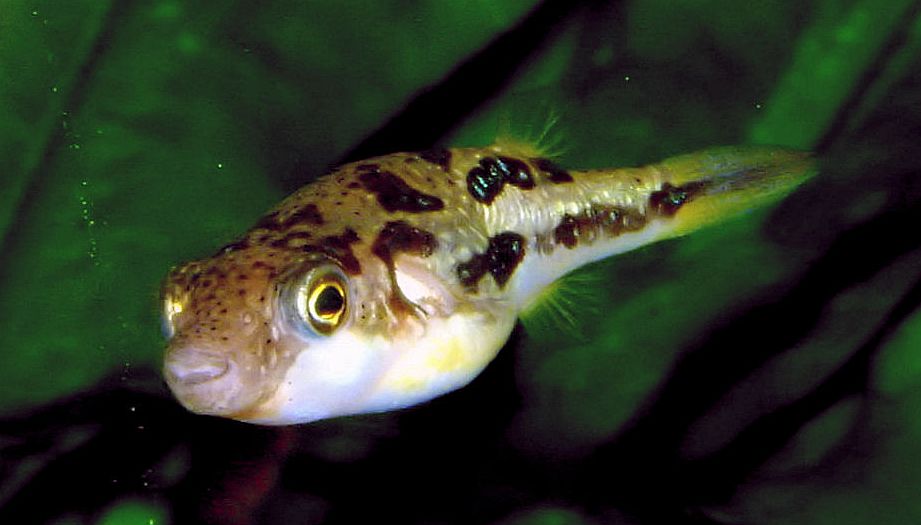
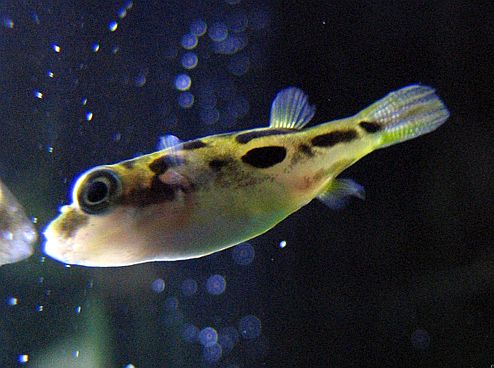
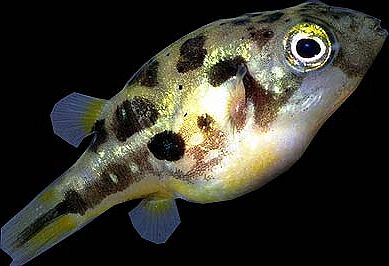
The Indian Dwarf Puffer (Tetraodon travancoricus) is also known as the Bumblebee, Malabar, Pea or Pygmy Puffer by tropical fish keeping enthusiasts.
The Indian Dwarf Puffer is the smallest freshwater pufferfish in the world and is unique to the River Pamba in Kerala, Southwest India. Although it is closely related to marine pufferfish, it is not found in salt or brackish water.

Indian Dwarf Puffers reach a maximum length of 1″ and are much smaller than other puffer species in the same family.

Female Indian Dwarf Puffer (Tetraodon travancoricus)

Female Indian Dwarf Puffer (Tetraodon travancoricus)

Overall they are yellow golden brown color, that blends into an off white underbelly. Black to dark green iridescent patches or “spots” cover most of the fish’s flanks and dorsal area.

Male Indian Dwarf Puffers have a pronounced black stripe running down the center of their pale belly from the tail to the pectoral fin and iridescent eye wrinkle patterns that females lack. Males are also smaller, leaner, and not as round as females of the species.

As juvenile Indian Dwarf Puffers mature, they will literally “choose” their own sex. As a puffer becomes a male, he will excrete hormones that prevent other puffers from becoming males. If two fish start maturing into males at the same time, one fish will quickly become the dominant male.

Indian Dwarf Puffers are mildly aggressive and should be housed in a densely planted aquarium of at least 30 gallons, with a sand or very fine gravel aggregate bottom and plenty of hiding places. They do not need salt in their tank like some other puffer fish.  Because they are so highly territorial, it is recommended that only one fish be housed in a tank.

In an aquarium environment Indian Dwarf Puffers should be fed a diet of  brine shrimp, small live snails, mollusks, krill and chopped earthworms. In the wild they are believed to feed on zooplankton, molluscs, and various crustaceans.

Indian Dwarf Puffers have been bred in an aquarium environment. They are plant spawners and will lay their eggs in Java Moss or other similar plants. They have been known to scatter their eggs in between vegetation on the substrate. Eggs are fertilized externally and will hatch after 5 days at 81 °F.  The fry should initially be fed infusoria until they grow larger, at which time brine shrimp and regular size food can be offered.

Dwarf Puffers do not guard their eggs or their fry.  When the eggs hatch, it is recommended that the fry be removed to a 10 gallon rearing tank until they are able to fend for themselves.

Indian Dwarf Puffers are not a common item in tropical fish shops but when available, they are sold at a size of 1/2″ to 1″.

Indian Dwarf Puffer (Tetraodon travancoricus)

Indian Dwarf Puffer (Tetraodon travancoricus)


Minimum Tank Size: 30 gallons
Care Level: Moderate
Temperament: Aggressive
Aquarium Hardiness: Moderately Hardy
Water Conditions: 72-82° F, KH 5-15, pH 7.0-8.0
Max. Size: 1″
Color Form: Tan, Yellow
Diet: Carnivore
Origin: Southwest India
Family: Tetraodontidae
Lifespan: 5 – 6 years
Aquarist Experience Level: Intermediate

Posted in Featured Articles, Freshwater Fish, Oddball Fish, Puffer Fish0 Comments

Bornean red-eye puffer (Carinotetraodon borneensis)

Bornean Red-Eye Puffer (Carinotetraodon borneensis)

Bornean Red-Eye Puffer (Carinotetraodon borneensis)

Bornean Red-Eye Puffer (Carinotetraodon borneensis)

The Bornean Red-Eye Puffer (Carinotetraodon borneensis) is a colorful species of puffer fish that is found exclusively in the tropical rain forests of the South Skrang river, in the State of Sarawak, Borneo.

The Bornean Red-Eye Puffer is similar to Carinotetraodon lorteti that is also found in Cambodia, Malaysia, Laos, Thailand, and Vietnam. The main difference between the two species is the reddish tail fin that is exhibited by Carinotetraodon lorteti.  The tail of the Bornean Red-Eye Puffer is relatively colorless.

The term “Red-Eye Puffers” is used by tropical fish keeping enthusiasts to describe a colorful quartet of puffer species that are sold under that general name.  It is represented by Carinotetraodon irrubesco, Carinotetraodon salivator, Carinotetraodon borneensis and Carinotetraodon lorteti of which C. lorteti is the most sought after.

The appeal of these puffers is mostly for their brilliant colors which change with their mood.  Male Bornean Red-Eye Puffers have a red dorsal fin and an orange or red ventral keel which becomes more vibrant during mating or when they show aggression. They have red eyes, yellowish bands across their backs, and a gray, blue to black tail trimmed with a white border.   Bornean Red-Eye Puffers have 12 – 13 soft dorsal rays, 11 – 13 soft anal rays and 16 – 17 vertebrae.   Their colors become more pronounced in a dimly lit aquarium.

Some Bornean Red-Eye Puffers are very aggressive, while others can be very shy.   All of them are generally very territorial. They remain inactive during daylight hours and become active hunters when the lights go out.

Like many other Southeast Asian fish, Bornean Red-Eye Puffers do best in soft, very warm, highly filtered, and slightly acidic water.  They cannot tolerate nitrites, nitrates or ammonia and because of their messy eating habits, must have highly filtered aquarium water.

These puffers are generally shy and enjoy a densely planted aquarium with driftwood, rock caves, and plenty of hiding places, with a sand or very fine gravel substrate.

The Bornean Red-Eye Puffer is relatively easy to feed.  They will eagerly eat most small invertebrates such as krill, snails, ghost shrimp, mussels, clams, and frozen bloodworms.   They do not seem to be plagued by overgrown teeth like most other puffer fish but some pond snails or other crunchy food fed on a regular basis will ensure their dental health.

Red-Eye Puffers are most active after dark, so feeding them in the late evening or early morning will minimize the amount leftovers in the tank.  To keep the water quality as clean as possible, avoid over feeding.

Male Bornean red-eye puffer (Carinotetraodon borneensis)

Male Bornean red-eye puffer (Carinotetraodon borneensis)


Minimum Tank Size: 20 gallons
Care Level: Moderately difficult
Temperament: Aggressive, nocturnal hunter
Aquarium Hardiness: Moderately Hardy
Water Conditions: 73-80° F, 6-16 °d , kH 5-10, pH 6.0-7.8
Max. Size: 2″
Color Form: Brown, Red
Diet: Carnivore
Origin: Only in Southern Sarawak, Borneo
Family: Tetraodontidae
Lifespan: Unknown
Aquarist Experience Level: Intermediate


Posted in Featured Articles, Freshwater Fish, Oddball Fish, Puffer Fish1 Comment

Greenbottle Pufferfish (Auriglobus nefastus)

Greenbottle Pufferfish (Auriglobus nefastus)

Greenbottle Pufferfish (Auriglobus nefastus)

Greenbottle Pufferfish (Auriglobus nefastus)

The Greenbottle Pufferfish (Auriglobus nefastus) is also called the Bottle Puffer and erroneously the Golden Puffer by tropical fish keeping enthusiasts.  It is found in the Mekong River basin of Cambodia, Laos, and Thailand; as well as many areas of Malaysia and Indonesia.

The Greenbottle Puffer is a bottom dwelling species that is found in moving waters of rivers, streams, and in the flooded plains and forests that occur during seasonal high water levels when the rivers overflow their banks.

Greenbottle Pufferfish are an aggressive species that primarily feeds on fish fins, rays, and scales.  They are extremely active for puffer fish and should never be included in a community aquarium.  Young specimens often frantically dart around the tank and can create havoc with their tank mates.

Greenbottle Pufferfish (Auriglobus nefastus)

Greenbottle Pufferfish (Auriglobus nefastus)

There are several pufferfish species that are erroneously called “Greenbottle Pufferfish” by tropical fish keeping enthusiasts.

Auriglobus modestus, Auriglobus nefastus, and Chonerhinos silus are commonly confused with one another and are quite difficult to tell apart.  Fortunately, they are all similar and require the same care.

The Greenbottle Pufferfish and their counterparts are all “bottle” green in color and have white bellies.  Their bodies are usually without distinct color markings except for a slightly darkened spot on the dorsal surface of their head, behind their eyes.

Chonerhinos naritus looks similar, but has a yellow belly and is a brackish water species.  Greenbottle Puffers can be distinguished from other species in the Mekong basin by their 23-27 dorsal rays and 19-22 anal rays, their relatively small nasal organ, and their upper lip which usually projects beyond the lower lip.  The exposed part of their eyeball is usually horizontally oval instead of being vertically oval and round.

The sexes of Greenbottle Puffers are indistinguishable and cannot be determined visually.

Like most freshwater pufferfish, the Greenbottle Puffer is highly territorial however, if they are housed in a large tank with plenty of hiding places, they can be kept in groups of three without too much harm being done.

Like most puffers they are messy eaters, and because they are extremely sensitive to ammonia and nitrites, need to be housed in an heavily filtered aquarium.  Never introduce these puffers to a “new” aquarium that has not been adequately cycled.

In an aquarium environment, the Greenbottle Pufferfish will eat live and frozen foods, snails, frozen shrimp, gut loaded ghost shrimp, and occasionally freeze dried krill.  A steady diet of snails or other freshwater crustaceans should be fed to them to prevent their beaks from over growing.

To date, Auriglobus nefastus has never been bred in captivity.

When available for purchase, they are usually 1″ to 1 1/2″ in size.

Greenbottle Pufferfish (Auriglobus nefastus)

Greenbottle Pufferfish (Auriglobus nefastus)


Minimum Tank Size: 35 gallons
Care Level: Difficult
Temperament: Aggressive, Hunts and searches out food
Aquarium Hardiness: Moderately Hardy
Water Conditions: 74-80° F, 5-12 °d , pH 6.0-7.8
Max. Size: 4-6 inches
Color Form: Gold, Green
Diet: Carnivore
Origin: Southeast Asia, Indonesia, Lakes and Rivers
Family: Tetraodontidae
Lifespan: 10 years or more
Aquarist Experience Level: Intermediate

Posted in Featured Articles, Freshwater Fish, Oddball Fish, Puffer Fish0 Comments

Golden Puffer (Auriglobus modestus)

Golden Puffer (Auriglobus modestus)

The Golden Puffer (Auriglobus modestus) is also called the Bronze Puffer or Avocado Puffer by tropical fish keeping enthusiasts.

The Golden Puffer has an unusual shape for a puffer fish.   It has is a sleeker, more streamlined, club like body with beautiful iridescent golden, green, to bronze hued colors.

Even though the Golden Puffer is a freshwater fish, they exhibit an unusual characteristic that is more  Golden Puffer (Auriglobus modestus)common to marine fish.

Their iridescent body colors modulate between green, gold and bronze.  The iridescent gold green body color gets progressively lighter towards the belly, and their fins and tail are translucent.

Golden Puffers are native to Thailand, Malaysia and Indonesia where they are found in the swifter moving currents of medium to large rivers. They are also commonly found in flood estuaries.

The Golden Puffer is an aggressive fin nipper that is better kept in a single species aquarium.  Its more streamlined body enables them to swim much faster than other puffers and many other fish, therefore they should never be housed with slow moving, long finned species or with any type of decorative crayfish, shrimp, or snail.  Any invertebrate placed in the same tank with a Golden Puffer will be on their menu and is usually immediately dispatched. Most other fast moving community fish such as giant Danios, will do fine provided   there is sufficient tank space and places for them to hide.

The Golden Puffer should be housed in an aquarium of at least 20 gallons, filtered with a canister filter that can change the tank water over 6 to 10 times per hour, and set up with at least one rotating power head to simulate the strong currents that they are found in in nature.

Golden Puffers are intelligent, curious little fish that like to root around a lot and should be housed in a tank that is well aquascaped.  They prefer a densely planted tank with a sandy substrate, some floating vegetation, driftwood roots and caves for hiding, and low lighting conditions.  If you choose to house you puffer with other fast moving fish, dense vegetation and an abundance of hiding places is essential for their survival.

Like other puffer fish, the Golden Puffer lacks scales and gill covers. This makes them more sensitive to changing water conditions and more susceptible to disease, nitrite, nitrate and ammonia levels.

The Golden Puffer is especially sensitive to nitrites and ammonia and in an aquarium environment, they should be provided with weekly water changes and highly filtered water.  All puffer fish are messy eaters, which is why high output canister filters are routinely used for keeping freshwater puffers.

Obviously, the Golden Puffer is not considered a good community fish. Because they are faster than most other puffer fish, they have a tendency to become extremely aggressive, despite their diminutive size (less than 4″).

Feed Golden Puffers an omnivore diet of live and frozen foods such as shrimp, ghost shrimp, bloodworms, krill, seeds, and snails.  Although they can be trained to eat flakes, freeze dried foods and pellets, they need a varied diet to keep them healthy and to keep their teeth worn down.

All Puffers have strong teeth that keep growing throughout their lives.  The Golden Puffer is prone to overgrown teeth and must be fed shelled live food on a regular basis to keep their teeth worn down.

Snails and other shelled foods fed on a daily basis will help to wear down their teeth but if the teeth get too long, they will be unable to eat and their teeth must be trimmed manually.

You can do this by adding 3 drops of clove oil per liter of water to temporarily sedate the puffer so it can be handled more easily.   Clip their top and bottom teeth with a cuticle clipper and put the puffer back into the main tank in front of a power head current until it revives.

This little procedure may need to be done 3 to 4 times a year.

Golden Puffers are relatively rare but when available for purchase are available in size up to 4″ in length.

Golden Puffer (Auriglobus modestus)

Golden Puffer (Auriglobus modestus)


Minimum Tank Size: 20 gallons
Care Level: Moderate
Temperament: Aggressive
Aquarium Hardiness: Moderately Hardy
Water Conditions: 74-80° F, 5-12 °d , pH 6.0-7.8
Max. Size: 4 1/2 ”
Color Form: Gold, Green
Diet: Omnivore
Origin: Southeast Asia
Family: Tetraodontidae
Lifespan: 8 – 10 years
Aquarist Experience Level: Intermediate

Posted in Featured Articles, Freshwater Fish, Oddball Fish, Puffer Fish1 Comment

Longfin Serpae Tetra (Hyphessobrycon eques).

Serpae Tetra (Hyphessobrycon eques)

Longfin Serpae Tetra (Hyphessobrycon eques)

Longfin Serpae Tetra (Hyphessobrycon eques)

The Serpae Tetra (Hyphessobrycon eques) is also commonly referred to as the Blood characin, Bloodtetra, Callistus tetra, Jewel tetra, Red minor tetra and Red serpae tetra by tropical fish keeping enthusiasts.  The term “Blood tetra” is a generalization that is used to describe a wide range of red colored tetras sold by tropical fish shops.

The Serpae tetra has a tall, rather compressed body and a distinct red body color.  The shades of red vary from bright red to reddish brown. A black comma shaped mark is located directly behind the gill cover in both sexes however, smaller and older specimens may have very small markings and sometimes no marking at all.   The anal fins of Serpae Tetras are fringed with black and white layers that sometimes display a reddish hue, but the ventral and tail fins are always red.  A long finned variety of Hyphessobrycon eques also exists.

Serpae Tetras are found in the Amazon river basin in South America, as well as the Guaporé and Paraguay rivers.  They are an active semi aggressive shoaling species that in the wild are found close to the surface in calm, black, densely vegetated waters.

Serpae tetras are popular in community aquariums but should not be kept with smaller tetras or fancy guppies. They will do best in soft, neutral to slightly acidic water in groups of at least six fish.

Serpae Tetras need a large, densely planted aquarium with a dark substrate, driftwood or bogwood for shelter and hiding places, and plenty of room for swimming.   Some floating plants can be added to mimic the dimly lit conditions they prefer in their natural habitat.

Serpae Tetras are aggressive and competitive feeders.  A school of Serpae tetras during feeding looks a lot like a school of Piranhas savaging their prey in a South American river.

In the wild, Serpae Tetras feed on worms, insects, crustaceans and plants.   In an aquarium environment they will accept flake food, live, freeze dried, or frozen bloodworms, brine shrimp, tubifex, or daphnia.   They need a varied diet to prevent malnutrition.

The Serpae Tetra is one of the easier tetras to breed.   Place a conditioned pair in a small (5 gallon) aquarium with a dark substrate and lots of fine leaved plants such as Java Moss, Myriophyllum, or Cabomba.   The pH should be between 6.0 to 7.0, the dH between 4 and 8, and the water temperature in the mid 70s.   Filtering the water in the breeding tank through peat moss is also helpful.

Serpae Tetras are egg scatters and will deposit their tiny translucent eggs in the plants.   As soon as the eggs are fertilized, remove the breeding pair to maximize the yield.

The eggs will hatch in 24 to 28 hours at which time the fry can be fed infusoria, egg yolk or baby brine shrimp.   In a few weeks the fry can be fed finely crushed flake food or powdered flakes.


Serpae Tetra (Hyphessobrycon eques)

Serpae Tetra (Hyphessobrycon eques)


Minimum Tank Size: 10 gallons
Care Level: Easy
Temperament: Peaceful
Water Conditions: 72-82° F, KH 4-8, pH 5.0-7.8, dH 10 – 25
Max. Size: 1 1/2″
Color Form: Red
Diet: Omnivore
Compatibility: Semi-aggressive in small groups
Origin: Amazon River Basin
Family: Characidae
Life Span: 7 years
Aquarist Level: Beginner

Posted in Featured Articles, Freshwater Fish, Tetras, Tropical Fish Keeping0 Comments

Gold Longfin Danio (Danio rerio)

Gold Longfin Danio (Danio rerio)

The Gold Longfin Danio (Danio rerio) is member of the Cyprinidae family that is native to the Ganges region of eastern India.

They are a popular variety of the Zebra Danio and are found in a variety of habitats from fast moving streams to slow moving, almost stagnant ponds.

The Gold Longfin Danio is a metallic gold in color with yellow stripes that run horizontally across its body.   They have long graceful fins that flow behind them as they literally glide around in your aquarium.

Gold Longfin Danios are a shoaling species that should be kept in the home aquarium in groups of at least 6 to 8 specimens.   They get along well with many of the smaller Danios and other peaceful, non-aggressive species of the same size.

Gold Longfin Danios prefer densely planted aquariums, with driftwood roots for hiding, and large open areas for swimming.   Like most other danios, they are easy to care for and do well on a diet of commercially prepared omnivore flake food and an occasional offering of live brine shrimp, tubifex or daphnia.

Like the Zebra Danio, Gold Longfin Danios are easy to breed.   The males are more torpedo shaped than the larger bellied females and once paired up, they remain loyal to one another.

Breeding pairs should be separated to a breeding tank with fine leaved plants or a “mop” for them to spawn over.   These Danios are egg scatters and will deposit anywhere from 300 to 400 eggs during a spawn which will hatch within a couple of days.   Fry should be fed live baby brine shrimp
when free swimming or small bits of live foods until they are able to accept flake food.

The Gold Longfin Danios that are available for purchase in your local pet shop are usually farm raised and range in size from 3/4″ to 1 1/2″ in length.


Gold Longfin Danio (Danio rerio)

Gold Longfin Danio (Danio rerio)


Minimum Tank Size: 10 gallons
Care Level: Easy
Temperament: Peaceful
Aquarium Hardiness: Hardy
Water Conditions: 64-75° F, KH 8-12, pH 6.5-7.0
Max. Size: 3″
Color Form: Gold
Diet: Omnivore
Origin: India, Farm raised in the USA
Family: Cyprinidae
Lifespan: up to 5 years
Aquarist Experience Level: Beginner

Posted in Danios and Minnows, Featured Articles, Freshwater Fish0 Comments

Emerald Eye Rasbora (Rasbora dorsiocellata).

Emerald Eye Rasbora (Rasbora dorsiocellata)

Emerald Eye Rasbora (Rasbora dorsiocellata)

Emerald Eye Rasbora (Rasbora dorsiocellata)

The Emerald Eye Rasbora (Rasbora dorsiocellata) is also called the Green Eyed Rasbora, the Eye-Spot Rasbora, the Ocellated Rasbora, and the Hi-spot Rasbora by tropical fish keeping enthusiasts.

The genus Brevibora of cyprinids that this fish belongs to,  is native to Southeast Asia and is restricted to the Malay Peninsula, and the Malay Arhipelago where they are found in the slow flowing black water rivers and streams that are associated with these ancient forest peat swamps.   They thrive in the canopy covered, dimly lit, tannin stained water that is normally littered with leaves, branches, twigs and decomposing organic matter.

The Emerald Eye Rasbora has an elongated body with a prominent yellow dorsal fin, that has a black dot in it’s center. The colors of this fish vary with locality but most of the fish available to tropical fish keeping enthusiasts have a bright blue eye, and at least one form has a reddish sheen on the caudal penducle and the base of the caudal fin.

Female Emerald Eye Rasboras are slightly larger than the males and are more rounded.

Like many species of rasbora, they are egg scatterers and will continuously spawn on their own when housed in a soft water, densely planted aquarium.  The parents will usually eat the eggs after spawning if they can find them, but some usually manage to survive into adulthood.

Emerald Eye Rasboras are a peaceful shoaling fish that should be kept with at least 6 or more specimens in a well established, dimly lit, densely planted aquarium with driftwood, dried Almond leaves and plenty of swimming space. They do well in a community tank with other small peaceful species that require the same water conditions such as other rasboras, small loaches, smaller gourami species, characins, or Corydoras. .

Emerald Eye Rasboras develop their best colors in acidic, very soft tanin stained water with a dark substrate, in an aquarium that has floating plants and subdued lighting. This is one species that should never be used to cycle an aquarium. They must be housed in a well established tank.

The Emerald Eye Rasbora is easy to feed. They do well on a diet of quality flake food and regular offerings of freeze dried bloodworms, daphnia and tubifex.

Most Emerald Eye Rasboras available for purchase are farm raised and are from 1/2″ to 1 1/2″ in size.

Brevibora dorsiocellata (Emerald Eye Rasbora)

Brevibora dorsiocellata (Emerald Eye Rasbora)


Minimum Tank Size: 10 gallons
Care Level: Moderate
Temperament: Peaceful
Aquarium Hardiness: Hardy
Water Conditions: 73-79° F, KH 3-7, pH 6.0-7.5
Max Size: 1 1/2″
Color Form: Black, Green, White
Diet: Omnivore
Compatibility:  Great soft water community tank fish
Origin: Southeast Asia
Family: Cyprinidae
Lifespan: 4-6 years
Aquarist Experience Level: Beginner/Advanced

Posted in Featured Articles, Freshwater Fish, Rasboras0 Comments

Celestial Pearl Danio (Celestichthys margaritatus)

Celestial Pearl Danio (Celestichthys margaritatus)

The Celestial Pearl Danio (Celestichthys margaritatus) is often incorrectly referred to as the Galaxy Rasbora by tropical fish keeping enthusiasts.

Since its discovery in 2006 in a small, high altitude area of Myanmar, east of Lake Inndi, it has become an instant hit with tropical fish keeping enthusiasts throughout the world.

Unfortunately, the demand for Celestichthys margaritatus has become so great that their environment has been devastated by over collecting, and the fish is considered rare in many areas.

Celestial Pearl Danios are richly colored and have striking markings that make it a highly sought after aquarium fish. The deep metallic blue body of the Celestial Pearl Danio is adorned with iridescent, jewel like spots and they have bright bands of orange color on their fins that add a breathtaking contrast to this majestic little fish.

Male Celestial Pearl Danios are more brightly colored and have a more streamlined body than females. The anal fin of the male is noticeably more orange and will have a black band. Females are more subdued in their overall coloration and have rounder bodies.

Celestial Pearl Danios are shoaling fish that in an aquarium environment should be kept in groups of at least 6 or more specimens. They are a peaceful species that get along well with other small peaceful fish, and although they prefer soft, acidic water, they adapt easily to a wide range of water conditions.

Celestial Pearl Danios do best in a densely planted aquarium aquascaped with rocks, driftwood, and a sandy or fine gravel bottom. They need plenty of swimming room but should be provided with ample plant cover for them to hide.

Fortunately the Celestial Pearl Danio has been captive bread and is relatively easy to breed. Being an egg scatterer, they need a well planted tank with subdued lighting and soft acidic water. The parents should be removed after spawning.  The fry can be fed fine pieces of live foods or finely crushed flake food.

Adults are omnivorous, easy to feed, and should be provided a mixed diet of a quality flake food, algae wafers, along with live, frozen, or freeze dried daphnia, brine shrimp, bloodworms, and tubifex.

Celestial Pearl Danio (Celestichthys margaritatus)

Celestial Pearl Danio (Celestichthys margaritatus)


Minimum Tank Size: 10 gallons
Care Level: Easy
Temperament: Peaceful
Aquarium Hardiness: Hardy
Water Conditions: 73-79° F, KH 8-12, pH 6.0-7.5
Max. Size: 1″
Color Form: Red, Yellow
Diet: Omnivore
Origin: Myanmar, India
Family: Cyprinidae
Lifespan: 5 – 7 years
Aquarist Experience Level: Beginner

Posted in Danios and Minnows, Featured Articles, Freshwater Fish, Tropical Fish Keeping1 Comment

Denison Barb (Sahyadria denisonii)

Denison Barb (Sahyadria denisonii)

The Denison Barb (Sahyadria denisonii) is also known by tropical fish keeping enthusiasts as the Red Lined Torpedo Barb or the Rose Line Shark.

The Denison Barb is a shoaling species that is found in the fast flowing rivers, tributaries, and streams in the state of Kerala and South Karnataka, in Southern India.  The demand for this beautiful species is so strong that it is reported to be India’s most popular aquarium fish export.  Unfortunately, due to over collecting, the fish is heading towards extinction if existing breeding programs don’t catch up with the demand.

Denison Barbs are longer than other barbs and torpedo shaped for speed.  They are fast swimmers that in their natural environment, like to jump out of the water.  To protect themselves from larger predatory species, Denison Barbs can be found living in huge shoals.

The fish is predominately silver in color with a black line running the length of its body and a bright red stripe running across its eyes to mid-body. It has a red edge on its dorsal fin, and yellow and black accents on the tips of its caudal fin.

Unlike some of the other barbs, the Denison Barb is a peaceful fish that is a welcome addition to any large community aquarium. They get along well with wide range of other similarly sized peaceful and semi-aggressive tropical fish species but need highly oxygenated water in order to thrive.

In an aquarium environment, they should be housed in groups of at least 6 – 8 specimens and because of their penchant for jumping, their tank must have a tightly fitting lid.

In addition to good water flow, Denison Barbs appreciate a densely planted aquarium with plenty of room to dart around and hide when they feel threatened.

In the wild Denison Barbs consume plant and animal based foods. They are not picky eaters but in an aquarium environment they should be provided a balanced diet of plant, algae, and meaty foods.

High quality flakes, carnivore pellets, live, frozen or freeze dried bloodworms, brine shrimp, and tubifex will keep Denison Barbs healthy and happy.

Denison Barbs are seldom available for purchase but when available, they are usually 1-1/2″ to 2″ in size.

Denison Barb (Sahyadria denisonii)

Denison Barb (Sahyadria denisonii)


Minimum Tank Size: 55 gallons
Care Level: Easy
Temperament: Peaceful
Aquarium Hardiness: Hardy
Water Conditions: 60-78° F, KH 4-10, pH 6.8-7.8
Max. Size: 5 – 6″
Color Form: Black, Red, White
Diet: Omnivore
Compatibility: Good Community Tank Fish
Origin: India, Captive Bred
Family: Cyprinidae
Lifespan: 8 years
Aquarist Experience Level: Beginner

Posted in Barbs, Featured Articles, Freshwater Fish, Sharks1 Comment

indainalmondLeaves

Almond Leaves For Blackwater Aquariums

Using Indian almond leaves for blackwater aquariums has been an easy, economical way to create the conditions necessary for keeping many types of sensitive South American tropical fish species.

Indian Almond Leaves

Indian Almond Leaves

For years, fish importers in southern Florida have been receiving boxes of fish from South American exporters that contained various species of dead leaves.

The reason exporters packed the leaves with some shipments was apparently for the medicinal properties that the leaves provided to the more sensitive species.

Indian Almond Leaves among several other types, do have special properties that leech out in the aquarium.   Primarily the tannins that are released from the leaves.

The addition of dead leaves into a tank results in the release of humic substances that will lower the pH of the aquarium water.

These humic substances also act as an antibacterial and antifungal agent, and reduce the amount of heavy metals in the water.

Using Almond leaves for blackwater aquariums also provides a food source for some species, primarily the fry of many species.

Tanks littered with leaves on the bottom obviously have a positive effect on fish fry.  The fry grow faster, larger, and happily appear to nibble on the decaying leaves.

The truth is that they are actually feeding on the “slime” that is created as the leaves are broken down by bacterial and fungal action.

Many South American blackwater habitats are characterized by large amounts of leaf litter, very low pH, and relatively few planktonic animals on which young fish can feed on.

Some fish species like Discus and uaru surmount this problem by excreting copious amounts of slime from their bodies for the fry to eat until they are able to fend for themselves.

As dead leaves are broken down by bacterial and fungal action, the slime produced seems to act as an alternative food source for fish that do not produce their own slime.

The survival rates of loricariid fry and many other species dramatically improve when leaves are present in the aquarium however, this could also be attributed to the increase in infusoria populations created by decaying leaves.

Using Almond Leaves for blackwater aquariums is not a new concept. Companies have been selling blackwater extract to tropical fish keeping enthusiasts for years as a “tonic” and as a cure for a variety of fish diseases. It has also been used to promote spawning in hard to breed species.

Some newcomers to tropical fish keeping recoil at the idea of placing leaves in an aquarium and letting them “rot”. The truth is that wild caught fish are much more likely to reside in areas with submerged decaying wood and plants than they encounter in an aquarium environment with sparkling clear, highly filtered water.

Most blackwater species seldom see the plants that they are housed with in an aquarium environment. The tannic acid in blackwater habitats makes the water extremely acidic and unsuitable for these type plants.

Discus, Angelfish, Apistogrammai spp., Uaru, Bettas, Badis and others benefit from bogwood, tree roots, and driftwood in their tanks, so why not use other humic substance releasers, like the dead leaves found in their natural environments?

Almond leaves for blackwater aquariums are not the only type of leaf that can be used.  Beach, red oak Q.rubra, European beech Fagus sylvatica, pendunculate oak Quercus robur, sessile oak Q. petraea, Turkey oak Q. cerris, hawthorn Crataegus monogyna and Japanese maple Acer palmatum have also been used with varying degrees of success.  European Alder cones and Pine cones have also been used with some success.  In short, it is reasonable to assume that as long as no poisonous tree species leaves are used, they should be aquarium safe when prepared correctly.

When collecting leaves, use only the leaves you can identify as being non-poisonous. Do not use live leaves from a tree, only use the leaves that have already dropped to the ground.

Autumn is a great time to collect freshly fallen leaves from deciduous trees. When the leaves fall to the ground, you can be sure there is no living tissue in them that could cause problems in the tank should they die.

Avoid collecting leaves that are near roadways or other areas that are possible sources of pollution.  Do not use leaves that have bird droppings on them or are overly dirty.

When you have collected a sufficient amount, take them home and dry them out. When they are dried out you can store them for some time in a dry environment.

When you are ready to use them in your aquarium, do not boil them before use.  Boiling sterilizes the leaves but also removes the beneficial qualities.

Indian Almond Leaves Soaking

Indian Almond Leaves Soaking

Instead, just soak the leaves in a 5 gallon bucket for a day or so.

They will float initially but will sink after becoming water logged.

Adding leaves to your tropical fish tank is a matter of trial and error.  There are no set guidelines, so try adding a couple at a time.

Some species contain more tannins than others. The Indian Almond tree leaf contains more tannins than an oak leaf. The volume of water in your tank also determines the amount of leaves you need to use.

You may only need 4 or 5 Indian Almond Leaves leaves in a 55 gallon tank, but when using Beech or Oak leaves, you may need 10 or more to achieve the same desired effect.

Over a period of time the leaves will break down in your tank. It is not necessary to remove the broken down leaves from your aquarium. They will not harm your fish and when they are broken down altogether, you can just add more leaves.

Some leaves last longer than others.  Indian Almond Leaves break down in three or four months, but Oak and Beech leaves will last at least twice as long.

Using almond leaves for blackwater aquariums is an economical, environmentally friendly way of keeping species that require soft, acidic conditions. Start with Indian Almond leaves and experiment with using some local species in your area.

A pocket tree guide might be of value.

Posted in Featured Articles, Tropical Fish Keeping3 Comments

Boraras maculatus pair

Dwarf Rasbora (R. maculata)

The Dwarf Rasbora (R. macula) is also referred to by tropical fish keeping enthusiasts as the Dwarf Spotted Rasbora, Dwarf, Pygmy Rasbora, or the Spotted Rasbora.

Dwarf Rasboras are widely distributed in southeast Asia and are found in southern Thailand (from Phunphin in Surathani Province south), Peninsular Malaysia, Singapore, Indonesia (Sumatra and unconfirmed records from Kalimantan).

The Dwarf Rasbora is vivid red with three or more dark black spots on the body behind the gill cover and adjoining the anal and caudal fin.   The males are more vividly colored than the females, and the females have an extra dark spot above the anal fin on both sides of their bodies.

The Dwarf Rasbora is a bottom dwelling species that inhabits the thickly vegetated slow flowing black water forest streams and freshwater swamps in their area of distribution.  It is a a micropredator that feeds on worms, crustaceans, small insects, and other zooplankton.  The waters where spawning occurs is usually shallow and thickly vegetated, with a maximum depth of 6 inches.

Dwarf Rasboras are an active, peaceful, sociable fish that prefer living in loose shoals with others of their own kind.

Because of their diminutive size (0.5″ to 1.0″) they should be housed in densely planted tanks with driftwood and catappa leaves on a sandy or fine aggregate bottom.  They do best in very acidic (pH 6.2 to 6.4) tannin stained water under low lighting conditions.     Floating plants should be added to provide the shady conditions they thrive in and to bring out their colors.

This is one species that benefits from the addition of dried leaf litter (Catappa leaves) to the tank.  As decomposition of the leaves occur, microbe colonies will begin to flourish.  These colonies of tiny creatures provide a valuable food source for the Dwarf Rasboras, especially the fry.  In addition, the tannins and chemicals that are released into the water as the leaves decay are beneficial to all blackwater species.

Using almond leaves for blackwater aquariums, (Catappa leaves) is an economical way to provide Dwarf Rasboras and other delicate species the tannin stained water they require in an aquarium environment.

The leaves should be left in the tank to break down and can be replenished every couple of weeks to maintain the desired water color.

Because of their small size, care should be exercised when choosing tank companions for these small Cyprinids.    They do well with Chocolate Gouramis (Sphaerichthys),  Licorice Gouramis (Parosphromenus ), small Bettas,  and freshwater shrimp such as Caridina or Neocaridina (Cherry Shrimp, Snowball Shrimp, Blue Pearl Shrimp).

Dwarf Rasboras are among the easiest of the species to spawn.  They need only a small densely planted tank with soft, acidic water, the addition of a catappa leaf or two, and low lighting for spawning to commence.  After the eggs are deposited, remove the pair to protect the spawn from being eaten.

Being carnivores, Dwarf Rasboras will accept most small foods.  In the absence of a biotope environment, they do well on a diet of crushed flakes, small micro-pellets, microworms, brine shrimp, and daphnia.

Dwarf Rasboras are rarely available for purchase but are less than 1″ in length when available.

Dwarf Rasbora (R. maculata)

Dwarf Rasbora (R. maculata)


Minimum Tank Size: 5 gallons
Care Level: Moderate
Temperament: Peaceful
Lighting: Subdued
Water Conditions: 75.2-78.8°F, 5-12 °d, pH 5.0-6.5
Max. Size: 0.5″ to 1″
Color Form: White/Red
Diet: Carnivore
Compatibility:  Suitable for biotope
Origin: Southeast Asia, Indonesia
Family: Cyprinidae
Life Span: 2 to 5 years
Aquarist Experience Level: Intermediate

Posted in Featured Articles, Freshwater Fish, Rasboras1 Comment

Rasboras

Rasboras – The Perfect Community Fish

Rasboras the perfect community fish, are a genus of a small group of minnow type fish that belong to the Cyprinidae (carp) family.  They are found in parts of Southeast Asia; Singapore, Sumatra, Malaysia, and South Thailand as well as parts of Africa.

Currently the genus Rasbora contains over 83 recognized species which are listed below.

Tropical fish from genera such as Boraras, Microrasbora, and Trigonostigma are commonly called rasboras by tropical fish keeping enthsiasts, but are not members of the Rasbora genus.   The genera Boraras and Trignonstigma were split from Rasbora leaving the genus Rasbora (found in Southeast Asia and Africa) the largest.

Most rasboras are small, under 4 inches long, and several of the species are commonly kept in community aquariums.

In many ways rasboras are the perfect community fish.  They are peaceful, elegant looking, active, easy to maintain and easy to breed.  Many species are beautiful but underrated and often overlooked by tropical fish keeping enthusiasts.

Rasboras typically inhabit streams and slow moving waterways in peat swamp forests which characteristically have low mineral content and high concentrations of humic acids. The water logged forest soil retards the complete decay of leaf litter with results in the formation of the peat. The resulting “black water” is created as the peat leaches humic acids and related compounds into the water.

These conditions are found in Southeast Asia and some areas in Africa and can be mimicked in an aquarium environment by the use of peat bags.

Rasboras are a popular family that includes Koi, goldfish, barbs, danios, labeo (sharks) and several other favorite species familiar to tropical fish keeping enthusiasts.

Some rasboras are streamlined like minnows, while others are deep bodied.  Many rasboras are adorned with prominent markings and attractive coloration, while others are more subtly marked with little to no coloration making them less desirable and thus unavailable to hobbyists.

Few aquarium fish are as peaceful, resilient, and easily maintained as the rasboras however, some of the species are difficult to acclimate and maintain.

Wild caught rasboras frequently display “white spot” or “velvet” disease which develops with improper handling during collection and delivery to wholesalers and ultimately, the retailer.  Both diseases are easily treated but it’s a good idea to quarantine newly acquired specimens before adding them to an established community tank.

In general Rasboras are extremely resilient, but some species are adversely affected by drastic changes in water chemistry which can be demonstrated by clamped fins, emaciation, or sickly looking fish.  This usually occurs with uncommon species of wild caught rasboras.  New fish should be full bodied, eating, alert, and healthy looking.

Rasboras are prolific breeders when a compatible pair is identified and placed in a suitable environment.

Although water chemistry varies according to the locale of the wild caught fish; generally soft, slightly acidic water with fine leaved aquatic plants in the tank is all that is needed to get a pair to spawn.  Condition the pair by feeding them live foods such as brine shrimp or daphnia.

Most Rasboras will scatter their adhesive eggs over fine leaved plants but some species such as the Harlequin Rasbora (Rasbora heteromorpha) deposit their eggs under broad leafed plants in batches over a period of several hours.

Hatching time varies but is usually relatively short (8 to 24 hours). After the egg sacs are absorbed (12 to 24 hours) the fry grow rapidly when provided with infusoria, baby brine shrimp, finely crushed flake food and daphnia.

Because most captive rasboras are housed in a community aquarium environment with other diverse companions, they are usually fed a quality flake food however, they do better with a varied diet that includes live, freeze dried or frozen bloodworms, tubifex, or brine shrimp.

Some of the rasbora species more commonly available from retailers to tropical fish keeping enthusiasts  and are pictured below, along with a list of the 83 currently  recognized species.

Harlequin Raspora (Rasbora heteromorpha)

Harlequin Raspora (Rasbora heteromorpha)

Harlequin Raspora (Rasbora heteromorpha)


Scissortail Rasbora (Rasbora trilineata)

Scissortail Rasbora (Rasbora trilineata)

Scissortail Rasbora (Rasbora trilineata)


Harlequin (Rasbora espei)

Harlequin (Rasbora espei)

Harlequin (Rasbora espei)


Redline Rasboras (R. pauciperforata)

Redline Rasboras (R. pauciperforata)

Redline Rasboras (R. pauciperforata)


Firetail or Blackline Rasbora (R. borapetensis)

Firetail or Blackline Rasbora (R. borapetensis)

Firetail or Blackline Rasbora (R. borapetensis)


Dwarf Rasbora (R. maculata)

Dwarf Rasbora (R. maculata)

Dwarf Rasbora (R. maculata)


Red Scissortail (R. caudimaculata)

Red Scissortail (R. caudimaculata)

Red Scissortail (R. caudimaculata)


Clown Rasbora (R. kalachroma)

Clown Rasbora (R. kalachroma)

Clown Rasbora (R. kalachroma)


Pygmy Rasbora (R. urophthalma)

Pygmy Rasbora (R. urophthalma)

Pygmy Rasbora (R. urophthalma)


Fire Rasbora (R. vaterifloris)

Fire Rasbora (R. vaterifloris)

Fire Rasbora (R. vaterifloris)


Golden Striped Rasbora (R. daniconius)

Golden Striped Rasbora (R. daniconius)

Golden Striped Rasbora (R. daniconius)


Green Eyed Rasbora (R. dorsiocellata)

Green Eyed Rasbora (R. dorsiocellata)

Green Eyed Rasbora (R. dorsiocellata)


Redline Rasbora (R. pauciperforata)

Redline Rasbora (R. pauciperforata)

Redline Rasbora (R. pauciperforata)


Black Striped Rasbora (R. agilis)

Black Striped Rasbora (R. agilis)  Leave a Reply  Logged in as Fishkeeper. Logout »

Black Striped Rasbora (R. agilis)

Posted in Featured Articles, Freshwater Fish, Rasboras1 Comment

Saltwater Fish

Featuring Clownfish

Aquarium Supplies

On-Sale Aquarium Supplies!

Saltwater Specials

Categories