Author Archives | Fishkeeper

Gilled African lungfish (Protopterus amphibius)

Gilled African lungfish (Protopterus amphibius)

Gilled African lungfish Protopterus amphibius

Gilled African lungfish Protopterus amphibius

The Gilled African lungfish (Protopterus amphibius) also known by tropical fish keeping enthusiasts as the East African Lungfish, is found in Kenya, Somalia, and Mozambique, East Africa and the delta of the Zambezi River.

Gilled African Lungfish are the smallest of the extant lungfish that seldom grow longer than 17 inches in length.    Their bodies are a slate gray or a uniform blue color with a light pale gray belly and are covered with small inconspicuous black spots.   All African Lungfish have soft scales, pelvic fins that look more like ropelike spaghetti appendages that they use to crawl around in the mud, and are eel like in appearance.   Their dorsal, caudal, and tail fins are all fused to form a single fin like structure.

Gilled African lungfish (Protopterus amphibius)

Juvenile Gilled African lungfish (Protopterus amphibius)

Like all African lungfish they posses two lungs (modified air bladders) which enable them to breathe air.   They are actually a highly vascularized pocket of the digestive tract where gulped air is stored to oxygenate the blood that runs through the organ.

Their heart has also adapted to pump oxygenated and deoxygenated blood in separate streams to different parts of their body.   This enables them to burrow into the mud and envelop themselves in a mucous cocoon during extended dry periods for months, to several years.

The process, known as estivation, allows the Gilled African Lungfish to lower it’s metabolic rate and survive severe droughts that normally deplete fish populations.

Gilled African Lungfish are found in swamps and flood plains where they can survive for months under the dried mud.   They are dug up and eaten for food by some natives of the area, however they reportedly have a strong taste and are not widely enjoyed.   The numbers lost to this practice are minimal.

Gilled African Lungfish are voracious eaters and their teeth are made for eating.   Their upper jaw has two rounded teeth at the front, having a hard bridge that moves from side to side.   Their lower jaw is equipped with numerous crushing teeth.   The lungfish first sucks the prey into their mouth to thoroughly crush it, and then chews the broken carcass thoroughly until it is swallowed.

Because African Lungfish are highly aggressive carnivores, they are best kept in a single species aquarium.   They are fearless and will attack any tankmate that moves in their vicinity.    They should be housed in at least a 30 gallon aquarium with a mud, sand, or very fine gravel substrate, some aquatic plants and driftwood roots for them to hide among, and dimmed lighting.

Although they are not particularly sensitive to water quality and can survive in stagnant, abnormal aquatic conditions, they should still have a good canister filter to keep their tank water clear.    Except when they need to surface to gulp oxygen from the atmosphere, they are mot very active and spend the time at the bottom of the aquarium.

The breeding season for Gilled African lungfish starts at the end of winter, which coincides with the beginning of the rainy season.    They reproduce by laying eggs which are fertilized externally by the males.   The males build a nest or “pit” in the mud and lines it with plants.   After the females lay their eggs, the male will guard them and oxygenate them until they hatch.

The 3.5 to 4 millimeter diameter white colored eggs hatch in approximately one week.   The tiny larvae look like tadpoles and have long, fan
like gills similar to newts that they initially use to breathe.   For the first three weeks or so the male will continue guarding the fry.   As the fry grow, they will undergo a metamorphosis of sorts that replaces their gills with openings that they will use to start breathing air into their lungs.

Gilled African Lungfish are highly versatile in their eating habits and will even eat dry food when trained to do so.   They are carnivores that prefer eating small fish, shrimp, invertebrates, amphibians, crayfish, clams, worms, and anything they can fit into their mouths.   When the food is too large for their mouths, they will nibble small pieces from it.

Gilled African Lungfish are rarely available to tropical fish keeping enthusiasts but can be “specialty ordered” online and from some specialty tropical fish shops.

Gilled African lungfish (Protopterus amphibius)

Gilled African lungfish (Protopterus amphibius)


Minimum Tank Size: 30 gallons
Care Level: Moderately Difficult
Temperament: Semi-Aggressive
Aquarium Hardiness: Moderately Hardy
Water Conditions: 77.0 to 86.0° F, 2 – 20 dGH, pH 6.0-8.0
Maximum Size: 17″
Color Form: Gray, Light Blue
Diet: Carnivore
Compatibility: Single Species Tank
Origin: Africa
Family: Protopteridae
Lifespan: 20-25 Years
Aquarist Experience Lever: Intermediate

Posted in Featured Articles, Freshwater Fish, Lungfish, Oddball Fish, Tropical Fish Species3 Comments

Marbled Lungfish (Protopterus aethiopicus)

Marbled Lungfish (Protopterus aethiopicus)

The Marbled Lungfish (Protopterus aethiopicus) is found in the African countries of Tanzania, Ethiopia, the Sudan, Kenya, Uganda, and the Democratic Republic of Congo and referred to by tropical fish keeping enthusiasts as the Leopard Lungfish, or African Lungfish .

Marbled Lungfish live in the Nile River as well as lakes Albert, Edward, Tanganyika, Victoria, Nabugabo, No, and Kyoga.   Different subspecies are found in the Nile River and lakes Victoria and Tanganyika, (Protopterus aethiopicus aethiopicus) the middle and upper Congo River, (Protopterus aethiopicus congicus) and the lower Congo, (Protopterus aethiopicus mesmaekersi).

As adults, Marbled Lungfish are found in swamps, riverbeds, floodplains, and river deltas throughout their range.    Juvenile members are often collected between the roots of papyrus plants and despite being an aquatic species, adults can live in riverbeds and other areas that seasonally dry up during portions of the year.   Like all Dipnoi, they have the ability to estivate in mucous lined burrows in the ground, and breathe out of a hole in the cocoon they form, for up to several years.

The Marbled Lungfish is a smooth, cylindrical, elongated, species with deeply embedded scales and a long tail that tapers at the end.   In their natural habitat, fully grown adults can reach almost 7 feet in length.    They have very long, thin, spaghetti like pectoral and pelvic fins that they use for gliding through the water column.   Newly hatched specimens have branched external gills that look like those of newts or water dogs.   After after 2 to 3 months when they metamorphose into their adult form, the gills are replaced by small gill openings that enable them to breathe air.

Marbled Lungfish (Protopterus aethiopicus)

Marbled Lungfish (Protopterus aethiopicus)

The body of the Marbled Lungfish is a yellowish gray to pinkish color.   They have dark, slate gray splotches over their entire bodies and fins which gives them a leopard or marbled look.   The color pattern is darker above and lighter underneath their belly.

Protopterus aethiopicus does not require much swimming space, but it should be kept in a tank large enough for it to stretch out completely. Because they are slow moving and not particularly active, a 60 gallon tank is sufficient for juvenile to medium size specimens however, they will eventually require a larger aquarium as they continue to grow.

Their tank should have a mud, sand, or very fine gravel substrate that will not damage their smooth skin, some driftwood roots and aquatic vegetation for them to hide among, subdued lighting over their tank, and a strong outside canister filter to keep their tank water clean.

Lungfish are not particularly fussy about water quality and they are quite messy, however they should have clean surroundings to minimize the potential of diseases.   Partial bi-weekly 20% to 30% water changes should be performed on a regular basis.

Because lungfish must be able to reach the surface of the tank to breathe air, it is important to remove any obstructions that could prevent them from getting a gulp of air.   African lungfish are one species that will drown if they are unable to breathe atmospheric air.

Marbled Lungfish have not been bred in captivity.   In the wild they generally breed during the flood season immediately after the first rains.   The males prepare a “pit” type nest or a deep hole for one or more females to lay their eggs in.   When the eggs are laid and the male fertilizes them, he will guard the nest and oxygenates the eggs to ensure their survival until they hatch, in approximately 8 weeks.   During the breeding season, adult males develop a structure in their pelvis that enables them to filter gasses in the air and use this to increase the oxygen levels in the nest.

After hatching, the young look like little tadpoles and have branched external gills that look like those of a newt or water dog.   After 2 to 3 months the young metamorphosize into their adult form and lose their external gills to gill openings.

Adult Marbled Lungfish have a diet that consists largely of mollusks, such as Mutela bourguignat (mussels) but they also eat small fish and insects.   Juveniles have a diet that consists almost entirely of insects.

In an aquarium environment, they will eat almost anything they can get into their mouths.   They need meaty foods to thrive and should be provided live, fresh dead, or defrosted small fish, chunks of fish, earthworms, shrimp, clams, crawfish, mussels, or insects.   You can use tongs to hold their food in front of them to make sure it is quickly eaten and not foul the water.

Juvenile Lungfish should be fed twice a day, but as they mature they only need to be fed 2 or 3 times per week.

The Marbled Lungfish or Leopard Lungfish is occasionally available as a “special order” but the price is usually high.   Albino Marbled Lungfish or Albino Leopard Lungfish are rarely available and command much higher prices.

At least three subspecies of Protopterus aethiopicus are sold by tropical fish keeping shops as “Marbled Lungfish” and all are similar.   The most significant difference between the subspecies is their maximum size which cannot be determined without knowledge of which area the specimen was collected from.   The most common subspecies is Protopterus aethiopicus congicus.

Marbled Lungfish (Protopterus aethiopicus)

Marbled Lungfish (Protopterus aethiopicus)


Minimum Tank Size: 60 gallons
Care Level: Moderately Difficult
Temperament: Semi-Aggressive
Aquarium Hardiness: Moderately Hardy
Water Conditions: 77.0 to 86.0° F, 2 – 20 dGH, pH 6.0-8.0
Maximum Size:

  • Protopterus aethiopicus aethiopicus – up to 6 1/2 feet
  • Protopterus aethiopicus congicus – up to 3 1/4 feet
  • Protopterus aethiopicus mesmaekersi – up to 3 feet

Color Form: Gray
Diet: Carnivore
Compatibility: Single Species Tank
Origin: Africa
Family: Protopteridae
Lifespan: 20 Years
Aquarist Experience Lever: Intermediate

Posted in Featured Articles, Freshwater Fish, Lungfish, Oddball Fish, Tropical Fish Species3 Comments

South American lungfish (Lepidosiren paradoxa)

South American lungfish (Lepidosiren paradoxa)

The South American lungfish (Lepidosiren paradoxa) is the only species of lungfish found in South America.

It frequents swamps and slow moving waters in the Amazon, Rio Paraguay, and lower Paraná River basins, and is known to tropical fish keeping enthusiasts as the American Mud Fish, Amazonian Lungfish, or Scaly Salamanderfish.    It is found in smaller numbers in Venezuela, Peru, Columbia, Brazil, French Guiana, Paraguay and Argentina, but the largest populations are predominately found in the Pio Parana and Rio Paraguay basins.

South American lungfish (Lepidosiren paradoxa)

Juvenile South American lungfish (Lepidosiren paradoxa)

Juvenile South American lungfish are black spotted with gold, but as they grow into adulthood, their body colors fade into a gray or brown color.

Like all Dipnoi, South American lungfish have an elongated body.   Their pectoral and anal fins are thin, ropey,  and almost thread thread like in appearance.    Their pelvic fins are set back and to the rear of the body, and are somewhat larger than their pectoral fins.   Their dorsal fin begins about midway up the body to joins with the caudal fin underneath.

Although they posses gills as juveniles, they become non functional as they become adults.    Adults posses fused teeth that become heavily mineralized and are used for crushing their prey before swallowing.

In their natural habitat, juvenile South American Lungfish primarily feed on snails and insect larvae.    As they attain adulthood, they become more omnivorous and add algae, fish, and shrimp to their diets.

South American Lungfish have two “lungs” which are actually modified swim bladders that allow them to absorb oxygen and remove wastes.   In waters with low oxygen content, they are able to breathe air through their swim bladders instead of their gills.   If kept underwater, these lungfish will drown if they are unable to surface for a gulp of air.

During the dry seasons as their habitat gradually disappear, they burrow into the mud and produce a mucous lined chamber that is usually between 12″ and 20″ below the surface of the soil.   A few holes are left in the chamber with access to the surface for air.   During this aestivation, their metabolism and activity slows down almost to a complete stop and if necessary, they can remain this way for up to 4 years.    As the rainy season begins again, they come out of their burrows and immediately begin mating.

South American Lungfish are large, messy fish, but relatively easy to keep in an aquarium environment.   Because they are highly predatory, they

are best housed alone.   They do require a good filtration system to keep their tank water clear and regular bi-weekly water changes of 20% to 30% are recommended, but they do not need need a lot of swimming area and can survive a wide range of water conditions.

Because they grow to over 4 feet long, South American Lungfish require a large tank of at least 60 gallons (initially) with very little water movement, a mud, sandy, or very fine gravel substrate, some aquatic plants and driftwood roots for them to hide among, and dim lighting.

Because of their soft skin, avoid placing any sharp rocks or coarse gravel in the tank and because of their large size as adults, a canister filter and outside heater is recommended to prevent damage to the equipment.

South American Lungfish are not very active and will spend most of their time on or near the bottom of the tank.   They will surface occasionally to take a gulp of air, therefore the water surface should be unobstructed and their tank should never be tightly covered.   Remember that these fish will drown without air.

The South American Lungfish has not been bred in captivity but in their natural environment, the adults will construct a tunnel type of hole “or nest” in the mud that they line with vegetal matter.   They go into the “nest”, seal it off, lay their eggs, and guard them even hatching.

During the breeding season, the adults do not breathe through their lungs.    Instead they breath with their gills and some thin branched appendages that temporarily develop in the males during the breeding season.   These appendages are actually highly vascularized structures on the male’s pelvic fins that release additional oxygen into the nest.    When the eggs hatch, the young lungfish larvae look like little tadpoles with four branched external gills, similar to those of newts.    After 7 weeks, the young metamorphosize into their adult form, become air breathing, and exchange their external gills for gill openings.

South American Lungfish are easy to feed.    The easiest way to feed them is to provide live, fresh dead, or fresh pieces of fish.   They will also eat shrimp, crayfish, crabs, clams, insects, snails, worms, or anything that they can catch and fit into their mouths.    Juveniles should be fed two times a day but adults only need to be fed two to three times a week.    Occasional feedings of vegetable matter should also be given to round out their diet.

South American Lungfish are not a common item in tropical fish keeping shops but are usually available as a “special order” item at a moderate cost.

South American lungfish (Lepidosiren paradoxa)

South American lungfish (Lepidosiren paradoxa)


Minimum Tank Size: 60 gallons
Care Level: Difficult
Temperament: Semi-Aggressive
Aquarium Hardiness: Moderately Hardy
Water Conditions: 75.0 to 82.0° F, 2 – 20 dGH, pH 6.0-8.0
Size: 49.3″
Color Form: Brown, Gray
Diet: Carnivore
Compatibility: Single Species Only
Origin: South America
Family: Lepidosirenidae
Lifespan: 8-20 Years
Aquarist Experience Lever: Intermediate

Posted in Featured Articles, Lungfish, Oddball Fish, Tropical Fish Species1 Comment

Queensland Lungfish (Neoceratodus forsteri)

Queensland Lungfish (Neoceratodus forsteri)

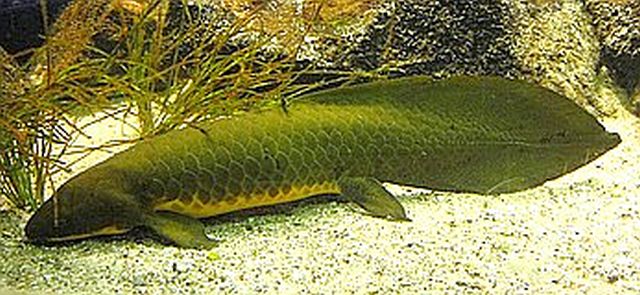
The Queensland Lungfish (Neoceratodus forsteri) is the sole surviving member of the family Ceratodontidae and is known to tropical fish keeping enthusiasts as the Australian lungfish, Barramunda, or Burnett Salmon.

The Queensland lungfish is truly a “living fossil” and one of only six species remaining in modern times. Of the six known surviving members of ancient air breathing lungfishes (Dipnoi) that flourished during the Devonian period (about 413–365 million years ago), it is the most primitive.

Like all lungfish, the Queensland lungfish has the ability to “breathe” out of water for extended periods however, unlike their African and South American cousins, it has gills and their skin must be kept moist to survive.   South American and African lungfish lack gills and can survive their annual dry seasons by secreting a mucous cocoon around their bodies and burying themselves in the mud.

The five other freshwater lungfish species are very different morphologically from Neoceratodus forsteri in that they have two lungs.
Queensland lungfish have only one dorsal lung that is actually a modified swim bladder used to supplement the oxygen supply through their gills during periods of drought or high temperatures when the waters become deoxygenated. During these conditions, the lungfish can rise to the surface to gulp air into it’s lung.

Although the Queensland lungfish is native only to the Mary and Burnett River systems in south eastern Queensland; they have been successfully introduced into the Brisbane, Albert, Stanley, Pine, Caboolture, Condamine, and Coomera Rivers, as well as the Enoggera Reservoir.

Queensland lungfish live in the still, slow moving waters of rivers and reservoirs that have some aquatic vegetation present.   They can be found in small groups under submerged logs, caves formed by the erosion of substrate from tree roots along river banks, or in dense banks of aquatic macrophytes.

They frequent slow moving pools that are anywhere from 10 to 35 feet deep, and are equally comfortable over mud, sandy, or gravel bottoms.

Although the Queensland lungfish is tolerant of the cold, it prefers water temperatures between 59 and 78 degrees F.

Queensland Lungfish are a sedentary species that spend their entire lives in a relatively restricted area. Their home territories seldom extend beyond a single deep pool or two adjacent pools, and except from July through December when they may seek out suitable spawning areas, they do not follow any set migratory paths.    Although they are sluggish and inactive, they are capable of rapid movement with a flick of their strong tail.    They are a nocturnal species that is usually more active during the late afternoon and evening hours than during the day.

Queensland Lungfish (Neoceratodus forsteri)

Queensland Lungfish (Neoceratodus forsteri)

Queensland lungfish are colored an olive green to a dull brown on the back, sides, tail, and fins, and a pale yellow to orange on the underside. Males have a reddish color along their sides that becomes much brighter during the breeding season and is the only distinguishing sexual characteristic of the species.

Queensland lungfish are the largest of all the known species of lungfish.   They have elongated bodies, flattened heads with small beady eyes, and small mouths that are positioned low on their heads.

They are slow growers that commonly reach lengths of almost 5 feet and weigh in at close to 100 pounds.   On average they weigh around 20 pounds and are a little over 3 feet in length with females being slightly larger.

The bodies of Queensland Lungfish are slimy and covered with large bony scales.    They have large, long, powerful tails; fleshy, flipper like pectoral fins, and fleshy, flipper like pelvic fins that are situated far back on the body. Their dorsal fins begin in the middle of the back and merge with the caudal and anal fins.

The scales of these fish overlap extensively and are embedded in their own pockets to protect vulnerable body areas of the fish that are covered by a thickness of at least four scales.   Their heads are also covered by very large, thick, interlocking scales that protect their thin bony skull.

The skeleton of the lungfish is partly cartilage and partly bone.   Their vertebrae are pure cartilage, but their ribs are hollow tubes filled with a cartilaginous substance.   They also have unusual teeth.   Two flat, slightly bent incisors are on the upper jaw with dental plates on the upper and lower jaws.

Juvenile Queensland lungfish are mottled with a base color of olive brown or gold. As they age, the mottling disappears but dark patches still remain. Juveniles are also able to change colors rapidly in response to different lighting conditions.   This trait disappears as their colors become denser.

Juveniles also have different body proportions than mature adults.   Their heads are rounder, the fins are smaller, and the body is more slender. Their mouth is located at the front of their head but shifts back as the fish grows and their dorsal fin begins at the back of the head but gradually moves to the center of their back as they mature.

Queensland Lungfish (Neoceratodus forsteri)

Queensland Lungfish (Neoceratodus forsteri)

The Queensland lungfish spawn and live their entire lives in freshwater.   Males are capable of spawning at 17 years of age and females at 22 years. They spawn in pairs from August to December before the spring rains, and reportedly go through an elaborate courtship.    Spawning activity is believed to be stimulated by the length of the day and they will spawn during daylight or at night.

Their eggs are deposited on aquatic plants in flowing streams that are at least three feet deep and immediately fertilized by the males.   They do not make a nest, guard their eggs, or exhibit any parental care for their young.    They are selective of their spawning sites and although their eggs have been observed on aquatic plants that are rooted in sand and gravel in fast moving waters, in full sun and in the shade; they will never deposit their eggs on plants that are covered with slimy algae, in stagnant water, or in water with floating debris on the surface.

The sticky eggs are hemispherical in shape, enclosed in a triple jelly envelope, and are about .39″ in size.   They are deposited by the female singly or sometimes in pairs but never in large clusters and the “stickiness” disappears shortly after the egg is attached to an underwater plant.

A female Queensland lungfish has the capacity to lay several hundred eggs but they seldom produce more than a few hundred during their lifetimes. They do not spawn every year but have cycles that seem to peak every five years or so, regardless of environmental conditions.    The eggs resemble those of a frogs eggs and hatch out after 3 to 4 weeks.   The young look like little tadpoles and are extremely slow growing.   They do not eat for 2 to 3 weeks until their egg sacs are absorbed.    By the time their egg sacs are absorbed, the fry develop a spiral valve in the intestine which allows them to feed.    After 100 days or so, they will be about 1″ in length, and at 8 months, only 2 1/2″ long.    Under optimal conditions, their growth rate is only about 2 inches a month.

Adult Queensland lungfish have a high survival rate and are extremely long lived.    They usually live to at least 20 or 30 years in their natural habitat but a specimen in the Shedd Aquarium in Chicago nicknamed “Granddad”, is at least 80 years old and has been there since 1933.

The Queensland lungfish is carnivorous and in the wild, its prey includes frogs, tadpoles, fishes, crayfish, crabs, a variety of invertebrates, and plant material.

Juveniles and lungfish larvae are bottom feeders and will eat small Tubifex worms, small crustaceans, earthworms, and filamentous algae.    As they grow into adulthood in captivity, they will feed on frogs, earthworms, shrimp, pieces of meat, and pelleted food.

The Australian lungfish is currently CITES protected but occasionally available to the trade through licensed breeders.    They are usually quite expensive ($700.00 or more) for a single specimen and considerably more for albino specimens.

Queensland Lungfish (Neoceratodus forsteri)

Queensland Lungfish (Neoceratodus forsteri)


Minimum Tank Size: 100 gallons
Care Level: Difficult
Temperament: Aggressive
Aquarium Hardiness: Extremely Hardy
Water Conditions: 59-79° F, KH 1-12, pH 6.0-7.5
Max. Size: 5′
Color Form: Gold, Olive Green
Diet: Carnivore
Compatibility: Single Species Only
Origin: Central Africa Family: Polypteridae
Lifespan: Up to 80 Years
Aquarist Experience Lever: Intermediate

Posted in Featured Articles, Lungfish, Oddball Fish, Tropical Fish Species1 Comment

West African lungfish Protopterus annectens

Lungfish – The Most Primitive Of Fishes

Lungfish is the generic name given to a group of fish belonging to the families Ceratodontidae, Lepidosirenidae and Protopteridae.    Each family represents a different continent where they can be found specifically, Australia, South America, and Africa.

Lungfish get their name from the fact that they can breed atmospheric oxygen by using lungs similar to those found in early amphibians.    This adaptation allows them to survive out of the water and in waters with very low oxygen content.

All lungfish are freshwater fish that belong to the subclass Dipnoi, and all have modified swim bladders or “lungs” that allow them to absorb oxygen and remove wastes.

The African and South American species all have two lungs and are able to burrow into the mud and secrete a mucous lined burrow where they can survive out of water for quite some time.   They are able to dramatically reduce their metabolic rate and breathe air through their swim bladder instead of their gills.    If kept underwater, these lungfish will actually drown if they are not able to surface for a gulp of air.

The Australian lungfish (Neoceratodus forsteri) is the largest, most primitive species, and has only one lung.    Unlike their African and South American counterparts, they can survive out of water for prolonged periods if they are kept moist.    Although they can breathe air using their “lungs” when out of the water, they cannot survive complete desiccation like their African and South American cousins.

Neoceratodus forsteri is native to the Mary and Burnett River systems in Western Australia and is protected under CITES. It is rarely seen in the aquarium hobby by tropical fish keeping enthusiasts.

The African and South American lungfish have adapted to survival when the pools of water that they normally live in evaporate during the dry seasons.   They are able to burrow into the mud and seal themselves into a mucous lined capsule or burrow, until the rainy season restores their natural habitat.

Changes in their physiology allow them to slow down their metabolism to as slow as 1/60th of their normal rate. Normally, lungfish excrete nitrogenous waste as ammonia directly into the water, but during the time they are in their “cocoons”, protein wastes are converted from ammonia to less toxic urea.

Australian lungfish are also known as the Queensland lungfish and can be distinguished from other lungfishes by their large scales and flipper like fins. This species is extremely long lived and grow much larger than other lungfish.

South American and African lungfish have slender, ropelike fins, and much smaller scales.

All species of lungfish are omnivores that have an intestinal spiral valve instead of a true stomach. In their natural habitats they feed on fish, insects, crustaceans, amphibians, worms, mollusks, plant matter and just about anything they can fit into their mouths.

As juvenile lungfish develop into adults, their teeth fuse together to form tooth plates which they use to chew their food.

The chart below depicts the three families and six species of lungfish known today. Four of the species are found in Africa (Protopteridae), one in Australia (Ceratodontidae), and one in South America (Lepidosirenidae).
Extant lungfishes

Extant
lungfishes
Order Family Species Image
Ceratodonti-
formes
Cerato-
dontidae
Queensland
lungfish Neoceratodus
forsteri

Queensland lungfish Neoceratodus forsteri

Queensland lungfish Neoceratodus forsteri

 
Lepidosireni-
formes
Lepido-
sirenidae
South
American lungfish Lepidosiren paradoxa

South American lungfish Lepidosiren paradoxa

South American lungfish Lepidosiren paradoxa

 
Proto-
pteridae
Marbled
lungfish Protopterus aethiopicus

Marbled lungfish Protopterus aethiopicus

Marbled lungfish Protopterus aethiopicus

 
Gilled African lungfish Protopterus amphibius

Gilled African lungfish Protopterus amphibius

Gilled African lungfish Protopterus amphibius

 
West
African lungfish Protopterus annectens

West African lungfish Protopterus annectens

West African lungfish Protopterus annectens


Spotted
African lungfish Protopterus dolloi

Spotted African lungfish Protopterus dolloi

Spotted African lungfish Protopterus dolloi


Australian lungfish (Neoceratodus forsteri) is considered to be the most primitive species, with the African and South American species being more closely related.

As their name suggests, members of this group possess either one lung (Ceratodontiformes), or two lungs (Lepidosireniformes) which are used to breathe atmospheric oxygen.

All juvenile lungfish possess external gills which (in most species) are lost as the fish develops into adulthood.    Members of Lepidosireniformes (South American and African) are all capable of estivation; a state of dormancy and low metabolism during periods of desiccation.

All species of lungfishes are predators and can grow very large in an aquarium environment.

Depending on the species, lungfish can grow from 4 to 6 1/2 feet in length and are only suitable for a single species tank.    They require a large tank of at least 100 gallons with a fine gravel or sandy substrate, some driftwood and smooth rocks for hiding places, and some plants for aesthetics.    They are tolerant of water conditions but prefer neutral to slightly acidic water.    Avoid sharp rocks that could damage them and any fish that could fit into their mouths.

Captive lungfish are extremely easy to feed.    They will literally eat just about anything that they can fit into their mouth.    Shrimp, fish, crawdads, crabs, meat (except pork), worms, and even omnivore pellets will keep them happy.

Except for the fact that they can be bred in ponds, little is known about the breeding habits of lungfish in an aquarium environment.

Lepidosirenidae builds nests to deposit their eggs which are guarded by the males until hatched out.    The young have gills and spend their first few weeks hiding among dense vegetation.    It is believed that the secret to breeding lungfish in an aquarium environment is to mimic the rainy season in their natural habitat.

Australian lungfish do not build nests.    They deposit their eggs on the bottom of the pond where they hatch out after about three weeks or so.    The young are said to grow very slowly, probably due to the longevity of this species.    One Australian lungfish has been housed in the Shedd Aquarium in Chicago since 1933.

African and South American lungfish are available to tropical fish keeping enthusiasts on a semi regular basis and are moderately priced according to size.

The Australian lungfish is CITES protected but occasionally available to the trade through licensed breeders.    They are usually very expensive ($800.00) for a single specimen and considerably more for albino specimens.


Posted in Featured Articles, Freshwater Fish, Lungfish, Oddball Fish, Tropical Fish Species0 Comments

Poecilocharax bovalii

Poecilocharax bovalii Tetra

Poecilocharax bovalii are found only in the Potaro River in Guyana up to Kaieteur Falls. They are exceptionally rare to tropical fish keeping enthusiasts and are difficult to maintain when available.

Poecilocharax bovalii are a shy, fast moving, bottom dwelling species that inhabit slow moving blackwater forest ponds where they feed on a variety of small aquatic invertebrates and insects.   In their natural environment they are found among decaying organic matter over soil or sandy bottoms that are usually littered with branches, sunken driftwood, and leaves in various states of decay.

Apistogramma, Characidium, Copella, Moenkhausia, Hemigrammus, Fluviphylax, and gobies are also commonly found in these conditions.

Poecilocharax bovalii

Poecilocharax bovalii

Male Poecilocharax bovalii grow to a length of 1.5″ to 1.75″, are more brightly colored, and have significantly increased dorsal and anal fins.

Their body shape somewhat resembles that of a goby or a Killy fish that has more developed and colored dorsal and anal fins than the females. Females are smaller, fuller in the body and much more pale than males.

In an aquarium environment, Poecilocharax bovalii require very soft acidic water (pH below 6) that is totally free from nitrates.    Their water must by aerated, highly filtered (preferably with a peat filter), and frequently changed to keep them free from disease.

Male Poecilocharax bovalii are shy but somewhat pugnacious and should be housed in a large densely planted aquarium with plenty of hiding places and a fine dark sand, or mixed sand and earth substrate .

They do best in a biotope setting with plenty of leaf litter on the bottom for them to hide among and feed, some driftwood branches, and a moderate degree of water movement.   If possible 8 to 10 specimens should be housed together and although they lead a very private life, they will get along with other calm peaceful species like Apistogramma, small catfish and some of the smaller toothcarps.

Feeding Poecilocharax bovalii can be difficult.   They require live foods and should be fed a diet of small crustaceans, live brine shrimp, live bloodworms, etc.   They will not eat foods that are not moving.

Nothing is known about the breeding habits of this species.

Poecilocharax bovallii is almost never available to tropical fish keeping enthusiasts.   Usually any specimens obtained are as a bycatch with shipments of tetras from Guyana, Brazil.

Poecilocharax bovalii

Poecilocharax bovalii


Minimum Tank Size: 25 gallons
Care Level: Very Difficult
Temperament: Peaceful, Shy
Aquarium Hardiness: Delicate
Water Conditions: 73-80° F, dH 2-8, pH 5.5-7.0
Max Size: 1.9”
Color Form: Brown, Black
Diet: Carnivore
Compatibility: Single species biotope
Origin: Potaro River, Guyana
Family: Crenuchidae
Lifespan: 3-4 years
Aquarist Experience Level: Advanced

Posted in Featured Articles, Freshwater Fish, Oddball Fish, Tetras, Tropical Fish Species0 Comments

German Blue Ram Cichlid (Mikrogeophagus ramirezi) Longfin

Ram Cichlids (Mikrogeophagus ramirezi)

Ram Cichlids (Mikrogeophagus ramirezi) are a peaceful, social species of Dwarf cichlid that are found in the Orinoco River basin in Venezuela and Columbia, South America.

There are several color variations of Mikrogeophagus ramirezi that lend to their common names such as German Blue Ram, Electric Blue Ram, German Gold Ram, Butterfly Cichlid, Blue Ram, Gold Ram, Golden Ram, Gold German Ram, Blue German Ram, and Singapore Ram.

Although their official scientific name is Mikrogeophagus ramirezi; Ram Cichlids are also called Microgeophagus ramirezi, Apistogramma ramerizi, or Papiliochromis ramirezi which can often cause additional confusion to tropical fish keeping enthusiasts.

Regardless of what you call them, Ram Cichlids are prized by tropical fish keeping enthusiasts for their beautiful colors, peaceful dispositions, and interesting personalities.

The Ram’s description is obviously based on color variations, but wild caught specimens and males in particular, are always more colorful than females.

German Blue Ram Cichlid (Mikrogeophagus ramirezi) Longfin

German Blue Ram Cichlid (Mikrogeophagus ramirezi) Longfin

German Blue Ram are known for their mottled deep blue splotches of color.   German Gold Rams have gold colored bodies with pink, red, and orange hues, and Electric Blue Rams are colored a dramatic electric blue over their entire body.

Although they have an extremely peaceful nature, their black spiked dorsal fin and low slung pectoral fins give them a ferocious look.

The Longfin German Blue Ram pictured to the left, has beautiful iridescent blue flecks over the body, with a tinge of gold toward the head.

Both sexes posses the spiked dorsal fin, which in males is noticeably more pronounced.   The black spot in the middle of the body in males lacks the blue coloration that the females posses.

Females are slightly smaller than males and have pinkish colored undersides.

Although Ram Cichlids are not a true “shoaling” species, they do well in small groups.   Ram Cichlids are slow swimmers and can become easily stressed.    They require a densely planted aquarium of at least 20 gallon capacity where they can easily hide, a sandy or fine gravel substrate, a couple of rock caves, some driftwood, and plenty of free swimming space.

They can be housed with other peaceful species of approximately the same size but are sensitive to water conditions and need a spotlessly clean environment to thrive.   Regular water changes are essential for this species.

Once they are sexually mature, Ram Cichlids are relatively easy to breed.   Rams breed best in soft to medium hard water with a neutral pH and a water temperature between 77° and 82°F.   Some peat or Indian Almond Leaves should be added to the water if desired to maintain the pH and prevent fungal problems.

Ram Cichlids are monogamous and will faithfully pair with just one mate for life. Like many cichlids, both sexes share the brooding and defense of their young, and males will not tolerate other males in the vacinity of their territory.

When close to spawning, the female ram will develop a pink or red blush on their abdomen.   Females will lay between 100 to 500 tiny (.9 to 1.5 mm) adhesive eggs on a flat stone or in small depressions fanned out in the sandy bottom.   They “fan” the water over their eggs which will normally hatch out in approximately 40 hours at a temperature of 85 degrees F.

Within five days the fry will absorb their egg sacs and become free swimming.   During this time the pair will escort the fry around the tank to forage for food. When the egg sacs are absorbed, they can be fed newly hatched baby brine shrimp, daphnia, or finely crushed flake food.

Ram Cichlids are easy to feed in an aquarium environment.   They will eagerly accept micro cichlid pellets and a quality flake food with occasional treats of fresh, frozen, or freeze dried tubifex, brine shrimp, bloodworms, etc.

Except for some varieties, most Ram cichlids are readily available to tropical fish keeping enthusiasts when they are between 1″ to 1-1/2″ in size.

German Blue Ram Cichlid (Mikrogeophagus ramirezi)

German Blue Ram Cichlid (Mikrogeophagus ramirezi)


Minimum Tank Size: 20 gallons
Care Level: Difficult
Temperament: Peaceful
Aquarium Hardiness: Hardy
Water Conditions: 72-79° F, KH 5-12, pH 5.0-7.0
Max. Size: 3”
Color Form: Blue, Orange, Red, Yellow
Diet: Omnivore
Compatibility: OK with small peaceful species
Origin: Venezuela, Columbia
Family: Cichlidae
Lifespan: 3-5 years
Aquarist Experience Level: Intermediate

Posted in Cichlids, Featured Articles, Freshwater Fish, New World Cichlids, South American Cichlids, Tropical Fish Species0 Comments

Purple Emperor Tetra (Inpaichthys kerri) School

Purple Emperor Tetra (Inpaichthys kerri)

The Purple Emperor Tetra (Inpaichthys kerri) is found in sluggish tributaries off the main river channels of the Rio Aripuanã and upper Rio Madeira basins, in Brazil and are known to tropical fish keeping enthusiasts as the Blue Emperor Tetra, Inpaichthys Tetra, Regal Emperor Tetra, or Royal Emperor Tetra.

They are a peaceful shoaling species that inhabit acidic, tannin stained waters in forested areas of their range and are often confused with the Emperor Tetra (Nematobrycon palmeri).   They are easily distinguished by the fact that Inpaichtys kerri possess an adipose fin, which Nematobrycon palmeri does not.

Purple Emperor Tetra (Inpaichthys kerri) Female

Purple Emperor Tetra (Inpaichthys kerri) Female

The Purple Emperor Tetra is colored a brilliant purple blue with a black to purplish line running from the mouth of fish to the base of the caudal fin. The translucent ventral, anal and caudal fins are tinged yellow and their dorsal fins are colored various shades of red. Both sexes possess an adipose fin and males are generally more brightly colored and less plump than females.

Females are much less colorful and have a stockier shaped body than males. They also have a predominantly red adipose fin, whereas the adipose fin in males is blue.

Purple Emperor Tetras are a peaceful species that can be housed in a single species biotope setup in small pods of 6 or more individuals, or with other small to medium sized species in a community tank environment. Other Tetras, Rasboras, Hatchetfish, Gourami, peaceful Barbs, small Cory cats and Ram Cichlids make good tank mates. Avoid any boisterous species like Barbs or Danios that would out compete them for food and territories.

They do best when housed in a densely planted aquarium with a dark sandy or fine gravel substrate, some bogwood or driftwood roots, a few floating plants to diffuse the lighting, and plenty of swimming areas with low to moderate water currents. Because their natural environment is in tannin colored slow moving jungle streams, a few handfuls of crushed Indian Almond Leaves is beneficial to the biotope. The darker substrate, dense vegetation and driftwood roots will bring out the brilliant blue and purple colors of the Purple Emperor Tetra and provide them with a sense of security.

Purple Emperor Tetras have been spawned in an aquarium environment but a separate breeding tank is needed if you plan to successfully raise a number of fry to adulthood.

The breeding tank should be dimly lit and contain a number fine leaved plants or several clumps of Java Moss for the fish to deposit their eggs on. Many successful breeders use a couple of spawning mops in a small tank or cover the bare bottom of the tank with a coarse mesh that is just large enough for the eggs to fall through, yet small enough so the parents cannot eat the eggs.

The water in the breeding tank should have a pH between 5.5 and 6.5, a water temperature between 75-82°F, and a hardness of gH 1-5. Fit the tank with a small seeded air powered sponge filter and either add crushed Indian Almond Leaves to the tank several weeks before introducing the fish to the tank or filter the water through peat.

When the water parameters are met, introduce a well conditioned group of 6 to 12 specimens of each sex to the tank. The fish can be conditioned by feeding them as much live mosquito larvae, mircoworms, Daphnia, or other small foods that they can eat.

Breeders also spawn Purple Emperor Tetras in pairs by conditioning them in segregated groups and placing them together only when the females are noticeably full of eggs and the males are displaying their best breeding colors. The best pair should be placed in the breeding tank in the evening. Spawning will usually take place the next morning.

Regardless of which method is used, the parents will eat the eggs when given the chance and should be removed as soon as eggs are detected. The eggs hatch in 24 to 48 hours and the fry are free swimming 3 to 4 days afterwards. Feed the fry infusoria until they can accept newly hatched baby brine shrimp or microworms.

Purple Emperor Tetras are omnivores and will readily accept live, frozen or freeze dried bloodworms, brine shrimp, Daphnia, mosquito larvae, and tubifex along with a staple diet of quality flake food. They should be fed as much as they can consume in a five minute period, two or three times a day in lieu of only one large feeding.

Purple Emperor Tetra (Inpaichthys kerri)

Purple Emperor Tetra (Inpaichthys kerri) Male


Minimum Tank Size: 20 gallons
Care Level: Easy
Temperament: Peaceful
Water Conditions: 76-82° F, dH 1=12, pH 5.5-7.0
Max. Size: 1½”
Color Form: Black, Purple
Diet: Omnivore
Compatibility: Community
Origin: Brazil, South America
Family: Characidae
Lifespan: 6 years
Aquarist Experience Level: Experienced

Posted in Featured Articles, Freshwater Fish, Tetras, Tropical Fish Species0 Comments

Weitzman Tetra (Poecilocharax weitzmani)

Weitzman Tetra (Poecilocharax weitzmani)

The Weitzman Tetra (Poecilocharax weitzmani) is widely distributed throughout several river drainages in Brazil, Colombia, Venezuela, and Peru, and is also known to tropical fish keeping enthusiasts as the Black Darter Tetra or Black morpho tetra.     Wild specimens collected from Colombia and Brazil are much more intensely colored, and specimens collected from Peru may be an undescribed species.

Weitzman Tetras are found in very soft, acidic, tannin stained waters that are most commonly found in slow moving rain forest streams with mud or sand substrates, lots of submerged trees, and an abundance of decomposing leaf litter.

These systems are typically in tropical rain forests where the dense jungle canopy provides constant shade, and the release of tannins and organic acids from decomposing plant material stains the water a dark tea color.  These conditions occur in the upper regions of the Río Negro, Río Orinoco, including the Río Inírida and Casiquiare canal, and Río Solimões where the fish are commonly collected.

Unlike the majority of Tetras, the Weitzman Tetra does not form into large shoals.   Males are territorial and aggressive towards each other, and although it is possible to keep a pair in an aquarium environment, it is better to keep them in a small group or “harem” of one or two males with several females to minimize bullying.

Poecilocharax weitzmani is a small elongated, slender bodied species that resembles a killifish and has the disposition of a dwarf cichlid.

Weitzman Tetra (Poecilocharax weitzmani)

Weitzman Tetra (Poecilocharax weitzmani)

The Weitzman Tetra, or Black Darter Tetra has pale yellow brown body color, with a bold black lateral band with neon blue “portholes” that runs from the gills to the caudal fin.

Mature males are slightly larger than females, considerably more colorful, and have extended dorsal and anal fins that the females lack.

Prior to spawning their colors intensify and the fin tips of the males turn white.    Females develop a red anal fin and become darker in appearance.    The extended dorsal fins of the males are often spectacular during spawning.

Weitzman Tetras are difficult to maintain and are best kept in a single species biotope tank with a soft, sandy substrate, some driftwood roots and branches to provide cover, some dried leaf litter for to maintain the pH and the addition of floating plants for shade.    Oak, Beech, Indian Almond Leaves or a mixture of all three are suitable for the biotope and are all effective in maintaining the tannin conditions needed.

Aquatic plants such as Microsorum, Taxiphyllum, or Cryptocoryne spp. can also be included.    Gentle filtration from an air powered system is all that is required to maintain the stable conditions necessary for these shy fish.    They should never be introduced into a new unstable system and will quickly die when maintained in hard water.    They will thrive in a biologically mature biotope system with soft, acidic water conditions.

Although Poecilocharax weitzmani is a micropredator, it is not an efficient competitor and although a single species aquarium is recommended for the Black Darter Tetra, they can be housed in community environments with like sized pelagic species such as Axelrodia, Carnegiella, Nannostomus, Otocinculus, Hisonotus spp., and some of the smaller Hyphessobrycon spp, as long as they are the focal species of the tank.

In their natural habitat in the upper rio Negro, they are collected alongside species of Apistogramma, Copella, Hemigrammus, Moenkhausia, Fluviphylax, as well as some unidentified characids and gobiidae.

Weitzman Tetras are rarely bred in an aquarium environment however, it has been accomplished.    They require very soft, acidic (pH 4-5) water, with plenty of hiding places such as rock caves, half of a flowerpot, or pieces of PVC pipe for them to lay their eggs.

Condition the fish by feeding them small live foods to bring them into spawning condition.   When ready to spawn, the females become darker and the anal fin turns an intense red color.   The colors in the males become more intense and the tips of their pelvic fins become thickened and white.

The males will select a cave or multiple caves as his territory and defend it from other males.    When the ripe female is ready to spawn, she will swim into the male’s territory where spawning will occur usually within in a couple of days.    The female will deposit between 50 and 100 eggs on the roof of the cave which are guarded by the male.    The male will not eat until the eggs hatch, which is usually within 4 to 5 days.

The fry are free swimming approximately 2 days after hatching and can be fed newly hatched baby brine shrimp.    At this point the males will cease caring for the brood and most breeders remove the fry or the adults into a rearing tank to prevent the parents from eating them.

Because the male does not eat during the brooding stage, it is important to feed him plenty of live food.  During the incubation period, it is also not uncommon for males to spawn with other females

The Black morpho tetra is a micropredator that feeds on aquatic insect larvae, crustaceans, worms, and possibly fish fry in their natural habitat.

In an aquarium environment they are somewhat difficult to feed.    Live foods are almost mandatory, but most fish can usually be coaxed over time to accept frozen bloodworms.    Poecilocharax weitzmani will not eat any food that is not moving.    They will accept live Daphnia, Brine shrimp, , chopped bloodworms, grindal worms, etc. but are notoriously reluctant to eat flakes or freeze dried foods.

Because they are very quiet and subdued, overly active tankmates will cause the fish to hide and not feed.   If is essential that live foods are directed towards individual fish during feeding.

Because of their delicate nature, Weitzman Tetras are seldom exported in large numbers.    They are usually brought in as a by catch with Cardinal Tetra shipments and often have hollow belly.    Newly purchased specimens almost always need to be brought into condition after being imported, as they ship poorly.

All specimens available for purchase will be wild caught and usually demand a premium price.    When available for purchase they can be from anywhere from 3/4″ to 1 1/2″ in size.

Weitzman Tetra (Poecilocharax weitzmani)

Weitzman Tetra (Poecilocharax weitzmani)


Minimum Tank Size: 10 gallons
Care Level: Difficult
Temperament: Peaceful, Shy
Aquarium Hardiness: Delicate
Water Conditions: 75-82° F, <5 dGH, pH 3.0-6.5
Max Size: 1 3/4”
Color Form: Brown, Black, Blue
Diet: Carnivore
Compatibility: Single species biotope
Origin: Brazil, Colombia, Venezuela, and Peru
Family: Characidae
Lifespan: 3-5 years
Aquarist Experience Level: Advanced

Posted in Featured Articles, Freshwater Fish, Tetras, Tropical Fish Species0 Comments

Green Fire Tetra (Aphyocharax rathbuni)

Green Fire Tetra (Aphyocharax rathbuni)

The Green Fire Tetra (Aphyocharax rathbuni) is found in the clear waters of the Paraguay river basin in South America, and  is known to tropical fish keeping enthusiasts as the Redflank Bloodfin or Rathbun’s Bloodfin tetra.   In addition to being found in the Paraguay river basin, it is also endemic to the Paraná and Uruguay river drainages in Brazil, Paraguay, Argentina and Uruguay.   In their natural habitat they prefer slower moving rivers, streams and tributaries that are shaded by overhanging or floating vegetation.

Green Fire Tetra (Aphyocharax rathbuni)

Green Fire Tetra (Aphyocharax rathbuni)

The Green Fire Tetra is a slender, almost spindle shaped species with a translucent, metallic light green body color, and a metallic yellow streak followed by a splash of red on the pelvic and caudal fins.

They have a black patch on the dorsal fin and a red, to orange underbelly.   Males have white tips on their anal, pelvic, and dorsal fins which the females of the species lack.   And, females generally have a more rounded abdomen than males.

The Green Fire Tetra is a popular peaceful shoaling species that is perfect for planted aquariums and peaceful community tanks.   They should be kept in groups of at least 15 or more in a densely planted tank of at least 15 gallon capacity, with a sandy or fine gravel substrate, some driftwood or roots for them to hide among, some river rock and plenty of free swimming space.

They need a constant temperature, a slightly acidic pH and although lighting is not a critical factor, they do best in low light conditions.   Some floating plants and tall background plants are perfect for bringing out their beautiful brilliant green colors.

Green Fire Tetras are somewhat difficult to breed but will often spawn in a dimly lit, densely planted aquarium, especially when thin leaved and floating plants are present, and a large number of individuals are housed together.

They are egg layers that spawn during daylight hours (usually at daybreak) and produce a relatively small number of eggs that generally hatch within three days of the spawning.   The fry are tiny and free swimming 5 to 6 days after hatching at which time they can be fed infusoria or newly hatched baby brine shrimp until they are able to eat adult foods.

To increase the amount of fry that reach maturity, use a breeding tank that makes it easier to remove the adults after spawning and prevent them from eating their offspring.

Green Fire Tetras are easy to feed and will eat fresh, frozen, or freeze dried brine shrimp, bloodworms, tubifex, micro pellets, Daphnia in addition to a quality flake food.

When available, Green Fire Tetras are usually moderately priced and between 3/4″ to 1-1/4″ in length.

Green Fire Tetra (Aphyocharax rathbuni)

Green Fire Tetra (Aphyocharax rathbuni)


Minimum Tank Size: 15 gallons
Care Level: Moderate
Temperament: Peaceful
Aquarium Hardiness: Hardy
Water Conditions: 72-80° F, KH 4-8, pH 6.6-7.0
Size: 2”
Color Form: Green, Orange, Yellow
Diet: Carnivore
Compatibility: Great in community tanks
Origin: Paraguay river basin
Family: Characidae
Lifespan: 3-6 years
Aquarist Experience Level: Beginner

Posted in Featured Articles, Freshwater Fish, Tetras, Tropical Fish Species1 Comment

Bucktoothed Tetra (Exodon paradoxus) Shoal

Bucktoothed Tetra (Exodon paradoxus)

The Bucktoothed Tetra (Exodon paradoxus) is found in the Rio Branco, Guyana and throughout the Brazilian Amazon. They are usually found over sandy bottoms in slower moving waters that flow through the savanna like grasslands.

Bucktoothed Tetra (Exodon paradoxus)

Bucktoothed Tetra (Exodon paradoxus)

Although the Bucktoothed Tetra gets its name from their uniquely designed mouth that allow it to rip the scales from other species, they show no signs of actually having teeth.

They are a highly predatory species that have a light tan body with two distinct black spots; one below the dorsal fin and the other just before the caudal fin.   The dorsal fin is colored a bright red, and males tend to have slightly elongated dorsal and anal fin rays.

Females of the species are plumper than males.

Because they will quickly strip the scales from any other fish in their proximity, they are definitely NOT a community tank fish.

They are best kept in a single species biotope tank setup with at least a dozen or more of their own kind.   25 to 50 or more fish in a large tank is considered a reasonable amount for this species.

When kept in smaller groups, even with piranhas and more aggressive species, the fish will pick the scales off each another until only one fish is left in the tank.   In larger shoals, the fish can’t target a single specimen as easily though you can still expect some losses.   They do seem to get along with loaches, eels, and other scaleless species.

Bucktoothed Tetras require a large, densely planted tank of at least 55 gallons, with a sandy substrate, and a few driftwood branches and roots to mimic their natural habitat and provide bullied fish with places to hide.   Because they are maintained in large groups, they need adequate filtration and a small powerhead to provide some water movement.   When placing fish into the aquarium, place all the fish in the tank at one time or the fish will regard new additions as food.

Breeding Bucktoothed Tetras has rarely been accomplished.   They are an egg scattering species that will quickly eat their eggs. Place a conditioned pair into a separate breeding tank with a fine mesh bottom.   The mesh should be small enough to prevent the pair from getting to the fertilized eggs that make it to the bottom of the tank.

The water should be at a pH of 6.0 to 6.5 and between 72 and 82°F. A single large water change of 40% to 50% with slightly warmer water will often induce spawning. Immediately after spawning is completed, remove the parents from the tank.

The eggs will hatch in approximately 2 to 3 days and the fry should be free swimming shortly thereafter.   Feed the fry freshly hatched baby brine shrimp and keep a close watch on them as they grow out as cannibalism is likely to occur.   When this happens, remove over sized fish to different tanks.

In the wild, Bucktoothed Tetras feed on insects, invertebrates, and the scales of other fish species. In an aquarium environment, they will accept fresh, frozen or freeze dried bloodworms, chopped prawn, mussels, earthworms and frozen lancefish.   Most of the time if they are farm raised, they will also accept dried food pellets or flakes.   They are greedy, violent feeders and go into a frenzy during feeding.   To prevent bullying, make sure all the fish in the tank are well fed.

Bucktooth Tetras are not commonly available to tropical fish keeping enthusiasts, but are available online and from specialty shops at a size of 1 1/2″ to 2″ in length.

Bucktoothed Tetra (Exodon paradoxus)

Bucktoothed Tetra (Exodon paradoxus)


Minimum Tank Size: 55 gallons
Care Level: Moderate
Temperament: Aggressive
Water Conditions: 73-80° F, 1 to 12°H, pH 5.6 – 7.2
Max. Size: 5-6”
Color Form: Black, Tan
Diet: Carnivore
Compatibility: Not for community tanks
Origin:
Family: Characidae
Lifespan: 10 years
Aquarist Experience Level: Experienced

Posted in Featured Articles, Freshwater Fish, Tetras, Tropical Fish Species0 Comments

Managuense Cichlid (Parachromis managuense)

Managuense Cichlid (Parachromis managuense)

The Managuense Cichlid (Parachromis managuense) is a large Central American species that is also known to tropical fish keeping enthusiasts as the Jaguar Cichlid or Aztec Cichlid.   The species was originally found in Lake Managua, Nicaragua where it got its name but is distributed throughout Central America from Honduras to Costa Rica.

Managuense Cichlid (Parachromis managuense)

Managuense Cichlid (Parachromis managuense)

The Jaguar or Managuense Cichlid, is a beautifully marked, carnivorous, highly predatory species that prefer turbid, eutrophic lakes, and are often found in warm, oxygen depleted waters.   They are usually found over mud bottoms at depths of 10 to 33 feet, but can also be found in sandy bottomed ponds and springs that are covered with plant debris.

Young Managuense Cichlids have a dull silver to gold body with dark black spots that run along the entire length of the fish.   As they mature, the drab blotches on the body become darker and eventually turn into an irregular black pattern that resembles a Jaguar’s color pattern.

Adult Managuense Cichlids have a background body color that is pearly yellow/bronze, with a light purple cast,  scattered with vivid black spots that occur all along the flanks and gill plates of the fish.   The large black irregular shaped pattern runs horizontally along the lateral line and the fins are usually dark to black in color, especially during spawning.   Males are generally larger, more brightly colored and have pointed dorsal and anal fins.

Although females are similarly colored, they are generally smaller than the males, less colorful, and lack the elongated extensions to the dorsal fins.

Managuense Cichlid (Parachromis managuense)

Managuense Cichlid (Parachromis managuense)

The red pigmentation in females during spawning is significantly more prominent in the gill plate area.

Juvenile Managuense Cichlids should be housed in at least a 55 gallon aquarium with a coarse gravel substrate, enough rocky structures for them to hide among, some driftwood and plenty of swimming space.    Hardy, potted plants can be added but these fish tend to burrow in the substrate and will quickly tear up plants.

Although Parachromis managuense are predators, they can be housed with other large South American Cichlids however, they may become aggressive with cichlids that are similar in color to them.   It is best to keep breeding pairs of Managuense Cichlids, or any other member of the Parachromis, separate unless the tank is a very large one.    Breeding pairs become hyper aggressive and will become a danger to any other species in the tank.   Under no circumstances should they be kept with any fish that could possibly fit into their mouths.

Managuense Cichlids are excellent parents, form nuclear families, and are easy to breed in an aquarium environment.   Place a breeding pair in a tank with several pieces of slate or flat rocks and little other decorations.   The male will begin to court the female by displaying his erect fins.   When she accepts his invitation, the pair will begin to clean a flat surface where she will lay up to 5,000 yellowish orange eggs.

The usual spawn is between 1000–2000 eggs and when fertilized by the male, usually hatch within 5 to 7 days.   The fry (called wrigglers) are fiercely guarded by the parents and moved between pits that were previously dug by them.   The fry will be free swimming in approximately 7 days and can be fed baby brine shrimp until they are able to eat Daphnia, blood worms, and other live foods.

At this stage, if you would like to keep more of the fry, remove them from the tank and transfer them in a rearing tank.   The parents will consume the fry when the female is ready to spawn again if they are left with the parents.

In their natural habitat, Managuense Cichlids feed on small fish and invertebrates.   In an aquarium environment, they are not fussy eaters and will readily accept almost anything offered.    A varied diet of live, frozen or freeze dried fish, prawn, bloodworms, mysis shrimp, tubifex, insects, crickets, small earthworms, or even chopped lean meat mixed with Cichlid pellets will keep them healthy.   To minimize the potential of disease, “feeder fish” should be offered only sparingly.

Managuense Cichlids are usually available to tropical fish keeping enthusiasts at a size of 1″ to 1-1/2″.

Managuense Cichlid (Parachromis managuense)

Managuense Cichlid (Parachromis managuense)


Minimum Tank Size: 55 gallons
Care Level: Moderate
Temperament: Aggressive
Aquarium Hardiness: Hardy
Water Conditions: 70-75° F, KH 4-10, pH 6.0-7.5
Max. Size: 1′ 6”
Color Form: Black, White, Yellow
Diet: Omnivore
Compatibility: Single species
Origin: Costa Rica, Honduras, Nicaragua
Family: Cichlidae
Lifespan: 15 years
Aquarist Experience Level: Intermediate

Posted in Central American Cichlids, Cichlids, Featured Articles, Freshwater Fish, Tropical Fish Species0 Comments

Firemouth Cichlid (Thorichthys meeki)

Firemouth Cichlid (Thorichthys meeki)

The Firemouth Cichlid (Thorichthys meeki) is found in the shallow, slower moving (and often turbid) rivers of the Yucatán Peninsula, Mexico, south through Belize and into northern Guatemala.

Firemouth Cichlid (Thorichthys meeki)

Firemouth Cichlid (Thorichthys meeki)

The Firemouth Cichlid’s body color is a pearlescent turquoise blue, with red edged scales.

The “throat” and breast areas are colored a brick to fire engine red, and beginning just behind the eye, there is a series of mainly vertical black marks that run down the length of the body and end at the base of the caudal fin.

The fins have turquoise spots and the dorsal fin is edged in blue with red outside.   The pelvic and anal fins are edged in black on the outside and a tinge of blue edging inside.

Males are larger and easily distinguished by their sharply pointed dorsal and anal fins and their brighter coloration around the throat area, especially during spawning.   Females have noticeably blunt genital papilla, and are less colorful.

Firemouth Cichlids are a widely distributed, semi aggressive species that have even been found in underground cave systems. They are suitable for community aquariums when kept with other like sized species but are territorial and aggressive towards their own species during spawning.

Male Firemouth Cichlids are noted for flaring their gills when threatened to expose their bright fiery red/orange throats on the underside of their jaw; hence their common name. During mating the displays are used to ward off rival males.

Firemouth Cichlids do best in a densely planted tank of least a 30 gallons, with a fine sand bottom for burrowing, some driftwood roots and rocks for hiding among, and plenty of swimming space.    They prefer clean, slightly acidic water and can tolerate a temperature range of 75-85 degrees F. Because of their penchant for burrowing, hardy potted plants like Sagittaria or Amazon Swords should be used to protect the roots and minimize uprooting.

Firemouth Cichlids are monogamous egg layers. They form pairs, make a nuclear family, are excellent parents, and are easy to spawn. They lay their eggs on flat rocks, a clean piece of slate, submerged bogwood, or even leaves. After cleaning off a suitable spawning area, the female will deposit anywhere from 100 to 500 eggs.

The male defends the territory and when the eggs hatch, both the male and female raise the fry.    The fry are protected in pits that are fanned out in the sandy bottom of the tank by the parents, and are moved several times during rearing.    The fry can be fed newly hatched brine shrimp or finely crushed flake food.   Firemouth Cichlid parents often raise several broods in a year. It is normally not necessary to remove the parents when raising the young.

Firemouth Cichlids are easy to feed.   They are omnivorous and have the ability to protrude their jaws and will eagerly eat fresh, frozen, or freeze dried bloodworms, tubifex, Cichlid pellets, as well as flake foods.   They are opportunistic feeders and will devour smaller fish when they can.

Firemouth Cichlids are usually readily available in tropical fish keeping shops at a purchase size of 1-1/2″ to 2″ in length.

Firemouth Cichlid (Thorichthys meeki)

Firemouth Cichlid (Thorichthys meeki)


Minimum Tank Size: 30 gallons
Care Level: Moderate
Temperament: Semi Aggressive
Aquarium Hardiness: Very Hardy
Water Conditions: 70-75° F, KH 4-10, pH 6.0-7.5
Max. Size: 6”
Color Form: Blue, Red
Diet: Omnivore
Compatibility: Community tank with like sized species
Origin: Central America
Family: Cichlidae
Lifespan: 6-10 years
Aquarist Experience Level: Beginner

Posted in Central American Cichlids, Cichlids, Featured Articles, Freshwater Fish0 Comments

Rainbow Tetra (Nematobrycon lacortei)

Rainbow Tetra (Nematobrycon lacortei)

The Rainbow Tetra (Nematobrycon lacortei) is peaceful shoaling species that is found in sluggish tributaries, small quiet rivers (Río Calima) and streams of the Rio San Juan basin in western Colombia, S.A.

The Rainbow Tetra (Nematobrycon lacortei) is rarer and the more colorful of the two species of Emperor Tetras that are found in Colombia.

Although Rainbow Tetras (Nematobrycon lacortei) share many of the same traits as the Emperor Tetra (Nematobrycon palmeri), other characteristics readily distinguish the species from each other.

Rainbow Tetra (Nematobrycon lacortei)

Rainbow Tetra (Nematobrycon lacortei)

Both species have club shaped bodies, a dark stripe that extends from the eye to the caudal fin, a trident tailed caudal fin with a central spike, and long anal fins that extend from the vent of the fish to the caudal fin.

They differ in that the male Emperor Tetra has a sickle shaped dorsal fin.   The dorsal fin in the Rainbow Tetra is more triangular shaped and shorter.   The Rainbow Tetra’s body color literally has every color of the rainbow displayed, while the Emperor Tetra is usually green or blue towards the front of the body, and a brownish gold over the balance.

The Rainbow Tetra’s eyes are large and banded with red, whereas the Emperor Tetra’s eyes are also large but blue in color.   The males of both species have long flowing dorsal fins that end in a point, but the dorsal fins of female Rainbow Tetras are more triangular shaped.

Rainbow Tetras are peaceful but somewhat territorial towards each other and should be kept together in groups of at least 10 or more of their own kind to minimize aggression between rival males.

They can be housed in a peaceful South American community tank with Nematobrycon lacortei and other tetras, Angelfish, gourami, rasboras, danios, dwarf South American cichlids, small catfish and loaches.

They also do well with Hemigrammus or Hyphessobrycon species, Apistogramma, Anabantoids and West African dwarf cichlids such as Pelvicachromis.

Rainbow Tetras do best in a densely planted, dimly lit 20 gallon (or larger) tank, with a dark fine gravel or sandy substrate, some driftwood or bogwood roots, and some river rock.   Adding some floating plants will help mimic their natural habitat, provide additional cover, and bring out the rainbow hues of these beautiful fish.

Rainbow Tetras are rarely seen in the aquarium hobby today and breeding them is somewhat difficult.   The females lay only one egg at a time and like many characins, will eat their eggs when given a chance.   The fry are extremely light sensitive and seldom survive unless they are kept in an aged, densely planted tank of fine leaved plants.

When breeding Rainbow Tetras, place a group in a large well planted tank with slightly acidic water and no other fish.   When conditioned on a diet of live or frozen foods, no extra stimulation is usually needed to get a pair to spawn and a majority of the fry will survive in the tank if the parents are removed immediately after spawning.

In an established, densely planted aquarium, the fry will have enough algae, protozoa, infusoria, etc. to survive.    As they grow, they can be fed Daphnia and crushed dry flake food.

Adult Rainbow Tetras are omnivores and will readily eat fresh, frozen, or freeze dried brine shrimp, daphnia, bloodworms, tubifex, micro pellets and high quality flake foods.

Rainbow Tetras are uncommon and when available for sale are usually wild caught specimens at a size of 3/4″ to 1 1/4″.

Rainbow Tetra (Nematobrycon lacortei)

Rainbow Tetra (Nematobrycon lacortei)


Minimum Tank Size: 20 gallons
Care Level: Moderate
Temperament: Peaceful
Water Conditions: 73-80° F, 1 to 12°H, pH 5.6 – 7.2
Max. Size: 3/4”
Color Form: Black, Purple, Silver
Diet: Omnivore
Compatibility: Peaceful community tanks
Origin: San Juan basin in western Colombia, South America
Family: Characidae
Lifespan: 4-6 years
Aquarist Experience Level: Experienced

Posted in Featured Articles, Freshwater Fish, Tetras, Tropical Fish Species0 Comments

Candy Cane Tetra (Hyphessobrycon bentosi)

Candy Cane Tetra (Hyphessobrycon bentosi)

The Candy Cane Tetra (Hyphessobrycon bentosi) is also known as the HY511, Ornate Tetra, White Tip Tetra, False Rosy Tetra, Bentos Tetra, and White Fin Ornate Tetra.

Hyphessobrycon bentosi is native to the Amazon basin in Peru and are found in the densely vegetated, shaded, slow moving creeks that branch off from the Amazon River.

Candy Cane Tetras are a schooling species that are similar in appearance to their close relative the Rosy Tetra (Hyphessobrycon rosaceus) which is why tropical fish keeping enthusiasts have aptly named them False Rosy Tetras.

Candy Cane Tetra (Hyphessobrycon bentosi)

Candy Cane Tetra (Hyphessobrycon bentosi)

Candy Cane and Rosy Tetras both have pink to salmon colored bodies with darker red markings on their fins however, the bodies of Candy Cane Tetras are a bit more transparent.   The Candy Cane Tetra will also have a faint grayish “shoulder patch” marking that is absent on the Rosy Tetra.

The Candy Cane Tetra will always have white tipped dorsal and pelvic fins (hence the name “white tip”), while the Rosy Tetra may not.    The Rosy Tetra always has a black “flag” marking on it’s dorsal fin that is absent in Candy Cane Tetras.    Males of both species will have longer fins and the females are usually shorter and more plump.

Candy Cane Tetras are a shoaling species that should be kept in groups of at least 6 or more specimens.    They can be safely housed with smaller rasboras, barbs, tetras, Anabantoids, angel fish, Discus, Apistogramma dwarf cichlids, Corydoras, small Loricariids and other Hyphessobrycon or Hemigrammus species.

They do best in a dimly lit, 20 gallon or larger aquarium with a river sand or fine gravel substrate that is densely planted and aquascaped with a few pieces of driftwood and river rock.    Leave them plenty of swimming areas and because they come from densely vegetated, dimly lit, dense forest black water pools, they do not like fast moving currents; so angle any returns or power heads away from main swimming areas in the tank.

Like many South American tetras, Candy Cane Tetras require clean stable black water conditions to thrive.    Adding a few handfuls of catappa leaves to the tank or some aquarium safe peat to the filtration system will provide these conditions.    A few floating plants will also give them a sense of well being.    Regular bi-weekly 30% to 50% water changes are a must for these fish.

Breeding the Candy Cane Tetra is tricky.   The breeding pair should be isolated in a separate tank with floating or other fine leaved plants where the female will distribute her eggs, and a seeded sponge filter to provide aeration and water circulation.   Immediately after spawning, the parents should be removed from the tank.   The eggs hatch in 24 hours and about five days after hatching, the fry should be free swimming and can be fed infusoria or finely crushed flake food.    The fry are slow growing and should be isolated until they are too large to be eaten and the breeding tank water should be changed out on a regular basis until then.

Candy Cane Tetras are easy to feed and will readily eat micro pellets, quality flake foods, and “treats” of fresh, frozen, or freeze dried bloodworms, tubifex, and brine shrimp.   Feed them several small portions daily.

Hyphessobrycon bentosi are frequently available in tropical fish keeping shops at reasonable prices when they are 1 1/2″ to 2″ in size.

Candy Cane Tetra (Hyphessobrycon bentosi)

Candy Cane Tetra (Hyphessobrycon bentosi)


Minimum Tank Size: 20 gallons
Care Level: Easy
Temperament: Peaceful
Aquarium Hardiness: Moderately Hardy
Water Conditions: 73-82° F, 3 – 12 dGH, pH 6.6-7.2
Max. Size: 3”
Color Form: Black, White
Diet: Omnivore
Compatibility: Suitable for peaceful community tanks
Origin: Peru
Family: Characidae
Lifespan: 3-5 years
Aquarist Experience Level: Intermediate

Posted in Featured Articles, Freshwater Fish, Tetras, Tropical Fish Species1 Comment

Lemon Tetra (Hyphessobrycon pulchripinnis)

Lemon Tetra (Hyphessobrycon pulchripinnis)

The Lemon Tetra (Hyphessobrycon pulchripinnis) is an Amazon River species that was first collected from the Rio Tapajos Basin, near Santarém, Brazil.   It is found in both the Rio Tapajos and stretches of the Amazon River where they join together at Santarem.

Lemon Tetra (Hyphessobrycon pulchripinnis)

Lemon Tetra (Hyphessobrycon pulchripinnis)

Lemon Tetras are one of the deeper bodied tetras that have a “diamond” like body shape.   The body of the fish is a translucent yellow that sometimes appears to be pearlescent.

An iridescent stripe extends laterally from the gill to the start of the Caudal fin.   The dorsal fin is black with a yellow central patch and the anal fin appears glass like with a black outer margin.   The anterior three or four anal rays are an intense, acrylic lemon yellow, hence their common name.

The caudal fin is mostly hyaline except for the males which acquire a gunmetal blue sheen.     The pectoral fins are glass like in appearance, while the pelvic fins are a translucent yellow, which in male specimens becomes more opaque yellow with black edges on the posterior.    Lemon tetras possesses an adipose fin that in males may acquire a black border.

The eyes of the Lemon Tetra are a distinguishing feature of the fish.   The upper half of the iris is an intense ruby red when the fish is in good condition.   When the red color fades or disappears entirely, it is an indication that the fish is seriously diseased.

The only reliable method to determine the gender of this species in adult specimens is by examining the black outer border of the anal fin.   In female specimens, the border looks like it was drawn onto the fin with a fine line pencil.    In males, particularly alpha males, the border is conspicuously wider.     During breeding, females are also more fully bodied when viewed from above.

In their natural habitat, Lemon Tetras congregate and travel in large shoals in clear, shallow, slightly acidic waters with a modest to moderate current flow, usually around submerged aquatic vegetation.

Lemon tetra shoals are often comprised of several thousand individuals that from a predatory standpoint makes predation of individual specimens extremely disruptive.      When threatened, the fish weave in and out between each other at great speed, creating a vivid black and yellow wave movement that confuses predators.

Lemon Tetras are a hardy, shy, peaceful species that do best in a densely planted tank with at least 10 to 15 or more of their own kind.    They mix well with other tetra species, small danios, barbs, rasboras, dwarf cichlids, Corydoras and Otocinclus catfish.

Their tank should have a fine gravel substrate, several dense thickets of plants, some driftwood roots, and plenty of swimming areas for the fish to move around in and display their best colors.    Good filtration and well oxygenated water is necessary for these fish, so a power head or canister filter is recommended.

Lemon Tetras are relatively easy to breed in an aquarium environment but they are notorious for eating their eggs.   The egg eating is instinctive.   In the wild, tens of thousands of pairs spawn simultaneously and in order to reduce competition for their own offspring, a pair will turn around and eat some of the eggs being produced by neighboring spawning pairs.    Unfortunately, this trait carries on to captive specimens.

If you place several females with one male in a well planted tank, there is an excellent possibility spawning will take place the next morning.    The morning sunlight seems to stimulate spawning behavior and a single adult female in prime condition will produce as many as 300 eggs during a single spawn.

Females will release their eggs among fine leaved plants like E. Tenellus, Cabomba, or Java Moss but will promptly eat them if they are not removed from the tank.    The eggs are non-adhesive and will fall through the foliage to rest at the base of the plants or on the substrate.    You can preserve more eggs if you line the bottom of the breeding tank with marbles or a mesh small enough to prevent the parents from getting to the eggs.

The eggs will hatch out in approximately 72 hours at 82 °F.   The fry will absorb their yolk sacs and be free swimming in another 24 to 48 hours.   The fry should be fed infusoria or a special egglayer fry food for the next week or until they are able to accept newly hatched baby brine shrimp.    At 12 weeks the fry become miniature versions of adults and at 9 months are sexually mature.

Lemon Tetras are easy to feed and will readily accept almost any quality flake food.  They should also be occasionally offered live foods such as Daphnia, brine shrimp, or mosquito larvae.   They are especially fond of live, frozen, or freeze dried bloodworms and tubifex.

Lemon Tetras are usually available to tropical fish keeping enthusiasts when they are 3/4″ to 1 1/2″ in size.

Lemon Tetra (Hyphessobrycon pulchripinnis)

Lemon Tetra (Hyphessobrycon pulchripinnis)


Minimum Tank Size: 30 gallons
Care Level: Easy
Temperament: Peaceful
Water Conditions: 72-82°F, dH 3-25, pH 6.0-7.5
Max. Size: 1 1/2″
Color Form: Yellow
Diet: Omnivore
Compatibility: Peaceful
Origin: Rio Tapajos, Brazil
Family: Characidae
Life Span: 6-8 years
Aquarist Level: Beginner

Posted in Featured Articles, Freshwater Fish, Tetras, Tropical Fish Species0 Comments

Colombian Tetra (Hyphessobrycon columbianus) School

Colombian Tetra (Hyphessobrycon columbianus)

The Colombian Tetra (Hyphessobrycon columbianus) also known to tropical fish keeping enthusiasts as the Blue Flame Tetra, Blue Red Tetra, and Colombian Red Fin Tetra is found only in the Río Acandí in Chocó Department, northern Colombia, close to the Panama border.

Colombian Tetra (Hyphessobrycon columbianus)

Colombian Tetra (Hyphessobrycon columbianus) Pair

Originally misidentified as Hyphessobrycon ecuadorensis, the Colombian Tetra has a deep body that is silver colored with iridescent blue on the back and upper portion in both males and females.

The caudal and anal fins are a bright blood red color and the ventral fins are transparent to a light orange color.   Sexually mature males are slightly smaller, more intensely colored, and develop a more extended dorsal fin than the females.

Colombian Tetras are a peaceful shoaling species that make ideal residents in a South American community aquarium.   They should be housed with at least 8 to 12 of their own kind and get along well with other like sized schooling tetras.

Colombian tetras do best in a 30 gallon aquarium with a fine gravel substrate that is densely planted with fine leaved plants, some driftwood, moderate filtration, a slight degree of water movement, and plenty of swimming space.

Like many tetras, they are egg scatterers that exhibit no parental care after spawning.   In a mature aquarium, they will often spawn spontaneously without intervention and occasionally a few fry can be observed.

To maximize the amount of fry that are produced, place a well conditioned adult group in a small dimly lit tank filled with aged water and a fine mesh carpet over the bottom that is large enough for the eggs to fall through, yet small enough so the adults cannot access the eggs.    Many breeders use a commercially produced plastic grass like matting or a layer of marbles to cover the entire bottom of the tank.   A less efficient but more natural media is a carpet of Dwarf Hairgrass or a bed of Java Moss on the bottom of an aged tank.

Regardless of what you use, the breeding tank should be filled with slightly acidic water with a pH at the lower range of 5.0 – 7.5,  a  temperature between 70 and 82 degrees F. and fitted with a seeded sponge filter or air stone to oxygenate the water and provide some water movement.

When a well conditioned group of one or two males and several females are introduced to the breeding tank, eggs will normally be observed the following morning.   Spawning activity usually lasts anywhere from 2 to 4 hours and as many as 2000 eggs may be laid.   Like most egg scatterers, the parents or spawning group should be removed from the breeding tank after spawning is completed or the eggs will be eaten.

Depending on the water temperature, the eggs will hatch in 24 to 36 hours.   When the yolk sacs are absorbed, the fry should be fed infusoria or finely crushed flake food until they are large enough to accept microworms, Daphnia, or newly hatched baby brine shrimp.

In their natural habitat, Colombian Tetras are omnivores that feed on insects, worms, zoo-plankton, organic detritus, and small bits of plant material.   In an aquarium environment, they should be given several small feedings of live, frozen, or freeze dried bloodworms, Daphnia, brine shrimp along with a quality omnivore flake food.

Colombian Tetras are sporadically available to tropical fish keeping enthusiasts when they are approximately 1 1/2″ – 2″ in length.

Colombian Tetra (Hyphessobrycon columbianus)

Colombian Tetra (Hyphessobrycon columbianus)


Minimum Tank Size: 30 gallons
Care Level: Easy
Temperament: Peaceful
Water Conditions: 73-80°F, 1-12°H, pH 5.0-7.0
Max. Size: 2 3/4″
Color Form: Blue, Red
Diet: Omnivore
Compatibility: Peaceful in small groups
Origin: Río Acandí, Colombia
Family: Characidae
Life Span: 3-5 years
Aquarist Level: Beginner

Posted in Featured Articles, Freshwater Fish, Tetras, Tropical Fish Species0 Comments

Marble Hatchet (Carnegiella strigata)

Marbled Hatchetfish (Carnegiella strigata)

Marbled Hatchetfish (Carnegiella strigata) have an enormous range that extends throughout Amazonian Bolivia, Brazil, Peru, Columbia, the Río Orinoco system in Venezuela, and some coastal drainages in Guyana and Suriname.

Marbled Hatchetfish are exclusive to acidic blackwater environments characterized by thick, overhanging vegetation and substrates covered with fallen branches, tree roots, and various types of leaf litter.   They seem to thrive in the tannin stained brownish colored water littered with decomposing organic matter.

The Marbled Hatchetfish is easily distinguished from other members of the genus by its larger adult size and it’s dark, marbled color pattern that appears as a series of dark and light stripes running diagonally across the body directly below the lateral line.    Adult females are rounder bodied and slightly larger than males.

Their color patterns are variable and different populations are known to exhibit differences in body depth and the number of anal fin rays which led to the description of several subspecies.

Marble Hatchet (Carnegiella strigata)

Marble Hatchet (Carnegiella strigata)

Carnegiella strigata fasciata was described from Tabatinga, Brazil, near the ‘Três Fronteiras’ where the borders of Brazil, Peru and Colombia meet, Carnegiella strigata vesca from the Mazarumi River, Guyana, Carnegiella strigata marowini from the Marowini River, Suriname and Carnegiella strigata surinamensis from an unnamed swamp in northern Suriname.

These subspecies were described as ‘forms’ and recognized as being two distinct species; Carnegiella strigata strigata with an essentially ‘V’-shaped color pattern found in Guyana, Suriname and parts of the Amazon, and Carnegiella strigata fasciata with a ‘Y’-shaped color pattern found throughout the Amazon.   Other color forms exist in the Rios Negro and Orinoco.

Marbled Hatchetfish are very peaceful but because of their small size and timid nature do not make good candidates for a community tank.    If they must be kept in a community environment, at least 10 or more should be housed together along with similarly sized tetras, peaceful characids and smaller sized loricariid or callichthyid catfish.  When kept in larger groups they tend to become bolder and exhibit more of their natural behavior.

Ideally, Marbled Hatchetfish should be kept in a densely planted tank with a dark substrate of sand or fine gravel, some floating plants
for the fish to congregate, and lots of surface area.   Dried leaf litter and driftwood branches can be added to provide the colonies of microbes that seem to be beneficial to the fry and adults.    A small power head should also be provided for some water movement.

The Marbled Hatchetfish is the easiest to breed if you can identify a breeding pair.   There is no difference between sexes except when females become gravid with eggs.   If you can identify a pair, separate them to a quiet, sheltered, breeding tank with soft, acidic water and plenty of floating vegetation.

After the eggs are laid among the floating plants, remove the parents or the eggs will be eaten.

Feed the fry infusoria or liquid food for a few days until they are able to accept newly hatched baby brine
shrimp, rotifers, or finely crushed flake food.

The Marbled Hatchetfish is a predator that feeds on aquatic and terrestrial insects, invertebrates, and other zooplankton in their natural habitat.    In an aquarium environment, they will accept small dried floating foods but prefer regular meals of live or frozen daphnia, Monia, brine shrimp, bloodworms, mosquito larvae, baby crickets or Drosophila fruit flies.

Marbled Hatchetfish are common in the aquarium hobby and are usually available for sale when they reach 3/4″ to 1 1/4″ in size.

Marble Hatchet (Carnegiella strigata)

Marble Hatchet (Carnegiella strigata)


Minimum Tank Size: 20 gallons
Care Level: Moderate
Temperament: Peaceful
Water Conditions: 75-81° F, KH 10-18, pH 5.5-7.5
Max. Size: 2”
Color Form: Green, Orange, Red, Tan
Diet: Carnivore
Compatibility: Excellent in peaceful community tanks
Origin: South America
Family: Gasteropelecidae
Lifespan: 2-5 years
Aquarist Experience Level: Advanced

Posted in Featured Articles, Freshwater Fish, Hatchetfish, Tropical Fish Species0 Comments

Blackwing Hatchetfish (Carnegiella marthae)

Blackwing Hatchetfish (Carnegiella marthae)

The Blackwing Hatchetfish (Carnegiella marthae) is also known to tropical fish keeping enthusiasts as the Marthae Silver Hatchet.

It is found locally in ‘ Caño de Quiribana, near Caicara, Venezuela and is thought to range throughout the upper Orinoco drainage in Venezuela and the rio Negro drainage in Amazonian Brazil with occasional specimens collected from the rio Madeira.   It may also occur in Columbia in the Rio Vichada and Rio Inirida tributaries.

Blackwing Hatchetfish (Carnegiella marthae)

Blackwing Hatchetfish (Carnegiella marthae)

Blackwinged Hatchetfish have convex bodies with a deep ventral profile.    Their anal fin is set back and their wing like pectoral fins often extend to half of the fish’s body length.   Their general body color is silver with black patches and stripes covering most of the body, and they have a gold stripe that stretches horizontally from the gill cover to the base of the tail.   This species of hatchetfish grows to around 1 1/2″ in length.

The Blackwing Hatchetfish is usually found in small shoals in slow moving to stagnant blackwater environments characterized by thick, overhanging, riparian vegetation and substrates covered with tree roots, fallen branches, and leaf litter.

Because they are such a gregarious species, they should be housed with at least 12 or more of their own
kind in an aquarium environment.

Blackwing Hatchetfish make excellent candidates for a South American blackwater biotope setup.   They need a tank with a lot of surface area and a dark sand or fine gravel substrate that is densely planted and covered with leaf litter to maintain the tannin level.   Some driftwood or bogwood along with some floating plants should be added to keep the fish from jumping and to provide a location for spawning.

Driftwood roots, branches and leaf litter will also produce colonies of beneficial microbes that act as a valuable secondary food source for the fry and protect the fish from disease.

Blackwing Hatchetfish require excellent water quality, a tightly fitting aquarium cover to keep them from “flying” out of the tank, and a power head to provide some water movement to keep them healthy. They are extremely sensitive to inferior water quality conditions.

Although the Blackwing Hatchetfish is a very peaceful species; because of its rather timid nature and small size, it does not make an ideal community tank fish.

When kept in a community environment, they should only be housed with like sized peaceful characids, dwarf cichlids (like Apistogramma spp.), and smaller callichthyid or loricariid catfish.

Although it is suscepted that Blackwing Hatchetfish breed like Marbled Hatchetfish (Carnegiella strigata), no successful breeding has ever been documented in an aquarium environment.

In their natural habitat, Carnegiella marthae are primarily a predatory species that feed on terrestrial and aquatic invertebrates and other zooplankton, at or near the surface of the water.   In an aquarium environment, they will accept dried flake foods, micro pellets, and freeze dried bloodworms or tubifex, however they should also be given frozen or live daphnia, brine shrimp, baby crickets, Drosophila fruit flies, mosquito larvae, and any other insects that might be available.

Blackwing Hatchetfish are commonly available to tropical fish keeping enthusiasts when they are 1″ to 1 1/2″ in size.

Blackwing Hatchetfish (Carnegiella marthae)

Blackwing Hatchetfish (Carnegiella marthae)


Minimum Tank Size: 20 gallons
Care Level: Moderate
Temperament: Peaceful
Water Conditions: 73-81° F, KH 2-4, pH 5.5-6.5
Max. Size: 2”
Color Form: Silver, Black, Orange, Red, Tan
Diet: Carnivore
Compatibility: Excellent in peaceful community tanks
Origin: Venezuela
Family: Gasteropelecidae
Lifespan: 5 years
Aquarist Experience Level: Advanced

Posted in Featured Articles, Freshwater Fish, Hatchetfish, Tropical Fish Species0 Comments

Spotted Hatchetfish (Gasteropelecus maculatus)

Spotted Hatchetfish (Gasteropelecus maculatus)

The Spotted Hatchetfish (Gasteropelecus maculatus) is found on the Pacific slopes of Panama, and in the Pacific and Atlantic drainages of Colombia, to the Maracaibo basin of Venezuela.

The Spotted Hatchetfish (Gasteropelecus maculatus) is one of three known species of the genus Gasteropelecus.    The other two species which are also often kept in an aquarium environment are Gasteropelecus sternicla and Gasteropelecus levis.

Like all hatchetfish, the Spotted Hatchetfish has a keeled body shape and an enlarged, highly developed pectoral fin musculature attached to the sternum that resembles the head of a hatchet, hence it’s common name.

Spotted Hatchetfish (Gasteropelecus maculatus)

Spotted Hatchetfish (Gasteropelecus maculatus)

The ventral fins are very small and the back is fairly straight. Their wing like pectoral fins are transparent and often measure up to one half of the overall body length of the fish.

Their overall body color is silver with an olive brown back and small black spots that cover mostly the mid sections and upper body of the fish. During spawning season, the females are uaully plumper in appearance.

Tropical fish keeping enthusiasts commonly categorize all Gasteropelecids as “freshwater hatchetfishes” which sometimes makes proper identification a challenge.

Like most Gasteropelecids, the Spotted Hatchetfish is a shy, peaceful, and somewhat nervous shoaling species that spend most of their time close to or just under the surface of the water where they feed primarily on terrestrial insects, mosquito larvae, worms, and small crustaceans.

All freshwater hatchetfish are known for their ability to leap from the water and glide several yards to escape predation and catch flying insects close to the surface.

Spotted Hatchetfish should be housed with at least 6 or more of their own species in an aquarium with a lot of water surface area.   Because of their skittishness, they should be kept in a densely planted tank with some floating plants, a moderate amount of current and a tightly fitting top.   An Amazon setup with some driftwood, leaf litter and a sandy substrate suits this fish well.

When housed in a community tank, they do well with other peaceful species lik tetras, smaller plecos, Corydoras and the smaller bottom dwelling cichlids.

Spotted Hatchetfish have been bred in an aquarium environment.   The fish will spawn among floating plants and should be removed as soon as spawning is completed.   The tiny fry should be initially be fed infusoria until they are able to accept baby brine shrimp and later, daphnia
.

In the wild, Spotted Hatchetfish eat insects as their main diet.   In an aquarium environment, they sometimes balk at eating dried floating flakes but over time they will usually accept them as well as floating micro pellets.   They should be offered a varied diet that also includes Drosophila fruit flies, daphnia, mosquito larvae, and frozen or freeze dried bloodworms. Several small portions should be fed over the course of a day.

Spotted Hatchetfish are readily available in most tropical fish keeping shops at a size of 3/4″-1″ in length.

Spotted Hatchetfish (Gasteropelecus maculatus)

Spotted Hatchetfish (Gasteropelecus maculatus)


Minimum Tank Size: 20 gallons
Care Level: Moderate Te
mperament: Peaceful
Water Conditions: 73-82° F, 2 – 15 dGH, pH 6.0-7.5
Max. Size: 2 1/2”
Color Form: Silver
Diet: Omnivore
Compatibility: Excellent in peaceful community tanks
Origin: Eastern Panama to Western Colombia
Family: Gasteropelecidae
Lifespan: 5 years Aquarist
Experience Level: Advanced

Posted in Featured Articles, Freshwater Fish, Hatchetfish, Tropical Fish Species0 Comments

Saltwater Fish

Featuring Clownfish

Aquarium Supplies

On-Sale Aquarium Supplies!

Saltwater Specials

Categories