Author Archives | Fishkeeper

Electric Blue Acara (Andinoacara pulcher) Trio

Electric Blue Acara (Andinoacara pulcher) formerly Aequidens pulcher

The Electric Blue Acara (Andinoacara pulcher) is a stunning color variety of the Blue Acara cichlid that is native to Trinidad and Tobogo and parts of Venezuela.  The Blue Acara is found in found throughout Central and South America from Panama to Columbia and is often confused with the highly aggressive Green Terror (Andinoacara rivulatus) by tropical fish keeping enthusiasts.

Blue Acara are an adaptable species that are found in a variety of habitats, from murky still waters to flowing clear water rivers and streams.

Electric Blue Acara (Andinoacara pulcher)

Electric Blue Acara (Andinoacara pulcher)

The Electric Blue Acara is a color strain that has only been available in the United States since 2013.  They have the temperament of Rams and will not usually dig up the plants or rearrange the decor in your aquarium, nor will they harass other members of a community tank.

The Blue Acara has a compact, somewhat stocky body with long, flowing fins and a rounder head than similar cichlids.   Their steel blue body color can vary by locale from shades of brown, blues, to black.   Their blueish green scales give them a sparkling appearance.  Their bodies are decorated with five to eight vertical stripes and blue iridescent spots, and they posses a few horizontal green lines on the face with a distinctive black line that runs from the eye down the cheek.  The fins have a tinge of orange on the tips with some specimens having a red dorsal rim.

The Electric Blue Acara strain has a uniform iridescent blue color over the entire body of the fish as well as the fins.  Both sexes posses a bright orange trim stripe that runs along the top of their dorsal fins.  Mature males develop more pointed dorsal and anal fins, while the females have a more rounded appearance.

Electric Blue Acara are actually peaceful cichlids for their size and can be housed in a community tank environment with other species of the same size. Some good tank mates include medium sized characins,  other relatively peaceful cichlids, Corydoras catfish, and Loricariids.

Electric Blue Acara are best housed in a densely planted 55 gallon or larger aquarium with a soft, sandy or fine gravel substrate, some driftwood branches, and some floating plants to provide shade.   Wild Blue Acara are avid diggers so plants such as Anubias spp. or java fern that can be attached to the decor stand a better chance of survival.  Electric Blue Acara and their wild cousins can be quite sensitive to deteriorating water quality, so an efficient biological filter and regular water changes are mandatory.  A canister filter system is a good choice for this species.

Electric Blue Acara are great parents and become sexually mature at about 4 months of age.   They are easy to breed and unlike some other electric blue species, breed color true.

The best way to identify a pair is to buy 6 juveniles and allow them to naturally pair off.   Once you have a pair, remove the fish to a breeding tank that is set up as above with slightly soft water with a  pH 6.5-7.0 and a water temperature between 77-82°F.

Use an air powered sponge filter in the breeding tank along with lots of flat stones and broad leaved Amazon (Echinodorus sp.) type plants for potential spawning sites.

Condition the fish with live or frozen bloodworms, tubifex, chopped earthworms, brine shrimp, etc. until they begin to clean off a spawning site.  This can be a broad plant leaf, excavated pit in the substrate, or a flat rock.  The female will lay a line of eggs on the surface and the male will follow her to fertilize them.  The process continues until up to 200 eggs are spawned.

The male will guard and defend the spawning site while the female tends to the eggs which normally hatch in around 48-72 hours.  After approximately 72 hours the fry become free swimming and can fe fed microworms or baby brine shrimp.

The parents will continue to care for the fry for about two weeks after which they may spawn again.

Electric Blue Acara are carnivorous and should be fed fresh, frozen or freeze dried bloodworms, brine shrimp, earthworms, tubifex, chopped mussels, or chopped shrimp.  They will also accept most cichlid flakes or granules.

Both Blue Acara and Electric Blue Acara are available online and from specialty shops to tropical fish keeping enthusiasts in a variety of sizes from 1 1/2″ to 6″ however,  the Electric Blue variety demand much higher prices.

Electric Blue Acara (Andinoacara pulcher)

Electric Blue Acara (Andinoacara pulcher)


Minimum Tank Size: 55 gallons
Care Level: Moderate
Temperament: Semi-aggressive
Aquarium Hardiness: Hardy
Water Conditions: 71-82° F, KH 5-25, pH 6.0-8.0
Max. Size: 6″
Color Form: Blue, Tan
Diet: Omnivore
Compatibility: OK with peaceful like size species
Origin: Central and South America, Farm Raised
Family: Cichlidae
Lifespan: 7-10 years
Aquarist Experience Level: Beginner

Posted in Cichlids, Featured Articles, Freshwater Fish, New World Cichlids, South American Cichlids, Tropical Fish Species0 Comments

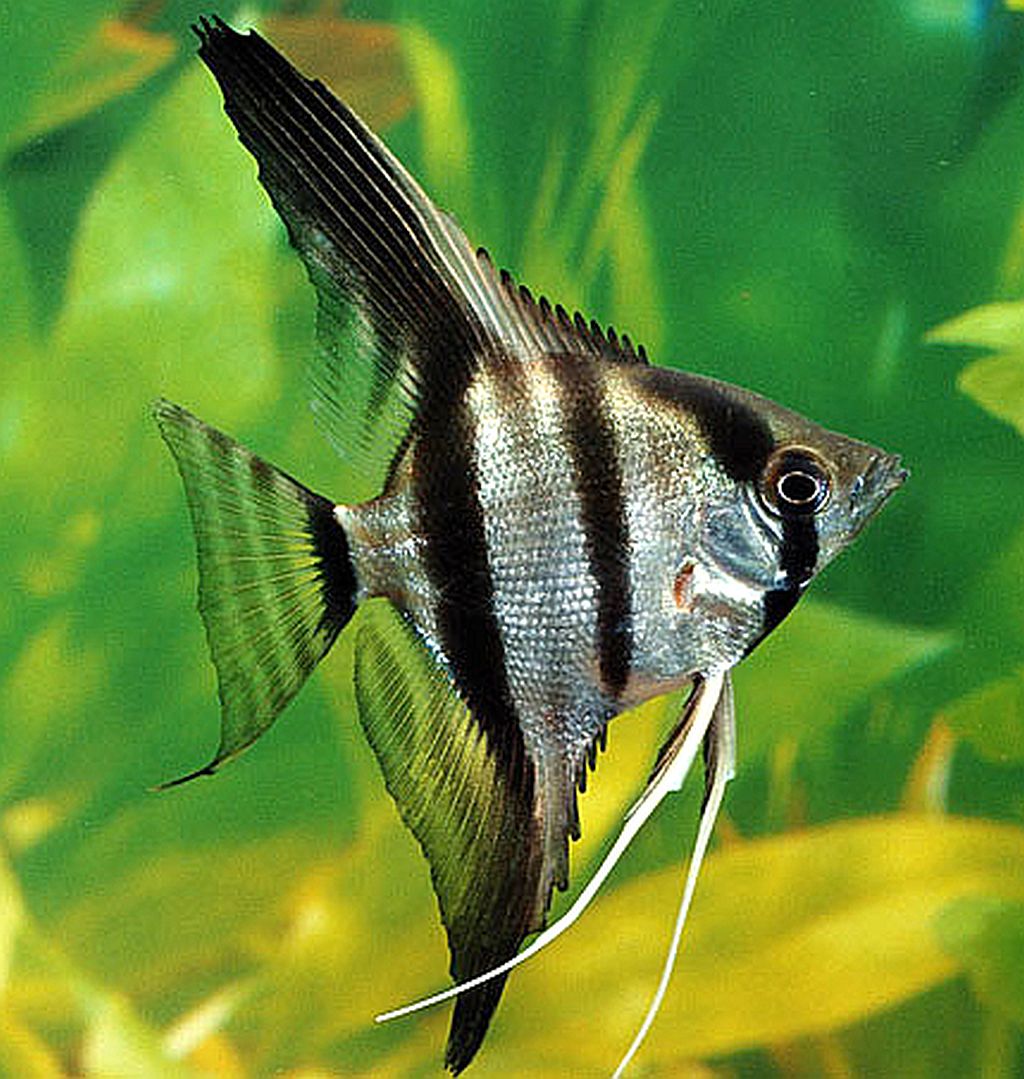
Silver Zebra Angelfish (Pterophyllum scalare) Pair

Silver Zebra Angelfish (Pterophyllum scalare)

The Silver Zebra Angelfish (Pterophyllum scalare) like all Pterophyllum species, originate from the Amazon River Basin, Orinoco Basin, and various other smaller rivers in the Guiana Shield in South America. They are a member of the family Cichlidae (Cichlids) and are all collectively known to tropical fish keeping enthusiasts as Angelfish.

In their natural environment, Silver Zebra Angelfish live in swamps and flooded areas around dense vegetation in either clear or silty colored water.  They are usually found among bulrushes and around underwater brush where they can quickly dart to shelter.  They are a relatively peaceful, social species that are often found swimming in large shoals.

There are three species of Pterophyllum, and are all unusually shaped for Cichlids.  They have round, laterally compressed bodies, elongated triangular dorsal and anal fins, and almost all wild specimens are striped longitudinally which provides them a modicum of camouflage.  Pterophyllum scalare is the most commonly kept species and no doubt the one most often bred in captivity. Pterophyllum altum is the second most common (usually captive bred) and Pterophyllum leopoldi is the smallest and least often found in the tropical fish keeping hobby.

All Pterophyllum species are egg layers that form monogamous pairs.  They generally deposit their eggs on a submerged log or a flattened leaf, and like other members of the cichlid family, exhibit highly developed care for their offspring.

Silver Zebra Angelfish (Pterophyllum scalare)

Silver Zebra Angelfish (Pterophyllum scalare)

Most Silver Zebra Angelfish purchased in the United States are captive bred and are mostly silver in color, with black or dark brown longitudinal stripes. They posses thin fins that typically extend the entire length of their body.

Silver Zebra Angelfish are considered a community fish by most tropical fish keeping enthusiasts but because they are cichlids, they may not be compatible or as sociable with smaller species. As juveniles they will school peacefully in small shoals but as they grow larger, they will pair off and become increasingly territorial.

Silver Zebra Angelfish should be kept in a densely planted tank of at least 30 gallon capacity, with a sandy or fine gravel substrate, some river rock formations, driftwood roots, and plenty of free swimming space.  These fish quickly grow big and tall,  and require as much tank space as possible.  The general rule for keeping angelfish is to provide 8 or 9 gallons of tank space per fish and because they can become quite territorial as they mature, to keep them in small groups of threes.   Six angelfish in a densely planted 55 gallon aquarium would make a nice display tank.

Because they are shy and timid, a densely planted tank is essential to keeping Silver Zebra Angelfish healthy and happy.   Amazon sword plants (Echinodorus) or other large leaved plants are preferred to give the fish places to hide, lay their eggs on, and to keep them calm.   Some driftwood is also beneficial to maintain water quality and provide them cover.

All Angelfish require good water quality and some water movement.   External canister filter are a good choice for this species.   In smaller tanks, an outside filter augmented with a small powerhead will also do an efficient job of maintaining water quality.

All angelfish are egg layers that form nuclear families.   In the wild they are open breeders and spawn on submerged leaves.  Because they are difficult to sex, the best way to breed the Silver Zebra Angelfish is to place a small school of 4 to 8 fish in a tank and let them pair off.  They become sexually mature in about 6 to 12 months, usually when they are about 2 inches in length.

Once you identify a pair, place a piece of slate, a flowerpot, or a large leafed plant into the aquarium in an area where there is a moderate amount of water flow where the pair can deposit their eggs.    Start conditioning them by feeding them a diet of protein rich foods and keep the water in the breeding tank at a pH of 6.5, a hardness of about 5° dGH, and a temperature of between 80 to 85° F.

When ready to breed, the female will lay about 1000 or more eggs on a carefully cleaned surface.   A leaf, angled piece of slate, flowerpot, or the side of the aquarium.   When the female deposits her eggs, the male will follow behind her and fertilize them.    If the parents don’t immediately eat the eggs, the eggs will hatch in 3 or 4 days and the tiny fry will be free swimming in about a  week.   Feed the fry newly hatched baby brine shrimp for the first week or two until they are able to eat finely crushed flake food on their own.

If the parents do not immediately eat their eggs, they will carefully guard them and the fry until they are able to fend for themselves.   Although the parents will swim around the tank with a shoal of tiny fry in tow until the fry are eating on their own,  it’s a good idea to remove the fry into a rearing tank to ensure that the parents don’t turn on them.

Being omnivores, Silver Zebra Angels need to be fed a variety meaty and vegetable based foods.   A quality flake food fed as a staple with live, frozen, and freeze dried bloodworms, brine shrimp, tubifex, blackworms, etc. will keep your angelfish health and happy.

Silver Zebra Angelfish are usually readily available for sale when they are approximately 3/4″ to 3″ in length.

Silver Zebra Angelfish (Pterophyllum scalare)

Silver Zebra Angelfish (Pterophyllum scalare)


Minimum Tank Size: 30 gallons
Care Level: Easy
Temperament: Semi-aggressive
Aquarium Hardiness: Hardy
Water Conditions: 75-82° F, KH 1-5, pH 5.8-7.0
Max Size: 6″
Color Form: Black, Tan, White
Diet: Omnivore
Compatibility: Community Tanks
Origin: Amazon and Orinoco River Basins
Family: Cichlidae
Life Span: 10-15 years
Aquarist Experience Level: Beginner

Posted in Angelfish, Featured Articles, Freshwater Fish, Tropical Fish Species0 Comments

Black Shark (Labeo chrysophekadion)

Black Shark (Labeo chrysophekadion)

The Black Shark (Labeo chrysophekadion) is also known to tropical fish keeping enthusiasts as the Black Shark Minnow or Black Labeo.   It is widely distributed throughout Southeast Asia and is found in the Mekong basin in Laos, Thailand, Cambodia, and Vietnam, the Dong Nai drainage in Vietnam, the Chao Phraya and Mae Klong systems in Thailand, and other smaller watersheds in southern Thailand, Peninsular Malaysia, and the Greater Sunda Islands of Borneo, Sumatra, and Java, Indonesia.

Black Sharks are found in large river channels, smaller river tributaries, canals, and in flooded plains during the rainy season. Adults forage in the floodplains and make seasonal migrations to breed in the upstream areas of their ranges.

Black Shark (Labeo chrysophekadion)

Black Shark (Labeo chrysophekadion)

In many parts of their range, the Black Shark is utilized as a food fish.

They can grow to three feet in length and in an aquarium environment are suitable only for very large home aquariums or public aquarium.

Black Sharks are often sold in the aquarium trade to tropical fish keeping enthusiasts as juveniles, but they quickly outgrow their surroundings and become belligerent and aggressively territorial towards conspecifics and similarly shaped fish, especially when space is at a premium.

This is one fish that should not be kept in a community tank with fish smaller than itself or anything that is delicate in nature.   Because of it’s aggressiveness and territorial behavior, it is best kept in a single species tank.   Although it is possible to keep them with other robust, similar sized, fast moving, mid-level species, they should be introduced into the tank last, after all the other tank inhabitants have settled in.   Even then, the fish will bully other bottom dwelling species.

Despite it’s unsuitability for home aquariums, an albino form of the Black Shark has been selectively bred for just for this purpose.

Aside from providing an extremely large tank, if you plan on keeping a Black Shark in an aquarium environment; a large mature filtration system, a rigorous maintenance regime comprised of weekly 50-70% water changes, and highly oxygenated water with some degree of water movement is considered mandatory maintenance for the species. They will also need a sandy or fine gravel substrate, some river rock and smaller boulders preferably formed into caves for them to hide among, some hardy plants like Java Fern or Anubias spp., some driftwood roots and plenty of swimming space.

In their natural environment, the Black Shark is primarily an aufwuchs grazer that feeds on algae, insect larvae, worms, small crustaceans, etc. In an aquarium environment they should be provided regular meals of live or frozen bloodworms, Daphnia, tubifex and brine shrimp, along with a good quality dried flake food or granule. They also need fresh plant material in their diet such as blanched cucumber, spinach, shelled peas, etc. Because they are grazers, they should be fed several times a day rather than a single feeding.

The Black Shark is difficult to sex and has not yet been bred in an aquarium environment.

Juvenile Black Shark are usually available online and from specialty fish shops at reasonable prices from 1 3/4″ to 3 1/2″ in size.

Black Shark (Labeo chrysophekadion)

Labeo chrysophekadion


Minimum Tank Size: 125 gallons
Care Level: Moderate
Temperament: Highly Aggressive
Aquarium Hardiness: Hardy
Water Conditions: 76-82° F, KH 10-15, pH 6.5-7.5
Max Size: 26″
Color Form: Black
Diet: Omnivore
Compatibility: Single species tank
Origin: Southeast Asia, Malaysia, Indonesia
Family: Cyprinidae
Life Span: 20 years or more
Aquarist Experience Level: Intermediate

Posted in Featured Articles, Freshwater Fish, Sharks, Tropical Fish Species2 Comments

Harlequin Shark (Labeo cyclorhynchus)

Harlequin Shark (Labeo cyclorhynchus)

The Harlequin Shark (Labeo cyclorhynchus) is native to the middle and lower Congo river basin in the Republic of the Congo, the Democratic Republic of the Congo, and the Ogooué drainage in Gabon, Africa.    It is also known to tropical fish keeping enthusiasts as the Harlequin Sharkminnow, or Varigated Shark.

The Harlequin Shark inhabits densely vegetated clear water rain forest streams with thick marginal vegetation.    They are usually collected over silt littered substrates in tannin stained waters that are littered with leaves, downed tree branches, and other decomposing organic matter where like other Labeo species, they are primarily aufwuchs feeders that  graze along the bottom for microscopic animals, algae, and other detritus.

In their natural habitat, Harlequin Sharks are aggressive loners that lead a solitary lifestyle and except during the spawning season, avoid coming into contact with others of their own kind.  They are a highly territorial fish that under no circumstances should be kept with other Labeo or Epalzeorhynchos species, including their own kind.    You can expect that most bottom dwelling species such as Bichirs or catfish to be constantly bullied by the Harlequin Shark.

Harlequin Shark (Labeo cyclorhynchus)

Harlequin Shark (Labeo cyclorhynchus)

The Harlequin Shark has an unusual gray black mottled body coloration over a creamy yellow base.   Their fins are translucent with black mottling and their bodies are shaped like Black Sharks or Rainbow Sharks.

Juvenile Harlequin Sharks have magnificent colors and markings, but their colors fade somewhat as they age.  They are notoriously hard to sex, but females are much more thicker bodied than than males, especially when in spawning condition.

Harlequin Sharks are best kept alone or in an African biotope setting with other robust, fast swimming, mid or top water species such as the larger Barbs, Danios, African Characins like  Arnoldichthys spilopterus, Brycinus longipinnis, Phenacogrammus or with some of the non African cyprinids.  They cannot be kept with others of their own kind, nor with other species that share their same body shape.   As juveniles, the Harlequin Shark will spend the majority of their time hiding but as they grow, they become highly territorial and extremely aggressive.

Harlequin Sharks require a well maintained, aged, densely planted, 55 gallon or larger aquarium set up with a silty and round rocky gravel substrate, variably sized rocks and small boulders, some driftwood branches, and plenty of nooks and crannies that can be used for hiding places.   Hardy plants such as Bolbitis, Java Fern, or Anubias can be grown and attached to the rocks or driftwood to promote the growth of algae and biofilm that the fish graze on.  Because they are a river dwelling species, the use of a powerhead in the tank is recommended to provide the beneficial current they need.

Because the Harlequin Shark is so intolerant of their own kind and almost impossible to accurately sex, there have been no successful breeding of this egg laying species in an aquarium environment.

In the wild, Harlequin Shark are highly adaptable feeders.  Some groups have become specialized towards a particular method of feeding and have been  recorded living among groups of hippopotamus, browsing on their bodies.    In an aquarium environment, they should be offered regular meals of small live, frozen or freeze dried foods such as mosquito larvae, bloodworms, Daphnia, and brine shrimp along with a good quality flake food, sinking granules, algae wafers, and plenty of vegetable matter.   Blanched spinach, shelled peas, cucumber, and finely chopped fruits make good additions to their diet and will promote their colors.

Unfortunately, Harlequin Sharks are not a common item in most tropical fish keeping shops however, from time to time they are available online from importers and specialty shops as juveniles and occasionally adults.

Harlequin Shark (Labeo cyclorhynchus)

Harlequin Shark (Labeo cyclorhynchus)


Minimum Tank Size: 55 gallons
Care Level: Moderate
Temperament: Highly Aggressive
Aquarium Hardiness: Hardy
Water Conditions: 72-81°F, dH 3-15°H, pH 6.0-7.5
Max Size: 6″
Color Form: Black, Gray
Diet: Omnivore
Compatibility: Single species tank
Origin: Central Africa
Family: Cyprinidae
Life Span: 4-6 years
Aquarist Experience Level: Intermediate

Posted in Featured Articles, Freshwater Fish, Sharks, Tropical Fish Species0 Comments

Sand's Cory (Corydoras davidsandsi)

Sand’s Cory (Corydoras davidsandsi)

The Sand’s Cory (Corydoras davidsandsi) is endemic to the lower rio Negro in Brazil where it primarily inhabits tannin stained flooded forests, creeks, and “whitewater areas” with little detectable water hardness, an acidic pH, and very low conductivity.

The Sand’s Cory is a facultative air breather that possess a modified intestine that has evolved to facilitate the breathing of atmospheric oxygen.   This allow the fish to survive in oxygen depleted environments where other species would perish and is why they will occasionally rise to the surface in your aquarium to gulp in air.

Like other Corydoras they have stiffened pectoral fin spines that are capable of piercing the skin and causing a painful sting.  Secretions from the axillary glands at the base of the spines are venomous and mildly toxic, so care should be exercised when handling them.

Sand's Cory (Corydoras davidsandsi)

Sand’s Cory (Corydoras davidsandsi)

The Sand’s Cory is similar to Corydoras melini in looks.   Both fish are tan and have a black stripe that runs from the lower dorsal fin to the lower caudal fin, just past the caudal peduncle.   However, when viewed from above, the black line splits above the caudal peduncle in the Sand’s Cory and in most other Cory species, it does not.

Additionally, it can be distinguished from Corydoras melini by it’s having a pale orange area between the dark facial stripe and the dorsal bars, and by lacking additional dark markings on it’s flanks.  Aside from the vertical eye stripe and the aforementioned back stripe, the flanks of C. davidsandsi are without further pigmentation.

Female Sand’s Corys are longer and plumper when viewed from above, especially during spawning.

The Sand’s Cory is a peaceful, gregarious species that should be housed with at least 4 to 6 of their own kind.  They are best kept in at a densely planted aquarium of at least 20 gallons or larger, with a sand or fine gravel substrate, some driftwood and rocks to provide cover, and a good filtration system that provides a small amount of current.   These fish require clean water and low nitrites to remain disease free.

The Sand’s Cory has been bred in an aquarium environment.   Two males per female should be placed in a breeding tank furnished with a sandy substrate, some plants and driftwood. When the female is visibly full of eggs, perform a 50 to 70% water change and place a small power filter or powerhead into the tank to increase oxygenation and water flow.   Repeat the water changes daily until the fish spawn.

The eggs are normally laid on the driftwood, among the plants, on spawning mops, and occasionally on the sides of the tank glass.  After spawning, either the parents or the eggs should be removed from the spawning tank.

If the eggs are removed, place them in the same well oxygenated water as the spawning tank and add a few drops of Methylene Blue or some Indian Almond Leaves to prevent fungus from developing.

In 3 to 4 days the eggs will hatch and the fry will be free swimming in another 3 days or so.   Feed the fry microworms or newly hatched brine shrimp until they are able to eat crushed flake food.

In their natural habitat, Sand’s Corys are omnivores that forage along the bottom for small insects, worms, crustaceans, and plant matter.   In an aquarium environment, they will accept most sinking dried foods, as well as live, frozen, and freeze dried bloodworms, Tubifex, blackworms, brine shrimp, etc.

They should not be expected “clean” the bottom and survive on any foods “left over” from other inhabitants of the aquarium. A well balanced diet is essential to their well being.

The Sand’s Cory is a relatively new addition to the tropical fish keeping hobby and is occasionally available online or from specialty fish shops. They are often imported with mixed shipments, and when available for purchase are usually 3/4″ to 1-1/4″ long.

Sand's Cory (Corydoras davidsandsi)

Sand’s Cory (Corydoras davidsandsi)


Minimum Tank Size: 20 gallons
Temperament: Peaceful
Aquarium Hardiness: Hardy
Water Conditions: 68-77° F, KH 2-12, pH 6.2-7.2
Max. Size: 2½”
Color Form: Black, White
Diet: Omnivore
Compatibility: Great in community tanks
Origin: Brazil
Family: Callichthyidae
Lifespan: 6 Years or more
Aquarist Experience Level: Beginner to Intermediate

Posted in Catfish, Corydoras, Featured Articles, Freshwater Fish, Tropical Fish Species0 Comments

Huge Pearlscale Goldfish (Carassius auratus)

Goldfish (Carassius auratus)

The common Goldfish (Carassius auratus) is a relatively small member of the carp (cyprinid) family that is one of the most commonly kept aquarium species in the world and arguably one of the earliest fish to be domesticated.

Special Pearlscale Goldfish (Carassius auratus)

Special Pearlscale Goldfish (Carassius auratus)

Goldfish are a domesticated version of the less colorful carp species (Carassius auratus) native to east Asia.  They were first domesticated over a thousand years ago by the Chinese where several distinct breeds have since been developed.    Though they may resemble ornamental carp, Goldfish lack the barbels in the mouth area, the markings at the base of the scales, and do not grow as large as carp and Koi.

For thousands of years in ancient China, various species of (Asian) carp were domesticated and reared as food fish.

During the Jin dynasty (265–420), breeders observed that some of these normally gray or silver Asian carp produced red, orange, or yellow color mutations.    Later, during the Tang dynasty (618–907) when it became popular to raise carp in ornamental ponds and water gardens, a yellowish orange (gold) genetic mutation was produced from the normal silver colored variety and people began to selectively breed them instead of the silver variety.

Goldfish domestication was firmly established by the Song dynasty (960–1279) and because yellow (gold) was the imperial color, the empress ordered the collection of all the red and gold varieties of goldfish and made it unlawful for the common people to keep goldfish of the yellow variety.   This is no doubt this is why there are more orange than yellow goldfish, even though yellow goldfish are genetically easier to breed.

During the Ming dynasty (1368–1644) Goldfish began to be raised indoors.  This allowed breeders to selectively breed mutations (such as the fancy tailed goldfish) that would not have been able to survive in outdoor ponds.

During the 1600s, Goldfish were introduced into Japan, Portugal, and other parts of Europe where they were highly regarded as a symbol of good luck and fortune.   They were not introduced into North America until around 1850 where they quickly became popular with tropical fish keeping enthusiasts.

There are currently about 300 recognized breeds of “goldfish” in China.  Selective breeding over the centuries has produced many color variations, body shapes, fin types, and eye configurations that may be hardier or less hardy than the “wild” Prussian carp (Carassius auratus gibelio) they were originally bred from.

Today, the majority of goldfish breeds originated from China and since it is virtually impossible to list them all, we have chosen some of the main and more popular varieties and listed them below:

Goldfish (Carassius auratus) The Common goldfish differ only in color from their closest relative, the Prussian or Gibel carp.   They are found in a variety of colors including red, orange, gold, white, black and yellow, and lemon.


Black Moor Telescope (Carassius auratus) The Black telescope, also referred to as the Black Moor, is a black variant of the telescope goldfish that has a characteristic pair of protruding eyes.   They are also referred to as popeye goldfish, telescope goldfish, kuro Demekin in Japan, and Dragon Eyes in China.


Bubble EyeBubble Eye goldfish are a small dorsal-less fancy variety that have upward pointing eyes accompanied by two large fluid-filled sacs.


Celestial Eye

The Fancy Celestial Eye goldfish or Choten gan has a double tail and a pair of upturned, telescopic eyes with the pupils gazing skyward.


Comet-tailed goldfishThe comet small or Comet-tailed goldfish is the most common fancy variety in the United States.   It resembles the common goldfish but it is slightly smaller, slimmer, and can be easily distinguished by its long, deeply forked tail.


Fantail Goldfish The Fantail goldfish is the western form of the Ryukin and possesses an egg-shaped body, a high dorsal fin, a long quadruple caudal fin, and no shoulder hump.


Lionhead GoldfishThe fancy Lionhead Goldfish has a tremendous hood or head growth with fat cheeks and a turned down tail.   This goldfish is the precursor to the Japanese bred ranchu.


OrandaThe fancy Oranda is characterized by a prominent bubble like “hood” on the head (also known as wen or head growth) that encases the whole head except for the eyes and mouth.


PearlscaleThe fancy Pearlscale or (in Japanese) Chinshurin, is a spherical (golf ball) bodied variety with fins  similar to the Fantail variety.

They can grow to tennis ball size.


Pompon or Hana Fusa The fancy Pompon or Hana Fusa goldfish have bundles of loose fleshy outgrowths between their nostrils, on each side of the head.


RyukinThe fancy Ryukin is a short, deep body goldfish with a characteristic shoulder hump.  They can be long-finned or short-finned with either a triple or quadruple tail.  The dorsal fin is high and the caudal fin is often twice as long as the body.


Shubunkin GoldfishThe Japanese Shubunkin goldfish is a hardy, single tail variety with nacreous scales and a pattern known as calico.  It is a cross between the Calico telescope eye and the Common goldfish.


Calico Teltscope GoldfishThe fancy Telescope goldfish is characterized by its protruding eyes. It is also known as the Globe eye or Dragon eye goldfish.


Ranchu GoldfishThe fancy Ranchu goldfish is a hooded variety that was developed in Japan by crossing different Lionhead goldfish.  In Japan it is referred to as the  “king of goldfish”.


Telescope Panda The fancy Panda Telescope is a panda variant of telescope goldfish.  They have the characteristic (Panda) black and white color pattern with telescopic protruding eyes.


Veiltail Goldfish

The fancy Veiltail goldfish is knwn for its extra long, flowing double tail and it’s sail type dorsal fin.   The hallmark of the breed is it’s long, graceful double tail which is square edged and without any forking or indentation between the lobes.  Modern standards require little to no indentation of the trailing edges of the caudal fins, as in a wedding veil for a bride.

Butterfly Tail GoldfishThe Butterfly Tail Moor or Butterfly Telescope is twin tailed variety of goldfish that when viewed from above resembles the spread of a butterfly’s wings.


Meteor goldfishThe Meteor goldfish is a strange looking variety that was developed by specialist breeders to have no tail fin, hence its name.  Despite the lack of a caudal fin, the other fins are elongated and it is said to swim surprising well.


LionchuThe Lionchu or Lionhead Ranchu goldfish is a result of crossbreeding Lionhead goldfish with Ranchus.


Egg-fish goldfishThe Egg-fish goldfish is a fancy goldfish that lacks a dorsal fin and has a pronounced egg shaped body.  The Phoenix is a Chinese variety of the Egg-fish that also has an egg shaped body and a long tail, without a dorsal fin and no head growth.   Both varieties are bred in all shades of color and scale types.

Shukin goldfishThe Shukin goldfish is Ranchu like variety that was developed in 19th century Japan from the Oranda varieties.   It’s body is shaped like a long Ranchu and it’s tail is long like the Oranda.  They come in red, red and white, white, blue, and silver.


Curled-gill goldfishThe Curled-gill or Reversed-gill goldfish is an uncommon variety that has was developed by specialist breeders.  Although it resembles a Ryukin, it’s name is derived by the unusual out turned appearance of its gill covers.


Tamasaba

The Tamasaba or Sabao goldfish is a rarer Japanesevariety that has a body shaped similar to the Ryukin with a very long, flowing, single tail that resembles a mackerel’s tail, hence its other common name, Mackerel Tail.


Tosakin The Tosakin or Curly fantail goldfish is a very distinctive breed with a large tail fin that spreads out (like a fan) horizontally behind the fish.
Although it technically has a divided tail, the two halves are attached at the center, in the middle to form a single fin.

Goldfish are a peaceful, gregarious species that often display schooling behavior and are able to thrive in a wide variety of environmental conditions.  They  are suitable for cooler water community aquariums, small water gardens, and outdoor ponds.

The only time they ever display any type of combative behavior towards each other is when they are competing for food.   For this reason, it is recommended that only breeds with similar body types and swimming characteristics be kept together.

Mixing faster swimming breeds like Comets, with slower swimming variants like Pearlscales, can lead to stunted growth or starvation, especially in ponds and water gardens.   The faster fish will quickly eat all the food before the slower swimming species can get to it.

Goldfish are best kept in large aquariums, water gardens, and ponds of at least 180 gallons or larger.  They do best with a gravel substrate, river rocks, and cold hardy plants.   When using a fine gravel or sandy substrate, place some large rocks around the base of the plants to protect their roots from being dug up by the fish.  Goldfish will eat the roots of plants and love to dig around in the substrate.

All goldfish are messy and expel copious amounts of waste, so adequate filtration is necessary to maintain proper water quality.

Goldfish are relatively easy to breed.  Generally before goldfish will begin to spawn,  the water temperature needs to drop down to 64*F for up to a 4 month period.   After 4 months at 64 degrees F, a slow warming of the water to 70-74 degrees F will trigger the spawning process.

The Male goldfish will endlessly chase the female around the tank until she tires out and releases her eggs (up to hundreds of thousands)  all over the tank.   Most of the eggs will adhere to the plants in the breeding tank or pond and the male will spray his milt over the eggs.  The tank or pond water will turn milky from the milt and in about 3 to 4 hours the spawning should stop.

Remove the fertilized eggs from the tank or pond, and place them into a separate 3 to 5 gallon rearing tank with heater, an air powered sponge filter, and not more than 6 inches of water.  Too much water makes it difficult for the fry to swim to the surface.

At 70 degrees F. the eggs will hatch in about 5 days.  At 65 degrees F. it will take 7 days for the eggs to hatch.  Remove all the white and fungus covered eggs from the tank.  Healthy eggs will be transparent in color.  After four days you should be able to see a small black dot inside the goldfish eggs and around the 7th day, the fry will emerge from the eggs and stick to the plants in the tank.  After 3 more days the fry will be free swimming.

The fry can be fed micro worms, crushed hard boiled egg yolk, finely crushed omnivore flakes, liquid fry food, or frozen baby brine shrimp.  Feed the fry three times a day, with as much as they can consume without fouling the water.  The fry grow quickly and should be transferred to “growing” tanks as they outgrow their surroundings.

In the wild Goldfish are opportunistic feeders and will forage on insects, crustaceans, and a variety of plant matter.   They do not stop eating on their own accord and domestically bred goldfish can actually gorge themselves to death.  When you spot a fish with feces trailing from the fish’s cloaca, it is being overfed and they are producing more waste than their intestinal tract can digest.

Goldfish flakes have less protein and more carbohydrates than conventional fish foods and should be provided as a staple with occasional supplements of bloodworms, blanched leafy vegetables and peas with the shells removed.  Young goldfish will also benefit from fresh live or frozen brine shrimp.

Wild Goldfish (Carassius auratus)

Wild Goldfish (Carassius auratus)


Minimum Pond Size: 180 gallons
Care Level: Easy
Temperament: Peaceful
Aquarium Hardiness: Hardy
Water Conditions: 36-90° F, KH 2-12, pH 6.8-7.2
Max. Size: 18″
Color Form: Orange, Red, White, Black
Diet: Omnivore
Compatibility:  Community tank or pond
Origin: China
Family: Cyprinidae
Lifespan: 30 years
Aquarist Experience Level:  Beginner

Posted in Featured Articles, Freshwater Fish, Goldfish, Tropical Fish Species1 Comment

Celebes Rainbow (Marosatherina ladigesi)

Celebes Rainbow (Marosatherina ladigesi)

The Celebes Rainbow (Marosatherina ladigesi) formerly Telmatherina ladigesi, is a species of sailfin silverside endemic to the Island of Sulawesi (Celebes) in Indonesia and is found only near the town of Maros.    They are also known to tropical fish keeping enthusiasts as the Celebes Rainbow Fish, Celebes Sailfish, and Celebes Sailfin.

The Celebes Rainbow can be found in clear, slow flowing, fresh to slightly brackish water streams and estuaries in areas with high levels of dissolved oxygen where they spend a good portion of the day hiding among the leaves of plants eating insects, small worms, vegetable matter, etc.

Celebes Rainbow (Marosatherina ladigesi)

Celebes Rainbow (Marosatherina ladigesi)

The Celebes Rainbow fish is a peaceful, slender, almost transparent schooling species that has a blue stripe that runs along the lateral line of the body.   Males are larger, darker colored than females, and have more elongated black colored, second ventral and dorsal fins.

Celebes Rainbow fish can be housed with other peaceful shoaling species in at least a 20 gallon aquarium that is densely planted with a sandy or fine gravel substrate, some smooth river rock, a few pieces of driftwood, and plenty of free swimming space.

Some good tank mates include other hard water species such as similarly sized rainbow fish, live bearers, and smaller freshwater gobies. Like many rainbow fish they can be skittish and should be kept in small shoals of at least 6 to 8 of their own kind, preferably in a ratio of 2 to 3 females for every male.

Natural lighting intensifies their colors, as does a dark substrate, but floating plants should be included to provide them with the dimly lit conditions they prefer.  High water quality is essential to the well being of this species, so weekly partial water changes are recommended. Because they are so sensitive to water conditions, an “aged”, well aerated aquarium with good filtration is mandatory.

The Celebes Rainbow is an egg scatterer that will drop their eggs among fine leaved plants, Java Moss, or in nylon spawning mops. Their breeding tank should be at least 18 inches long and filled with aged, slightly hard, alkaline water, kept at a pH of 7.5 and a temperature of around 72-74°F. No substrate is needed with the plants, moss or spawning mops but a small air powered sponge filter should be added for oxygenation and water flow.

Condition a group by feeding them live or frozen food, select the best looking pair, and place them into the breeding tank.  Drop the water temperature a couple of degrees and spawning activity should commence.   The pair will continue to lay several batches of eggs attached by a small thread to the Java moss or spawning mops daily, for a period of several weeks or more. Depending on the water temperature, the eggs will usually hatch within 5 to 10 days and the fry will be free swimming shortly thereafter. After spawning, either remove the parents from the spawning tank or remove the plants or mops to a rearing tank to prevent the parents from eating their eggs.

Initially, the minute fry should be fed infusoria for a week or so until they are able to consume freshly hatched baby brine shrimp, daphnia
, or finely crushed flake food. The fry will remain at or near the water surface, so crushed floating foods are recommended over sinking varieties.

The Celebes Rainbow is an omnivore that has a large mouth but a small throat. They eagerly eat a diet of fresh, frozen, or freeze dried bloodworms, brine shrimp, tubifex, or Spirulina in addition to a quality omnivore flake food. Several small feedings a day are recommended in lieu of feeding single large portions.

Wild Celebes Rainbow populations have been dramatically reduced because of pollution and over harvesting for the ornamental tropical fish keeping hobby however, European and Far Eastern farm bred specimens are readily available online and from specialty tropical fish keeping shops at sizes from 1-1/4″ to 2″.   Wild caught specimens are seldom if ever available for purchase.

Celebes Rainbow (Marosatherina ladigesi)

Celebes Rainbow (Marosatherina ladigesi)


Minimum Tank Size: 20 gallons
Care Level: Easy
Temperament: Peaceful
Aquarium Hardiness: Relatively Hardy
Water Conditions: 72-82° F, KH 10-25, pH 7.0-8.0
Max. Size: 3″
Color Form: Black
Diet: Omnivore
Compatibility: Peaceful Community
Origin: Indonesia
Family: Atherinopsidae
Lifespan: 3-5 years
Aquarist Experience Level: Beginner/Advanced

Posted in Featured Articles, Freshwater Fish, Rainbowfish, Tropical Fish Species3 Comments

Hornet Cichlid (Tilapia buttikoferi)

Hornet Cichlid (Tilapia buttikoferi)

Africa’s Hornet Cichlid (Tilapia buttikoferi) inhabits the coastal rivers of Western Africa from Guinea-Bissau to West Liberia and is also known to tropical fish keeping enthusiasts as the Buttikoferi Cichlid, Tiger Tilapia, Zebra Tilapia, and Hornet Tilapia.

Hornet Cichlids prefer the deeper waters and rocky habitats of vegetation choked West African rivers with salinities between next to nothing to nearly seawater strength at their mouths.   They forage among the rock crevices for small crustaceans, worms, small fish, and vegetable matter.   They are highly aggressive, extremely territorial, and in the wild maintain large territories.

Hornet Cichlid (Tilapia buttikoferi)

Hornet Cichlid (Tilapia buttikoferi)

The Hornet Cichlid is a large oval shaped, robust species that is colored black with a series of 7 to 9 yellow to white vertical bands running down the body.

The vertical black bars are broader than the lighter yellow or white bands, and their stripes tend to fade as they age.   The head is colored a dusky yellow, their throat and fins are black, and all but their anal and pelvic fins have the same striping as the body.

The fins in mature males are more pointed than in females and they display a slight nuchal hump, especially during spawning.

Although juvenile Hornet Cichlids are relatively peaceful, their dispositions degrade as they grow older and they become extremely territorial.

Although they can be housed with other large aggressive or semi-aggressive fish, the Hornet Cichlid is best kept alone in a single species tank.   They become extremely aggressive towards smaller fish, so if you don’t house them in a species tank, it is important to keep them with similar sized specimens.

The ideal setup for Hornet Cichlids is a large mature tank of at least 100 gallons with a medium size gravel substrate, some hardy (potted) plants, plenty of rock work, and several pieces of driftwood.   They are diggers and tend to move around the decor in their surroundings, so any decorations should be securely anchored.

They are messy fish and require good filtration for their system.   Canister filters are a perfect choice for these fish.

Hornet Cichlid (Tilapia buttikoferi)

Hornet Cichlid (Tilapia buttikoferi) and Young

Hornet Cichlids or Buttikoferi Cichlids are substrate spawners and have been successfully bred in an aquarium environment as well as in commercial fish farms.   Unfortunately, the males and females are colored identically so there is no sure way to differentiate between sexes.

Males are believed to be larger than females, but unless a breeding pair is purchased, the best way to obtain a pair is to place several juveniles in a large aquarium until a couple pairs off.   When this occurs, remove the rest of the fish from the tank and condition the pair for breeding.

A slight increase in water temperature will sometimes induce spawning behavior.   When ready to spawn, the pair will dig a pit in the substrate where the female lays her eggs.   The male fertilizes them and both parents guard the eggs and fry until they are able to fend for themselves.   The fry can be fed newly hatched baby brine shrimp and crushed omnivore flake food until larger foods can be eaten.

In an aquarium environment, Hornet Cichlids will eat almost anything placed in front of them.   They do best with a quality omnivore cichlid stick as a staple, along with regular supplements of live, frozen, or freeze dried foods such as prawns, brine shrimp, mosquito larvae, earthworms, shrimp, and blanched peas or spinach.  Two or three smaller feedings a day is preferred to a single feeding schedule.

The Hornet Cichlid is an extremely intelligent and aggressive aquarium species that reacts to movements outside of the aquarium glass.  They can be “trained” by offering them food and they recognize their owners when they enter the room.   Despite their aggressiveness, they remain popular with many tropical fish keeping enthusiasts.

Hornet Cichlids or Buttikoferi Cichlids are available online and through specialty tropical fish keeping shops.   They are usually sold as juveniles when they are 1″ to 1-1/2″ in size, but can be purchased as proven pairs as adults.

Hornet Cichlid (Tilapia buttikoferi)

Hornet Cichlid (Tilapia buttikoferi)


Minimum Tank Size: 100 gallons
Care Level: Easy
Temperament: Aggressive
Aquarium Hardiness: Hardy
Water Conditions: 73-79° F, KH 10-15, pH 6.8-7.5
Max. Size: 14″
Color Form: Black, White, Yellow
Diet: Omnivore
Compatibility: Single species tank
Origin: Western Africa
Family: Cichlidae
Lifespan: 10-15 years
Aquarist Experience Level: Advanced

Posted in African Cichlids, Featured Articles, Freshwater Fish, Lake Victoria, West Africa and Madagascar, Tropical Fish Species9 Comments

Midas cichlid (Amphilophus citrinellum)

Midas cichlid (Amphilophus citrinellum)

The Midas cichlid (Amphilophus citrinellum) is endemic to the San Juan River in Nicaragua and Costa Rica, and is one of the most belligerent cichlids known to tropical fish keeping enthusiasts.   They are frequently confused with the Red Devil cichlid (Amphilophus labiatus) which has larger lips, a smaller nuchal hump and less thickly set in appearance.

The Midas Cichlid prefers large lakes, ponds, and slower moving areas of large rivers where they tend to favor living among the rocky walls and banks where they can easily forage among the crevices for smaller fish, a variety of mollusks, and plant materials.   They have powerful jaws, sharp teeth, and are extremely aggressive in the wild as well as in an aquarium environment.

Midas cichlid (Amphilophus citrinellum)

Midas cichlid (Amphilophus citrinellum)

Midas Cichlids exist in several color forms dependent on where they have been collected.  Some specimens are colored pink, white, yellow, orange and gold, but most wild caught specimens are grey to olive brown in color with a characteristic pattern of black horizontal banding.

The more brightly colored forms (called “golds”) exist naturally throughout their range.   In nature, the males have nuchal humps which in aquarium specimens, have become more accentuated by selective breeding through several generations.

Mature males are more “well built” than females, have longer dorsal and anal fins, and possess a more pronounced nuchal hump.  The genital papilla in males is thinner and more elongate than the papilla in females.

In the wild, the nuchal humps only develop during the breeding season, however, in an aquarium environment many show specimens possess enormous, permanent humps.

Extensive hybridization between Amphilophus citrinellum and other species has produced white, grey, yellow, orange, gold, red, barred and piebald forms as well as the Flowerhorn and Parrot Cichlid.

Parrot cichlid hybrid (Amphilophus citrinellum)

Parrot cichlid hybrid (Amphilophus citrinellum)

Not surprisingly, it is the more colorful variants that have become the most popular with tropical fish keeping enthusiasts.

Midas Cichlids should NOT be housed in a densely planted tank.   They are fond of shifting around large quantities of substrate and will quickly destroy any well decorated aquarium, regardless of size.

They can be housed in a large aquarium with a gravel substrate, some pieces of driftwood, plenty of rocks for cover, and a even a few large flowerpots.   You can try using anchored plastic plants, but expect them to be rearranged on a regular basis.   These fish are so aggressive that they will even attack unprotected heaters, filter outlets, etc. unless they are placed behind some heavy rocks or anchored with strong suction cups.

They require an efficient filtration system and weekly water changes to deal with the huge amount of waste these messy fish produce.   An outside canister filtration system is recommended to maintain water quality and keep the dissolved oxygen levels in the tank elevated.  Large air stones can also be provided to maintain the required oxygen levels.

Because Midas Cichlids are so aggressive, they need an extremely large tank with plenty of rock work and driftwood to minimize their behavior, especially if they are to be housed with other fish.   Although it is possible to keep them with other aggressive Central American cichlids like Convicts, Jack Dempseys, Oscars, Green Terrors, Umbees as well as large catfish, large Loricariids, and even large fast swimming fish like tinfoil barbs or silver sharks, but they are best kept isolated in a “show” tank.

Midas cichlid (Amphilophus citrinellum) pair

Midas cichlid (Amphilophus citrinellum) pair

Breeding Midas Cichlids is fairly straightforward provided you can obtain a compatible pair however, getting a compatible pair is the problem.  It is possible to pair up adult fish by placing a tank divider in the breeding tank and letting the potential pair get used to each other for a few weeks before removing the divider.  Unfortunately, this does not always come to a successful conclusion.

A better method is to purchase at least 6 or more juveniles, raise them together, and allow them to pair off naturally.   When a pair forms, the other fish in the tank should immediately be removed from the tank to prevent them from being killed.

Once you have a pair they will usually breed without too much more encouragement from you.  Place the pair in at least a 6 foot wide tank with plenty of rocks and heavy flowerpots to act as potential spawning sites and feed them live foods to get them into spawning condition.  The increased size of the nuchal hump of both sexes indicates that the fish are in spawning condition.

Spawning is usually a violent affair that can be quite prolonged.  Both fish will exhibit gaping, tail slapping and a lot of digging behavior.  When ready to spawn, the ovipositor of the female will be clearly visible and the female will rub her lateral line along the hump of the male.  If the male does not turn on the female and kill her, the pair will lay eggs inside a flower pot, cave, or on a vertical rock where the male fertilizes them.  Both parents care for the eggs and will viciously defend their territory, so keep your hands out of the tank during this period.

The eggs will hatch in 2 to 3 days and the fry will be moved to a pit excavated in the substrate.   The fry become free swimming 5 to 7 days later and at this point, a divider should be placed into the tank to protect the female from the male.   Leave the fry in the tank or the male may get confused and try to mate with the female a second time and potentially kill her.

The fry grow quickly and should initially be fed brine shrimp until they are able to accept dried foods.  When they are born they are gray in color but will begin to change colors when they are about 2″ to 2 1/2″ in size.

Midas Cichlids are not fussy eaters and will try to eat anything you put in the tank.   They do best on a staple diet of high quality cichlid sticks with regular supplements of live, frozen, or freeze dried foods such as prawns, earthworms, mussels, shrimp, and blanched peas or spinach.   They should not be fed red meats or beef heart since these high protein foods can cause digestive problems.   Because Midas Cichlids predate on other fish in their natural habitat, many tropical fish keeping enthusiasts feed them live “feeder” fish, however in an aquarium environment, diseases can be introduced into the system and there is little proof that any benefit results in feeding them live fish.

Despite it’s aggressiveness, the Midas Cichlid is one of the most popular aquarium species among cichlidophiles.   They have great personalities and quickly learn to recognize their owners.   They also seem to display a greater level of intelligence than other aquarium species and can even be trained to perform tricks in reward for food.

Midas Cichlids are available online at reasonable prices in sizes from 2″ to 4″ in size and as adults.

Midas cichlid (Amphilophus citrinellum)

Midas cichlid (Amphilophus citrinellum)


Minimum Tank Size: 100 gallons
Care Level: Difficult
Temperament: Super Aggressive
Aquarium Hardiness: Hardy
Water Conditions: 69.8-78.8° F, KH 5-25, pH 6.0-8.0
Max. Size: 12-14”
Color Form: Gray, Orange, Red, Yellow
Diet: Omnivore
Compatibility: Single species tank
Origin: Nicaragua, Costa Rica
Family: Cichlidae
Lifespan: 10-15 years
Aquarist Experience Level: Advanced

Posted in Central American Cichlids, Cichlids, Featured Articles, Freshwater Fish, New World Cichlids, Tropical Fish Species2 Comments

Tire Track Eel (Mastacembelus armatus)

Tire Track Eel (Mastacembelus armatus)

The Tire Track Eel (Mastacembelus armatus) is native to the rivers and streams of India, Pakistan, Sumatra, Sri Lanka, Thailand, Viet Nam, Indonesia and other parts of South East Asia.   They are also known to tropical fish keeping enthusiasts as the Zigzag eel, Spiny Eel, Leopard Spiny Eel, Marbled Spiny Eel, Giant Spiny Eel, Giant Mottled Eel, Car Track Spiny Eel, and White Spotted Spiny Eel.

Although the Tire Track Eel is a popular aquarium fish in Europe and the United States, they are regarded as a food fish in their native countries.

Tire Track Eel (Mastacembelus armatus)

Tire Track Eel (Mastacembelus armatus)

Tire Track Eels are a nocturnal predator species that are members of the Mastacembelidae family, which are not true eels.  They thrive in still waters, highland streams, lowland wetlands, coastal marshes, and highly vegetated rivers with sandy or rocky riverbeds. In the rainy season during the summer months, they can be found in canals, lakes, and other areas of the flooded plains.

Tire Track Eels are a large elongated snake like fish that are devoid of pelvic fins. Their anal and dorsal fins are elongated and connected to their caudal fin and numerous spines can be found just before their dorsal fin.

Tire Track Eel (Mastacembelus armatus)

Tire Track Eel (Mastacembelus armatus)

They are colored a dark beige along the back with a silver beige head. The body is colored a dull brown with a lighter shade of brown on the belly. Circular brown patterns mark the body along with one to three darker longitudinal zig zag lines that connect to form a distinctive reticulated pattern along the dorsal two thirds of their body. Brown stripes run laterally through the eyes of the fish. Adult female Tire Track Eels are plumper than males but indistinguishable as juveniles.

The Tire Track Eel should be keep in a large single species aquarium of at least 100 gallons with a sand or fine gravel substrate, some driftwood, rock work in the form of caves, and some potted or floating plants. Because they are fond of digging into the substrate and burying themselves, they will uproot plants and quickly rearrange any decorations in the tank.

They should not be kept with smaller fish that they might consider a meal but can be housed with other large species. They are commonly kept in a community aquarium environment with knifefish, danios, medium to large gouramis, loaches, Loricariids, eartheaters, acaras, Cichlasomines, and Asian catfish. Adding 2 teaspoons of aquarium salt for every 2 1/2 gallons of tank water is beneficial to this species.

Tire Track Eels have never been bred in an aquarium environment and although they reproduce abundantly in the wild, there are no known successful breeding programs.

As a nocturnal carnivore, Tire Track Eels feed on benthic insect larvae, earthworms, blackworms, and occasionally on submerged plant material in their natural environment. In an aquarium environment, they should be fed live, frozen, or freeze dried foods such as live fish, tubifex worms, brine shrimp, ghost shrimp, mosquito larvae, bloodworms, cyclops, krill, or even ocean plankton.

Tire Track Eels are wild caught and available to tropical fish keeping enthusiasts online and seasonally from specialty specialty shops when they are 3″ to 6″ in size.

Tire Track Eel (Mastacembelus armatus)

Tire Track Eel (Mastacembelus armatus)


Minimum Tank Size: 125 gallons
Care Level: Moderate
Temperament: Semi Aggressive
Aquarium Hardiness: Hardy
Water Conditions: 72-82° F, KH 10-16, pH 6.8-7.2
Max. Size: 2′6″
Color Form: Brown, Tan
Diet: Carnivore
Compatibility: Single species tank
Origin: Southeast Asia
Family: Mastacembelidae
Lifespan: 8-19 years
Aquarist Experience Level: Intermediate

Posted in Eels, Featured Articles, Freshwater Fish, Tropical Fish Species1 Comment

Red Marbled Oscar (Astronotus ocellatus)

Oscar (Astronotus ocellatus)

The Oscar (Astronotus ocellatus) is a popular South American cichlid species that is also known to tropical fish keeping enthusiasts as the Tiger Oscar, Marble Cichlid and Velvet Cichlid.

Astronotus ocellatus is native to Brazil, Colombia, Ecuador, French Guiana, Peru, and occurs in the Amazon River basin, along the Amazonas, Içá, Negro, Solimões, and Ucayali River systems, as well as in the Approuague and Oyapock River drainages.

Feral populations occur in northern Australia, China, and southern Florida where they were introduced as a byproduct of the tropical fish keeping hobby.   Fortunately, its intolerance to cooler water temperatures (less than 55.22 °F) has limited its distribution to more tropical areas.

In their natural environment, Oscars prefer slower moving, white water areas where they stage around submerged tree branches and other cover to prey on small fish, worms, insects, crayfish and other crustaceans.

The Oscar is a popular aquarium species in the United States but in their natural habitat they are commonly harvested as a food fish and are frequently found in local fish markets.


Wild Oscar (Astronotus ocellatus)

Wild Oscar (Astronotus ocellatus)

Wild caught Oscars are darkly colored with yellow ringed spots or ocelli on the dorsal fin and caudal peduncle.   They are able to quickly change their coloration when confronted with aggressive conspecifics.

The eye spots are believed to minimize the amount of fin nipping caused by predators like piranha (Serrasalmus spp.) that occur with them in their natural range.

Juveniles are striped with white and orange wavy bands, and have spots on their heads.

Several varieties of Astronotus ocellatus have been developed by breeders over the years for the aquarium hobby.   These include the Red Tiger Oscar which has marbled patches of red pigmentation, the Red Oscar which has mainly red coloration on its flanks, Albino Oscars which are all white, Zebra Oscars which are black and white with gray shading, and a recently developed long finned variety called the Veil Tail Oscar.

Red Tiger Oscar (Astronotus ocellatus)

Red Tiger Oscar (Astronotus ocellatus)

Red Oscar (Astronotus ocellatus)

Red Oscar (Astronotus ocellatus)

Albino Oscar (Astronotus ocellatus)

Albino Oscar (Astronotus ocellatus)

Bumblebee Oscar or ‘Sao Paulo Bumblebee Oscar' (Astronotus Orbicularis)

Bumblebee Oscar or ‘Sao Paulo Bumblebee Oscar’ (Astronotus Orbicularis)

Red Marbled Oscar (Astronotus ocellatus)

Red Marbled Oscar (Astronotus ocellatus)

Veil Tail Oscar (Astronotus ocellatus)

Veil Tail Oscar (Astronotus ocellatus)

Yellow Oscar (Astronotus ocellatus)

Yellow Oscar (Astronotus ocellatus)

The Tiger Oscar has a blue black body with a beautiful orange red pattern and a brightly colored eye spot.    The Yellow Oscar is a relatively new variety to the trade that has a minimal eye spot.

Differentiating sexes is difficult but during spawning the females develop genital papilla and are slightly plumper in appearance.

Oscars require a large lightly planted aquarium of at least 70 gallons with a deep sand or fine gravel substrate, a few large rocks, and some driftwood
for them to hide among.   Because they are substrate “diggers”, its a good idea to either use floating plants in the tank or bury some potted plants into the substrate, covered with a few small rocks to hold them down.

Oscars are not as territorial as other cichlids, however they are predaceous carnivores and will eat anything large enough for them to fit into their mouths.   As juveniles, they cluster together for protection and as they grow into adulthood, they will form into pairs, make a nuclear family, and become generally peaceful in nature.

When keeping Oscars in an aquarium environment, it is best to keep either one specimen in a tank, or at least six specimens in a tank to minimize aggressiveness.  Keep in mind that as the fish grow, each specimen will require at least 70 to 80 gallons of water to thrive.  This means that if you purchase 6 Oscars, you will eventually need at least a 500 gallon tank to keep them happy and safe from each other.

Oscars can be housed in a large community aquarium with large Plecostomus, Texas Cichlids, Jack Dempseys, Salvini, White Tip Sharks, Clown Knifefish, Tinfoil Barbs, Black Barred Tiger Fish, groups of large Clown Loaches,  and even some of the larger freshwater eels like the Snowflake Eel.

Oscars are relatively easy to breed in an aquarium environment however they need a large tank of at least 100 gallon capacity.   They will spawn in clean clear water that is between 79 and 86°F. The hardness of the water is irrelevant as long as the water quality is pristine.

When ready to spawn, the pair will carefully clean off an area on a rock where the female will deposit between 1,000 to 2.000 opaque eggs.   The eggs turn transparent within 24 hours and will hatch shortly thereafter.   The parents will guard and care for the fry by digging shallow pits in the substrate where they are herded.   When the fry are free swimming, they can be fed baby brine shrimp, Cyclops, daphnia and later, crushed flake food.  There is usually no need to separate the parents from the fry.

Oscar are predatory carnivores that are hearty eaters in an aquarium environment.   They will eat a variety of fresh, frozen and freeze dried meaty foods such as small fish, bloodworms, tubifex
, earthworms, small shrimp, and ocean plankton.   They will eagerly eat Cichlid pellets and large size flake foods but should not be fed beef heart, mammal or poultry meats, goldfish, or rosy red feeder minnows.

Oscars of all varieties are usually available for purchase when they are 1 1/2″ to 3 1/2″ or larger in size.

Red Oscar (Astronotus ocellatus)

Red Oscar (Astronotus ocellatus)


Minimum Tank Size: 70 gallons
Care Level: Easy
Temperament: Semi Aggressive
Aquarium Hardiness: Hardy
Water Conditions: 72-77° F, KH 5-19, pH 6.0-8.0
Max. Size: 1′
Color Form: Black, Orange, Red
Diet: Carnivore
Compatibility: Single species tank
Origin: Amazon, South America
Family: Cichlidae
Lifespan: 10-15 years
Aquarist Experience Level: Beginner

Posted in Cichlids, Featured Articles, Freshwater Fish, New World Cichlids, South American Cichlids, Tropical Fish Species4 Comments

Red Fin Shark (Epalzeorhynchos munense)

Red Fin Shark (Epalzeorhynchos munense)

The Red Fin Shark (Epalzeorhynchos munense) is a rare species of cyprinid fish found in the Mekong, Chao Phraya, and Mae Klong rivers basins in Indochina that closely resembles the Rainbow Shark (Epalzeorhynchos frenatum).

The Red Fin Shark was named for the Menam Mun River at Tha Chang, East of Korat in eastern Thailand from where it was first collected, and unlike the Rainbow Shark, it is rare in the aquarium trade and has not been commercially bred in Southeast Asian farms.   Specimens have been recorded from some other tributaries of the middle Mekong in both Thailand and Laos, and may occur in Cambodia as well.

The Red Fin Shark is a benthopelagic species that is usually found among boulders and rocks in flowing rivers and streams for most of the year, but are known to move into seasonally inundated floodplains and forested areas during the rainy seasons.

Red Fin Shark (Epalzeorhynchos munense)

Red Fin Shark (Epalzeorhynchos munense)

The head, body and anal fin of the Red Fin Shark is black.   They have bright red caudal fin and dorsal fins, and black margins on the red pelvic and pectoral fins.   This species also has 11 to 12 branched dorsal-fin rays, and 26 to 30 gill rakers on anterior side of the first arch.

A local variety found in the Mun/Moon river, a tributary of the Mekong in eastern Thailand, has a brown body with a black dorsal fin edged in white, and a white caudal fin.

The unique combination of a black head, body, and anal fin, red caudal and dorsal fins, and black margins on the pelvic and pectoral fins distinguish the Red Fin Shark from the Rainbow Shark (Epalzeorhynchos frenatum).

The two can also be differentiated by the position of their dorsal and pelvic fins.   In Epalzeorhynchos munense, the dorsal base starts ahead of the pelvic fins. In

Albino Redfin Shark (Epalzeorhynchos munense)

Albino Redfin Shark (Epalzeorhynchos munense)

Epalzeorhynchos frenatus, the dorsal base is just about in line with the pelvic fins.

Unfortunately, the two species are cross named in tropical fish keeping shops and unless both fish are in hand, they can be difficult to identify.

Fortunately, both species have the same temperament and grow to about the same size. Both become more aggressive as they grow, and although E. munense grows to a little over 9″ long in the wild, both rarely grow more than 3″ or 4″ long in an aquarium environment.

The Red Fin Shark is antagonistic towards their own kind or fish that are similar in appearance.   They are best kept as a single species, one fish per tank. As juveniles, they can be housed with most peaceful species in a community tank, but as they grow larger, they become highly territorial and are best kept with other, like sized medium aggressive fish.   Barbs, larger gourami, danios, and various SouthEast Asian catfish species are all good candidates.   Avoid mixing them with other shark like looking cyprinids.

The Red Fin Shark is best kept in a moderately planted 55 gallon aquarium with a coarse sand or medium size gravel substrate, some rocks and driftwood for them to hide among, and a good filtration system that provides good circulation and a high dissolved oxygen content to the water.   They prefer subdued lighting, a pH of 6.8-7.5, a constant temperature, and a minimum (less than 10 ppm of nitrate, no ammonia or nitrite) of nitrogenous waste.   A tightly fitting cover is also necessary as these species can be jumpers.

Like most minnows, the Red Fin Shark is an egg scatterer as well as an egg eater.  They have not yet been bred in an aquarium environment but they have reportedly been bred through gonadotropic hormone injection.   After scattering up to several hundred eggs and milt, the pair should immediately removed from their eggs.  Any uneaten fertilized eggs will hatch out in a day or so at 80 F.    The fry are free swimming in another day and can be fed newly hatched brine shrimp and finely ground flake foods.

In the wild, the Red Fin Shark feeds on on phytoplankton and zooplankton.  Being largely herbivorous, they eat copious amounts of algae and vascular aquatic plants by grinding them with their pharyngeal teeth. In an aquarium environment, they should be fed spirulina wafers, algae wafers, sinking pellets and some meaty foods in the form of frozen or freeze dried bloodworms or tubifex.

The Red Fin Shark is a rare find for tropical fish keeping enthusiasts and specimens when available are almost always caught in the wild.   Misidentified specimens are occasionally imported and mixed in with other “shark minnows” as juveniles.

Red Fin Shark (Epalzeorhynchos munense)

Red Fin Shark (Epalzeorhynchos munense)


Minimum Tank Size: 55 gallons
Care Level: Moderate
Temperament: Semi-aggressive
Aquarium Hardiness: Hardy
Water Conditions: 72-79° F, dH 2-15, pH 6.8-7.5
Max Size: 9″
Color Form: Black, Red
Diet: Omnivore
Compatibility: Single species peaceful community tanks
Origin: Thailand, Laos, Cambodia
Family: Cyprinidae
Life Span: 4-6 years
Aquarist Experience Level: Intermediate

Posted in Featured Articles, Freshwater Fish, Sharks, Tropical Fish Species1 Comment

Rainbow Shark (Epalzeorhynchos frenatus)

Rainbow Shark (Epalzeorhynchos frenatus)

The Rainbow Shark (Epalzeorhynchos frenatus) is a popular semi aggressive aquarium species known to tropical fish keeping enthusiasts as the Ruby Shark, Red-Finned Shark, Red-Fin Shark, Rainbow Sharkminnow, Green Fringelip Labeo, Whitefin Shark and Whitetail Sharkminnow.

Rainbow Sharks are native to the Mekong, Chao Phraya, Xe Bangfai and Maeklong river basins in Indochina where they are most commonly found over sandy substrates along the bottom of rivers.

Rainbow Shark (Epalzeorhynchos frenatus)

Rainbow Shark (Epalzeorhynchos frenatus)

The Rainbow Shark is a beautifully colored fish that has an elongated dark blue gray to black body, or a bright blue body and red, to orange red fins with a pointed snout.

The abdominal area is flat, and there is a short dark stripe that starts at the mouth of the fish, goes through the eye and ends at the gill cover. Their colors become more intense as they mature.

Albino Rainbow Shark (Epalzeorhynchos frenatus)

Albino Rainbow Shark (Epalzeorhynchos frenatus)

There is a well known color variation of the Rainbow Shark called the Albino Red Fin Shark or Albino Rainbow Sharkminnow.

This variant has a white body and red to orange fins and is almost identical to the Rainbow Shark in temperament and appearance.

Male Rainbow Sharks have thinner bodies than the females, black lines along the tailfins, and are more vividly colored.

Epalzeorhynchos munense is a separate species that rarely enters the aquarium trade and is commonly confused with the Rainbow Shark (Epalzeorhynchos frenatus).

The Rainbow Shark is great for a semi-aggressive community aquarium, provided they are the only shark in the tank, and their tankmates are of similar size.   Rainbow sharks are compatible with Barbs, Rainbowfish, Danios, Loaches, Plecos, Rasboras, and Gouramis.   They are not compatible with smaller, more timid fish which they will dominate and terrorize.

Rainbow Sharks are best housed in a densely planted aquarium of at least 55 gallons, with a sandy or fine gravel substrate, rocks, some driftwood, and plenty of swimming space.   Sharks will usually stake out territories in an aquarium and become very aggressive towards others of their own species.

Rainbow Sharks are egg layers and although large quantitie are commercially bred in Southeast Asian fish farms, no breedings have been documented in an aquarium environment.

In their natural habitat, Rainbow Shark are omnivores that feed on algae and plankton along sandy river bottoms.   They migrate into flooded areas during the rainy seasons and back into the rivers as the floods recede.   In an aquarium environment, they are not picky eaters and will readily accept flake foods as well as live, frozen, or freeze dried bloodworms, tubifex, and vegetable based foods.

The Rainbow Shark is readily available to tropical fish keeping enthusiasts at an approximate purchase size of 1-1/4″ to 2″.

Rainbow Shark (Epalzeorhynchos frenatus)

Rainbow Shark (Epalzeorhynchos frenatus)


Minimum Tank Size: 55 gallons
Care Level: Moderate
Temperament: Semi-aggressive
Aquarium Hardiness: Hardy
Water Conditions: 75-81° F, KH 10-15, pH 6.5-8.0
Max Size: 6″
Color Form: Black, Red
Diet: Omnivore
Compatibility: Not suitable for peaceful community tanks
Origin: Indochina, Farm Raised, Thailand
Family: Cyprinidae
Life Span: 4-6 years
Aquarist Experience Level: Intermediate

Posted in Featured Articles, Freshwater Fish, Sharks, Tropical Fish Species2 Comments

Scarlet Livebearer (Micropoecilia picta)

Scarlet Livebearer (Micropoecilia picta)

The Scarlet Livebearer (Micropoecilia picta)  is a highly sought after, brackish water guppy species known to tropical fish keeping enthusiasts as the Swamp Guppy, Painted Guppy, or Barrigudinho Guppy.  They are distributed throughout Central and South America, from Trinidad to the Amazon River Delta countries of Brazil, French Guiana, Guyuana, and Trinidad Tobago.

Scarlet Livebearers are found in the mildly brackish water marshes, swamps, drainage ditches, and canals of their range where they primarily feed on mosquito larvae, small crustaceans, algae, and plant foods.

Scarlet Livebearer (Micropoecilia picta)

Scarlet Livebearer (Micropoecilia picta)

Scarlet Livebearers have a striking red to orange body color that is dramatically accented with black markings, making it a highly desirable species.   Males are smaller and have a base body color that ranges from silver and green with black, yellow and blue spots to a red base color with yellow and black spots.

Male Scarlet Livebearers are also more slender and brightly colored than females, and have a gonopodium.   Females are larger, fuller bodied, and have a silver base color with some gold points or orange around the abdomen.   Like female Poecilia reticulata, they develop a spot during pregnancy.

Micropoecilia picta prefer hard, slightly brackish, alkaline water conditions and are prime candidates for a biotope aquarium setup.  They can be kept in fresh water with a slightly alkaline pH of medium hardness, but they thrive in brackish water.  They cannot tolerate soft, acidic water conditions.

The Scarlet Livebearer should be housed in a densely planted tank of at least 20 gallon capacity with a sandy or fine gravel substrate that already has some growing algae and plenty of swimming space

Large tall salt tolerant plants and a couple of pieces of bogwood will finish the setting and help bring out their colors.   A minimum of one teaspoon of aquarium salt per gallon of aquarium water is recommended to keep these fish healthy, and a bright “grow” light is suggested to enhance their rich iridescent colors and to promote algae growth.

Scarlet Livebearers are an active, extremely peaceful species that spend most of their time at or near the waters surface.  But, because they constantly harass females, it is recommended to keep at least three females to each male in a single species tank.   They are a shoaling species that do best with others of their own kind, and at least 8 to 10 should be placed together in a biotope system.

Tank bred specimens can be housed with Endler’s Livebearers, Rainbowfish, Danios, small Gouramis, and other small to medium size aquarium fish that are salt tolerent in a community setting but a slightly brackish biotope setting is recommended.

Black Livebearer (Micropoecilia picta) Pair

Black Livebearer (Micropoecilia picta) Pair

As their name implies, the Scarlet Livebearer is a Viviparous species.   Their fertilization is internal and their reproduction is similar to Poecilia reticulata.

When the female is able to reproduce, a spot develops on her abdomen and the male uses his gonopodium to fertilize the female.  The fry are able to swim freely immediately after being expelled from the female and are able to eat shortly thereafter.

Ideally, the breeding tank should be thickly covered with floating plants and a breeding box to protect the fry.  If left to fend for themselves, the fry will be eaten by the adults.  The fry can be fed baby brine shrimp, , or finely crushed omnivore flakes almost immediately after birth.

Adult Scarlet Livebearers are omnivores that require algae in their diet along with live, frozen, or freeze dried meaty foods like bloodworms, mosquito larvae, tubifex, etc.

Smaller than Poecilia reticulata and a slightly less prolific breeder, the Scarlet Livebearer is rarely available to tropical fish keeping enthusiasts.   When available they are usually 0.75″ to 1″ in length and demand a premium price.

Their continued lack of availability in the aquarium trade and their dramatic coloration continue to make the Scarlet Livebearer one of the most highly sought after species of guppy.

Scarlet Livebearer (Micropoecilia picta)

Scarlet Livebearer (Micropoecilia picta)


Minimum Tank Size: 20 gallons
Care Level: Easy
Temperament: Peaceful
Aquarium Hardiness: Relatively Hardy
Water Conditions:  64-82° F, dH 20-40, pH 7.5-8.2
Max. Size:  1″
Color Form:  Black, Red
Diet: Omnivore
Compatibility:  Single species tank
Origin:  South America
Family:  Poeciliidae
Lifespan: 2-5 years
Aquarist Experience Level: Advanced

Posted in Brackish Water Fish, Featured Articles, Guppies, Tropical Fish Species2 Comments

Fancy Guppy

The Fancy Guppy (Poecilia reticulata)

The Fancy Guppy (Poecilia reticulata) is also known to tropical fish keeping enthusiasts as the rainbowfish, missionary fish, millionfish, or mosquito fish.   Although it is widely distributed throughout the world and is arguably one of the most popular freshwater fish of all time, it’s natural range is in northeast South America

The Common Guppy (Poecilia reticulata) has two other relatives in the Poeciliidae family; Poecilia wingei (the Endler guppy), and Micropoecilia picta, the smallest member of the guppy family that is found in brackish waters.

Wild Guppies can be found in the wild in Antigua, Barbados, Brazil, Guyana, Jamaica, the Netherlands Antilles, Trinidad and Tobago, the U.S. Virgin Islands, and Venezuela and have been introduced into many different countries for the purpose of mosquito control, hence the name mosquito fish.

The common Guppy is a highly adaptable species that can survive and thrive in a variety of relatively “harsh” environments.  They are found in almost every freshwater body of water accessible to them, but prefer smaller streams and still pools rather than large, deep, or fast flowing rivers. Because of their high tolerance to salt water, they have also populated brackish water Estuaries.

In their natural environment, common Guppies feed on both animal and vegetable matter; primarily small insect larvae, small crustaceans, and benthic algae.

Male guppies are always much smaller than females, however their dorsal, anal, and caudal fins are usually much longer and colorful.  Female guppies are usually much larger, drab in color, and lack the ornamental fins that adorn the males.  Wild caught Guppies are much less colorful than their domestically bred counterparts however, through selective breeding, many unique color strains, body color patterns, and caudal fin types have been developed over the years to provide tropical fish keeping enthusiasts a plethora of choices for stocking peaceful community aquarium.  These strains are generically called Fancy Guppies.

Fancy Guppies are available in every color combination of the rainbow, as well as different body patterns and tail types.   Guppy breeders are constantly working on creating new varieties, and because of the limitless variations that can be bred, it is practically impossible to describe every variety here.   Instead we will try to identify some of the more popular varieties available to tropical fish keeping enthusiasts.


Types Of Guppies

Types Of Guppies

Three characteristics are used to distinguish Fancy Guppy strains.

  • Color (Body and fins which are often different)
  • Pattern (Body and tail patterns frequently vary)
  • Fin types (Delta, Round, Lyretail, etc.)

Fancy Guppies are bred in every conceivable color of the rainbow including albino, iridescent, and metallic varieties.  Their colors can be solid, split on the upper and lower portions, split on the front and rear portions, or mixed.   Except for the albino, gold, and platinum strains, the head and main body colors are usually lighter and in many strains, the posterior portions of the body closer to the caudal fin, is sometimes differently colored.

Fancy Guppy body patterns can be broken down to three or four types.

Cobra body patterns exhibit rosettes as well as some vertical barring.
Snakeskin body patterns have a chain like look across the base body color. Some strains have rosettes.
Tuxedo body patterns have the front half of the body one color, and the rear half a different color. Light colored upper bodies and a darker lower body color also distinguish Tuxedo strains.
Solid body color strains are also available and except for true albinos, are actually more difficult to obtain.

Fancy Guppy caudal fins can be a solid color, or patterned.  The most common patterns are Grass, Lace, Leopard, and Mosaic.

Grass pattern tails are made up of a series of fine dots that cover the base color and are said to resemble grass seeds.
Lace pattern tails have a web like appearance.
Leopard pattern tails cover the fin with a series of spots that vaguely resemble those of a leopard.
Mosaic pattern tails are made up of an irregular pattern of connected spots.

Guppy breeders have developed several different tail types over the years, most of which are listed below:

Bottom swordtail
Cofer Tail (Spade Tail)
Delta Tail (Triangle Tail)
Double sword Tail
Fantail
Lyretail
Pintail (Needle Tail)
Ribbon
Roundtail
Scarf Tail (Flag Tail)
Speartail
Swallow
Top swordtail
Veiltail

The above tail types often go by different names in different areas of the world, which can lend to some confusion in identification.   The pictures however are self explanatory.

Most Fancy Guppies have black eyes however, there are two types that have red eyes.  The true albino guppies that lack melanin and have paler red eyes, and the so called Real Red Eye guppies which are colored normally, but have red eyes.  The latter are usually smaller than the strains with normal colored eyes.

If you think about all the possibilities when you mix these characteristics, you can understand why it is impossible to describe all the strains available to tropical fish keeping enthusiasts and why only a small fraction of fancy guppy varieties are ever sold in tropical fish shops.

As you might guess, Guppies are highly prolific breeders and one of the easiest to breed species; perfect for beginning tropical fish keeping enthusiasts.   These colorful fish are live bearers and can be bred in a community tank or in the case of Fancy Guppies, in separate tanks to create a new strain or keep an existing strain pure.

Although they are hardy, quite adaptable, and can breed in almost any type of water conditions, the breeding tank water should be kept between 74 and 82°F.

When a well conditioned pair or trio is placed together and ready to spawn.   A male will approach the female from below, extend his gonopodium, and inseminates the female.   If mating is successful, the female guppy can store the sperm from a single male for up to 3 months and give birth to up to three spawns from one coupling.   This is important if the breeder is trying to develop a new strain or maintain the current strain.

If a new color strain, body pattern, or fin type is trying to be developed, the female should be kept isolated for at least 3 spawns to allow all the sperm to be used up before introducing another male.

When the female is pregnant, her belly will become rounded and quite large.   A dark gravid spot will appear on her belly near the anal vent which is actually the fry developing.  Immediately before birth, the tiny eyes of the fry can be seen through the skin of the female’s body.  During this period she should be left alone to reduce any stress which could cause her to either absorb the fry or have a premature birth; either of which could kill the fry.

When birthing occurs, individual fry are dropped in sequence over a period of up to eight hours.

Although the gestation period for the common guppy is usually around 28 days, they can give birth anywhere from 20 and 40 days after mating.   And, depending on the size and age of the female, anywhere from 20 to 200 fry can be produced per spawn.

After the female gives birth, the fry should be provided with plenty of Java Moss, Water Sprite, Water Wisteria, Duckweed, or other dense cover for them to hide and escape from being eaten.  Although, well fed adults seldom eat their young, it’s a good idea to remove the parents from the breeding tank after spawning.

The fry can be fed newly hatched baby brine shrimp, liquid fry food, microworms, infusoria, vinegar eels, finely crushed or powdered flake food, or Daphnia almost immediately after being born.   Avoid overfeeding and make frequent 25% water changes to keep pollution in the tank to a minimum.

Guppy fry grow quickly and only take about three to four months to reach maturity.  Within a couple of months you should be able to determine the sex of the fry.

The Fancy Guppy (Poecilia reticulata) has been successfully hybridized with various molly species (Poecilia latipinna or Poecilia velifera) using a male guppy and a female molly, however, the hybrids are always infertile males.   Guppies have also been hybridized with the Endler’s livebearer (Poecilia wingei) which produce fertile offspring.

Guppies are the perfect “starter fish” for beginning tropical fish keeping enthusiasts the world over.   They are peaceful, colorful, inexpensive, easy to keep, and tolerant of varied water conditions.   Although they prefer a hard water aquarium, temperatures between 78 and 82 °F, and a salt level equivalent to one tablespoon per 5 gallons of fresh water, they are able to tolerate salt levels up to 150% of normal seawater.

In the wild, Guppies are usually collected from large groups or shoals and should not be kept alone in an aquarium environment.   They lend towards nipping the fins of fish with long flowing fins and with other males, but they normally don’t do much damage.  In general, they make a colorful addition to any peaceful well planted community tank.

Adult Guppies are easy to feed and should be provided with a mixed diet of live, frozen, or freeze dried Daphnia, brine shrimp, tubifex, or bloodworms along with a quality flake food.

A plethora of Fancy Guppies varieties are readily available online from wholesalers, importers, breeders and at almost every tropical fish keeping retailer in the country.  Prices can vary greatly and are dependent on color strain, body and fin pattern, quality, rarity, etc.


Posted in Featured Articles, Freshwater Fish, Guppies, Tropical Fish Keeping, Tropical Fish Species4 Comments

Round Tailed Paradise Fish (Macropodus Ocellatus)

Round Tailed Paradise Fish (Macropodus Ocellatus)

The Round Tailed Paradise Fish (Macropodus Ocellatus) is also known to tropical fish keeping enthusiasts as the Chinese Paradise Fish and is found throughout China, Korea, Japan, and probably northeastern Vietnam between the Zhu Jiang (Pearl River) in southern China and the Heilong Jiang (Amur River) at the northeastern China, Russian border.   There are also populations in the Russian portion of the Amur basin which are believed to have been artificially introduced.

Round Tailed Paradise Fish are frequently collected from irrigation ditches, marshes, rice paddies, pools, streams, and slow moving backwaters of larger rivers.

This species is extremely adaptable and during the winter months, temperatures across some of its natural range often drop well below zero, resulting in frozen water surfaces and water temperatures as low as 37°F.   They thrive in colder, still or slow moving water with dense vegetation and can be seen swimming under the ice in some parts of their range.

Round Tailed Paradise Fish (Macropodus Ocellatus)

Round Tailed Paradise Fish (Macropodus Ocellatus)

Unlike other species of paradise fish, Macropodus ocellatus has a round, red tail with white flecks.   The body is colored a charcoal grey with white stripes on the head.

They have enormously extended dorsal and anal fins that are colored red and yellow.   The tips of these fins can go well beyond the end of their caudal fins.

The eye stripe is a not connecting spot on the posterior projection of the opercle with the eye and the posterior tips or margins of their body scales are not any darker than the color of the scales.

Males are larger than females, have much darker colors, and possess extended soft rays in their dorsal, anal, and caudal fins.   Females are more of a beige color and have shorter fins, but are otherwise similar in appearance to the males.

Round Tailed Paradise Fish behave identically to Macropodus Opercularis, except that they are slightly less aggressive to their own kind and prefer cooler water temperatures.   Several specimens can be kept together as a group in a large aquarium without incident but kept alone, it is not a trustworthy candidate for a community tank.   When choosing tank mates, it is important to keep in mind the lower temperatures that these fish require. Keeping them in pairs or small groups is the preferred option.

Macropodus ocellatus are best kept in a densely planted, 30 gallon or larger aquarium with a fine gravel substrate, some rock work and/or driftwood for them to hide among, and some floating plants.   The water temperature in the tank should not exceed 75 degrees F. and their tank should be allowed to cool down to around 50 degrees F. for several months of the year to mimic their natural habitat.

Round Tailed Paradise Fish are bubble nest builders and can be bred in the same manner as Macropodus Opercularis.   Soft water with a slightly raised temperature is said to induce spawning activity and a tightly fitting cover for the tank is necessary to create a layer of warmer humid air that is necessary for the development of the labyrinth organ in the fry.

When a conditioned pair is ready to breed, the male will construct a bubble nest among the surface vegetation. The female is normally tolerated during the building of the nest and once the nest is complete, the male will entice the female by displaying his elongated dorsal, anal, and caudal fins.

The female will become paler and the typical spawning “embrace” commences under the nest.   The male wraps his body around the female until some milt and a few eggs are released.  The eggs contain a globule of oil which allows them to float upwards into the nest however, the male will usually help out the process by gathering the fertilized eggs into his mouth and placing them in the bubble nest.   The process is repeated several times until the female is spent and several hundred eggs are deposited into the nest.

After spawning is completed and as long as sufficient cover is provided, the female can be left in the tank to help guard the eggs.   The eggs will hatch in 3 to 4 days and the fry will remain in the nest until their egg sacs are absorbed and they become free swimming.   At this point the adults should be removed from the breeding tank and the fry should be fed infusoria until they are able to accept microworms or newly hatched baby brine shrimp. Frequent small water changes should be performed during the rearing process.

Because of their extreme tolerance to cold, Round Tailed Paradise Fish are often kept in ponds throughout the world.   It is important not to release them into the wild as they could easily survive, breed, and become a potential invasive species.

In their natural habitat, Round Tailed Paradise Fish prey on insect larvae, small crustaceans and small fish.   In an aquarium environment, they will eagerly accept live, frozen, or freeze dried Daphnia, brine shrimp, white worms, tubifex and a quality omnivore flake food.

Macropodus Ocellatus are a strikingly beautiful species that are rarely available to tropical fish keeping enthusiasts.   They are sometimes available online from importers and European breeders and are moderately priced.

Round Tailed Paradise Fish (Macropodus Ocellatus)

Round Tailed Paradise Fish (Macropodus Ocellatus)


Minimum Tank Size: 30 gallons
Care Level: Easy
Temperament: Mildly Aggressive
Aquarium Hardiness: Hardy
Water Conditions: 50-72° F, 6-10 dKH, pH 6.0-7.5
Max Size: 3.1″
Color Form: Gray, Beige
Diet: Omnivore
Compatibility: OK community tank
Origin: Asia, Russia
Family: Osphronemidae
Lifespan: 3-5 years
Aquarist Experience Level: Intermediate

Posted in Featured Articles, Freshwater Fish, Gourami, Tropical Fish Species0 Comments

Black Paradise Fish (Macropodus spechti) Pair

Black Paradise Fish (Macropodus spechti)

Black Paradise Fish (Macropodus spechti) are found in central Vietnam in the Thu Bồn River system in Quảng Nam province and the Hương (Perfume) River basin in Thừa Thiên-Huế province.   Like other Paradise Fish species, they inhabit rice paddies, irrigation ditches, small pools, marshes, densely vegetated hill streams, and the backwaters of larger rivers in their range.

Black Paradise Fish (Macropodus spechti)

Black Paradise Fish (Macropodus spechti)

The Black Paradise Fish has a forked caudal fin and either lacks the dark bars on the body entirely, or has 4 to 12 very faint, inconspicuous dark bars on a pale brown to dark gray background on the body.

The dorsal surface of the head and predorsum does not have the dark spots or saddle like blotches of other species and the rear tip or margin of the scales on the head and body are noticeably darker than the scales themselves.

Unlike the similar looking Macropodus erythropterus which is easily identified by its reddish pigmentation on the dorsal, anal and caudal fins, Macropodus spechti have the distal portion of their anterior soft pelvic fin ray red with black spots and bars on the dorsal and caudal fin membranes, posterior dorsal fin membranes, and the caudal fin membranes being blue.

The filamentous caudal fin rays have a white or black posterior extremity with no red pigmentation in the unpaired fins.  Males are generally larger than females and have extended soft rays in their dorsal, anal, and caudal fins.

Macropodus spechti, like other gourami species possess a labyrinth organ that allows the fish to breathe atmospheric air and survive in harsh water quality environments that would kill other species.

Black Paradise Fish are best kept in a densely planted 30 gallon or larger aquarium with a sandy or fine gravel substrate, some driftwood arranged to provide shady areas for them to hide among, some floating plants, and a layer of dried Indian Almond Leaves to mimic their natural environment.  The leaf litter develops beneficial microbe colonies as the leaves decompose which become a valuable food source for the fry.

Like most gourami species, Macropodus spechti are bubble nest builders and are relatively easy to spawn.

Spawning can be induced by providing soft water in the breeding tank, lowering the water level to about 6″ and slightly raising the water temperature.

Black Paradise Fish do not need to be separated prior to breeding. The male will build a bubble nest among vegetation at the surface and will usually tolerate the female during this period. When the nest if completed, the male will “court” the female by displaying this elongated dorsal, anal and caudal fins until she show interest in spawning.

Spawning occurs under the bubble nest in the typical embrace with the male wrapped around the female. As the eggs and sperm are simultaneously released into the water column, the male will collect any fertilized eggs that do not float to the surface of the nest and place them there before continuing the mating ritual. Typically, several hindered eggs will be released into the nest before the female is spent and spawning is completed.

Unlike some other species, the female is tolerated by the male after spawning and often helps guard the bubble nest.

When the eggs hatch and the fry have absorbed their egg sacs, they can be fed infusoria for the first few days until they can accept freshly hatched baby brine shrimp or . During this period frequent small water changes should be made and a tight cover should be placed on the rearing tank to ensure that the labyrinth organs in the fry develop properly. Although the parents usually do not eat their offspring, many breeders remove both parents to ensure a high yield.

Black Paradise Fish prey on mosquito larvae, insect larvae and small fish in their natural environment. In an aquarium environment, they will eagerly accept live, frozen, or freeze dried Daphnia, white worms, grindal worms, brine shrimp, tubifex, etc. along with a good quality omnivore flake food.

Black Paradise Fish are not common in the aquarium trade but are occasionally available from importers or breeders online at a modest cost when they are 1 1/2″ to 2 1/2″ in size.

Black Paradise Fish (Macropodus spechti) Pair

Black Paradise Fish (Macropodus spechti) Pair


Minimum Tank Size: 30 gallons
Care Level: Easy
Temperament: Peaceful
Aquarium Hardiness: Hardy
Water Conditions: 68-86° F, 5-20 dKH, pH 6.0-8.0
Max Size: 3″
Color Form: Black, Gray
Diet: Omnivore
Compatibility: OK community tank
Origin: Vietnam
Family: Belontiidae
Lifespan: 5-8 years
Aquarist Experience Level: Intermediate


Posted in Featured Articles, Freshwater Fish, Gourami, Tropical Fish Species4 Comments

Paradise Fish (Macropodus opercularis)

Paradise Fish (Macropodus opercularis)

Paradise Fish (Macropodus opercularis) are a species of Gourami that is found throughout East Asia, from the Korean peninsula to North Vietnam.   There are a number of species of Paradise fish known to tropical fish keeping enthusiasts but the most common are Macropodus Opercularis, Macropodus Ocellatus, and Macropodus Spechti.   Of the three, Macropodus opercularis is by far the best known species seen in western tropical fish shops.

All Paradise Fish frequent the marshes, irrigation canals, ditches, rice paddies,  and other shallow densely vegetated waters throughout their range where they feed on insects, invertebrates, and fish fry.

Like other species of gourami, Paradise Fish have a labyrinth organ that allows them to breathe air and survive in stagnant, oxygen depleted waters that would normally kill most other species and in an aquarium environment, they need access to the surface of the tank.

Paradise Fish (Macropodus opercularis)

Paradise Fish (Macropodus opercularis)

Paradise Fish are a brightly colored species that were one of the first ornamental fish available to western tropical fish keeping enthusiasts as early as 1869.

They have alternating turquoise blue and orange stripes that extend into their feather like fins and Betta like tail.  There is a spot on the gills and a pattern of dark scales on the head that continues over the back and gradually fades as it goes down the back of the fish.

Males have much longer fins and are more brightly colored than the females.

The Paradise Fish is one of the few species that can change its color in response to stimuli.   Its colors becomes darker and more enhanced during combat or when frightened, or lighter colored at will, and it can also be taught though a type of restrictive learning process.

Paradise fish are a pugnacious, highly territorial species that should only be kept with other large, semi aggressive species.  They will eat smaller tank mates and are as combative as Bettas therefore, only one male should be kept per tank.  They are best housed in densely planted aquarium of at least 30 gallon capacity with a sandy or fine gravel substrate, some smooth rock work and some driftwood or bogwood for them to hide among.   They need adequate filtration with little to no water movement in the tank and because they are great jumpers, it’s a good idea to place a tight fitting cover over their tank.

Paradise Fish can be kept in a community environment with large tetras, some of the less aggressive cichlids (Firemouth Cichlids), Giant Danios, and most of the smaller catfishes.  They can also be kept with significantly larger non-aggressive species, like geophagus cichlids, the larger gouramis, and some of the larger synodontis catfishes.  Slower moving, long finned species like Angelfish, Bettas, or other male Paradise Fish should be avoided.

Like most Bettas and Gourami, the Paradise Fish is a bubble nest builder.   To induce spawning, lower the water level in the spawning tank to about 6″ and increase the water temperature.   When conditions are “right”, the male will begin to construct a floating mat of saliva coated air bubbles under floating vegetation or some other plant matter where the eggs will be held for hatching.

The male will begin to make advances toward the female until she is receptive to his open water embrace where both eggs and sperm are released into the water column.    After each embrace, the male will gather the fertilized eggs into his mouth and deposit them into the bubble nest.    After spawning is complete, as many as 500 eggs may be deposited into the nest where the male guards them until they hatch.

At this point, the female should be removed from the spawning tank or the male will violently attack her and any other fish venturing into the territory of the nest.

When the eggs hatch out and the fry have absorbed their egg sacs, the male should also be removed from the tank.  The tiny fry should be fed infusoria until they are able to eat newly hatched baby brine shrimp or finely crushed flake food on their own.

Paradise Fish are omnivores that require both algae based and “meaty” foods.   Although they will accept virtually any food, they should be given a relatively high protein diet of live, frozen, or freeze dried mosquito larvae, small flies, black worms, brine shrimp, or tubifex along with a quality algae based flake food.

Paradise Fish are usually readily available in most tropical fish keeping shops when they are 1-3/4″ to 2-1/4″ in size.

Paradise Fish (Macropodus opercularis)

Paradise Fish (Macropodus opercularis)


Minimum Tank Size: 30 gallons
Care Level: Easy
Temperament: Semi-aggressive
Aquarium Hardiness: Hardy
Water Conditions: 61-79° F, KH 4-18, pH 6.0-8.0
Max Size: 3″
Color Form:  Blue, Orange
Diet: Omnivore
Compatibility: OK community tank
Origin: East Asia
Family: Belontiidae
Lifespan: 5-8 years
Aquarist Experience Level: Easy

Posted in Featured Articles, Freshwater Fish, Gourami, Tropical Fish Species2 Comments

Dwarf Gourami (Colisa lalia)

Dwarf Gourami (Colisa lalia)

Dwarf Gourami (Colisa lalia) are widely distributed throughout Pakistan, northern India, West Bengal, Assam, and Bangladesh.   They are usually found in thickly vegetated areas together with other Colisa species in swamps, ditches, ponds, irrigation canals, streams, and other sluggish moving waters.

Dwarf Gourami have been hybridized into several color variations known to tropical fish keeping enthusiasts as Flame Gourami, Powder Blue Gourami, Blue Gourami, Neon Gourami, Rainbow Gourami, Red Gourami, Sunset Gourami, Red/Blushing Gourami, etc.

Powder Blue Gourami (Colisa lalia)

Powder Blue Gourami (Colisa lalia)

Powder Blue Gourami are predominately blue with little to no red showing on the body.


Neon Blue Gourami (Colisa lalia)

Neon Blue Gourami (Colisa lalia)

Neon Gourami have a much brighter blue pattern than the standard variety.


Sunset Gourami (Colisa lalia)

Sunset Gourami (Colisa lalia)

Sunset Gourami have a brilliantly  colored red orange body color with an almost metallic blue dorsal fin.  They are similar to Flame Gourami and also called Red Gourami.


Rainbow GouramiRainbow Gourami have devastatingly brilliant orange-red bodies with blue stripes and a metallic green-gold sheen.


Although feral populations exist in Singapore, Colombia, and the southern United States; almost all the fish that are now purchased from tropical fish shops have been mass-bred for the aquarium trade. Wild specimens are seldom if ever available for purchase.

Mating Pair

Mating Pair of Dwarf Gourami (Colisa lalia)

Dwarf Gourami are aptly named. They only grow to a maximum length of about 2″ with males being slightly larger than females.

Males have pointed dorsal and anal fins and a bright orange-red body color with turquoise blue vertical stripes that extend into the fins.

Females have more rounded dorsal fins and are a duller silvery blue gray color that is never as brilliant as those of the males. The females never achieve the brilliant colors of the males.

Like all gourami, Dwarf Gourami have a labyrinth organ that allows them to breathe atmospheric air to survive in stagnant waters with low oxygen content.  In an aquarium environment, they should always have access to the surface of the aquarium to take a gulp of air when needed.

Because of their peaceful nature and diminutive size, Dwarf Gourami are perfect for smaller community aquariums. They should not be kept with very large or aggressive fish, or very brightly colored fish that can be perceived as a rival to males.

Like most Anabantoids, Dwarf Gourami prefer an aquarium with slow moving water.  They do best in a densely planted aquarium of at least 15 gallon capacity with plenty of shade and hiding places. A dark sandy or fine gravel substrate with floating plants is also recommended to keep these shy fish calm. Some driftwood, twigs, branches, and leaf litter can be added to provide a more natural looking, biotope setup.

Modern tank bred Dwarf Gourami are fairly adaptable and will thrive in most well maintained aquariums provided there are sufficient hiding places and shady areas for the females to escape male harassment.  They are usually sold together in sexed pairs and it is not a god idea to keep two males or a group of Dwarf Gourami together in the same tank, regardless of size.

Dwarf Gourami are a bubble nesting species that is not difficult to breed. Place a conditioned breeding pair into a separate breeding tank with plenty of floating plants like Riccia and/or several good sized clumps of hornwort or other fine leaved plants along with a small air driven corner sponge filter. A diet containing plenty of live and frozen foods will quickly get the pair into inbreeding condition.

Most breeders drop the water level in the breeding tank to about 6″ and raise the water temperature to around 80 to 84°F. A tight fitting cover is essential to keep the humidity and air temperature in the tank constant for the proper development of the labyrinth organ in the fry. Many breeders also add dried Indian Almond Leaves to the breeding tank to prevent diseases in the eggs, the fry, and the adults.

When the female is ripe with eggs, place her into the spawning tank for a few days before adding the male, and then add the male during the evening to minimize any aggression.

The male will immediately begin to construct a bubble nest strengthened with plant material at the waters surface. During the nest building, the male will attack the female if he spots her in the area, which is why the addition of a lot of plants is essential.

When the nest is finished, the behaviour between the fish changes and the male stops being aggressive towards the female. When ready to spawn, the female will nudge the male underneath the nest with her feelers and snout until spawning occurs.

The male will wrap himself around the female as the eggs and sperm are simultaneously released. As the pair uncouples, the female will drift to the bottom of the tank and most of the buoyant eggs will float upwards and come to rest within the nest. The male will quickly collect any eggs that are outside the nest and place them there manually. The process is repeated several times until spawning is completed and the female is spent of eggs. An individual spawn can number up to 800 eggs.

When spawning is completed, remove the female from the breeding tank to prevent her from being injured by the male. The male will guard the nest and tend to the brood. Depending on the water temperature, the eggs will usually hatch within 36 hours and the tiny fry become free swimming within a few days.

The males are generally good parents and can be left to tend to the fry for a few days until the egg sacs are absorbed. Once the fry are free swimming, the male can be removed from the breeding tank.

The tiny fry require infusoria for a couple of weeks until they are large enough to feed on freshly hatched baby brine shrimp or .   Because bullying occurs as the fry grow, most successful breeders set up at least two rearing tanks to minimize losses.  As the fry grow, separate the smaller fry to a separate tank.

Dwarf Gourami are omnivorous in nature. They feed on small invertebrates, algae, and other aufwuchs. In an aquarium environment, they will eagerly accept most foods offered to them.  A good quality dried food as the staple diet should be supplemented with regular meals of small live, frozen, or freeze dried bloodworm, brine shrimp, tubifex, mosquito larvae, etc.

All varieties of Dwarf Gourami are available for purchase at sizes from 1-1/4″ to 2″ in length.

Dwarf Gourami (Colisa lalia)

Dwarf Gourami (Colisa lalia)


Minimum Tank Size: 10 gallons
Care Level: Easy
Temperament: Peaceful
Aquarium Hardiness: Very Hardy
Water Conditions: 72-82° F, 4-10 dGH, pH 6.0-7.5
Max Size: 2″
Color Form: Blue, Clear, Orange, Red
Diet: Omnivore
Compatibility: suitable for community tanks
Origin: Ganges, Jumna, Bramaputra
Family: Belontiidae
Lifespan: 4-8 years
Aquarist Experience Level: Intermediate

Posted in Featured Articles, Freshwater Fish, Gourami, Tropical Fish Species0 Comments

Gold Gourami (Trichogaster trichopterus)

Gold Gourami (Trichogaster trichopterus)

Gold Gourami (Trichogaster trichopterus) along with other mutations, are a color variant of Three Spot Gourami (Trichopodus trichopterus) that were developed for tropical fish keeping enthusiasts during the 1970s.   Gold Gourami are also known to tropical fish keeping enthusiasts as the Crosby Gourami after the breeder who developed the morph.   It was further mutated into the Opaline Gourami (Marbled Gourami) and the silver colored Platinum Gourami, which also appeared during the 70s.

Like all gourami, Gold Gourami posses a labyrinth organ that allows them to breathe atmospheric air to survive in stagnant waters with low oxygen content and in an aquarium environment, they should always have access to the surface of the aquarium to take a gulp of air when needed.

Gold Gourami (Trichogaster trichopterus)

Gold Gourami (Trichogaster trichopterus)

Gold Gourami are an elongated, laterally compressed species with long, touch sensitive, threadlike ventral fins that are used to “feel” their surroundings.   Their fins are relatively large and rounded, with males having more pointed dorsal and anal fins than females.

The body color is a pretty gold tone with deeper toned stripe pattern along the back of the fish.   The two dark spots normally seen on Three Spot Gourami are totally absent on this morph and the white spots on the body that extend to the fins give the fish an exceptionally attractive body pattern.

Except for their disposition and their strikingly different gold coloring, Gold Gourami grow to the same size and require the same care as their predecessors.   As juveniles, they make excellent community fish with others of their same size, but their temperament becomes more belligerent as they attain adulthood.  Because they are exceptionally hardy and long lived, they make a great “first fish” for tropical fish keeping enthusiasts new to the hobby.

Gold Gourami are best kept in a densely planted tank of at least 30 gallons with a dark sandy or fine gravel substrate, some rock work and driftwood for them to hide among, and plenty of free swimming space.   They like the cover of floating plants, but they will regularly breath air at the surface, so its important to have some open areas.   They are tolerant of wide range of water parameters but do best with little to no water movement, and an adequate filtration system.

Gold Gourami are bubble nest builders that are relatively easy to breed.   The breeding tank water level should be lowered to about 6″ to 8″ and the temperature should be raised to about 80 degrees F.   The male will build a bubble nest at the surface of the water and when ready to breed will entice the female to spawn by repeatedly swimming back and forth under the nest with his tail raised and fins flared.   The male will wrap himself around the female and fertilize up to 800 eggs during a single spawn.  As the female lays her eggs, the male places them into the nest where he guards them until they hatch.

It is recommend to remove the female from the spawning tank immediately after spawning is completed.   The eggs will hatch within 48 hours and the fry will become free swimming shortly thereafter.   Remove the male from the tank and place a tight cover over the aquarium to ensure the proper development of the labyrinth organs in the fry.  The fry should be fed liquid fry food or infusoria until they are large enough to eat baby brine shrimp.

Gold Gourami are omnivorous and will eat all kinds of live, frozen, freeze dried, and flake foods.   To keep a good balance, give them a quality flake or pellet food as a base diet and supplement it with white worms, blood worms, brine shrimp, or any other suitable substitute.   Blanched vegetables can also be offered occasionally.

Interestingly, Gold Gourami, Three Spot Gourami, and Pearl Gourami are all fond of eating hydra and will quickly rid your system of a hydra infestation in your aquarium.   The hydra is a tiny tentacled, venomous pest that can capture and paralyze tiny fry and very small fish in your aquarium.

Gold Gourami are readily available at most tropical fish shops at reasonable prices when they are 1 1/2″ to 2 1/2″ in size.

Gold Gourami (Trichogaster trichopterus)

Gold Gourami (Trichogaster trichopterus)


Minimum Tank Size: 20 gallons
Care Level: Easy
Temperament: Peaceful to Semi Aggressive
Aquarium Hardiness: Very Hardy
Water Conditions: 72-82° F, KH 4-18, pH 6.0-8.8
Max Size: 6″
Color Form: Gold
Diet: Omnivore
Compatibility: OK community tank fish
Origin: Southeast Asia
Family: Belontiidae
Lifespan: 4-8 years
Aquarist Experience Level: Easy

Posted in Featured Articles, Freshwater Fish, Gourami, Tropical Fish Species0 Comments

Saltwater Fish

Featuring Clownfish

Aquarium Supplies

On-Sale Aquarium Supplies!

Saltwater Specials

Categories