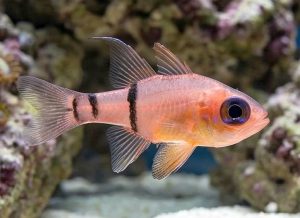
Belted Cardinalfish (Apogon townsendi)
The Belted Cardinalfish (Apogon townsendi), known to tropical fish keeping enthusiasts as the Townsend’s Cardinalfish or Red Belted Cardinalfish, is native to the Western Atlantic Ocean.
The range of the Belted Cardinalfish extends from Bermuda and Southern Florida, across the Bahamas, to the Gulf of Mexico and the entire Caribbean Sea (including the Antilles) southward to northern South America.
The Belted Cardinalfish is a colorful, reef-associated species that during daylight hours is found alone or in small groups hovering inside deep rocky crevices, coral reef holes and underwater caves at depths from 10 to over 180 feet.
During the day in thelir shallower reef environments, in depths from 15 to 45 feet where they are most commonly encountered, Belted Cardinalfish can frequently be seen hovering between the protective, venomous spines of the long-spined sea urchin (Diadema antillarum) or sheltering deep underneath ledges and grottoes.
Although Belted Cardinalfish are occasionally seen hovering over hard rocky or rubble substrates along the base of a reef slope, they rarely venture out over open sand flats devoid of overhead coral structure or the cover of sea urchins.
Belted Cardinalfish are strictly nocturnal predators that during daylight hours are very territorial of their chosen cave or sea urchin territory. As night falls, they merge into loose, temporary aggregations to forage in the water column on benthic and pelagic crustaceans, zooplankton, and small larvae.
When Belted Cardinalfish hunt in the darkness, they utilize their large eyes to pick out drifting zooplankton and microscopic micro-crustaceans passing by the reefs edge. To avoid larger nocturnal predators like eels and groupers, their brilliant red colors wash out slightly at night into a cryptic pattern.
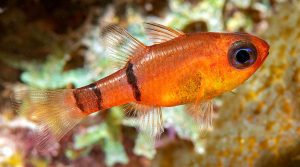
Belted Cardinalfish (Apogon townsendi)
The Belted Cardinalfish has a bright pinkish-red to translucent red-orange body color on its upper flank, transitioning to a yellowish-red hue on its belly; a large, oblique mouth with bands of tiny, simple teeth lining its jaws, and oversize eyes with a dark pupil.
They have two separate dorsal fins, with a long black bar or “belt” wrapped vertically under the end of the second dorsal fin, and a broad, dark vertical bar defined by black edges wrapped entirely over the caudal peduncle at the base of the tail.
Male Belted Cardinalfish have larger, more pronounced dorsal fins, a broader squared-off jawline that facilitates oral incubation, and retain a leaner body profile than females which become noticeably plumper when gravid.
The Belted Cardinalfish (Apogon townsendi) is often confused with the Barred Cardinalfish (Apogon binotatus), which is a
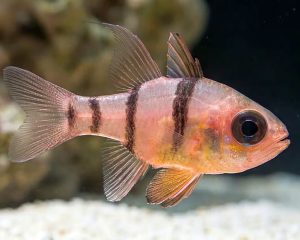
Barred Cardinalfish (Apogon binotatus)
closely related Western Atlantic species that shares a similar reddish tone but has two thin, complete dark bands wrapped entirely around the body rather than the unique trailing “belt” and broad peduncle bar configuration of Apogon townsendi.
The Belted Cardinalfish can be housed in a mature FOWLR or reef aquarium of at least 30 gallon capacity with an aragonite sand substrate, plenty of live rock stacked into dark shaded caverns, overhangs and crevices for them to shelter among during the day. In a reef tank, adding a long-spined sea urchin will replicate their natural habitat.
Because they startle easily, a tight fitting mesh or glass lid is mandatory, and a programmable LED with Moonlight setting is recommended to provide subdued lighting and keep them from staying hidden. An oversized protein skimmer, strong filtration system and a small power head is recommended to maintain water quality and provide low to moderate movement.
The Belted Cardinalfish is reef safe with caution. They will not bother corals or ornamental clams but large specimens will eat tiny ornamental shrimp and small worms in the system.
Unless you are buying a guaranteed, pre-bonded mated pair or a small group into a aquarium, only purchase a single Belted Cardinalfish per tank. Putting two random Belted Cardinals in a 30 gallon tank will result in severe territorial fighting over cave or sea urchin occupancy.
In larger FOWLR or reef tanks Belted Cardinals can be housed with peaceful, non aggressive species that occupy different levels in the tank such as Royal Grammas, Firefish Gobies, Clownfish or Tailspot Blennies.
Avoid aggressive predators like Groupers, Lionfish, Eels, Frogfish, large Hawkfish and Wrasses and hyperactive fish like Maroon Clownfish, Dottybacks, large Tangs, Damselfish and large aggressive Angelfish.
The Belted Cardinalfish is rarely bred successfully on a commercial scale in an aquarium environment and raising the fry to adulthood is exceptionally difficult.
Unlike Banggai Cardinalfish which release fully formed, large miniature juveniles that can immediately eat baby brine shrimp, Belted Cardinalfish release tiny, microscopic pelagic larvae that require a dedicated, separate rearing tank equipped only with a very gentle air stone and constant availability to specialized, live microscopic copepod cultures.
Belted Cardinalfish are paternal mouthbrooders that after a distinct courtship carry out spawning. A pair will produce a sticky, cohesive, ball like mass, that consists of thousands of incredibly tiny 0.5 to 0.6 mm eggs. The male catches the fertilized egg mass in his mouth where he aerates them by churning them and rolling them around. After fasting for 7 to 14 days during incubation, the tiny fry are released at night into the plankton rich ocean currents to feed on microscopic copepod nauplii until they become juveniles and eventually adults.
A mature female Belted Cardinalfish (Apogon townsendi) typically produces a clutch of several hundred to over a thousand eggs per spawning cycle.
In the wild, Belted Cardinalfish are nocturnal ambush predators that feed on zooplankton, copepods, amphipods, and small crustacean larvae. In an aquarium environment they should be initially fed live or frozen mysis shrimp, enriched brine shrimp, calanus, and finely chopped seafoods at dusk and dawn. Feed adults 1 or 2 times a day, juveniles 2 to 3 times a day, and post brooding males at least 2 to 3 times a day. Feeding them once in the morning and once in the evening replicates their nocturnal schedule.
The Belted Cardinalfish (Apogon townsendi) is occasionally available to tropical fish keeping enthusiasts from specialty online retailers, wholesalers, and local fish shops at prices that range from $19.00 to $45.00 depending on size and area of collection.
Because they are rarely captive bred on a commercial scale, the marine aquarium trade relies almost entirely on wild caught imports from the Caribbean and the Western Atlantic. They are usually available in stock or are easily ordered upon request.
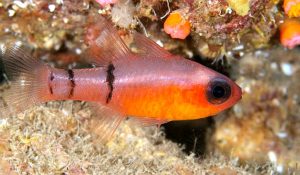
Belted Cardinalfish (Apogon townsendi)
Minimum Tank Size: 30 gallons
Aquarium Type: FOWLR or Reef
Care Level: Easy
Temperament: Highly Peaceful
Aquarium Hardiness: Very Hardy
Water Conditions: 72-78° F, dKH 8 – 12°, pH 8.1-8.4, sg 1.020-1.025
Max size: 2.6” to 3″
Color Form: Pink, Red, Orange, Black
Diet: Carnivore
Compatibility: Reef Safe with Caution
Origin: Western Atlantic, Caribbean Sea, Bermuda, Southern Florida down to South America
Family: Apogonidae
Lifespan: 5-7 years
Aquarist Experience Level: Beginner/Advanced