
Rock Flower Anemone (Phymanthus crucifer)
The Rock Flower Anemone (Phymanthus crucifer)—also classified under the synonym Epicystis crucifer —is abundant across tropical marine environments throughout the Caribbean Sea and western Atlantic Ocean. In the aquarium hobby, it is commonly sold as an RFA, Flower Anemone, or Ultra Rock Flower Anemone.
Tropical fish keeping enthusiasts also recognize Phymanthus crucifer as the Beaded Sea Anemone, Crucifer Anemone, or Caribbean Flower Anemone.
The Rock Flower Anemone’s natural range extends from Bermuda, southern Florida, and the Bahamas throughout the Gulf of America, the Greater and Lesser Antilles, and down to the northern coast of South America.
Rock Flower Anemones are most commonly found in loose aggregations among shallow coral reefs, rocky lagoons, rubble zones, reef ledges, and seagrass beds. From just below the low-tide line down to roughly 100 feet, they live nestled into rock crevices and sand-rubble interfaces. Unlike clownfish-hosting anemones from the Indo-Pacific, Phymanthus crucifer is not recognized as a natural host for familiar aquarium clownfish species.
Phymanthus crucifer is a semi-burrowing, sedentary benthic organism commonly collected from shallow tidal pools and sandy lagoon pockets. Unlike restless wandering anemones such as Bubble Tips or Condylactis that constantly roam across rockwork and climb tank glass, Rock Flower Anemones are remarkably stationary.
They wedge their sticky, muscular pedal disc deep into a rock hole or down through shallow sand onto a buried hard surface, allowing their flattened oral disc to rest completely flush with the substrate—often staying put for years.
Day and night, Rock Flower Anemones spread their circular, flower-like oral disc flat against the rock or sand to soak up reef lighting. Staying anchored inside rocky pockets or buried sand-rock crevices provides immediate physical protection, letting the anemone rapidly pull its entire oral disc down into the substrate when threatened by diurnal reef predators.
Although Rock Flower Anemones are peaceful toward their own kind and can be grouped together in dense, colorful gardens, they are mildly territorial toward unrelated stony and soft corals that remain in direct contact with their marginal tentacles. Because they rarely wander once settled and lack long sweeping tentacles, they are widely regarded as one of the most reef-safe anemones available to tropical fish keeping enthusiasts.
Phymanthus crucifer are compact marine invertebrates that commonly reach 3 to 6 inches in oral disc diameter in home aquariums, with exceptionally large mature specimens occasionally expanding up to 8 inches across.
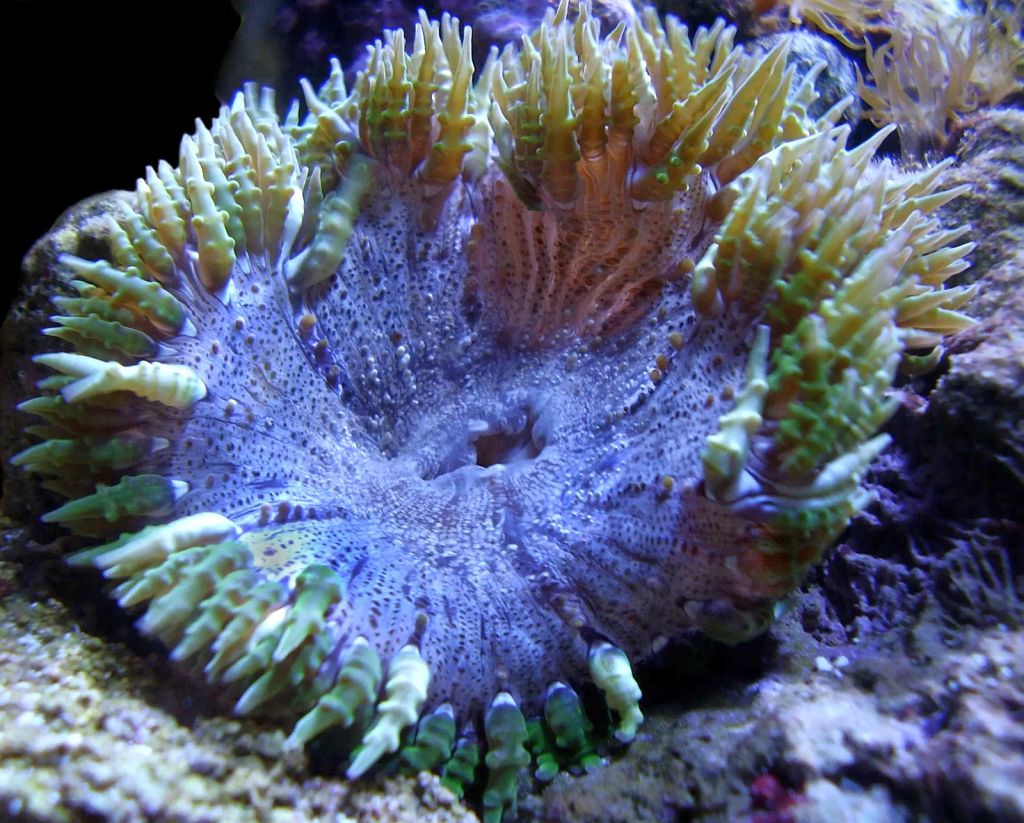
Rock Flower Anemone (Phymanthus crucifer)
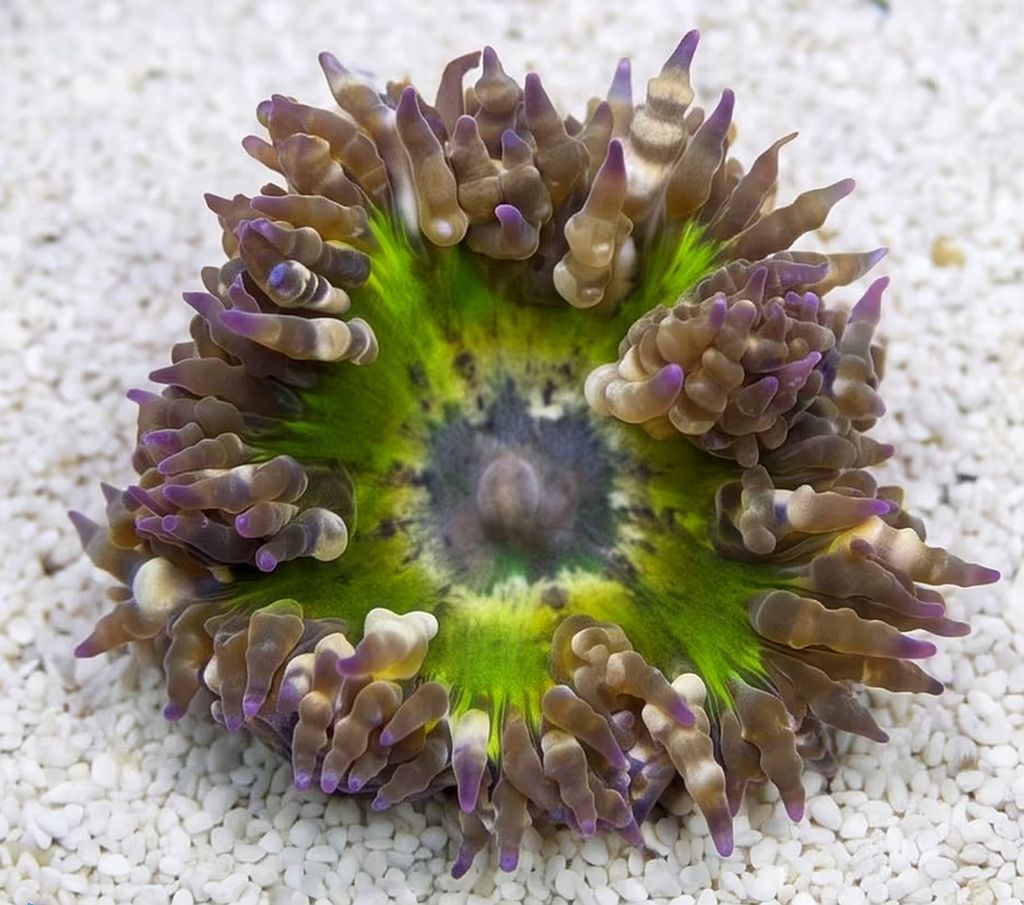
True Rock Flower Anemones display a dazzling, kaleidoscopic appearance featuring a wide, flat, circular oral disc encircled by a lush fringe of short, stubby, beaded tentacles that resemble the petals of a blooming flower. A mottled, striped, or speckled oral disc radiates outward from a raised central mouth, supported by a tough, pale grey to pinkish-tan column studded with rows of adhesive bumps (verrucae).
Rock Flower Anemones harbor dense populations of symbiotic photosynthetic algae (zooxanthellae) within their tissues, alongside vibrant fluorescent proteins that glow brilliantly under blue actinic reef lighting. Popular hobby color morphs span nearly every shade in the spectrum, including electric neon green, fiery orange, crimson red, royal purple, bright yellow, white zebra stripes, and multi-colored rainbow combinations.
Unlike stony corals that secrete a rigid calcium carbonate skeleton, the Rock Flower Anemone lacks any hard protective armor. Instead, it relies on mildly stinging nematocysts lining its short marginal tentacles, tough leathery column tissue, and rapid retraction for survival. When startled or disturbed, the anemone expels internal water and pulls its colorful oral disc tightly down into its rocky shelter until danger passes.
The Rock Flower Anemone is a broadcast-spawning and internal-brooding cnidarian that lacks external sexual dimorphism, making it impossible to visually distinguish males from females in a home aquarium. Unlike Bubble Tip Anemones that reproduce via asexual splitting, Phymanthus crucifer does not split in captivity—instead, separate male and female specimens reproduce sexually right inside well-established reef tanks.
The Rock Flower Anemone is reef-safe with caution and is best housed in a well-established nano or reef aquarium of at least 10 to 20 gallons. An ideal setup features an aragonite sand substrate, plenty of porous live rock with crevices, and a mature biological filter, paired with low to moderate reef lighting and gentle, indirect water flow.
Because Phymanthus crucifer is a stationary species, unprotected powerheads and overflow drains pose far less danger than they do to wandering anemones. Still, turning off circulation pumps for 15 to 20 minutes during initial introduction—and using covered wavemaker intakes until it settles—helps the anemone anchor securely without blowing across the tank.
Rock Flower Anemones are completely peaceful toward their own kind, allowing hobbyists to cluster multiple color
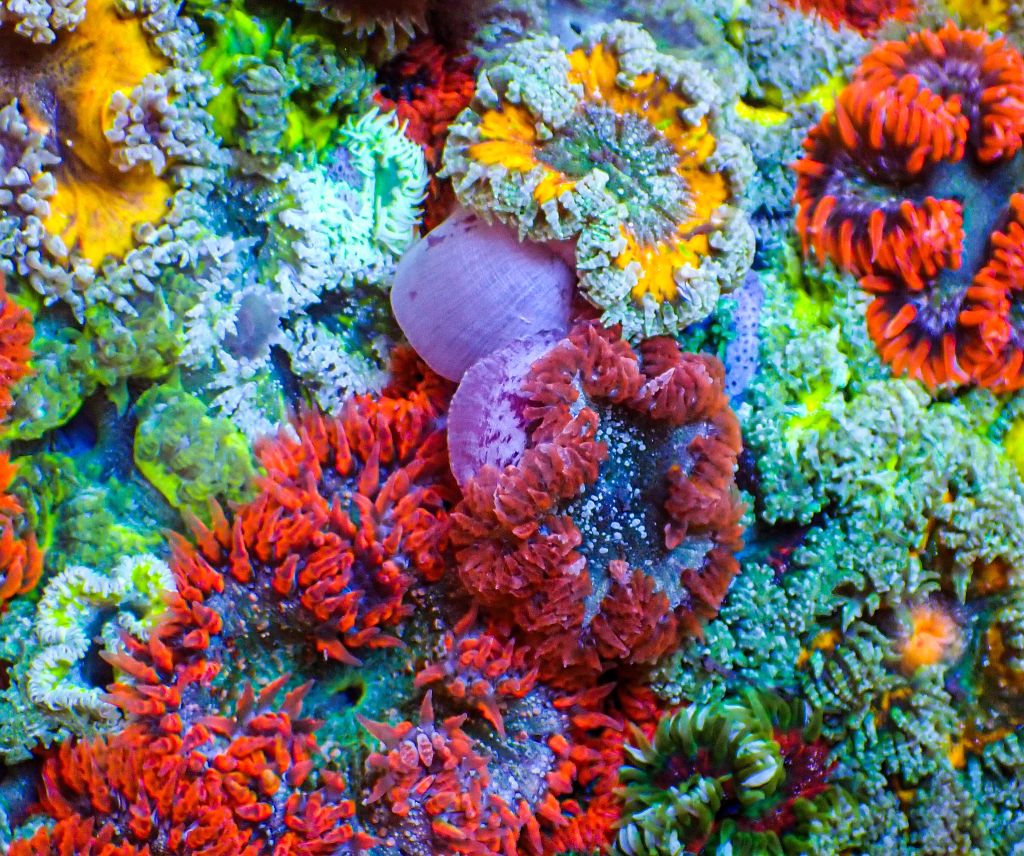
Rock Flower Anemone (Phymanthus crucifer)
morphs side by side to create a vibrant “RFA garden.” Because they stay compact and rarely move once settled, they pose minimal threat to neighboring corals—and unlike larger host anemones, they almost never prey on healthy reef fish.
Rock Flower Anemones are peaceful toward reef fish and invertebrates, thriving in a calm, mature nano reef, mixed reef, or Caribbean biotope alongside cautious tankmates.
Compatible Tankmates: Sexy Anemone Shrimp, Pederson’s Cleaner Shrimp, Porcelain Anemone Crabs, Ocellaris and Percula Clownfish (note: clownfish rarely host in RFAs), Gobies, Blennies, Firefish, Cardinalfish, and peaceful Wrasses.
Tankmates to Avoid: Large Angelfish, Butterflyfish, Filefish, Triggerfish, and Pufferfish, as well as Peppermint and Camel Shrimp, which frequently nip at or consume their delicate marginal tentacles.
The Rock Flower Anemone is the easiest, hardiest, and most forgiving sea anemone in the marine aquarium hobby, though it still requires a cycled, stable reef system running for at least 3 to 4 months. Like all marine invertebrates, it is sensitive to sudden salinity swings, elevated nitrates, and copper-based medications—which are immediately fatal.
To thrive, maintain stable tropical temperatures between 74–80°F, a specific gravity of 1.024–1.026, a pH of 8.1–8.4, low to moderate lighting (75–180 PAR), and gentle, indirect water movement. Consistent reef water chemistry and moderate illumination make this species ideal even for nano-reef beginners.
Rock Flower Anemone (Phymanthus crucifer)
The Rock Flower Anemone is a broadcast-spawning and internal-brooding cnidarian that lacks external sexual dimorphism, making it impossible to visually distinguish males from females in a home aquarium. Unlike Bubble Tip Anemones that reproduce via asexual splitting, Phymanthus crucifer does not split in captivity—instead, it regularly reproduces sexually when kept in small groups of three or more individuals.
During seasonal spawning events—often triggered by lunar cycles, water changes, or slight temperature shifts—males release sperm into the water column, which is drawn into the mouths of nearby females to fertilize their eggs internally. The females brood the developing larvae inside their gastric cavity before releasing dozens of fully formed, miniature baby Rock Flower Anemones around their oral disc, which then crawl off to settle on nearby rockwork.
Unlike predatory fish that actively pursue prey, the Rock Flower Anemone (Phymanthus crucifer) is primarily photosynthetic, relying heavily on its internal zooxanthellae for daily energy alongside opportunistic carnivory. In the wild, it uses its sticky marginal tentacles to trap passing zooplankton, copepods, and tiny benthic crustaceans, drawing food inward toward its central mouth.
In an established aquarium, Rock Flower Anemones derive the vast majority of their nutrition directly from reef lighting and dissolved nutrients in the water column. Hobbyists can supplement their diet by target-feeding tiny portions of mysis shrimp, brine shrimp, finely chopped krill, or reef-roids once every 1 to 2 weeks to promote vibrant coloration, faster growth, and frequent spawning.
The Rock Flower Anemone (Phymanthus crucifer) is a popular, widely available marine invertebrate offered by online reef retailers, coral vendors, and local fish stores. It is prized by nano-reef and coral collectors for its compact size, stationary behavior, vivid fluorescent patterns, and ability to breed in the home aquarium.
Current retail prices range from $24.99 to $49.99 for classic green, brown, or white-striped specimens, while ultra-bright rainbow, fiery orange, red, and multi-colored designer morphs typically cost between $59.99 and $119.99, depending on size and vendor.
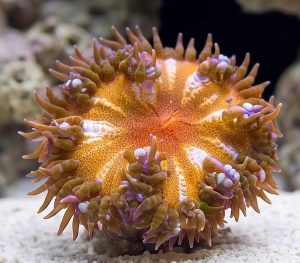
Rock Flower Anemone (Phymanthus crucifer)
Minimum Tank Size: 10 – 20 gallons (mature tank running 3–4+ months)
Aquarium Type: Mature Nano Reef, Mixed Reef, FOWLR, or Caribbean Biotope System
Tank Care Level: Easy
Temperament: Peaceful (Can be kept in multi-anemone gardens; minimal coral aggression)
Aquarium Hardiness: Hardy
Water Conditions: 74–80° F, dKH 8 to 12, pH 8.1 – 8.4, sg 1.024 – 1.026
Max Size: 6″ – 8″
Color Form: Green, Orange, Red, Purple, Yellow, White, and Multi-Colored Rainbow Morphs
Diet: Photosynthetic (Zooxanthellae) / Carnivore
Compatibility: Reef Safe (With Minor Caution Near Touching Corals)
Origin: Caribbean and Western Atlantic (Florida, Bahamas, and Gulf of America)
Family: Phymanthidae
Lifespan: 15 – 30+ years
Aquarist Experience Level: Beginner