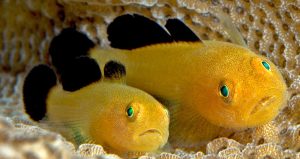
Panda Goby (Paragobiodon lacunicolus)
The Panda Goby (Paragobiodon lacunicolus) known to tropical fish keeping enthusiasts as the Blackfin Coral Goby, Panda Clown Goby, Blackfin Goby, Panda Coral Goby, and Nano Goby is native to the islands of the Indo Australian Archipelago in the Western Pacific Ocean and ranges from the Seychelles and Chagos Islands to the Line and Tuamoto Islands; north to the Ryukyu and Bonin Islands; south to Lord Howe Island; and throughout Micronesia.
The Panda Goby is a small, peaceful, strikingly beautiful, specilized reef species that is normally encountered alone or in pairs on the shallow to moderate reef slopes and lagoons of their range in close proximity to specific types of branching corals where it feeds on zooplankton and coral mucus.
Although the Panda Goby is most commonly found in shallower lagoons and seward reefs living almost exclusively within the complex branches of small polyp stony (SPS) corals (particularly Pocillopora damicornis) that they use for shelter, nesting, and as a feeding ground; they have been collected at a depths from 3 to over 200 feet among Pocillopora damicornis and Seriatopora spp.
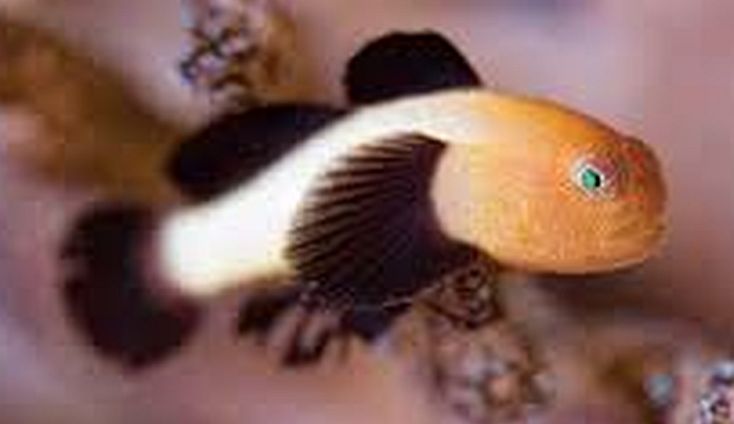
Panda Goby (Paragobiodon lacunicolus)
The Panda Goby (Paragobiodon lacunicolus) is a small, stocky fish with a relatively large head in proportion to its body length. They have fleshy papillae on the snout and cheek and scaleless areas on the head and abdomen that distinguish them from the Black Tear Goby (Paragobiodon lacrimae). Paragobiodon lacunicolus have a pale yellow to white body color with rosy to orange hues on the head or cheeks and large, rounded deep black dorsal, anal, and caudal fins that lends to its panda like appearance. Males and females are visually indistinguishable.
The Panda Coral Goby is a small, shy, cryptic species that will thrive in a peaceful, well established reef tank of at least 10 gallon capacity with a live sand or fine coralline gravel substrate, plenty of live rock, and dense growths of healthy Acropora or Stylophora corals which they need to survive. Without a suitable SPS coral host, Paragobiodon lacunicolus will be stressed, refuse to settle, and will ultimately perish.
Because Paragobiodon lacunicolus are very specilized fish that rarely leave the the SPS coral structure that they reside among, they are best suited for reef systems where they can be kept as pairs, in small groups, or with other small, non aggressive gobies and slow moving invertebrates that do not outcompete them for food.
Although the Panda Goby is entirely reef safe, their constant presence on the host Acropora may occasionally cause localized tissue recession on that specific coral branch.
The Panda Coral Goby has been successfully bred by specialized facilities in an aquarium environment.
Like the Black Clown Goby, the Panda Goby forms strong, permanent, socially monogamous pairs and rarely leave their host coral. They are hermaphroditec and have the unusual ability to change ther sex in both directions which helps stabilize their social structure within a coral colony.
When ready to breed, the pair prepares a nesting site by clearing a small area on a branch of SPS coral where the female deposits her tiny, adhesive eggs. Immediately after the female deposits her eggs, the male follows behind her and fertilizes them. The male vigorously guards the nest against potential predators while aerating the eggs with his pectoral fins and mouthing the eggs to clean them from detritus and remove any that are dead or infertile.
After a short incubation period of 4 to 5 days, the eggs hatch out into tiny larvae that are planktonic and drift along in the water column for several weeks before settling onto a new coral colony and developing into juvenile gobies. Under optimal conditions, spawning can occur as frequently as every few days.
In an aquarium environment, rearing the larval stage is challenging due to the minute size of the fry and their requirement for specialized live foods (rotifers and microalgae) during the long planktonic phase.
In their natural environment, the Panda Goby feeds primarily on tiny zooplankton and microorganisms picked from the water column and coral branches.
In an aquarium environment, due to their small size and shyness, they must be fed by a pipette small, high quality meaty foods like baby brine shrimp, minced frozen mysis shrimp, Calanus or Clyclops Rotifers, finely powdered flake foods, and other small frozen carnivore food preparations. They are slow deliberate eaters that require targeted feedings at least 2 to 3 times a day to ensure that they consume the meal before other fish steal it or the current disperses it.
The Panda Goby (Paragobiodon lacunicolus) is a rare specialty species that is only occasionally available to tropical fish keeping enthusiasts from highly specialized marine livestock importers or distributors who deal in rare or “by-catch” species from specific regions of the Indo Pacific where they are found. Because of its unique appearancce, specialized collection and breeding requirements, they are usually expensive.
Prices for wild caught Paragobiodon lacunicolus vary by retailer, area of collection, and size but range in the area of $28.99 to $40.00 for 1/4″ to 3/4″ specimens.
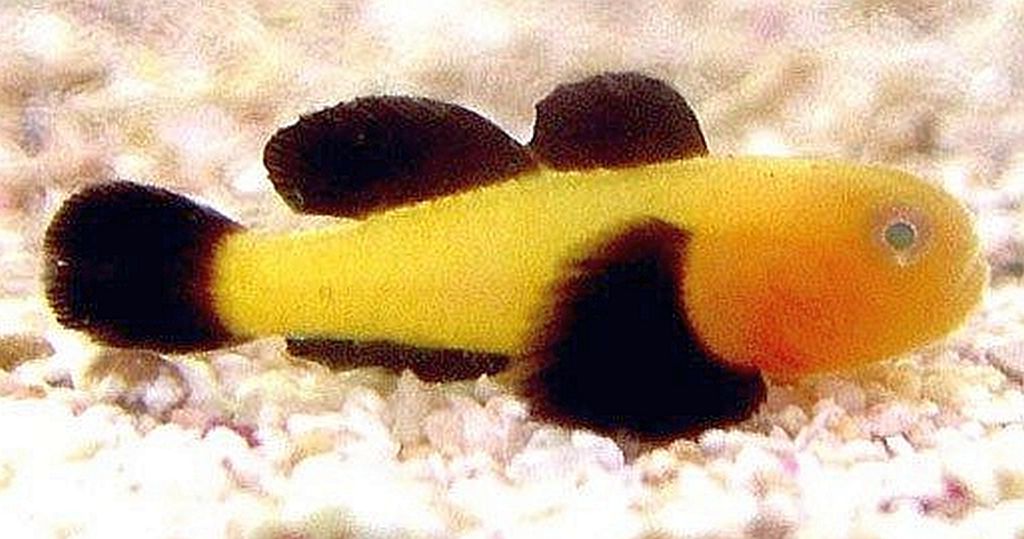
Panda Goby (Paragobiodon lacunicolus)
Minimum Tank Size: 10 gallon
Aquarium Type: Reef
Care Level: Moderate
Temperament: Extremely Peaceful
Aquarium Hardiness: Hardy when acclimated
Water Conditions: 72-78° F, dKH 8 – 12°, pH 8.1–8.4, sg 1.020-1.025
Max size: 1″-1.5″
Color Form: Black, White, Yellow
Diet: Micro-carnivore/Planktivore
Compatibility: Reef Safe
Origin: Western Pacific Ocean
Family: Gobiidae
Lifespan: 4 – 5 years
Aquarist Experience Level: Intermediate