Emperor Shrimp Red (Zenopontonia rex)
The Emperor Shrimp Red (Zenopontonia rex), formerly Periclimenes imperator and commonly sold as Periclimenes sp., known to tropical fish keeping enthusiasts as the Imperial Shrimp, Red Emperor Shrimp, or Sea Cucumber Shrimp, is a small commensal decapod crustacean species that is found across tropical marine environments throughout the Indo-Pacific.
Their range extends from the Red Sea and East Africa to Hawaii, French Polynesia, southern Japan, and northern Australia.
Emperor Shrimp are most commonly found among tropical coral reefs, sandy lagoons, sea grass beds, and silty rubble slopes of their range in shallow coastal waters, down to depths of 150 feet where they live in close, obligate association with large benthic invertebrate hosts.
Zenopontonia rex have been recorded from the shallow sublittoral zone down to roughly 148 feet among sandy sea floors, patch reefs, and rubble zones where their primary hosts—sea cucumbers, large nudibranchs, and sea stars—are most abundant.
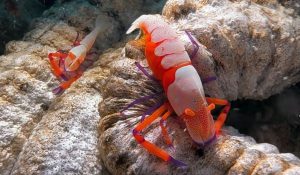
Zenopontonia rex are not natural burrowers. Instead of digging into the substrate, Emperor Shrimp are obligate commensals that spend nearly their entire adult lives hitchhiking directly on the backs, sides, or undersides of large, slow-moving invertebrates.
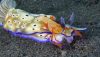
Throughout the day and night, Emperor Shrimp cling tightly to the skin of sea cucumbers (such as Bohadschia, Stichopus, Synapta, and Thelenota species), large sea slugs like the Spanish Dancer (Hexabranchus sanguineus), and certain sea stars. Living directly on these hosts provides constant mobile transportation across multiple feeding grounds and immediate shelter underneath the host’s body when diurnal reef predators approach.
Although Emperor Shrimp are famous for sharing space with massive invertebrates, they are strongly territorial toward their own kind. Emperor Shrimp are typically found either alone or in stable, mated male-female pairs riding on a single host. While peaceful toward other reef inhabitants, mated pairs will aggressively chase away and defend their host territory from any intruding conspecifics attempting to board.
Zenopontonia rex are diminutive marine crustaceans that seldom exceed 1 to 1.2 inches in body length, with most adult specimens measuring between 0.75 and 1 inch.
Emperor Shrimp Red (Zenopontonia rex)
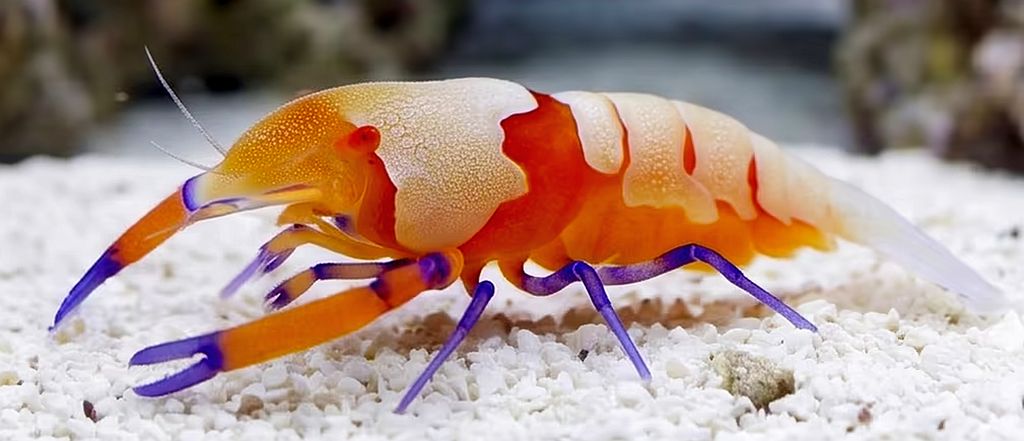
True Red Emperor Shrimp has a striking, highly distinctive coloration that features a vivid scarlet-red to bright orange-red body accented by a wide, white dorsal band or fine white speckling along the carapace, contrasted sharply by bright purple legs, claws, and broad antennal plates. They have a characteristically stout, dorsoventrally flattened body shape with a crest-like rostrum and paddle-shaped antennal scales that help streamline them while riding on their moving hosts.
Red Emperor Shrimp have specialized chromatophores in their skin that allow them to shift their color intensity. They can appear as a vivid red and white color on sea cucumbers, or transition toward deeper oranges, yellows, or purples to camouflage themselves against different host species.
Emperor Shrimp are gonochoric (separate male and female individuals), displaying subtle external sexual dimorphism. Mature females grow slightly larger and develop a broader, deeper abdomen than males to accommodate carrying fertilized egg clutches. Females are usually somewhat duller or less intensely pigmented than their male counterparts.
Unlike heavily armored crabs or lobsters, the Emperor Shrimp lacks thick protective plating. Instead, they rely on adaptive camouflage, tiny size, and the chemical defenses or sheer bulk of their host invertebrate for survival. When threatened by a predator, they will rapidly scuttle underneath their host’s body or wedge themselves into the skin folds of a sea cucumber to remain completely hidden until danger passes.
The Emperor Shrimp is reef safe and is best housed in a well established reef aquarium of at least 20 to 30 gallon capacity with a mature deep sand bed, a minimal amount of live rock, plenty of natural organic detritus, gentle water flow, and a compatible invertebrate host.
Emperor Shrimp are harmless to corals, clams, and anemones, making them completely reef safe. They should never be housed without a suitable invertebrates host such as a hardy sand-sifting sea cucumber (Holothuria spp.) or a large, peaceful sea star—as they rarely survive long-term in bare tanks without one.
Spanish Dancer nudibranchs should be avoided in home aquariums due to their specialized sponge diets and poor survival rates.
Emperor Shrimp are peaceful toward other species and do best in a calm FOWLR, reef, or dedicated invertebrate tank with small, non-aggressive tank mates.
Good tank mates include Firefish, Neon Gobies, Clown Gobies, Dragonets, Pipefish, and peaceful snails like Nassarius or Cerith snails.
Avoid keeping them with large and/or aggressive fish, Wrasses, Hawkfish, Dottybacks, Triggerfish, Pufferfish, Coral Banded Shrimp, or large predatory crabs, as their small size and bright coloration make them an easy meal for almost any carnivorous tank mate.
The Emperor Shrimp is moderately difficult to care for and should only be added to a mature, stable marine system that can support its host. Like most marine crustaceans, they are highly sensitive to sudden parameter swings—especially rapid shifts in salinity and elevated nitrates—and copper-based medications are immediately fatal to them. To thrive, they require stable tropical temperatures between 75–80°F (24–27°C), gentle currents that will not sweep them off their host, and trace iodine from regular water changes to support proper molting. Consistent water quality and a well-fed host are essential for keeping this delicate shrimp alive in captivity.
Though mated pairs frequently breed and carry eggs in captivity, Emperor Shrimp do not generally reproduce successfully in a standard home aquarium due to their complex planktonic larval stages.
Mating takes place shortly after the female molts, and she carries a cluster of fertilized eggs tucked beneath her pleopods for approximately two weeks until they mature.
The microscopic larvae hatch and are released into the water column after dark. In a home reef aquarium, these microscopic free-swimming larvae are quickly eaten by filter-feeding invertebrates and fish or drawn into mechanical filtration long before they can settle onto a host.
Unlike predatory shrimp that hunt active prey, the Emperor Shrimp (Zenopontonia rex) is an obligate commensal detritivore and mucus grazer that relies heavily on its host for daily nutrition. In their natural environment, they patrol the surface of their host sea cucumber or sea star, using their delicate pincers to graze on sloughed host mucus, trapped organic detritus, fecal matter, micro-algae, and external parasites. Field observations have also documented them opportunistically feeding on host spawning eggs as well as occasionally capturing tiny post-larval fish and micro-crustaceans.
In an established aquarium environment, Emperor Shrimp survive primarily by grazing natural detritus and mucus off their host sea cucumber as it sifts through the sand bed.
Experienced tropical fish keeping enthusiuasts can supplement their diet by target-feeding tiny amounts of finely minced mysis shrimp, frozen brine shrimp, cyclops, or sinking micro-pellets near their host, ensuring they receive adequate nutrition without polluting the tank.
The Emperor Shrimp Red (Zenopontonia rex / Periclimenes sp.) is a relatively uncommon, highly sought-after specialty invertebrate that can be purchased from online marine retailers and specialized local reef stores at moderate to high prices.
They are highly prized by nano-reef and invertebrate enthusiasts for their vivid red and purple coloration and engaging symbiotic behavior with sand sifting sea cucumbers.
Current retail prices for the Emperor Shrimp range from $49.95 to over $127.99 for an individual shrimp depending on size and vendor. Bundle pairs that include a symbiotic host can cost up to $254.97.
Because Zenopontonia rex is a rare, seasonal marine invertebrate that relies entirely on wild collection, most online tropical fish retailers frequently list them as out of stock between Indo-Pacific imports.
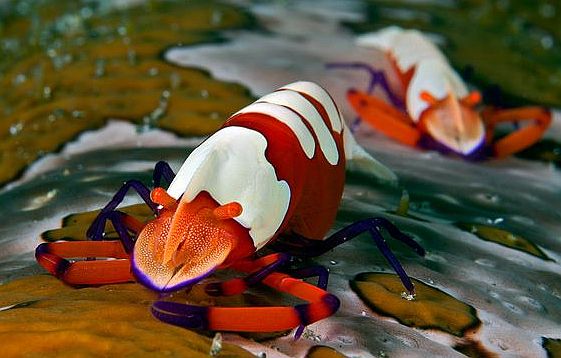
Emperor Shrimp Red (Zenopontonia rex)
Minimum Tank Size: 20 gallons (including a suitable host)
Aquarium Type: Mature Reef or Dedicated Invert
Tank Care Level: Moderate to Difficult
Temperament: Peaceful (Territorial toward conspecifics)
Aquarium Hardiness: Delicate
Water Conditions: 75-80° F, dKH 8 to 12, pH 8.1 – 8.4, sg 1.024 – 1.026
Max Size: 1.2″
Color Form: Red, Orange-Red with White Markings and Purple Legs
Diet: Detritivore / Omnivorous Scavenger
Compatibility: Reef Compatable
Origin: Indo Pacific (Red Sea to Hawaii and Australia)
Family: Palaemonidae
Lifespan: 1 – 2 years
Aquarist Experience Level: Intermediate/Expert