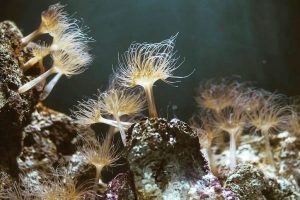
Aiptasia Anemone (Aiptasia spp.)
The Aiptasia Anemone (Aiptasia spp.), including common hitchhiking species such as Aiptasia pallida (now classified as Exaiptasia diaphana), Aiptasia pulchella, and Aiptasia mutabilis, known to tropical fish keeping enthusiasts as the Glass Anemone, Rock Anemone, or Pale Anemone, is a small, translucent, hyper-invasive cnidarian species that is widely regarded as the single most common nuisance pest hitchhiker in saltwater aquariums. Aiptasia Anemone are found across tropical and subtropical marine environments worldwide
Their range spans tropical and warm-temperate coastal waters across the Atlantic Ocean, Caribbean Sea, Gulf of America, Mediterranean Sea, Red Sea, and throughout the Indo-Pacific.
Aiptasia Anemones are most commonly found among shallow coral reefs, mangrove prop roots, rocky shorelines, harbor pilings, and seagrass beds of their range in warm coastal waters, from the intertidal zone down to depths of 100 feet where they colonize hard surfaces, dead coral skeletons, and sheltered crevices.
Aiptasia Anemone have been recorded from shallow tide pools and estuaries down to roughly 100 feet among limestone rubble, pier structures, and nutrient-rich reef lagoons throughout their range where extreme adaptability allows them to survive dramatic shifts in temperature, salinity, and water clarity.
All Aiptasia species are rock-anchoring, mobile benthic organisms rather than sand burrowers. Instead of digging into loose substrate, Glass Anemones attach their slender, adhesive pedal disc onto porous live rock, coral frag plugs, overflow boxes, and sump plumbing, readily gliding across aquarium surfaces to reach optimal flow and feeding zones.
Throughout the day and night, Aiptasia Anemones extend their delicate crown of slender tentacles out into passing currents to trap food and absorb light. Living anchored inside tiny pores and crevices in live rock provides exceptional physical security, allowing the anemone to vanish instantaneously inside the rock pore in a fraction of a second when threatened or poked.
Although Aiptasia Anemones are completely tolerant of their own genetically identical clones—rapidly blanketing entire aquascapes in dense forests of polyps—they are fiercely aggressive and territorial toward all neighboring stony and soft corals.
Aiptasia Anemones pack an unusually potent sting for their small size, causing adjacent LPS, SPS, and zoanthid corals to retract, bleach, and die back wherever their tentacles touch.
Aiptasia species are small marine invertebrates whose individual polyps commonly reach 0.5 to 2 inches in oral disc and tentacle spread, with exceptionally well-fed specimens in sumps or overflows occasionally growing up to 3 inches across.
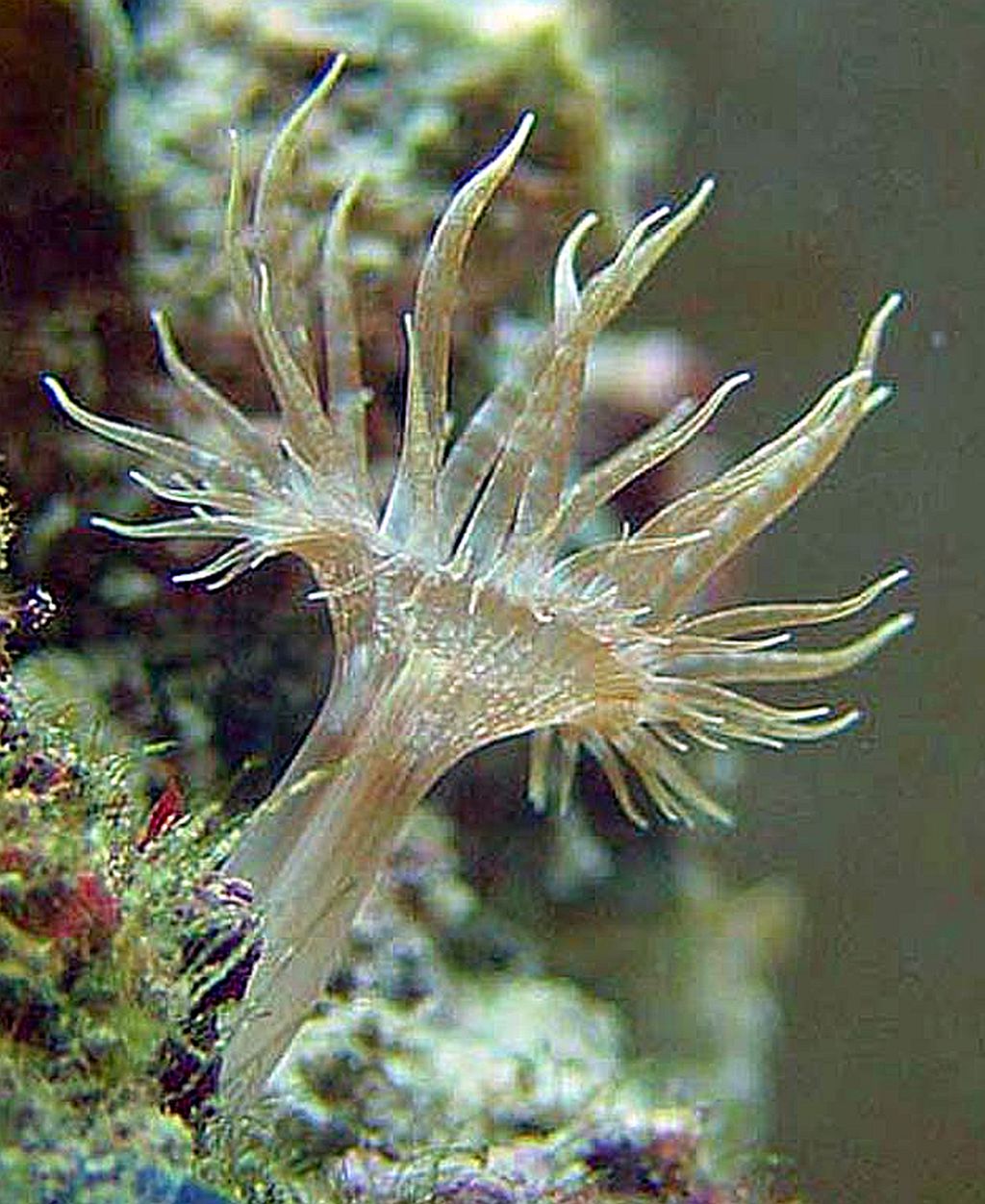
Aiptasia Anemone (Aiptasia spp.)
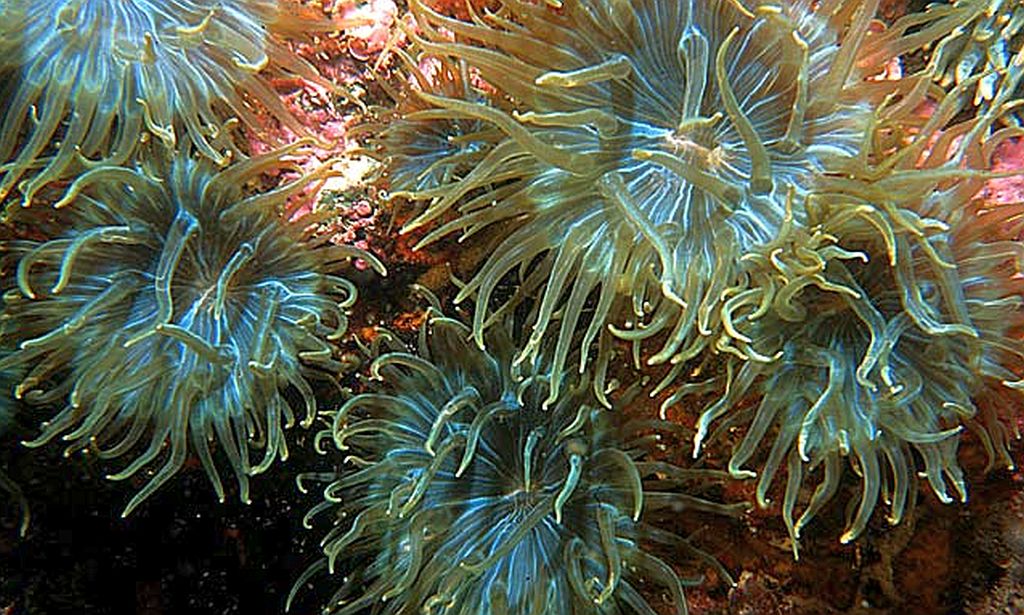
True Aiptasia Anemones display a delicate, trumpet-shaped, semi-transparent silhouette that features a slender, fleshy column topped by a small circular oral disc surrounded by a wispy ring of long, thin, smoothly tapering tentacles. Unlike Curly-Cue Anemones (Bartholomea annulata), which feature distinct white spiral bands along their tentacles, Aiptasia tentacles are smooth and semi-translucent—appearing pale golden-brown, amber, tan, or ghostly glass-white depending on lighting and algae density.
Aiptasia Anemones harbor symbiotic photosynthetic algae known as zooxanthellae within their tissues, which give healthy polyps their characteristic translucent brownish-amber hue. Specimens living inside dark aquarium sumps, overflows, or shaded caves often appear completely colorless and transparent, like spun glass.
Aiptasia Anemones are broadcast-spawning and prodigiously asexually reproducing cnidarians that lack external sexual dimorphism, making it impossible to visually distinguish males from females in a home aquarium.
In home reef systems, Aiptasia reproduces almost exclusively through explosive asexual pedal laceration. They shed tiny fragments of foot tissue as they creep across the rockwork that regenerate into dozens of new baby anemones within days.
Unlike stony corals that secrete a rigid calcium carbonate skeleton, the Aiptasia Anemone lacks any hard protective armor. Instead, they rely on their potent stinging nematocysts, lightning-fast retraction deep into porous rock holes, and near-indestructible cellular regeneration for survival. When tropical fish keeping enthusiasts scrub, scrape, or crush a polyp underwater, the surviving microscopic tissue fragments scatter in the current and rapidly grow into a massive tank-wide outbreak.
Although marine researchers occasionally maintain them in isolated laboratory tanks to study coral-algae symbiosis (zooxanthellae), the Aiptasia Anemone is not reef safe and is universally classified as an invasive pest hitchhiker rather than an intentional aquarium resident.
Aiptasia Anemones are destructive to reef aquariums because they multiply exponentially, clog plumbing and overflow teeth, do not host clownfish, and severely sting valuable corals until they recede and perish. Reef keepers should carefully inspect all newly purchased live rock, snail shells, and coral frag plugs—ideally remounting corals onto fresh plugs—to prevent introducing even a single polyp into a display tank.
Unprotected rock pores, overflow boxes, and sump baffles serve as hidden breeding reservoirs that continuously seed the main display with microscopic planula larvae and detached tissue fragments.
In reef systems where Aiptasia Anemones appear as unwanted hitchhikers, most reef keepers rely on specialized biological predators and targeted chemical eradication methods rather than standard reef tank mates.
Natural predators and control options include Berghia Nudibranchs (Aeolidiella stephanieae—obligate Aiptasia eaters), true Peppermint Shrimp (Lysmata wurdemanni or Lysmata boggessi), Copperband Butterflyfish (Chelmon rostratus), Matted Filefish (Acreichthys tomentosus), Klein’s Butterflyfish (Chaetodon kleinii), and targeted kalkwasser or sodium hydroxide paste injections (such as Aiptasia-X or F-Aiptasia).
Note that aquarists purchasing Peppermint Shrimp for pest control should verify the exact species, as look-alike Camel Shrimp (Rhynchocinetes durbanensis) will eat corals while ignoring Aiptasia.
The Aiptasia Anemone is virtually indestructible and extraordinarily hardy, thriving effortlessly across extreme aquarium conditions—including high nitrates, elevated phosphates, near-total darkness in sumps, and dramatic salinity swings—where almost all corals would die. While copper-based medications or boiling freshwater injections will destroy isolated polyps, standard reef parameters between 70–84°F (21–29°C), a specific gravity of 1.018–1.028, a pH of 7.6–8.5, and any lighting level allow them to flourish indefinitely. Controlling excess nutrients and deploying natural predators early are the most effective ways to keep a reef system Aiptasia-free.
Though Aiptasia Anemones reproduce via seasonal broadcast spawning in their natural coastal habitats, they multiply relentlessly in home aquariums via asexual pedal laceration and longitudinal fission.
Every time an Aiptasia polyp slides across rockwork or contracts from stress, tiny rings of basal tissue tear away from its pedal disc. Within one to two weeks, each microscopic tissue speck develops a functional mouth and ring of stinging tentacles, turning a single unnoticed hitchhiker into hundreds of polyps across the tank.
Unlike strictly photosynthetic corals, the Aiptasia Anemone (Aiptasia spp.) is an aggressive mixotroph that combines solar energy from its internal zooxanthellae with opportunistic carnivory and dissolved nutrient absorption. In both the wild and home aquariums, they use their sticky tentacles to capture passing zooplankton, brine shrimp, mysis shrimp, fish pellets, and particulate coral foods drifting through the water column.
In an established reef aquarium, Aiptasia Anemones require zero intentional feeding and will thrive indefinitely on ambient light, fish waste, and leftover food particles.
Aquarists battling an Aiptasia infestation should cut back on broadcast-feeding fine particulate coral foods and keep mechanical filter socks clean, as abundant suspended food dramatically accelerates their reproduction rate.
The Aiptasia Anemone (Aiptasia spp.) is never intentionally sold as an ornamental livestock item by reputable marine retailers and is always acquired accidentally as an unwanted hitchhiker on live rock, macroalgae, snail shells, or coral frags.
While marine biology laboratories cultivate them for scientific research, reef aquarists view them strictly as a pervasive pest requiring proactive quarantine and eradication.
Current retail value for the Aiptasia Anemone is $0.00 (unwanted aquarium hitchhiker), though hobbyists routinely spend $15.00 to $120.00 on Peppermint Shrimp, Berghia Nudibranchs, Copperband Butterflyfish, or targeted kalkwasser treatments to eliminate outbreaks.
Aiptasia Anemone (Aiptasia spp.)
Minimum Tank Size: Not Recommended (Invasive Hitchhiker Pest)
Aquarium Type: Unwanted Hitchhiker in Reef, FOWLR, and Sump Systems
Tank Care Level: Easy (Indestructible Pest — Difficult to Eradicate)
Temperament: Aggressive (Stings and kills neighboring corals; multiplies rapidly)
Aquarium Hardiness: Extremely Hardy
Water Conditions: 70–84° F, dKH 7 to 14, pH 7.6 – 8.5, sg 1.018 – 1.028
Max Size: 1.5″ – 3″ per polyp (Forms tank-wide clonal outbreaks)
Color Form: Translucent Glass-White, Pale Tan, Golden-Brown, or Amber
Diet: Photosynthetic (Zooxanthellae) / Opportunistic Carnivore & Detritivore
Compatibility: Not Reef Safe (Invasive Coral-Killing Pest — Not a Clownfish Host)
Origin: Circumtropical (Atlantic, Caribbean, Red Sea, Mediterranean, and Indo-Pacific)
Family: Aiptasiidae
Lifespan: Potentially indefinite via rapid pedal laceration
Aquarist Experience Level: Not Recommended (Pest Identification Guide)