Author Archives | Fishkeeper

Bleeding Heart Tetras (Hyphessobrycon erythrostigma

Bleeding Heart Tetra (Hyphessobrycon erythrostigma)

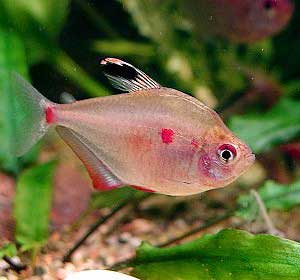
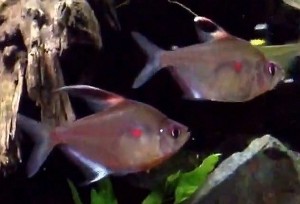
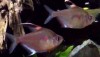
Bleeding Heart Tetras (Hyphessobrycon erythrostigma) are peaceful mid-water fish that get their name from the blushing blood red marking near their gills.  They are a school fish native to the upper Amazon River Basin and should be kept in small schools of 6 or more individuals when in an aquarium environment.

The dorsal fin of male Bleeding Heart Tetras can become quite long and flowing. Both sexes have the eye catching, blood-red spot at the heart area, as well as the distinguishing black and white patch on their dorsal fins.

Female Bleeding Heart Tetra

Female Bleeding Heart Tetra

The males can be identified by longer extended dorsal and anal fins. The dorsal fins in the males are elongated into a distinct sickle shape that arches to the length of the tail base.

Female Bleeding Heart Tetras have shorter, more rounded fins.

Bleeding Heart Tetras are perfect for community aquariums and are a good choice for beginning tropical fish keeping enthusiasts.

They are hardy fish and easy to keep as long as you provide them with a densely planted tank of at least 20 gallons.  Rocks and driftwood
should be added to the tank to mimic their natural habitat and reduce stress on the fish.

Like most South American tetras, Bleeding Hearts do best in soft, highly filtered, slightly acid water, with plenty of plants.

They do well in a variety of community tank settings when in small groups with other tetras of their own kind. Tiger barbs, other tetras of the same size and bottom dwellers like corydoras, loaches, etc. are good choices. In smaller groups the males often become territorial. Bleeding Hearts are mischievious little fish and seem to enjoy nipping at other fish entering their territory, especially during feeding.

Bleeding Heart Tetras are difficult to breed but not impossible. They are egg layers and are occasionally bred in an aquarium environment. After the eggs are laid, the parents should be immediately removed from the tank or they will eat the eggs.  When the fry are free swimming, start feeding them newly hatched baby brine shrimp until they are able to eat finely crushed flake foods.

Bleeding Heart Tetras will eat a variety of foods including daphnia, brine shrimp, tubifex worms, freeze dried bloodworms, micro pellets and flake foods.

Bleeding Heart Tetras are a common and readily available fish. Most aquarium shops put them up for sale when they are 3/4″ to 1-1/4″ long.

Bleeding Heart Tetras (Hyphessobrycon erythrostigma

Bleeding Heart Tetras (Hyphessobrycon erythrostigma


Minimum Tank Size: 10 gallons
Care Level: Easy
Temperament: Peaceful
Water Conditions: 72-77° F, KH 4-8, pH 6.0-6.8
Max. Size: 2″
Color Form: Red
Diet: Omnivore
Compatibility: Peaceful in small groups
Origin: Amazon River Basin; Farm Raised in Thailand
Family: Characidae
Life Span: 5 to 6 years
Aquarist Level: Beginner

Posted in Featured Articles, Freshwater Fish, Tetras, Tropical Fish Keeping1 Comment

Rosy Barb (Puntius conchonius)

Rosy Barb (Puntius conchonius)

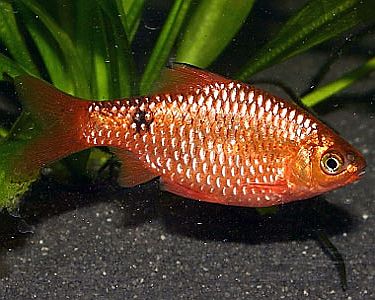
The Rosy Barb (Puntius conchonius) is one of the larger Barbs that in their natural habitat grow up to 6 inches in length.

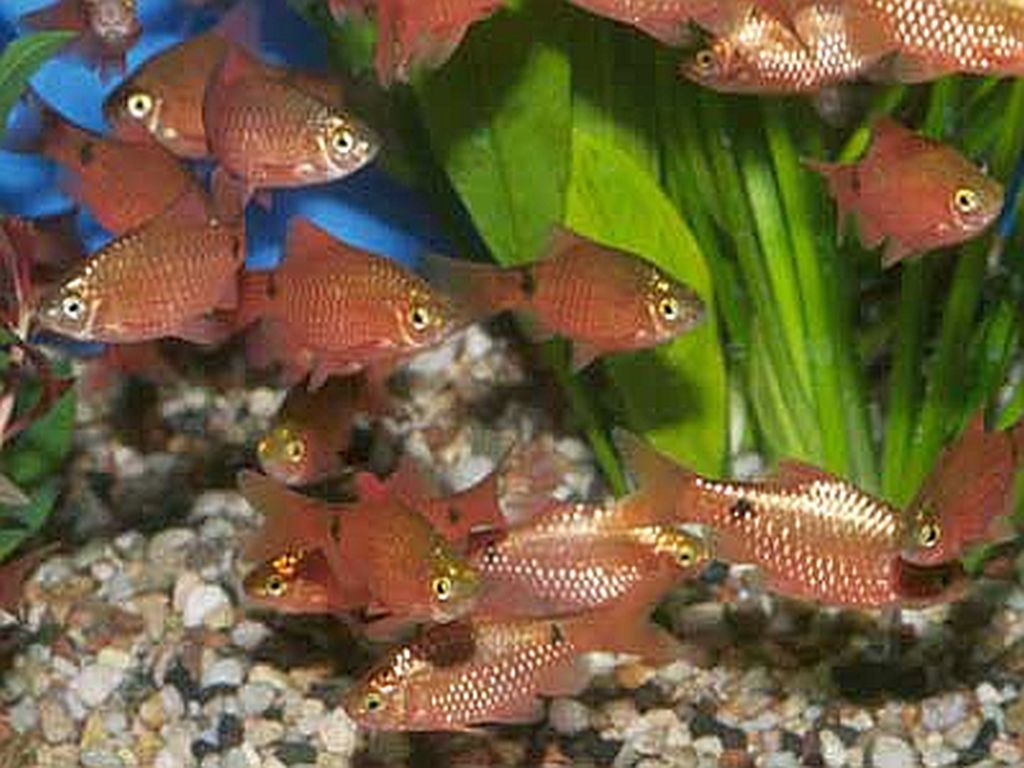
The male is red and gold with black spots near the rear and at the dorsal fin.  Their colors become bolder during the mating period.  Female Rosy Barbs lack the red coloration and are mostly gold.  Females do not have any black color  in their fins as males do.

Rosy Barb Tank

Rosy Barb Tank

Rosy Barbs prefer soft, slightly acidic water and a densly planted tank of at least a 30 gallon capacity.

Driftwood and rocks can be added to tank, but be sure to allow plenty of room for the fish to swim.

In nature, Rosy Barbs are a school fish and prefer being with others of their own kind in larger groups.

Rosy Barbs are semi aggressive in an aquarium environment, but when they are placed in a large enough school, they will usually keep to themselves and not bother any other fish in the tank.  Under these conditions, the rosy barb is an active, peaceful species,  well suited for community aquariums.

Breeding Rosy Barbs is relatively easy.  Place two females with one male in a breeding tank with coarse gravel on the bottom.  Spawning usually occurs in the early morning hours and lasts several hours.  During this time several hundred eggs are deposited.  After the eggs have been laid and fertilized, immediately remove the parents to another tank or they will eat their eggs. The fry will hatch out  in approximately 24 to 36 hours.  In about six days the young will be free swimming and can be fed newly hatched brine shrimp until they are large enough to eat crushed flake foods.

Rosy Barbs are omnivorous and should be fed a variety of foods. Meaty foods like frine shrimp and bloodworms, vegetables, flake foods, freeze dried and frozen foods will all be greedily accepted. Most aquarists feed them a quality flake food with an occasional suppliment of tubifex or bloodworms to their diet.

Rosy Barbs are usually purchased when they are about 1-1/4″ to 2″ long but since they grow as large as 6″ in length, they should be housed in an aquarium of at least 30 gallons. A 55 gallon tank would be more suitable.

Rosy Barb (Puntius conchonius)

Rosy Barb (Puntius conchonius)


Minimum Tank Size: 30 gallons
Care Level: Easy
Temperament: Semi-aggressive
Aquarium Hardiness: Very Hardy
Water Conditions: 74-79° F, KH 4-10, pH 6.0-7.0
Max. Size: 6″
Color Form: Red, Yellow
Diet: Omnivore
Compatibility:  Suitable for commuinty tanks
Origin: Farm Raised, USA
Family: Cyprinidae
Lifespan: up to 5 years
Aquarist Experience Level: Beginner

Posted in Barbs, Featured Articles, Freshwater Fish, Tropical Fish Keeping0 Comments

Tinfoil Barb (Barbonymus schwanenfeldii)

Tinfoil Barb (Barbonymus schwanenfeldii)

The eye catching Tinfoil Barb (Barbonymus schwanenfeldii) has large, distinct silvery metallic scales, red-tipped fins, a forked tail and grows up to 14″ in length.

In nature, Tinfoil Barbs live in the larger, fast flowing rivers of Southeast Asia.

Compared to other barbs, the Tinfoil Barb is a hardy, peaceful fish, and in natre is actually quite docile.  For this reason Tinfoil Barbs make an eye catching addition to any large community tank.

Tinfoil Barbs are a fast swimming school fish and should be kept in groups of at least 6 or more individuals.  They can be housed with other large non aggressive fish but require a large (at least 70 gallon) aquarium with a tight fitting hood.

Tinfoil Barbs are jumpers. In the aquarium they require good filtration and strong water movement.  Adding powerheads to their aquarium is highly recommended.

Tropical fish keeping enthusiasts agree that Tinfoil Barbs are easy to care for once they are set up in an acceptable size tank.

They are easy to feed and accept most prepared commercial fish foods.  They will eagerly chow down on pellets, flakes, freeze dried and frozen foods.

In their natural habitat their diet consists mainly of algae and other plant matter.  In an aquarium environment, they should occasionally be fed spirulina wafers or some other herbivore preparation such as the algae wafers that are given as a dietary supplement to Plecostomus.

Tinfoil Barbs are normally purchased when they are 1″ to 1 1/2″ long, but since they quickly grow to over a foot in length, a large tank for these fish is an absolute must.

TinfoilBarb (Barbonymus schwanenfeldii)

TinfoilBarb (Barbonymus schwanenfeldii)


Minimum Tank Size: 70 gallons
Care Level: Easy
Temperament: Peaceful
Aquarium Hardiness: Hardy
Water Conditions: 75-80° F, KH 4-10, pH 6.0-7.5
Max. Size: 14″
Color Form: Red, Silver
Diet: Omnivore
Compativility: Ok with large non agressive fish
Origin: Southeast Asia
Family: Cyprinidae
Lifespan: 8 to 10 years
Aquarist Experience Level: Beginner

Posted in Barbs, Featured Articles, Freshwater Fish, Tropical Fish Keeping3 Comments

Types of UG filters

Tropical Fish Keeping – Pros And Cons Of Undergravel Filters

Types of UG filters

Types of UG Filters

There are several Pros and Cons of Undergravel Filters used in freshwater and marine aquariums that you need to know about before you purchase one for your tank.

Undergravel filters are arguably the most frequently sold filters to beginning tropical fish keeping enthusiasts.

They are simply a slotted plastic plate with one or more “lift tubes” that is placed in the bottom of the tank under a sufficient bed of gravel. An air stone or power head is placed in or on the lift tubes to draw water down through the gravel bed where the mechanical and biological filtration actually takes place.

Many DIY aquarists custom make their own undergravel filters from PVC pipe and plastic “egg crate”.

That being said, here are some of the Pros (advantages) and Cons (disadvantages) of Undergravel Filters:

Pros

  • Undergravel filters are extremely versitile. They can be used in a goldfish bowl, a 55 gallon tank and even larger.
  • Undergravel filters have no moving parts and are easy to install.
  • Undergravel filters are very inexpensive compared to other types of filters
  • Undergravel filters are reliable
  • Undergravel filters are efficient when cleaned on a regular basis
  • Undergravel filters provide huge amount of surface area for bacteria colonization
  • Undergravel filters are relatively easy to maintain
  • Undergravel filters are perfect in tanks used for rearing fish fry.

Cons

  • Undergravel filters require regular maintenance to function properly
  • Undergravel filters are not recommended for planted aquariums
  • Undergravel filters should not be used with fish who dig.
  • Export of waste is much more difficult
  • Undergravel filters have unavoidavble “dead spots” beneath the filter and in the bed that cause buildups of hydrogen sulfide.
  • Undergravel filters usually have higher levels of nitrates and phosphates.
  • No separation of mechanical and biological filtration

Some of the cons for undergravel filters have been debated by tropical fish keeping enthusiasts for years; especially the negative recommendation for using them in planted aquariums.
Some fish keepers have no problem raising live plants with undergravel filters, yet others report plants with stunted growth or with plant roots growing underneath the filters causing restricted water flow.

Efficiency does not seem to pose a problem, as long as the filter bed is being maintained on a regular schedule.

The hydrogen sulfide problem can be avoided to some extent by the use of power heads instead of air stones to increase water flow, and by agitating the gravel on a regular basis.

Knowing the pros and cons of undergravel filters before you purchase one for your aquariium can save you a lot of money, or cost you some if you don’t consider all the facts.

Posted in Featured Articles, Filters, Setting Up Your First Aquarium, Tropical Fish Keeping0 Comments

Filter Types

Tropical Fish Keeping – All About Types Of Filters

Recent advancements in filtration technology have made tropical fish keeping much easier than most people can ever imagine.

The old phrase “Aquariums are too much trouble to keep” for the most part can be put to pasture, and organisms that were once thought impossible to keep in a closed aquarium environment are now being kept by thousands of aquarists throought the world.

Before you decide on what type filter to use in your aquarium, you need to consider some basic information.

  • What species are you going to keep in your tank?
  • What are their special requirements, if any?
  • How many fish are you going to keep?
  • Is your tank freshwater or saltwater?
  • How big is your tank?
  • How much can you afford?

The answers to these basic questions will have an impact on what type filter or filters you choose, and how well it will clean the water in your tank.

There are many types of filters available that vary in price, size, efficiency and their their ability to mechanically, chemically and biologically filter your aquarium’s water.

The more common types of filters are listed below:

  • Under Gravel Filters
  • Internal Tank Filters
  • Power Filters
  • Canister Filters
  • Wet/Dry Filters
  • Fluidized Bed Filters

Some densly planted freshwater aquariums and saltwater reef aquariums do not require biological filtration, but they DO need chemical and/or mechanical filtration to keep the tank healthy.

Most other types of freshwater or saltwater aquariums need a filter that efficiently performs all three types of filtration. Unplanted tanks, invert tanks and heavily stocked tanks fit into this category.

Here is a brief synopsis of the types of filters and how they function.

Under Gravel Filters:

Under Gravel Filters are made from a slotted plastic plate that is installed under a gravel substrate.

The undergravel filter has one or more uplift tubes that extend towards the surface of the tank. An air stone is placed inside and at the bottom of the tube to create an upward flow of water that pulls additional water through the substrate.

A power head is frequently substitued for the air stone to create increased water flow through the gravel substrate.

As water is sucked through the substrate, mechanical and biological filtration occurs.

The gravel traps suspended particulate matter before it decays and creates an unwelcome biological load in the aquarium. Biological filtration also occurs by the bacteria that live on the surface of the substrate that the water is passing through.

In order to function correctly, a sufficient layer of gravel must be placed above the slotted plastic plate and the substrate must be cleaned from built up particulate matter on a regular basis.

A weekly cleaning with a gravel cleaner will remove built up particulates before they begin to decay and cause problems with your tank. The weekly gravel cleanings also provide an opportunity for making partial water changes.

The amount of biological filtration that actually takes place in an undergravel filter is limited by the amount of dissolved oxygen in the water that passes through the substrate.

Another con to biological filtration using this type of filter is the uneven flow of water through the substrate.

Even when the gravel is layered evenly over the slotted plastic filter, decorations and rocks placed on the substrate will create unavoidavble “dead spots” underneath the filter and in the filter bed. These “dead spots” can cause hydrogen sulfide to build up to dangerous levels however, this problem can be easily addressed by agitating the filter bed with regular gravel cleaning and by adding a carbon cartridge to the uplift tubes.

Unless regularly maintained, tanks with undergravel filters will usually have higher nitrate and phosphate levels.

A pro for ungergravel filters is their cost. They are low to moderately priced but require an air stone, air pump or power head to function.

They are versitile and can be used in a variety of aquarium set ups; from a goldfish bowl to a 55 gallon tank.

Undergravel filters should not be used for planted freshwater tanks. The plant roots eventually grow underneath the filter plates and restrict water flow.

Internal Tank Filters:

Internal filters are placed inside of your aquarium either mounted to the glass by suction cups or in a corner on top of the substrate.

Like Undergravel Filters, most Internal Tank Filters have an airstone that is driven by an air pump outside the aquarium. The air that is pumped to the stone at the bottom of the filter creates water circulation through the filter and air bubbles that increase dissolved oxygen levels in the tank.

Corner box filters are the most common type of Internal Tank Filter. They are simply plastic boxes with slots in the top and bottom that allow water flow through the filter media. Corner box filters economically perform all three types of filtration but with limited efficiency.

Layers of fiberglass floss and activated carbon are generally used for mechanical and chemical filtration, and the bacteria colonies that grow on the filter media provides a modicum of biological filtration.

Corner box filters need regular cleaning in order to remain efficient. This is usually done during routine water changes by rinsing the filter media in the aquarium water that is removed from the tank. Using tap water to rinse off the filter media will kill the bacteria and render biological filtration useless.

When replacing the filter media in these filters, only replace half of the media at one time. This will preserve the bacteria that needed for biological filtrattion.

Sponge Filters are another type of Internal Tank Filter that provide mechanical and biological filtration, usually in smaller systems.

Sponge filters are designed with a U-shaped tube that is used to pull water through a very large surface area sponge like material.

The sponge media provides both mechanical and biological filtration.

Suspended particulates are trapped by the pores in the sponge as water passes through it, and biological filtration is provided by the beneficial bacteria that live on the sponge’s surface.

Sponge filters are easy to maintain and are very cost effective. Cleaning is a matter of simply rinsing out the sponge in water from the aquarium.

Both types of Internal Tank Filters are primarily used in smaller aquariums with only a few fish, in tanks where fry are being reared, in tanks where brine shrimp are being hatched out and in hospital tanks.

Because these filters have no moving parts, the fry cannot be sucked into the filter to die.

Power Filters:

The term “Power filter” is used to describe a variety of filters available on the marketplace that are specifically designed to hang on the back of your aquarium.

Almost all of these filters provide mechanical, chemical and biological filtration and are extremely easy to maintain.

All of these filters are powered by a small, self contained, electric water pump, that pulls water from the aquarium through a U-tube and forces it through some type of filter cartridge where it is “polished” and then returned back into the tank.

Most Power Filters have filter cartridges that use activated carbon for chemical filtration. These filter cartridges are specific to each manufacturer and generally are not interchangeable.

Mechanical filtration is accomplished as water passes through the floss or foam filter cartridge.

The main con to power filters is that the filter cartridges load up quickly and must be cleaned or changed out on a regular basis to remain efficient. As the cartridges load up and become clogged; water passes around the filter cartridge and is returned to the aquarium without being filtered.

Like other mechanical filtration systems, it is important to remove an rinse out power filter cartridges on a regular basis in tank water to maintain their efficiency.

Biological filtration also takes place in the mechanical and chemical areas of the power filter. Huge numbers of beneficial bacteria that aid the nitrogen cycle in the tank grow on these surfaces and are dependent on sufficient oxygen to survive.

Another con to these filters is that when you replace a filter cartridge, you lose all the beneficial bacteria that is growing on the old cartridge’s surface.

On Power filters that have two filter cartridges; it’s a simple matter to change out only one cartridge at a time at set intervals.

With power filters that have only one cartridge, many aquarists keep a new cartridge in the back of the tank or inside the filter to seed it with beneficial bacteria prior to changing it out.

Replacing an old filter cartridge with a new one without doing this will cause a spike in your aquarium’s biological filtration that could cause problems with your fish.

Some Power Filters are designed with separate chambers for adding activated carbon or more specialized chemical media and resins. Their efficiency is directly proportional to the amount of water flowing through the media.

Several companies make Power Filters with biowheels in addition to the regular filter cartridges for more efficient biological filtration.

Biowheels are constructed from pleated media and look like minature canister filters. The wheel is mounted sideways and spins as water passes over it. Because of the amount of air that contacts the water as the wheel spins, biowheels are extremely efficient biological filters.

They only need a periodic rinsing to remove excess buildup on the media and require little other maintenance.

Because of their relatively low price and ease of maintenance, Power Filters are the preferred filtration system for most beginning tropical fish keeping enthusiasts.

Canister Filters:

Canister filters are pressurized outside units that are usually placed underneath the aquarium. They also mechanically, chemically and biologically filter the water in freshwater and marine aquariums.

They are manufactured as complete units and as modular filters that require an additional pump.

Many tropical fish keepers prefer modular units plumbed in with other types of filtration systemsm, such as wet/dry filters.

Self contained canister filters use a U-tube to siphon water from the tank into the filter and another U-tube, usually fitted with a spray bar, to return the filtered water back into the tank.

To install the system, first prime the canister filter by starting a siphon from the tank into the canister. The tank water is first forced under pressure through a mechaical media (usually filter pads or floss), then through the chemical media, and finally into the last chamber where the biological media is kept. The filtered water is then pumped back to the tank.
Canister filter mechanical filtration is far more superior to any other mechanical filtration system. This is because the tank water is forced under pressure through a much finer filter media than in other systems.

The finer filter media traps up to micron size particulates, and literally “polishes” the water in the aquarium.

Chemical filtration is also more efficient in canister filters for the same reasons as mechanical filtration. In addition, you have the added flexibility of being able to use more specialized types of chemical filtration media for the removal of specific contaminants.

Canister filters have long been used as backup filters in emergencies to remove a wide range of tank pollutants and excess nutrients but, they can also be used on a regular basis to minimize the amount of maintenance required on a system.

Although Canister Filters are far superior in mechanical and chemical filtration, they are less efficient biological filters. Because they are pressurized, there is very little water to air contact within the biological media, therefore less biological activity takes place.

This con can be overcome by adding a biowheel to the Canister Filter water return to the aquarium.

Canister Filters need a moderate amount of maintenance, are moderately priced and are a good choice for almost any type of aquarium setup.

They are great for densely planted freshwater aquariums and when used in conjunction with added biological filtration, are an excellent choice for saltwater reef and tropical fish aquariums.

A pro for Canister Filters is their ability to be customized to fit specific requirements.

They can be used strictly for mechanical or chemical filtration, a combination of both, or in conjunction with more efficient biological filtration in fresh or saltwater. Because they return filtered water to the tank without disturbing the surface, they are ideal filters for planted freshwater aquariums, marine reef aquariums and tanks where surface agitation is not desireable.

Wet/Dry Filters:

Wet/dry filters are normally located underneath the aquarium and use an overflow device inside the tank to siphon water into the filter, or they can be directly plumbed into the tank overflow if one exists.

If the tank is not built with a center or corner overflow, an overflow device must be used to pull water from the aquarium.

The “device” is made from two boxes joined together. One is placed inside the aquarium and the other outside the aquarium. A large diameter U tube siphons water from the inside box to the box outside the tank which contains the prefilter media. The inside box can be raised or lowered to alter the water level inside the aquarium.

As the water enters the outside box, it is filtered free of large particulates before dropping into the wet/dry filter beneath the tank.

Before the water drops into the wet/dry biological filter media chamber, it is aerated and dispersed by a drip plate or a spray bar. The oxygenated water then passes over the filter media where the biological activity takes place before collecting in another chamber of the filter called the sump.

The sump is where protein skimmers, calcium reactors, denitrators, or additional chemical media is placed to further condition the water before it is pumped back into the tank.

An in-line, exterior pump or an inside submersable water pump is used to return the filtered water back into the tank.

Because of their design, water flow in wet/dry filters cannot be restricted therefore, mechanical filtration in these systems is limited to what occurs in the prefilter, (usually by a large pored sponge) which is not very efficient.

The prefilter media must be cleaned regularly to prevent clogging and to insure the cleanliness of the main biological media. If the main biological media becomes dirty or covered with slime, biological activity is significantly reduced.

Biological filtration in wet/dry filters is far superior to any other type of filtration system and is highly recommended for both freshwater and marine systems.

When huge numbers of beneficial bacteria colonize vast amounts of surface area that the biological media in a wet/dry filter provides, more biological filtration occurs.

In addition to the oxygen content of the water being extremely high, the filter media is directly exposed to the air and bacteria that grow on it are exposed to higher amounts of oxygen, making them more efficient.

Although chemical filtration can be accomplished by placing chemical media in the sump, wet/dry filters are not very efficient chemical filters.
.
There are many different types of filter media used in wet/dry filters. From bio balls, engineered glass, plastic products of various shapes, to the use of live rock in marine aquariums; all will work well depending on the bio load of the tank.

Wet/dry filters are pricey but they are low maintenance and extremely effective biological filters. For this reason they are used by most commercial tropical fish keeping operations and are an ideal solution for heavily stocked fresh and saltwater tanks.

Fluidized Bed Filters:

Fluidized bed filters are also called “suspended particle filters” or “suspended sand filters”.

They are highly efficient biological filters that can either be hung on the back of your tank, placed in the sump under your tank, or located on the floor next to your tank.

It is nothing more than a round tube or square box with a water inlet at the bottom and a water outlet at the very top. The filter is partially filled with small heavy granules; usually sand, plastic, or silica chips in the bottom.

A water pump is needed to pump water from the tank into the bottom of the filter, up through the media, and then return it back into the tank from the top of the filter body.

Water passes through the suspended filter media at such a speed that it becomes “fluidized”.

The small heavy granules of sand, plastic, or silica chips are constantly being pushed up by the water current and falling back through the water in response to gravity. They have the same action as the agitated “snow” in snow globes.

Fluidized bed filters provide biological filtration similar to that provided by under gravel filters.

Colonies of nitrifying bacteria grow on the surface of the sand particles in the bed and process ammonia and Nitrite into Nitrate as the water passes through the filter.

Fluidized Bed Filters require very little maintenance, however they are quite expensive.

The only cons to fluidized bed filters is that they need to be monitored to ensure that the bed particles remain “fluidized” and free moving.

In the event of an extended power outage, they may need to be restarted by shaking the filter or inverting it to get the bed back in motion.

Fluidized Bed Filters can take enormous loads and like wet/dry filters are used in many commercial tropical fish import operations.

Each of these types of filters have their strengths and weaknesses. Consider your needs vs the price of each type filter when making your decision.

 

Posted in Featured Articles, Filters, Setting Up Your First Aquarium1 Comment

The Nitrogen Cycle

Tropical Fish Keeping – Aquarium Water Filtration

Proper water filtration is essential to successful tropical fish keeping.

Your aquarium’s water filtration system is responsible for eliminating toxic compounds and particulate matter from your fish tank.

Fish give off waste products in the form of feces, uneaten food, carbon dioxide, etc. and the water in the tank begins to degrade immediately after the introduction of the first fish, plant, live rock, or invert.

Pollution begins in your aquarium the moment you introduce the first fish into your tank.

Without proper filtration in a closed aquarium system, the tank water will degrade to the point that it will become toxic and eventually poison the inhabitants.

Three types of filtration is necessary to maintain the health of any freshwater or saltwater aquarium fish.

  • Mechanical Filtration
  • Biological Filtration
  • Chemical Filtration

It is extremely important that you select the correct type of filtration system for your aquarium.

Your selection will be dependent on several things:

  • The type of fish you are keeping
  • The amount of fish you are keeping in the tank
  • The water volume of your tank
  • The surface area of your tank
  • The amount of time you want to devote to maintenance

It is important that you understand how the three types of water filtration systems will effect your personal situation before you make your purchase.

Although there is no such thing as “over filtration”, some of the systems or combinations of systems could bust your budget.

Mechanical Filtration

Mechanical filtration is the process of removing solid particulates from aquarium water.

It is normally accomplished by forcing water through some type of media that is specifically designed to trap and hold the particles.

Many types of filter media is available to do this effeciently and each has its pros and cons.

  • Filter floss
  • Foam in different porosities
  • Pleated paper micron filters
  • Diatomaceous earth
  • Gravel
  • Sand

Whatever media is used to remove solid particulates from the water must be cleaned on a regular basis in order to work properly and maintain its efficiency.

Eventually, all mechanical filters will clog up with particulate matter over time. When this happens, the water flow will decrease and eventually cease. The dirty tank water will then flow around the clogged media instead of going through it. When this happens it signals that a cleaning is necessary.

Some tropical fish keepers believe that oversizing the mechanical filter will allow you to keep more fish in the system and that less maintenance will be necessary. This is a fallicy.

Although you may not feel the need to clean the mechanical filter as frequently when you oversize it to your tank, the filter loses its efficiency and will be holding a greater amount of decaying detritus that is slowly contaminating the water.

Although your tank may look clean and free of floating particles, the slowly decaying plant and animal matter in the media is breaking down and creating ammonia, nitrites and nitrates which are all toxic to the fish.

The point is that oversizing a mechanical filter to your tank can actually reduce the number of fish you can safely keep in the aquarium.

Biological Filtration

Biological filtration is simply the bacterial breakdown of toxic byproducts in the aquarium into less toxic nutrients. The bacterial breakdown process is commonly called the Nitrogen Cycle.

The Nitrogen Cycle can be explained as follows:

Waste products from fish, plants, and invertebrates and dead organisms or uneaten food, are broken down by bacteria and fungi into ammonia.

Ammonia is extremely toxic to all aquarium fish, but in the biological filter it is broken down by oxygen loving Nitrosomonas bacteria into less toxic nitrites.

Although the nitrites are not as toxic as ammonia, they are still harmful to fish and especially invertebrates in even low concentrations.

Fortunately, another oxygen loving bacteria called Nitrobacter acts like Nitrosomonas in the biological filter and changes the nitrites into harmless nitrates, which are less harmful to fish.

Low to moderate levels of Nitrates will not harm fish or most inverts but they can cause some serious algae problems in your tank. You can reduce this by performing reglar partial water changes or by including chemical filtration to your system.

To some extent, biological filtration occurs in all filters as well as inside your tank. However, for the Nitrogen Cycle to work efficiently two things are required.

A large area for the beneficial bacteria to live and grow on.
Sufficient oxygen in the water to keep the bacteria colony alive.

Obviously not all filters have the same biological filtration capacity. The most efficient biological filtration systems are those that have the greatest amount of biological surface media exposed to the air.

Chemical Filtration

As the name implies, Chemical filtration removes toxic and unwanted chemicals from the tank water as it passes through some sort of chemical media.

Activated charcoal or carbon has been used for years to provide chemical filtration however, there have been a number of new products over the years that are targeted at removing specific chemicals or excess nutrients from the water.   The most popular types of chemical media are activated carbon, ion exchange resins and other adsorbents.   Other forms of chemical filtration are protein foam skimming and ozone oxidation.

Activated carbon will remove many harmful elements from your aquarium including sulfa drugs, antibiotics, dissolved proteins, chlorine, copper, carbohydrates, etc.

For this reason it should be removed when treating your aquarium with antibiotics or other medications and replaced after the treatment is complete to remove any leftover medication or discolorants.

Ion exchange resins are used less frequently than carbon but are becoming more common.

Resins work by attracting specific mocules to them.  Some attract mitrates or ammonia and some target dissolved organics.  Some ion exchange resins strengthen the ability of carbon to chemically filter dissolved particles from the water and help biological activity by removing pollutants before they enter the nitrogen cycle.  These are sold as carbon/ion mixes under several brand names.

When used correctly, Chemical filtration can be one of the most useful tools that tropical fish keeping enthusiasts have for  improving water quality, reducing the amount of water changes needed  and the amount of tank maintenance that has to be performed in order to maintain a healthy aquarium.

This does not mean you will never have to make another water change!


Posted in Featured Articles, Filters, Setting Up Your First Aquarium0 Comments

Round Acrylic Aquarium

Acrylic Aquariums – Pros And Cons

The pros and cons of  acrylic aquariums are very similar to those of all glass aquariums.

Bow Front Acrylic Aquarium

Bow Front Acrylic Aquarium

Acrylic aquariums have become more and more popular with tropical fish keeping enthusiasts.

Acrylic tanks are much lighter than glass aquariums and are popular with fish keepers setting up extra large aquariums, especially marine aquariums.

Tanks over 180 gallons are frequently constructed from acrylic rather than glass. The difference in weight between glass and acrylic in these sizes is substantial, and when weight is an issue, acrylic tanks usually win the day.

An 8 foot long 250 gallon tank weighs well over 500 pounds empty.  Moving a tank of this size up a flight of stairs, or anywhere for that matter is a major feat. You also need to consider rated capacity of the sub flooring when situating a tropical fish tank of this size.

Acrylic tanks offer a greater variety of shapes than glass tanks. Acrylic tanks come in cubes, round columns, corner, hexagon, octogon, bow front, half globe and almsot any other configuration you can think of.

Shaped acrylic aquariums are cool but impact the viewing of your fish. A curved acrylic tank distorts the view of the residents inside the tank.

Affordability is also a major consideration with acrylic aquariums.

Acrylic aquariums are considerably more expensive than glass aquariums. This is primarily due to the cost of the materials and the labor involved in tank construction.

Despite their cost, acrylic aquariums are much stronger than glass tanks and seldom break, however they are susceptable to scratching.

The main con for acrylic tanks is the fact that they scratch easily.  You need to exercise extreme caution when placing rocks, coral, sand, gravel or decorations around the tank.

You also need to be careful when cleaning the inside surfaces of the tank when algae accumulates.

Although special tools are made just for cleaning acrylic tanks,  you still need to exercise caution.

Acrylic Aquariums – Pros

  • Larger selection of shapes
  • Stronger than glass tanks
  • Lighter than glass tanks
  • Clearer than glass.  Acrylic tanks have no tint.
  • Retains heat in the water better than glass.  A better insulator

Acrylic Aquariums – Cons

  • Scratch very easily
  • Substantially more expensive
  • Views can be distorted depending on the shape of the tank

Posted in Aquariums, Featured Articles, Setting Up Your First Aquarium0 Comments

10 Gal. Plastic Mini Aquarium

Plastic Aquariums – Pros And Cons

Plastic aquariums are normally available in only small sizes.  Usually from less than ½ gallon to less than 10 gallons.

Plastic Betta Aquarium

Plastic Betta Aquarium

Most plastic tanks are sold in small kits to keep Goldfish or Bettas.  Not many are worth purchasing but a few of them suffice for their intended purpose.

Normally the kits contain an undergravel filter, gravel, hood, light bulb and a sometimes a smalll bottle of chlorine remover or water conditioner.

Plastic tank kits are manufactured in a variety of shapes such as hexagon, octogan, bowl shaped, square, or rectangular.

Plastic tanks are cheaply made and will usually crack and break very quickly if you’re not careful handling them. Care should be taken when moving these small tanks and since they scratch very easily, when cleaning algae from the inside.

The other problem with small plastic tanks is overheating.  Because they only hold a small quantity of water, the light bulb that is normally supplied with the hood in the kit creates too much heat. That combined with the fish waste buildup usually creates havoc with the entire system and kills the fish.

If you perform a daily check on the water quality, feed your fish sparingly, limit the amount of light to the tank and make frequent water changes, small plastic tank setups can be successfully maintained.

A plastic tank “setup” for a single Betta that you want to keep at your desk at work is fine, but for anything more than that, save your money!

What usually occurs in small plastic tanks is too much feeding and too much light.  Both create poor water quality and algae problems which will inevitibly kill the fish in the tank.

Plastic Aquarium – Pros

  • Inexpensive
  • Small systems that require very little space

Plastic Aquarium – Cons

  • Cheap construction. Easily scratch and break.
  • Difficult to regulate water temperature
  • Small capacity. Water quality degrades very quickly without constant care
  • Inadequate filtration

Posted in Aquariums, Featured Articles, Setting Up Your First Aquarium0 Comments

Glass Aquariums

Glass Aquariuims – Pros And Cons

Although glass aquariums are the most popular with tropical fish keeping enthusiasts, there are pros and cons with their use.

There are pros and cons for each type aquarium but despite the cons, most freshwater enthusiasts house their fish in glass tanks.

Glass aquariums are constructed in almost any size using either tempered glass, plate glass, or a combination of the two types.

Tempered glass aquariums are super strong and lighter than plate glass aquariums.  Tempered glass does not crack when it breaks, instead for safety, it shatters into many pieces.

Many tropical fish keeping enthusiasts drill through the bottom of their tanks to install custom overflows or sump filtration systems.  Drilling through tempered glass is extremely difficult to accomplish without shattering the glass.

Plate glass is thicker and heavier than tempered glass, and unlike tempered glass, plate glass cracks at the point of impact and does not shatter.   It is also much easier to drill than tempered glass.

Most smaller aquariums are constructed from plate glass for a number of reasons but primarily because it is more economical, more available and clearer than tempered glass.

Some custom made glass aquariums are constructed with tempered glass bottoms and plate glass sides.

When you select a glass aquarium, there will usually be a sticker on the bottom of the tank telling you if it is a plate glass or a tempered glass aquarium.

If you look carefully at the corner of a glass aquarium tank where the plates of glass meet, you will notice a hint of color.  All glass aquariums tend to have a green to bluish tint to them.

There is a relatively new type of glass now being used for aquarium construction called Starphire.  Starphire glass is a low iron glass that provides a clearer view of colors than regular plate glass aquariums.

Starphire glass costs a bit more, but is well worth the additional cost if you are looking for pure color without the color tint.  The view with Starphire glass is almost perfectly clear.

If you are shopping for an odd shaped tank, a glass fish tank may not be for you.

Glass is more difficult to manipulate which is why most glass tanks are rectangular in shape. Octoganal ,  hexagonal and “bow front”  glass tanks are available, but the seams where the glass meet gradually discolor with age.

When you purchase a glass aquarium make sure you purchase a canopy or full hood to control evaporation and help keep the water temperature constant.

Compared to acrylic tanks, glass aquariums tend to lose heat more quickly and are not as well insulated.

Glass Aquariums – Pros

  • Stronger
  • Scratch resistant.  Do not scratch as easy as acrylic tanks
  • Cheaper.  Much less expensive than acrylic tanks
  • More readily  available.  Almost always in stock  in most fish shops

Glass Aquariums – Cons

  • Weight.  Glass tanks weigh much more than acrylic tanks.
  • Limited design and shape.  Glass tanks are mainly rectangular in shape due to the difficulty of manipulation of the glass sheets.
  • Glass tint.  Glass has a blue to green tint in it.
  • Heat Loss.  Glass tanks are not as insulated as acrylic.

Posted in Aquariums, Featured Articles, Setting Up Your First Aquarium0 Comments

Asian arowana (Scleropages formosus)

Pros And Cons Of Keeping Arowana – The “Water Monkey” or “Good Luck” Fish

What are the pros and cons of keeping Arowana in a freshwater aquarium?

Arowana are a beautiful, colorful fish that is also locally referred to as Water Monkeys, Dragon Fish, Baramundi, Saratoga, Kelesa, and Aruana.  They belong to the Osteoglossidae Family of freshwater bony fish and are found in South America, Asia and Australia.  There is an African species in the Family Arapaimidae that includes the Arapaima which is now considered a separate species.

Regardless of their origin, Arowana are a beautiful, long, sleek, streamlined fish with a unique character.
Most of the more colorful Asian species are listed as endangered and are protected from export to the United States.  All species are aggressive, super efficient predators that grow rapidly in the wild and in an aquarium environment.

Arowana are found in big river channels with strong water currents.  They are solitary fish and and sociable only as juveniles.  As they grow, most Arowana become dominant and extremely aggressive.

Arowana are carnivorous surface feeders and in the wild their diet is comprised of insects, fish, birds or anything that drops on to the surface that they can fit into their mouths.

They have mandibular barbels or whiskers that they use to sense movement on the water surface, and they often jump out of the water to pick off small birds or insects from low hanging vegetation.

Arowana

Asian arowana (Scleropages formosus)

Tropical fish keeping enthusiasts regard the Arowana as an extremely difficult fish to house for the following reasons:

  • Because of their fast growth rate and the fact that Arowana are surface feeders, a huge tank is needed to keep them healthy. The width of the tank is much more important than the height of the tank they are kept in. As a general rule, the width of the tank should be at least as wide as the length of the fish.As Arowana grow, they should be relocated to progressively larger tanks to keep them from developing a permanent spinal curvature.  Since adult Arowana grow to over four feet in length, a tank of over 200 gallons is recommended.
  • Arowana are active jumpers so their tanks should always be covered.
  • Because of their large size and aggressiveness, Arowana are best kept alone in a single species tank.If housed with other fish, they must be peaceful, preferably bottom dwellers and large enough not to be swallowed. More aggressive fish that could destroy the beautiful long flowing fins of Arowana should be avoided.Large Clown Knifefish, Pacu, Plecostomus, Oscars, Green Terrors, Pacu, Tinfoil Barbs, Siamese Tigerfish and other semi aggressive fish large enough not to be inhaled by the Arowana have been successfully kept with them.
  • Arowana are more sensitive to nitrites than other fish so in order to maintain optimum health, proper filtration, good water movement, and 25 to 50% weekly water changes are required.  Stable water quality is critical to the health of these fish.
  • Filters, water temperature and other equipment should be checked daily. The water temperature should be held between 72° F. and 82° F.
  • An average size (6″ to 12″ long) Arowana will easily outgrow their tank within 8 to 10 months.

Arowana are best kept by feeding them live or frozen foods.  Provide them with live or frozen fish, shrimp, worms, krill, or as juveniles with floating Arowana pellet foods.  Feed juveniles 2 to 3 times a day and adults what they can eat in 3 to 5 minutes, daily.

With proper care and diet Arowana can live up to 10 years.

Posted in Featured Articles, Oddball Fish, Setting Up Your First Aquarium, Tropical Fish Keeping0 Comments

Shoal Of Tiger Barbs

Tiger Barb (Puntius tetrazona)

The Tiger Barb (Puntius tetrazona), also known as the Sumatra Barb, is a tropical species of cyprinid that is found in Sumatra, Borneo, Cambodia and throughout the Malay Peninsula.

Tiger Barbs are found in the clear or turbid shallow waters of moderately flowing streams and in swamp lakes. They are an extremely active, playful shoaling fish that do best in schools of 6 or more individuals.

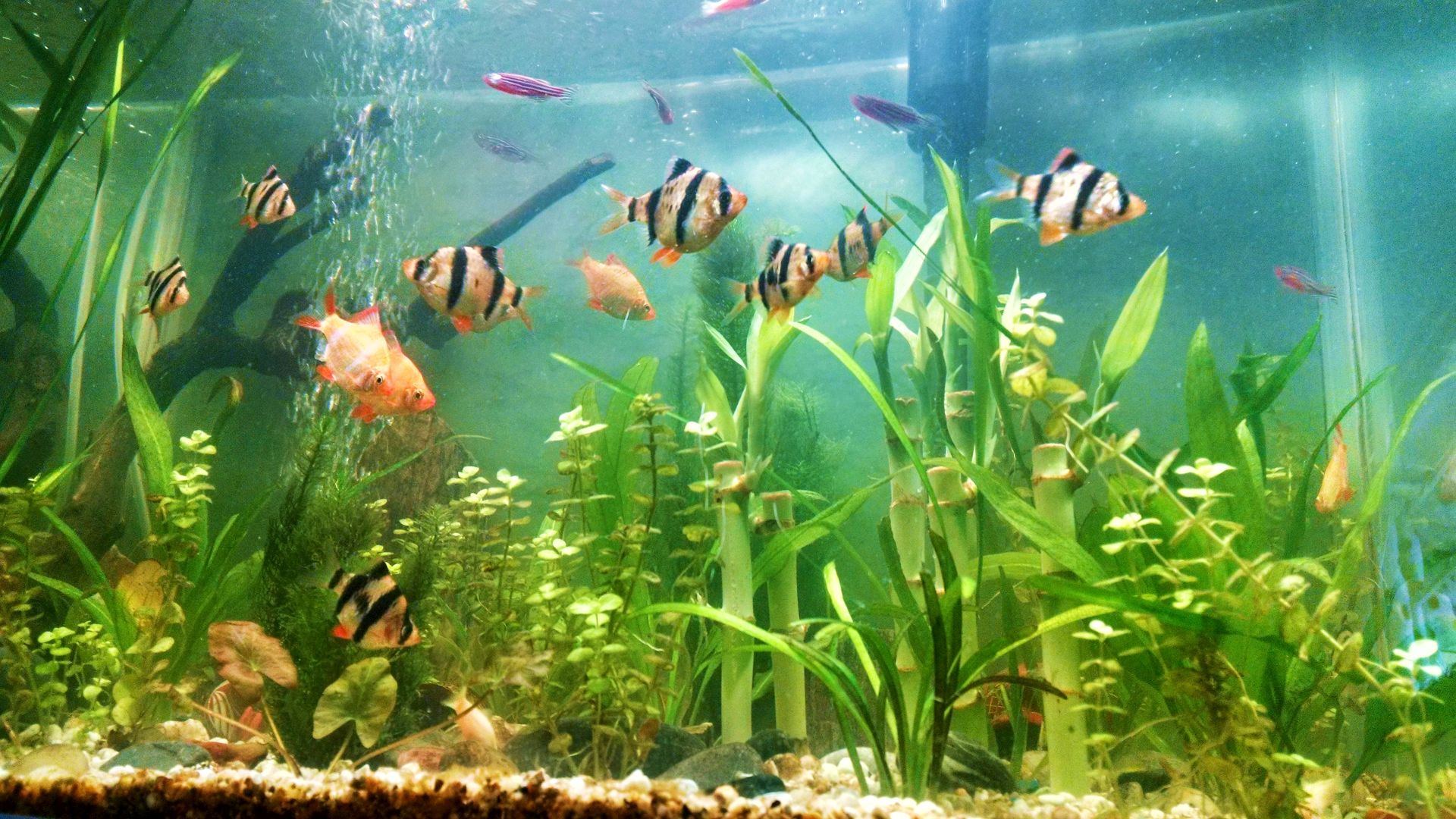
In an aquarium setting they prefer a densely planted tank of at least 30 gallons, with a few rocks and some driftwood. Tiger Barbs need slighty acidic water to breed successfully, but are tolerant to water quality fluctuations. Tiger Barbs are very active fish and will pester or nip at other slower moving fish housed with them.

Tiger Barbs are a silver gold to brownish yellow fish with four vertical black stripes on it’s body, and red to orange accented fins and snouts. They can grow up to 4 inches long in their natural habitat but remain smaller when kept in captivity.

The Green Tiger Barb or Moss Tiger Barb as it is sometimes referred to, grows to the same size as the native Barb but has a dark green to almost black body. Albino barbs are cream and gold with four barely visible white vertical stripes on their body and red to orange accented fins.

Both the Green and Albino Tiger Barb have the same disposition as “regular” Barbs and can be kept together.

The highly melanistic green tiger barbs (that reflect green over their black because of the Tyndall effect), the gold tiger barbs and albino tiger barbs are all examples of selective breeding that has been done over the years to emphasize their bright color combinations.

When breeding Tiger Barbs, place several specimens in the same aquarium until they pair off. When this occurs, the male will follow behind the female and fertilize the eggs as she lays them. Females tend to spawn several hundred eggs in the early morning hours in clumps of plants. You can expect on average around 300 eggs from each spawn. Once the spawning is completed, the parents will usually eat any eggs they can find, so remove them to another tank.

The fry will be free swimming after about 5 or 6 days, at which time they should be fed newly hatched brine shrimp until they are capable of eating finely crushed flake foods.

In their tropical environment Tiger Barbs prefer water with a 6.0–8.0 pH, a water hardness of 5–19 dGH, and a temperature range of 77 – 82 °F.

Their tanks should be well lit and about two thirds of the tank space planted with ample vegetation for them to munch on and hide in.

Tiger Barbs are omnivorous and will eagerly consume processed flake foods and crisps, as well as a variety of live and frozen foods such as daphnia, brine shrimp and bloodworms. They are greedy eaters and can become extremely aggressive during feeding time.

When kept in groups of less than 6 fish, they become aggressive and form a “pecking order” or sorts that includes any other fish in their tank. This gives them the reputation for being fin nippers in a community tank environment.

For this reason it is not recommended to place Tiger Barbs in with slower, more peaceful fishes like gouramis, angelfish, bettas, or any other fish with long flowing fins.

Tiger Barbs can be successfully kept with more active, faster moving fish like platys, danios, Clown Loaches and most catfish.

When at least a dozen or so Tiger Barbs are kept in a mixed tank, they will spend most of their time chasing each other and leave the other residents alone. Clown Loaches are an excellent match for Tiger Barbs.  They will swim along with the school and mimic the actions of the Barbs.

Tiger Barb

Tiger Barb (Puntius tetrazona)


Minimum Tank Size: 30 gallons
Care Level: Easy
Temperament: Semi-aggressive in small groups
Aquarium Hardiness: Hardy
Water Conditions: 74-79° F, KH 4-10, pH 6.0-8.0
Max. Size: 4″
Color Form: Black, Orange, White, Yellow
Diet: Omnivore
Compatibility: Ok with other fast moving fish
Origin: Farm Raised, USA
Family: Cyprinidae
Lifespan: 6 years
Aquarist Experience Level: Beginner

Posted in Barbs, Featured Articles, Freshwater Fish, Tropical Fish Keeping0 Comments

School of Cherry Barbs

Cherry Barb (Puntius titteya)

The Cherry Barb (Puntius titteya) is a hardy, slender barb that is very popular with tropical fish keeping enthusiasts.

The Cherry Barb is much more slender than most other barbs. It has a silver/black body with a golden, horizontal stripe after the lateral line. The male fish turns a bright cherry red during spawning, hence it’s name.

Cherry barbs are found in the tropical shallow, slow moving, well shaded streams of Sri Lanka from Kelani to the Nilwala basin.  In it’s natural habitat, it thrives in areas where there is a silt substrate with plenty of leaf debris

Cherry Barbs prefer a well planted tank of at least 30 gallons with soft, slightly acidic (pH 6.0-7.0) water. They need plenty of space for swimming but benefit from having driftwood and rocks added to the tank.

In their natural environment Cherry Barbs live in slow flowing streams but in an aquarium setting, provide them with good filtration and a strong current

Cherry Barbs are a shy, timid fish that should be kept with other fish having the same temperament. Providing them with some sturdy plants that grow to the waters surface will give your fish a sense of security, some places to hide and something to nibble on.  (See Video Above)

Java Moss is a good choice if you plan to breed your barbs.  The moss provides the female with a place to lay her eggs and gives the fry a place to hide and increases their chances of survival.

Good filtration and a quite a strong current are recommended. Cherry barbs live in slow flowing waters in the wild.

When breeding Cherry Barbs, place several of them in an aquarium until they pair off.  When a pair comes together, the female will lay the eggs with the male following closely behind her fertilizing them.

In about five days the fry will be free swimming.  Feed them newly hatched brine shrimp until they grow large enough to eat crushed flake foods.

Cherry Barbs should be fed a variety of foods including vegetables and meaty foods.

A good quality flake food along with occasional feedings of live brine shrimp, daphnia, bloodworms, and frozen foods will keep them healthy in your aquarium.  Cherry barbs also enjoy eating algae.

The average life span for Cherry Barbs is 4 years, but they can live to over 7 years in a well maintained aquarium.

Cherry Barb

Cherry Barb


Minimum Tank Size: 30 gallons
Care Level: Easy
Temperament: Peaceful
Aquarium Hardiness: Hardy
Water Conditions: 73-80.5° F, KH 4-10, pH 6.0-8.0
Max. Size: 2″
Color: Black, Red, White
Diet: Omnivore
Compatibility:
Origin: Sri Lanka
Family: Cyprinidae
Lifespan: 4 to 10 years
Aquarist Experience Level: Beginner

Posted in Barbs, Featured Articles, Freshwater Fish, Tropical Fish Keeping1 Comment

Red Line Torpedo Barb

Tropical Fish Keeping – Barbs

Barb Aquarium

Barb Aquarium

The term ”Barb” is loosely used to describe a wide range of different fish species in the aquarium trade.

The true barbs are the only species found in the genus Barbus, in the family Cyprinidae.    Most members of the Barbus genera have a pair of barbels on their mouths, which are used to search for food on the bottom.

Most all Barbs are small, lively, colorful, hardy fish that do well in community aquariums. They are a peaceful to semi aggressive schooling species that do best when kept in groups of at least six or more individuals. When kept separately, they tend to become more aggressive towards their tank mates and can become fin nippers.

When considering this family of fish for your freshwater tropical fish aquarium, keep them with other barbs or species that can tolerate highly active, semi aggressive behavior. Do not place them in with slower moving long finned fish like some tetras or Bettas.

Most barbs prefer well aerated, soft acidic to neutral water that is on the cooler side of the tropical fish spectrum.

When setting up your aquarium for barbs, try to mimic their natural environment. Include plenty of plants, especially some floating plants, but don’t crowd your tank. Give them enough room to swim and roots, rocks, or water logged wood to hide around. Barbs are naturally shy fish and do not like strong direct light.

Barbs will readily accept most types of food when in captivity. They are omnivorous and should be fed a mixed diet of meat and vegetable based food flakes. An occasional treat of brine shrimp or daphnia will keep them healthy in your tank.

Posted in Barbs0 Comments

Green Spotted Puffer

Pros And Cons Of Keeping Freshwater Puffer Fish

What are the  pros and cons of keeping freshwater Puffer Fish?

Puffer fish, also referred to as Sea Squab, Globefish, Ballonfish, Blowfish or Toadies belong to the family Tetradontidae which is in the Order Tetraodontiformes that are ancient fish over 40 million years old.

Puffer fish (Tetradontidae) are scaleless, chubby, adorable looking little fish that can be found around the world in freshwater, brackish water and marine environments.

All Puffer Fish have four fused teeth that look like a type of beak, and all have the defensive ability to gulp water or air to puff themselves up until they look like a small golf ball when they feel threatened.

The bodies of Puffer Fish are rigid and they rely on using their little fins for balance and motion. Their small rounded fins stick out from their round bodies causing them to move awkwardly. They use their pectoral fins for locomotion and their tail fin only when they need a quick burst of speed.

Puffer fish come in a variety of colors and sizes and present a comical appearance in aquariums because of their ability to independently rotate their eyes. Puffer fish are extremely active, intelligent, curious and interesting to watch, but they have a nasty temperament and are very efficient predators.

The vast majority of Puffer Fish are found in marine environments in most of the tropical oceans around the world, and fewer than 40 types of Puffer Fish are found in brackish waters.

To date, only 29 species of Puffer Fish have been found that are actually true freshwater Puffers.

This partial list of Puffer Fish and Their Water Requirements shows some of the more common types of puffers along with their water preferences.

In a community aquarium, freshwater Puffer Fish can be fin nippers if they are not well fed, and as they grow older they become more aggressive.

If you must keep them in a community tank, place them in with fast swimming fish such as Barbs, Danios or Rainbow Fish.  Puffers are particularly fond of crabs, snails and shrimp so don’t put them in the same tank  with your prized Blue Crayfish.

Novice tropical fish keeping enthusiasts should refrain from keeping Puffer Fish because of their special care and feeding requirements.

Although they will almost always adapt to aquarium foods, they require plenty of room and top notch water quality if you want them to thrive in an aquarium environment.

Puffer Fish need an adequate diet to remain healthy. They always seem to be hungry and they love to eat.

They act like little puppies waiting for you to feed them when they see you through the aquarium glass.

  • Puffer Fish Care

Puffer Fish do not have scales or gill covers. Because of this they are believed to be more susceptible to nitrite, nitrate and ammonia levels and many diseases.

Puffer Fish also tend to be messy eaters. They usually leave food on the bottom of their tanks which puts an excessive load on the aquarium’s filtration system.

Because they require top notch water quality, a large tank with plenty of room and a 50% weekly water change is recommended for keeping Puffer Fish.

Puffer Fish are like cats, they each have a different personality that varies greatly between species, and even within a single species. However, they are all predators and are usually aggressive to tank mates.

All Puffer Fish are fin nippers and although some tropical fish keepers report them to be good community fish, they become aggressive as they mature.

If you want to try your hand at keeping Puffer Fish, keep a single specimen tank.

  • Feeding

In their native environment freshwater Puffer Fish eat a variety of sails, crustaceans, shellfish and other fish.

In your tank they will eat a variety of live, frozen and freeze dried foods. They will “beg” for food but they should only be fed daily (if under 2 inches).  Medium size fish should be fed every other day and large fish (5 inches or more) only a couple of times a week.

As Puffer Fish grow, their strong teeth (beak) needs to be worn down or they will be unable to eat.  You can do this in an aquarium setting by providing them with snails, shellfish or other hard shelled crustaceans to gnaw on.

You will eventually see the Puffer Fish in your aquarium blowing sand or gravel  around on the bottom of the tank. They do this in the wild to uncover snails or other foods.  It is not a sign that they need to be fed.

  • Puffer Fish Facts

As their name implies, Puffer Fish “puff” themselves up when threatened so they are less likely to be eaten by predators however, some species have toxic substances in their skin and their flesh is poisonous when eaten.

Several deaths occur each year in Japan from Puffer Fish poisoning due to improper preparation. Powerful neurotoxins accumulate in their livers which is acquired from the food they eat.  Freshwater Puffer Fish housed in aquariums are toxin free.

Puffer Fish can live in an aquarium for over 10 years.  They range in size from less than 1 inch to over 48 inches in some marine species.

The brackish water species are found primarily around estuaries, in the mouths of rivers where they meet the ocean, and in freshwater streams where the Puffers enter periodically to feed or breed like eels.

Some species spend their entire lives in brackish water and never venture into freshwater.


Posted in Featured Articles, Setting Up Your First Aquarium, Tropical Fish Keeping0 Comments

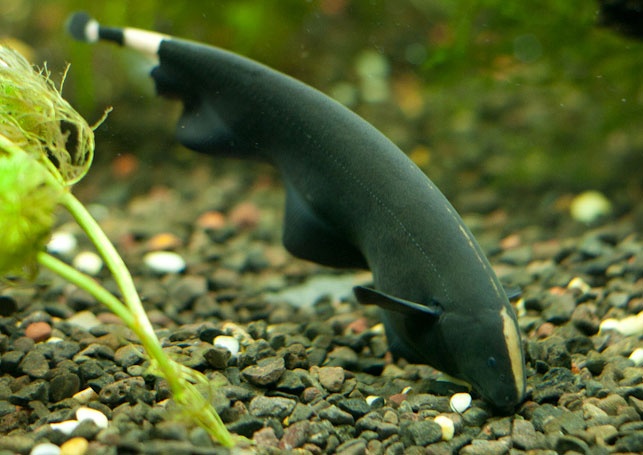
Black Ghost Knifefish (Apteronotus albifrons)

Black Ghost Knifefish – The Friendly Ghost

The Black Ghost Knifefish (Apteronotus albifrons) is a true bony fish that has a weak electrical organ at it’s caudal peduncles that run throughout the length of their body.  The organ is apparently used for communication and to help locate and identify it’s food.

The scaleless Ghost Knifefish is predominantly black with two white rings on its tail and a white blaze on its nose. It has one long undulating fin beneath that it uses for movement. They can move backward as quickly as they swim forward.

As their name implies, all knifefish have long tapered bodies that resemble a kitchen knife. The Black Ghost Knifefish comes from the Amazon River Basin in South America, Peru, and from the Parana River that runs from Venezuela through Paraguay.

Juvenile Black Ghost Knifefish swim in small groups of 6 or more. When the get older, they separate from the school and become more aggressive.

Black Ghost Knifefish are a shy, reclusive, nocturnal species that prefer sandy or fine gravel bottomed aquariums with live plants, some water logged driftwood and plenty of rocks to hide in during the day.

Since they are a nocturnal species, they do better in dimly lit aquariums with other large, more peaceful, mid-water species but being a shy bottom dweller, they also need plenty of hiding places.

Black Ghost Knifefish are carnivores and will eat almost any type of live food.  tubifex worms, ghost shrimp, brine shrimp, small fish, chopped earthworms, insect larvae, meat, frozen and flaked foods will all be eagerly accepted.

They need a large aquarium and can be kept with many other larger non-aggressive species however, they have been known to eat smaller fish if they can get them into their mouths.

Most tropical fish keeping enthusiasts find Black Ghost Knifefish an interesting and friendly species.  Although they are listed as being “aggressive”, most people who own them will argue the point.

After they settle into their aquarium surroundings, Black Ghost Knifefish become unbelievably tame.  Their owners can hand feed them and most fish even like being “petted” by their owners.  This fact belies their “aggressive” reputation.

Black Ghost Knifefish

Black Ghost Knifefish (Apteronotus albifrons)


Minimum Tank Size: 75 – 150 gallons
Care Level: Moderate
Temperament: Semi Aggressive
Aquarium Hardiness: Hardy
Water Conditions: 72 – 82° F, KH 0 – 10, pH 6.5-7.0
Max. Size: 20″
Color: Black
Tank Compatability: Bottom swimmer, sometimes aggressive to smaller fish
Diet: Carnivore
Origin: South America,
Family: Apteronotidae
Lifespan: Up to 15 years
Aquarist Experience Level: Advanced

Posted in Featured Articles, Freshwater Fish, Knife Fish, Oddball Fish, Tropical Fish Keeping0 Comments

African Butterfly Fish

African Butterfly Fish (Pantodon buchholzi)

African Butterfly Fish (Pantodon buchholzi) are uniquely interesting predator species common to many lakes throughout West Africa.

Tropical fish keeping enthusiasts have been housing butterfly fish for over 90 years, but they have never been available in large numbers.

Butterfly fish are surface dwellers and spend most of their lives on or near the water’s surface foraging for other surface dwellers and insects that fall into the water.   They have large eyes that sit high on their heads and a very large upturned mouth like their distant cousins the Arowanas.

They will usually ignore mid water and bottom dwelling fish unless they venture to close to the surface.  Butterfly fish will eat almost anything they can fit into their mouths, but with a few exceptions are a good community fish.

African Butterfly fish are strange looking, yet strikingly beautiful fish.  Their gossamer looking pectoral fins resemble a butterfly’s wings, hence the name and they have a dark brown to black body, speckled with lighter brown to black coloration that give them a camouflage appearance.

Butterfly fish are jumpers and should be provided a large well planted tank of at least 30 gallons that with some open areas free of vegetation and some sparse floating plants.

Plants that reach almost to the water surface will provide them with places to hide and make them less likely to jump.  A tight fitting cover is a must for these fish to stop them from jumping out of your tank.

African Butterfly fish do best in soft, slightly acidic, tannin stained water at about 80 degrees F.  You can place peat bags in a box or a canister filter to achieve the desired results or add driftwood to your tank.

Butterfly fish eagerly accept flake foods and some floating pellets, but being carnivorous they prefer live foods (crickets in particular), freeze dried or frozen floating foods.   They have been known to eat small tetras that get too close to the surface.

To breed African Butterfly fish, lower the water level in the aquarium to a couple of inches for a few weeks.  Then re-fill the aquarium using soft acidic water.   Males will climb on top of the female at the water’s surface to spawn and after about a day, the eggs will turn dark and float back to the surface.

It’s best to remove the eggs to a separate aquarium with the same water until they hatch. The eggs will normally hatch in two days at which time you can feed the fry baby brine shrimp, daphnia or any other small live foods.

Feed adult African Butterfly fish a steady diet of crickets, flies, brine shrimp, insects, freeze dried foods or flake foods to keep them healthy.

African Butterflyfish (Pantodon buchholzi)

African Butterfly Fish

African Butterfly Fish


Minimum Tank Size: 30 gallons
Care Level: Moderate
Temperament: Relatively Peaceful
Aquarium Hardiness: Hardy
Water Conditions: 75-86° F, KH 1-10, pH 6.5-7.1
Max. Size: 4″
Color Form: Green, Tan
Diet: Carnivore
Origin: West Africa
Family: Pantodontidae
Lifespan: 5 years or longer
Aquarist Experience Level: Beginner

Posted in Featured Articles, Freshwater Fish, Oddball Fish, Tropical Fish Keeping1 Comment

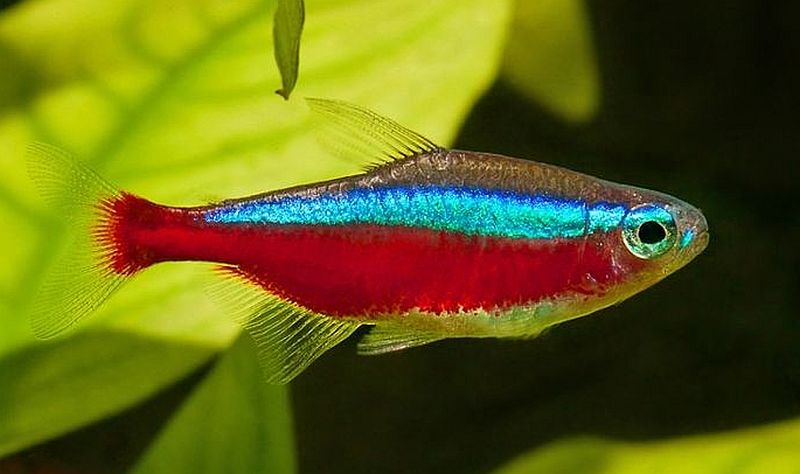
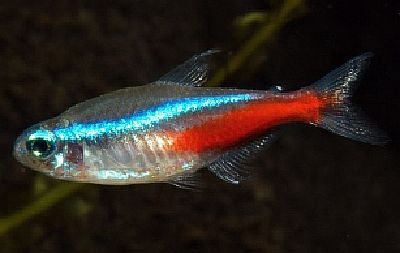
Cardinal Tetra (Paracheirodon axelrodi)

Cardinal Tetra (Paracheirodon axelrodi) – Delicate Beauties

The Cardinal Tetra (Paracheirodon axelrodi) is a spectacular delicate beauty that has been described as “one of the most popular aquarium fish ever”  by many tropical fish keeping enthusiasts.

The Cardinal Tetra (Paracheirodon axelrodi) like it’s peaceful cousin the Neon Tetra is a charming little schooling fish that is in both appearance and behavior awesome. Although it is slightly more delicate than the Neon Tetra, it thrives in large schools with it’s own kind and should be housed in densely planted, dimly lit aquariums of at least 15 gallons. The larger the aquarium, the easier they are to take care of and the healthier they stay.

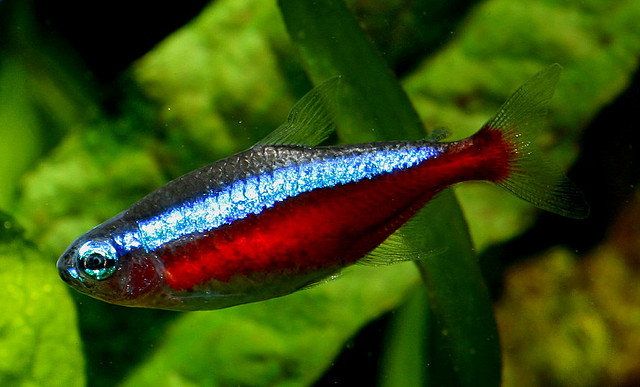
Cardinal Tetra (Paracheirodon axelrodi)

Cardinal Tetra (Paracheirodon axelrodi)

The Cardinal Tetra (Paracheirodon axelrodi) has a distinctive color pattern with a brilliant neon blue stripe above it’s center line and a bright (Cardinal) red stripe extending through its entire body length below. It is often referred to as the “big brother” of the Neon Tetra and the two color patterns are similar. The difference is that the Cardinal Tetra has the red coloration extending through it’s entire body length and in the Neon, the red is limited to the back half of the fish.

The brilliant contrast of the Cardinal Tetra’s colors is startling when viewed in low light conditions and their colors improve when they are housed together in large schools. The bigger the school; the more radiant their coloration becomes.

Plant their tank heavily with shrimp pellets, water sprite, etc. in a dark substrate, provide them with a lot of swimming space, some driftwood (bogwood) to hide in, keep their water soft, the pH acidic, and their colors become even brighter.

Cardinal Tetras cannot tolerate harsh light conditions, so don’t leave the hood lights on without providing them with some places to hide.

In the vegetated slow moving tributaries of South America where they were originally collected, Cardinal Tetras travel in huge shoals and live in very low light conditions under the rainforest canopy.

This is why they should be kept in groups of 10 or more with other equally peaceful tank mates like pencil fish, hatchet fish, small rasboras, dwarf cichlids, small Loricariids, and anabantoids.

Although native to the upper Orinoco and Negro Rivers, like the Neon Tetra they are being bred in captivity for the aquarium trade.

Breeding the Cardinal Tetra is similar to breeding Neon Tetras.  You need to provide the adults with soft water in the 1-2 dH range, a pH of 5-6, a temperature of 82 degrees F. and low lighting.   Female Cardinal Tetras will lay as many as 180 eggs at which time the parents should be taken from the tank.  The eggs are photosensitive and will die if exposed to bright light.  Consequently, after spawning, the aquarium should be covered to darken it and provide the developing eggs the conditions necessary for a successful hatch.

At 82 degrees F.  the eggs will normally hatch in as little as 24 hours, to as long as  3 days .  The fry remain waterborne and photosensitive for approximately 5 – 7  days.  During this period gradually increase the light in the tank.  The The fry should be fed newly hatched baby brine shrimp or water Daphnia after their egg sacs are absorbed.  After 8 to 12 weeks the fry reach adulthood and full coloration .

When Cardinals are kept in favorable conditions, they are easy to keep and resist diseases. However, when housed in unstable conditions they quickly decline in color quality and will die.   Neon Tetra disease is a primary concern for tropical fish keeping enthusiasts who keep Cardinal and Neon Tetras.   It affects many species of fish, is highly contagious and to date is incurable.

When purchasing Cardinal Tetras, look for commercially bred specimens with good color and that are in good condition.    Whenever possible,  purchase larger specimens, especially if they have been caught in the wild.

The wild caught specimens have more vibrant colors than commercially bred fish but are not as tolerant to unstable water conditions that inevitably occur in freshwater aquariums.

When available for purchase, Cardinal Tetras are usually 3/4″ to 1-1/2″ in size.


Cardinal Tetra (Paracheirodon axelrodi)

Cardinal Tetra (Paracheirodon axelrodi)


Minimum Tank Size: 15 gallons
Care Level: Moderate
Temperament: Peaceful
Aquarium Hardiness: Less hardy than Neon Tetras
Water Conditions: 73-81° F, KH 2-6, pH 5.5-7.5
Max. Size: 3″
Color Form: Iridescent Blue, Red
Diet: Omnivore
Compatibility: Peaceful, keep with other small tetras
Origin: Farm Raised in Europe, Indigenous to South America
Family: Characidae
Lifespan: Up to 8 years
Aquarist Experience Level: Moderate Experience

Posted in Featured Articles, Freshwater Fish, Tetras, Tropical Fish Species3 Comments

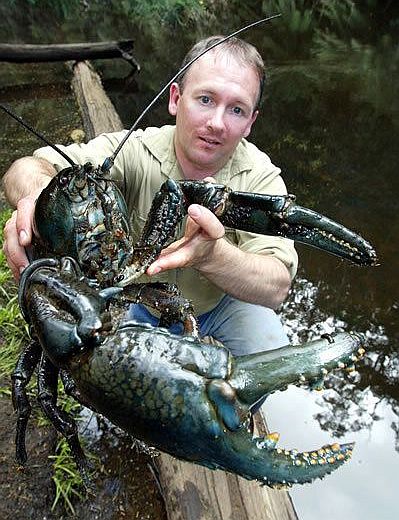
Tasmanian Gian Crayfish

Crayfish: Beautiful Freshwater Lobsters

Crayfish are also referred to as crawfish, crawdads, mudbugs, or freshwater lobsters.  They are freshwater crustaceans that resemble their saltwater cousins, lobsters, to which they are closely related.  There are well over 150 different species of freshwater crayfish worldwide which can live an average lifespan of 2 to 6 years,  some even longer.

Crayfish breathe through feather like gills and are found in both slow and fast moving bodies of water.   The majority of species are found in streams and small brooks in fresh running water.  Other species thrive in swamps, ditches and in many areas are cultured in rice paddies.   Most species of crayfish cannot tolerate polluted water however, some invasive species like  (Procambarus clarkii ) are much hardier.

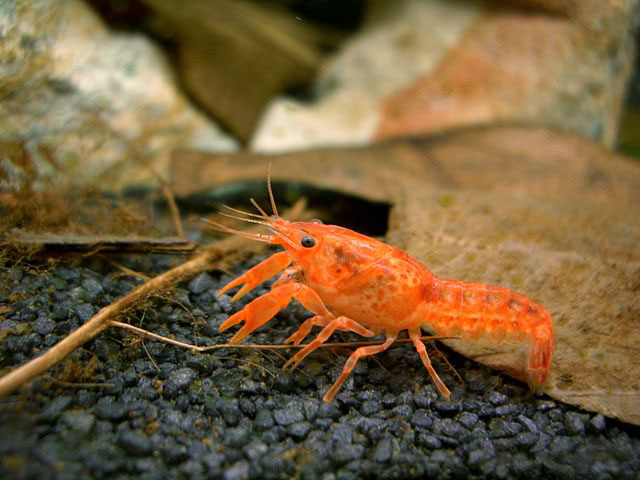
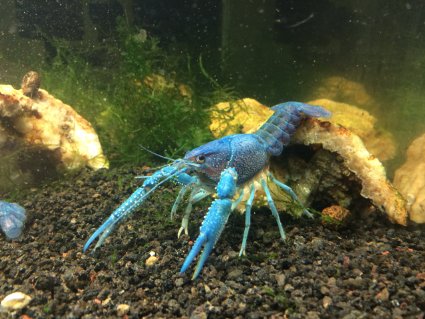
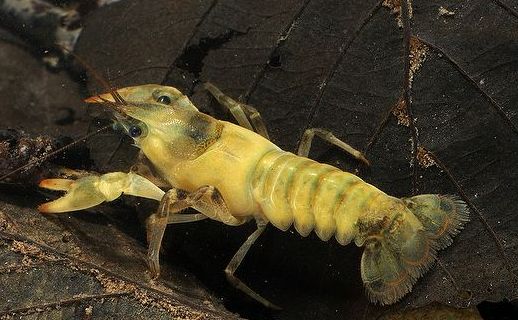
Crayfish are fascinating creatures that come in a variety of colors and can be quite entertaining to watch.  Many tropical fish keeping enthusiasts eventually wind up keeping Crayfish in their tanks. Their color variations range from brown (the most common), red, yellow, green, blue, albino and several other combinations.

Mexican Dwarf Red Crayfish

Mexican Dwarf Red Crayfish


Blue Crayfish

Blue Crayfish


White Clawed Crayfish

White Clawed Crayfish


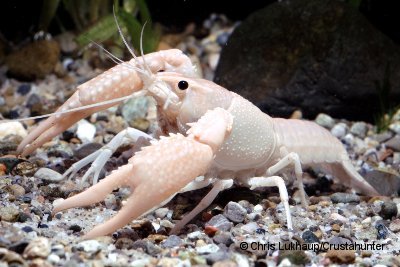
White Crayfish

White Crayfish


Most people acquire their first specimens by collecting them from a local stream, a slow moving area in a river or from a backwater in their local lake.   The more colorful specimens can be ordered online from almost anywhere in the world if your local aquarium store cannot get them for you.

Before you bring your crayfish home, make sure you have a separate tank set up for them.

Crayfish Tank

Crayfish require at least a 10 gallon tank if you are keeping only one specimen. Because crayfish are very territorial, they will do much better and demand less care when housed in a much larger (30 to 55 Gallon) tank.

Crayfish are “diggers” and love to burrow, so set up your tank with the smallest size gravel you can get or just use sand as a substrate. Include some rocks, a hollow log or cave decoration, or a clay flower pot for them to hide in.

They are active but naturally shy creatures and you can expect your tank decor to be rearranged withing a day or so after introducing them. Most activity occurs during the evening hours or during low light conditions.

Do not use live plants in your tank. Crayfish are omnivores and will enjoy eating them. Use plastic plants for decorating. Your crayfish tank should be set up just like your tropical fish tank. Use a good filter and heater if necessary, NO NOT use an underground filter.

Since most North American species are cold water, you can probably do without a tank heater.  You will need one if you purchase any of the Australian, Tasmanian, Asian or South American varieties.

Care

In the wild, Crayfish feed on living and dead animals and plants.  They are scavengers and will leave uneaten food on the bottom of your tank.  A 25 to 50% weekly water change will take care of this problem and keep your specimens healthy.

Like their saltwater lobster and crab cousins, crayfish molt and shed their exoskeletons as they grow.  They need an alkaline environment a lot of calcium in their diets.  Add a few drops of liquid calcium to their water on a daily basis during the molt to help them along with the process.

Crayfish are great fishermen. They will perch themselves with their claws wide open and wait for a passing fish to swim by. Unless you don’t mind having your tropical fish eaten by them, don’t mix crayfish with other tropical fish.

Foods

Crayfish are scavengers and will eat animal and vegetable matter. Feed them commercial foods such as shrimp pellets, that you give your Plecostomus, freeze dried or most large flake foods.   High calcium foods like fresh spinach, raisins, zucchini, leaf lettuce, squash, etc. should also be fed occasionally, but be sure to remove any uneaten food after a few hours to ensure water quality.

Molting

As your Crayfish grow they will shed their old exoskeletons and in a couple of days grow a new replacement.  During the molting process they will also replace any legs or claws that were lost during friendly skirmishes.

During this “soft shell” stage they are extremely vulnerable and will hide in your tank.   Don’t think you lost your specimen when you see what looks like a dead crayfish on the bottom of the tank; it’s just the old exoskeleton. Most Aquarius pull it out of the tank but the crayfish will usually eat it when their new skeleton hardens up.

As noted above, adding a few drops of liquid calcium to their water on a daily basis during this period will help them along and speed up the process. After the molt, don’t be surprised if your crayfish looks bigger or it changes color, this is perfectly normal.

The life cycle of Crayfish is fascinating to watch and given the proper care, they will reward tropical fish keeping enthusiasts with years of enjoyment.

Tasmanian Giant Crayfish A. Gouldi

Tasmanian Giant Crayfish A. Gouldi


Minimum Tank Size: 10 gallons
Care Level: Easy
Temperament: Aggressive
Aquarium Hardiness: Relatively Hardy
Water Conditions: 68-77° F, KH 4-8, pH 5.0-7.0
Max. Size: 2″to over 31″ (Tasmanian, Astacopsis gouldi)
Color: Varied
Diet: Omnivore
Compatibility: Territorial, better housed alone
Origin: Worldwide
Family: Superfamilies Astacoidea and Parastacoidea
Lifespan: 2– 40 years
Aquarist Experience Level: Beginner


Posted in Crayfish, Featured Articles, Freshwater Fish, Freshwater Invertebrates & Amphibians, Oddball Fish0 Comments

School Of Neons

Neon Tetra (Paracheirodon innesi) – Jewels Of Tropical Fish Keepers

The diminutive Neon Tetra (Paracheirodon innesi)  is  frequently described as the “Jewel of the aquarium hobby” by tropical fish keeping enthusiasts for several reasons.  These popular little freshwater tropical fish are adorned with beautiful iridescent colors and when kept in large schools provide a beautiful addition to any South American community tank.

Neon Tetras (Paracheirodon innesi) are native to the clear water streams of South America.  They have an iridescent blue body with bright red tails and when kept in schools of eight or more, create a startling splash of color to any aquarium.

Neon Tetras prefer a setting similar to their natural habitat.  A densely planted aquarium that  has a few rocks, some driftwood nestled between the plants, some floating plants and plenty of low light areas for the fish to hide in, will keep your Neons healthy and happy.

Neon Tetras have a tendency to swim or remain suspended in the water column in large schools. This trait creates a breathtakingly colorful display in any aquarium.

Neons are peaceful little fish and should be housed with other similar South American tetras of the same size.  They belong to the family “Characidae” and thrive in slightly acidic (pH 5.0 to 7.0) water.

Neon Tetras can be successfully bred in captivity by placing a pair into a dark or dimly lit breeding tank.  Increase the lighting in the tank until breeding occurs.

Breeding can be induced by keeping the water hardness at less than 4 dH and providing daphnia, brine shrimp, mosquito larvae or other live foods to the spawning pair. After spawning occurs, remove the parents to their original environment.  The parents will usually eat their eggs if kept in the breeding tank.  The eggs usually hatch within 30 hours or so.

Neon Tetras will eagerly accept many small foods such as live brine shrimp, daphnia, mosquito larvae, tubifex worms, bloodworms, freeze-dried products, micro pellets, and high quality flake foods.  Vary their diet to keep them healthy and happy.

Neon Tetra (Paracheirodon innesi)

Neon Tetra

Neon Tetra


Minimum Tank Size: 10 gallons
Care Level: Easy
Temperament: Peaceful
Aquarium Hardiness: Hardy
Water Conditions: 68-77° F, KH 4-8, pH 5.0-7.0
Max. Size: 2″
Color: Iridescent Blue, Red
Diet: Omnivore
Compatibility: Peaceful
Origin: South America, the Paraguay River basin; Rio Taquari, Pantanal of Mato Grosso do Sul, and Brazil
Family: Characidae
Lifespan: 5 – 10 years
Aquarist Experience Level: Beginner

Posted in Featured Articles, Freshwater Fish, Tetras, Tropical Fish Keeping, Tropical Fish Species2 Comments

Awesome Reef Tank

Pros And Cons – Freshwater Or Saltwater Aquarium?

What are the pros and cons of keeping a freshwater or saltwater aquarium?


Tropical fish keeping can be divided into two primary categories.  Maintaining the care of freshwater fish or caring for their saltwater counterparts.

Both types of tropical fish keeping will provide you with a great deal of enjoyment and add some living color to your home.

Children and adults have been bringing home fish and other creatures from their local waters since the beginning of time. It could be crayfish, minnows or baby bluegill from a stream or a small octopus or Blenny from a saltwater pool at low tide. Regardless of what you bring home, you will need to take care of it, or eat it.

Assuming that you don’t want to eat your catch, your next step is to decide how to keep it alive. Aquariums fit the bill nicely and can be set up for either freshwater fish or saltwater specimens.

  • Freshwater Aquariums:

Freshwater tropical fish are beautiful to look at and many species are adorned with unique color patterns akin to their more colorful saltwater cousins. Some are more exotic looking than others but if you have never dealt with freshwater tropical fish before, you will be mesmerized by them.

Colorful Freshwater Aquarium

Colorful Freshwater Aquarium

Each species of fish may have have different requirements for their living conditions but many species can be housed together in a “community tank” setting and peacefully coexist with each other.

Beginning tropical fish keepers usually start with freshwater aquariums because they are easier to take care of and are more “forgiving” if you make a mistake. De-chlorinated tap water can be used to fill your tank and make periodic water changes, and test kits are readily available to ensure that everything is in order.

Fish that thrive in freshwater are not necessarily too particular about where they swim. Most will thrive in a neutral pH water environment however the water temperature IS important.

As their name implies, tropical fish like to have their water a bit warm. You can monitor and adjust this with a good heater placed in the tank. The emphasis is on GOOD one. A cheap heater could cause you to lose all your fish.

Freshwater aquarium setups are normally less expensive than the saltwater variety. The cost of the tank and stand is usually the same but the lighting, filters, protien skimmers, etc.can set you back a bit.

You can get a 30 Gallon acrylic show aquarium combo these days for around $225.00. This may sound expensive but it will save you money because you won’t have to spend more on additional equipment.

Freshwater tropical fish are also less expensive than saltwater fish unless you get into the really exotic species like Discus, Arrowanna, freshwater rays, etc.

  • Saltwater Aquariums:

Saltwater aquariums are awesome in their beauty and will give and your friends hours of viewing pleasure, but they do require more work. This is why most beginning tropical fish keepers choose a freshwater aquarium to start with.

Saltwater Reef Aquarium

Saltwater Reef Aquarium

However, if you are a dedicated person willing to learn everything necessary to keep a saltwater aquarium running smoothly, saltwater fish keeping may be for you.

Saltwater tropical fish are a little more delicate than the freshwater fish you may be used to keeping. Setting up their environment correctly is critical to their survival and well being, at least in the beginning. Once they settle into their tank environment, their activities becomes what you would expect to see in a small part of the ocean.

Everything revolves around keeping the water salinity correct.

When keeping saltwater aquariums, monitoring of salt levels is crucial. Too much or too little salt will kill your fish and because saltwater tropical fish cost substantially more than freshwater tropicals, you will probably want to keep your fish alive as long as humanly possible.

Maintaining marine tropicals costs more than it does to maintain freshwater species, but do you know why?

Unless you live on the coast where you can easily collect fresh seawater to conduct periodic water changes, you will have to mix your own “sea water” using synthetic sea salt mixtures. Commercial sea salt for the aquarium trade has come down in price but is still expensive.

In addition, protein skimmers are needed to keep pollutant buildups out of your tank water and special lighting is needed if you choose to keep corals alive and healthy.  These can initially be quite expensive however, if you don’t mind paying a bit extra and you have the dedication necessary to maintain a saltwater tank, you can literally move a part of the ocean into your home.

Once you decide to take on the responsibility of tropical fish keeping, your next decision is whether to invest in a freshwater or saltwater tank.

Hopefully, the above information will help you make your decision.
Posted in Featured Articles, Setting Up Your First Aquarium0 Comments

Saltwater Fish

Featuring Clownfish

Aquarium Supplies

On-Sale Aquarium Supplies!

Saltwater Specials

Categories