Ignitus Anthias (Pseudanthias ignitus)
Ignitus Anthias (Pseudanthias ignitus) known to tropical fish keeping enthusiasts as the Flame Anthias, Flame Basslet, Flame Fairy Basslet, Flame Fairy Anthias, and Indian Flame Anthias are found in the eastern Indian and far western edge of the Pacific Ocean.
The range of the Flame Anthias extends into the Maldives, the Andaman Islands, the Similan Islands off western Thailand, and Sumatra, Indonesia.
Ignitus Anthias are typically found in masive schools hovering over the outer coral reef slopes and passes of their range in areas with heavy wave action and strong tidal currents in shallower depths from 10 to 50 feet.
Schools of Pseudanthias ignitus are frequently seen by divers several feet above live corals where they use the strong currents to their advantage by snatching passing zooplankton from the water column.
Most Ignitus Anthias are collected in strong currents from the reef passes and drop offs as they feed.
Although Ignitus Anthias display clear sexual dimorphism, both males and females have the fiery hues associated with their name Flame Anthias.
Ignitus Anthias (Pseudanthias ignitus)
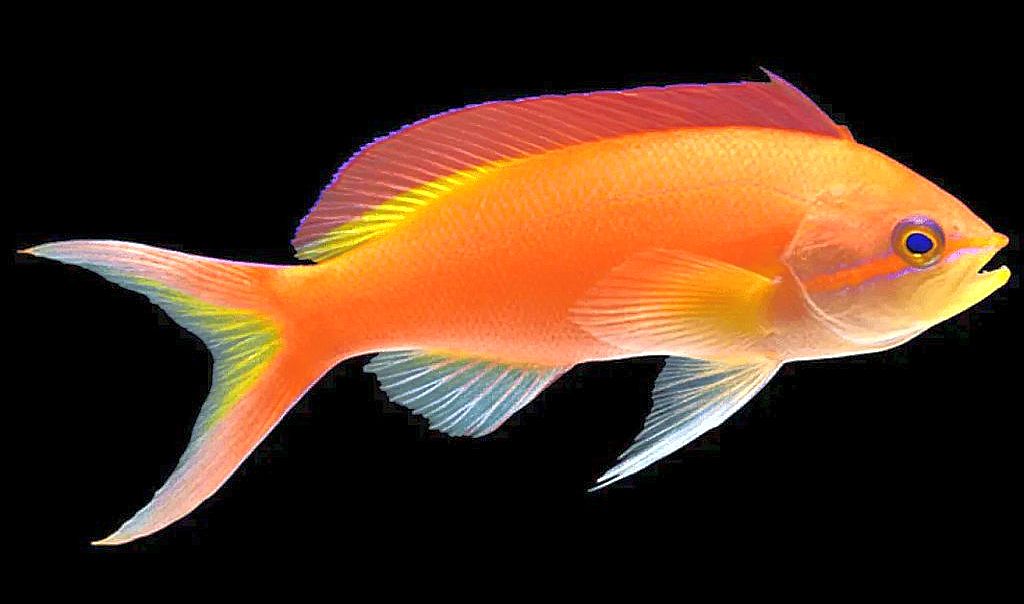
Male Ignitus Anthias have an elongated, laterally compressed body with large eyes suited for spotting tiny zooplankton in the water column, a medium sized mouth that opens at an upward angle, and a fleshy, moveable protuberance on the front of their upper lip.
The head and mid section of the body are an intense orange yellow color that becomes firey red toward the back and upper torso. The lower jaw and bottom half of the head are pale yellow with an orange stripe edged with lavender or purple that runs from the tip of the snout across the lower half of the eye to the edge of the gill cover.
The top of the bright firey red dorsal fin in males is edged in purple or lavender, and is yellow at the base. The transparent anal fin has a lavender hue, the pectoral fins have a red spot at the base, and the deeply forked caudal fin has an orange base that transitions into bright red lobes at the tips. The lower abdomen and belly are a soft lavender to silvery white color.
Ignitus Anthias (Pseudanthias ignitus)
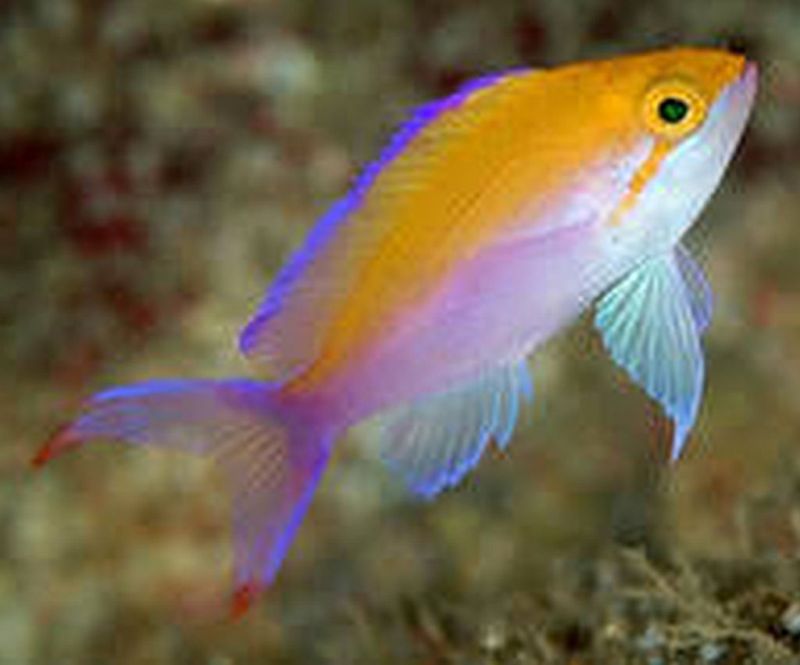
Females have similar but more subdued colors. The body is yellow orange with a red dorsal fin and pectoral fins with a red dot at their base. The intense lavender highlights and deep crimson rear body shading found in males is absent in females.
Juvenile Flame Anthias have a uniform orange to soft yellow body color that deepen as they age.
Ignitus Anthias are protogynous hermaphrodites. When a community of females lacks a male, the dominant female will transition into a male within a few weeks.
A single Ignitus Anthias can be housed in a mature reef or FOWLR aquarium of at least 70 gallon capacity with a coralline substrate, large amounts of live rock arranged into caves, crevaces, ledges and overhangs for them to hide among, and plenty of free swimming space.
A small harem of one male and several females or a group of females are best kept in at least a 125 gallon tank decorated in the same fashion. They thrive in well established reef aquariums with stable water conditions.
To replicate their natural reef slope environment, multiple wavemakers are needed to provide strong, continuous water movement and proper oxygenation necessary for them to thrive. Try to create a brisk current across the upper and middle sections of the tank where they prefer to swim
Because Ignitus Anthias require constant small feedings; heavy filtration, aggressive protein skimming, regular water changes, and media reactors are required to keep nitrates and phosphates at zero.
Ignitus Anthias are notorious jumpers, particularly when startled, during feedings, or when minor hierarchy disputes arise. Providing a tight fitting mesh or glass lid on their tank is non negotiable.
Flame Fairy Anthias are completely reef safe and will ignore corals, clams, crabs, and ornamental shrimp. They are quite docile and should only be kept with peaceful, non aggressive tankmates like gobies, basslets, firefish, pygmy angels, small wrasses, or peaceful tangs. Avoid aggressive triggers, eels or large groupers.
When housed with conspecifics, Ignitus Anthias do best in harems of one male with 3 to up to 10 females. Never introduce more than one mature male, or they will fight aggressively.
When keeping a group, it is best to buy females of slightly varying sizes and introduce them all into the tank at the same time. This allows the group to establish a natural pecking order with minimum stress. Within a few weeks, the largest, most dominant female in the group will physically transition into a male.
Unlike deep water Anthias that prefer lower light levels and need plenty of shaded areas in the tank to retreat to, Ignitus Anthias quickly adjust to reef lighting. However, a lighting system that provides a gradual dawn to dusk lighting cycle can greatlly benefit this species.
Breeding Ignitus Anthias in an aquarium environment is extremely rare. Like Squarespot Anthias, healthy harems will display spawning behavior and even release eggs in an aquarium environment but raising the larvae to adulthood is virtually impossible without specialized kreisel tanks.
When a stable mature harem is well fed and the females are fully conditioned; courtship behavior will typically occur during the evening or at dusk.
The male’s colors will intensify, his bright red dorsal fin will become fully erect, and he will perform a U turn swimming pattern “dance” swimming downward to a receptive female and then darting up to the surface. A receptive female will simultaneously rush toward the surface with the male and release their eggs and sperm into the water column before darting back down to the safety of the live rock in the tank.
The pelagic, transparent, fertilized eggs contain an oil globule that keeps them afloat on the water surface. In the aquarium they are usually sucked into the filtration system, protein skimmer, or eaten by other fish in the tank before they can be captured.
Any collected eggs will hatch out in just 14 to 16 hours depending on water temperature. The tiny hatched out larvae will survive on their yolk sac for about 48 hours before they need microscopic live foods like first stage rotifers and copepod nauplii. After a week or two, any surviving larvae will be able to handle brine shrimp. The larval fry have to drift as plankton in a specialized, perfectly circular flow tank for about 30 to 35 days before they metamorphose into recognizable juveniles.
Ignitus Anthias are zooplanktivores that in the wild gather in large shoals in the open water column, just above the the safety of the corals where the ocean currents deliver a continuous suply of copepods, amphipods, fish and invertebrate larvae, pelagic fish eggs, tunicates and rotifers.
In an aquarium environment, they need to be fed small amounts of zooplankton 3 to 4 times a day. Mysis shrimp, vitamin enriched brine shrimp, frozen Cyclops, Calanus, rotifers, finely chopped clams or shrimp. Over time high quality protein rich marine pellets or flakes may be accepted and should be broadcast into the water current to mimic zooplankton. Any food that falls to the bottom of the tank will generally be ignored.
An established refugium connected to your main tank is strongly recommended to provide this species a continuous, natural supply of live copepods into the water column between regular feedings.
Ignitus Anthias (Pseudanthias ignitus) are available to tropical fish keeping enthusiasts from a number of online wholesalers, trans shippers and retailers, usually by special order.
Prices vary by size and area of collection but start around $49.99 to $59.99 for small size .5″ to 1.5″ females collected from the Maldives. South Asia specimens 2.25″ to 4.75″ are priced from $56.99 to over $79.99.
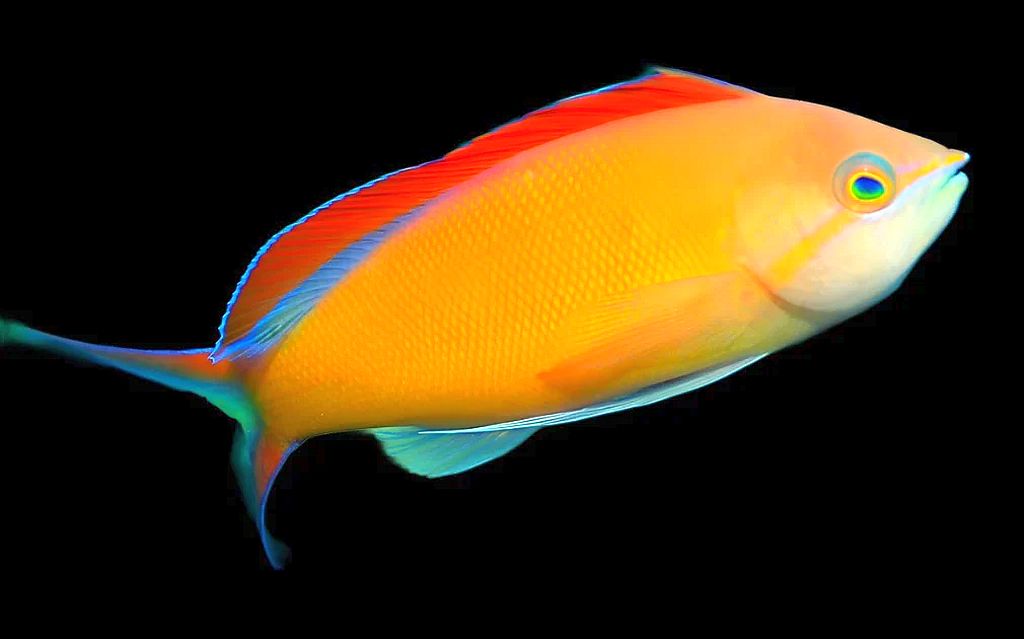
Ignitus Anthias (Pseudanthias ignitus)
Minimum Tank Size: 70 gallons
Aquarium Type: Reef or FOLR
Care Level: Moderate
Temperament: Semi Aggressive
Aquarium Hardiness: Hardy
Water Conditions: 72-78° F, dKH 8 to 12, pH 8.1-8.4, sg 1.020-1.025
Max size: Males 4″, Females 3″-3.5″
Color Form: Orange, Red, Yellow, Purple
Diet: Carnivore
Compatibility: Reef
Origin: Indo-Pacific
Family: Serranidae
Lifespan: 5 – 7 years
Aquarist Experience Level: Intermediate