Tag Archive | "tropical fish keeping"

300 Gal South American Chiclid Tank

Setting Up Your First Tropical Fish Aquarium

Setting Up A Tropical Aquarium
Tropical fish keeping is an enjoyable, relaxing hobby, but setting up your first tropical fish aquarium for the first time can be a daunting experience if you have never done it before.  Before you even think about bringing your first fish home, they must have a place to stay.  Since the aquarium will now be their new official residence,  it should ideally have as many of the amenities of their previous digs as possible.

Here is a simple guide to setting up your first tropical fish aquarium:

The first step is to purchase a suitable aquarium for the fish you intend to keep.  Ideally, you need to purchase the largest aquarium that you can afford.   A twenty or thirty gallon tank may seem large for one small fish, but in time the fish will grow and so will the other fish that you will inevitably add to the tank.  Size does matter!

Fish need plenty of room to swim around in both to reduce stress and to provide them with as much oxygen as possible to their gills.   The more fish you add to your tank, regardless of the size of the tank, the less oxygen the fish will be able to absorb.  Therefore take some time to plan ahead on what type fish you will be keeping and size the tank.

After you purchase a suitable tank, think about where you want to showcase your fish.  Positioning your aquarium is important for several reasons.  – Placing your tank close to a window is a bad idea.  Sunlight can heat up your tank and cause the water temperatures to rise beyond what the fish can tolerate and you could find your tropical fish going belly up.

Conversely, situating the tank near an air conditioner or directly under a ceiling fan can have the opposite effect and keep the tank water too cool for tropical fish.   In most areas of the country you will need a heater to keep the tank water at a comfortable temperature for your fish, so be sure there is an outlet nearby for plugging in your heater,  running your filters and your tank lights.

Another consideration most people overlook is the weight of the tank when filled with water.  One gallon of water weighs approximately 8.35 pounds which makes a 55 gallon tank setup with gravel, scenery, filter, hood, stand, etc. weigh in at a minimum of 460 pounds.  Make sure your  tank is placed in an area that can support the weight when fully set up.

Your next step in setting up your first tropical fish aquarium is to add a suitable substrate over your under gravel filter along with rocks, caves, fake or real plants, etc. for the fish to enjoy.  If you are going to use an under-gravel filtration system, you need to cover it with at least an inch of gravel to provide for adequate filtration and slope it towards the front of the tank.  The sloping is done to aid in siphoning out fish waste and other nasty stuff from the bottom of the tank after it has cycled.

If you use not using an under-gravel filtration system, be sure to purchase either a good canister filter or an outside filter that requires at least two filter cartridges.   This minimizes the disruption of the naturally growing beneficial bacteria when your need to replace a dirty cartridge.  The idea is to replace one filter cartridge at a time at different intervals so you do not disrupt the nitrogen cycle.

Your next step is to slowly fill your tank with de-chlorinated tap water.    Tap water is convenient for filling freshwater aquariums but municipal water generally has high levels of chlorine, nitrites and nitrates in it which will kill tropical fish.   Additionally, depending on the area that you live in, your tap water may be excessively soft or hard.

Use one of the many available chlorine removal products, along with an approved test kit to check your water hardness before adding any fish to your tank and adjust your pH accordingly.   Add water to your tank slowly so you don’t disrupt the gravel, plants or other scenery.  Placing a small plate on the bottom of the tank and running your water on it will minimize cloudiness.

After your tank is filled, don’t bother re-testing the water until you add fish to the tank. –  Pet stores stock test kits which you can purchase that test a variety of chemical levels in your tropical fish tank.  Excessive amounts of ammonia, nitrates and nitrites will kill your fish and should be carefully monitored after fish have been added to the tank.

Test the water regularly to make sure that these levels stay within normal limits as your tank goes through its nitrogen cycle.  The filtration system and beneficial bacteria that grow inside your tank environment will gradually rid the tank water of excess ammonia, nitrites and nitrates.  Keep a keen eye on these levels for the first few weeks before and after your tank cycles out.

Accessories and additional fish can be gradually added after your tank completes it’s nitrogen cycle.   Add only one or two fish at a time to prevent ammonia spikes.

Most fish love to hide in rocks or coral caves and swim through dense live or artificial plants, so it’s generally a good idea to make your tank look as much as possible like their natural surroundings.

An aquarium planted with live foliage along with an anchored wooden log will keep most South American fish healthy and happy and maintain the correct pH of the water. 

South American Tank

An aquarium set up with plenty of open rock structure and makeshift caves will keep African cichlids healthy and happy.

African Chiclids Tank

Want to know more about setting up your first tropical fish aquarium?   Look for additional posts on this site or visit your local bookstore to check out the numerous magazines and manuals written on how to care for your tropical fish.

.

Posted in Featured Articles, Setting Up Your First AquariumComments (0)

Discus

Freshwater Tropical Fish – Brilliant Gems From The Deep

Discus School

Most people eventually tire of watching the same old goldfish swimming around in the bowl that they won at the local Fair and will start looking for something a little bit more exotic.

If you know where to go and what species to look for, you will be able to find many brilliant gems from the deep that will brighten up your home and provide your family with hours of enjoyment.   There are more types of brilliantly colored exotic tropical fish available to tropical fish keeping enthusiasts than you could ever imagine.   Many exotic fish have strange body shapes, weird breeding rituals, odd colorations and are found in sizes that can be kept in an aquarium environment with very little effort.

Exotic fish are hard to define.  There are so many fish species that are different from what we are normally used to seeing that we often refer to them as “exotics”.   Usually fish that are rare or hard to find have this distinction.  But, fish that are interbred to keep certain specific characteristics (like Discus, show Koi, Guppies or Angelfish) are also placed into this category.

Here are a few freshwater species you might want to check out.:

Discus FishDiscus – Discus are a flat, wide, brilliantly colored freshwater fish named after the discus used in the Olympic Games in Greece.  These shy fish come from the Amazon River Basin and easily get along with others of their kind in an aquarium setting.  They come in a variety of colors and patterns and are tank bred to enhance these characteristics.  Discus are sensitive to water quality changes, prefer soft water (pH level of 6) and temperatures at a constant 82 to 86 degrees F.   Discus fish thrive in deep water and because they can grow up to 7 inches long, they are not usually found alone in community tanks but in rather large aquariums.

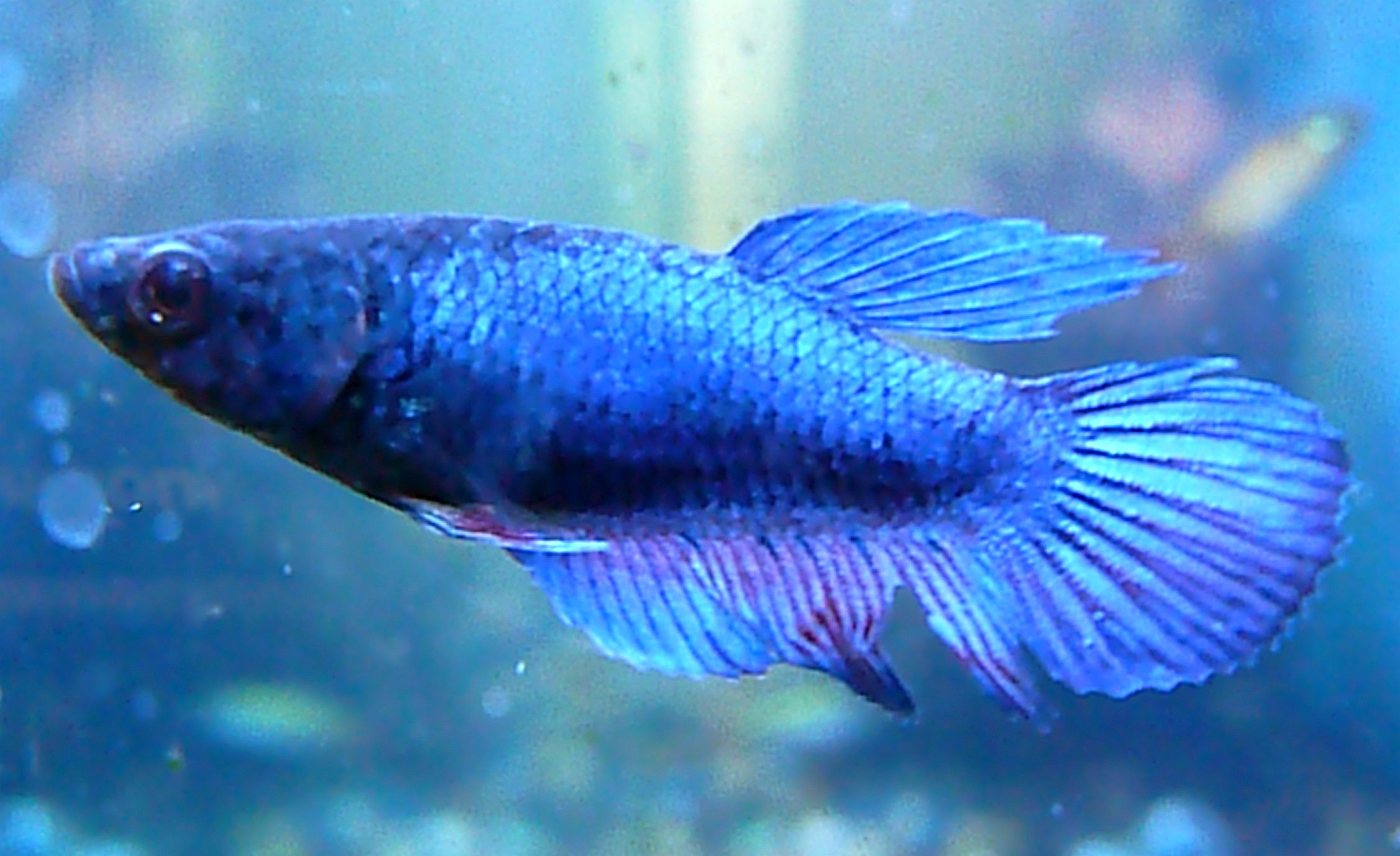
BettaBetta – Betta fish are beautiful and quite aggressive.  Bettas are VERY territorial toward any fish that they think is another male Betta and they will fight other male betta fish to the death if left unattended.  Their beautiful coloring extends to their feathery fins and as they swim, their fins will open up to an even more beautiful show.   Betta fish come in a variety of colors (primarily blue and red) are because of their coloring, choosing betta fish that are healthy can be a challenge.  Look for fish with no bruising, scarring or white spots which is an indication of ich.

Blue Moscow GuppyGuppies – People have always loved keeping guppies.  These small hardy fish with brightly colored tail fins resemble a bride in a tight dress with a flared bottom.  The various types (Tuxedo, Cobra, Mosaic, Grass,  Metal, Platinum) come in almost  every color of the rainbow, are easy to care for, easy to breed and do especially well in community aquariums.  Female guppies generally grow larger than the males, sometimes by about two or three inches.   For the fish keeper on a tight budget, they do well in a 10 gallon aquarium, will eat almost any type of fish flake and thrive with minimal care.  Guppies are another exotic tropical fish that have been interbred to achieve specific skin and color patterns.  A true rare beauty from the deep.

High Fin PlatyPlaty – Platys are a hearty tropical freshwater fish that thrive in community tank conditions.  Platy fish have dark colored fins that outline their beautiful red, yellow and orange colored bodies.  Because Platys can tolerate wide changes in nitrate and nitrite levels, they are a good fish to use for stocking and cycling a new aquarium.  They thrive do best with tank vegetation planted to hide their eggs when they breed.

Black MoorGoldfish –  Goldfish should not be counted out of the exotic tropical fish category just yet.   There are goldfish species that are very exotic and bring a high price, especially in the Chinese and Japanese markets.  Consider the Black Moor, the various types of Koi and other inbred goldfish varieties.  The Black Moor is a round bodied goldfish with bulging eyes and long velvety tail fins.  It is a telescope-eyed variety of fancy goldfish that has a characteristic pair of protruding eyes.  It is also referred to as popeye, telescope, kuro demekin in Japan and dragon-eye in China.  They can grow up to a length of 10 inches and have a lifespan of 6 to 25 years.   Black Moors are a cold water fish and may revert to a metallic orange color when exposed to warm water temperatures.

Marbled AngelfishAngelfish – Angelfish are a tropical freshwater and saltwater species prized by tropical fish keepers.  The freshwater Angelfish is a cichlid that comes from the Amazon Basin of South America and is one of the most commonly kept freshwater aquarium fish.  They are prized for their unique shape, color patterns and behavior.  Angelfish were not successfully bred in captivity in the United States until the late 1920s to 1930s, but now are frequently bred to enhance their distinct fin patterns and unique color markings.

Regardless of what type of exotic tropical fish you like, there is a variety that will liven up your tank for  beginners as well as those more expert in Tropical Fish Keeping.

Posted in Featured Articles, Freshwater Fish, Tropical Fish Keeping, Tropical Fish SpeciesComments (1)

Saltwater Fish

Featuring Clownfish

Aquarium Supplies

On-Sale Aquarium Supplies!

Saltwater Specials

Categories