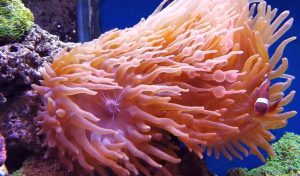
Bubble Tip Anemone (Entacmaea quadricolor)
The Bubble Tip Anemone (Entacmaea quadricolor), formerly classified as Actinia quadricolor and commonly sold in the hobby as BTA, RBTA, or GBTA, known to tropical fish keeping enthusiasts as the Bubble-Tip Sea Anemone, Four-Colored Anemone, or Bulb-Tentacle Sea Anemone, is a striking, photosynthetic cnidarian species that is found across tropical marine environments throughout the Indo-Pacific.
Their range extends from the Red Sea and East Africa to Micronesia, Melanesia, southern Japan, and Australia’s Great Barrier Reef.
The Bubble Tip Anemone inhabits warm coastal waters across a wide vertical range, living from just below the low-tide mark down to roughly 130 feet, with occasional deep-water individuals recorded down to 200 feet. Within these coastal reefs, they live in close, mutualistic association with several species of anemonefish.
In the upper, sun-drenched sublittoral zone—such as shallow reef flats, rocky lagoons, and surge channels—Entacmaea quadricolor
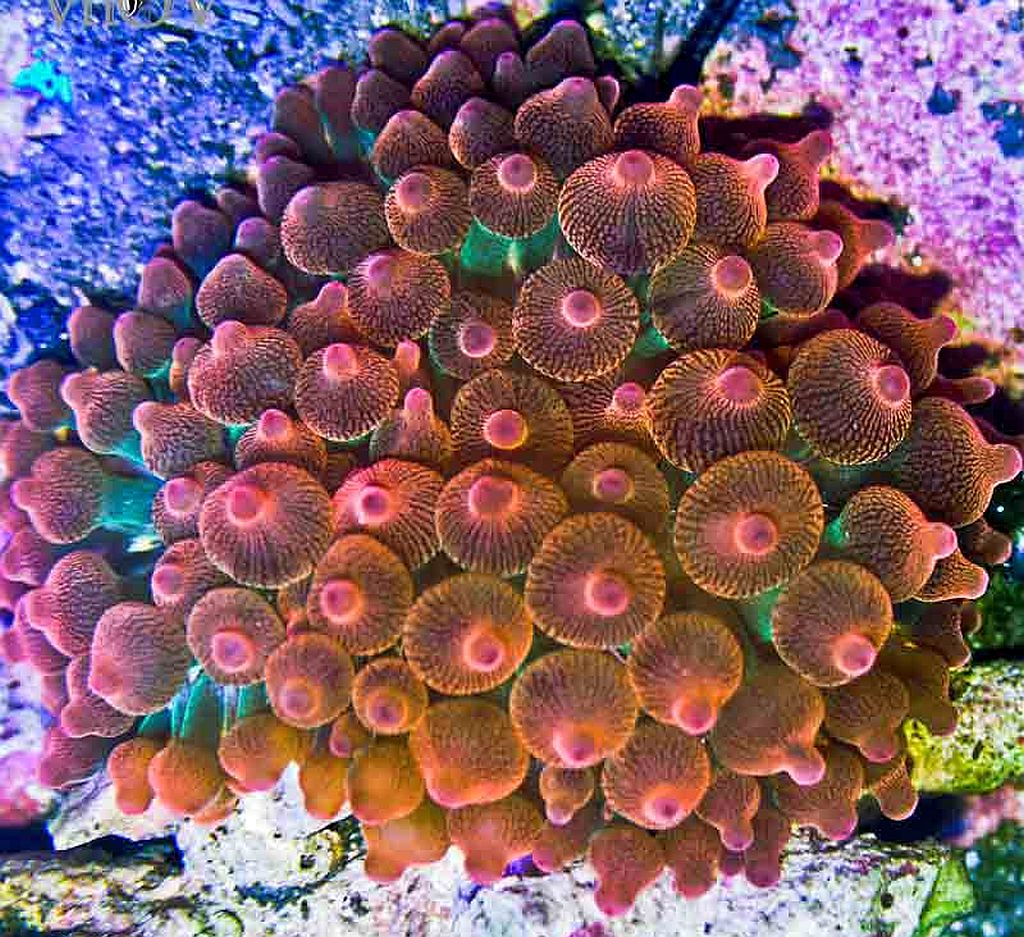
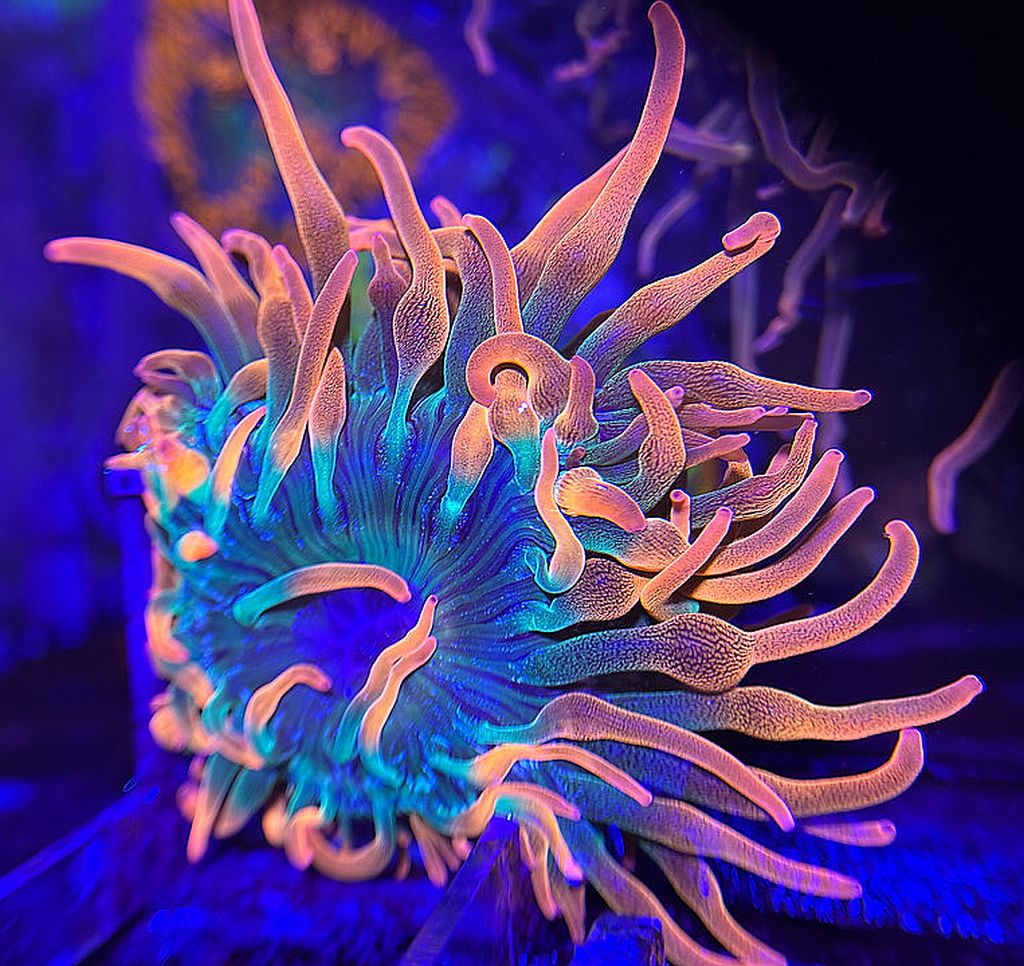
Bubble Tip Anemone (Entacmaea quadricolor) Rose Morph
typically grows in dense, clonal clusters exposed to strong light. In deeper water on the dimly lit patch reefs and rubble slopes, they are typically encountered as solitary giant specimens.
Entacmaea quadricolor are not free-swimming pelagic organisms. Instead of drifting in the open water column, Bubble Tip Anemones are benthic, semi-sessile invertebrates that anchor their sticky pedal disc deep inside of rocky holes, caves, or dead coral crevices while extending their oral disc and tentacles out into the light. Throughout the day and at night, Bubble Tip Anemones stay firmly wedged inside of their live rock crevices, using their adhesive foot to hold fast against the reef currents.
Living anchored inside the narrow rockwork provides immediate physical protection, allowing the anemone to rapidly deflate and retract its entire soft body deep inside the crevice when threatened by diurnal reef predators.
Although Bubble Tip Anemones are famous for forming dense, clonal colonies in shallow reef environments, they are aggressively territorial toward unrelated corals and neighboring sessile invertebrates. While tolerant of their own genetically identical clones, they will aggressively sting and overgrow competing stony and soft corals that encroach upon their territory.
Entacmaea quadricolor are medium to large marine invertebrates that commonly reach 6 to 12 inches in oral disc diameter in home aquariums, with solitary deep-water specimens occasionally growing up to 16 inches across.
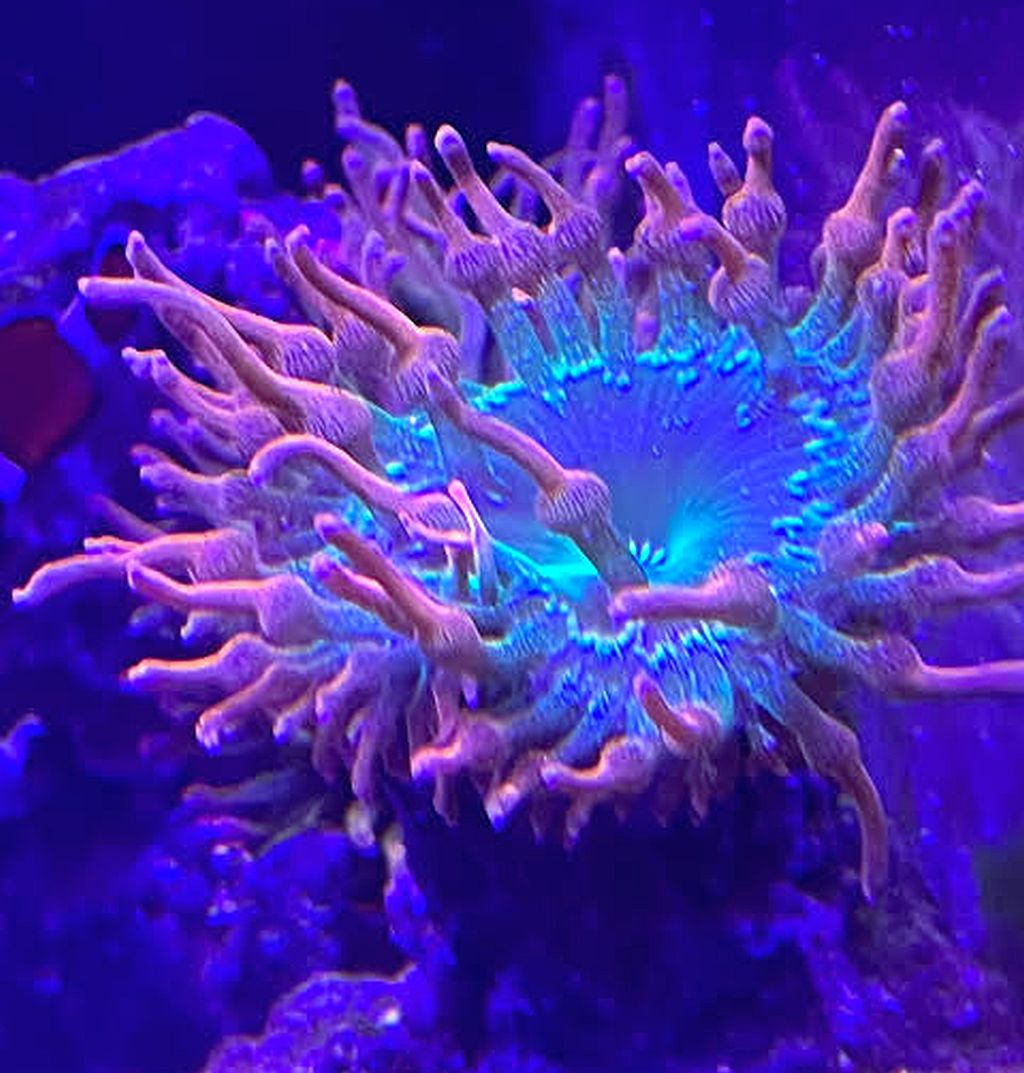
Bubble Tip Anemone (Entacmaea quadricolor)
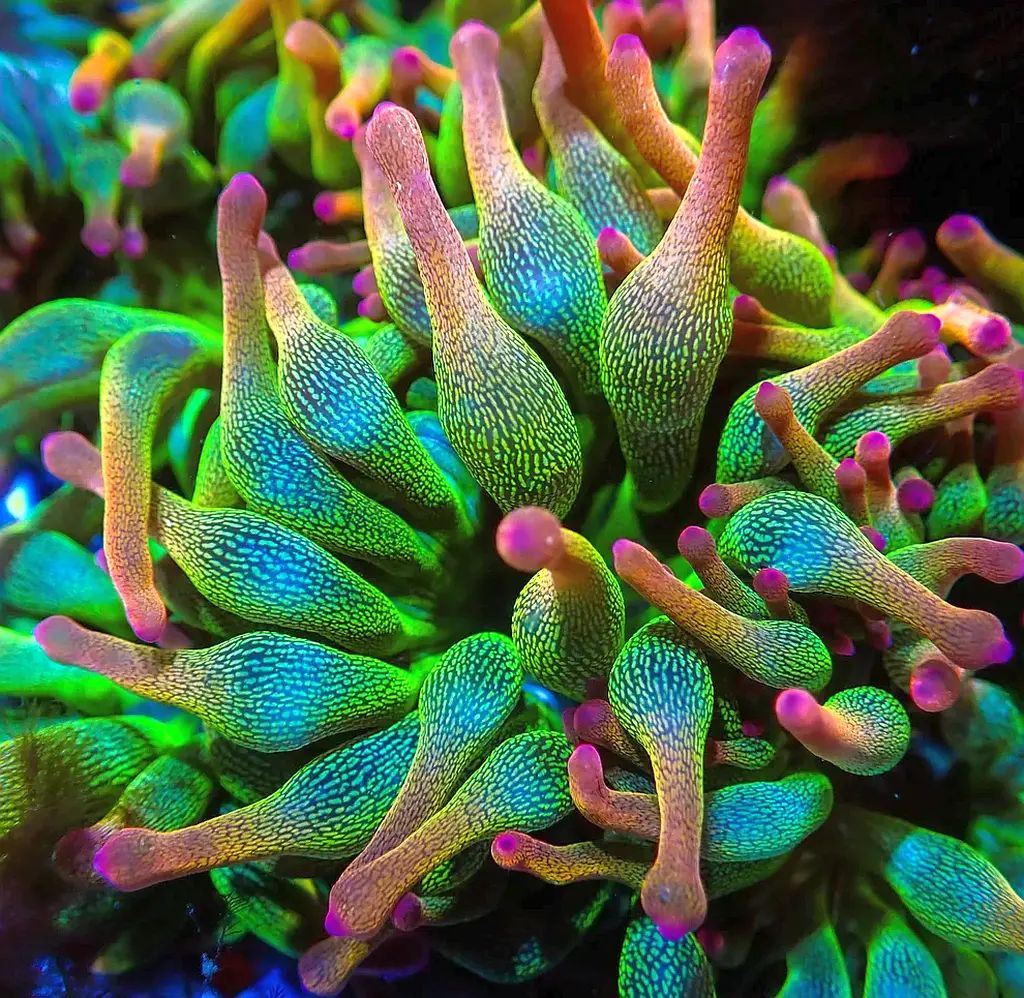
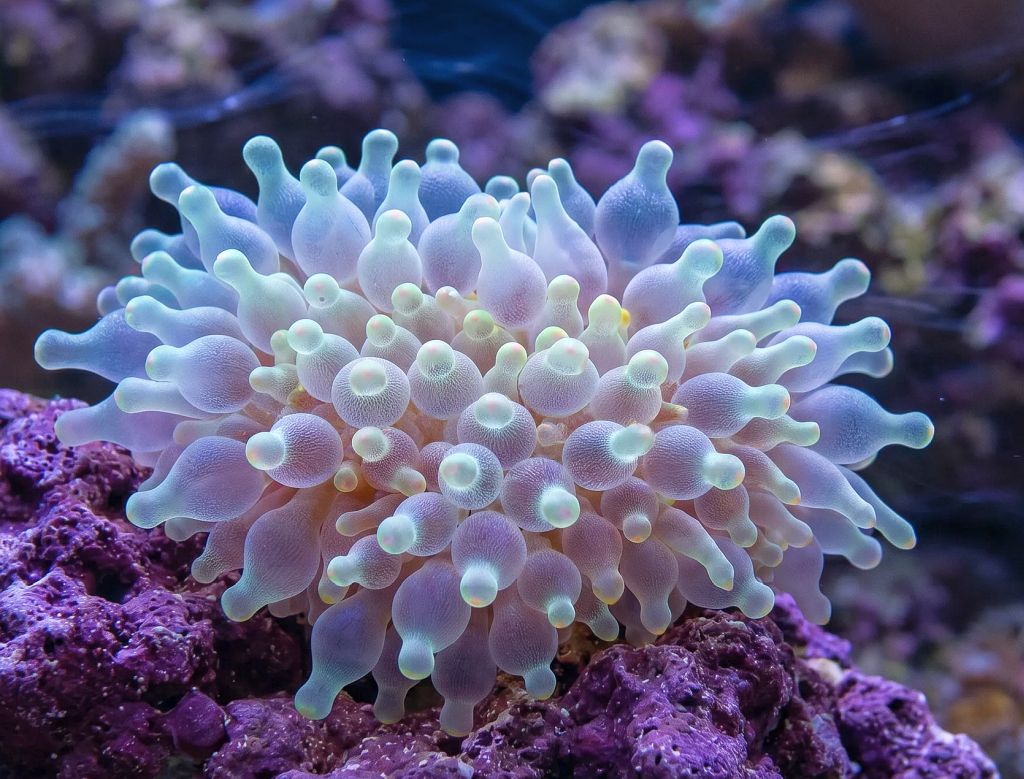
True Bubble Tip Anemones display a wide, highly distinctive range of color morphs that feature a smooth, brownish-tan to bright red or green column topped by an oral disc and numerous tentacles accented by swollen, bulb-like tips.
They have a characteristically flexible, soft-bodied anatomy with a central slit-like mouth surrounded by concentric rings of tentacles that can inflate into prominent bubbles or stretch out into long, flowing ribbons depending on lighting, water flow, and the presence of clownfish.
Bubble Tip Anemones harbor dense populations of symbiotic photosynthetic algae known as zooxanthellae
Bubble Tip Anemone (Entacmaea quadricolor)
within their tissues. This gives them their rich base coloration and shifts their hue depending on light spectrum. Popular varieties such as the Green Bubble Tip Anemone (GBTA), Rose Bubble Tip Anemone (RBTA), Rainbow, Sunburst, and Black Widow morphs showcase vibrant shades of neon green, crimson red, bright orange, yellow, and dark webbing.
The Bubble Tip Anemone is a broadcast-spawning cnidarian that lacks external sexual dimorphism. In a home reef aquarium it is impossible to visually distinguish males from females.
In the wild, separate male and female colonies release gametes into the water column synchronously. In a reef aquarium environment, they reproduce almost exclusively through asexual longitudinal fission.
Unlike stony corals that secrete a rigid calcium carbonate skeleton, the Bubble Tip Anemone lacks any hard protective armor. Instead, they rely on potent stinging cells called nematocysts packed into their tentacles alongside their rapid deflation defense inside deep rock crevices for survival.
The Bubble Tip Anemone is semi-reef safe and is best housed in a well-established FOWLR or reef aquarium of at least a 30 gallon capacity with a aragonite sand substrate, plenty of porous live rock with deep crevices, mature biological filter, moderate to high reef lighting, moderate indirect water flow, and covered wavemaker intakes. Unprotected powerheads and overflow drains should always be covered with foam guards or mesh screens, as wandering Bubble Tip Anemones can easily get pulled into pump intakes and foul the entire aquarium.
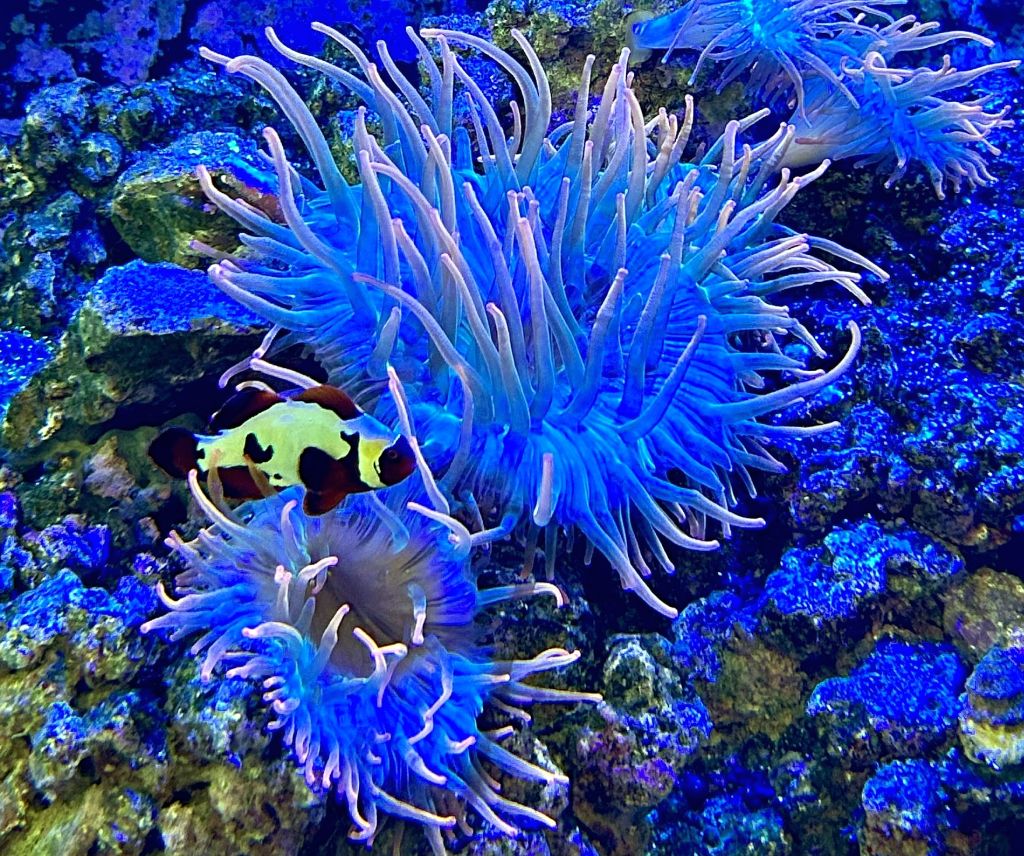
Bubble Tip Anemones are peaceful toward symbiotic clownfish, making them an iconic centerpiece for reef tanks. However, they are highly mobile invertebrates that will slowly walk across the rockwork in the tank until they find ideal light and flow. Their potent sting can severely injure or kill any neighboring LPS, SPS, or soft corals that they touch along the way.
Because Bubble Tip Anemones are peaceful toward fast-swimming reef fish, they seem to do best in a mature reef or anemone-dominated system with compatible clownfish and cautious tank mates.
Some good tank mates include Maroon Clownfish, Ocellaris Clownfish, Percula Clownfish, Clarkii Clownfish, Tomato Clownfish, Cardinalfish, Chromis, Dartfish, and peaceful reef-safe Blennies. Although Ocellaris and Percula clownfish will readily adopt the Bubble Tip Anemone in home aquariums, they are not natural hosts for them in the wild (unlike Maroon, Clarkii, and Tomato clowns).
Avoid keeping them with large Angelfish, Butterflyfish, Filefish, Triggerfish, Pufferfish, or aggressive Peppermint and Camel Shrimp, as these species frequently nip at or consume anemone tentacles and can stress the animal to death.
Bubble Tip Anemone (Entacmaea quadricolor)
The Bubble Tip Anemone is moderately difficult to care for and should only be added to a mature, stable marine system that has been running for at least six months. Like most host anemones, they are highly sensitive to sudden water parameter swings—especially rapid shifts in salinity, alkalinity, and temperature. Copper-based medications are immediately fatal to them.
Four-Colored Anemones require stable tropical temperatures between 75–82°F , a specific gravity of 1.025–1.026, a pH of 8.1–8.4, moderate to high lighting (150–200 PAR), and turbulent, indirect currents to really thrive. Consistent water quality and intense reef lighting are essential for keeping this photosynthetic invertebrate alive in a reef aquarium.
Although Bubble Tip Anemones rarely spawn sexually in a home aquarium environment, they reproduce readily in captivity through asexual splitting.
Asexual reproduction occurs via longitudinal fission, where a single healthy anemone slowly stretches its oral disc and tears itself directly
Bubble Tip Anemone (Entacmaea quadricolor)
down the middle over the course of several hours to days. The two resulting halves quickly heal their edges and form fully functional mouths, creating two genetically identical clones. Splitting is commonly triggered in home aquariums by regular target feeding and robust growth, though sudden water changes or environmental stress can also prompt an anemone to divide as a survival response.
In their natural environment, the Bubble Tip Anemone (Entacmaea quadricolor) is primarily a photosynthetic organism that relies heavily on its internal zooxanthellae for daily energy. They are opportunistic carnivores that supplement their diet by using their sticky, nematocyst-laden tentacles to paralyze and capture passing zooplankton, small crustaceans, and tiny fish, while also absorbing dissolved organic nutrients and nitrogenous waste excreted by their host clownfish.
In an established aquarium environment, Bubble Tip Anemones obtain the majority of their nutrition directly from high-output reef lighting and fish waste.
Experienced tropical fish keeping enthusiasts can supplement their diet by target-feeding small portions of finely chopped mysis shrimp, krill, clam, mussel, or squid once every one to two weeks, ensuring that the food pieces remain smaller than the anemone’s mouth to prevent regurgitation and internal bacterial infections.
The Bubble Tip Anemone (Entacmaea quadricolor) is widely available from wholesalers, online reef retailers, local fish stores, and fellow hobbyists at low to high prices depending on the color morph. They are highly prized by reef and clownfish enthusiasts for their vibrant fluorescent coloration, bubbly tentacle morphology, and hardy adaptability compared to other host anemones.
Current retail prices for the Bubble Tip Anemone range from $39.99 to $89.99 for classic Green and Rose morphs, while rare designer varieties such as Colorado Sunburst, Chicago Sunburst, and Black Widow morphs can cost anywhere from $150.00 to over $500.00 per specimen depending on size and lineage.
Bubble Tip Anemone (Entacmaea quadricolor)
Minimum Tank Size: 30 gallons (mature tank running 6+ months)
Aquarium Type: Mature Reef or Anemone-Dominated System
Tank Care Level: Moderate
Temperament: Semi-Aggressive (Stings neighboring corals; peaceful with host clownfish)
Aquarium Hardiness: Moderately Hardy
Water Conditions: 75–82° F, dKH 8 to 12, pH 8.1 – 8.4, sg 1.025 – 1.026
Max Size: 12″ – 16″
Color Form: Green, Rose/Red, Orange, Yellow, or Rainbow Morphs
Diet: Photosynthetic (Zooxanthellae) / Carnivore
Compatibility: Semi-Reef Safe (With Caution)
Origin: Indo-Pacific (Red Sea to Micronesia and Australia)
Family: Actiniidae
Lifespan: 20 – 50+ years (Potentially indefinite via clonal division)
Aquarist Experience Level: Intermediate