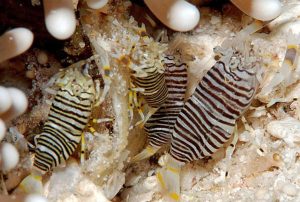
Bumble Bee Shrimp (Gnathophyllum americanum)
The Bumble Bee Shrimp (Gnathophyllum americanum), known to tropical fish keeping enthusiasts as the Striped Bumblebee Shrimp, Striped Harlequin Shrimp or Echinoderm Shrimp, is a small marine decapod crustacean species that is found globally throughout circumtropical marine environments across the Indo-Pacific, the Caribbean, and the western Atlantic Ocean.
Bumble Bee Shrimp are most commonly found among the tropical lagoons, shallow coral reef flats, grass beds, and rocky rubble zones of their range in the intertidal zone, down to depths of 165 feet where they live in close proximity to their echinoderm hosts.
Bumble Bee Shrimp have been recorded as deep as 330 feet among hard bottoms, coral rubble, rock ledges, and sandy sea floors where their primary food sources—sea stars, urchins, and sea cucumbers—are most abundant.
Gnathophyllum americanum are not natural burrowers. While they are constantly on the move, Bumble Bee Shrimp are highly cryptic and primarily nocturnal, with their peak activity beginning at dusk. During the day, Bumble Bee Shrimp are commonly found sheltering beneath the spines of sea urchins, around sea cucumbers, or wedged deep within live rock cavities. These sheltered microhabitats protect them from diurnal reef predators—especially small wrasses—that hunt them in the open.
Although Bumble Bee Shrimp are frequently found sharing the same reef structures or even the same host urchin, they are not necessarily social animals in a tight school. They are a docile, non-aggressive species that do not seem to associate closely with conspecifics unless they decide to mate or aggregate loosely for protection under a large host. Because of their tiny size, several individuals can safely inhabit the same large nano aquarium without territorial conflict.
Gnathophyllum americanum are exceptionally miniature marine crustaceans that seldom exceed 0.5 to 1 inch in body length.
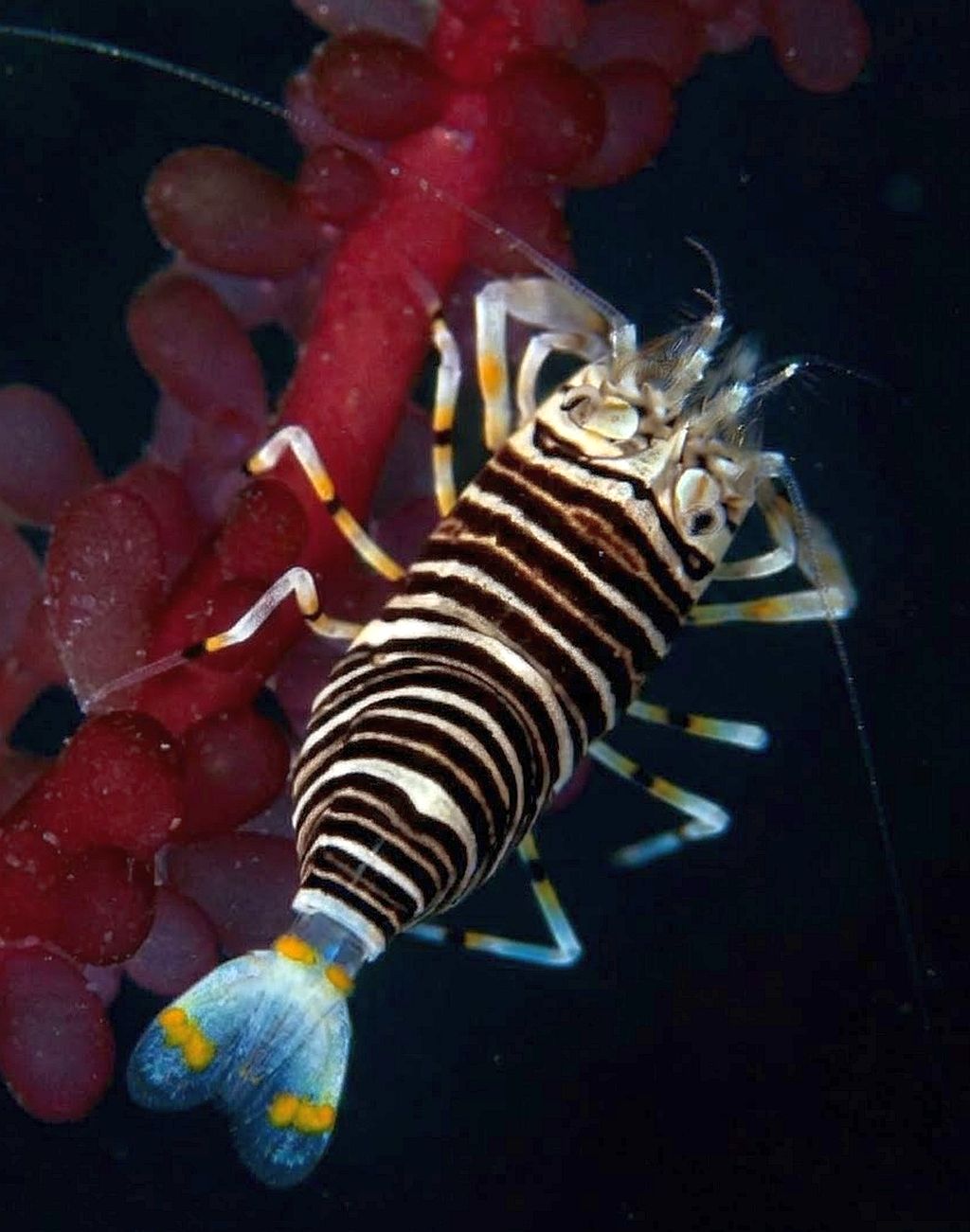
Bumble Bee Shrimp (Gnathophyllum americanum)
True Bumble Bee Shrimp have a striking, highly distinct coloration that features alternating, bold horizontal bands of dark brown-to-black and bright yellow-to-white across their entire plump body—resembling a bumblebee. They have a characteristically short, stout, and robust body shape with small, translucent pincers and relatively short antennae compared to larger cleaner shrimp species.
Bumble Bee Shrimp are gonochoric (separate male and female individuals), displaying mild external sexual dimorphism. Mature females grow slightly larger and develop a significantly broader, rounder abdomen than males to accommodate carrying their egg masses, though their striking coloration remains identical.
Unlike many marine creatures that can retreat into a heavy shell, the Bumble Bee Shrimp lacks thick armor. Instead, they rely on their bold warning coloration, tiny size, and the physical protection of their host sea urchin’s sharp spines. Their reaction time is exceptionally fast, allowing them to rapidly flick backward or sidestep deep into rock cracks or between a sea urchin’s spines when threatened.
The Bumble Bee Shrimp is reef safe with caution and is best housed in a well-established nano or pico reef aquarium of at least 5 gallon capacity with a fine coralline sand substrate, plenty of live rock arranged into tiny hiding places, crevices, and shadowed areas, and sufficient room for them to scavenge. Bumble Bee Shrimp are far too small to cause any physical damage to tank decor and will completely ignore all corals and true anemones, making them physically safe for reef layouts, though they will opportunistically pick at the tube feet of small ornamental sea stars.
Bumble Bee Shrimp are non-aggressive, exceptionally docile by nature, and do best in a small, dedicated nano tank with peaceful, tiny tank mates like small, non-carnivorous fish. Good tank mates include Neon Gobies, Clown Gobies, Sexy Shrimp, and peaceful snails like Cerith or Trochus snails.
Avoid keeping them with large and/or aggressive fish, Hawkfish, Dottybacks, Coral Banded Shrimp, large predatory crabs, and any carnivorous fish, as their minuscule size makes them an instant snack for almost any predatory tank mate.
The Bumble Bee Shrimp is relatively easy to care for in a mature nano aquarium free of predatory fish. Like most marine invertebrates, they are highly sensitive to sudden parameter swings—especially rapid shifts in salinity—and copper-based medications are fatal to them. To thrive, they need a consistent food supply, stable temperatures between 72–78°F (22–26°C), and trace iodine from regular water changes to support healthy molting. Reliable filtration and routine partial water changes are essential for keeping water quality pristine for this tiny shrimp.
Though they frequently pair up and produce eggs in captivity, Bumble Bee Shrimp do not generally reproduce successfully in a standard home aquarium due to their delicate planktonic larval stages. Mating occurs right after the female molts, and she carries a small cluster of fertilized eggs attached to her pleopods beneath her abdomen for roughly 10 to 14 days.
The larvae hatch and are released into the water column after dark. In a standard reef tank, this sudden burst of microscopic, free-swimming larvae often triggers a brief feeding response from corals and filter feeders, while any remaining young are quickly eaten by fish or pulled into filtration long before they can settle.
Like their larger relatives the Harlequin Shrimp (Hymenocera picta), the Bumble Bee Shrimp (Gnathophyllum americanum) has a specialized appetite for echinoderms, though they are much more opportunistic.
In their natural environment, they feed on organic detrital elements, micro-fauna, and the tube feet or tissue mucus sloughed off by host sea urchins, starfish, and sea cucumbers, grazing the surfaces of these echinoderms or scavenging organic waste trapped in rubble fields.
In an established aquarium environment, Bumble Bee Shrimp are great scavengers that thrive on natural tank detritus, organic debris, and leftover shrimp or fish foods such as crushed flakes, small pellets, powdered coral foods, mysis shrimp, and frozen brine shrimp. They will also actively supplement their diet by eating the tube feet of sea urchins, sea cucumbers, and nuisance Asterina starfish, making them excellent micro-biological controls for small pest starfish.
Because they are opportunistic and easily adapt to standard aquarium feeding, they do not require a constant supply of live starfish to survive like Harlequin Shrimp do.
The Bumble Bee Shrimp (Gnathophyllum americanum) is a relatively uncommon but highly popular saltwater species that can be purchased from online retailers, specialized local fish stores, and wholesalers at moderate prices. They are occasionally sold online to tropical nano-reef keeping enthusiasts as specialized biological solutions for Asterina starfish infestations or exotic additions to miniature nano reef aquariums.
Current pricing ranges from $15.99 to over $24.99 per individual, excluding overnight live arrivial shipping costs.
Because Gnathophyllum americanum relies on wild collection rather than commercial aquaculture, several major vendors frequently show them as sold out between seasonal shipments.
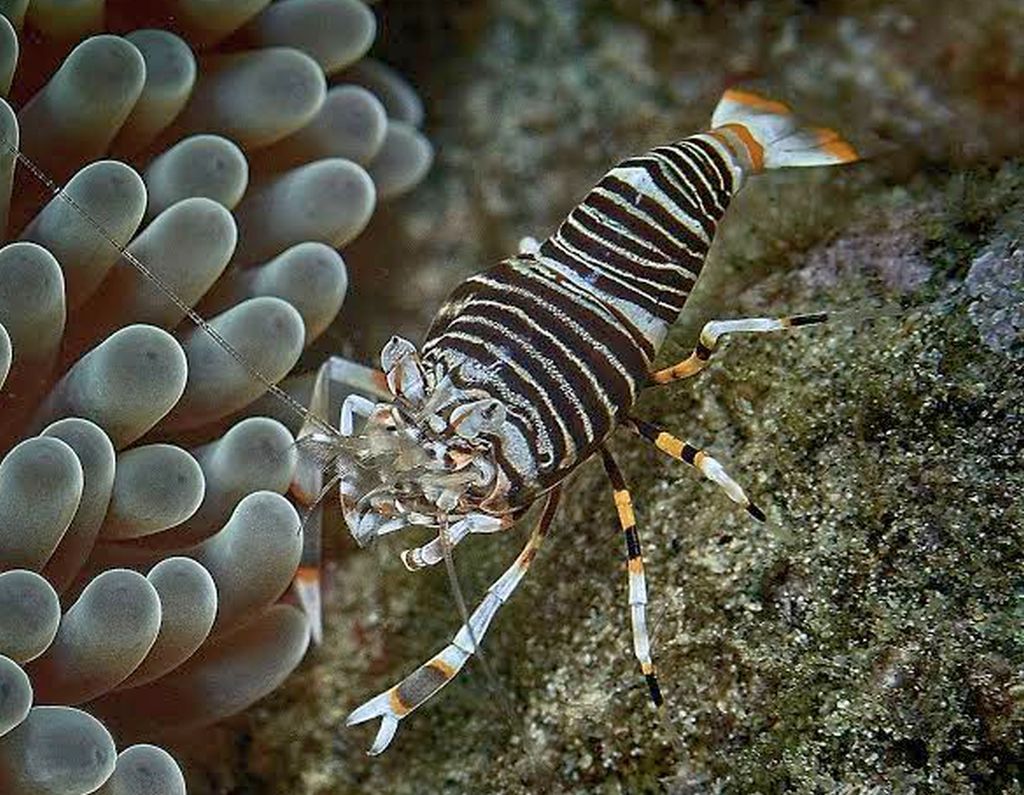
Bumble Bee Shrimp (Gnathophyllum americanum)
Minimum Tank Size: 10 gallons
Aquarium Type: Nano Reef or Dedicated Invertebrate Tank
Care Level: Easy to Moderate
Temperament: Peaceful
Aquarium Hardiness: Semi-Hardy
Water Conditions: 72–78°F, dKH 8 to 12, pH 8.1-8.4, sg 1.023-1.025
Max. Size: 1″
Color Form: Black/Dark Brown and Yellow/White Striped
Diet: Omnivore/scavenger
Compatibility: Reef Compatible (With Caution)
Origin: Circumtropical (Indo-Pacific, Caribbean, Atlantic)
Family: Gnathophyllidae
Lifespan: 1 – 2 years
Aquarist Experience Level: Beginner to Intermediate