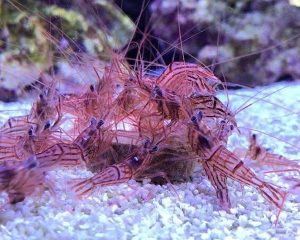
Peppermint Shrimp (Lysmata wurdemanni)
The Peppermint Shrimp (Lysmata wurdemanni), known to tropical fish keeping enthusiasts as the Veined Shrimp or Caribbean Cleaner Shrimp, is a marine decapod crustacean species that is found throughout the western Atlantic Ocean. Its range extends from the coast of New England down through the Gulf of Mexico and the Caribbean, to Brazil.
Peppermint Shrimp are normally found in areas with heavy structural cover among the shallow reefs, rock jetties, and dock pilings of their range at depths from the low intertidal zone to around 100 feet.
Unlike Pistol Shrimp, Lysmata wurdemanni are not natural diggers. They are constantly on the move and are strictly considered nocturnal animals, with the peak of their activity beginning at dusk.
During the day, substantial numbers of Peppermint Shrimp are often found by divers huddled deep inside of dark caves, under rocky ledges, or wedged between tight crevices, apparently seeking refuge from benthic and pelagic predators like groupers and wrasses that actively hunt them from open water..
Although Peppermint Shrimp are frequently found gathered together in large numbers sharing the same reef structures, they are not necessarily social animals. Lysmata wurdemanni are a docile, non-aggressive species that do not seem to associate closely with conspecifics unless they decide to mate or aggregate loosely for daytime safety.
Unlike some territorial shrimp, they are highly tolerant of their own kind and can be kept in large groups without conflict.
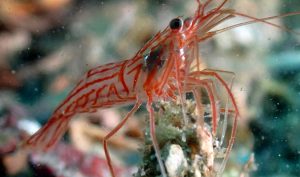
Peppermint Shrimp (Lysmata wurdemanni)
The Peppermint Shrimp is a small marine crustacean that seldom exceeds 1.5 to 2 inches in body length. They have a translucent, creamy-white to pinkish body that is covered in a complex network of longitudinal and transverse bright red or bright pink stripes that is remeniscent to a classic peppermint candy, hence their common name. Lysmata wurdemanni lack the intense, solid pigmentation seen in their scarlet cousins the Fire Shrimp (Lysmata debelius) and have shorter, translucent antennae compared to other cleaner shrimp species
Peppermint shrimp are protandric simultaneous hermaphrodites. They begin their mature lifecycle as functional males, but as they grow, they develop functioning female reproductive organs while still retaining their male reproductive organs. There is no external sexual dimorphism, making it impossible to visually separate individuals by visual appearance.
The Peppermint Shrimp does not have any heavy defensive shell mechanism for protection from predators; instead, they rely heavily on their transparent camouflage and agility to survive. When a predator approaches, they rapidly flick their tails to propel themselves backward into the deepest recesses of the rockwork. Their response time is incredibly rapid, which makes them very difficult to catch in a mature reef system.
The Peppermint Shrimp is best housed in a well established FOWRL or reef aquarium of at least 10 to 20 gallon capacity with a fine sand or coralline gravel substrate, plenty of live rock arranged into dark caves, overhangs, and deep hiding places, and enough room for them to roam and scavange under low light conditions.
The Peppermint Shrimp is completely reef safe with caution. Although they are too small do any damage to decorations in a reef tank, they will nip on soft corals, polyps, and decorative clam mantles if their primary food source is not available.
Peppermint Shrimp do well in a FOWLR tank with small, peaceful, non-carnivorous reef fish. Suitable tankmates include Firefish, Gobies, Blennies, Clownfish, and peaceful snails like Cerith or Nassarius snails.
They should never be housed with large and/or aggressive species like Hawkfish, Dottybacks, Longnose Hawkfish, large predatory Wrasses, and most predatory crab species that will quickly hunt them down and consume them.
The Peppermint Shrimp (Lysmata wurdemanni) has a ravenous appetite for nuisance pests and organic waste, which makes them excellent candidates for a tank clean-up crew.
In an aquarium environment, they are legendary scavengers that thrive on detritus, debris, leftover fish foods, and most notably, nuisance Aiptasia (glass anemones). They are a primary biological control method for reef keepers struggling to rid their tanks from pest anemones.
Although the Peppermint Shrimp is relatively easy to keep, they are very sensitive to sudden changes in water values, rapid fluctuations in salinity and pH, and copper-based medications that are lethal to them.
An efficient, high quality filtration system and protein skimmer is highly recommended to maintain the clean water quality and stable water conditions they require. A constant food source and adequate iodine levels to aid with their frequent molting schedule is also needed to keep them healthy.
There have been numerous reports of tropical fish keeping enthusiasts successfully breeding Lysmata wurdemanni in an aquarium environment, but even on a commercial scale, Peppermint Shrimp do not generally produce surviving offspring without dedicated rearing tank setups.
Since they are simultaneous hermaphrodites, any two mature Peppermint Shrimp can act as a pair. Spawning occurs shortly after a molt when the female-phase exoskeleton is soft and the eggs are fertilized externally before being attached to the pleopods.
The “female” shrimp carries the fertilized eggs under its abdomen for approximately 10 to 14 days, during which the egg mass changes color from a bright green, to a translucent gold, before hatching.
The microscopic free swimming larvae are released into the water column after dark as plankton, which in a standard reef aquarium will often trigger a feeding frenzy from corals and fish. Few if any of the free swimming larvae ever reach settlement before becoming planktonic food.
In their natural environment, Peppermint Shrimp feed on dead organic tissue, detritus, small pest cnidarians, and other microscopic organisms. Their primary wild diet consists of scavenging organic waste from the sea floor and picking at small sedentary invertebrates.
In an established aquarium environment, they are opportunistic scavengers that will feed on the nuisance Aiptasia anemones with gusto, along with any leftover shrimp or fish food flakes, pellets, algae wafers, frozen mysis, or brine shrimp.
Peppermint Shrimp are opportunistic feeders that will quickly venture out into the open water column as soon as the main aquarium lights go out and food is introduced.
The Peppermint Shrimp (Lysmata wurdemanni) is one of the most common and inexpensive saltwater species that can be purchased from online retailers and local fish stores at prices that range from $10.00 to $18.00 per individual; depending on size, variant, area of collection, quantity, and vendor.
They are frequently sold to tropical fish keeping enthusiasts as essential members of “cleanup crews” for Aiptasia anemone removal in reef tanks. Purchasing a 3-pack or larger quantity not only drops the individual price below $10, but when introduced in small groups is much more efficient at clearing target pests.
Unlike many other ornamental shrimp, a lot of online retailers now offer captive bred Peppermint Shrimp alongside wild-caught individuals. Captive bred specimens are slightly more costly but are less likely to nip at corals or soft polyps in a reef tank.
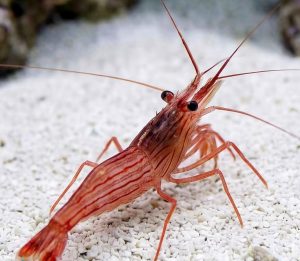
Peppermint Shrimp (Lysmata wurdemanni)
Minimum Tank Size: 10 gallons
Aquarium Type: Established Reef or FOWLR
Care Level: Easy
Temperament: Peaceful
Aquarium Hardiness: Semi-Hardy
Water Conditions: 72–78°F, dKH 8 to 12, pH 8.1–8.4, sg 1.023–1.025
Max. Size: 1.5″ – 2″
Color Form: Translucent Pink, Red Stripes
Diet: Omnivore/scavenger
Compatibility: Reef Compatible (With Caution)
Origin: Western Atlantic (Caribbean, Gulf of Mexico)
Family: Lysmatidae
Lifespan: 1 – 2 years
Aquarist Experience Level: Beginner