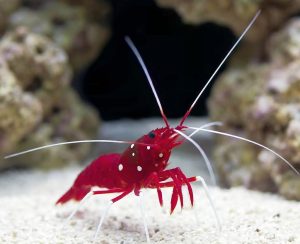
Fire Shrimp (Lysmata debelius)
The Fire Shrimp (Lysmata debelius), known to tropical fish keeping enthusiasts as the Blood Shrimp, Blood Red Fire Shrimp, Scarlet Cleaner Shrimp, or Cardinal Shrimp, is a marine decapod crustacean species that is found throughout the Indo-West Pacific, from the Red Sea and East Africa to the Tuamotu Archipelago.
Fire Shrimp are normally found among the deep coral reef slopes and rocky crevices of their range at depths from 30 to over 100 feet where they prefer deeper, darker areas than other cleaner species.
Lysmata debelius are not natural diggers. They are a notably crybtic species that are constantly on the move and considered nocturnal animals, with the peak of their activity beginning at dusk.
During the day, substantial numbers of Fire Shrimp can normally be found hidden deep inside caves, under dark rocky overhangs, or tucked away in reef crevices that provide a safe haven from large benthic and pelagic predators that actively hunt them on the open reef faces.
Although Fire Shrimp are frequently found together in the wild sharing the same large cave system, they are not necessarily social animals. In smaller confines, they can be highly territorial toward conspecifics.
Fire Shrimp are a usually docile and non-aggressive toward fish. They do not seem to associate closely with other members of their own species unless they are a mated pair or housed in a massive aquarium with plenty of live rock to stake out a territory.
Lysmata debelius are small marine crustaceans that seldom exceed 2 inches in body length (excluding their antennae).
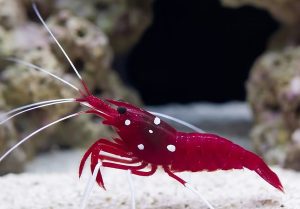
Fire Shrimp (Lysmata debelius)
True Fire Shrimp have an intensely vibrant, striking coloration featuring a deep blood-red or scarlet body, contrasted by brilliant white spots on the carapace and white stockings on their legs. They possess long, stark white antennae that they wave carefully to signal passing fish, though they are generally more reclusive than their cousins, the Skunk Cleaner Shrimp.
Fire Shrimp are protandric simultaneous hermaphrodites. They begin their mature life as males, but as they grow, they develop functioning female reproductive organs while still retaining their male reproductive organs. There is no external sexual dimorphism to visually distinguish between individuals.
Unlike many marine organisms that can retreat into a heavy, protective shell; the Fire Shrimp does not have a heavy defensive shell mechanism. Instead, they rely on their extreme reclusiveness, speed, and the safety of dark caves for defense. Like lobsters when startled, they use their pleopods (swimmerets) to rapidly flick backward into the deepest recesses of the rockwork or cave to escape.
The Fire Shrimp is completely reef safe and is best housed in a well-established FOWLR or reef aquarium with a fine coralline gravel or sand substrate, plenty of live rock arranged into deep caves, dark overhangs, and hiding places, and sufficient room for them to roam and graze under low-light conditions.
Fire Shrimp are too small to damage any decor in a reef tank and will not bother corals, decorative clams, or invertebrates, making them an excellent aesthetic addition to a reef layout.
Fire Shrimp are docile by nature, non-aggressive, and do well in a FOWLR tank with peaceful tank mates like small, non-carnivorous reef fish. Some good tankmates include Firefish, Neon Gobies, Fairy Wrasses, Cardinalfish, Clownfish, and peaceful invertebrates like Tuxedo Urchins or Cerith snails.
Avoid keeping them with large and/or aggressive carnivorous fish like Lionfish, Hawkfish, Dottybacks, Groupers, and large Triggers, as well as aggressive predatory crabs and large hermit crabs that may attempt to trap them in their caves.
Like other cleanup crew members, the Fire Shrimp (Lysmata debelius) has a great appetite for organic debris and opportunistic parasites, which makes them excellent candidates for a tank clean-up crew. In the aquarium, they are excellent scavengers that thrive on tissue parasites, dead skin, detritus, and leftover fish waste that often settles into the hard-to-reach crevices of the live rock.
Provided they are acclimated slowly, the Fire Shrimp is not particularly difficult to keep. Like many species of marine shrimp, they are very sensitive to sudden changes in water values, especially salinity, and copper based medications that are lethal to them.
In addition to stable water quality, Lysmata debelius require a constant food source, a stable tropical water temperature between 72–78°F, and proper iodine levels to ensure successful molting. An excellent filtration system and protein skimmer are recommended to keep this species healthy.
Although Scarlet Cleaner Shrimp will frequently mate and carry their eggs in an aquarium environment, they generally will not reproduce successfully, mainly due to their incredibly complex, multi-stage larval development. Because Lysmata debelius are simultaneous hermaphrodites, any two mature individuals can successfully mate with each other. After one shrimp molts, the other will fertilize the eggs which are then carried under its abdomen attached to its pleopods.
The fertilized eggs are carried for approximately 10 to 14 days until they hatch and the tiny larvae are released as plankton into the water column, usually after dark. In a reef aquarium, the water may briefly cloud up with the microscopic larvae and trigger a feeding frenzy among the corals and other filter feeders in the tank. The microscopic larvae are a prized food source and are usually quickly consumed before they can ever metamorphose into crawling shrimp.
In their natural environment, the Fire Shrimp feeds on organic detrital elements, tissue parasites, and mucus scraped from cooperating client fish that visit their caves. Their primary food consists of small parasites and organic debris found within the reef cracks.
In an established aquarium environment, they feed on the algae biofilm and detritus in the tank along with any leftover shrimp or fish foods. They will readily consume marine flakes, pellets, algae or spirulina wafers, mysis shrimp, brine shrimp, and high-quality frozen preparations. Initially shy, they quickly become bold enough to emerge from their caves at feeding time to snatch food from the water column.
The Fire Shrimp (Lysmata debelius) is a highly sought after species that is occasionally available to tropical fish keeping enthusiasts from a variety of online retailers, premium transhippers, and local fish stores at prices that range between $48.00 to $98.00 per individual; depending on size, area of collection, and vendor.
Because of their spectacular scarlet and blood red coloration, they normally command higher prices than the common Skunk Cleaner Shrimp (Lysmata amboinensis).
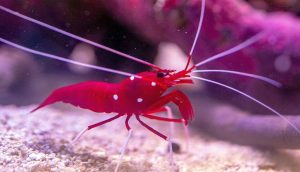
Fire Shrimp (Lysmata debelius)
Minimum Tank Size: 10 gallons
Aquarium Type: Established Reef or FOWLR
Care Level: Easy to Moderate
Temperament: Peaceful (Territorial with conspecifics)
Aquarium Hardiness: Semi-Hardy
Water Conditions: 72–78°F, dKH 8 to 12, pH 8.1–8.4, sg 1.023–1.025
Max. Size: 2″
Color Form: Deep Scarlet Red, White Spots, White Legs
Diet: Omnivore/scavenger
Compatibility: Reef Compatible
Origin: Indo-West Pacific (Red Sea to Tuamotu)
Family: Lysmatidae
Lifespan: 2 – 5 years
Aquarist Experience Level: Beginner to Intermediate