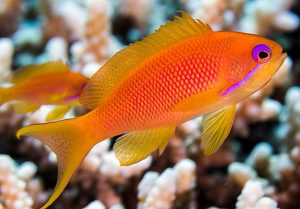
Lyretail Anthias (Pseudanthias squamipinnis)
Lyretail Anthias (Pseudanthias squamipinnis) known to tropical fish keeping enthusiasts as the Scalefin Anthias, Squamipinnis Anthias, Sea Goldie, and Orange Fairy Basslet is found throughout Indo-Pacific waters, from the Red Sea to the East Coast of Africa all the way to the outer islands of Polynesia in the Central Pacific.
Lyretail Anthias are generally found in large schools or harems over rocky structure and areas with abundant coral along the outer reef slopes and shallow coastal lagoons of their range at depths from 30 to over 130 feet; usually foraging on zooplankton, fish eggs, small invertebrates, and crustaceans.
Lyretail Anthias are hermaphroditic and exhibit sexual dimorphism.
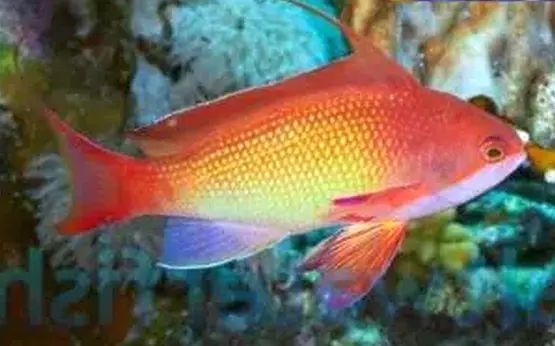
Lyretail Anthias (Pseudanthias squamipinnis)
Male Lyretail Anthias have a red, pinkish or peach colored body with a yellow gradient splotch in the center of the body, a prominent first spike on the dorsal fin and lyre shaped pectoral and caudal fins.
Female Lyretail Anthias tend to be more orange in color with bright yellow edging along their fins.
Males are larger and have more vibrant colors than females. Slight color variations exist depending on geographic area of collection.
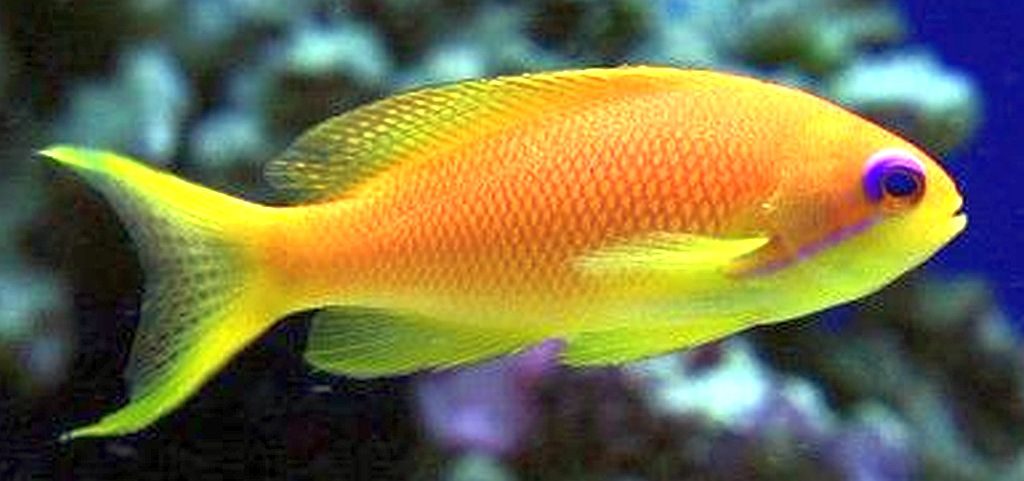
Lyretail Anthias (Pseudanthias squamipinnis)
Lyretail Anthias are a peaceful species that can be kept as a mated pair, in small schools of females, or in odd numbers of larger harems with a single dominant male and several females. Avoid keeping two males in the same tank, as it can lead to extreme aggression.
A pair or single Pseudanthias squamipinnis can be housed in a mature reef or well established FOWLR aquarium of at least 100 gallon capacity with a coralline sandy substrate, an abundant amount of live rock arranged into caves, crevices, overhangs, and crevices for hiding, and plenty of free swimming space.
A powerhead or wavemaker is needed to provide the heavy water flow and proper oxygenation necessary to mimic their natural reef environment. An aquarium chiller should also be considered to maintain water temperatures at their recommended range, and because they are excellent jumpers; a tight fitting mesh lid or glass cover is essential to prevent them from jumping out of the tank.
Lyretail Anthias are reef safe and fully compatible with corals and invertebrates.
Although they can become aggressive towards conspecifics when kept in small groups in smaller aquariums; housing them in larger groups or as a single male with several females is recommended to mitigate aggression. Sea Goldies thrive in large schools of five or more individuals (preferably one male and up to ten females), in a 150 gallon or larger tank.
Compatible tank mates include the Green Mandarin Dragonet (Synchiropus splendidus), Banggai Cardinalfish (Pterapogon kauderni), Flame Hawkfish (Neocirrhites armatus), gobies, blennies, jawfish, tangs, and wrasses.
Aquaculture efforts for the Lyretail Anthias are limited and although they will spawn in an aquarium environment, raising the larvae to adulthood is virtually impossible.
Spawning behavior is similar to the Dispar Anthias (Pseudanthias dispar). In the wild, spawning typically occurs in the early morning hours around dawn. The male will establish a territory where he performs a courting ritual that includes color displays, fin flicking, and synchronized swimming to attract females for spawning. A single male will court and spawn with multiple females as they release their eggs into the water column and are fertilized by the male.
In the wild, Pseudanthias squamipinnis spawn in huge schools where the fertilized eggs are swept away by strong currents to become plankton. In an aquarium environment, the floating eggs are usually sucked into the filtration system or eaten by other fish in the tank before they can be collected. The microscopic newly hatched larvae are nearly impossible to raise and require copepod nauplii that are challenging to culture.
In the wild, Lyretail Anthias constantly feed on zooplankton, fish eggs, small invertebrates, and crustaceans. In an aquarium environment with plenty of live rock, they should be fed a variety of meaty foods like finely chopped seafood, vitamin enriched frozen mysis shrimp, brine shrimp, copepods, and amphipods 3 to 4 times a day.
Over time they will accept high quality flake foods or pellets but to keep them thriving, a refugium is recommended for cultivating a continuous food supply of nutritious live copepods and amphipods.
Lyretail Anthias (Pseudanthias squamipinnis) are available to tropical fish keeping enthusiasts from a number of online wholesalers, trans shippers, and retailers, as wild caught individuals usually by special order at approximate purchase sizes: Small: 1″ to 2″, Medium: 2″ to 3″, Large: 3″ to 4-1/2″.
Prices vary by size and area of collection but start around $69.99 for 2″ to 3″ African females to $99.99 for the same size Red Sea specimen.
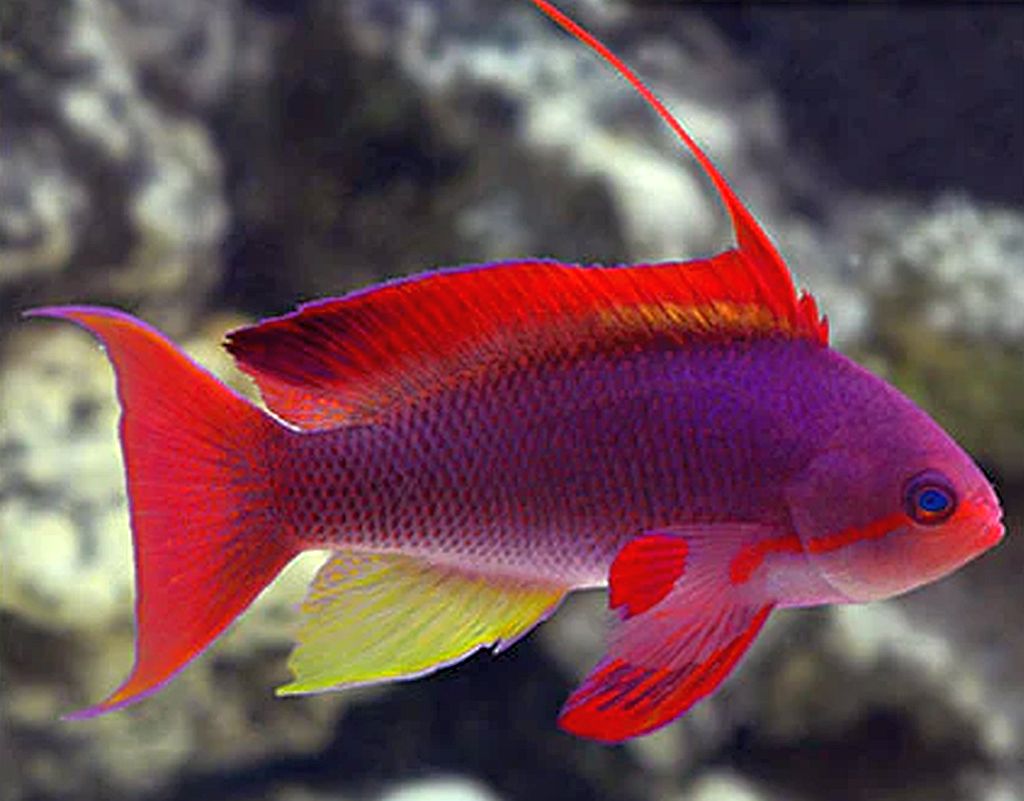
Lyretail Anthias (Pseudanthias squamipinnis)
Minimum Tank Size: 100 gallons
Aquarium Type: Reef or FOLR
Care Level: Moderate
Temperament: Semi Aggressive
Aquarium Hardiness: Hardy
Water Conditions: 72-78° F, dKH 8 to 12, pH 8.1-8.4, sg 1.020-1.025
Max size: 5″
Color Form: Orange, Red, Yellow
Diet: Carnivore
Compatibility: Reef
Origin: Indo-Pacific
Family: Serranidae
Lifespan: 5 – 7 years
Aquarist Experience Level: Intermediate/Advanced