
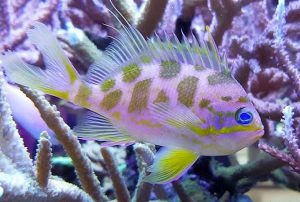
Blotched Anthias (Odontanthias borbonbius)
The Blotched Anthias (Odontanthias borbonius) known to tropical fish keeping enthsiasts as the Borbonius Lyretail Anthias, Borbonius Anthias, or Blotchy Anthias is a rare deep water species that is native to the Western Indian Ocean; specificially around the Mauritius and Réunion islands.
Blothched Anthias are are often found in loose groups or schools in the deep sea coral reefs of their range in areas with strong currents at depths from 200 and 300 feet all the way down to 1000 feet.
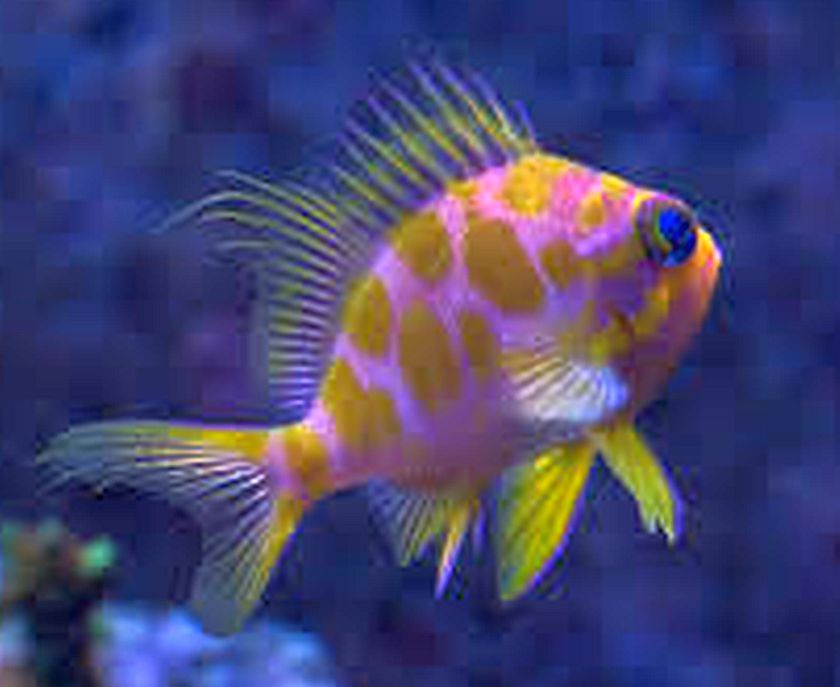
Blotched Anthias (Odontanthias borbonbius)
Blothched Anthias have a striking warm pink body color that is accented with irregular mottled shaped rustic gold markings and light lemon yellow colored fins. The anterior fin has distinct spines, while their dorsal and caudal fins terminate into filaments.
The Blotched Anthias exhibits sexual dimorphism with males being typically larger than females and displaying more vibranthly colored orange to red bodies with striking purple accents. Females have more subdued coloration that often appeas as shades of red and yellow. Adult males typically reach a maximum size of about 4 inches, while females are slightly smaller.
Juvenile Blotched Anthias have a more uniform red to pink body coloration with less prominent purple markings than adult males. Their colors become more intense as they attain adulthood.
Odontanthias borbonius are best housed singly or in small groups in a mature well established FOWLR or reef aquarium of at least 100 gallon capacity, with a sandy or finely crushed coral substrate and plenty of live rock arranged into crevices, caves, and overhangs for them to hide among. They need ample caves and shaded, lower light areas with strong to moderate water flow for proper oxygenation to mimic their natural deep water environment. An aquarium chiller is recommended to keep water temperatures in their recommended range.
The Blotched Anthias is completely reef safe and compatible with corals and invertebrates in a reef environment. Generally peaceful, they can be kept singly, as a mated pair, or as small groups of females. Although they can become aggressive towards conspecifics when kept in small groups in smaller tanks; keeping them in larger groups or as a single male with several females is recommended to mitigate aggression.
Compatible tank mates that coexist peacefully with the Blotched Anthias include clownfish, blennies, dottybacks, tangs, and gobies.
The Blotched Anthias has been successfully bred in an aquarium environment at temperatures around 80°F in Palau, with successful rearing of larvae reported by Biota Palau.
Odontanthias borbonius are deep water protogynous hermaphrodites that spawn in harems, with dominant females transforming into males. They are pelagic spawners that often spawn daily when conditioned with multiple feedings. Males perform fin flicking displays and courtship dives starting above the reef and diving towards the bottom while displaying their ventral fins. The eggs are released by the females and fertilized by the males as they are released into the water colum without further attention. The voracious larvae eventually develop into small adults.
Breeding can be accomplished in a 75 to 120 gallon or larger aquarium kept at a temperature of 70-78°F and decorated with plenty of live rock. Select a mated pair or small group of females and feed them 4 to 5 times a day with live foods to get them into breeding condition. Raising the water temperature to around 80°F will trigger spawning.
Larvae require a continuous supply of live micro zooplankton after their yolk sacs are absorbed. Start feeding Parvocalanus crassirostris to the larvae 3 to 4 times daily to maintain a high prey density. After day 10, switch to Brachionus plicatillis for the next 25 days and finally to newly hatched Artemia Nauplii and as the larvae grow, to Tisbe or Apocyclops.
Maintain prey density in the larvae tank. If they are not literally swimming in a dense cloud of copepod nauplii, they will starve. Adding live microalgae like Isochrysis galbana directly to the larval tank tints the water green which reduces larval stress, provides background contrast for hunting prey, and keeps the live copepods/rotifers nutritionally enriched.
In their natural habitat, Blotched Anthias feed on zooplankton and small crustaceans. In an aquarium environment they require a diverse range of foods to replicate their diet including high-quality marine pellets, frozen Mysis shrimp, brine shrimp, and live copepods. Regular, small feedings throughout the day help mimic their natural feeding behavior.
An attached refugium cultivating copepods and amphipods is highly recommended to provide a steady supply of nutritious live foods.
The Blotched Anthias (Odontanthias borbonius) is sporadically available to tropical fish keeping enthusiasts from a number of online wholesalers, trans shippers, and retailers, usually by special order at prices around $ 749.99 for small; 1″ to 13/4 specimens. They are expensive and seasonal with availability often limited to the winter months in the USA.
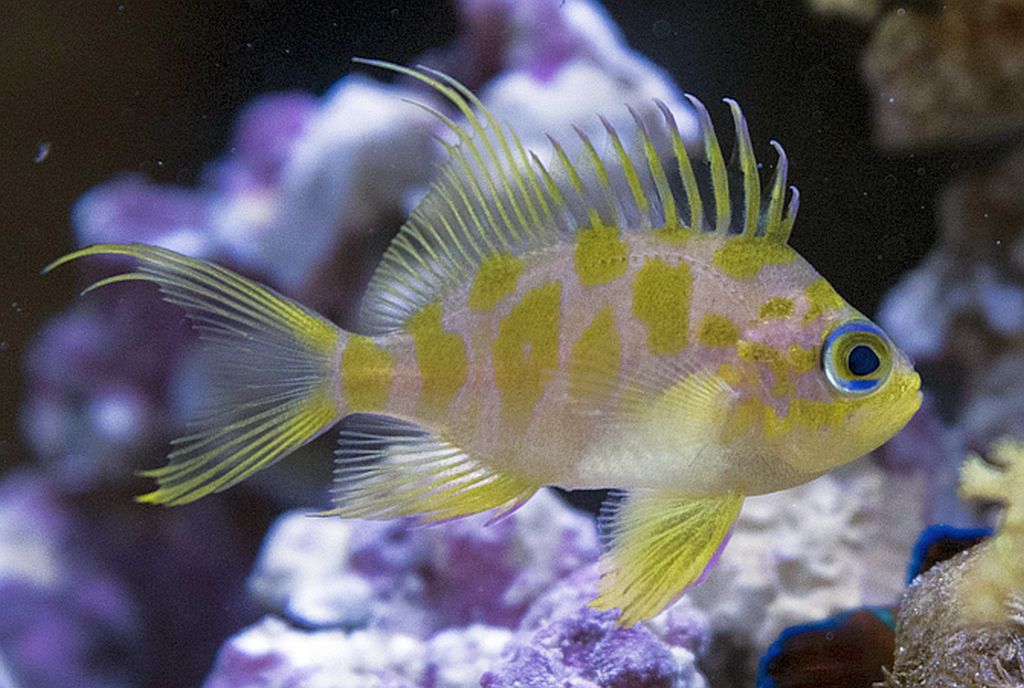
Blotched Anthias (Odontanthias borbonbius)
Minimum Tank Size: 100 gallons
Aquarium Type: Reef or FOLR
Care Level: Moderate
Temperament: Semi Aggressive
Aquarium Hardiness: Hardy when acclimated
Water Conditions: 72-78° F, dKH 8 to 12, pH 8.1-8.4, sg 1.023-1.025
Max size: 6″
Color Form: Pink, Orange, Purple, Yellow
Diet: Carnivore
Compatibility: Reef
Origin: Mauritius and Réunion islands
Family: Serranidae
Lifespan: 5 – 7 years
Aquarist Experience Level: Intermediate/Advanced
One Response to “Blotched Anthias (Odontanthias borbonius)”
Trackbacks/Pingbacks
[…] other exotic deepwater anthias like the Blotched Anthias (Odontanthias borbonius) and Marcia’s Anthias (Pseudanthias marciae) have seen breakthroughs in captive breeding; all […]